

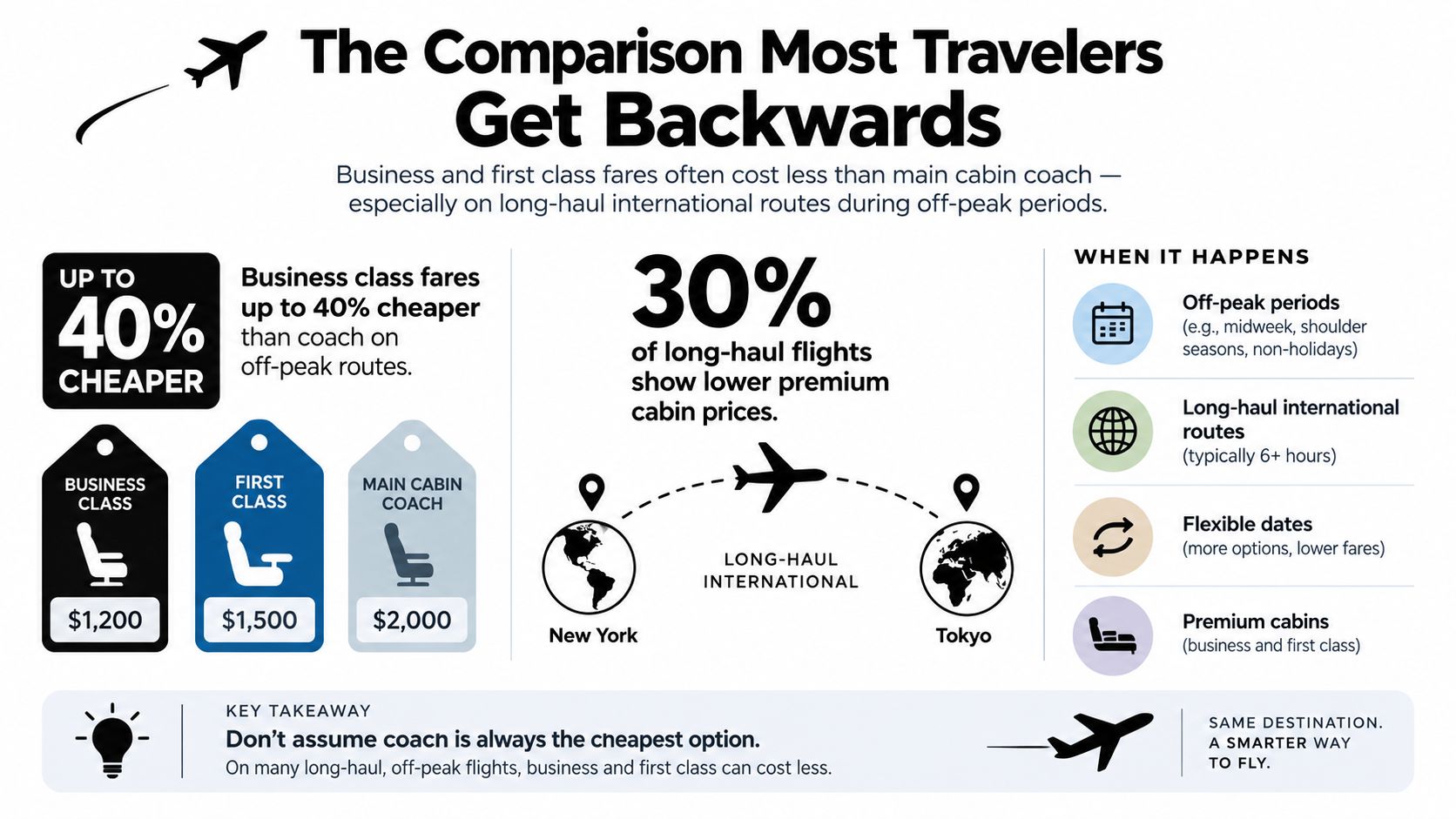
Business class can cost less than coach, and first class can occasionally do the same. On some routes, business-class cash fares have matched or undercut economy fares, while premium tickets on other routes cost several times more than coach.
That contradiction is the point. 1st class vs coach isn't a simple luxury-versus-budget decision. Airlines price seats according to demand, inventory, fare rules, and timing. A restrictive coach fare can be more expensive than a discounted premium seat, particularly when an airline needs to fill unsold premium inventory. Corporate travelers who default to the cheapest-looking cabin often miss that distinction.
The Comparison Most Travelers Get Backwards
The usual assumption is that coach is the baseline and every premium cabin represents an automatic surcharge. That assumption fails often enough to change how I search. The Points Guy has documented routes where business-class cash fares equal or fall below economy fares, including the once-weekly LATAM route between Easter Island and Papeete.
The mechanism is straightforward. Airlines don't sell every seat at one fixed price. Revenue-management systems open and close fare buckets as demand changes, and a full-fare coach seat may remain expensive while a premium cabin is discounted to attract buyers. Fare wars, surplus premium seats, and flexible travel dates can create the same inversion, as explained in this breakdown of premium fare sales.
The price is not the product
A coach fare with no seat selection, limited flexibility, and poor change terms isn't automatically better value than a premium fare with more usable space and stronger service. The reverse can also be true. A discounted premium tier that removes lounge access and seat selection may be less useful than a flexible standard coach ticket.
Recent airline offerings reflect this fragmentation. Delta and United have introduced lower-priced premium-cabin tiers that remove benefits such as seat selection and lounge access, according to WTOP's reporting on the widening fare-class divide.
My advice is blunt: price every relevant cabin on the same flight before you decide that coach wins. Compare the final, usable fare, not the label. The rest of the decision comes down to route length, sleep needs, arrival obligations, and the terms attached to each ticket.
How Premium Cabins and Coach Actually Evolved
Premium cabins began as the default, not an indulgence. Around 1914, all seats were effectively first class, according to InsideHook's history of first class. Airlines introduced a two-tier structure on the Paris to London route in 1928, when first and second class differed by just $5.50, or about $77 adjusted for inflation, according to the same historical account.
Lower-priced coach emerged by the 1940s, as airlines and regulators separated cheaper, less convenient travel from premium service. In the United States, coach passenger miles exceeded first-class passenger miles in 1961. Air travel had shifted from a largely premium service to transportation used by a much broader public.
Why the two-cabin model no longer works
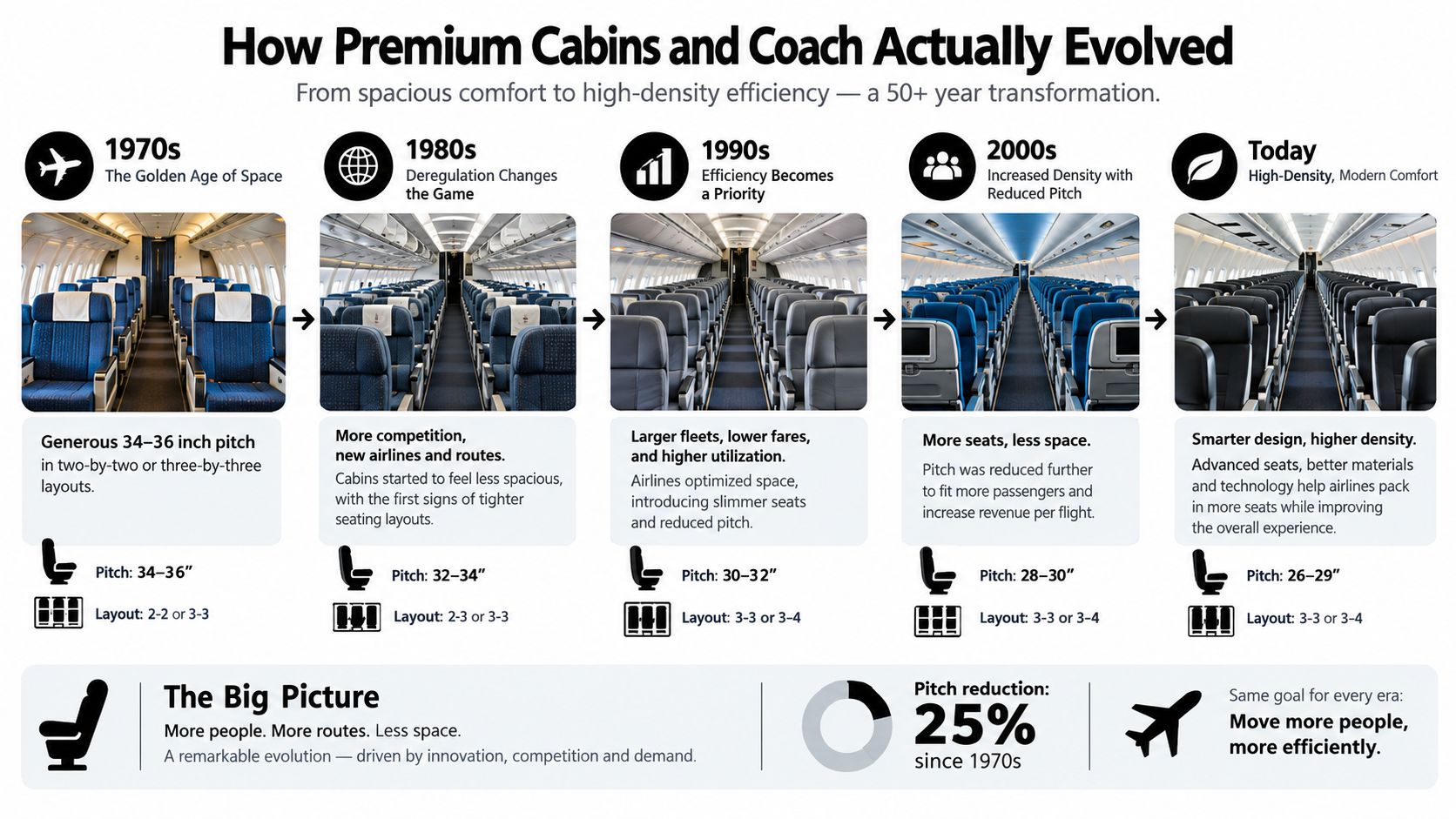
Deregulation increased fare segmentation. In a 1991 Los Angeles to New York example, first class cost $2,202, compared with $1,262 for full-fare coach, while airlines offered more than 60 coach price categories. That example, reported by the Los Angeles Times account, still captures the central pricing problem: the cabin label does not determine value.
Business class became the middle tier between economy and first. Premium economy added another option for travelers seeking more space without paying for a lie-flat bed or suite. A single aircraft can now carry basic economy, standard coach, extra-legroom economy, premium economy, business class, and first class, each with its own restrictions and benefits.
That history should shape your buying decision. Coach is not one product, and premium is not one experience. Fare volatility can make a higher cabin cheaper than coach on the same flight, while a restrictive premium fare may deliver less practical value than a flexible economy ticket. Compare the actual fare conditions before choosing by cabin name.
What You Really Get in Each Cabin
Cabin names describe a commercial product, not a universal seat. Domestic first class often means a wider recliner, priority handling, and upgraded service. Long-haul international first class may mean an enclosed suite, a bed, dedicated storage, and far more privacy.
On long-haul aircraft, coach typically provides 31 to 34 inches of seat pitch and roughly 17 to 18.5 inches of width, while first class commonly ranges from 60 to more than 100 inches of pitch and about 19 to 35 inches of width, depending on the design. Those ranges come from Navan's explanation of seat pitch.
Domestic differences are narrower. First class often offers around 37 to 39 inches of pitch and 20 to 21 inches of width, while coach sits around 30 to 34 inches of pitch and 16.2 to 18.5 inches of width, based on TravelBank's cabin comparison.
Cabin comparison
Cabin Comparison: Seat, Service, and Ground Benefits
| Feature | Coach | Premium Economy | Business Class | First Class |
|---|---|---|---|---|
| Seat | Standard economy seat, usually the tightest personal space | Wider seat and additional recline | Wider seat, often lie-flat on long-haul routes | Largest seat or enclosed suite on eligible aircraft |
| Long-haul sleep | Recline only | Deeper recline, not usually a bed | Fully flat bed on many long-haul aircraft | Fully flat bed, sometimes with privacy doors |
| Dining | Basic included service or paid options, depending on fare and airline | Upgraded meal service on many international routes | Multi-course premium service | More flexible, higher-touch service on some airlines |
| Airport handling | Standard check-in and boarding | Priority benefits vary | Priority check-in, boarding, and lounge access often included | Highest-priority handling and premium lounge access where offered |
| Baggage | Lowest allowance or paid bags on restrictive fares | More generous allowance may apply | Higher allowance is common | Highest allowance is common |
| Best use | Short trips, daytime travel, and cost-controlled itineraries | Medium-length flights where extra space matters | Overnight long-haul travel and meeting-critical arrivals | Long-haul trips where privacy and sleep quality justify the fare |
The practical difference isn't just legroom. Business and first class can reduce airport friction through priority lanes, lounge access, and better baggage terms. But benefits vary by airline and fare brand, so read the conditions before treating a premium label as a complete package.
What the Price Gap Between Cabins Really Looks Like
Published fare multiples are weak decision tools. First class can cost several times more than coach, with some routes reaching four to fifteen times higher, yet airlines may discount unsold premium seats instead of maintaining the original asking price. The result is a fare market shaped by inventory and timing, not a fixed luxury premium.
Compare the final fares for your exact date and requirements. A restrictive coach ticket can lose its apparent advantage after baggage, seat selection, change exposure, and the productivity cost of arriving exhausted are included. On some dates, business class can even price below a restrictive coach fare.
A route-level comparison
I will not manufacture sample prices to make the calculation look precise. The 1991 Los Angeles to New York example priced first class at $2,202 and full-fare coach at $1,262, while airlines offered more than 60 coach categories after deregulation. That range of fare buckets makes one list-price ratio nearly meaningless.
List Price vs. Actual Fare: Same Routes, Same Dates
| Route | Coach (Paid) | Premium Economy (Paid) | Business (Paid) | List Ratio vs Actual |
|---|---|---|---|---|
| Los Angeles to New York, 1991 example | $1,262 | Not stated | Not stated | First class was about 1.7 times the full-fare coach price |
| Transatlantic route | Varies by date and inventory | Varies by date and inventory | Can fall below a restrictive coach fare | Compare final prices, not the advertised cabin multiple |
| Transpacific route | Varies by date and inventory | Varies by date and inventory | Premium fares can be available through specialized channels | Confirm rules, routing, and inclusions before purchase |
This guide to first-class ticket pricing keeps attention on fare construction rather than the fantasy price assigned to an empty premium seat.
What changes the spread
Load factor, advance-purchase rules, airline competition, and unsold premium inventory all affect the result. Corporate agreements can also shift the calculation when a negotiated fare applies to one cabin but not another.
Use a consistent buying process. Search the same route and date across coach, premium economy, business, and first. Compare the total fare, flexibility, baggage, lounge access, seat assignment, and likely arrival condition. The actual cost gap is what you pay for a cabin you can use, not the ratio shown in an airline's marketing grid. If business or first costs less than coach after the rules are included, take the premium cabin. If the premium fare demands a large premium without improving the part of the trip that matters, stay in coach.
Productivity and Arrival Differences That Matter
The business case for premium travel isn't champagne. It's whether the cabin preserves enough working capacity to justify the fare. A larger seat matters only when it helps you sleep, work, or arrive ready for an obligation that cannot move.
Work in the air
Coach can support light email and document review when the seat has power and the passenger beside you leaves enough room. A premium seat usually gives you a more stable work surface, easier access to power, and less disruption from neighboring passengers. Connectivity quality still depends on the airline, aircraft, and route, so don't promise yourself a productive office just because you upgraded.
Seat pitch is part of that calculation. This explanation of airline seat pitch shows why the measurement describes the distance between seats, not the full usable space available to your laptop or legs.
Sleep is the main business benefit
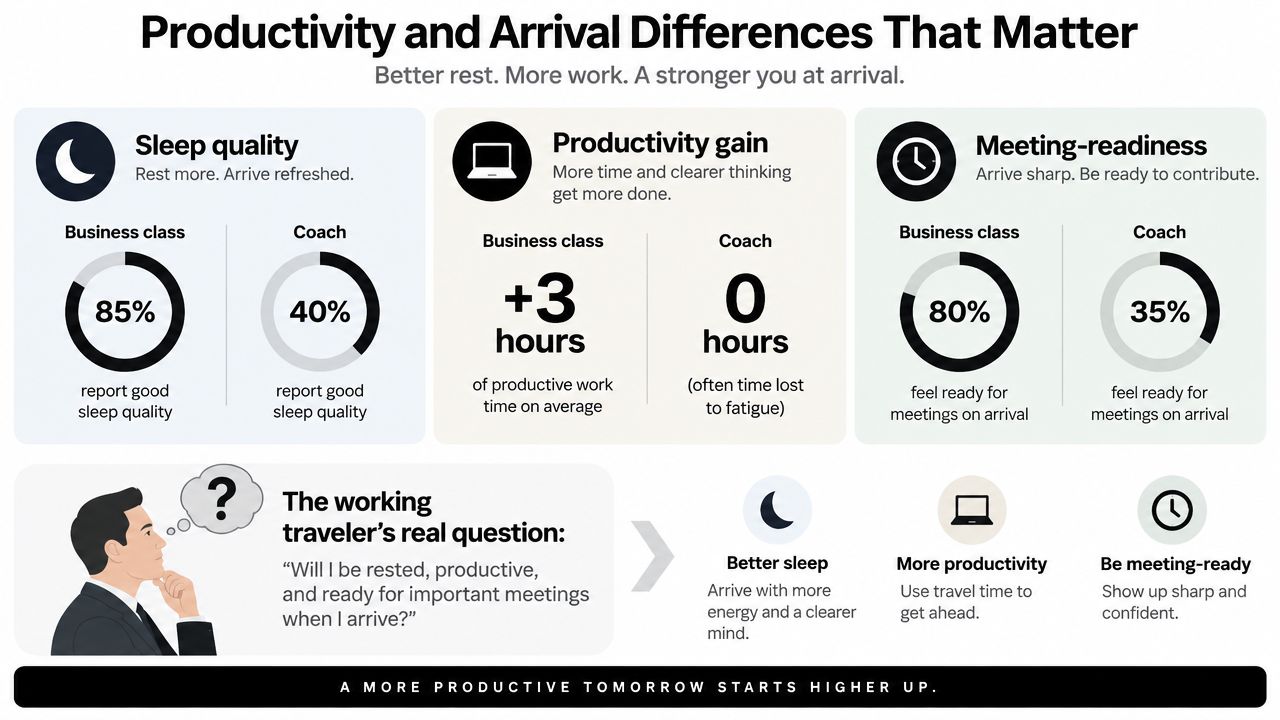
On a red-eye, the question is whether you can get meaningful rest rather than whether the seat feels luxurious. Long-haul business class can convert into a fully flat bed, while coach generally cannot. First class may add greater privacy and storage, but the marginal benefit over business depends heavily on how well you sleep in an open cabin.
A rested arrival can protect a client call, a negotiation, or a presentation. A poor arrival can consume the morning in recovery, even when the ticket looked economical.
Practical rule: Pay for the cabin when sleep protects a fixed business commitment. Don't pay for it merely because the seat looks impressive in the booking engine.
Arrival readiness has a price
Travel managers should treat arrival condition as an operating variable. If the traveler lands and goes straight to a meeting, the fare should be judged against the value of a usable workday, not only against the airline's seat map.
That doesn't make first class automatically rational. Business class often delivers the essential benefit, a flat bed, without the additional privacy and service cost of first. For many executives, the premium cabin is a business-day multiplier, but first class is only the right multiplier when the extra space and privacy solve a real problem.
When Upgrades Pay Off and When They Do Not
The strongest upgrade case is a recovery-critical itinerary. Think of an overnight flight followed by a morning meeting, a red-eye after a major client event, or a trip where arriving depleted would force a hotel night, a cab home, or a missed appointment.
The weakest case is a short daytime flight where everyone arrives with time to spare. Domestic first class can be more comfortable, but the operational difference from coach is often modest compared with the long-haul step up to a flat bed.
Upgrade decision matrix
Upgrade Decision Matrix: Trip by Trip
| Trip Type | Coach | Premium Economy | Business / First | Verdict |
|---|---|---|---|---|
| Domestic flight under two hours | Usually sufficient | Rarely necessary | Comfort premium is often hard to recover | Choose coach |
| Four-to-six-hour daytime route | Acceptable if budget is tight | Strong middle option | Consider only with a large fare gap or important arrival | Premium economy often wins |
| Overnight international flight | Poor choice when sleep is essential | Better space, but usually not a bed | Business class can justify the premium | Buy business when the next day matters |
| Red-eye followed by a morning meeting | High recovery risk | Helpful but limited for sleep | Lie-flat business or first offers the clearest benefit | Upgrade |
| Daytime return with rest at destination | Cost-efficient | Optional | Usually unnecessary | Choose coach or premium economy |
| Discounted premium fare below coach | Paying more gets you less | Depends on terms | Premium cabin becomes the rational purchase | Buy the usable premium fare |
Corporate policy can settle the question before comfort enters it. If reimbursement is capped at coach, don't treat a personal upgrade as a business expense unless the policy expressly allows it and the traveler accepts the cost.
The middle choices matter
Premium economy is often the rational answer on medium-length routes. It gives you more space without forcing the company to fund a lie-flat product that the schedule doesn't require.
Same-day upgrades deserve discipline. Consider one only when the premium price has fallen below what you already paid for coach, and check whether the upgrade removes seat selection, lounge access, or flexibility. An attractive cabin can still carry unattractive terms.
My candid adviser read is simple: most executives should choose coach on domestic and short-haul routes, then reserve business or first for international overnight flights and recovery-critical trips. Status should never make the decision for you.
How to Fly Premium Cabin for Less Than Coach
Start with the search behavior, not the loyalty balance. Premium seats can become cheaper when airlines need to fill them, but you must be looking across cabins and dates to see the inversion.
Search for the weak points
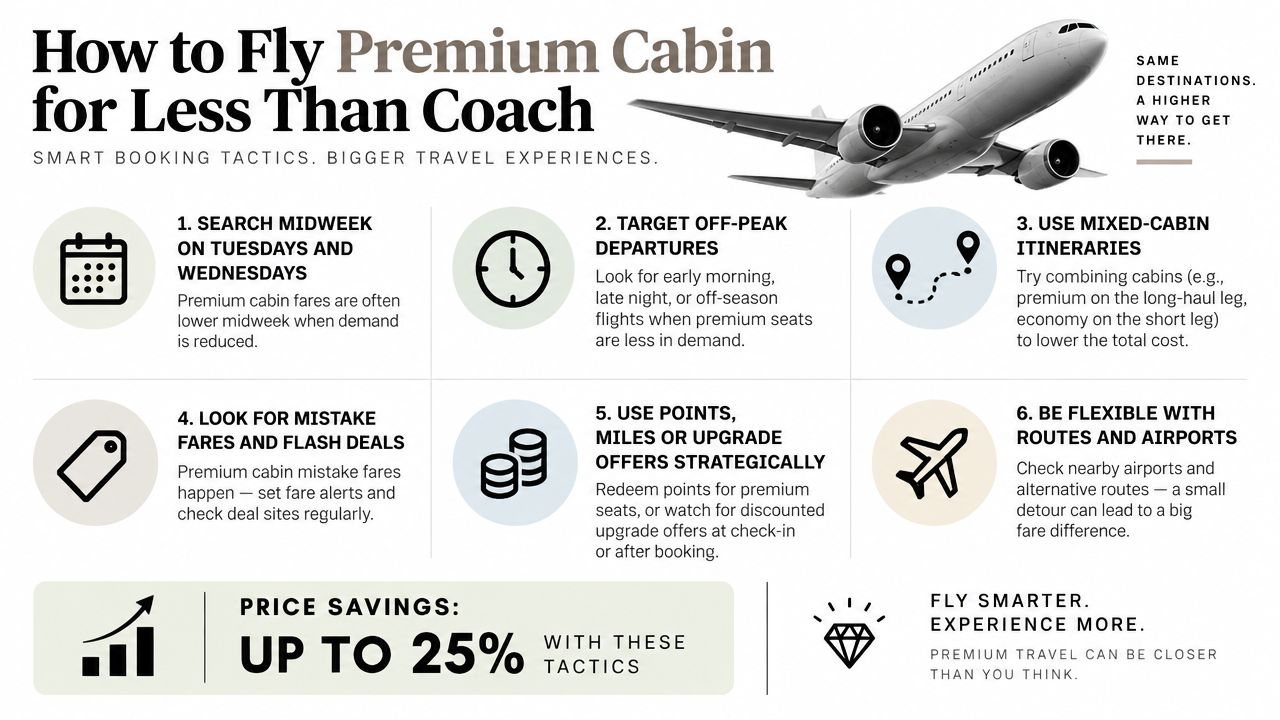
Use Google Flights or another fare-monitoring tool to compare the full cabin ladder. Search Tuesdays and Wednesdays, test off-peak departures, and check nearby airports. A connection or a flexible departure can expose a cheaper premium fare that a nonstop search hides.
Mixed-cabin itineraries are especially useful. Put business class on the overnight or longest segment, then accept coach on a short connection where the seat won't determine whether you function the next morning.
Use the fare mechanics
Airlines may discount unsold premium inventory during off-peak periods or competitive fare fights. A restrictive coach fare can remain high while business inventory drops, particularly on international routes where airlines are competing for premium demand.
Practical tactics include:
- Set route alerts: Track business and first separately instead of monitoring only the lowest economy fare.
- Compare fare rules: Check changes, cancellations, baggage, seat selection, lounge access, and upgrade eligibility.
- Use transfer partners: Credit-card points can make a premium award or upgrade more practical, but calculate taxes, availability, and the value of the points.
- Watch airline sales: Premium promotions can appear outside the dates most leisure travelers search.
- Consider last-call upgrades: Check the price close to departure only when you can tolerate losing the upgrade and the terms are clear.
- Test alternate airports: A nearby airport or an added connection can expose a different fare bucket.
This practical guide to finding discounted first-class travel covers the same core principle: the fare is a moving market price, not a permanent statement of cabin value.
One caution: don't chase a premium fare that creates an expensive connection, weak protection, or an overnight airport stay. Cheap premium is only a win when the itinerary remains operationally sensible.
Choosing the Right Cabin for Your Next Trip
Give your assistant a rule that starts with the arrival, not the aircraft. A short domestic trip under three hours usually favors coach or premium economy because the time saved by a larger seat rarely offsets a meaningful fare premium. A transcontinental or transatlantic overnight trip is different, especially when the traveler must work soon after landing.
Use this decision filter:
- How long is the critical segment? Short daytime flights rarely need first class. Longer overnight sectors create the strongest case for business.
- What happens after landing? A morning client meeting, presentation, or negotiation raises the value of sleep.
- Can the traveler recover at the destination? If the schedule allows a shower, meal, and rest, coach becomes easier to defend.
- What does the fare include? A premium label without lounge access, seat selection, or flexibility may not deliver the expected value.
- What is the actual spread today? If business prices below coach, the decision is no longer a luxury purchase. It's the better fare.
For unusual itineraries, a luxury flight decision guide can help frame first class against other premium travel options. Most corporate trips don't need that level of analysis, but high-stakes travel does benefit from comparing privacy, ground handling, and arrival readiness rather than staring only at the cabin name.
The mental rule I give executives is this: book the cabin that matches the work requirement of the arrival, not the aspirational image of the flight. Coach is the right answer when the trip is short, flexible, and recoverable. Business is the right answer when sleep protects the workday. First class earns its place only when its additional privacy, space, or service solves a specific problem and the fare is competitive.
Passport Premiere helps travelers monitor international business and first-class fares, compare premium-cabin fare cycles, and identify situations where a premium ticket can price close to or below coach. If you want fare intelligence for an upcoming corporate or long-haul trip, visit Passport Premiere and review the available membership details.
