Flights from Newark to Shannon Ireland: Premium Fares

Most travelers searching for flights from Newark to Shannon, Ireland start with the wrong assumption: business class is automatically too expensive. That advice is tidy, familiar, and often wrong. On a thin transatlantic route, a discounted lie-flat seat can sometimes cost less than a standard economy fare, particularly when the airline needs to reposition premium inventory before departure.

The better approach isn't to search for the cheapest seat in a fixed cabin. It's to monitor the relationship between cabins, dates, demand, and available inventory. Newark to Shannon is an unusually good market for that strategy because a single nonstop operator and a narrow schedule create fare swings that reward disciplined buyers.

Rethinking Transatlantic Premium Cabin Pricing

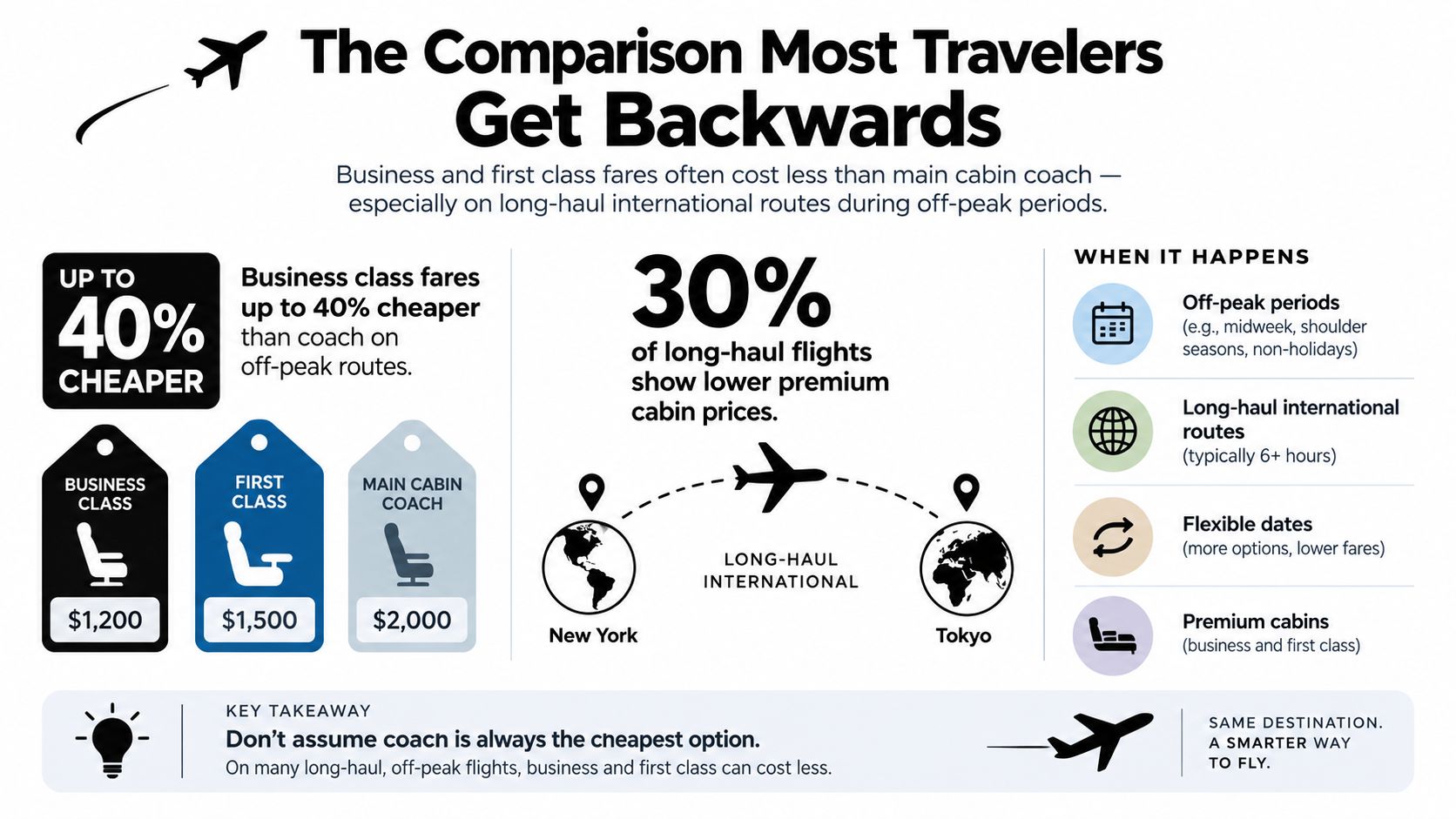
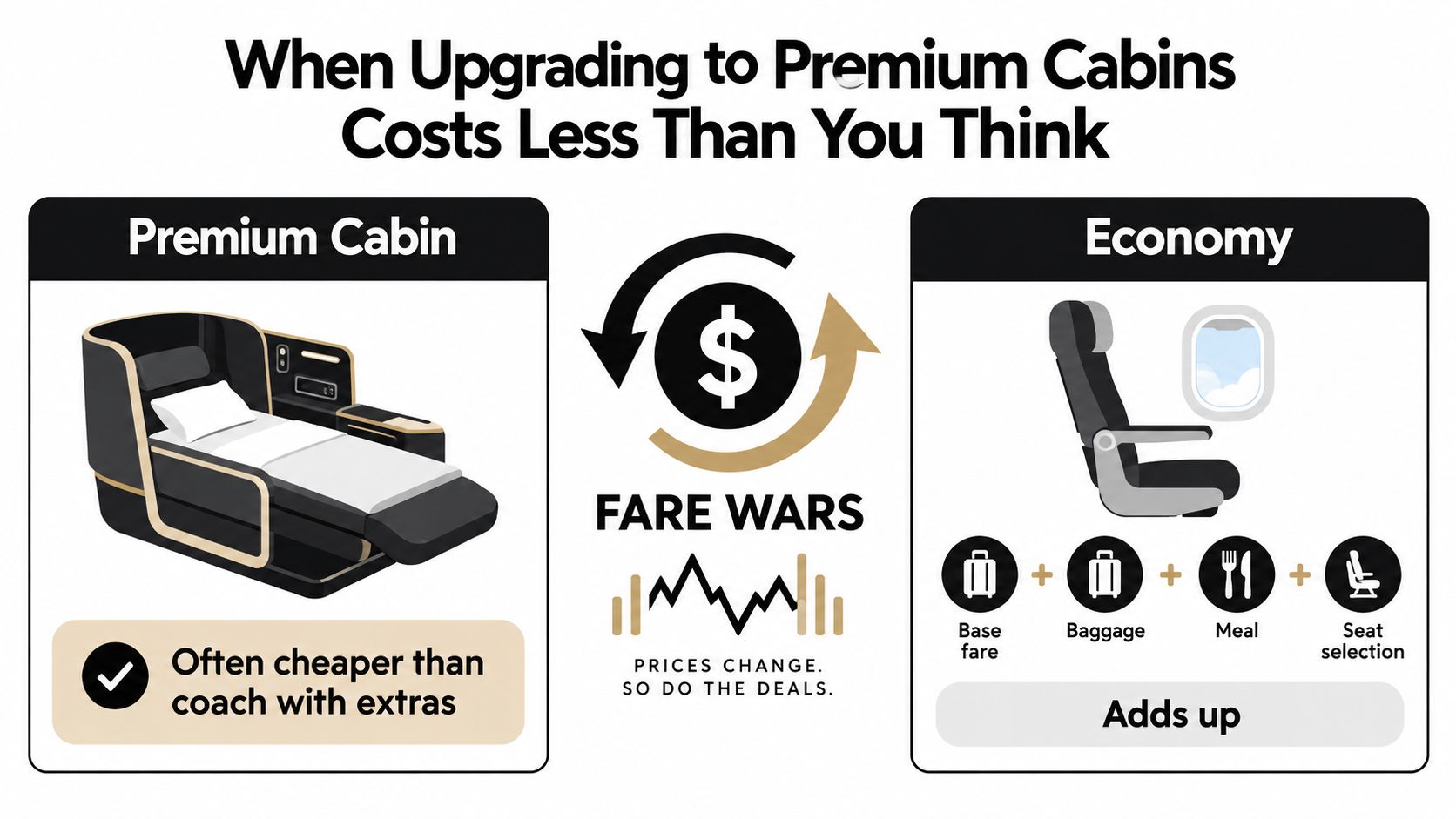
The old rule says comfort costs several times more than inconvenience. That rule works often enough to shape traveler behavior, but it fails when airlines price each cabin independently. Economy fares may rise because the cheaper inventory has disappeared, while business class remains discounted because premium seats are still available. The result is fare inversion, where the more comfortable option becomes the better-priced purchase.

That distinction matters on a transatlantic flight. A long-haul journey is generally defined as more than 3,000 miles or more than 7 hours, and business class has particular value on those sectors because of lie-flat beds and other long-haul amenities, as explained in this guide to transatlantic flight planning. Newark to Shannon sits firmly in that category, so the difference between a cramped overnight journey and a usable workday on arrival is substantial.

Stop comparing cabins at their usual prices

Business class commonly carries a large premium over coach. One airfare analysis places the typical difference at 4 to 10 times the economy price, while also noting that sales and last-minute upgrade pricing can narrow the gap enough for a premium option to undercut full-fare economy on some itineraries (business class and economy fare comparison). That isn't a promise that every Newark to Shannon itinerary will invert. It is a reason to check before dismissing the premium cabin.

Premium economy creates another useful comparison point. Industry fare guidance says premium economy is often about 65% less than business class and can sit anywhere from 15% to 100% above coach, depending on the itinerary and fare conditions (premium economy pricing guidance). Those relationships show why the cheapest cabin isn't always the cheapest ticket. Airlines manage each inventory bucket according to demand, restrictions, and remaining seats.

Practical rule: Search economy, premium economy, and business class together. If you search only for coach, you can miss the fare that actually offers the best value.

Treat this route as a pricing problem, not a simple transportation query. Set a comfort threshold, monitor the premium cabin, and buy when the fare relationship becomes favorable. Travelers who accept the first economy quote are behaving like retail shoppers. Corporate travel managers should behave more like market buyers.

Analyzing the Newark to Shannon Flight Market

The Newark to Shannon market is small, predictable, and highly sensitive to inventory changes. Current search results show about 21 weekly flight listings, daily direct availability, and a route distance of approximately 3,085 to 3,088 miles (current Newark to Shannon flight schedules). That creates a reliable travel option, but not a deep selection of competing departures.

United operates the nonstop route 7 times per week, and route data identifies it as the only nonstop airline, with the earliest Shannon departure around 12:30 (United Newark to Shannon route information). Use that figure as the practical operating frequency. Search engines can show about 21 listings per week or roughly 3 flights per day because their schedule views may count broader itinerary or availability results rather than separate United nonstop departures.

The route's thin, single-carrier structure matters more than the headline schedule. United controls the only nonstop option, so travelers cannot use a rival nonstop airline to pressure the fare lower. When economy inventory tightens, prices can rise quickly. When business-class demand softens, United can release selected premium seats at a lower fare without reducing every cabin.
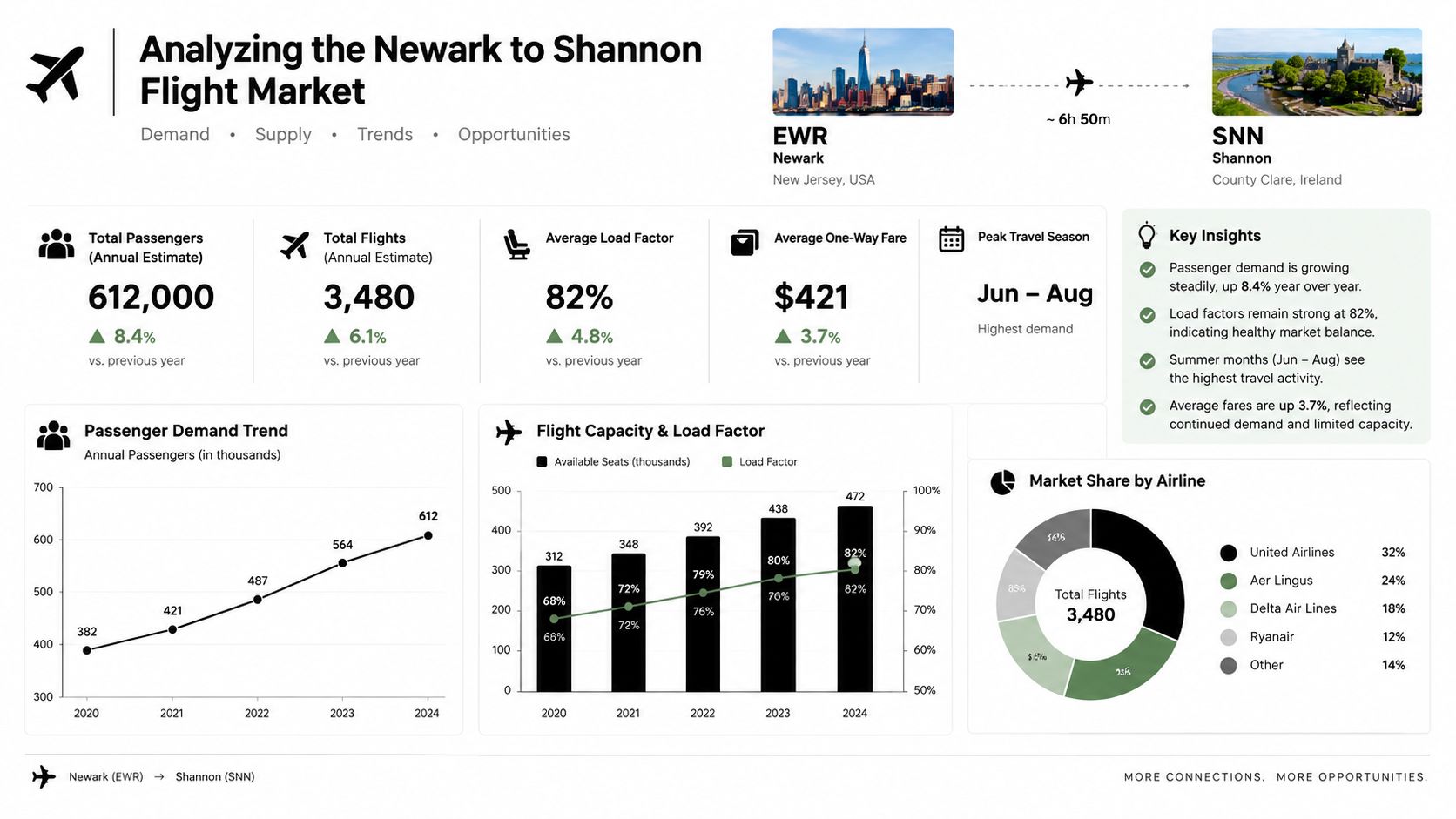
An infographic analyzing the Newark to Shannon flight market trends including passenger demand and airline share.

Why thin routes produce sharper fare movement

Every departure carries more pricing weight on a limited-frequency route. A traveler with fixed dates may have one practical nonstop choice, especially when avoiding a connection or preserving the overnight pattern. That concentrated demand gives the airline room to raise fares on popular dates.

The same constraint creates the opportunity for disciplined buyers. An unsold business-class seat has little value after departure, so the airline may open a targeted premium fare to stimulate demand. It can keep restricted economy inventory expensive while offering business class at a level below the standard economy fare. That is the pricing anomaly this route rewards.

Block times vary by source, from about 6 hours 25 minutes of scheduled block time to an average nonstop duration of roughly 7 hours 23 minutes to 7 hours 30 minutes. The difference reflects winds, routing, and schedule padding, not two different routes. KAYAK also places the service at roughly 3,087 miles (Newark to Shannon schedule and flight duration).

The commercial takeaway is direct: monitor premium inventory instead of accepting the first coach quote. A thin route can produce extreme fare swings because one airline manages the entire nonstop cabin mix. Travelers who regularly compare business-class flights from New York should include Newark to Shannon in that search. A larger airport does not guarantee a better nonstop fare. Here, limited competition makes fare monitoring more valuable.

Navigating Seasonality and Departure Schedules

Seasonality matters more on Newark to Shannon than on a heavily served transatlantic route. A thin, single-carrier schedule leaves fewer departures to absorb demand, so a small shift in seasonal capacity can create a sharp premium-cabin fare swing. Buyers should study the operating pattern before judging whether a quote is high or attractive.

Shannon's position on Europe's western edge has long supported its role as a transatlantic gateway, including multiple U.S. services, as described in RTÉ's Shannon gateway analysis. Seasonal changes across that network can alter total seat supply. The practical result is simple: a route that looks expensive one week may produce a valuable premium fare when schedules and demand shift.

Read the schedule before reading the fare

Newark to Shannon is built around an overnight crossing. Published schedule data places Newark departures in a narrow evening band around 22:40 to 22:50, while route information identifies the service as an evening departure designed for overnight travel (Newark to Shannon route schedule). That concentration makes the departure time convenient, but it also concentrates demand. A conference, school holiday, corporate trip, or weekend break can fill the preferred flight quickly.

Use the calendar as a demand filter:

  • Peak leisure periods: Treat popular holiday and summer dates as high-risk periods for premium fare increases. Travelers competing for the same nonstop have less pricing power.
  • Quieter corporate windows: Search outside obvious leisure peaks and avoid dates favored by business travelers. The goal is to find weaker demand, not to rely on a supposedly perfect month.
  • Nearby departure dates: Compare adjacent dates before accepting any fare. On a low-frequency route, shifting the trip can expose a different inventory position and a materially different premium quote.
  • Capacity changes: Recheck the route after seasonal schedule adjustments. Expanded service can increase available seats, while a reduction can push fares higher with little warning.

Make the overnight schedule work for you

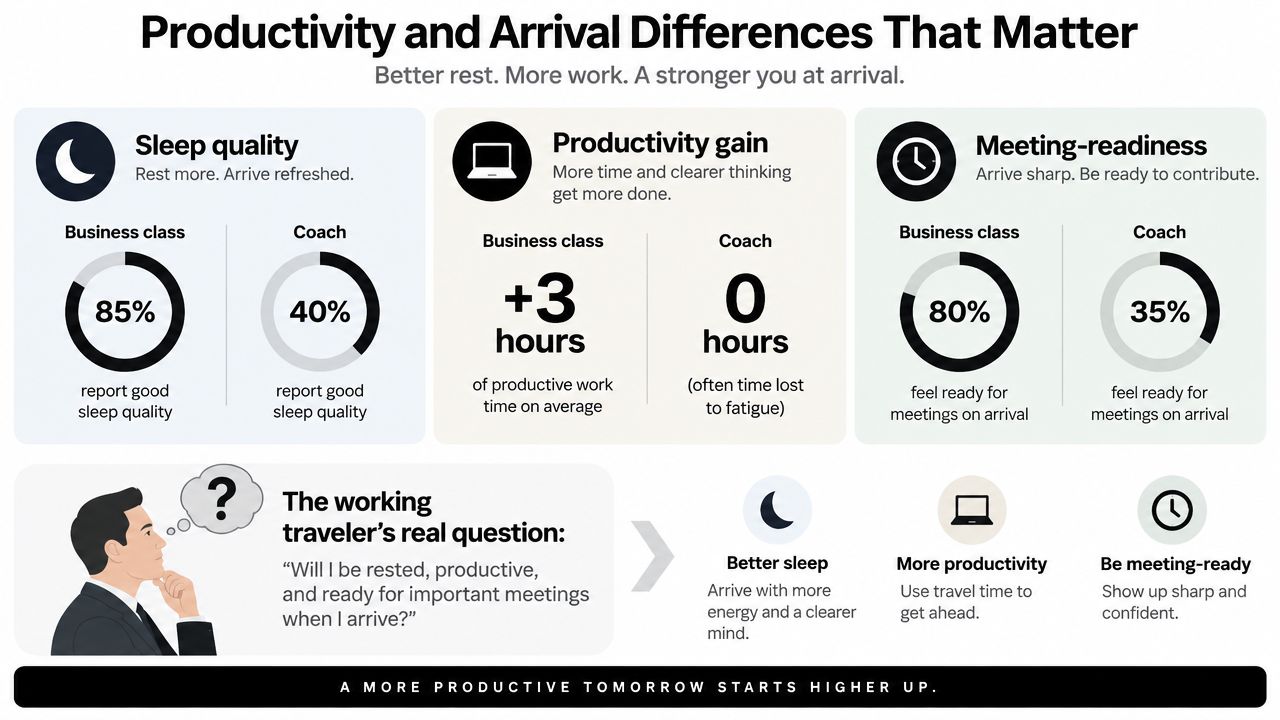
A late Newark departure gives business class a practical advantage. A lie-flat seat can support sleep and work, while an economy seat on the same overnight sector may leave a traveler less productive on arrival. That matters for consultants, executives, and anyone scheduled for a meeting soon after landing.

Set a buying rule before searching. Check fare restrictions, baggage terms, change conditions, seat selection, and connection protection. A discounted premium fare is worth considering when the dates are stable and the cabin improves the first working day in Ireland. Do not pay a premium merely for the label, but do act quickly when a flexible search reveals business class priced below the economy options available for the same departure.

Why Business Class Can Be Cheaper Than Coach

Business class can cost less than coach on Newark to Shannon, and that is not an error in the search results. Airline pricing follows inventory rules, demand forecasts, fare restrictions, and release decisions rather than a simple ladder from economy to premium cabins. On a thin route with one nonstop carrier and limited frequency, a small change in remaining inventory can create a large price gap between cabins.

The practical trigger is economy sellout. Once the lowest coach buckets disappear, the remaining economy fare may reflect high demand, flexibility, or limited availability. Business class can then fall below that specific buyable economy option without becoming inexpensive in absolute terms. The traveler is comparing live fares, not the usual hierarchy of cabin labels.

A flexible economy ticket deserves particular scrutiny. Its price may include changeability, baggage, and other conditions that make it more expensive than a restricted business fare released for the same departure. Review the fare rules before assuming coach is the cheaper or safer choice.

The economics of fare inversion

Route-specific listings show how widely Newark to Shannon pricing can move. One-way fares have ranged from about $672 to $3,370, while round-trip listings have ranged from about $890 to $5,012 (Newark to Shannon nonstop fare listings). These figures are not a forecast. They show why a buyer should compare cabins on the exact dates, not rely on a standard business-to-economy price ratio.

A premium seat can win in three practical ways:

  1. It can beat full-fare economy. The traveler receives a better seat while paying less than the remaining flexible coach inventory.
  2. It can beat a coach-plus-upgrade plan. Buying economy first leaves the upgrade uncertain. The request may not clear, may carry a substantial co-pay, or may be unavailable on the preferred departure.
  3. It can protect working time. On an overnight flight, a lie-flat seat and a quieter workspace can preserve productivity on arrival. For a consultant or executive, that benefit belongs in the travel-cost calculation.

The upgrade path also changes the comparison. One published United example shows a premium-economy ticket costing $269 more than coach, while reducing the upgrade co-pay and improving upgrade priority (United upgrade pricing example). Use that example as a pricing lesson, not as a promise for every Newark to Shannon booking. Compare the premium fare, the available economy fare, the upgrade cost, and the chance of securing the desired cabin.

Newark to Shannon Fare Volatility Snapshot

Cabin Class Standard Pricing Model Inverted Pricing Scenario
Economy The cheapest coach inventory sells first. Remaining fares may be higher, more restrictive, or both. The available economy fare costs more than a targeted business-class offer for the same dates.
Premium economy It generally sits between coach and business class, but its position can shift by itinerary and fare rules (premium economy pricing guidance). A reduced premium-economy fare offers a sensible compromise when business class remains above budget.
Business class It normally carries a substantial premium over coach, with business fares often costing 4 to 10 times economy on many routes (business class and economy fare comparison). A lower premium inventory release puts business class below full-fare economy or below the combined cost of coach and a later upgrade attempt.

Use the buyable fare as the benchmark. Confirm refundability, change conditions, baggage, seat selection, and upgrade terms. If the business fare satisfies the trip requirements and undercuts the available coach alternative, book the premium cabin instead of paying more for less.

Timing Strategies to Capture Premium Fare Drops

The best fare on this route may sit in business class, not coach. Newark to Shannon has a thin schedule with a single nonstop carrier, so a small inventory change can create sharp premium-cabin price swings. Strategic buyers should monitor the relationship between cabins instead of assuming economy is always the cheaper choice.

United's published schedule shows a daily nonstop in each direction, although seasonal timetables can reduce westbound service to about four weekly departures (Newark to Shannon directional schedule). That limited frequency gives the airline less room to absorb demand spikes. It also makes last-minute flexibility valuable, because waiting for a discount on a fixed departure can leave you with no acceptable alternative.
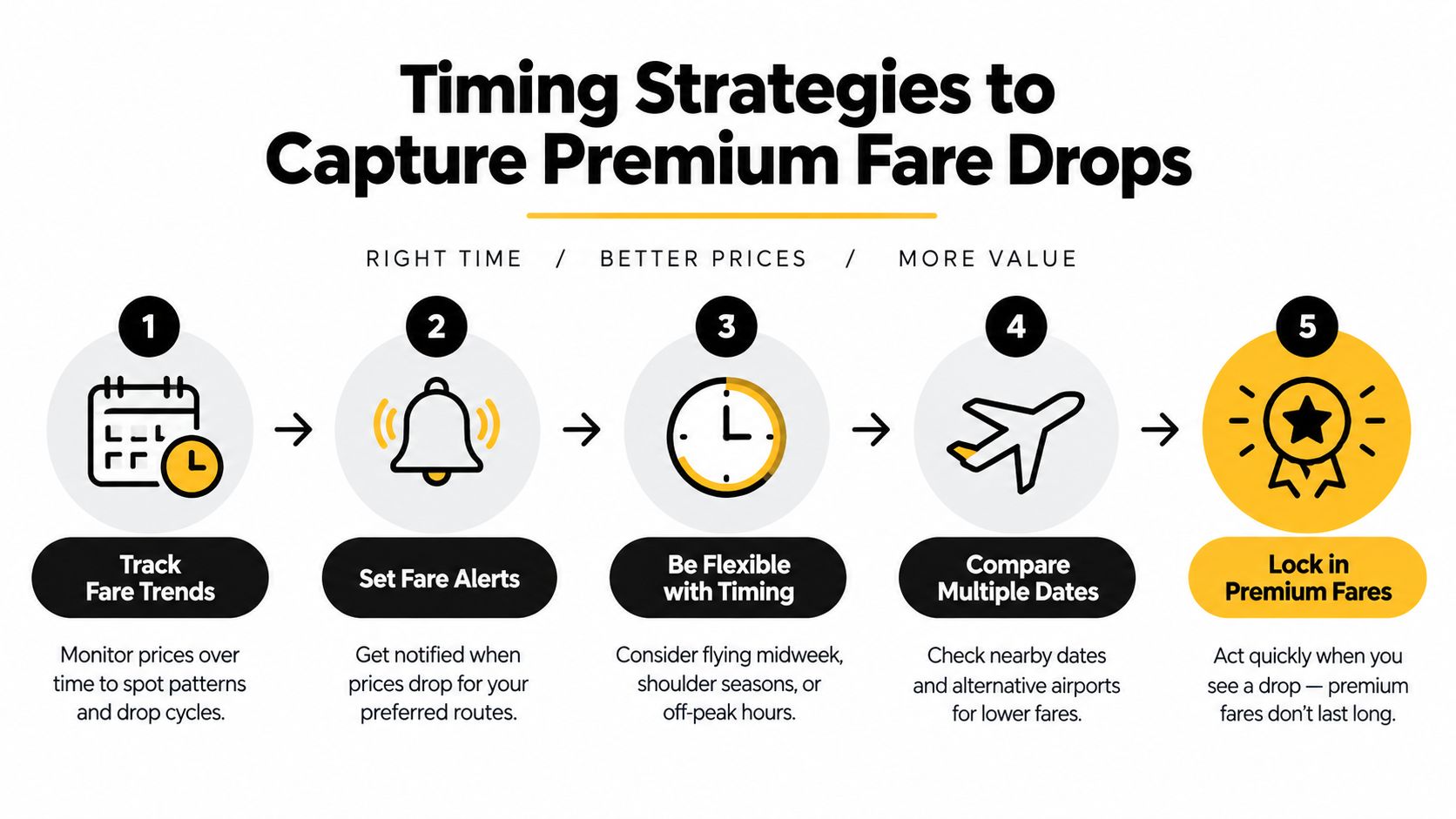
A step-by-step infographic titled Timing Strategies to Capture Premium Fare Drops for cheaper airline travel.

Build a premium fare watch

Set a date range before you search. Record economy, premium economy, and business-class prices for the same departure and return combinations, then note the conditions attached to each fare. A low headline price is irrelevant if it lacks the flexibility your travel policy requires.

Use this decision process:

  1. Define your trigger. Set the business-class price that beats the coach option you can buy. Include change fees, baggage, seat selection, and any potential upgrade cost.
  2. Track identical flights. Compare the same route, dates, and cabin over time. Random itineraries produce misleading conclusions.
  3. Target softer demand. Flexible dates, less popular travel periods, and departures with broader seat availability offer better opportunities than heavily booked peak dates.
  4. Check the rules immediately. Review refunds, changes, baggage, seat selection, and upgrade terms as soon as a premium fare appears.
  5. Book when the economics work. Do not wait for a theoretical lowest price. If business class costs less than the acceptable economy alternative and the conditions fit, purchase it.

A discounted premium fare is more reliable than an upgrade plan. Upgrade inventory is separate, and the later price may be high. Required points or a co-pay may fall outside policy, while upgrade priority may leave the traveler without the cabin expected. Buying business class at the lower fare removes that uncertainty from the start.

A specialized airline fare prediction service can organize this monitoring around fare behavior rather than generic lowest-price alerts. Passport Premiere presents a Video Gallery, news resources, and a Fare Monitor demonstration for travelers assessing this workflow. It cannot remove airline volatility, but it can focus attention on price movements that deserve immediate review.

Buying discipline: Never ask only, “What is the cheapest flight?” Ask, “What is the cheapest acceptable way to travel this exact departure?”

Leveraging Fare Intelligence for Discounted Fares

Manual monitoring fails for a simple reason. Corporate travelers and frequent flyers have work to do, and premium fare drops may appear in narrow inventory windows that disappear before anyone notices them. Checking several booking sites repeatedly can show the current price, but it doesn't necessarily explain whether that price is normal, inflated, or unusually favorable for the route.

A membership-based fare intelligence service can fill that gap by combining fare monitoring with market analysis. The relevant capabilities are straightforward: watch international premium cabins, compare a current offer with the route's observed pricing behavior, and send a signal when a purchase opportunity appears. That approach is more useful than a generic “cheap flights” alert because it evaluates the cabin travelers want.

What to inspect before joining

Look for practical evidence rather than broad promises. A useful service should show how its alerts work, explain fare characteristics, and help members distinguish a real premium opportunity from a low headline fare with poor conditions. Passport Premiere presents a Video Gallery, news resources, and a Fare Monitor demonstration for travelers evaluating this type of workflow.

Screenshot from https://www.passportpremiere.com

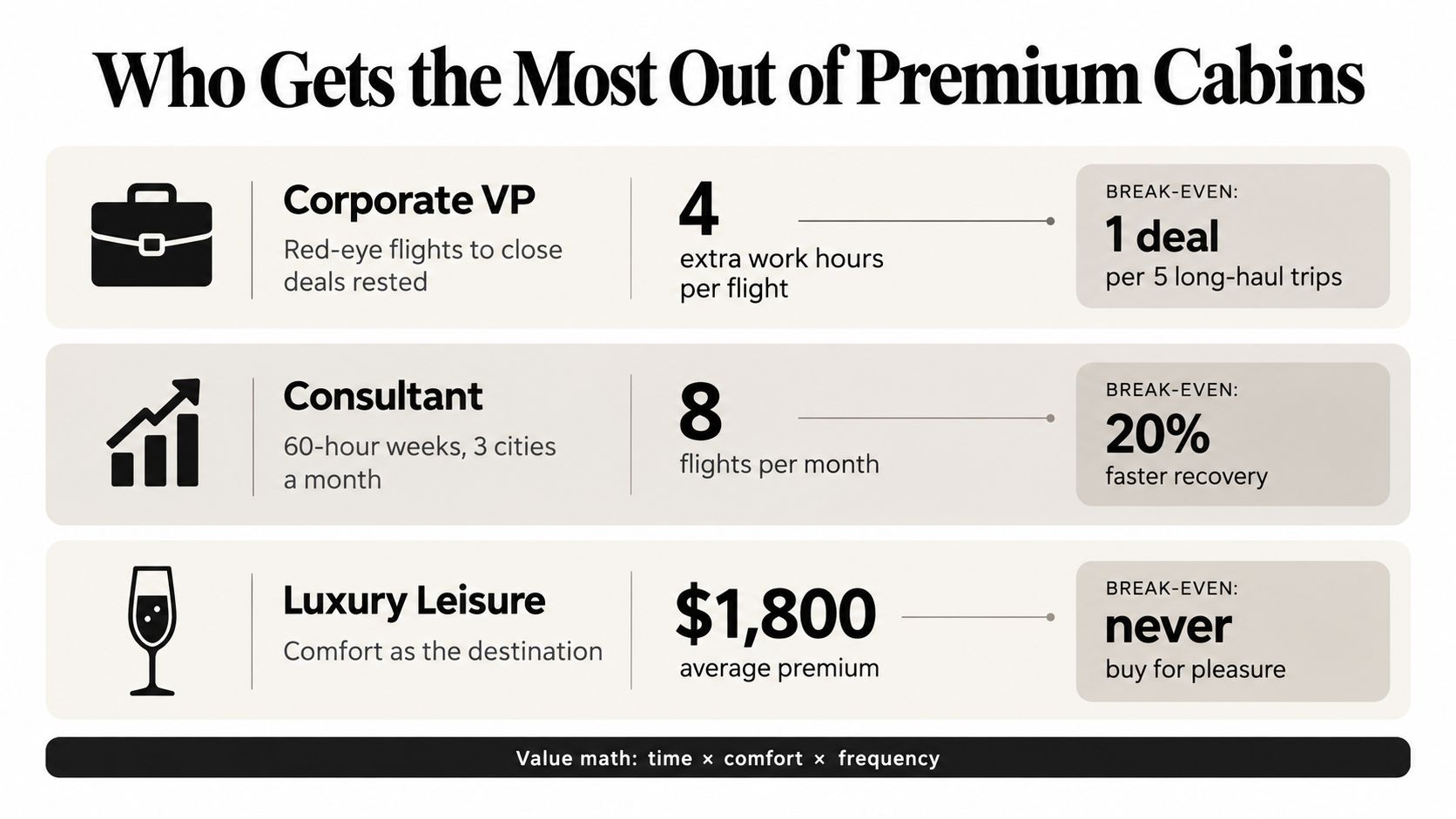
For a corporate travel manager, the value lies in reducing the time between a fare release and a purchasing decision. A consultant flying overnight can use the same intelligence differently, prioritizing sleep and arrival readiness. A luxury leisure traveler may care more about turning a fixed travel budget into a better cabin without changing the destination.

Apply the intelligence to Newark and Shannon

Set the search around the actual business need. If the traveler must arrive for a meeting, track the nonstop overnight departure and evaluate the total value of arriving rested. If the dates are flexible, monitor a wider range and allow the fare monitor to expose dates where the premium cabin is mispriced relative to coach.

Use the resulting alert as a prompt, not an automatic booking instruction. Confirm the operating carrier, flight times, ticket conditions, baggage, seat availability, and cancellation terms. Also check whether the fare is available for the full itinerary, rather than being a limited quote that vanishes at checkout.

The central advantage is speed with context. You don't need to predict every airline move. You need to recognize when a premium fare has moved far enough to beat the alternative you were prepared to buy.

Finalizing Your Transatlantic Travel Plans

The smart way to book flights from Newark to Shannon, Ireland is to stop treating airfare as a fixed retail price. This route has regular nonstop service, but its thin schedule and single-carrier structure can make inventory unusually sensitive to travel dates. That creates risk for passive buyers and opportunity for travelers who compare cabins continuously.

Use this checklist before purchasing:

  • Track the exact nonstop departures that fit the trip.
  • Compare economy, premium economy, and business class on identical dates.
  • Measure the premium fare against the economy fare you can buy, not an outdated starting price.
  • Check flexibility, baggage, seat selection, and upgrade conditions.
  • Keep alternative dates available when the schedule permits.
  • Buy when the premium cabin offers the strongest total value, even if the fare doesn't look cheap in isolation.

The route can also serve as a practical entry point for a broader Ireland itinerary. Travelers continuing beyond Shannon may find a separate Dublin to Limerick 2026 guide useful when planning the ground portion of the trip. That kind of end-to-end planning matters because the cheapest flight isn't necessarily the lowest-cost journey once transfers, lost work time, and recovery after an overnight flight are included.

You don't need to accept an inflated business-class quote, and you shouldn't assume coach is automatically the economical choice. Monitor the market, compare the total fare conditions, and treat every premium drop as a buying decision with a deadline.


Passport Premiere helps travelers monitor international premium-cabin fares, interpret fare conditions, and spot buying opportunities on routes such as Newark to Shannon. Visit Passport Premiere to review the Fare Monitor, Video Gallery, and membership options before your next transatlantic booking.
Cheap Business Class to Japan: A Playbook That Works

You're staring at a $7,000 Tokyo business-class fare, wondering whether comfort is worth accepting a fourteen-hour economy flight instead. That price is real, but it isn't the market. Cheap business class to Japan appears when route capacity, demand, fare inventory, and airline competition line up. The traveler who waits for that alignment can sometimes find a premium seat priced close to, or even below, what coach costs on the same journey.

The mistake is treating airfare as a fixed product with a fixed price. It's an event-driven market. Your advantage comes from identifying the fare cycle, monitoring several origin and destination combinations, and acting when the right inventory opens.

Why Cheap Business Class to Japan Is Real

A Tokyo business-class seat can show $5,000 or more on Monday and fall below $2,000 when the airline needs to stimulate demand. That swing is not an error. It reflects changing booking classes, route competition, departure dates, and the amount of premium inventory still available. Cheap business class to Japan exists, but only during specific points in the fare cycle.

Airlines price these routes around strong corporate demand and uneven capacity. ANA, JAL, United, Delta, and their alliance partners adjust fares in response to one another, often creating brief discounts on city pairs that otherwise command premium prices. A published fare shows what the airline wants at that moment, not the lowest price it will accept later.

Route capacity adds pressure to the market. Fewer available seats can support high fares, while extra flights or weaker demand can force carriers to open cheaper booking classes. Wide-body aircraft also devote a substantial share of their cabins to business class, giving airlines a large block of high-value inventory to manage. Route capacity and Japan fare analysis illustrates how capacity and cabin mix influence the fare cycle, but treat its route figures as directional rather than definitive.

The headline fare isn't the target

Fare distributions show why a single search produces the wrong conclusion. Observed round-trip business-class fares to Japan have reached $758, while another market summary reports a low of $1,137 and an average of $5,473. The cheapest fare seen in the prior two weeks was $1,820, compared with an average near $4,335. Those figures describe volatility, not a price guarantee.

Practical rule: Treat a high fare as a timing signal, not a verdict. If your dates can move, keep watching.

Track fare cycles instead of relying on one flexible-date calendar. Compare East Coast and West Coast origins, test cash and award options, and check HND, NRT, KIX, and FUK rather than treating Japan as one market. Set a ceiling before searching, then book when the fare reaches it.

Random searches rarely beat a monitoring process. Search engines show the inventory available now, not whether the fare is unusually high or a cheaper booking class may return. Monitor several origin, destination, and travel-date combinations. The same cabin can move from a sub-$2,000 opportunity to a $5,000-plus fare while you wait. The timing window, not the headline price, determines whether the deal is real.

Reading the Price Spread the Right Way

The spread between the observed low of $758 round trip and the reported $5,473 average isn't a promise that every traveler can buy the lowest fare. It's evidence that Japan business-class pricing is volatile. Buyers should read that distribution as a map of possible market conditions, not as a normal price range available on demand.

A fare moves because airlines open and close booking classes, competitors react, and demand changes by travel date and departure airport. A nonstop from an East Coast gateway may carry a large premium over a one-stop itinerary from the West Coast. A Tuesday departure can behave differently from a Saturday departure even when the aircraft and cabin are identical.

The left tail is where the opportunity lives

Travelers usually miss the lowest fares for predictable reasons:

  • They search once: A one-time result captures one inventory state, not the route's full cycle.
  • They search too early: Peak-season fares can remain expensive months before departure, especially when demand is obvious.
  • They ignore gateways: A nearby positioning flight can expose a cheaper fare market.
  • They insist on nonstop service: One-stop itineraries often create more pricing competition.
  • They focus only on HND: NRT, KIX, and FUK can carry different inventory and demand patterns.

The verified fare data supports a sharp conclusion. One neutral fare index places average U.S.-Japan business-class pricing around $3,716 to $4,271, depending on market and sample, while another route comparison showed Tokyo fares starting around $2,914 against a typical fare near $8,102. A route-level comparison of Japan business fares makes a sub-$3,000 itinerary look like what it is, an outlier that generally requires flexible dates, a lower-yield origin, or unusually favorable inventory.

Route Observed Low (RT) Average (RT) Peak (RT)
U.S. to Japan route family $758 $5,473 $8,102 typical Tokyo fare

The precise timing of every drop can't be guaranteed, and you shouldn't build a plan around an invented “magic day.” The practical approach is to watch for repeated movement across your chosen route family. When a fare falls sharply below its recent level, verify the cabin, fare rules, connection quality, and ticketing deadline immediately.

Timing Your Booking Window

A Tokyo business-class seat can move from about $1,650 to above $4,800 without changing aircraft or cabin. The difference is often the booking window, demand period, and fare inventory available when you search. For shoulder-season trips, start monitoring roughly 10 to 16 weeks before departure, then act when the fare breaks below its recent range. A Japan business-class booking guide also identifies Tuesday and Wednesday departures as generally cheaper than Friday and Saturday, with West Coast gateways often pricing below East Coast nonstops.

Use a shorter window for quieter dates and a longer one for predictable demand. Late January and mid-November departures can justify searches about six to ten weeks out. Spring travel deserves attention around four to six months ahead because cherry blossom demand and Golden Week can remove attractive inventory early.

Monitor early Monitor later
Cherry blossom travel: Peak spring dates. Search around four to six months ahead because demand concentrates quickly. Late February and early March: Begin watching around 10 to 16 weeks out, then compare each fare against its recent movement.
Golden Week: April 29 through May 5. Treat this as a pressured period and search well before ordinary shoulder-season timing. June: Often a quieter period for Japan travel. Watch for drops rather than assuming a particular booking day will produce one.
Obon: Mid-August, plus New Year from December 28 through January 4. Expect tighter inventory and monitor earlier than usual. October: Start tracking early, but wait for a meaningful fare break instead of buying solely because the month is traditionally cheaper.

A San Francisco to Tokyo Haneda itinerary for early March shows why volatility matters. A fare found about 56 days before departure could land near $1,650, while the same flight booked 120 days out for peak cherry blossom week could exceed $4,800. Treat that comparison as a timing pattern, not a promised quote. Date, fare class, and availability still have to align.

For a clearer explanation of booking-window mechanics, read this guide to when to book business-class flights.

Rebooking move: If changes are permitted, secure a workable fare, keep monitoring, and reissue when the same inventory drops by more than $400. Confirm the fare difference, ticketing deadline, and change conditions first.

Award Miles vs Cash Fares

Cash and points solve different problems. Cash fares usually offer better flexibility, simpler ticketing, and more useful one-way options. Awards become more valuable when peak-season cash pricing rises past $4,000, because the mileage requirement may remain comparatively stable even while the retail fare becomes unreasonable.

The award strategy must be route-specific. ANA Mileage Club round trips from the United States can price at 88,000 to 95,000 miles in business class, United MileagePlus can reach 70,000 to 80,000 miles with careful routing, and Aeroplan can fall within 55,000 to 75,000 points through partner carriers. These figures come from the supplied booking framework, so verify the live award calendar, taxes, carrier charges, and routing rules before transferring anything.

Strategy Typical Cost Best For Watch Out For
Cash fare Varies by inventory and route Flexible dates, last-minute availability, one-way travel Retail prices can surge during peak demand
ANA award 88,000 to 95,000 miles round trip Travelers targeting ANA availability Award space can be limited
United MileagePlus 70,000 to 80,000 miles Careful partner and hub routing Dynamic pricing and routing differences
Aeroplan partner award 55,000 to 75,000 points Partner availability and planned trips Taxes, fees, and transfer timing
Hybrid itinerary Cash positioning plus an award Travelers near a saver gateway Separate-ticket connection risk

JAL Mileage Bank and Asia Miles can be difficult during peak periods because premium-cabin award space is scarce. JAL's North America to Japan business awards were also revised upward in 2025, so old redemption advice can be dangerously stale.

When hybrid wins

A hybrid itinerary uses a cheap cash flight to a gateway such as Vancouver or Honolulu, followed by an award segment to Japan. It can reveal saver space that isn't available from your home airport, but separate tickets require generous protection against missed connections, baggage complications, and schedule changes.

A useful comparison is a Tokyo summer itinerary booked 11 months ahead for 75,000 Aeroplan miles, versus the same date at $5,200 cash. The award isn't automatically superior. Taxes, fees, transfer risk, and the value of your points still matter. But during peak demand, the stability of a confirmed award can beat waiting indefinitely for a cash sale.

Before moving points, review this MileagePlus upgrade and award guide and confirm that the specific itinerary fits your account and travel needs.

Routing Tricks That Lower the Fare

A Tokyo business-class seat can swing from $1,950 to $5,200 on the same broad route. The airport pair and connection plan often matter more than the airline you prefer. West Coast gateways such as LAX, SFO, SEA, and YVR usually price better than eastern origins because they sit closer to Japan and face heavier transpacific competition. A positioning flight to Los Angeles can beat a JFK to Haneda itinerary, provided you leave enough time between separate tickets.

Vancouver can expose Air Canada and ANA inventory, while Toronto may offer seasonal ANA nonstop options. Some travelers also test Mexico City or MEX to IAH to Japan through United. Each additional segment raises the risk of misconnection, schedule disruption, and baggage problems, so compare the saving against the operational burden.

Build the comparison around gateways

Start with a small route matrix, then narrow it to fares that survive a real trip:

  • West Coast origin: Search LAX, SFO, SEA, and YVR to HND, NRT, KIX, and FUK.
  • Home airport versus positioning: Compare your full itinerary through a U.S. hub with a separate ticket to the gateway.
  • Asian connection: Test Taipei, Seoul, and other regional hubs before Japan.
  • European connection: Check Istanbul or Helsinki only when the fare reduction justifies the extra travel time.
  • Open-jaw itinerary: Arrive in Tokyo and leave from Osaka, or reverse the pattern. An open-jaw flight planning resource can help organize those combinations.

Connections through Istanbul, Helsinki, or Taipei can sometimes cut $800 or more from the fare. Taipei to Narita on JX and Seoul to Narita on OZ may also expose lower-priced premium inventory. Osaka can price 15% to 25% below Tokyo on comparable searches, which suits itineraries that already include Kyoto or western Japan. Treat these as search signals, not guarantees. Inventory changes quickly.

One comparison shows the tradeoff clearly. A SEA to IAH to HND itinerary could appear near $1,950 round trip, while a comparable JFK to HND nonstop could sit around $3,400. The cheaper ticket costs more time and adds connection exposure. That can still be the right decision when the savings cover a positioning flight, a buffer night, or the inconvenience of a longer journey.

Route discipline: Compare total travel time, airport changes, connection protection, baggage rules, and the aircraft assigned to every premium segment, not just the displayed fare.

Search each arrival and departure combination separately. The cheapest Tokyo fare may become more useful when you return from Osaka, and a slightly longer route can beat a nonstop once the fare difference is large enough.

Monitoring Fare Volatility

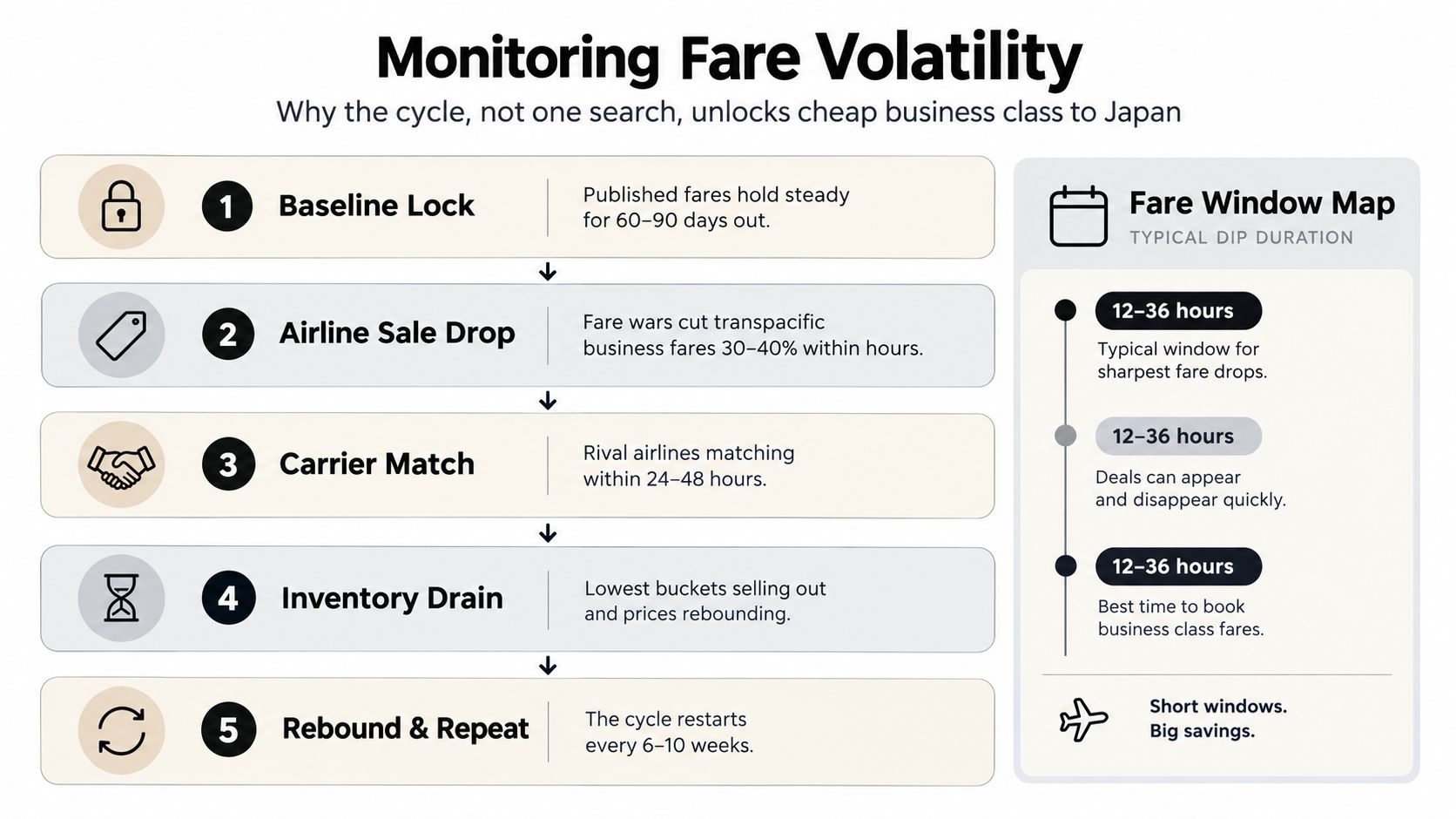
An infographic titled Monitoring Fare Volatility explaining the five-step cycle for finding cheap business class flights to Japan.

A Tokyo business-class seat can sit near $1,950, then climb above $5,000 after the lower booking classes disappear. A single search captures only today's price. Tracking the movement shows whether you are seeing a real opportunity or a temporary gap.

Airlines commonly adjust transpacific fares in response to competitors and booking activity. One carrier loads a lower fare, another matches it, and the cheapest inventory can vanish as seats sell. Our monitoring framework models this movement as a cycle that may develop over 6 to 12 weeks, with worthwhile drops appearing briefly. The cycle includes baseline pricing, a sale, a competitor match, inventory depletion, and a rebound that may return every 6 to 10 weeks, as shown in the fare-volatility infographic.

The practical rule is simple: record the fare before judging it. A price that looks low in isolation may be ordinary for that route, while a brief drop against its recent baseline deserves immediate review.

Build a watch system, not a larger spreadsheet

A weekly matrix can cover home airports, positioning gateways, four Japanese airports, multiple travel dates, and nonstop or connecting routes. It teaches you the market, but manual searching still misses changes that appear overnight or disappear before the next check.

Set up monitoring around the decisions that affect the ticket:

  1. Group routes: Include home airports, positioning gateways, and Japanese alternatives.
  2. Use flexible dates: Track a range rather than one departure and return pair.
  3. Specify the cabin: Confirm that alerts target business inventory, not premium economy.
  4. Set a ceiling: Compare new fares with your recorded baseline before calling them bargains.
  5. Verify quickly: Check the airline site, fare basis, operating carrier, aircraft, connection, baggage, and ticket rules.

Passport Premiere fare monitoring and deal signals can identify Japan-related premium-cabin drops by routing class and booking bucket. Use it to spot movement, then validate the actual ticket before transferring points or booking.

When an alert arrives, inspect the itinerary immediately. Confirm the cabin and fare basis, save the result, and act while the lowest class remains available. The objective is not endless searching. It is recognizing a meaningful Tokyo fare drop before the market resets.

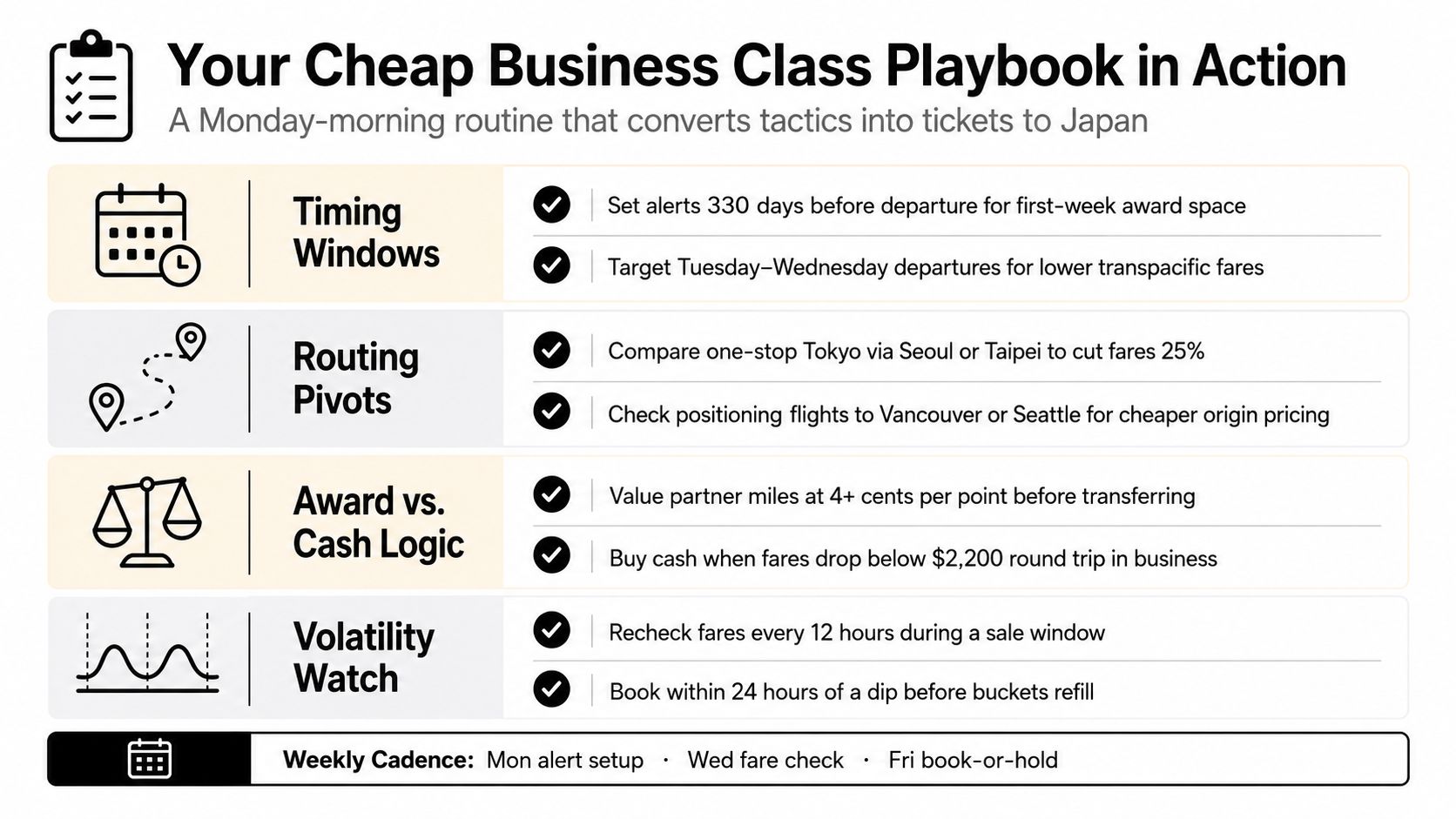
Your Cheap Business Class Playbook in Action

Turn the strategy into a routine you can run every week. Start with a 14-day rolling date search across three origin gateways, then compare the same dates through awards and positioning airports. Don't wait for a perfect result from one city pair. The cheapest business class to Japan ticket often appears only after you widen the map.

The Monday routine

  1. Define flexibility: Choose your acceptable travel period, cabin, maximum connection time, and Japanese arrival airports.
  2. Set the baseline: Record current cash fares for your three origin groups and your preferred destination airports.
  3. Layer awards: Search partner programs on the same routes before transferring points.
  4. Set the ceiling: Create a fare alert tied to your actual budget and route tolerance.
  5. Watch movement: Treat a 20% drop versus the trailing average as a trigger to investigate, not as an automatic purchase.
  6. Validate directly: Recheck the airline calendar, operating carrier, aircraft, baggage, and cancellation terms.
  7. Act quickly: Book the cash fare or transfer points within 24 hours when the itinerary passes your checks.
  8. Walk away deliberately: If the cabin is wrong, the connection is unsafe, or the terms undermine the savings, keep monitoring.

A structured playbook infographic outlining strategies for booking affordable business class airfare to Japan.

Build comfort into the operating plan

Long-haul comfort doesn't end at the seat. If you're repositioning, connecting, or working across time zones, small practical choices can protect the value of the itinerary. Travelers who want to reduce neck strain during airport waits and flights can browse travel neck pillows at SunnyBay as part of their preparation.

Keep the cadence consistent. Monday is for alert setup, Wednesday is for checking fare movement, and Friday is for deciding whether to book or hold. Your records should show the route, date, cabin, price, and reason for rejecting an offer. That history makes the next alert easier to judge.

Cheap business class to Japan isn't a lucky search. It's a repeatable purchasing system built around route flexibility, award awareness, and fast responses to temporary inventory. The traveler who watches the cycle has a better chance of buying the seat when the airline is discounting it, rather than when the airline is testing the highest price the market will tolerate.


Passport Premiere tracks premium-cabin fare cycles, price drops, and Japan-related business-class opportunities so you can judge whether a fare is attractive before booking. Visit Passport Premiere to explore its fare monitoring and market-intelligence membership, then set your Japan routes and price ceiling before the next drop appears.

How to Get First Class Tickets for Less

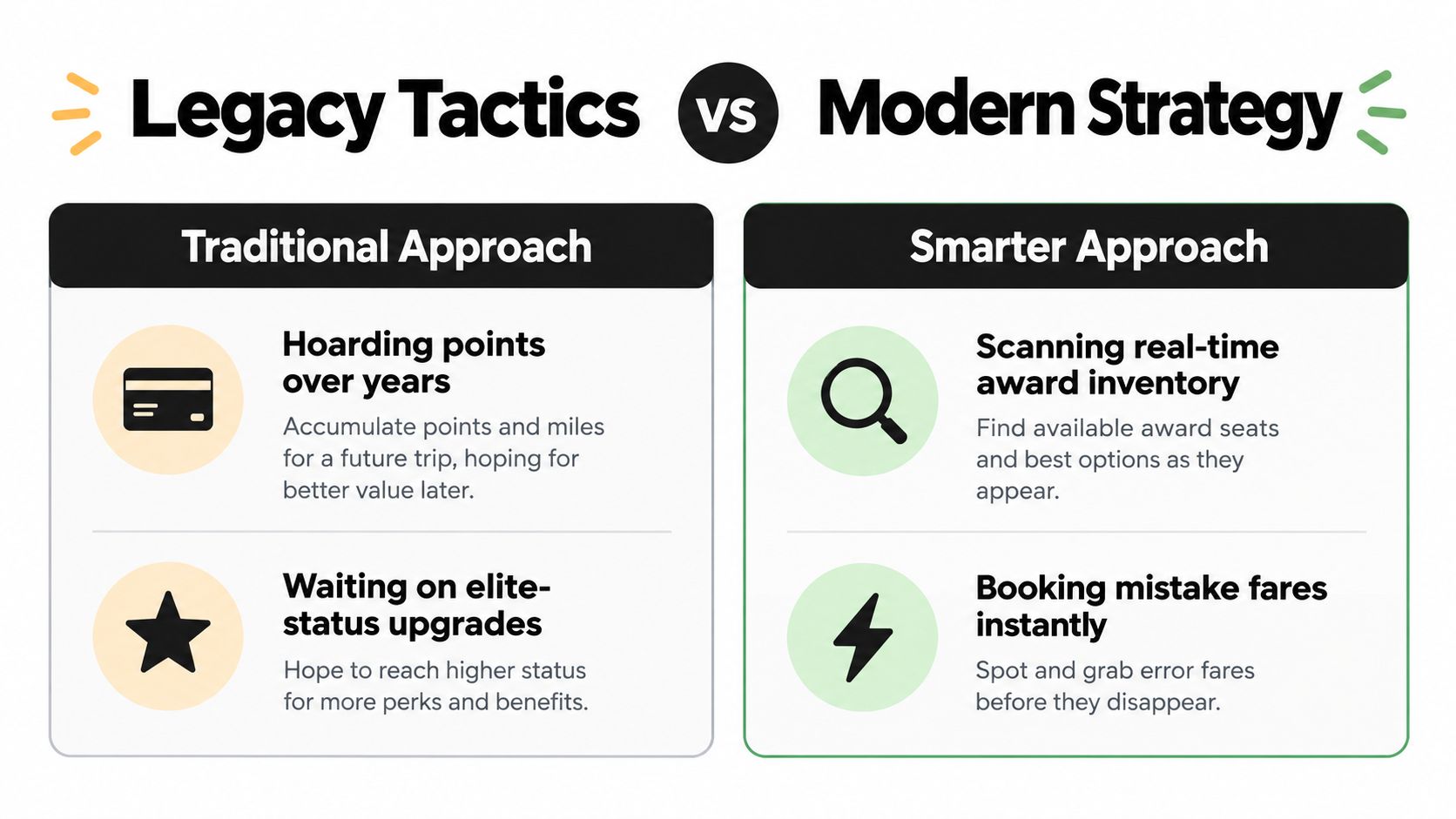
Most advice on how to get first class tickets starts with points, elite status, and waiting for a complimentary upgrade. That playbook is outdated. Airlines increasingly sell premium seats directly, award availability is inconsistent, and status alone won't rescue an expensive itinerary.

Treat first class like a volatile financial market, not a fixed luxury product. Published fares are often an opening position, not the true value of the seat. Your advantage comes from comparing cabins, monitoring routes, recognizing anomalies, and acting when the fare reflects weak demand rather than the airline's ideal price.

Business class can even be cheaper than coach on specific routes and dates. That sounds irrational only if you assume airlines price cabins in a simple upward ladder. They don't. Fare classes, competition, inventory, and demand can produce legitimate premium fares below economy, which is why disciplined monitoring beats loyalty alone.

Rethinking Premium Cabin Pricing and Value

First class isn't reserved exclusively for the ultra-wealthy or travelers with top-tier status. It is expensive, but it isn't always sold at the headline fare. Airlines manage several fare buckets at once, and the price you see today may reflect a temporary inventory decision rather than the lasting value of the seat.

The right question isn't, “Can I afford the published first-class fare?” Ask instead, “What is this seat worth on this route, for these dates, through this buying channel?” That shift prevents emotional decisions and makes premium travel comparable with any other major business expense.

A premium cabin can carry a high list price while still attracting weak demand. The airline must then choose between protecting the published fare and selling the seat at a lower transaction level. On many international routes, that second option is commercially sensible because an empty seat generates no passenger revenue.

Stop treating status as the product

Elite status may improve your experience, but it shouldn't be your primary acquisition strategy. Complimentary upgrades depend on the number of premium seats available, the fare class you purchased, competing elites, and the airline's decision to monetize inventory.

Delta executives described a major change in who occupies first class. About 15 years ago, roughly 12% of first-class passengers paid for their seats, while around 75% pay outright today, according to reporting on the decline of complimentary upgrades. That leaves fewer seats for automatic upgrades and makes historical advice less reliable.

Strategic rule: Buy the cabin you need at a market price you can defend. Treat an upgrade as upside, not as the plan.

For corporate travelers, value includes productivity, sleep, arrival condition, schedule flexibility, and the cost of lost working time. For leisure travelers, it may include privacy, rest, and a smoother long-haul experience. A useful overview of the distinction between premium cabins appears in this guide to premium-cabin products.

Don't pay for benefits you won't use. A stripped-down first-class fare may remove lounge access, flexibility, baggage benefits, or other features that once shaped the premium calculation. Read the fare conditions before you compare it with business class or a flexible economy ticket.

Analyzing the True Cost of First Class Fares

First-class pricing is a market, not a fixed premium attached to a better seat. Its structure dates to 1955, when TWA introduced a two-class service model on its Super Constellations after IATA rules changed in 1952 to permit different fare levels on one flight, as described in the history of first class in aviation). That decision established the cabin hierarchy airlines still price today.

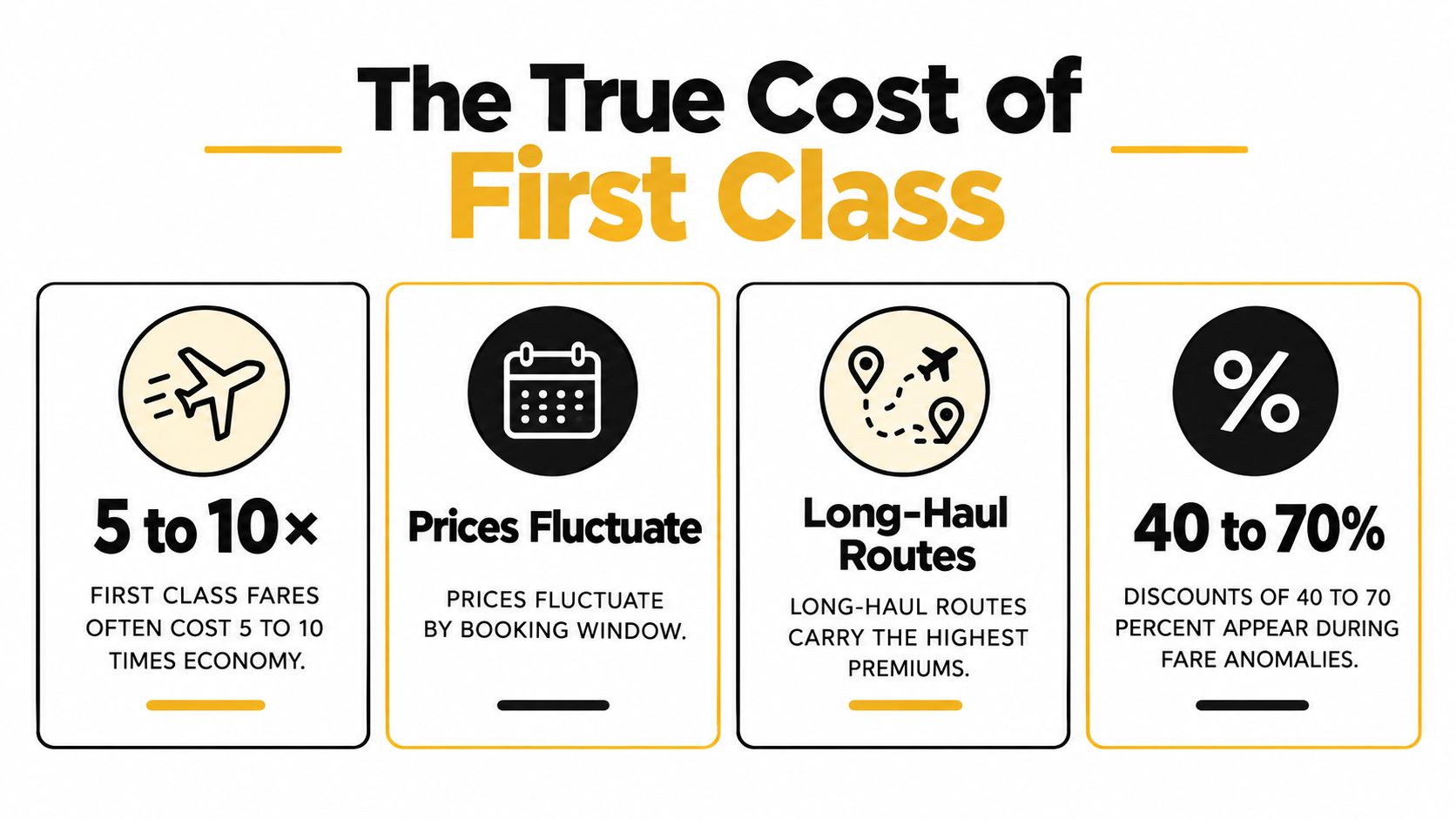
On intercontinental round trips, first class often exceeds $10,000 or €10,000 per person, while business class commonly falls around $4,000 to $5,000 and economy around $300 to $2,000. Treat these as broad market references, not quotes for your itinerary. The important point is that a high initial fare may reflect public pricing rather than the value of the seat or the lowest available transaction.

An infographic titled The True Cost of First Class detailing price fluctuations, route premiums, and ticket discounts.

Published fare versus transaction value

A September 2026 first-class index covering 25 routes found negotiated first-class fares averaging 43% below published fares. Its New York to London example fell from about $11,000 published to about $5,500 negotiated, a 50% reduction. Boston to Zurich fell from about $9,000 to about $6,500, a 28% reduction, according to the first-class fare index.

Use those examples as a pricing benchmark. A $10,000 quote can be normal public pricing and still be a poor purchase if comparable fares are materially lower. Record observed prices before booking so “deal” has a measurable meaning.

Compare three dimensions:

  • Cabin: Check first, business, premium economy, and coach on identical flights and dates.
  • Route: Test nearby airports, one-stop options, and competing carriers.
  • Timing: Track earlier schedule windows and later periods when airlines may adjust inventory.

Account for the surcharge structure

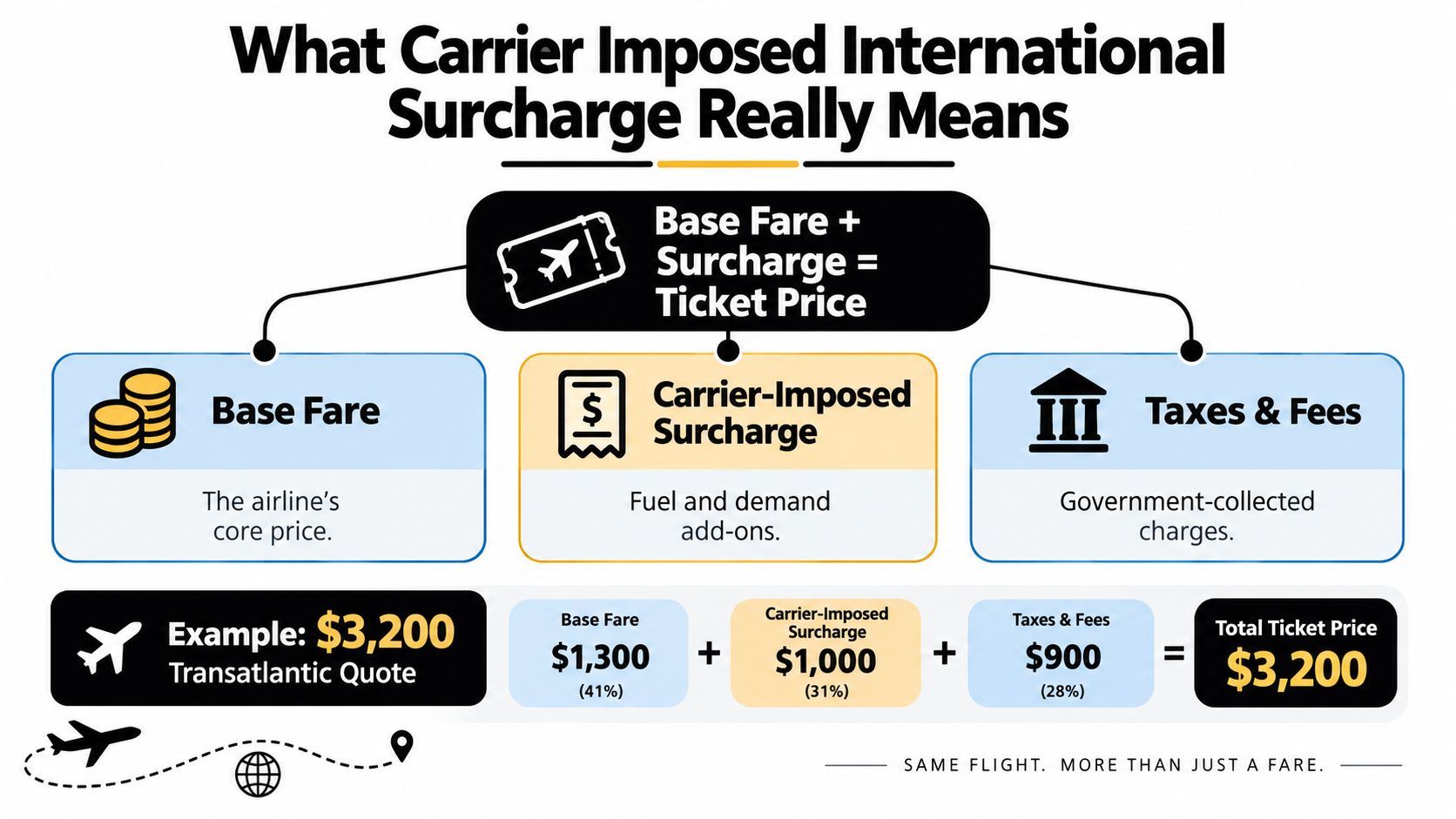
The displayed base fare does not represent the entire international ticket price. Carrier-imposed surcharges can widen or narrow the difference between cabins, so inspect the fare construction instead of comparing only the headline number. Use this explanation of carrier-imposed international surcharges to separate the underlying fare from added charges.

Judge the total against observed transaction levels, the benefits you will use, and the best business-class alternative. That comparison turns first-class shopping from points speculation into fare analysis.

Mastering Search Timing and Route Selection

The fastest way to overpay is to search one airport, one airline, and one date, then accept the first premium result. Airlines price each market independently, so your search needs enough flexibility to reveal where demand is weak and competition is forcing fares down.

Start with the route, not the loyalty program. Identify every practical departure airport, destination airport, nonstop option, and one-stop connection. Then search the same journey across several carriers and cabin combinations before deciding that first class is unaffordable.

A woman with a bun hairstyle working on a laptop at an airport gate near a window.

Use a two-window search

Monitor the itinerary when schedules first open, then check again as departure approaches. Early searches can reveal award space and attractive promotional inventory. Late searches can uncover reductions when the carrier needs to improve cabin occupancy, although waiting carries more risk if your dates and routing are fixed.

Don't confuse a low probability with a bad strategy. Premium pricing changes quickly, and a route that looks impossible on one day may produce a rational fare after a schedule adjustment, competitive response, or weak booking period.

Look actively for inverted cabin pricing

Business class cheaper than coach is a real market outcome, not a search-engine error. KAYAK's 2025 flight-class fare analysis lists average domestic economy at $316 and domestic business at $1,784, while also explaining that route and timing can produce unusual pricing. The normal hierarchy remains intact in many markets, but you shouldn't assume it applies to every itinerary.

Competition and weak business demand make inversions more likely. The Points Guy documented a once-weekly LATAM routing between Easter Island and Papeete where business-class cash fares could match or undercut economy, illustrating how route-specific supply and demand reshape the cabin ladder in this analysis of premium fares below economy.

Run this workflow for every serious trip:

  1. Search all cabins first. Record the total price, not just the cabin label.
  2. Test nearby airports. A different origin or destination can expose another carrier's fare competition.
  3. Compare one-way combinations. Separate tickets may produce a better premium value, but only use them when the connection risk fits your schedule.
  4. Check unusual dates. Move the outbound and return independently where business travel permits.
  5. Validate the result. A premium fare below coach can be legitimate. One Mile at a Time calls such pricing “not unheard of” and advises that it probably isn't a glitch in its analysis of premium-cabin anomalies.

Book only after confirming fare rules, connection protection, baggage treatment, and change conditions. A cheap premium cabin is still a bad purchase if it creates operational risk your company can't accept.

Navigating Award Inventory and Upgrade Realities

Points can reduce the cash cost, but hoarding them does not create premium seats. Start with a defined route, target cabin, transferable balance or usable miles, and a realistic view of each airline's award releases.

An analysis of 256,503 unique flights found an overall award-search success rate of only 11.7% across airlines. First-class results differed sharply: Delta domestic first class appeared in 30.8% of searches, American first or business searches succeeded 24.6% of the time, and Alaska first class succeeded only 8.6%, according to The Points Guy's award-availability analysis.

A comparison chart showing traditional legacy travel tactics versus a smarter modern strategy for booking flights.

Match the program to the route

Carrier-level differences make universal points advice unreliable. Search by airline and cabin, then learn the program's release pattern, routing rules, partner restrictions, and cancellation terms. Availability on one carrier says nothing about another.

Begin monitoring when schedules open and check again near departure. Premium award space can appear during both early-release and last-minute periods. Do not transfer flexible points speculatively. Confirm the transfer time and locate bookable space first.

Award inventory is an access problem before it is a currency problem. Miles without a route-specific search plan do not create a seat.

Replace upgrade optimism with price discipline

Premium cabins are increasingly sold through paid fares rather than complimentary upgrades. U.S. airline premium-seat capacity grew 69% over the past decade, and Delta sells over 70% of its first-class seats, according to reporting cited in the upgrade-market analysis. That shift makes elite status a poor booking plan.

For a step-by-step explanation of upgrade conditions, see this guide on how to get upgraded to first class. Check paid upgrade offers at booking and during check-in. Compare the offer with the fare difference, seat quality, included services, and value of arriving rested. If the price fails that test, keep monitoring the fare instead of waiting for status to rescue the itinerary.

Airlines also unbundle premium benefits. Compare flexibility, baggage, lounge access, seat selection, and onboard service before approving the purchase. Corporate travelers should measure the complete trip against company policy and schedule demands, not the cabin label alone. A monitored cash fare can be more dependable than an uncertain upgrade and may deliver the better financial result.

Leveraging Fare Monitoring for Hidden Discounts

Manual searching fails because premium fares can change before a traveler checks again. A better approach turns the itinerary into a monitored market with defined routes, acceptable cabins, target prices, and an action rule.

Global searches for first and business class flights rose 99% year over year in early 2026, while award availability remained limited, according to InsideFlyer's coverage of premium-cabin demand and award timing. More travelers are looking for premium seats, but that doesn't mean inventory is easy to secure. It means you need earlier signals and faster decisions.

A four-step infographic illustrating how fare monitoring tools help travelers secure discounted premium cabin airline tickets.

Build the monitor around buying decisions

Define the market before you set an alert. Include acceptable departure airports, destination alternatives, maximum connections, preferred airlines, minimum cabin, travel dates, and the total price that would trigger action.

A useful monitor should do more than tell you that a fare changed. It should help you judge whether the new fare sits below the route's normal transaction value, whether the fare rules are usable, and whether the cabin includes the benefits your traveler needs.

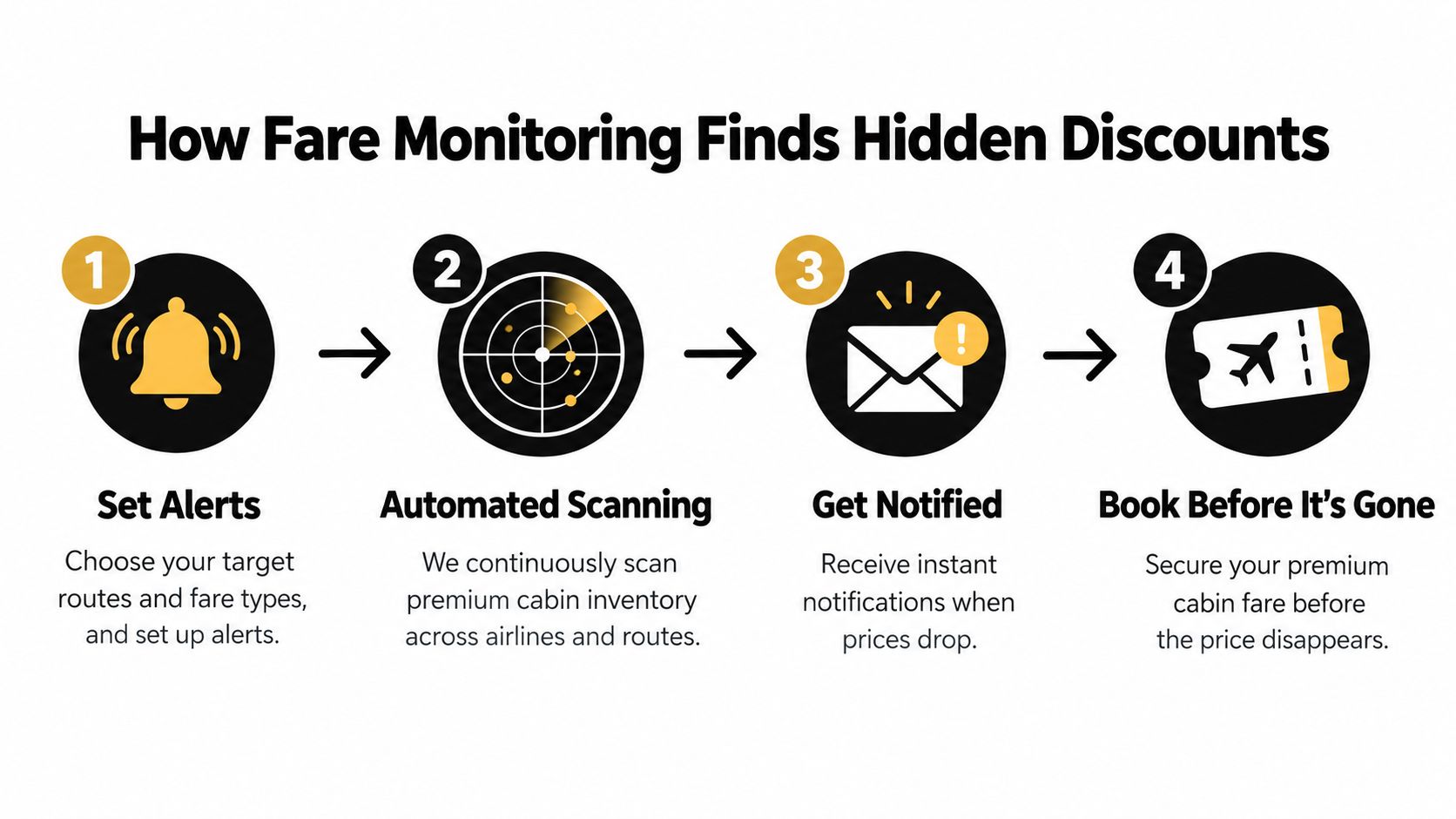
Use a four-part operating rhythm:

  • Set route alerts: Include several viable airport pairs rather than one exact flight.
  • Scan premium inventory: Review first and business fares against coach and against competing carriers.
  • Inspect the notification: Confirm dates, aircraft, connection quality, fare conditions, and total charges.
  • Book decisively: Move when the fare meets your threshold and the itinerary passes your risk review.

Corporate buying rule: A fare alert is useful only when someone has authority to approve and ticket quickly.

Specialized services can combine fare monitoring with market analysis and member guidance. Passport Premiere, for example, tracks international business and first-class fare cycles, surfaces lower-priced premium fares and contract fare combinations from North America, and provides practical resources such as fare-monitor demonstrations and travel news.

The point isn't to chase every drop. It is to distinguish a genuine buying event from a cheap-looking fare with poor routing, restrictive rules, or missing benefits. For companies, document the approval threshold and traveler requirements in advance. For leisure trips, decide whether a lower business fare delivers enough comfort to make first class unnecessary.

Finalizing Your First Class Booking Strategy

A discounted first-class fare only creates value if you execute the purchase correctly. Travelers lose savings by selecting the wrong fare family, overlooking a surcharge, accepting an unsafe self-connection, or paying for premium benefits they don't need.

Use a final review that separates price from usefulness. First, verify the exact aircraft and seat. “First class” can describe very different products across airlines and routes, especially when a carrier sells a reduced fare with fewer inclusions.

Apply the booking checklist

Before payment, confirm:

  • Fare conditions: Check changes, cancellations, refunds, upgrade eligibility, and ticket validity.
  • Cabin continuity: Make sure every long segment is in the cabin you think you're buying.
  • Seat quality: Review the aircraft layout and confirm whether the seat offers the space, privacy, or lie-flat capability that justifies the purchase.
  • Included services: Verify baggage, lounge access, meals, priority handling, and seat selection instead of assuming the fare includes them.
  • Connection exposure: Reject an itinerary whose savings depend on an impractical transfer or unprotected separate ticket.
  • Policy fit: Corporate buyers should confirm the ticket meets approval rules and documentation requirements.
  • Payment and ticketing: Ensure the transaction produces a ticket number and that the itinerary appears correctly in the airline's system.

Don't compare first class only with economy. Compare it with business class, premium economy, and a better-timed coach itinerary. If business class is cheaper than coach on your route, the correct answer may be to book business and preserve cash, not force a first-class purchase because it sounds more luxurious.

Make the process repeatable

Maintain a simple record of routes, dates, observed fares, cabin differences, and booking outcomes. Over time, that record gives you a practical sense of which markets produce useful premium pricing and which consistently demand a premium.

Travel managers should create approved alternatives before monitoring begins. Give the traveler a route range, cabin floor, maximum connection tolerance, and purchase ceiling. That removes delay when a fare drops and prevents a rushed decision based on the first attractive number.

Luxury travelers should make the same distinction between comfort and theater. A premium seat matters most when it improves sleep, privacy, working ability, or arrival readiness. Lounge branding and a polished menu may add value, but they shouldn't justify a fare that fails your personal threshold.

The durable strategy is straightforward: monitor multiple routes, compare every cabin, understand the full fare, and buy when the total value is clear. Points and upgrades remain useful tools, but they belong inside that framework rather than replacing it.


Passport Premiere helps travelers monitor international Business and First Class fares, compare premium-cabin value, and identify fare drops before they disappear. If you're managing corporate travel or planning a long-haul trip, visit Passport Premiere to review its fare-monitoring approach and membership options.

International Timing: Mastering Airfare Strategy

Business class can cost less than coach. A published transatlantic example compares a $1,950 coach total, including bags and seat selection, with a $1,850 discounted business-class fare, making the premium cabin cheaper outright (Passport Premiere's fare analysis). That isn't a pricing error in the usual sense. It's the visible result of airline inventory, demand forecasting, ancillary fees, and international timing colliding at the right moment.

Most travelers treat the economy fare as the market's baseline and assume every premium option must sit above it. That assumption fails because airlines don't price cabins as a simple ladder. They manage each inventory pool for a different customer, and those pools can move in opposite directions. The practical question, therefore, isn't whether business class normally costs more. It's whether the price gap still reflects the airline's current demand for the empty premium seat.

Understanding the Premium Cabin Paradox

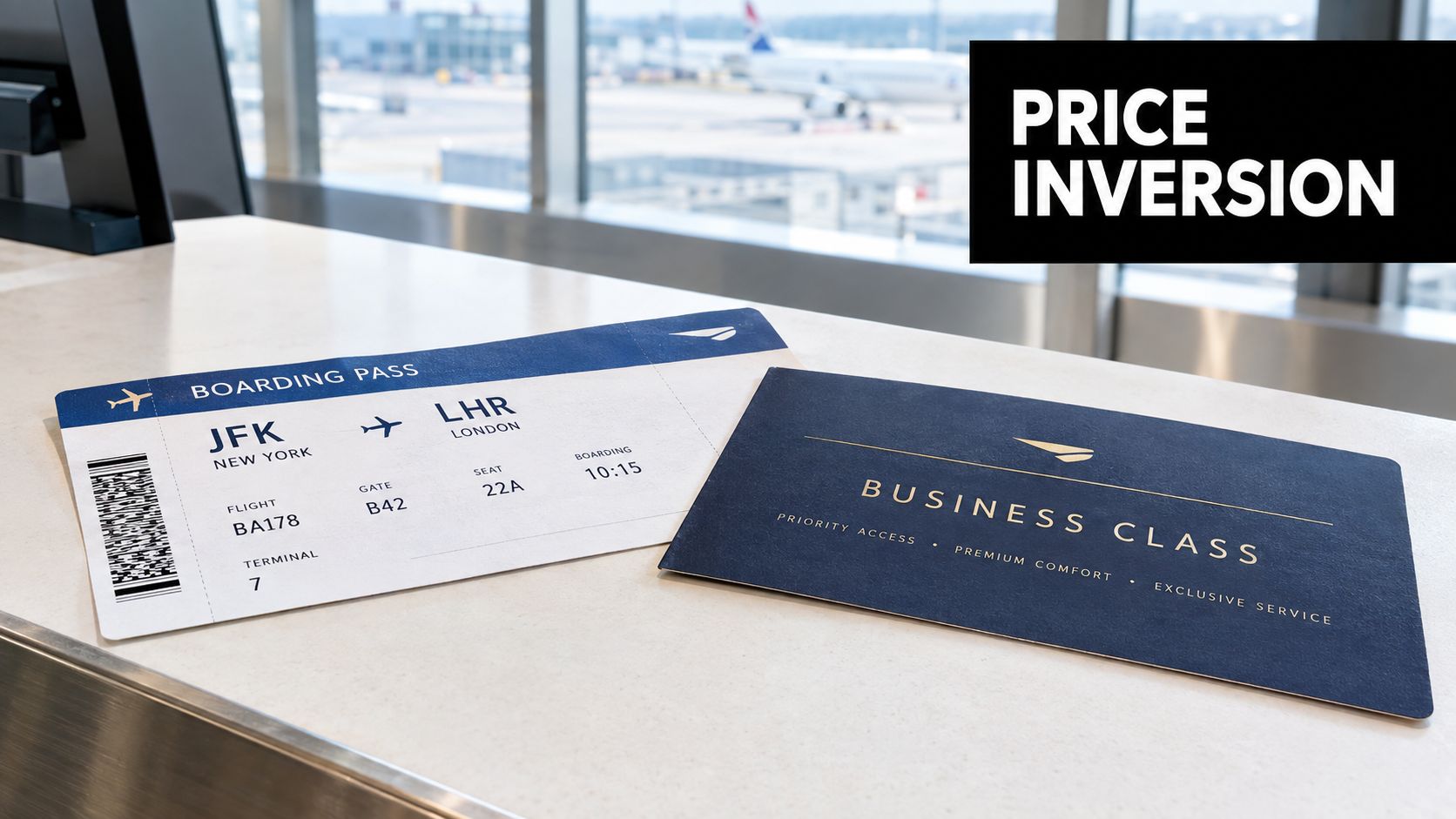
The price inversion paradox occurs when a business-class fare falls below the total cost of an economy itinerary. It sounds rare because travelers usually compare headline fares, not the full transaction. Coach may carry separate charges for baggage, seat selection, or other services, while a discounted premium fare can bundle more of the journey into one price.

Passport Premiere states that fewer than 15% of premium-cabin seats are sold at their initial asking price. That point changes the way a buyer should interpret the first fare displayed in a search result. The opening price is a market signal, not necessarily a reliable valuation of the seat.

A boarding pass for a Business Class flight from JFK to London sitting on a counter.

Why the cabin ladder breaks

Airlines sell economy seats to a broad mix of leisure and price-sensitive travelers. Premium cabins depend more heavily on customers who value schedule, flexibility, status, or comfort, including corporate travelers and long-haul leisure passengers. Those customers don't arrive at the same time, and their willingness to pay can change sharply as departure approaches.

A carrier may protect business-class inventory early because it expects high-yield demand later. If that demand doesn't materialize, the airline has an empty seat that can't be stored for another flight. A late fare reduction can then make commercial sense, even if the lower price appears to undermine the cabin hierarchy.

Practical rule: Treat the empty premium seat as perishable inventory, not as a luxury product with a permanent price premium.

Airfare behaves like a volatile asset

The analogy to an asset class is useful, with one limitation. A flight seat has no resale value after departure, so the airline must continually adjust its price before the asset expires. Demand forecasts, competitive fares, seasonality, corporate traffic, and remaining inventory all influence the adjustment.

This is why a traveler who accepts the first listed business-class fare may overpay, while a traveler who monitors the route can encounter a correction. The correction won't appear on every itinerary, and it isn't guaranteed to persist. But it is structurally possible, which makes international timing more valuable than a simple “book economy early” rule.

The executive takeaway is straightforward: compare total trip cost by cabin, monitor the route's behavior, and define a purchase threshold before emotions or urgency take over. Business class cheaper than coach is an outcome to test for, not a claim to assume.

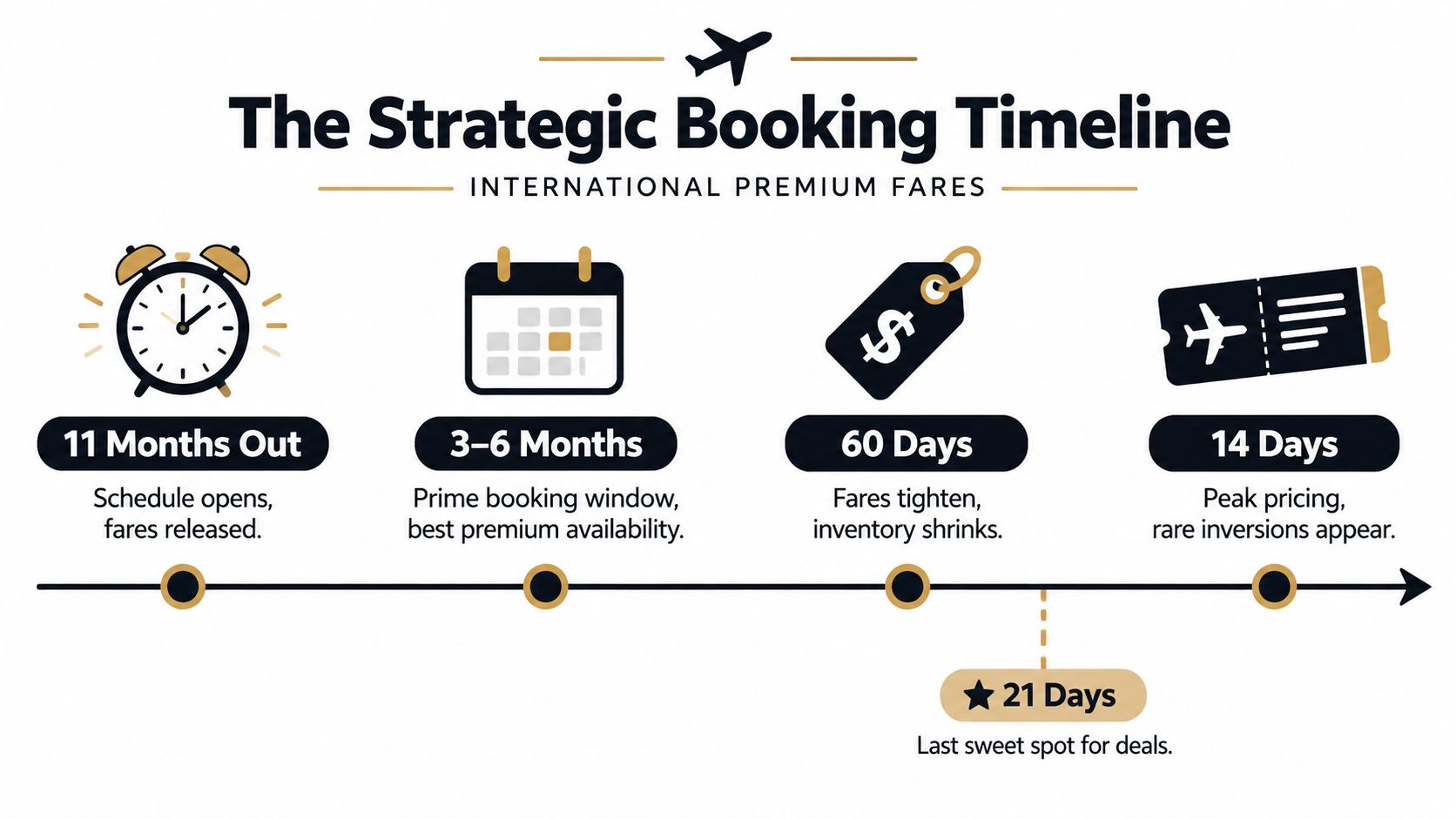
The Strategic Booking Timeline

Premium fares reward a calendar-based process rather than a single search session. Independent travel guidance places a practical booking band at roughly 2 to 8 months before departure, with business and first class often performing best in the 3 to 8 month range (premium booking timing guidance). Airlines can load inventory roughly 330 to 361 days in advance, but the cheapest premium booking classes may appear later as demand becomes clearer.

Start with the early loading phase

When a schedule first opens, the airline makes seats available and establishes an initial pricing structure. That phase is useful for understanding dates, routing, and baseline availability, but it isn't automatically the right moment to buy. A traveler with fixed dates or an important corporate commitment may value certainty more than a possible fare correction.

Use the early phase to record:

  • Schedule options: Identify nonstop and connecting itineraries, nearby airports, and acceptable departure times.
  • Cabin availability: Check whether business class is present across the dates you could use.
  • Price context: Save the fare without treating it as the route's final value.

The point is to build a reference, not to chase a low price that hasn't appeared.

A strategic timeline infographic showing the best time to book international premium airline fares in advance.

Monitor the demand-testing phase

The middle of the cycle is where monitoring becomes most useful. The 3 to 8 month window gives the airline time to observe bookings while leaving room for premium inventory to be repriced. Route-specific conditions still matter, so a broad rule should become a watchlist with clear decision boundaries.

Set a target that reflects the complete trip, not only the base fare. Compare the same itinerary in economy and business class, include unavoidable extras, and note whether the fare has change or cancellation restrictions. A lower fare with severe limitations may not offer the same business value as a slightly higher flexible ticket.

Decide during the inventory-release phase

The period closer to departure requires discipline. McKinsey reports that, at one large U.S. airline, about half of premium seats were booked more than 21 days before departure, reflecting early leisure demand (McKinsey analysis of premium cabins). That means waiting can expose you to shrinking inventory, even though it may also create a final opportunity for a correction.

A sensible operating rule is to monitor actively through the broader 2 to 8 month range, become more decisive around the route's observed low points, and avoid relying on a last-minute rescue. The closer you get to departure, the more important flexibility becomes, because the remaining seats may be scarce even when a temporary deal appears.

Economics of Dynamic Pricing Models

Airline pricing looks chaotic to passengers because different cabins respond to different demand signals. Economy fares often react visibly to search demand, remaining seats, travel dates, and competitive activity. Premium fares also change dynamically, but carriers manage them through a separate yield strategy shaped by corporate contracts, seasonal expectations, and the risk of losing high-value customers.

The central mistake is comparing the cheapest economy bucket with the most expensive business bucket, then concluding that the cabin difference is permanent. A better comparison asks how each inventory pool is behaving at the same moment.

Economy behavior Premium-cabin behavior
Responds strongly to broad leisure demand Responds to premium demand, corporate patterns, and cabin availability
Can become expensive when low fare classes disappear Can remain high while the carrier protects inventory
Total cost may rise through bags and seat fees A reduced fare can narrow or reverse the cabin gap
Price pressure is often visible in headline searches Corrections may require route monitoring and timing

Why late economy can hurt

A traveler buying late may encounter a nearly full coach cabin, especially on a popular international departure. The remaining economy seats can sit in expensive fare classes, while the carrier still has unsold premium seats that need a different solution. Those two conditions can coexist without contradicting the airline's revenue strategy.

The result is counterintuitive. Coach becomes expensive because its discounted inventory has disappeared, while business class becomes comparatively attractive because the airline wants to stimulate premium demand. The fare difference isn't a statement about comfort. It reflects separate inventory decisions.

For a useful vocabulary primer, this explanation of dynamic airline pricing helps frame fares as changing inventory categories rather than fixed product prices.

A correction isn't the same as a bargain

A genuine correction should survive a basic audit. Check the exact itinerary, baggage rules, connection, fare conditions, and ticketing deadline. Then compare the fare with nearby dates and alternative airports. A displayed reduction may reflect a restrictive class, a different routing, or a temporary filing that disappears before payment.

A low premium fare matters only after the traveler verifies that the ticket solves the same transportation problem as the cheaper-looking coach option.

The economic logic is therefore less about predicting a universal lowest day and more about recognizing when the two cabins have become misaligned. That's the moment international timing can turn a premium upgrade into a rational purchase.

Fare Wars and Market Corrections

A fare war begins with competition, but it ends in an inventory decision. When multiple carriers serve the same international corridor, each airline must defend its schedule, connecting network, and share of high-value travelers. A premium fare reduction can attract bookings without forcing the carrier to lower every economy price on the route.

This is why a business-class sale isn't necessarily an act of generosity. The airline may be trading some yield per seat for a better chance of filling capacity. An empty business-class seat produces no revenue after departure, so a targeted discount can be preferable to preserving a published price that few customers will pay.

What creates the opening

Several conditions can produce a correction:

  • Overestimated premium demand: The carrier protected seats for corporate or event traffic that doesn't arrive at the expected level.
  • Competitive pressure: Another airline introduces a more attractive premium offer, forcing a response.
  • Uneven seasonal demand: Economy remains active while premium demand softens, or the reverse.
  • Network imbalance: A connecting itinerary has unsold premium capacity on one segment and needs stimulation.

These conditions don't guarantee that business class will undercut coach. They explain why the possibility exists and why route monitoring is more productive than relying on a fixed booking myth.

The timing signal is relative

A traveler shouldn't ask only whether a business fare is “cheap.” The stronger question is whether the premium fare has weakened relative to its own recent behavior and relative to the complete economy alternative. That comparison captures both airline strategy and the buyer's actual cost.

The most useful signal can be a narrowing cabin gap rather than an absolute price floor. If economy rises because its lower inventory is gone while business remains stable, the premium cabin may become the better value without any dramatic business-class sale. If business drops while coach remains steady, the inversion becomes more obvious.

A fare war also has an expiration risk. Once bookings accelerate, the airline can close discounted inventory and restore higher fare classes. Buyers need a purchase rule before the correction appears, such as a maximum acceptable total, an acceptable connection, and a deadline tied to their travel purpose.

The non-obvious conclusion is that competition can create a premium opportunity even for travelers who aren't loyal to a particular airline. A carrier doesn't need to offer the lowest economy fare to win the price-sensitive customer. It can instead use a targeted premium filing to capture someone who compares total value across cabins.

Case Studies in Price Inversion

The clearest evidence comes from itinerary-level comparisons. On one published last-minute transatlantic example, the coach total reached $1,950, made up of a $1,700 fare, $150 in bags, and $100 for a seat, while discounted business class cost $1,850 (documented business-class price inversion). The premium cabin was therefore cheaper by $100 after ancillary charges.

The lesson isn't that every traveler should wait until the final days. It's that the headline coach fare can conceal the actual cost of choosing economy. A business-class comparison becomes financially rational when it includes the services the traveler would otherwise purchase separately.

A scenic view of a sunset over the ocean seen through an airplane window while flying.

A transatlantic decision

A leisure traveler with flexible departure dates might search a transatlantic route and see a coach fare that looks acceptable at first glance. After adding a checked bag and preferred seat, the total moves closer to the available business fare. The rational decision then depends on more than cabin prestige.

Business class may provide a better financial trade if the traveler values the included services, lounge access, onboard work environment, or ability to arrive rested. The fare comparison also needs to account for restrictions, because a cheaper premium ticket can still be inferior if it cannot be changed when plans are uncertain.

An Asian corridor near departure

A separate analysis describes a Tokyo to Singapore example in which close-in business-class fares can fall into the $1,900 to $2,600 range (last-minute premium fare analysis). The same source identifies the 7 to 21 day pre-departure period as a window in which carriers may try to clear unsold premium seats.

That window creates opportunity and risk simultaneously. A traveler with flexible dates may find a meaningful correction, but a traveler with fixed dates could discover that the remaining inventory has disappeared instead. The practical response is to monitor before the final window and buy when the fare meets the trip's predefined value threshold.

Award pricing can invert too

Cash fares aren't the only setting where the cabin hierarchy breaks. The Points Guy describes a case in which a traveler saved 32,000 Delta SkyMiles by booking first class instead of coach on New York-JFK to Orlando-MCO, while also discussing international scenarios where business-class cash fares can equal or beat economy (award and cash fare inversion example).

That example widens the analysis. Travelers should compare the redemption cost, taxes, fees, and availability of each cabin rather than assume coach always offers the better use of points. In both cash and award markets, the correct question is the marginal cost of moving into the premium cabin.

The Value of Specialized Intelligence

Airlines know their own inventory position, competitor filings, booking pace, and revenue targets. Individual travelers see only the fares exposed through a search at a particular moment. That information asymmetry makes timing difficult, especially for executives who need a reliable decision process rather than repeated manual searches.

Specialized monitoring can reduce the workload by turning a moving fare market into a set of signals. The useful output is not merely “business class is available.” It's whether a route appears weak, whether a lower fare may emerge, and whether the observed price is attractive compared with the full economy alternative.

Screenshot from https://www.passportpremiere.com

From raw volatility to a decision

A corporate travel manager can use a monitoring service to define preferred routes, cabin requirements, acceptable connections, and purchase limits. A frequent consultant can separate trips that require flexibility from trips where a temporary fare reduction justifies immediate commitment. A leisure traveler can monitor a destination without guessing whether the current price reflects a real correction.

Passport Premiere combines fare monitoring and market analysis, and its business-class fare alerts are designed to surface premium fare opportunities. Its Fare Monitor also provides a daily progress report when lower fares are anticipated at a future date, according to the publisher's product description.

What intelligence should answer

A useful alert or analyst should help resolve four practical questions:

  • Is the fare actionable: Can the traveler book it now under the required conditions?
  • What is the comparison point: Does it beat the complete economy cost or only the base fare?
  • How much flexibility is required: Can the traveler accept a nearby date, airport, or connection?
  • What could invalidate the signal: Are seats disappearing, restrictions severe, or ticketing rules tight?

The value lies in compressing observation time and improving the quality of the decision. It doesn't eliminate uncertainty, and no service can guarantee that a lower fare will appear. It can, however, help a buyer avoid treating the airline's first quoted price as the final word.

For companies, that distinction has operational value. A repeatable process makes premium travel budgets easier to govern because travelers can document why they bought, what alternatives they compared, and which conditions triggered the decision.

Mastering Your International Travel Timing

International timing works best as a controlled buying process:

  1. Start early enough to observe: Use the broad 2 to 8 month range as the monitoring horizon, with particular attention to the 3 to 8 month premium window.
  2. Compare complete costs: Add baggage, seat selection, and other unavoidable economy charges before judging the cabin gap.
  3. Track relative movement: Look for a business fare that weakens against its own route history or approaches the total economy alternative.
  4. Respect inventory risk: Premium seats can sell early, so waiting for a last-minute inversion is a tactical gamble, not a default strategy.
  5. Use informed triggers: Decide in advance what fare, routing, flexibility, and cancellation terms justify purchase.

The deeper conclusion is that business class cheaper than coach isn't a contradiction. It's a market outcome created when cabin demand, inventory protection, competitive pressure, and ancillary fees stop moving in parallel. Travelers who recognize that structure can make premium comfort a measured financial choice rather than an indulgence bought at the first displayed price.

For broader planning beyond premium-cabin monitoring, these international flight savings tips offer useful context on comparing routes, dates, and booking decisions. The strongest strategy combines that general discipline with route-specific observation and a clear threshold for action.


Passport Premiere offers fare monitoring and market analysis for travelers seeking international Business and First Class fares at lower prices, including opportunities where premium fares can approach or undercut coach totals. Visit Passport Premiere to review how its Fare Monitor and member insights can support a more disciplined international timing strategy.

Is Business Class Worth It? a Real Cost-Benefit Guide

The most popular advice about business class is also the least useful: compare the cheapest economy ticket with the most expensive business fare, then call the upgrade a waste of money. That comparison answers the wrong question. Business class can sometimes be cheaper than coach, but only when airline pricing becomes distorted. The normal relationship is still heavily tilted toward economy, with KAYAK listing typical global averages of about US$868 for international economy versus US$4,227 for international business (KAYAK's fare guide).

The sharper question is this: when is the published business fare inflated enough that a discount changes the entire calculation? That depends on the route, the departure date, your need for sleep, the value of your arrival-day time, and whether the airline is carrying unsold premium inventory. This guide gives you a practical way to decide instead of relying on the lazy “business is worth it for long flights” rule.

The Question Most Travelers Ask Wrong

Airlines don't price business class as a simple comfort upgrade. They price it as a high-yield product, and premium cabins now contribute disproportionately to airline revenue. McKinsey reports that between 2019 and 2025, business-class and first-class cabins across several major markets contributed a growing share of passengers and an even faster-growing share of revenue, while IATA says premium fares contribute about 15% of passenger revenue excluding ancillary income despite occupying a much smaller share of seats (McKinsey's premium-cabin analysis).

That structure creates a misleading comparison. A traveler sees a discounted economy fare beside a protected, high-yield business fare and concludes that the front cabin is irrational. Often, the traveler is right about that specific fare. But the conclusion doesn't apply to every business-class ticket, because airlines don't always sell premium seats at the initial asking price.

List price isn't the same as market value

A University of North Carolina paper on airline revenue management found an economy-to-premium seat ratio of about 11 to 1 across operated flights, with both cabins averaging just above 80% load factor at departure in the study dataset. Average premium fares were about $379, compared with $184 for economy, making the premium fare roughly 106% higher in that sample (the UNC revenue-management paper).

The implication is important. Airlines may have fewer premium seats, protect them for high-yield buyers, and still depart with some of them empty. An empty seat has no value after takeoff, but the carrier may prefer to leave it unsold rather than train customers to expect permanent discounts. When demand softens, fare events, competitive pressure, or inventory changes can force the airline to accept less.

The real buying decision: don't ask whether business class is worth the full published price. Ask whether the current premium is reasonable for this flight, this traveler, and this arrival schedule.

That turns a binary debate into an ROI decision. A rested executive flying overnight to a board meeting has a different threshold from a leisure traveler on a daytime hop. A consultant who can bill after landing has a different calculation from a family that wants a more comfortable holiday flight.

What Business Class Actually Buys You

Business class earns its price through space, sleep, and reduced friction, not through a better meal. On long-haul aircraft, business-class seat pitch commonly ranges from about 55 to 80+ inches, and many layouts convert into fully flat beds. Economy commonly offers about 28 to 32 inches of pitch and a shallow recline, according to this seat-pitch comparison.

That difference changes what you can do with the flight. In economy, an overnight sector often becomes a negotiation with your neck, knees, and the passenger in front of you. In business, a lie-flat seat can turn the same cabin time into usable sleep. The benefit isn't “more luxury” in the abstract. It's the possibility of arriving functional rather than spending the first day recovering.

Evaluate the seat by its output

A lie-flat bed matters most when the flight overlaps your normal sleep window. Direct aisle access matters when you need to work, use the lavatory, or leave your seat without disturbing another passenger. A wider surface and a laptop-friendly table matter if the alternative is losing productive hours before an important meeting.

The best test is practical:

  • Sleep: How many hours can you realistically sleep or rest in a flat position?
  • Work: Can you prepare, write, or take calls without fighting for elbow room?
  • Arrival: Do you need to perform immediately after landing?
  • Recovery: Will economy force you to lose part of the next day?

Lounge access belongs in the same calculation. Treat it as a productivity surface, not a champagne entitlement. A quiet seat, reliable power, food, Wi-Fi, and a shower can reduce airport fatigue before a long flight, especially when you're traveling for work. Fast-track security, dedicated check-in, and priority baggage matter only if they reduce stress or protect a tight schedule.

Use the three-output test

Before paying, estimate the outputs you need:

  1. Hours of sleep gained, especially on an overnight route.
  2. Hours of billable or decision-critical work protected on arrival day.
  3. Hours of recovery avoided, including lost meetings, reduced concentration, or a wasted first vacation day.

A business seat can be materially better than economy and still be a poor purchase. The product delivers the most value when it protects one of those outputs. If you're flying for three hours in daylight and have no work obligation afterward, much of the business-class package becomes expensive theater.

For a closer look at the feature that usually drives the decision, compare the practical differences in business-class lie-flat seats. The question isn't whether the seat looks premium. It's whether the seat changes what you can do after landing.

The Hourly Value of Rest and Productivity

The cleanest way to decide is to price the time business class protects. Start with the fare premium, not the total ticket price. If economy costs $900 and business costs $2,100, your decision concerns the $1,200 difference, not the full $2,100.

Use this formula:

Breakeven value = recovered sleep hours × hourly value + protected arrival-day work + avoided recovery cost

For a self-employed traveler, hourly value may be close to a billable rate. For a salaried employee, it may be better represented by the value of a meeting, a decision, or a day of usable output. Don't pretend every hour of sleep converts directly into cash. Assign a conservative value and see whether the fare still clears the test.

A worked overnight example

Consider a New York to London redeye. Suppose you estimate 6 hours of usable sleep in business versus 2 hours in economy, giving you 4 recovered hours. If your billable rate is $150 per hour, those recovered hours represent $600 in potential value.

Now add the protected work window. If you have a same-day meeting and business class lets you prepare, participate, and follow up without losing the morning, you might assign an additional value based on your role. The fare premium becomes rational only when the total of recovered sleep, protected work, and avoided recovery exceeds the extra cost.

The calculation changes sharply by traveler:

  • Self-employed consultant: A direct connection between recovered capacity and billable work can make a premium defensible.
  • Salaried employee: Salary alone doesn't justify the fare. The meeting's importance, company policy, and expected output matter more.
  • Leisure traveler: The value is personal rather than financial. You may still buy business, but call it a comfort purchase, not an ROI purchase.

Cost-per-hour-saved breakeven on overnight long-haul

Variable Value Notes
Usable sleep in business 6 hours Example assumption for the calculation
Usable sleep in economy 2 hours Example assumption for the calculation
Sleep recovered 4 hours Difference between the two assumptions
Hourly value $150 Example billable rate
Sleep value $600 4 hours multiplied by $150
Breakeven premium Depends on arrival-day value Add protected work and avoided recovery

A short daytime flight almost never clears this threshold because the seat doesn't protect enough sleep or productive time. For comparison, people who outsource airport transfers can use an hourly luxury car when ground-time efficiency has a clear value. The same principle applies in the cabin: pay for time protection when you can identify what that time is worth.

Who Gets the Most Out of Premium Cabins

The strongest business-class buyer isn't necessarily the wealthiest traveler. It's the person whose itinerary turns fatigue into a measurable cost.

An infographic analyzing the value of premium airline cabins for corporate VPs, consultants, and luxury leisure travelers.

The corporate VP

A VP flying JFK to Tokyo for a Monday board meeting has a narrow decision. The fare matters, but the bigger issue is whether the traveler can arrive, shower, review the agenda, and make high-stakes decisions without spending the morning recovering.

For this profile, business class is strongest on an overnight itinerary with a meeting soon after arrival. The company shouldn't approve it because the cabin looks impressive. It should approve it when the arrival-day performance risk is higher than the fare premium.

A weekday schedule can also matter. A lower-demand departure may provide a more defensible premium fare than a peak return, especially when the airline is trying to fill protected inventory.

The consultant

The consultant flying between London, Singapore, and other client cities has a different equation. The cabin functions as a portable office and recovery room. A lie-flat seat may protect preparation time before a client session, while lounge access gives the traveler a controlled place to work between airport and aircraft.

This traveler should track the premium against the number of long-haul sectors in the schedule. A single expensive upgrade may be indulgent. Repeated overnight flights can turn small productivity losses into a recurring operating cost. The consultant should also distinguish between time that can be billed and time that merely feels more pleasant.

The luxury leisure traveler

A leisure traveler flying to Singapore may not have a business case at all. The reason to buy can be the experience: a flat bed, a quieter cabin, a better start to the trip, and less exhaustion on arrival. That's a valid purchase, but the traveler shouldn't disguise it as financial efficiency.

Pleasure is a legitimate reason to fly business. It just needs a pleasure budget, not a fabricated productivity calculation.

The attributes that predict strong value are consistent across profiles:

  • Overnight timing: The flight overlaps sleep.
  • Long distance: Economy fatigue has more time to accumulate.
  • Immediate obligations: A meeting, event, or first-day itinerary starts soon.
  • Flexible dates: You can avoid the most expensive departure and return patterns.
  • Discount access: The premium has fallen enough to match the trip's value.

Watch the video below for another visual perspective on the business-class decision.

Sample Fare Gaps on Real Long-Haul Routes

Business class is rarely worth its published premium. The better question is whether that premium has been inflated by demand, then cut far enough for the trip's value to justify buying it. Route snapshots without a travel date, airline, fare rules, and live inventory can mislead, so compare market relationships rather than invented prices.

KAYAK's global baseline, cited earlier, places typical international economy around US$868 and business around US$4,227, a gap of roughly US$3,359 per ticket. Independent analysis found business class averaging 250% more than economy across a sample of routes (Holidu's business-class fare analysis). That spread is the starting point, not a verdict. A discounted business fare can change the calculation completely.

A defensible route comparison

Route Economy (Shoulder) Business (Shoulder) Business/Economy Multiple Peak Premium Markup
New York to London Varies by date and fare rules Varies by date and fare rules Often materially above economy Can widen sharply on peak departures
Los Angeles to Tokyo Varies by date and fare rules Varies by date and fare rules Long-haul premium usually substantial Demand and aircraft product matter
Chicago to Frankfurt Varies by date and fare rules Varies by date and fare rules Discount events can compress the gap Business demand can rise around work travel
Sydney to Los Angeles Varies by date and fare rules Varies by date and fare rules Ultra-long-haul comfort can command a large spread School holidays and peak returns can inflate fares

The table avoids false precision. A single route price says little without the aircraft, cabin layout, connection, fare basis, and departure date. Judge the fare against the normal relationship for that city pair, then ask whether the compressed premium buys meaningful sleep, usable work time, or a better arrival.

Why the ratio moves

Airlines can price a Tuesday departure far below a Friday return because demand differs. A fare war may compress business class on one route, while a high-demand weekend keeps the forward cabin expensive. Flexible dates give you access to those gaps. Passport Premiere's business-class flight comparison can help compare the complete itinerary, including aircraft, seat layout, connection risk, baggage, lounge access, and change conditions.

Timing matters as much as the route. Watch for fare events before assuming the cabin is unaffordable, then compare the discounted fare with the cost of arriving exhausted or losing productive hours. A cheap business ticket with a poor connection can still lose to a slightly higher nonstop that protects sleep. The published fare is only the headline. The decision that matters is the price after the market has exposed its weakness.

Why Business Class Can Sometimes Beat Coach on Price

Business class can appear cheaper than coach, but the crossover is an exception created by fare mechanics, not the normal airline model. Skyscanner illustrates the usual relationship with an Air Canada example from Vancouver to Singapore: business started at about C$5,700, while economy started at C$425 on the same day (Skyscanner's business-class fare guidance).

The rare opposite result usually comes from mismatched fare buckets. A restricted economy fare may sell out, while a promotional business fare remains available. A carrier can then display business below that particular economy option, even though business remains above the broader economy market.

The empty-seat problem

Premium cabins aren't always full at the price airlines first publish. An industry analysis reported Emirates premium-cabin load factor at about 73% or higher in recent years, while revenue-management commentary describes airlines protecting high-yield premium inventory rather than discounting aggressively (Skift's premium-cabin analysis).

That creates a narrow opportunity. A carrier might hold a business seat at a high price while demand remains strong, then release lower fare inventory when the departure approaches and the seat still hasn't sold. The traveler sees a sudden price change, but the airline sees an inventory decision.

Other triggers can produce the same effect:

  • Fare wars: Competing airlines cut premium fares to defend a route.
  • Schedule changes: A revised timetable leaves flat-bed inventory on a less attractive departure.
  • Contract releases: Corporate seat blocks return to public inventory after booking patterns change.
  • Connecting-market pressure: The airline adjusts premium pricing to support broader network demand.

A price that is lower than one economy option still requires scrutiny. Check whether the business fare includes the same direction, dates, baggage, connection, and change conditions. The comparison must be like for like.

Advance-purchase rules can also affect the result, so review advance purchase excursion fares before assuming a displayed price is a genuine market anomaly. Timing alerts generally outperform static searches because a fare event may last only until the airline closes that inventory bucket.

When Business Class Pays Off and When to Skip It

My recommendation is simple: buy business class for protected performance, not vague comfort. The exception is a fare event that makes the premium small enough that comfort becomes a reasonable bonus.

The airline economics support discipline. McKinsey and IATA data show why premium seats command attention from carriers, while the UNC research shows why the average premium fare can be materially higher than economy. You shouldn't fight that pricing structure by paying whatever the first search result demands.

Use this decision table

Scenario Recommendation Fare Gap Trigger Passport Premiere Edge
Overnight long-haul, executive billing $300+ per hour Book if arrival-day performance matters Under $1,200 one-way is a strong starting threshold Surface fare events when premium inventory softens
Transcontinental hop under four hours Usually skip Skip when the flight is under three hours or daytime Compare only when the product materially changes the itinerary
Family leisure vacation under six hours Usually skip Skip when there are no work or sleep obligations Watch for an unusually low premium spread
Ultra-long-haul economy itinerary Consider business carefully Buy when a discount makes the premium fit your comfort budget Track changes instead of accepting the initial asking price
Same-day meeting after an overnight flight Strong case for business The fare can clear if it protects preparation and recovery Help identify when the published gap has compressed
Leisure trip with no schedule pressure Buy only for pleasure Skip when the premium exceeds your personal comfort budget Give you a market reference before purchasing

The $1,200 one-way trigger is not a universal law. It's a practical discipline point for a traveler who can attach real value to sleep and arrival-day work. A fare premium above $2,500 demands a much stronger reason, such as an unusually important meeting, an ultra-long sector, or a deliberate luxury purchase.

Don't confuse a cabin decision with broader travel-budget control. Corporate teams comparing approval thresholds, traveler productivity, and policy exceptions may also benefit from reviewing Snyp travel expense management as part of their travel-spend process.

Passport Premiere monitors premium fare movements, analyzes fare events, and helps travelers identify when business-class inventory is priced below its usual market relationship. Use it as a timing aid, not as permission to buy every discounted seat. The correct outcome may still be economy or premium economy.

Your final rule should be blunt. Skip business on short daytime flights, flexible leisure trips, and any itinerary where the fare premium is larger than the value of your arrival. Buy it on overnight long-haul routes when sleep protects work, when the fare gap has compressed, or when the experience itself is worth the money to you.


Passport Premiere tracks international business and first-class fare events so you can judge whether a premium price is inflated or genuinely attractive. Visit Passport Premiere to monitor discounted premium inventory and make your next cabin decision with a fare target instead of guesswork.

Carrier Imposed International Surcharge: Full Guide

Carrier-imposed international surcharges can add $500 to $1,500+ to a single transatlantic business-class ticket, and on some itineraries they're the largest invisible part of the price. A quote that looks like a $3,200 fare can hide a very different total once the airline's own YQ or YR charges are layered in.

Business class can look expensive right up until the surcharge line is added to coach, then the gap narrows fast or even flips. That's why the comparison is never just base fare versus base fare, it's the full ticket total.

What Carrier Imposed International Surcharge Really Means

Carrier-imposed international surcharge can change the economics of an international ticket as sharply as a fare sale. Airlines add YQ or YR charges to the base fare, separately from government taxes, so the visible fare may conceal a substantial part of the amount payable at checkout.

An infographic explaining the components of airline ticket pricing, including base fare, carrier-imposed surcharges, and government taxes.

The mechanism emerged from the early 2000s fuel shock and later became a permanent pricing tool. Industry summaries place the practice's expansion around 2004. It has since become partly decoupled from actual fuel costs, allowing a surcharge to remain high even when fuel prices no longer explain the full amount Navan's explanation of fuel surcharge history and pricing behavior.

What it looks like in a real fare

A New York to London itinerary cited in public reporting illustrates the structure: a $1,012 base fare, a $320 carrier-imposed surcharge, and $225 in taxes and fees Delta's published taxes and fees page. The traveler who compares only the headline fare is therefore measuring the wrong cost.

The surcharge also changes the premium-cabin decision. Economy tickets on transatlantic routes often carry about $100 to $200 in YQ or YR, while premium cabins can exceed $500 per direction Navan's surcharge guide. For executive travel programs, that difference affects budget forecasts, approval limits, and whether a business-class quote is a premium at all.

The timing matters because airlines can adjust the surcharge independently of the base fare. A lower advertised fare may therefore be offset by a higher carrier charge, while a surcharge reduction can produce savings comparable to a fare promotion. Compare both components across the same itinerary and booking date.

Practical rule: If the quote does not show the surcharge separately, the comparison is incomplete.

Teams arranging executive air travel solutions should review the full fare before approving a booking. The objective is straightforward: identify the airline-controlled cost, compare it across options, and commit funds only after the total ticket price is visible.

How YQ and YR Fees Appear on Your Fare Breakdown

YQ and YR are airline-controlled charges, not government taxes. That distinction affects both accounting and fare comparisons. Airlines must identify these amounts clearly so travelers can distinguish carrier pricing from government-collected taxes, as outlined in DOT compliance guidance on fee and tax display.

How to read the line items

YQ usually reflects fuel-related surcharge logic. YR can cover other carrier-imposed costs, including distribution, environmental, or operating expenses. The labels do not create a universal allocation rule, because each airline decides how to structure and apply its charges. Two tickets on the same route can therefore have comparable base fares but materially different totals.

The surcharge line also acts as a market signal. Airlines can change it independently of the advertised fare, so fare shopping that ignores YQ and YR can miss a cost change comparable to a sale on the base ticket.

For corporate buyers, coding matters. A surcharge is not a tax. Misclassifying it can distort expense reports, weaken route comparisons, and hide how much of the price comes from airline-controlled charges.

What to check before approving a fare

  1. Look for YQ and YR separately. If the fields are absent, the airline may have bundled the charge into the fare, making its pricing decision harder to assess.
  2. Scan for government agency names. Government taxes typically identify a country, airport, or regulator. Carrier surcharges do not.
  3. Compare the complete ticket total. A lower base fare can still produce the higher price after YQ or YR is added.
  4. Read the refund language before ticketing. In practice, some carriers treat surcharges differently from the base fare on refunds, so flexibility can cost more than the seat itself.

A fare breakdown is a pricing record, not a formality. Review the surcharge line alongside the base fare, taxes, itinerary, and refund conditions before approving the ticket. That process shows whether a quoted saving is genuine or only offset by an airline-controlled charge.

Why 2026 Surcharge Moves Matter Now

Carrier-imposed surcharges now operate as a separate pricing signal. Airlines can raise or reset them while the advertised fare stays unchanged, so the right booking window can matter as much as a base-fare sale. In 2026, Air India introduced international surcharges as high as $280 per leg on North America and Australia routes, Cathay Pacific doubled its long-haul levy to about HK$1,560, Korean Air tripled its international fuel surcharges, and Thai Airways adjusted Japan-origin charges for tickets issued in 2025, according to Travel Market Report's 2026 surcharge roundup.

The Asia-Pacific signal is especially loud

Korean Air's September 2026 surcharge tier was described as a seven-tier jump in a single month. One-way charges ranged from roughly 36,200 won to 451,400 won, depending on distance and cabin context. For a travel manager, that is a ticketing variable, not background noise. A fare that looks competitive in the morning can carry a materially different total after a surcharge reset.

Japan-origin tickets show how deliberately these fees are structured. ANA applies the surcharge to adults, children, and seated infants, refunds it on unused refundable tickets, and recalculates it using the prior two-month average Singapore kerosene price. United's 2026 schedule follows the same two-month pattern, with fees as high as ¥65,000 one-way on Japan to U.S. routes for tickets issued in July to August 2026, then ¥55,000 for tickets issued in September to October 2026. The schedule details are reproduced in Air Canada Japan's fuel surcharge update, which reproduces ANA and United schedule details.

Carrier Route Surcharge Change Impact Level
Air India North America and Australia Up to $280 per leg High
Cathay Pacific Long-haul About HK$1,560 after doubling High
Korean Air International Tripled, with a seven-tier jump in one month Very high

Why buyers should care now

The practical question is not only today's surcharge. It is whether the charge is moving before ticketing, particularly on premium cabins where a surcharge increase can erase savings found through base-fare shopping. Corporate programs should compare the complete ticket total across booking dates, not just the fare displayed first.

A discounted fare can therefore conceal a higher trip cost if the airline-controlled surcharge changes during the same purchase window. Surcharge timing deserves its own tracking alongside fare availability.

Business Class vs Coach After Surcharges Are Added

Coach is not automatically the lower-cost choice once carrier-imposed surcharges enter the comparison. A 2026 airfare guide gives an urgent cross-country example of about $850 for business versus $1,200+ for flexible last-minute economy, plus a last-minute international example of about $2,100 for discounted business versus $2,500+ for full-fare coach Passport Premiere's 2026 cost examples.

An infographic comparing the value of business class versus coach airline seats after surcharges are added.

Why the paradox happens

Airline pricing separates the cabin product from the market conditions around it. Fare buckets can shift, premium demand can soften, and route competition can force business-class prices down while flexible economy remains expensive. A July 2024 explainer reported that first-class or business-class fares can cost less than economy because airline pricing behavior, rather than cabin quality alone, determines the displayed fare One Mile at a Time on business class being cheaper than economy.

Surcharges add another signal. They are attached to the ticket separately from the base fare, so a lower advertised fare does not guarantee a lower all-in total. The surcharge level can move the final price by an amount comparable to a fare sale, especially on long-haul premium tickets. Compare both components on the same itinerary and ticketing date.

On competitive Atlantic and Pacific routes, unsold premium inventory or a sudden fare war can push business class below last-minute economy Passport Premiere's premium fare sales guide. A transatlantic business-class ticket from the United States typically averages about $3,000 to $5,000 roundtrip on major carriers, showing how widely the total can vary before surcharge timing is considered Going's 2026 business-class guide.

Decision rule: Compare the all-in price, including the carrier-imposed surcharge, then assess whether the cabin difference justifies the remaining gap.

For another cabin comparison, see first class versus coach. The final total and ticket flexibility matter more than the seat label alone.

When to Time Your Booking to Control Surcharge Costs

Carrier-imposed surcharges follow fuel review cycles, creating a separate pricing signal from the base fare. For Japan-origin international tickets, carriers use the prior two-month average Singapore kerosene price, so the surcharge changes during defined review windows rather than moving randomly each day Air Canada Japan's fuel surcharge update. That timing can alter the all-in price by as much as a fare sale, particularly on long-haul premium tickets.

The booking logic that works

Track the surcharge direction alongside seat availability. If the benchmark has fallen across two review periods and premium inventory remains open, waiting for the next window may reduce the total. If the benchmark is rising, issuing the ticket before the carrier refreshes the fee can protect the lower rate. Fare-cycle tracking tools such as Passport Premiere's airline fare prediction guidance apply the same timing logic to base fares.

United's published examples illustrate the potential difference:

Origin and route Published surcharge example
Japan to the United States, tickets issued in July to August 2026 ¥65,000 one-way
Japan to the United States, tickets scheduled for issue from September to October 2026 ¥55,000 one-way
Hong Kong to the United States, Canada, and Latin America HK$1,164, later reduced to HK$965

The reduction matters only if the desired cabin is still available. A lower surcharge cannot compensate for a business-class fare bucket disappearing or a replacement itinerary costing more.

Timing rules that hold up in practice

  • Falling surcharge cycle: wait for the next review when premium seats remain available.
  • Rising surcharge cycle: ticket promptly, especially for long-haul business class.
  • Tight inventory: buy sooner, because availability can erase the benefit of a lower fee.
  • Flexible dates: compare issue dates as well as travel dates.

The practical advantage is clear. Surcharge timing operates as its own market signal, and tracking it can save as much as chasing a modest base-fare reduction.

How Passport Premiere Helps Members Avoid Overpaying

A Cathay or Korean Air quote can change midweek when the carrier resets its international surcharge. The base fare may look unchanged, yet the total rises because the YQ/YR line has moved. That separate price signal can erase the benefit of a fare sale, which is why Passport Premiere focuses on fare monitoring and market analysis rather than the headline fare alone.

Screenshot from https://www.passportpremiere.com

Where the signal becomes usable

Passport Premiere's FARE MONITOR can help members compare two quotes for the same route and cabin. One result might show a lower base fare with a higher YQ/YR amount, while another shows a slightly higher fare with a smaller surcharge. The useful comparison is the all-in price, not the fare headline.

That distinction matters for corporate travel programs. A traveler who checks only the base fare can approve an itinerary that appears cheaper but costs more after the carrier-imposed charge is added. Monitoring also gives the buyer a chance to act before a surcharge reset, provided the required fare bucket and seats remain available.

Passport Premiere presents a Video Gallery, news updates, and a Fare Monitor demonstration. These materials can help members recognize recurring premium-cabin patterns and identify whether a price change comes from the fare, the surcharge, or both.

The service is most useful when members record the surcharge line during repeated searches. A route with stable availability but a rising YQ/YR amount may justify earlier ticketing. A route with a falling surcharge and flexible premium inventory may justify waiting. The decision depends on the fee cycle and seat availability together, not on either one in isolation.

Passport Premiere's business-class fare sales guide and Passport Premiere's business-class guide provide broader context on premium-cabin pricing, while the surcharge comparison supplies the missing cost check.

Practical Checklist for Travelers and Travel Managers

Request the full fare breakdown before you pay, because YQ and YR tell you whether the airline's own pricing is inflating the total. If the quote only shows a headline fare, you're not seeing the full cost yet.

Compare the all-in price across carriers on the same route, not just the base fare. The cheapest base fare can lose once the surcharge column is added, and that's a common mistake in both leisure and managed travel.

Check the surcharge review cycle for your origin market, especially on Japan-origin itineraries where the benchmark follows a two-month average. If your ticket date sits just before a likely reset, the timing may be worth more than a small fare discount.

Ask whether a business-class fare drop is live before assuming coach is the cheaper option. On some routes, business can beat coach once you include the full ticket total and the volatility of premium-cabin pricing.

Use a monitoring service only if it changes your buying behavior. Passport Premiere's corporate travel expense management guidance is relevant when your team needs a process for watching premium-cabin value, not just a one-off fare quote.

Travel manager rule: If your approval process ignores surcharge timing, it's approving incomplete prices.


Passport Premiere helps travelers track premium-cabin fare cycles, spot surcharge-driven price swings, and buy when the market makes sense instead of when the headline fare looks tempting. If you're trying to keep international premium travel under control, visit Passport Premiere and use its fare intelligence to check the all-in price before you book.

1st Class vs Coach: A Business Traveler’s Honest Breakdown

Business class can cost less than coach, and first class can occasionally do the same. On some routes, business-class cash fares have matched or undercut economy fares, while premium tickets on other routes cost several times more than coach.

That contradiction is the point. 1st class vs coach isn't a simple luxury-versus-budget decision. Airlines price seats according to demand, inventory, fare rules, and timing. A restrictive coach fare can be more expensive than a discounted premium seat, particularly when an airline needs to fill unsold premium inventory. Corporate travelers who default to the cheapest-looking cabin often miss that distinction.

The Comparison Most Travelers Get Backwards

The usual assumption is that coach is the baseline and every premium cabin represents an automatic surcharge. That assumption fails often enough to change how I search. The Points Guy has documented routes where business-class cash fares equal or fall below economy fares, including the once-weekly LATAM route between Easter Island and Papeete.

The mechanism is straightforward. Airlines don't sell every seat at one fixed price. Revenue-management systems open and close fare buckets as demand changes, and a full-fare coach seat may remain expensive while a premium cabin is discounted to attract buyers. Fare wars, surplus premium seats, and flexible travel dates can create the same inversion, as explained in this breakdown of premium fare sales.

An infographic illustrating that business and first class flights can sometimes be cheaper than main cabin coach.

The price is not the product

A coach fare with no seat selection, limited flexibility, and poor change terms isn't automatically better value than a premium fare with more usable space and stronger service. The reverse can also be true. A discounted premium tier that removes lounge access and seat selection may be less useful than a flexible standard coach ticket.

Recent airline offerings reflect this fragmentation. Delta and United have introduced lower-priced premium-cabin tiers that remove benefits such as seat selection and lounge access, according to WTOP's reporting on the widening fare-class divide.

My advice is blunt: price every relevant cabin on the same flight before you decide that coach wins. Compare the final, usable fare, not the label. The rest of the decision comes down to route length, sleep needs, arrival obligations, and the terms attached to each ticket.

How Premium Cabins and Coach Actually Evolved

Premium cabins began as the default, not an indulgence. Around 1914, all seats were effectively first class, according to InsideHook's history of first class. Airlines introduced a two-tier structure on the Paris to London route in 1928, when first and second class differed by just $5.50, or about $77 adjusted for inflation, according to the same historical account.

Lower-priced coach emerged by the 1940s, as airlines and regulators separated cheaper, less convenient travel from premium service. In the United States, coach passenger miles exceeded first-class passenger miles in 1961. Air travel had shifted from a largely premium service to transportation used by a much broader public.

A timeline infographic detailing the evolution of airplane cabin density, reduced seat pitch, and seating layouts since the 1970s.

Why the two-cabin model no longer works

Deregulation increased fare segmentation. In a 1991 Los Angeles to New York example, first class cost $2,202, compared with $1,262 for full-fare coach, while airlines offered more than 60 coach price categories. That example, reported by the Los Angeles Times account, still captures the central pricing problem: the cabin label does not determine value.

Business class became the middle tier between economy and first. Premium economy added another option for travelers seeking more space without paying for a lie-flat bed or suite. A single aircraft can now carry basic economy, standard coach, extra-legroom economy, premium economy, business class, and first class, each with its own restrictions and benefits.

That history should shape your buying decision. Coach is not one product, and premium is not one experience. Fare volatility can make a higher cabin cheaper than coach on the same flight, while a restrictive premium fare may deliver less practical value than a flexible economy ticket. Compare the actual fare conditions before choosing by cabin name.

What You Really Get in Each Cabin

Cabin names describe a commercial product, not a universal seat. Domestic first class often means a wider recliner, priority handling, and upgraded service. Long-haul international first class may mean an enclosed suite, a bed, dedicated storage, and far more privacy.

On long-haul aircraft, coach typically provides 31 to 34 inches of seat pitch and roughly 17 to 18.5 inches of width, while first class commonly ranges from 60 to more than 100 inches of pitch and about 19 to 35 inches of width, depending on the design. Those ranges come from Navan's explanation of seat pitch.

Domestic differences are narrower. First class often offers around 37 to 39 inches of pitch and 20 to 21 inches of width, while coach sits around 30 to 34 inches of pitch and 16.2 to 18.5 inches of width, based on TravelBank's cabin comparison.

Cabin comparison

Cabin Comparison: Seat, Service, and Ground Benefits

Feature Coach Premium Economy Business Class First Class
Seat Standard economy seat, usually the tightest personal space Wider seat and additional recline Wider seat, often lie-flat on long-haul routes Largest seat or enclosed suite on eligible aircraft
Long-haul sleep Recline only Deeper recline, not usually a bed Fully flat bed on many long-haul aircraft Fully flat bed, sometimes with privacy doors
Dining Basic included service or paid options, depending on fare and airline Upgraded meal service on many international routes Multi-course premium service More flexible, higher-touch service on some airlines
Airport handling Standard check-in and boarding Priority benefits vary Priority check-in, boarding, and lounge access often included Highest-priority handling and premium lounge access where offered
Baggage Lowest allowance or paid bags on restrictive fares More generous allowance may apply Higher allowance is common Highest allowance is common
Best use Short trips, daytime travel, and cost-controlled itineraries Medium-length flights where extra space matters Overnight long-haul travel and meeting-critical arrivals Long-haul trips where privacy and sleep quality justify the fare

The practical difference isn't just legroom. Business and first class can reduce airport friction through priority lanes, lounge access, and better baggage terms. But benefits vary by airline and fare brand, so read the conditions before treating a premium label as a complete package.

What the Price Gap Between Cabins Really Looks Like

Published fare multiples are weak decision tools. First class can cost several times more than coach, with some routes reaching four to fifteen times higher, yet airlines may discount unsold premium seats instead of maintaining the original asking price. The result is a fare market shaped by inventory and timing, not a fixed luxury premium.

Compare the final fares for your exact date and requirements. A restrictive coach ticket can lose its apparent advantage after baggage, seat selection, change exposure, and the productivity cost of arriving exhausted are included. On some dates, business class can even price below a restrictive coach fare.

A route-level comparison

I will not manufacture sample prices to make the calculation look precise. The 1991 Los Angeles to New York example priced first class at $2,202 and full-fare coach at $1,262, while airlines offered more than 60 coach categories after deregulation. That range of fare buckets makes one list-price ratio nearly meaningless.

List Price vs. Actual Fare: Same Routes, Same Dates

Route Coach (Paid) Premium Economy (Paid) Business (Paid) List Ratio vs Actual
Los Angeles to New York, 1991 example $1,262 Not stated Not stated First class was about 1.7 times the full-fare coach price
Transatlantic route Varies by date and inventory Varies by date and inventory Can fall below a restrictive coach fare Compare final prices, not the advertised cabin multiple
Transpacific route Varies by date and inventory Varies by date and inventory Premium fares can be available through specialized channels Confirm rules, routing, and inclusions before purchase

This guide to first-class ticket pricing keeps attention on fare construction rather than the fantasy price assigned to an empty premium seat.

What changes the spread

Load factor, advance-purchase rules, airline competition, and unsold premium inventory all affect the result. Corporate agreements can also shift the calculation when a negotiated fare applies to one cabin but not another.

Use a consistent buying process. Search the same route and date across coach, premium economy, business, and first. Compare the total fare, flexibility, baggage, lounge access, seat assignment, and likely arrival condition. The actual cost gap is what you pay for a cabin you can use, not the ratio shown in an airline's marketing grid. If business or first costs less than coach after the rules are included, take the premium cabin. If the premium fare demands a large premium without improving the part of the trip that matters, stay in coach.

Productivity and Arrival Differences That Matter

The business case for premium travel isn't champagne. It's whether the cabin preserves enough working capacity to justify the fare. A larger seat matters only when it helps you sleep, work, or arrive ready for an obligation that cannot move.

Work in the air

Coach can support light email and document review when the seat has power and the passenger beside you leaves enough room. A premium seat usually gives you a more stable work surface, easier access to power, and less disruption from neighboring passengers. Connectivity quality still depends on the airline, aircraft, and route, so don't promise yourself a productive office just because you upgraded.

Seat pitch is part of that calculation. This explanation of airline seat pitch shows why the measurement describes the distance between seats, not the full usable space available to your laptop or legs.

An infographic comparing productivity, sleep quality, and meeting readiness between business class and coach airplane travel.

Sleep is the main business benefit

On a red-eye, the question is whether you can get meaningful rest rather than whether the seat feels luxurious. Long-haul business class can convert into a fully flat bed, while coach generally cannot. First class may add greater privacy and storage, but the marginal benefit over business depends heavily on how well you sleep in an open cabin.

A rested arrival can protect a client call, a negotiation, or a presentation. A poor arrival can consume the morning in recovery, even when the ticket looked economical.

Practical rule: Pay for the cabin when sleep protects a fixed business commitment. Don't pay for it merely because the seat looks impressive in the booking engine.

Arrival readiness has a price

Travel managers should treat arrival condition as an operating variable. If the traveler lands and goes straight to a meeting, the fare should be judged against the value of a usable workday, not only against the airline's seat map.

That doesn't make first class automatically rational. Business class often delivers the essential benefit, a flat bed, without the additional privacy and service cost of first. For many executives, the premium cabin is a business-day multiplier, but first class is only the right multiplier when the extra space and privacy solve a real problem.

When Upgrades Pay Off and When They Do Not

The strongest upgrade case is a recovery-critical itinerary. Think of an overnight flight followed by a morning meeting, a red-eye after a major client event, or a trip where arriving depleted would force a hotel night, a cab home, or a missed appointment.

The weakest case is a short daytime flight where everyone arrives with time to spare. Domestic first class can be more comfortable, but the operational difference from coach is often modest compared with the long-haul step up to a flat bed.

Upgrade decision matrix

Upgrade Decision Matrix: Trip by Trip

Trip Type Coach Premium Economy Business / First Verdict
Domestic flight under two hours Usually sufficient Rarely necessary Comfort premium is often hard to recover Choose coach
Four-to-six-hour daytime route Acceptable if budget is tight Strong middle option Consider only with a large fare gap or important arrival Premium economy often wins
Overnight international flight Poor choice when sleep is essential Better space, but usually not a bed Business class can justify the premium Buy business when the next day matters
Red-eye followed by a morning meeting High recovery risk Helpful but limited for sleep Lie-flat business or first offers the clearest benefit Upgrade
Daytime return with rest at destination Cost-efficient Optional Usually unnecessary Choose coach or premium economy
Discounted premium fare below coach Paying more gets you less Depends on terms Premium cabin becomes the rational purchase Buy the usable premium fare

Corporate policy can settle the question before comfort enters it. If reimbursement is capped at coach, don't treat a personal upgrade as a business expense unless the policy expressly allows it and the traveler accepts the cost.

The middle choices matter

Premium economy is often the rational answer on medium-length routes. It gives you more space without forcing the company to fund a lie-flat product that the schedule doesn't require.

Same-day upgrades deserve discipline. Consider one only when the premium price has fallen below what you already paid for coach, and check whether the upgrade removes seat selection, lounge access, or flexibility. An attractive cabin can still carry unattractive terms.

My candid adviser read is simple: most executives should choose coach on domestic and short-haul routes, then reserve business or first for international overnight flights and recovery-critical trips. Status should never make the decision for you.

How to Fly Premium Cabin for Less Than Coach

Start with the search behavior, not the loyalty balance. Premium seats can become cheaper when airlines need to fill them, but you must be looking across cabins and dates to see the inversion.

Search for the weak points

Use Google Flights or another fare-monitoring tool to compare the full cabin ladder. Search Tuesdays and Wednesdays, test off-peak departures, and check nearby airports. A connection or a flexible departure can expose a cheaper premium fare that a nonstop search hides.

Mixed-cabin itineraries are especially useful. Put business class on the overnight or longest segment, then accept coach on a short connection where the seat won't determine whether you function the next morning.

An infographic detailing six expert tips on how to book premium cabin airline tickets for lower prices.

Use the fare mechanics

Airlines may discount unsold premium inventory during off-peak periods or competitive fare fights. A restrictive coach fare can remain high while business inventory drops, particularly on international routes where airlines are competing for premium demand.

Practical tactics include:

  • Set route alerts: Track business and first separately instead of monitoring only the lowest economy fare.
  • Compare fare rules: Check changes, cancellations, baggage, seat selection, lounge access, and upgrade eligibility.
  • Use transfer partners: Credit-card points can make a premium award or upgrade more practical, but calculate taxes, availability, and the value of the points.
  • Watch airline sales: Premium promotions can appear outside the dates most leisure travelers search.
  • Consider last-call upgrades: Check the price close to departure only when you can tolerate losing the upgrade and the terms are clear.
  • Test alternate airports: A nearby airport or an added connection can expose a different fare bucket.

This practical guide to finding discounted first-class travel covers the same core principle: the fare is a moving market price, not a permanent statement of cabin value.

One caution: don't chase a premium fare that creates an expensive connection, weak protection, or an overnight airport stay. Cheap premium is only a win when the itinerary remains operationally sensible.

Choosing the Right Cabin for Your Next Trip

Give your assistant a rule that starts with the arrival, not the aircraft. A short domestic trip under three hours usually favors coach or premium economy because the time saved by a larger seat rarely offsets a meaningful fare premium. A transcontinental or transatlantic overnight trip is different, especially when the traveler must work soon after landing.

Use this decision filter:

  1. How long is the critical segment? Short daytime flights rarely need first class. Longer overnight sectors create the strongest case for business.
  2. What happens after landing? A morning client meeting, presentation, or negotiation raises the value of sleep.
  3. Can the traveler recover at the destination? If the schedule allows a shower, meal, and rest, coach becomes easier to defend.
  4. What does the fare include? A premium label without lounge access, seat selection, or flexibility may not deliver the expected value.
  5. What is the actual spread today? If business prices below coach, the decision is no longer a luxury purchase. It's the better fare.

For unusual itineraries, a luxury flight decision guide can help frame first class against other premium travel options. Most corporate trips don't need that level of analysis, but high-stakes travel does benefit from comparing privacy, ground handling, and arrival readiness rather than staring only at the cabin name.

The mental rule I give executives is this: book the cabin that matches the work requirement of the arrival, not the aspirational image of the flight. Coach is the right answer when the trip is short, flexible, and recoverable. Business is the right answer when sleep protects the workday. First class earns its place only when its additional privacy, space, or service solves a specific problem and the fare is competitive.


Passport Premiere helps travelers monitor international business and first-class fares, compare premium-cabin fare cycles, and identify situations where a premium ticket can price close to or below coach. If you want fare intelligence for an upcoming corporate or long-haul trip, visit Passport Premiere and review the available membership details.

7 Airlines with Beds: Suites, Routes, and Lower Fares

A bed in the sky isn't automatically a suite, and a suite isn't automatically the best way to sleep. An enclosed first-class apartment, a business-class seat that folds flat, a double bed created from two center seats, and a curtained economy bunk solve different problems. The useful comparison is practical: privacy, cabin class, aircraft, route, bed configuration, and booking limitations.

That distinction matters because a premium bed may be available only on one aircraft version or only during a scheduled rollout. It also matters at checkout. Business-class fares are often much higher than economy, but fare corrections, inventory pressure, and route-specific discounts can reverse the usual order. Business class can be cheaper than coach on some bookings, so comparing the first visible fare isn't enough.

Passport Premiere is relevant here because its fare-monitoring and market-timing guidance focuses on finding the point at which premium-cabin pricing makes sense, without promising a specific saving. For the sleep itself, pair the seat decision with practical airplane sleep hacks for better rest.

1. Singapore Airlines Suites on the A380

Singapore Airlines Suites are among the clearest examples of a commercial aircraft offering a separate sleeping surface rather than a seat that merely reclines. Each Suite combines a reclining armchair with a separate full-size bed, creating a bedroom-style arrangement within the aircraft cabin. The doors add privacy, while the center suites can be combined into a true double bed when two adjoining suites are booked.

That configuration makes the product especially appealing to couples, but the double-bed experience depends on selecting the correct center seats and finding two available Suites. It isn't enough to search for “Singapore Suites” and assume every seat map offers the same layout. The aircraft must be the A380, and the route must be one on which Singapore Airlines has scheduled the Suites cabin.

The route is part of the product

The A380 Suites roster is curated and can change with seasonal scheduling. That gives the cabin a flagship feel, but it also creates the main trade-off. Travelers usually need to position themselves around Singapore's A380 network rather than expect the product to appear across the airline's entire long-haul map.

The cabin's privacy and service make it a strong choice for travelers who value the complete first-class experience, not just horizontal sleeping. Yet scarce inventory can make popular dates difficult, particularly when two center Suites are required.

Booking rule: Confirm the aircraft type and inspect the seat map before treating a Singapore Airlines first-class fare as a double-bed booking.

The Airbus A380-800 seat guide can help travelers understand why aircraft-specific research matters. Check the Singapore Airlines official site for the operating aircraft, cabin map, and current availability.

2. Etihad Airways The Residence and First Apartments

Etihad offers two different answers to the question of whether an airline has beds. First Apartments provide an enclosed suite with a separate reclining armchair and bed, while The Residence goes further with a three-room suite, a private double bed, and a private bathroom with a shower.

The Residence isn't just a larger first-class seat. Its appeal comes from the separation between living, sleeping, and bathing spaces, although the experience remains highly dependent on the exact A380 service. First Apartments also deliver substantial privacy, but they shouldn't be confused with The Residence. The two products occupy different levels of space, access, and availability.

Etihad Airways – The Residence and First Apartments

Availability can change after booking

Etihad deploys these products on select A380 routes, often making Abu Dhabi an important connection point. A published itinerary can still change if the airline substitutes another aircraft. That substitution may remove First Apartments or The Residence entirely, even when the route itself hasn't changed.

This is the central operational weakness of an aircraft-specific luxury cabin. Travelers booking for the private double bed should monitor the reservation after ticketing, especially close to departure. A fare that looks like a bargain loses its value if the aircraft no longer carries the promised suite.

The first-class flight seat guide provides useful context for distinguishing an enclosed apartment from other premium seats. For current route and aircraft information, use Etihad Airways and verify the operating cabin before paying for the experience.

3. Qatar Airways Qsuite

Qatar Airways Qsuite is the most practical double-bed option for many travelers because it places the feature in Business Class, not only in a rare first-class cabin. The enclosed suite has a lie-flat bed, and the center pair can convert into a double bed. Four adjoining seats can also form a group space, giving families or colleagues a flexible mini-suite arrangement.

That flexibility changes the value calculation. A traveler doesn't need to pay for a dedicated first-class bedroom to access doors, direct sleeping space, and a shared configuration. The product is still a seat-based bed, however, so the experience depends on choosing the correct center seats and confirming that the aircraft has Qsuite.

Don't trust the airline name alone

Qsuite isn't installed on every Qatar Airways aircraft or every route. Many 777-300ER and A350-1000 services feature it, but equipment can vary by flight and schedule. A route commonly associated with Qsuite may still operate with another Business Class configuration.

The double-bed option also has a social cost. Center suites are ideal for couples who want to share space, but solo travelers seeking maximum privacy may prefer a window suite. The booking decision should start with the desired sleeping arrangement, then move to the seat map.

“Qsuite” describes a specific cabin product, not a guarantee that every Qatar Airways Business Class flight has a double bed.

Read the Qatar Airways Business Class menu guide for a broader view of the product, then check the Qatar Airways website for the aircraft, seat map, and flight-specific cabin.

4. Lufthansa Allegris First Class Suites and Suite Plus

Lufthansa's Allegris First Class introduces a more deliberate bedroom concept for travelers flying between Europe and North America. The fully enclosed suites are designed around privacy, while Suite Plus can be booked for two and converted into a double bed. The notable route example is Munich to New York, where travelers may find a European first-class option with a shared sleeping surface.

The product's appeal comes from its new-generation design rather than from broad fleet availability. Allegris is rolling out in stages, so the same airline, city pair, and booking class don't necessarily provide the same physical cabin on every departure.

Rollout status matters more than the cabin name

Travelers should treat the flight number and aircraft assignment as part of the fare. A first-class ticket on Lufthansa doesn't by itself confirm that the Allegris Suite Plus configuration will operate. Travelers seeking the double-bed setup should also expect limited inventory and possible booking friction through normal online channels.

That makes this product less suitable for a rigid itinerary where the bed is essential. It can be compelling for travelers who can adjust dates, monitor the reservation, and accept that the rollout is still selective. The privacy is a meaningful advantage, but only when the assigned aircraft carries the right suite.

A second limitation is access. Suite Plus availability may be scarce and may require a first-class sales channel rather than a simple online selection. Verify the configuration with Lufthansa before purchase, and don't rely on a generic first-class label to establish that two passengers will share a double bed.

5. Emirates First Class Suites on the A380 and 777

Emirates provides a broad first-class bed proposition through enclosed suites on the A380 and many 777 aircraft. The suites convert into full lie-flat beds, so the product is more consistent in concept than a timed bunk or a double-bed arrangement that requires two adjacent bookings.

The A380 version adds distinctive onboard features, including the Shower Spa and an onboard lounge. Some newer 777 aircraft offer the “Game Changer” First Class suite, with floor-to-ceiling doors and virtual windows in the middle suites. Those features make the aircraft distinction essential, because the newer privacy design isn't present on every Emirates 777.

The network helps, but the aircraft decides

Emirates has extensive coverage from the United States, which can make its first-class suites easier to integrate into an international itinerary than a product tied to a smaller flagship fleet. Still, route access doesn't eliminate the need for verification. A 777 assignment may provide an enclosed suite and lie-flat bed without providing the newest Game Changer version.

Travelers should separate three questions during booking:

  • Bed type: Does the suite convert to a fully flat sleeping surface?
  • Aircraft version: Is the flight using an A380, a standard 777 first-class cabin, or the newer 777 product?
  • Onboard amenities: Are the Shower Spa and lounge available on the assigned aircraft?

That distinction prevents a common mistake, paying for a named cabin while assuming every aircraft offers the same amenities. Emirates displays aircraft and cabin information during the booking process, but travelers should recheck after schedule changes.

6. Air New Zealand Economy Skynest

Air New Zealand's Economy Skynest changes the meaning of an airline bed. It isn't a private suite and it isn't an unrestricted bed for the entire flight. Instead, Skynest provides curtained, lie-flat bunk pods that passengers add to an existing Economy or Premium Economy booking as a timed rest session.

The product is planned for select nonstop Auckland to New York flights from late December 2026, so this is a future-dated availability claim rather than a current network-wide option. Each passenger receives a four-hour session, and the six-pod zone rotates bedding between sessions. Ambient lighting and curtains address some of the practical problems of sleeping in a conventional economy seat, but the space remains shared and time-limited.

A bed doesn't always replace Business Class

Skynest is best understood as a sleep add-on, not an economy-class suite. It may appeal to travelers who care more about securing a period of horizontal rest than about privacy, lounge access, or a bed available throughout the flight. It also gives economy and premium economy passengers a third category between an ordinary seat and a full business-class bed.

The capped session is the key limitation. If your sleep schedule requires uninterrupted rest for most of an overnight sector, a conventional lie-flat Business Class seat remains a different product. If you mainly need a defined rest window, Skynest may be more relevant.

Check the projected launch details and eligible flights through Air New Zealand, then confirm that the add-on is available for your specific departure. Don't treat an announcement as proof that every Auckland to New York flight will offer the pods.

7. JetBlue Mint Suite and Mint Studio

JetBlue Mint brings enclosed lie-flat suites to a US-focused network, making it one of the more useful options for travelers who want a bed without starting with a traditional global first-class itinerary. Mint-configured A321LR and A321neo aircraft offer suites with doors that convert into lie-flat beds. The front-row Mint Studio adds extra space and a second seat or sofa, supporting face-to-face dining or work.

The strongest use case is a transatlantic itinerary from New York or Boston to destinations such as London, Paris, Amsterdam, Dublin, or London Gatwick. JetBlue also operates Mint on selected premium domestic and Caribbean routes, but the exact aircraft and configuration still need to be checked.

Value depends on the individual flight

JetBlue's advantage is not that every Mint fare is low. It's that the product combines privacy and a full bed in Business Class, with payment options that include cash, TrueBlue points, and eligible transfer-partner currencies. Those options make it worth comparing against legacy-carrier fares rather than assuming a door-equipped suite must be priced as a first-class splurge.

The caveat is equipment consistency. Not every city pair or aircraft has the newest Mint layout, and the Mint Studio is limited to the front row. Use the JetBlue website to verify the aircraft and seat map, then check whether the specific seat you want is available before committing.

Practical rule: A Mint fare is only a Mint Suite decision after the aircraft, cabin layout, and seat map agree.

Top 7 Airlines with In-Flight Beds, Comparison

Product Complexity 🔄 Resource requirements ⚡ Expected outcomes 📊⭐ Ideal use cases 💡 Key advantages ⭐
Singapore Airlines – A380 Suites High, requires A380 deployment and seasonal routing High, dedicated A380 fleet, premium crew/service, scarce inventory Exceptional privacy and comfort; true separate bed; limited availability 📊⭐ Travelers prioritizing maximum privacy/comfort on flagship A380 routes Enclosed private suites; separate full-size bed; double-suite option
Etihad Airways – The Residence & First Apartments Very high, specialized A380 interiors and limited routing 🔄 Very high, three-room configuration, confined capacity, premium pricing ⚡ Ultra-luxury, unique 3-room Residence with ensuite shower; extremely exclusive 📊⭐ Ultra-luxury travelers or couples seeking a private double-bed and shower The Residence: one-of-a-kind three-room suite; very spacious and private
Qatar Airways – Qsuite Moderate, retrofit across many 777/A350s; equipment verification needed 🔄 Moderate, business-class suite infrastructure; broadly deployed ⚡ High-quality business product; convertible center double-bed; flexible mini-suites 📊⭐ Business travelers wanting wide access to a double-bed option, incl. US routes Widely available; top-ranked business experience; flexible seating configurations
Lufthansa – Allegris First & Suite Plus High, new-generation First with phased rollout; limited routes 🔄 High, new First cabins, limited Suite Plus inventory, phone/book-only sales ⚡ True First-class double-bed experience on select Europe–US routes; high privacy 📊⭐ Travelers between Europe and US seeking newest First-class privacy (e.g., MUC–JFK) Fully enclosed new suites; Suite Plus converts for double occupancy
Emirates – First Class Suites (A380 & 777) Moderate to high, varies by aircraft (A380 vs 777 “Game Changer”) 🔄 High, A380/777 deployments, Shower Spa on A380, varied equipment ⚡ Consistently premium experience; onboard Shower Spa (A380); strong service 📊⭐ Travelers wanting consistent luxury and unique amenities across many US routes Extensive route coverage; Shower Spa and lounge on A380; strong soft product
Air New Zealand – Economy Skynest Moderate, new service model with timed sessions and pod logistics 🔄 Moderate, dedicated six-pod zone, bedding rotation, staffing ⚡ Practical lie-flat rest for economy passengers in timed sessions; not private 📊⭐ Economy/Premium Economy passengers on ultra–long sectors seeking affordable rest First true lie-flat option for economy travelers at a lower price point
JetBlue – Mint Suite & Mint Studio Moderate, A321LR/neo cabin conversions; verify equipment 🔄 Moderate, single-aisle premium fit, point/cash booking flexibility ⚡ Door-equipped lie-flat suites with studio option for two; strong value 📊⭐ US–Europe/transatlantic and premium domestic travelers seeking value suites Enclosed suites at competitive price; Mint Studio adds extra space/seat for two

Turn the Bed Into a Fare-Tracking Decision

The best airline bed depends less on the marketing label than on the sleep outcome you need. If privacy is the priority, Singapore Suites, Etihad's First Apartments, Emirates First Class, Lufthansa Allegris, and JetBlue Mint provide enclosed environments, but their aircraft and route availability differ sharply. If two people want to sleep together, Singapore Suites, Etihad's Residence, Qatar Qsuite, and Lufthansa Suite Plus offer more relevant configurations than a conventional single-seat bed.

Business Class is often the sensible middle ground. The global lie-flat business-class seat market was estimated at USD 681.0 million in 2025, with a projection of about USD 803.96 million by 2029, while full lie-flat seats represented 71.2% of revenue in 2025 in that estimate, according to market coverage of lie-flat business-class seats. A separate report put lie-flat configurations at 52.4% of the business-class seats market in 2025, with an estimated OEM price of $120,000 to $180,000 per seat and a 6 to 7 foot sleeping surface, as detailed by Business Class Seats Market data. The conclusion is straightforward: a lie-flat bed is now a core premium-cabin product, not an unusual extra.

Price still changes the decision. Published guidance puts Business Class at roughly 2x to 5x economy fares, but economy versus Business Class fare analysis notes that the relationship can invert when economy inventory is constrained or premium inventory is discounted. Going's business-class fare guide documents mistake fares as low as about $300, compared with typical long-haul roundtrips of roughly $3,000 to $5,000. The Points Guy has also reported routes where premium cabins priced at or below coach, including a once-weekly LATAM service between Easter Island and Papeete. A Holidu analysis found Business Class averaged 250.19% more than economy, while ANA's gap in that analysis was 82.22%.

Use that volatility deliberately. Start with the bed type, then compare the total fare for Business Class, First Class, and coach on the same flight or a realistic alternative. Don't assume the initial asking price represents the aircraft's true market value.

Run four checks before paying

  • Confirm the aircraft: A380 Suites, Qsuite, Allegris, Game Changer, Mint, and Skynest are aircraft- or route-dependent products.
  • Confirm the bed format: Separate beds, lie-flat seats, double beds, and timed bunk sessions aren't interchangeable.
  • Read the seat map: Double-bed products require specific adjoining seats, and premium studio or suite positions may be limited.
  • Monitor for substitutions: An aircraft swap can remove the suite, shower, lounge, or double-bed layout you selected.

Passenger satisfaction also evaluates the wider premium journey, not just the mechanism that folds a seat flat. The 2026 JD Power results measure first and Business Class across reservations, digital tools, onboard experience, staff, and value for money, and ranked JetBlue's first and Business Class cabin highest in North America in that survey. That supports a broader booking principle: a bed helps, but the surrounding service and value determine whether the premium fare works.

Use Passport Premiere's fare-monitoring insights when timing an international booking, especially if you can compare multiple departure dates and cabin types. The aim isn't to chase luxury for its own sake. It's to identify when a real bed, on the aircraft you want, costs less than the fare you first expected.


Passport Premiere offers membership-based fare monitoring, market analysis, and practical guidance for finding international Business and First Class fares at lower prices. If you're comparing airlines with beds and want to track premium fares against coach, visit Passport Premiere and review the available membership information and fare-monitoring resources.

How Do You Get Last Minute Flight Deals: A 2026 Guide

Last-minute business class can be cheaper than coach on the right international routes. A 2025 airline study found last-minute one-way tickets averaged $228.21, and some carriers priced them 8.3% below advance fares, while others raised prices sharply near departure.

That sounds backward because most travelers associate late booking with panic pricing. Yet airlines sometimes need to clear unsold premium seats, particularly on competitive transatlantic and Pacific routes. A fare-pricing analysis found that carriers may slash business-class prices close to departure to avoid flying empty high-value seats, creating the unusual situation where a last-minute business-class ticket costs less than economy on the same aircraft. Passport Premiere's analysis of last-minute business-class fares documents this buying-event logic.

The answer to how do you get last minute flight deals isn't “wait until the day before and hope.” It's to identify routes where premium inventory can soften, monitor the fare against route history, and set a purchase threshold before the airline removes the opportunity.

What Last Minute Flight Deals Actually Mean in 2026

An infographic detailing the reality of booking last-minute flight deals in 2026, featuring three key strategic points.

Last-minute airfare is a premium-cabin buying event, not a universal economy strategy. For domestic economy travelers, booking late usually means accepting rising fares and fewer choices. For international business-class buyers, it can create a short opportunity to purchase unsold premium inventory before departure.

Use one to 21 days before departure as the practical international last-minute window. The strongest premium-cabin period is narrower, roughly four to 14 days before departure. Airlines still have time to fill empty seats, while urgent business travel, schedule changes, and spontaneous trips generate late demand.

Carrier behavior varies sharply. A 2025 study of major airlines found Spirit averaged $151.53 for the analyzed last-minute one-way tickets, compared with $160.89 for Frontier. JetBlue's last-minute fares were 29.9% higher than its advance fares, while United's were 15.6% higher. The airline-by-airline fare comparison supports a strict rule: wait only on routes and carriers with a history of late fare softness.

The premium opportunity

A widebody with empty business-class seats creates a different pricing decision. The airline may prefer a discounted premium sale to flying valuable inventory unused. Routes such as JFK to London, SFO to Tokyo, or LAX to Sydney can produce this opportunity, but none should be treated as a guaranteed pattern. Passport Premiere's analysis describes this buying-event logic and the conditions that can make last-minute business class attractive.

Set a route-specific fare threshold, then monitor premium inventory against the economy price. If business class approaches or falls below coach, buy before the airline removes the remaining seats.

Domestic routes require a separate policy. Fare-history guidance places stronger domestic and short-haul opportunities in the broader three-week to 2.5-month window, not necessarily the final days. The same guidance reports that some large datasets showed their lowest average fares around 42 to 54 days before departure, while fares in the final six days could be materially higher. Travel Agent Central's fare-timing analysis supports a firm operating rule: do not gamble on a same-day economy fare unless the schedule and budget can absorb a poor result.

Practical rule: Treat last minute as a premium-inventory strategy. Book economy earlier when the route's fare history shows late prices rising.

The Booking Curve and Why Last Minute Is Not One Window

Airfare behaves differently by market. Domestic North American pricing usually becomes less forgiving as departure approaches, especially after the main advance-purchase period. International premium cabins can follow a more uneven curve because airlines are balancing corporate demand, connecting traffic, loyalty inventory, and the cost of flying an empty business-class seat.

The useful comparison is not “early versus late.” It's today's fare versus the route's own history. Consumer tools can show about 60 days of recent price movement for a specific itinerary, while U.S. government aviation datasets offer decades of route-level history. This fare-history guidance explains why a current price needs context before you call it a deal.

A practical fare-position framework

The table below is deliberately qualitative. The available verified evidence supports distinct behavior by market, but it doesn't provide a standardized index for each booking window.

Booking Window Domestic Fare Index International Business Fare Index
More than two months out Often reasonable, but not automatically lowest Useful for establishing a baseline
About three weeks to 2.5 months out Frequently the strongest monitoring period Monitor, but don't assume the lowest premium fare appears here
Seven to 21 days out Usually rising or volatile A possible buying-event period on competitive long-haul routes
Final six days Often materially above the optimum window Can produce a premium dip, but inventory risk is high
Same day A poor economy strategy A specialist opportunity only when availability and fare rules are favorable

For domestic travel, start monitoring before the final month and act when the fare reaches a defensible level. A major study found that the lowest fare for a given flight changed an average of 71 times before departure, roughly every 4.5 days, with each move averaging about $33 up or down. That volatility favors regular checking over a single late search.

For international business class, establish a longer baseline, then watch closely inside the final three weeks. The right question is whether the fare has entered a historically favorable band, not whether the calendar says “last minute.” The guide to when airlines drop prices is useful for building that route-specific monitoring habit.

Setting Up Fare Alerts That Catch Real Drops

A fare alert is only useful when it's designed around the fare you want. Most travelers configure alerts for the cheapest economy result, then miss a premium-cabin buying event because the business-class price remains above an unrealistic general-market threshold.

Start 21 to 30 days before departure for an international premium search. Track the exact route, nearby airports, one-way combinations, and business-class cabin separately. Google Flights is useful for the broad market view, Hopper can provide movement notifications, and Scott's Cheap Flights, now operating under the Going brand, can surface broader sale activity. Use Kayak when you want another price-history perspective.

Set a percentage-based trigger rather than a fixed dollar amount. A 15% or larger drop is a sensible alert threshold for a premium fare because the value of the event depends on the route's baseline. A modest absolute reduction can matter on a low fare, while a larger premium ticket may move meaningfully without reaching the lowest economy price.

Read the graph before you react

A single downward tick isn't enough. Compare the current result with the recent pattern and ask:

  • Is the route falling broadly? A genuine market dip usually appears across nearby dates or competing carriers.
  • Is the change isolated? One low result may reflect a restrictive fare, a long connection, or an airport mismatch.
  • Does the fare class have real space? Booking buckets such as G, R, and Z can help you distinguish a genuine premium availability signal from a display that disappears at checkout.
  • Are the rules acceptable? A cheap business fare with severe change restrictions may not suit a corporate traveler.

Layer a route-specific alert with a trusted sale newsletter. Short-lived premium buying events can vanish before a routine daily email reaches you, so mobile notifications and an approval process matter. Corporate travelers should also decide in advance who can authorize a purchase when the fare appears.

For a more specialized monitoring workflow, review airline price-drop alerts alongside the general-purpose tools. The point isn't to subscribe to every service. It's to create overlapping coverage without confusing a marketing notification with a bookable fare.

Flexible Routing and Error-Fare Tactics

Flexible routing can uncover value, but it also introduces operational risk. Search the itinerary a corporate traveler can manage, then test alternatives separately rather than accepting every cheap construction the search engine displays.

The first tactic is hidden-city ticketing, such as searching JFK to FRA to HEL instead of a direct JFK to HEL itinerary. The second is throwaway ticketing, where a traveler buys a longer itinerary because the airline prices the desired first segment more cheaply inside that structure. The third is self-connecting across separate tickets, potentially combining different carriers or airports.

These methods can work, but they're unsuitable for checked bags, missed-connection protection, or complex corporate itineraries. This guide to multiple-leg flights is useful when comparing separate-ticket constructions with a conventional through fare.

A graphic infographic explaining three strategies for finding cheaper airfare: hidden-city hubs, nearby airport swaps, and error-fare monitoring.

How error fares appear

Error fares can result from human pricing mistakes, currency-conversion glitches, or fuel-surcharge calculations that post incorrectly. They often disappear once the airline or distribution system corrects the filing. Routes that attract attention include long-haul low-cost-carrier services, transpacific itineraries, and Latin America positioning flights.

Use a disciplined sequence:

  1. Monitor discovery channels. Check Secret Flying, Fly4Free, and the @SecretFlying and @seats31 feeds.
  2. Rebuild the itinerary. Use an ITA Matrix search to verify that the fare exists beyond a single affiliate display.
  3. Confirm the booking class. Call the carrier and ask whether the displayed class is available.
  4. Check the contract. Review cancellation, change, baggage, and ticketing conditions before payment.
  5. Use a protected card. Choose a credit card with strong travel protections appropriate to the itinerary.

Airlines may honor an error fare, void the booking, or offer credit instead of a refund. Don't issue nonrefundable hotels, ground transport, or client commitments until the ticket is secure.

Hidden-city tickets carry an additional warning. Skiplagged-style itineraries can violate airline contract-of-carriage clauses and may lead to cancellation of later segments, including a return flight. Use them only when you understand the risk, preferably on a refundable or one-way ticket, and never with checked baggage.

For a separate destination where routing complexity matters, the Maximum Adventure Trails budget guide offers a useful example of why airport choice and ground transport must be evaluated together, not as isolated airfare tricks.

Loyalty Inventory and Premium-Cabin Buying Events

Cash pricing is only one pool of premium availability. Airlines may also release award seats close to departure when a business-class cabin risks flying empty. Corporate cancellations, partner allocations, and negotiated channels can expose inventory that never appears in a standard economy search.

The release pattern depends on the airline and program. Lufthansa may open more First Class award space inside 14 days of departure. Singapore Airlines is associated with premium award waves at T-355, T-30, and T-3. Air France-KLM Flying Blue Promo Rewards can place one-way business-class awards to Europe below 60,000 miles around two weeks before departure. These examples come from the cited industry guidance, and availability can disappear quickly. Going's 2026 travel report also distinguishes late award-seat availability from cash-fare behavior, an important distinction for premium searches.

Where to look

Use ExpertFlyer's award and upgrade screens, Seats.aero's alliance search, and the airline's own fare calendar. Filter for the relevant cabin and fare family instead of searching only for the lowest published result.

Airline or program Award release wave Sweet spot for business class Typical one-way miles
Lufthansa More First Class availability within 14 days Near departure, when award space appears Varies by program and route
Singapore Airlines T-355, T-30, and T-3 Monitor each release wave Varies by program and route
Air France-KLM Flying Blue Promo Rewards can appear around two weeks out Short-notice Europe travel Under 60,000 miles in qualifying examples

Passport Premiere's buying-event framework adds a cash-fare perspective. When a corporate block is canceled inside the final two weeks, an airline may need to clear premium seats through public, corporate, or consolidator channels. A business-class fare can then undercut a constrained coach fare, especially on a competitive long-haul route.

The baseline price gap explains why this feels so dramatic. A 2025 comparison reported that business class often costs five to 10 times more than economy, so a discounted premium fare can still be lower than a walk-up coach fare when economy inventory has tightened. The business-class versus coach comparison provides that baseline.

Hold a refundable coach ticket when the trip is unavoidable and premium availability is uncertain. Switch only after confirming the premium ticket's refund, change, baggage, and seat conditions.

When to Buy and When to Stop Waiting

For last-minute premium travel, waiting for the theoretical bottom is usually the wrong decision. Set a price threshold, then buy when the fare compensates for the risk of losing the seat. Passport Premiere's buying-event framework is useful here: a canceled corporate block can leave premium seats to be cleared publicly, through corporate channels, or via consolidators. On a competitive long-haul route, business class may briefly cost less than the remaining coach inventory.

For international premium cabins, watch the final 31 to 45 days closely. Published fare guidance reports a possible saving of about $190 compared with booking more than six months out, while also warning that last-minute discounts remain unusual. Prices commonly rise during the final two to three weeks, as airlines protect seats for late-booking business travelers. The premium-cabin booking guidance supports early monitoring followed by selective purchase.

Use a hard purchase rule

Buy as soon as one of these conditions is met:

  • The fare enters a historically cheap band for that route.
  • The current price sits clearly below its recent moving average.
  • Business class costs less than the available coach alternative.
  • The fare rules work, but remaining inventory looks fragile.
  • The itinerary is a competitive transatlantic or Pacific route where premium inventory can soften.

Fare drops often create a short buying window, not a long decline. Analysis of fare movements found that 75% of fare drops recovered within 24 hours, while the average meaningful drop was $38. The fare-movement analysis makes hesitation hard to justify when the current fare already meets the company's requirements.

The best deal is the fare you can verify, approve, and ticket before the inventory disappears.

Corporate travel managers should predefine an acceptable premium fare, maximum connection time, and required refund policy. Approval speed then becomes an operating advantage. Your team can act on a genuine drop instead of reopening the entire decision whenever the price changes.

A Repeatable Last Minute Deal Playbook

Use the same operating rhythm on every international booking. Consistency prevents the two common failures, searching too late and hesitating after a viable fare appears.

The six-step workflow

  1. Lock the flexibility window. Mark the dates and times you can move, then tag routes where premium inventory may soften, including JFK to Frankfurt and LAX to Tokyo. For urgent travel, preserve flexibility across departure times and nearby airports.
  2. Fire four alerts. Use Google Flights, Hopper, Kayak, and Scott's Cheap Flights, or Going, for the same route. Save price-history screenshots so your team can compare the new fare with the prior baseline.
  3. Scan flexible constructions. Check nearby airports, one-way combinations, and hidden-city possibilities. Use a hidden-city option only without checked bags and only when you can accept the contract and missed-segment risks.
  4. Verify the fare rules. Confirm the booking class, baggage allowance, change terms, refund conditions, and any applicable 24-hour cancellation or hold policy before issuing the ticket.
  5. Query award and buy-up inventory. Search United Polaris, ANA First, and Virgin Atlantic Upper Class through partner tools, then compare the miles requirement with the airline's published premium fare.
  6. Book when the evidence is sufficient. Don't chase a phantom drop after a fare has already entered your acceptable range. Check the ticket immediately, capture the fare basis, and communicate the decision to the traveler.

A six-step infographic guide titled A Repeatable Last Minute Deal Playbook for finding cheap airfare.

A checklist for the travel desk

Action Tool or evidence Time to action
Set route and cabin alerts Google Flights, Hopper, Kayak, Going Early in the monitoring period
Compare recent movement Saved fare-history screenshots At every alert
Validate unusual pricing ITA Matrix and airline confirmation Immediately
Review award inventory ExpertFlyer, Seats.aero, airline calendars During the premium search
Approve and ticket Fare rules and corporate policy As soon as the threshold is met
Recheck the itinerary Airline account and ticket record After booking

The workflow works because it separates discovery from judgment. Alerts find movement, historical data tells you whether the movement matters, and fare rules determine whether the apparent bargain is usable.

Passport Premiere offers members real-time premium-fare monitoring, downward fare alerts, international Business and First Class combinations, and a BUY IT NOW option for short-notice travelers who need immediate confirmation. If your team regularly books international travel inside the final weeks, visit Passport Premiere to evaluate whether its fare intelligence fits your approval and booking process.

What Is Meant by Red Eye Flight and How to Survive It

A red-eye flight is an overnight flight that leaves late at night and lands the next morning during normal sleeping hours. In U.S. domestic flying, researchers counted 115,580 red-eye flights out of 6,898,743 flights in 2025, or 2.28%, using a working definition of departures between 9 p.m. and 3 a.m. and arrivals between 3 a.m. and 10 a.m. local time (Champion Traveler).

You're probably here because you're looking at a flight that leaves when your body wants a pillow, not a boarding group. Maybe it departs at 10:45 p.m., maybe it lands before breakfast, and maybe you're wondering whether “red-eye” is just slang or a real travel category.

It's both. Airlines and travelers use the term for a specific kind of schedule: late-night departure, early-morning arrival. Once you understand that, the rest gets easier. You can tell whether a flight counts as a red-eye, why these flights are clustered in certain parts of the map, and whether the trade-off makes sense for your trip.

Introduction to Overnight Flying and Why It Matters

At 11 p.m., airports feel different. The coffee line is shorter, people lean against backpacks, and gate areas turn into a mix of business travelers, families trying to keep kids awake, and leisure flyers hoping they can sleep in a seat just long enough to function after landing.

That's where the question usually starts. What is meant by red eye flight? In plain English, it means a flight timed to run through the hours when you'd normally be asleep. It isn't defined by luxury, route length, or plane model. It's defined by the clock.

Why this matters before you book

A red-eye can be smart. It can also be miserable.

If you leave late, travel while you'd otherwise be in bed, and arrive in the morning, you may protect daytime hours at your destination. That's a big reason people choose them for work trips, short weekend visits, or schedules that don't leave room for a daytime flight.

But the same timing creates the main problem. You're trying to squeeze sleep into a narrow seat, in dry cabin air, with lights, announcements, and other passengers around you. Even if you doze off, the rest often feels chopped into pieces.

Practical rule: Don't judge a red-eye only by departure time. Judge it by how functional you need to be after landing.

A simple way to think about it

A daytime flight asks, “Can you tolerate a few travel hours?”

A red-eye asks, “Can you trade a normal night of sleep for travel efficiency?”

That's a different decision. If you have a relaxed arrival day, a red-eye may work well. If you need to lead a meeting, drive a long distance, or parent small children immediately after landing, the same flight may feel much more expensive than the ticket price suggests.

This is why overnight flying deserves more than a dictionary definition. The skill is knowing what the schedule means for your body, your arrival, and your total trip plan.

What a Red Eye Flight Really Means in Practice

A red-eye is easiest to spot once you stop thinking about the plane and start thinking about your sleep window. If your flight leaves during the hours when you'd normally be winding down or asleep, and it lands the next morning before the day is fully underway, you're likely looking at a red-eye.

According to Skyscanner, the term is used for an overnight commercial flight that departs late at night and arrives the following morning, usually during the passenger's normal sleep window. In practice, that often means departures roughly after 9 to 10 PM and arrivals before 8 to 10 AM, and the schedule, not the aircraft type, fare class, or route length, is what defines it (Skyscanner red-eye guide).

An infographic explaining the characteristics of a red eye flight including departure, arrival, schedule, and cabin class.

It's about timing, not the seat map

People often mix up red-eyes with long flights, international flights, or premium cabins. That's where confusion creeps in.

A short domestic flight can be a red-eye if it leaves late enough and lands the next morning. A long daytime flight is not a red-eye just because it lasts many hours. Business class doesn't make a flight a red-eye, and economy doesn't prevent it from being one.

Think of it this way:

  • A red-eye is a schedule type.
  • A cabin class is a comfort level.
  • An aircraft type is the machine.
  • A route length is the distance.

Those are separate things.

Why sleeping on one feels different

Sleeping on a red-eye is a little like trying to nap in a reclining office chair while someone occasionally bumps your elbow and turns lights on. You might get rest, but it's rarely the same as uninterrupted sleep in a bed.

That matters because many first-time overnight flyers assume, “I'll just sleep on the plane.” Sometimes you will. More often, you'll get fragments of sleep. That can still help, but it changes how you should plan the next morning.

A few practical signs you're booking a red-eye:

  • Late departure: It leaves when your evening routine would normally be ending.
  • Morning arrival: You land before or around the start of the local workday.
  • Sleep pressure: The trip overlaps your usual sleep hours, not just your leisure time.

If you're also sorting your packing for that kind of trip, compact carry-on gear becomes more useful than bulky luggage. A sturdy weekender can make an overnight itinerary simpler, especially if you want clothes and toiletries within reach. If you want examples of that style, you can browse leather overnight bags built for short travel runs.

Why Flights Are Called Red Eye and Where They Fly Most

The name sounds dramatic, but it's grounded in something ordinary: tired eyes.

Historically, “red-eye” came from the visible fatigue people show after poor overnight sleep. In airline use, the term became common in the late 1960s. One reference notes that the airline sense was first heard in the United States in 1968, and another notes that American Airlines was advertising red-eye flights in 1969 as scheduling and navigation improvements supported more overnight routes (Wikipedia entry on red-eye flights).

An infographic explaining the origin of the term red eye flight and its common travel routes.

The name is about the traveler, not the plane

A red-eye isn't named after a route code or an aircraft feature. It's named after how passengers often look and feel when they arrive. That's why the phrase stuck. It translates the whole experience into one image: overnight travel with too little real sleep.

Some travelers outside North America are more likely to say overnight flight. The meaning is close, but “red-eye” carries the extra human detail. It hints that this kind of trip isn't just late. It's physically demanding.

The phrase survives because it describes both the schedule and the consequence.

Why red-eyes cluster in certain places

Here's the part many travel pages skip. Red-eyes are not spread evenly across the map.

A 2026 industry analysis found 115,580 U.S. domestic red-eye flights in 2025, up from 75,158 in 2000, and reported that 97% of those overnight flights departed from the Pacific and Mountain states plus Alaska and Hawaii (Travel Industry Wire analysis).

That concentration makes sense once you think in time zones and aircraft use.

  • West-to-east timing works better: A late departure from the West Coast can still arrive in the morning on the East Coast.
  • Long domestic routes fit the overnight window: Airlines can cover a meaningful distance while passengers would otherwise be asleep.
  • Aircraft utilization matters: Instead of leaving a plane parked overnight, airlines can keep it flying and generate another segment of service.

For travelers, this explains why you'll see many more red-eye options on some domestic corridors than others. If you live in or depart from the western side of the U.S., your odds of seeing overnight options are much better. If you're flying a shorter route with awkward timing, the airline may not offer a true red-eye at all.

Advantages and Drawbacks of Choosing a Red Eye Flight

Red-eyes aren't automatically good or bad. They're useful when the job of the trip matches the cost to your sleep.

A consultant flying home after a project may love one because it preserves the next day. A vacationer starting a beach holiday may hate one if it turns arrival day into a fog. A budget-minded traveler may accept the trade because overnight flying can line up neatly with a short schedule, while a parent with tired kids may decide the trade isn't worth it.

Who usually benefits most

Some travelers get more value from overnight flying than others.

  • Business travelers with flexible mornings: If the first meeting isn't immediate, a red-eye can free up daylight on both ends of the trip.
  • Weekend leisure travelers: Leaving late can stretch a short trip without using as many daytime hours in transit.
  • Travelers trying to avoid a hotel night: An overnight schedule can reduce the need for one more evening on the ground.

Who should be cautious

The drawback isn't mysterious. It's sleep disruption.

If you know you don't sleep well sitting upright, if you're sensitive to time changes, or if you need to perform at a high level right after landing, red-eyes can backfire quickly. The hidden cost is not on the booking screen. It's in your energy, mood, and decision-making the next day.

If arrival day matters more than departure day, protect arrival day.

Should You Take the Red Eye Decision Matrix

Factor Red Eye Advantage Red Eye Drawback
Daytime schedule Preserves daytime hours for work or vacation You may lose sharpness the next morning
Overnight timing Travel happens while you'd otherwise be inactive Sleep often feels fragmented
Short trips Can make a quick trip more efficient Recovery may take part of the trip anyway
Arrival day plans Useful if you can ease into the day Risky if you must drive, present, or make big decisions right away
Family travel Sometimes helps children sleep through part of the trip Bedtime disruption can make the whole journey harder
Cost thinking May fit a practical trip plan well Comfort shortcuts can feel expensive after a rough night

A good rule is simple. If the red-eye gives you meaningful schedule savings and you can build in a soft landing after arrival, it's often worth considering. If it asks you to perform immediately after too little sleep, think twice.

How to Sleep and Stay Comfortable on a Red Eye Flight

The best red-eye strategy starts before boarding. Most bad overnight flights are the result of small mistakes stacked together: the wrong seat, bright screens, awkward clothing, no eye mask, no plan for arrival.

A woman sleeping comfortably in an airplane seat wearing an eye mask and a neck pillow.

Before you leave for the airport

Start by making sleep easier, not by hoping sleep happens anyway.

Choose clothing you can sit and doze in comfortably. Keep your toothbrush, deodorant, medication, and a simple face wipe where you can reach them quickly. If you want a deeper routine for overnight flying, this guide on how to sleep on long flights is a useful companion.

Seat choice matters too. A window seat usually gives you a wall to lean on and fewer interruptions from neighbors getting up. If you're comparing premium options on a longer overnight route, reviewing best seats in business class can help you think about privacy, recline, and actual sleep posture rather than just fare labels.

What to do once you're on board

After takeoff, treat the cabin like a temporary sleep space.

  • Block light fast: Use an eye mask early instead of waiting until the cabin gets brighter.
  • Cut noise deliberately: Earplugs or over-ear headphones reduce the small sounds that keep waking you.
  • Limit phone scrolling: Bright screens tell your brain it's still daytime.
  • Settle your neck: A neck pillow helps prevent the head-drop that keeps jolting people awake.

Arrival rule: Aim for “good enough sleep,” not perfect sleep. Even partial rest can make the morning much easier.

A red-eye usually rewards simple discipline more than elaborate hacks. Once the meal service ends or the cabin quiets down, start acting as if bedtime has already begun.

This video walks through practical in-flight sleep tactics that many travelers find easy to apply:

How to handle the arrival

The morning after a red-eye is where comfort turns into function.

Don't expect to feel polished the instant you step off the plane. Give yourself a reset. Wash your face, brush your teeth, change your shirt if needed, and get daylight when you can. If possible, avoid stacking your first hour with complicated decisions.

Many seasoned travelers also keep a tiny “landing kit” together:

  • Fresh basics: Toothbrush, toothpaste, deodorant
  • Face and eye relief: Face wipe or splash of water
  • A simple clothing backup: Clean shirt, underwear, or socks
  • One comfort item: Lip balm, moisturizer, or eye drops

That small routine won't create a full night's rest. It does help you feel more human, which is often enough to turn a rough arrival into a workable one.

When Upgrading to Premium Cabins Costs Less Than You Think

People often treat premium cabins as a pure luxury question. On overnight travel, they're often a value question instead. Business class cheaper than coach sounds backwards, but it can happen.

Independent travel reporting notes that business class being cheaper than economy is “not unheard of,” especially on competitive routes where airlines discount premium inventory more heavily to fill empty seats (One Mile at a Time analysis).

When the math flips

The biggest mistake travelers make is comparing only the base economy fare to the premium fare headline. That leaves out the extras many people add anyway.

One industry example shows an ORD to LHR itinerary where a typical coach total of $1,950 is higher than a discounted business-class fare of $1,850 once common extras like bags, seat selection, and meals are included (Passport Premiere fare example).

Another example for a New York to London trip shows a discounted business-class fare around $1,800 that can come in below the last-minute economy price on the same flight, illustrating how volatile premium and coach pricing can be (Luxury travel fare example).

An infographic comparing premium cabin upgrades to economy flights with added costs for baggage and services.

Why this matters more on overnight flights

On a daytime hop, extra comfort may be nice. On a red-eye, extra comfort can change the whole outcome of the trip.

That's why fare monitoring matters. Tools and services that track premium-cabin swings can help travelers decide whether a lie-flat seat is overpriced or unexpectedly reasonable. One option in that category is red-eye fare tracking for premium cabins, which focuses on watching fare cycles rather than assuming the first listed price is the market value.

Don't ask only, “Can I afford business class?” Ask, “What am I already spending to make coach tolerable?”

If you'd pay for seat selection, checked bags, airport meals, and maybe a rough hotel night because you're too tired to function after arrival, the comparison changes. On some overnight long-haul routes, a premium cabin isn't just comfort. It's a cleaner travel plan.

Making the Right Call on Your Next Overnight Trip

A red-eye is easiest to judge when you stop seeing it as a flight label and start seeing it as a travel strategy. The question isn't whether overnight flying sounds efficient. It's whether that efficiency still works once your sleep, arrival plans, and comfort needs are part of the equation.

A quick booking filter

Before you book, run through three checks:

  • Timing fit: Does the departure cut into your normal sleep window, and can you handle the morning after?
  • Arrival reality: Are you landing into a light day, or into tasks that require patience and sharp thinking?
  • Comfort value: Would paying a bit more, or upgrading smartly, protect the whole trip?

For fare timing, it also helps to watch booking patterns instead of guessing. If you're trying to decide whether to buy now or wait, this guide on when airlines drop prices can help you think more clearly about timing.

The takeaway most travelers miss

What is meant by red eye flight isn't just “a late flight.” It's a flight shaped by sleep hours, time-zone geography, and airline scheduling choices. That's why some routes are full of them and others barely offer them.

Once you understand that, you can book more intentionally. You'll know when to use a red-eye to save daylight, when to avoid one because the morning matters too much, and when a premium seat may be the more rational buy instead of an indulgence.

A good overnight trip rarely happens by accident. It happens because the schedule, the seat, and the next morning all fit together.


Passport Premiere helps travelers evaluate international premium-cabin fares, monitor fare changes, and spot situations where business or first class may make more sense than standard coach on overnight routes. If you want help turning red-eye pricing volatility into a smarter booking decision, visit Passport Premiere.