Best Airfare Tracker by Trip Type: Leisure vs Corporate

Global business- and first-class traffic reached 109.7 million international passengers in 2025, up 4.5% year over year, while premium travelers represented 5.5% of international traffic, according to the IATA 2025 World Air Transport Statistics report. That scale changes what you should ask from the best airfare tracker. You're not hunting for a faster ping. You're trying to judge whether a premium seat that's still empty is priced like a scarce asset, a routine seat, or a short-lived bargain.

Most tools answer a narrower question. They tell you a price moved. They don't tell you whether the move matters for your route, your cabin, and your deadline. A leisure traveler with flexible dates can wait through noise. A corporate buyer with a fixed meeting can't. A premium-cabin buyer faces a different problem again, because the gap between business and economy isn't fixed and a small inventory change can reprice the cabin.

Judge trackers in that order. Start with the trip type, then ask whether the tool keeps enough route history to label a fare high, typical, or unusually low. Speed only helps after that judgment is sound.

Best Airfare Tracker Picks by Trip Type

There's no single winner across every trip. Choose by trip type first, then compare features, because the same person may need a free economy alert for a family holiday and a different system for a long-haul premium trip. The table below gives the pick before the rationale.

Traveler Type Tracker Category Cabin Coverage Price History Cost Model Best Fit
Budget leisure traveler, one route Free search-engine alerts Economy, some premium Short trend view Free One route with flexible dates
Flexible leisure traveler, several airports Dedicated alert app Economy, some premium Multi-month history Free tier plus paid upgrades Multi-route alerts, watch for noise
Frequent economy flyer Dedicated alert app with price history Economy, some premium Multi-month history, depth varies Free tier plus paid upgrades Judging high versus typical fares
Booking-platform user Booking-platform alerts Mostly economy Limited Free Travelers who book on one platform
Premium-cabin leisure traveler Premium fare monitoring membership, such as Passport Premiere Business and first class Route-level fare history Membership fee Trip volume covers the fee
Corporate travel manager Corporate platform tracking Policy-defined cabins Booking-level data Contract-based Companies with travel programs, needing approval and integration

What Each Row Is Really Buying

A budget leisure traveler on one route usually needs coverage, not sophistication. Free search-engine alerts are enough when dates flex and the cabin is economy, because a short trend view can still stop you buying on an obviously expensive day. The weakness is context. You'll see the fare move, but you may not know whether it's low for that route in that season.

A flexible leisure traveler watching several airports trades quiet for breadth. A dedicated alert app can follow more combinations, which helps when you'll depart from two or three airports or land at alternatives. It's also noisier. More alerts don't mean more insight, and you'll need to mute routes you'd never fly.

A frequent economy flyer gets more value from history than from extra alerts. If you fly the same corridors often, a multi-month record helps you separate a typical fare from an expensive one. Check the actual depth, because providers don't hold the same history for every route and cabin.

Booking-platform alerts suit travelers who already buy through one seller. They're free and convenient, but they're limited to that seller's saved searches and inventory view. That's acceptable for simple economy trips. It's a poor basis for judging the wider market.

Where Premium and Corporate Needs Split

Premium-cabin leisure travel is where a plain alert starts to fail. Travel-industry analyst Scott Keyes reported a round-trip business-class fare from New York to Buenos Aires priced at $1,293 in August, compared with $961 for economy, a premium of $332, or about 35%, in Boomer Magazine's account of flying in style for less. That example matters because business class isn't always priced at three or four times economy. When leisure demand is strong and business travel slows, the gap can compress hard.

A premium monitoring membership is justified when your trip volume can cover the fee and you need route-level business and first-class history. One saved mistake on a long-haul fare can matter more than a year of small economy alerts. If you buy premium once every few years, the arithmetic is weaker.

Corporate travel managers need a different signal altogether. Managed platform tracking works inside policy-defined cabins and can flag negotiated fares, but it needs approval and integration with the travel program. The cost is contract-based, not a casual subscription decision.

The tracker has to support one of three decisions: book now, wait, or switch cabins. If it can't help you choose among those, it's only reporting movement.

Use the criteria later in this article to test the category you pick here. Don't start by downloading three apps and comparing alert speed.

Why Airfare Prices Move Before You Book

Airlines don't set one price for a seat and leave it there. Their revenue-management systems adjust offers according to demand, customer segments, inventory, and transaction information, as described in research on dynamic price adjustment in the Journal of Revenue and Pricing Management. That practice dates to the 1980s, when computerized inventory controls and differentiated fare classes let airlines sell seats at multiple price levels.

This short clip shows the pricing logic in motion before the details below break it down.

The first fare you see isn't the market value of the seat. It's one quote at one moment, produced for one set of conditions. The same route can carry materially different prices depending on when and how it's purchased, which is why our explanation of dynamic pricing in the airline industry treats a single search as a snapshot, not a valuation.

Why Premium Cabins Move More Sharply

Premium cabins have fewer seats split across several booking classes. When a small block sells, the next seat may come from a higher class, so the displayed price jumps rather than drifts. Demand shifts, departure gets closer, or a competitor cuts a fare, and the cabin reprices again.

That's also why comfort details shouldn't distract you from fare class. Even practical reading like a frequent flyer's guide to buckling up from Seat Belt Extenders is useful for the flight itself, but it won't tell you whether the seat is fairly priced today. You need the pricing record for that.

The dashboard below captures the working reality behind that record, inventory watched continuously rather than checked once.
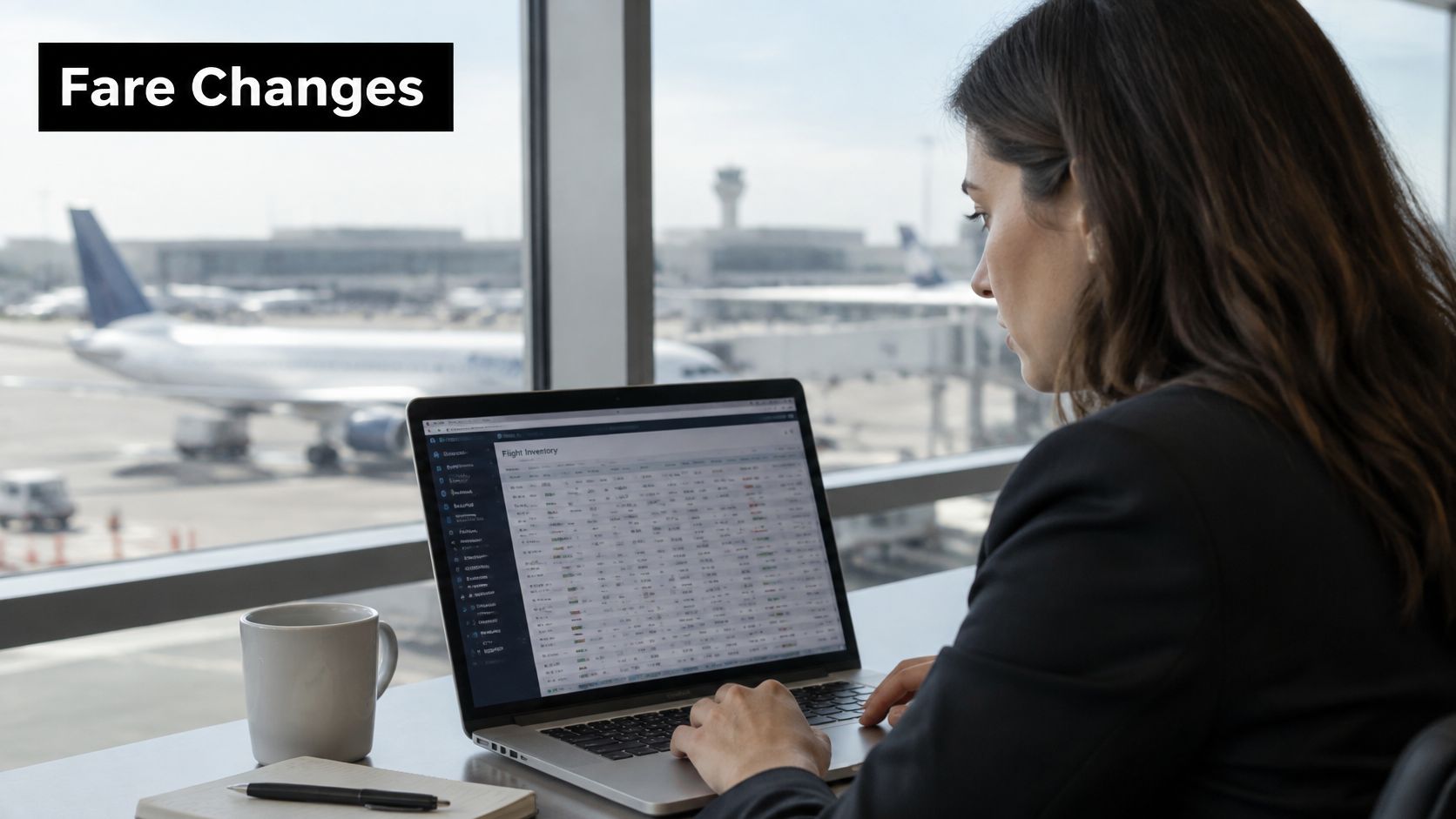
A professional woman working on a flight inventory dashboard on her laptop near an airport runway.

The Minimum Record Worth Keeping

A tracker that can't keep these five fields can't judge a fare properly:

  1. Observation date: when the price was seen
  2. Route: the exact origin and destination
  3. Cabin: economy, business, or first class
  4. Days to departure: the booking lead time
  5. Fare class: the booking class behind the quote

Without days to departure, you're comparing a fare bought three months out with one bought three days out. Without fare class, you can't tell whether the price fell or the product got more restricted.

Practical rule: Place today's fare against the route's own history and label it high, typical, or unusually low before you decide anything.

That test separates routine fluctuation from a genuine discount. It's the standard every picking decision in the first table has to meet.

Buying Criteria That Separate Reliable Trackers

A single accuracy percentage doesn't prove a tracker is good. A peer-reviewed study compared three prediction platforms using daily observations over 77 days across 10 one-way routes and found no universally superior platform, because forecast accuracy varied with days remaining before departure, as reported in the Journal of Revenue and Pricing Management comparison of airfare prediction platforms. The route sample was limited, so don't treat it as a universal benchmark. Treat it as a warning against headline scores.

Inputs matter just as much as the model label. A review of forecasting research reports that models using external variables produced a mean absolute percentage error of 4.66%, compared with 5.22% for historical data alone, in a review of airfare price prediction research. Those benchmarks come from different datasets, so they aren't directly comparable. They still tell you to favor tools that use more than the last quoted fare.

Criterion What to Verify Red Flag
Route and cabin coverage Monitors your exact origin, destination and cabin Only economy shown for premium trips
Price history depth At least 12 months of route data Only the current price
Forecast validation Results split by 30-plus days, 8 to 30 days, and under 8 days One headline accuracy figure
Alert precision Share of alerts followed by a real fare drop Alerts for every small price change
Data inputs Days to departure, stops, departure time, holidays, seasonality Compares only the last quoted fare
Fare-class clarity Seat selection, change rules and baggage shown Restrictions hidden until checkout
Cost against value Annual fee divided by savings per trip Fee exceeds typical savings

How to Run the Checks

Split forecast validation into 30-plus days, 8 to 30 days, and under 8 days. A tool that's calm and accurate three months out may be useless in the final week, when premium inventory moves in steps. Ask for results by window, not blended together.

Ask for error metrics by name. You want mean absolute error, directional accuracy, and the share of alerts that preceded a meaningful fare decline. A vendor that can't define what its price is compared against hasn't given you a signal. It's given you a notification.

Check fare-class clarity before you celebrate a drop. Confirm whether the fare includes seat selection, change rules, and baggage, because a lower price on a worse product isn't a saving. This matters most when a premium fare looks suddenly cheap.

The Cost Test and a Back Test

Do the break-even arithmetic plainly. Divide the annual fee by the savings you realistically capture per trip. If you need an implausible saving on every journey to cover the fee, don't buy it, whatever the alert design looks like.

Run the tool against a route you already flew and compare its alerts with what fares actually did.

That one back test exposes noisy alerts, missing cabins, and shallow history faster than any sales page. If the tracker can't explain a fare you already understand, it won't help on one you don't.

Business Class Versus Coach Pricing

Business class can cost only slightly more than coach, and in narrow conditions you'll see business class cheaper than coach on comparable value once restrictions and timing line up. The honest version is conditional. It happens when the normal relationship between cabins breaks down, not because premium seats are secretly cheap all year.

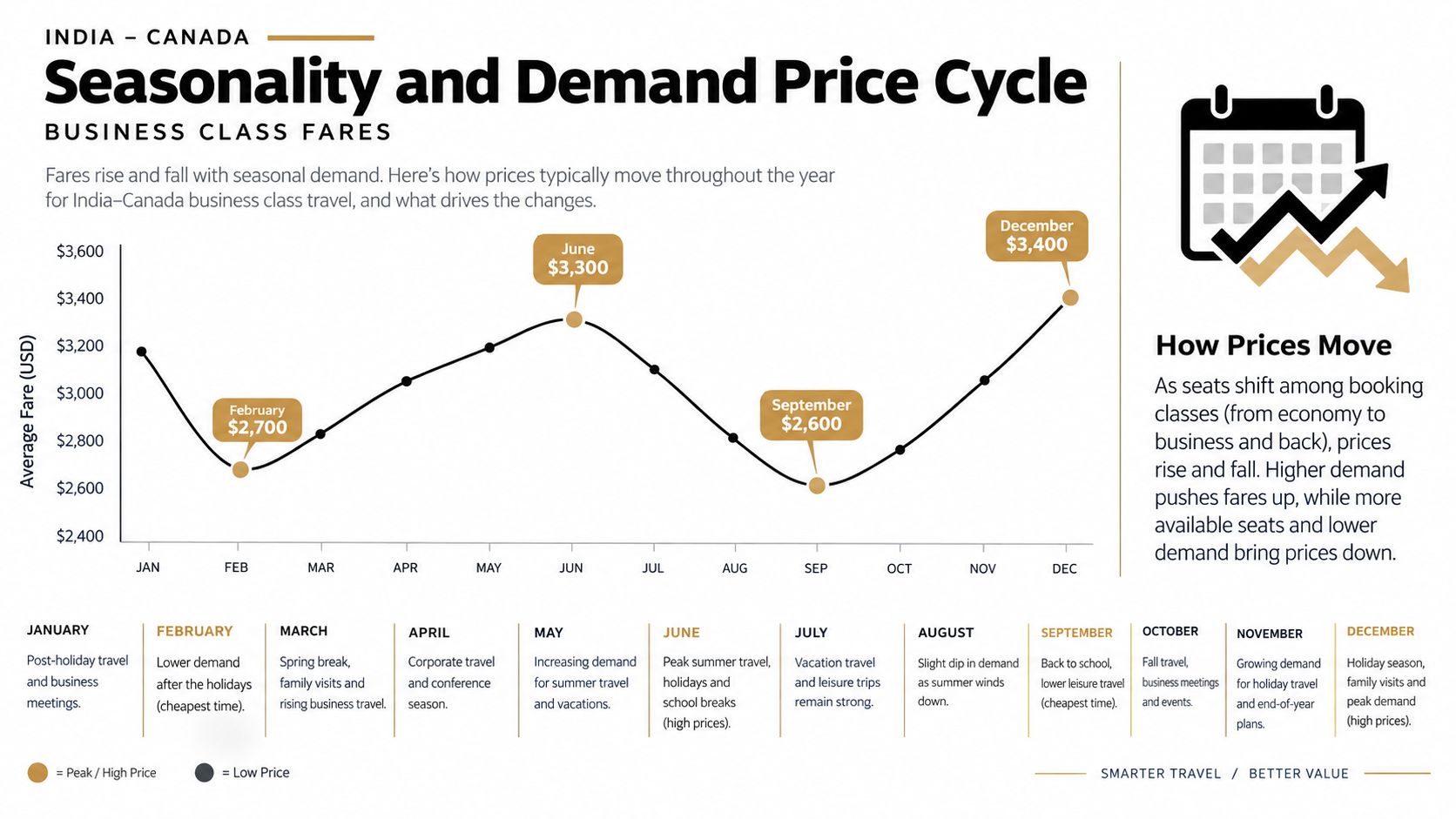
IATA reports that premium fares average about five times economy fares overall, but business-class fares decline during summer and rebound in September and from March through May alongside the corporate travel cycle, in IATA's report on the resurgence of premium class travel. That average hides the useful part. In summer, leisure demand lifts economy while corporate demand softens, so airlines have more reason to discount unsold business inventory.

Three Ways the Gap Closes

Seasonality is the first mechanism. When business travelers stay home in midsummer or around the winter holidays, premium cabins can carry empty seats on routes where economy is full. Airlines would rather sell those seats at a compressed premium than fly them empty.

Fare brands are the second. Delta announced basic premium-cabin fares, and United introduced similar tiered products that let travelers buy a lower-priced premium seat while giving up benefits such as seat selection and lounge access, as reported in coverage of tiered premium fares in the Winnipeg Free Press. You're still in the premium cabin. You're buying fewer bundled services, so compare it against the economy fare you'd be willing to accept, not against an imaginary fully flexible ticket.

Corporate pricing is the third, and it works differently. On New York to London, a corporate-discount example showed a business fare of approximately $3,700 for a J-class ticket booked 21 days in advance, versus about $4,150 for the lowest public business fare, a $450 reduction, or roughly 10.8%, in ITILITE's comparison of corporate airline discounts and public fares. That doesn't make business cheaper than economy. It makes the negotiated premium fare cheaper than the public one, which changes the switch-cabins decision for eligible buyers.

The Same-Date Check

Run the comparison properly before you book:

  • Compare same date, same route: Business on Tuesday against economy on Saturday proves nothing.
  • Confirm the restrictions: Check seat selection, lounge access, changes, and baggage on both fares.
  • Price the premium in dollars: Decide what the seat, sleep, and flexibility are worth on that flight length.
  • Check both cabins every time: Our guide to business class vs economy pricing works from this same-date habit.

A five-times average should never stop you checking the premium cabin on a summer long-haul date.

Buy only when the premium is justified for that trip. The mistake isn't paying more for business. It's assuming the gap is fixed and never looking.

Leisure Versus Corporate Use Cases

A leisure buyer can wait. A corporate buyer usually can't. That difference in deadline, more than app design, decides which tracker is useful, because the two buyers aren't measuring value against the same fare.

Requirement Leisure Traveler Corporate Buyer
Decision deadline Flexible, can wait for a drop Fixed travel dates, cannot wait indefinitely
Cabin priority Economy or occasional premium Policy-defined business class
Fare type Public fares Negotiated and qualifying fares
Number of travelers One or two Several travelers under one policy
Alert scope One or two routes Many routes across the year
Key tool signal Historical low and trend Policy-compliant fare below the negotiated rate

A Family Trip to Europe

Say a family of four is planning a European trip and watching a premium fare for the parents while the teenagers fly economy. The leisure advantage is patience. They can set a buy threshold, watch the route history, and walk away if the fare stays high.

The catch is who gets the lower price. When our Fare Monitor detects lower pricing, additional travelers may not be able to get the same lower pricing on the same flights unless they have an active subscription. We suggest a supplemental Spousal Plan subscription when family members or co-workers plan to use Fare Monitor.

Sort that out before the first search, not after a drop appears. A family that discovers the coverage limit at the moment of booking has wasted the alert. The requirement that should decide the tool here is traveler coverage, ahead of alert speed.

A Corporate Buyer on a Fixed Date

Now take a consultant flying to a client meeting on a fixed date, in a policy-defined cabin. A public fare drop is almost irrelevant. The useful signal is whether a policy-compliant fare sits below the negotiated rate, which is the logic behind our work on corporate travel cost savings.

The common corporate mistake is relying on public-fare alerts when negotiated fares would already undercut them. The travel manager celebrates a public discount that the company could beat through its own program, and nobody checks. Approval workflow and integration look like overhead until you price that error across a year of trips.

Corporate buyers also can't wait indefinitely for a better signal. As departure approaches, the cost of an unsold seat to the airline and the cost of no seat to the traveler move in opposite directions. The tracker has to flag the decision point early enough for approval to happen.

Decision rule: Leisure buyers should let deadline flexibility pick the tool. Corporate buyers should let policy compliance pick it, and treat everything else as secondary.

Test each fare on its own route and date in both cases. Neither buyer should assume the premium gap is fixed, and neither should buy a tool whose main signal doesn't match the fare they pay.

Using Passport Premiere and Setting Your First Alert

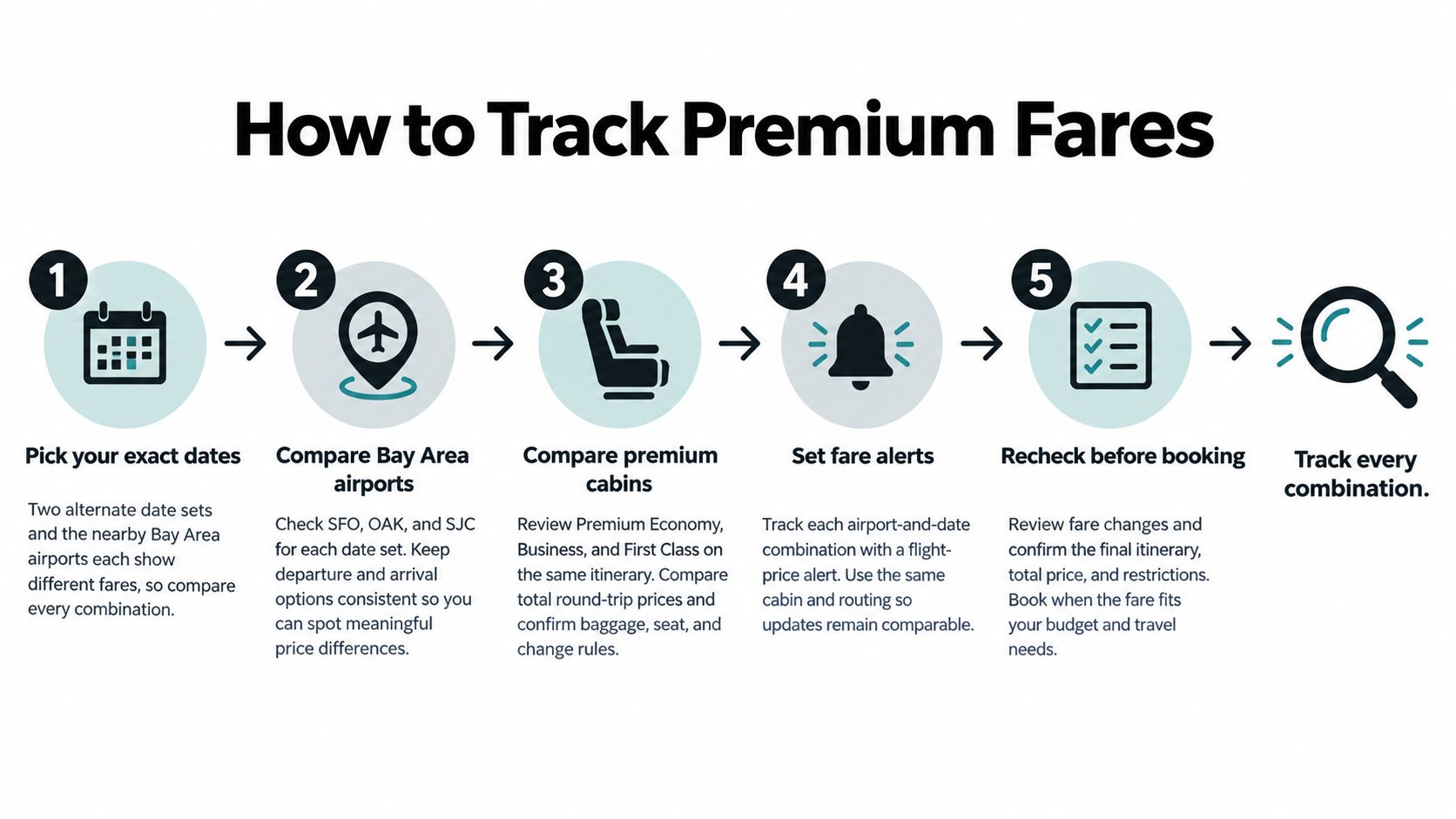
The workflow below treats an alert as the start of a judgment, not the end of one. As our fare analysis approach puts the distinction, a fare alert tells you the price moved, but only a fare analysis tells you whether the premium cabin is worth buying at that price. Follow the sequence in order.

The process in brief, before the detailed steps:
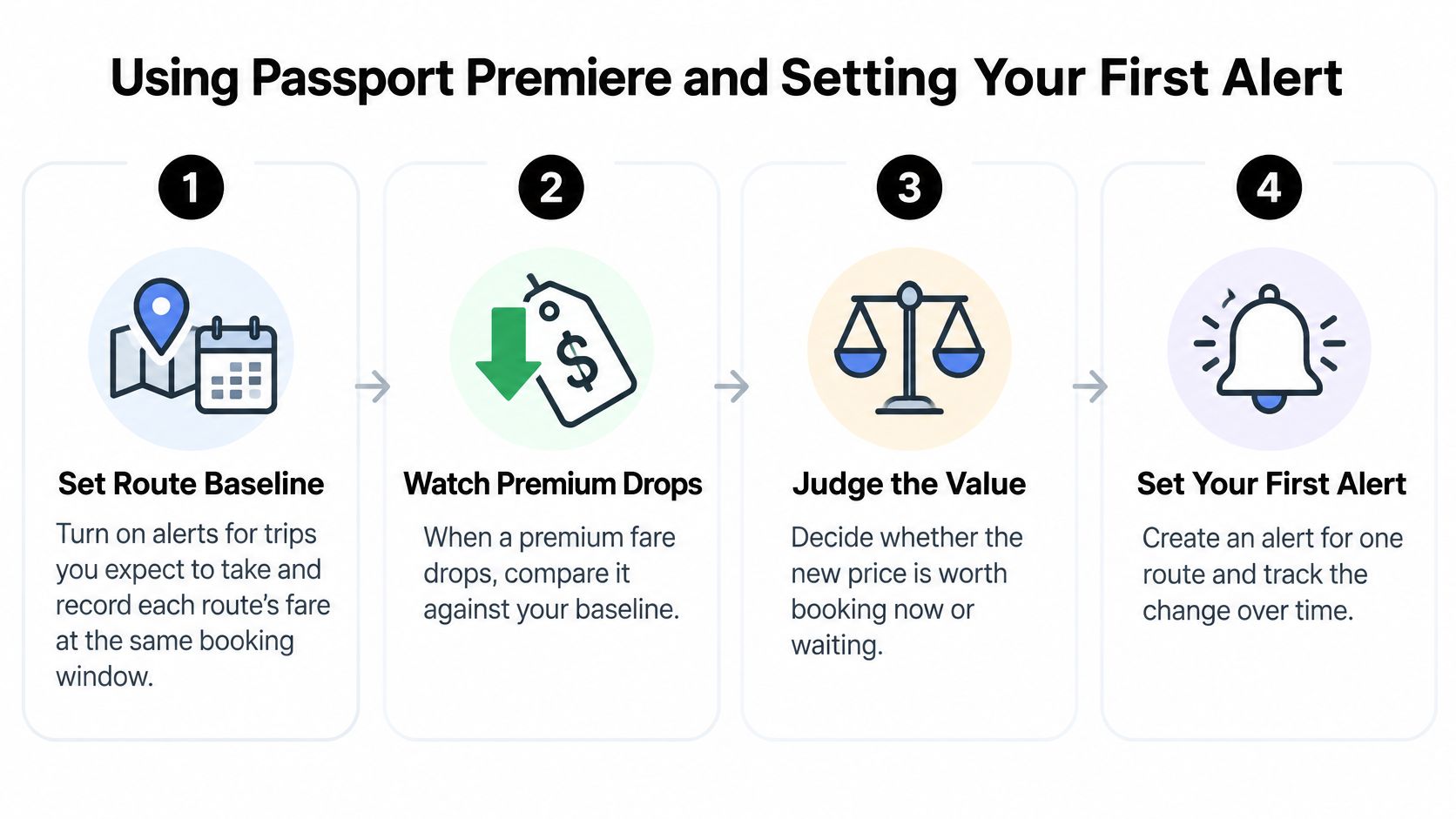
A four-step infographic illustrating how to use Passport Premiere to set travel alerts and track airfare.

The Monitoring Workflow

  1. Set a route baseline: Turn on alerts for trips you expect to take and record each route's fare at the same booking window, so later prices have something honest to be compared against.
  2. Judge the drop: When a premium fare falls, decide whether real demand supports it or it's a speculative dip. A plain alert won't make that call for you.
  3. Decide between buying and holding: Our Fare Monitor watches for a lower fare after you run a trip search, and it lets you hold an itinerary and preserve current pricing while deferring purchase in anticipation of lower pricing.
  4. Respect the overlap rule: You may not use Fare Monitor while simultaneously holding pending or confirmed space on the same or similar flights.
  5. Use telephone support: After fare validation, telephone support helps you interpret BUY IT NOW or FARE MONITOR recommendations before you act.

Be candid about the limit. The value depends on how often you buy premium cabins, and this doesn't replace checking economy on the same date. If you fly business once a year on a short route, a free alert and your own same-date check may be enough.

Your First-Alert Routine

  1. List your next three trips: Write down cabin and dates for each, including the ones you haven't committed to yet.
  2. Shortlist two categories: Take them from the trip-type table, not from an app store ranking.
  3. Confirm the fundamentals: Check cabin coverage, twelve months of history, and lead-time validation for each option.
  4. Set your buy threshold early: Decide the price at which you'll book before the first alert fires, while you're calm.
  5. Test one premium monitor: Run it on a single trip before committing a full year of spend.

Setting the threshold in step 9 is where most travelers go wrong. They wait for an alert, then improvise a decision under time pressure, which turns the tracker into a source of anxiety. A threshold set in advance converts the alert into a yes or no.

The Cost Check Before You Start

Subscriptions are bundled with four Fare Monitor scans per year, and additional scans cost $39 per record. Subscribers who use Fare Monitor without quantifiable booking activity may be subject to subscription fee escalation, so match the plan to trips you'll book.

Count your expected premium trips against those four scans before you begin. If you'll run ten monitored trips a year, price the extra scans into the break-even. If you'll run two, you're well inside the bundle.

Start with the trip nearest to booking. Set its baseline today, set your threshold today, and let the first real alert test whether the tool earns its fee.


If you buy international business or first class more than once a year, we can monitor those routes, judge each fare against its history, and signal when a premium seat is worth its price. Start with the trip you're closest to booking and set your first baseline through Passport Premiere today.
Why Fly Business Class When It Costs Less

Business class is worth flying when its bed or its schedule protects a workday you can't afford to lose. And on some documented fares, it costs less than coach. The familiar advice to save money by choosing economy skips the most useful step: comparing what both cabins cost on the flights you need.

Business Class Cheaper Than Coach on Real Fares

A One Mile at a Time comparison documented economy at $575 versus $471 in business, a $104 saving, and another same-flight comparison at $480 versus $373, making business $107 cheaper. These aren't upgrades purchased with miles. They're examples of a higher cabin carrying a lower cash fare.

Airlines price cabins through separate fare buckets, rather than adding a standard business-class surcharge to the economy price. When cheaper economy inventory sells out, a discounted business bucket can remain available. An airline can also discount business independently to attract bookings.

When business class costs less or barely more

Comparison Economy Business Gap
Documented same-flight reversal $575 $471 Business $104 cheaper
Second same-flight reversal $480 $373 Business $107 cheaper
Iberia Madrid–Athens £454 £562 Business only £108 more
Study average across routes Base fare 250.19% above economy Average business premium
ANA, smallest average markup Base fare 82.22% above economy Smallest gap in the study

The Iberia comparison and airline averages come from Holidu's business-class fare study, which recorded £454 in economy and £562 in business on Madrid–Athens, an average business premium of 250.19% across its sample, and ANA's smallest average markup of 82.22% above economy.

Read the fare display, not a presumed markup

The important distinction is between an average premium and your available fare. An airline's average tells you little about the remaining inventory on a particular departure. Applying a mental multiplier to the economy price can cause you to reject business without ever searching it.

Compare the same departure, connection, travel dates, passenger count, and ticket direction. A cheaper business itinerary with an inconvenient connection isn't the same proposition as a cheaper business seat on the flight you already wanted.

Booking rule: Search the cabin you think you can't afford before deciding that you can't afford it.

These reversals are unusual, not a dependable pricing pattern. The documented comparisons establish that business can undercut coach, not that those prices remain bookable or that every route produces them.

There's another useful conclusion: a narrow premium deserves a different decision process from a large premium. When the gap is modest, baggage, flexibility, and airport services may settle the comparison. When it's substantial, the bed and the arrival schedule need to justify the additional spending.

That's the practical answer to why fly business class: sometimes it's the lower-priced ticket. When it isn't, you need to know exactly what the extra money buys.

The Lie-Flat Bed Behind the Cabin Name

The principal long-haul benefit isn't a wider chair. It's a usable sleep surface. A cabin that lets you lie down should be evaluated more like overnight accommodation than like an improved seat.

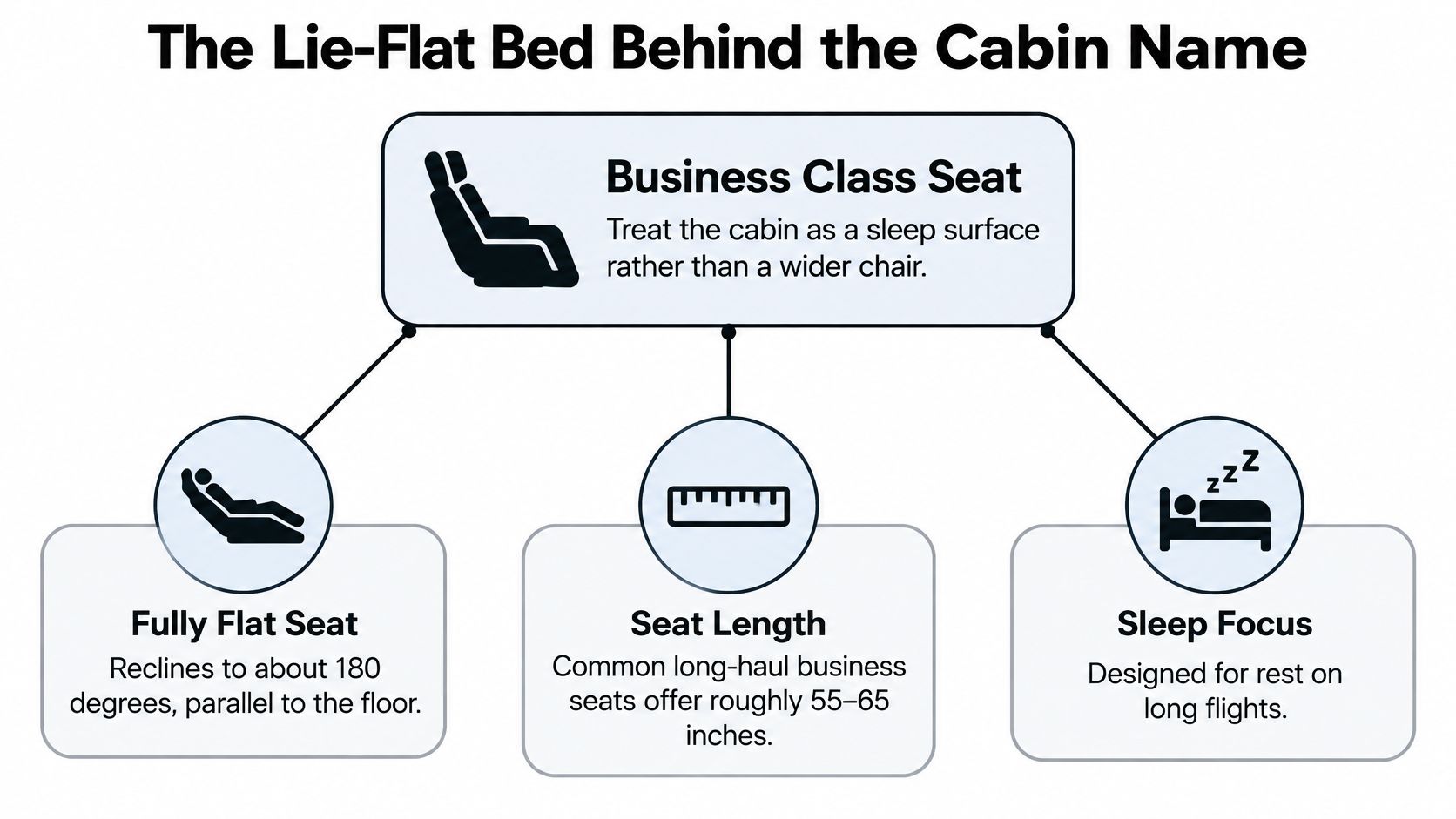
The business-class reference overview describes fully flat seats reclining to approximately 180 degrees, parallel to the floor, with common premium configurations offering roughly 55–65 inches of pitch and 18–23 inches of width, although aircraft and airline specifications differ. Pitch isn't bed length, so don't treat those measurements as interchangeable.

A diagram explaining the features of airline business class lie-flat seats, including recline, length, and sleep benefits.

An angled-flat product can look nearly horizontal without giving your body the same alignment as a fully flat bed. Footwell shape also matters: a generous-looking seat can still leave little room to turn comfortably.

Inspect the sleeping position

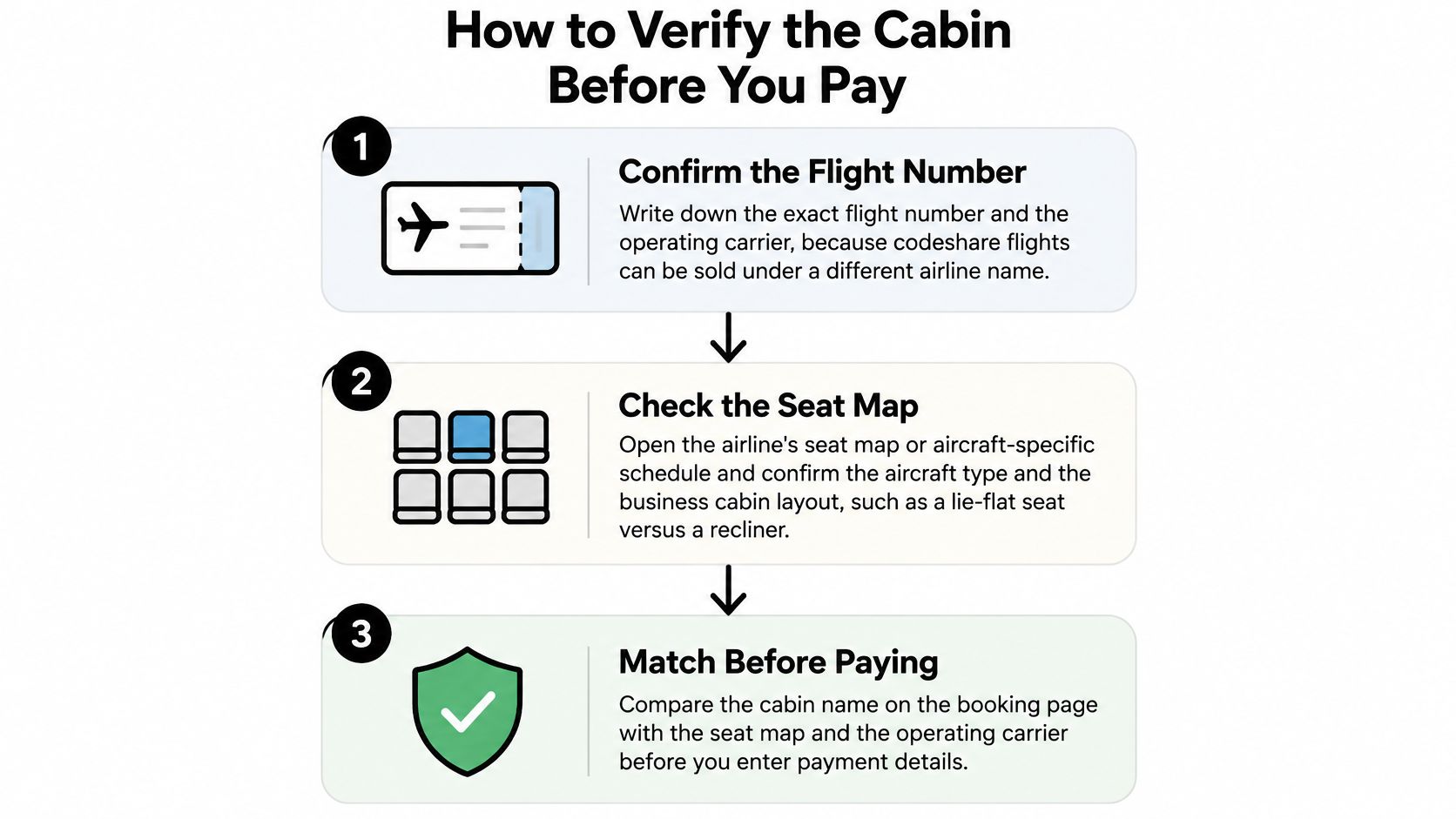
Before paying, open the operating airline's aircraft-specific seat map and seat description. Our explanation of what a business-class flight includes provides useful context, but the actual aircraft should determine your choice.

  • Recline: Confirm a flat sleeping position, not just a reclining seat.
  • Footwell: Look for space that accommodates your normal sleeping posture.
  • Bedding: Check whether a mattress pad or other sleep surface is included.
  • Aisle access: Prefer a layout that doesn't require you or your neighbor to climb over someone.
  • Operating aircraft: Verify every long sector, not just the aircraft pictured on the booking page.

Think of an overnight flight as a hotel night you might preserve, or a night you give the airline without getting much rest back. That analogy doesn't make the fare automatically worthwhile. It tells you which part of the product deserves scrutiny.

Buy the opportunity, then protect it

A bed creates an opportunity to sleep, not a guarantee that you will. If you spend the available rest window eating, working, and watching films, you may arrive having paid for a benefit you barely used.

For a practical companion to seat selection, The Sleep Consultant's in-flight sleep planning for busy executives can help you think through how to use that opportunity. Plan your onboard priorities before boarding rather than deciding after the meal service starts.

A useful distinction is sleep capability versus sleep behavior. The airline supplies the former; your schedule and choices determine how much of it you use. Airport perks should be assessed separately, because even an excellent lounge can't turn an unsuitable seat into a bed.

Lounges Bags Miles and the Rest of the Bundle

A premium ticket can change the hours surrounding the flight as much as the flight itself. Assess those benefits as services you'll actually use, not as a list whose length proves value.

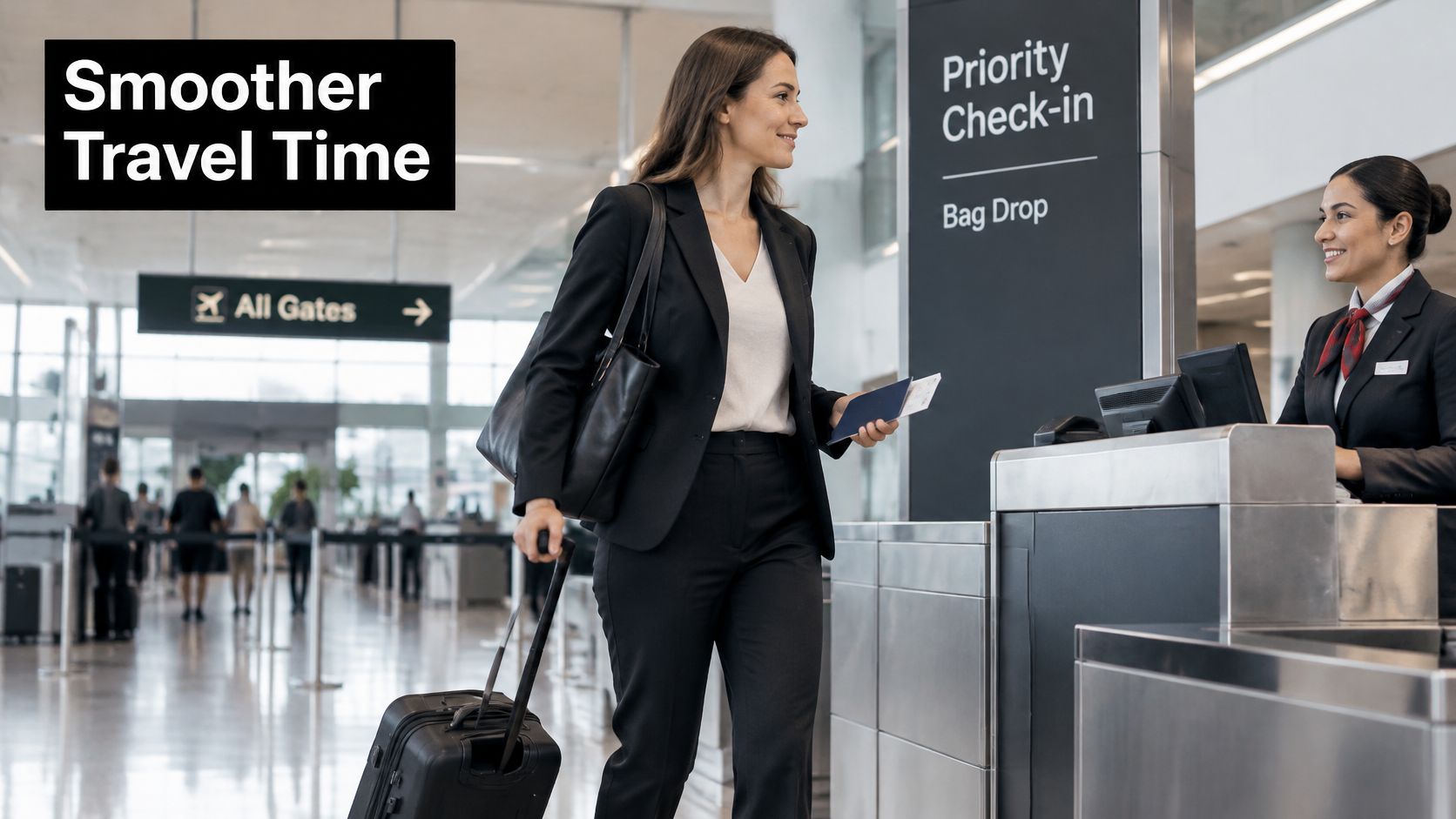
Priority check-in is one example of a benefit worth inspecting before departure.

A professional businesswoman walking towards a priority check-in counter at an airport with her luggage.

Assign each benefit a job

Priority check-in, bag drop, and eligible security access can reduce queueing, but they aren't permission to ignore airport deadlines. Their value is greatest when they remove uncertainty from an already demanding itinerary.

A lounge earns its place when you need a table, power, food, or an available shower before an overnight departure. Check the actual departure lounge and opening hours. Access to a room you can't use adds nothing to the fare comparison.

  • Checked baggage: Compare the ticket's allowance with your actual luggage, especially if you're carrying presentation equipment or a demonstration kit.
  • Dining: Included meals can replace a separate airport purchase, provided the service timing suits your plans.
  • Workspace: Check the tray table, power provision, and usable personal space rather than assuming that every premium seat supports comfortable laptop work.
  • Loyalty credit: Confirm the booking class's redeemable-mile and status-credit eligibility before assigning either a value.

The cabin can function as a bedroom with an office attached. Economy is closer to a seat in a crowded waiting room. Those are useful descriptions of personal space, not promises that every business-class product delivers the same facilities.

The following video offers another perspective on evaluating the premium-cabin proposition.

Separate immediate savings from loyalty value

For a daytime regional flight, baggage and lounge access may matter more than sleeping capability. For an overnight intercontinental trip, don't let an attractive airport package distract you from the seat.

Tickets bought through Passport Premiere have characteristics consistent with open-market terms, including flexibility and mileage accrual, regardless of the final fare level. That doesn't remove the need to understand the particular fare's conditions.

Our guide to maximizing airline miles helps frame the loyalty side of the calculation. Keep that value conservative: an account balance isn't cash, and earning credit isn't useful if you won't redeem it.

The frequent flyer captures the greatest potential loyalty value. For an occasional traveler, the stronger purchasing case is usually what the ticket delivers on this trip.

When a Work Trip Pays Back the Premium

Start with a financial test, not a comfort preference:

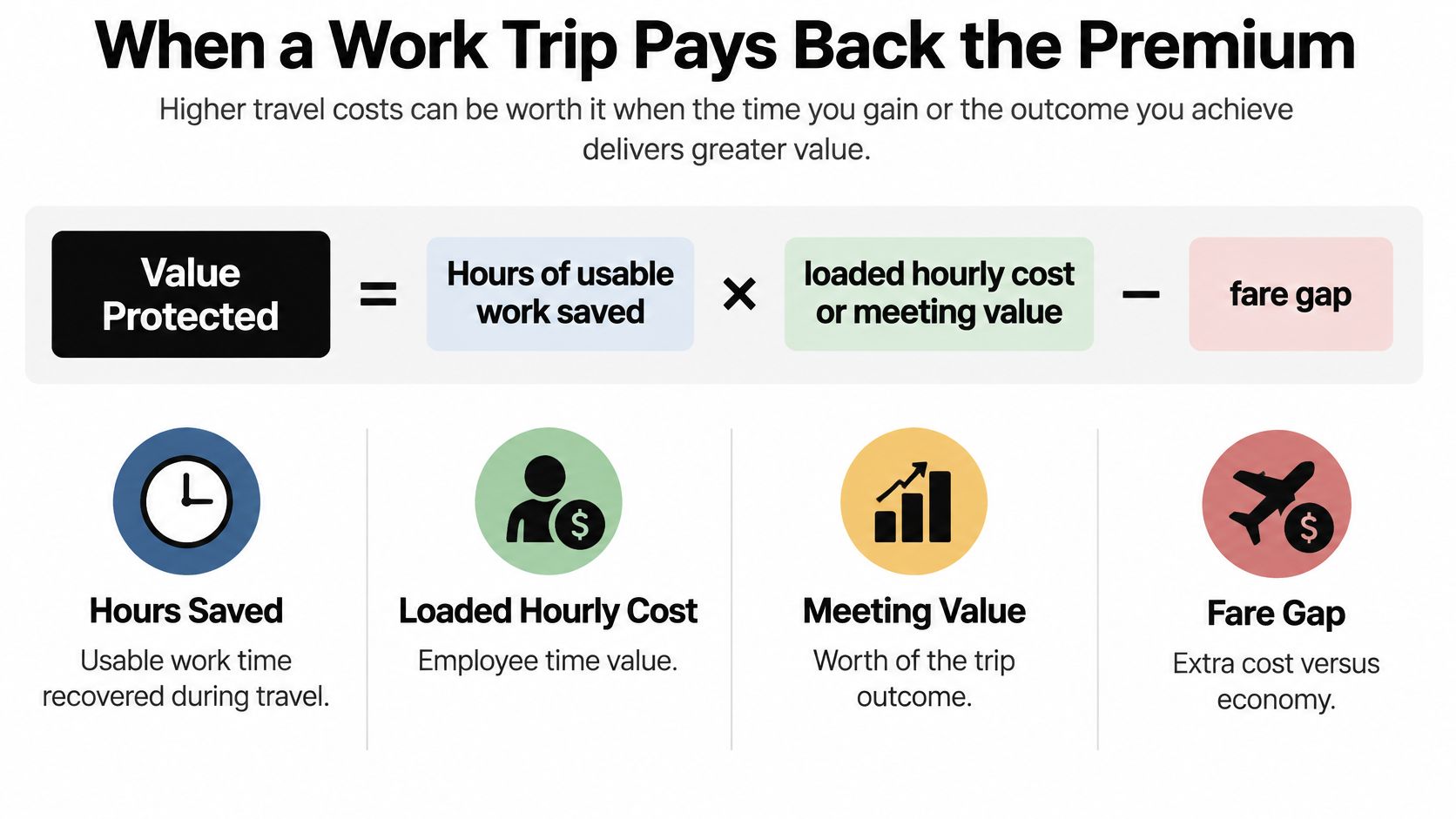
Net value protected = usable work hours saved × loaded hourly cost, plus avoidable recovery costs, minus the fare gap.

For a consequential meeting, assess the value of arriving prepared separately. Don't multiply hours by the entire contract value, and don't count both a recovered workday and the same hours again as a recovery expense.

In Deloitte's corporate travel analysis, 86% of surveyed travelers lost at least one productive hour after a stressful trip, 45% of C-level executives reported losing four to eight hours, and 37% said premium or business-class booking would reduce travel stress. These findings support evaluating arrival readiness, but they don't prove that purchasing business recovers every lost hour.

A diagram illustrating the formula for calculating the value of paying a premium for business travel.

Match the decision to the obligation

The following situations are decision scenarios, not forecasts of the return a particular traveler will receive.

Break-even situations for a business fare

Situation Typical stakes Cabin that fits Why
Overnight long-haul into a same-day meeting Potentially several hours of executive time at risk Business if the seat is fully flat Helps protect the workday the fare is buying
Contract or client trip worth many times the gap Hypothetically, a four-figure premium against a five-figure outcome Business when arrival readiness matters The meeting's expected value may justify the gap
Stressful connection with no recovery window Productive time and readiness at risk Business on the long sector Prioritizes rest where it can be most useful
Flexible arrival and a free next day Comfort, with no same-day duty Economy or premium economy An existing recovery window weakens the financial case
Eastbound with short rest between duties Continuing fatigue exposure Business only if the bed adds usable sleep A better seat doesn't repair an unsuitable schedule

Consider a consultant who must lead a client workshop immediately after arrival. Estimate the work at risk, then compare its value with the actual premium. Billing rates can inform the calculation, but revenue isn't automatically profit, and not every tired hour becomes lost billable work.

For a sales trip, use expected meeting value, not the headline contract amount. Ask whether arriving better rested could materially affect preparation, judgment, or delivery. If the meeting would be equally effective after a recovery day, compare that alternative too.

Keep the limits in the approval note

Business class doesn't erase jet lag. For eastbound travel or a tightly compressed duty schedule, consider changing the departure, arrival, or meeting time rather than treating a seat purchase as the entire fatigue plan.

A flexible leisure trip or internal visit has a different calculation. If the traveler already has a free arrival day, there may be little productive time to recover financially. Comfort remains a legitimate personal preference, but it shouldn't be presented as a guaranteed business return.

The American Express 2024 Business Travel Edition survey found that 85% of surveyed companies covered business-class seats on longer flights at least case by case. The useful approval request is therefore a concise break-even note: itinerary, arrival obligation, fare difference, and realistic alternative.

For managers defining what counts as business travel, that approach also separates an operational requirement from an employee preference.

Emissions and the Trips That Should Stay in Coach

Business- and first-class travel carry a substantial environmental trade-off. The aviation analysis described in Deloitte's corporate travel discussion puts their per-passenger emissions at two to five times economy's and attributes more than 20% of global passenger-air-traffic carbon dioxide emissions to premium travel.

A discounted fare doesn't remove that trade-off. Price and emissions answer different questions, so a financially attractive upgrade isn't automatically the environmentally preferable booking.

Choose the trip before choosing the cabin

Travel need Choice to evaluate first What must justify premium
Overnight arrival before essential work Suitable nonstop itinerary and usable rest A material arrival-readiness benefit
Flexible arrival without immediate duties Economy or premium economy A reason beyond routine entitlement
Meeting that works remotely Videoconferencing A clear need for physical attendance
Practical rail alternative Rail A genuine operational reason to fly
Repeated visits to the same destination Consolidated, fewer trips Why separate journeys are necessary

Aircraft type, seating density, cabin configuration, occupancy, and routing affect the allocation of emissions. That makes a cabin label an incomplete accounting method, even though premium seating generally requires more aircraft space per passenger.

Compare complete itineraries. If someone proposes an additional positioning journey or separate recovery trip, include it rather than assessing only the main flight. An extra hotel night also belongs in the overall travel assessment, but don't assume its footprint automatically outweighs a cabin change.

A lower fare is evidence about purchasing value, not evidence of lower emissions.

Record the reason rather than hiding the choice

For corporate reporting, retain the cabin, route, emissions methodology, and operational reason for the booking. A general travel total won't explain why a premium seat was necessary.

Distinguish a documented emissions estimate from a broad sustainability slogan. Ask what the figure measures and whether it accounts for cabin allocation and connections; don't treat an airline's marketing language as an itinerary calculation.

The defensible position isn't that nobody should fly business. It's that a company should identify when the additional space serves a real purpose. When the productivity case fails and a workable lower-emission option exists, that option is usually the better purchase too.

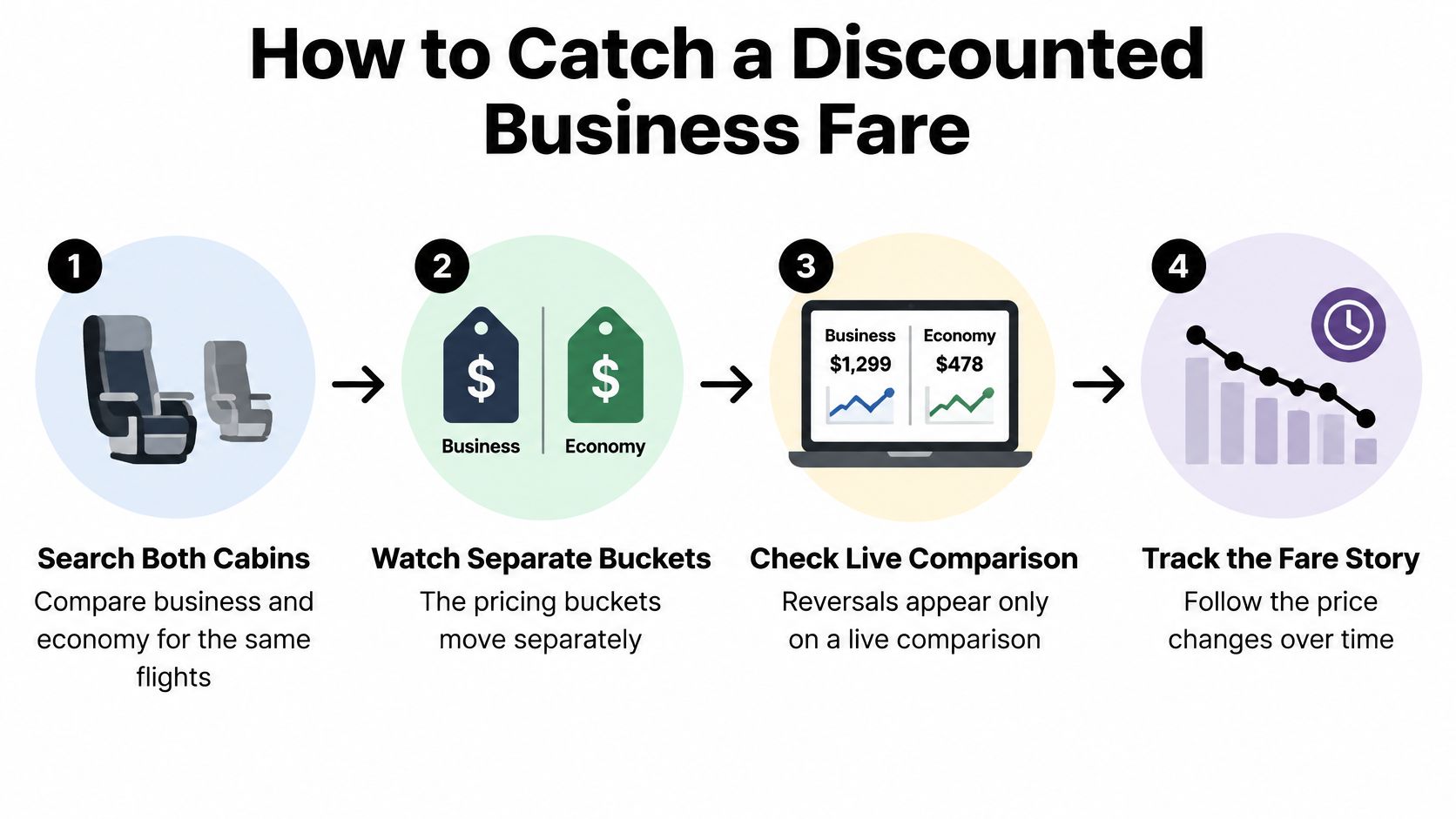
How to Catch a Discounted Business Fare

Finding a useful premium fare requires a repeatable buying routine. Search broadly enough to detect a pricing opportunity, then inspect narrowly enough to avoid buying the wrong ticket.

A four-step infographic illustrating how to find discounted business class airfare by monitoring pricing trends.

Make the comparison actionable

  1. Search both cabins on matching flights. Keep dates, passenger count, and connections constant. A Passport Premiere member described an international Melbourne–New York booking this way: “I used Passport Premiere for an international flight between Melbourne and New York and managed to obtain a business seat for the price of an economy.” That's an individual testimonial, not a promised result.

  2. Watch route launches and competitive sales. Don't use a carrier's ordinary asking price as your only benchmark. Thrifty Traveler's business-class booking guide reports Condor Europe fares slightly above $2,500 round trip, Air France below $2,000, JetBlue Mint around $2,000 on certain Europe routes, and nonstop Colombia business fares as low as $420 round trip, about one-third of the cited normal price.

Reported business sale levels

Route or airline Reported fare Note
Condor, to European destinations Slightly above $2,500 round trip Business class
Air France business Below $2,000 round trip Reported sale
JetBlue Mint, certain Europe routes Around $2,000 round trip Often after new route launches
Nonstop business to Colombia As low as $420 round trip About one-third of the cited normal price

These are reported sale examples, not current quotes or promises for every departure. Use them to recognize that meaningful discounts exist, not to set an inflexible target for an unrelated itinerary.

  1. Read the fare brand before celebrating. Executive Traveller's guide to unbundled business fares identifies Air France and KLM Business Light, Emirates Business Class Special, Finnair Business Light, and Qatar Airways Business Class Lite, with potential restrictions affecting changes, refunds, lounges, or baggage; its Finnair Helsinki–Singapore example showed only €136 between Business Light and Business Classic. A small step up may purchase conditions worth more to you than the saving.

  2. Confirm the ticket's actual terms. Establish whether it's a published fare and inspect change conditions, refundability, baggage, and mileage eligibility. Don't infer restrictions solely from a low price, or flexibility solely from the business-class label.

  3. Act on a verified buying opportunity. We issue alerts when fare sales occur. Check the live total and ticket conditions promptly, then purchase if the itinerary meets your requirements rather than assuming the same availability will remain.

Treat savings claims as individual outcomes

Another member, Terry, reported: “Saved $4000 on a single flight.” That testimonial describes Terry's result, not an expected saving for every booking.

The useful habit is to retain your original comparable quote. Without a matching baseline, you can't distinguish a genuine saving from a cheaper but materially different journey.

Book the Cabin Only After the Fare Makes Sense

Make the booking decision with a clear hierarchy: operational fit, comparable price, then purchase timing. A premium label shouldn't substitute for any of those tests.

Apply three purchase rules

  • Work on arrival: For an overnight long-haul followed by immediate duties, purchase only after confirming that the actual seat and itinerary support the rest you need.
  • Business at or below coach: Choose business when the same-date, same-flight comparison is favorable and its conditions meet your needs.
  • A large gap with a free next day: Keep economy or premium economy in contention. Don't manufacture a productivity argument for a comfort purchase.

Once a trip qualifies for premium travel, evaluate the timing rather than accepting the first quote. At Passport Premiere, we anticipate business-class buying events so members can capture savings when fares change. We help assess whether a current premium is justified or likely to fall, without guaranteeing the lowest price.

Our system also lets a customer hold a fare while we monitor for a lower fare, with the held fare preserved. That gives the purchasing decision a defined alternative instead of relying only on a hope that prices will decline.

Keep the service's scope clear

Our pricing methods don't apply to economy-class travel or premium travel within one continent, such as U.S.–Canada or intra-European journeys. The relevant use is international premium-cabin purchasing within our service scope, not every airfare search.

Decision standard: Buy a useful itinerary at a defensible price, not a prestigious cabin at an unexamined price.

For your next long-haul trip, write down the arrival obligation, the acceptable schedule, and the maximum fare gap you can justify. Then compare the available ticket with monitored alternatives before committing. You'll have a reason to buy, a reason to decline, and a baseline against which to measure the outcome.


Passport Premiere combines international business- and first-class fare monitoring with market analysis to help travelers judge when a premium fare makes sense. Visit Passport Premiere to explore membership and assess whether its fare intelligence fits your next qualifying international trip.

International First Class Seats for Less in 2026

The usual advice about international first class seats is to pick a celebrated airline, find its flagship suite, and hunt for a discount. That puts the cabin label ahead of the purchase decision. A famous first-class seat can be a poor buy when business class already provides the bed, privacy, and airport access you need.

Start with the aircraft and the fare instead. Scarcity makes first class harder to find, but it doesn't make every ticket worth buying. Sometimes the smarter purchase is business class cheaper than coach, particularly when an airline discounts premium inventory while economy fares remain high.

How Rare International First Class Seats Are

Say you're planning a long-haul trip and want first class in both directions. You find an attractive outbound flight, then discover that the return offers business as its highest cabin. Moving the departure time might solve the problem, but changing airlines or connecting airports might be necessary.

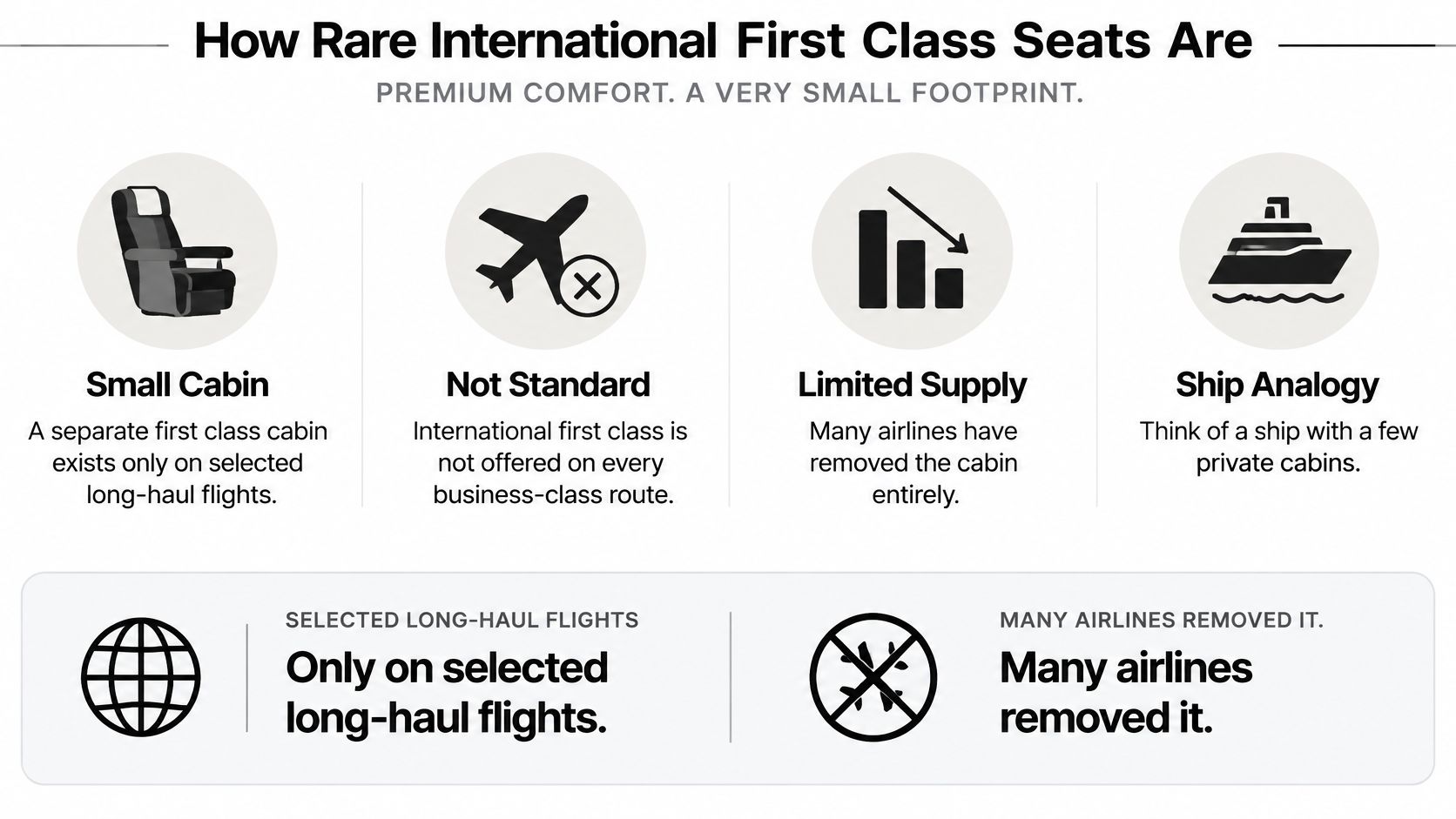
That's not merely a booking inconvenience. International first class is a separate product on selected flights, rather than a standard upgrade above every business-class seat. Think of a ship with a few private cabins: some operators preserve them, while others use the space for more passengers.

The supply picture helps explain why route selection comes before bargain hunting.

An infographic showing that international first class seats are rare due to small cabins and limited supply.

How international first-class supply has shrunk

The following figures, including Cirium's finding that fewer than half of approximately 60 surveyed long-haul international airlines retained a separate first cabin in 2025, are reported by AFAR.

Measure Figure What it means
Airlines with a true separate first cabin Fewer than half of about 60 long-haul carriers Many long-haul fleets no longer sell it
Share of available seats Less than 1 percent A tiny slice of the seat market
First-class seats, 2019 21.05 million Pre-pandemic baseline
First-class seats, 2024 12.6 million More than 40 percent below 2019
Seats removed, 2025 versus 2023 1.2 million fewer Contraction continued as total capacity grew
Total airline seats, 2019 to 2024 5.7 billion to 5.9 billion The network grew while first class shrank
Highest reported carrier share ANA about 3.2 percent Even the leader allocates a small slice

For a traveler, the important contrast isn't that first class contracted. Airlines expanded their overall seating capacity while reducing this particular cabin. A broader choice of flights therefore doesn't necessarily create a broader choice of first-class tickets.

Airlines have different reasons to retain the product. A flagship cabin can attract travelers who want exceptional space and service, while another carrier may prefer to sell more business suites in the same aircraft footprint. Neither strategy tells you whether a particular fare is attractive.

Practical rule: Establish that the cabin exists on your actual flight before spending time comparing first-class prices.

Keep the supply table beside your initial shortlist. A nonstop business flight may be more useful than a first-class itinerary that requires an awkward connection, an inconvenient departure, or a substantial detour.

Seat Hardware That the Cabin Label Hides

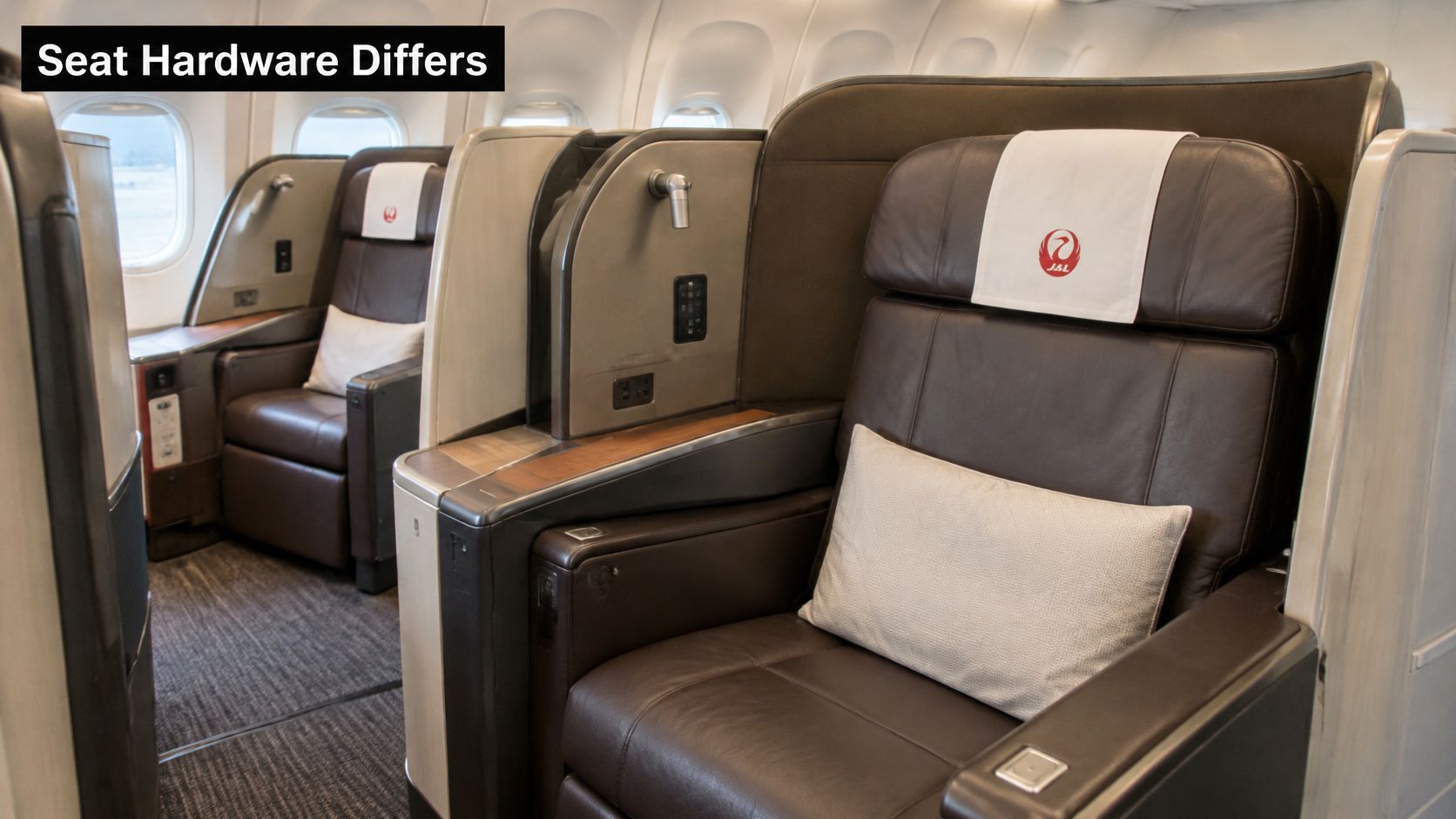
Two tickets called first class can buy noticeably different rooms. Japan Airlines offers a particularly useful comparison because the airline name stays the same while the aircraft changes the physical product.

The photograph illustrates the importance of looking beyond the fare label to the seat and its surrounding partitions.

Japan Airlines premium international first class seats featuring brown leather upholstery and private cabin partitions.

Measured first-class seats on two JAL aircraft

The dimensions below come from Japan Airlines' first-class seat specifications, which distinguish its Boeing 777-300ER JAL Suite from its Airbus A350-1000 product.

Spec 777-300ER JAL Suite A350-1000 first class
Seat width About 58 cm About 123 cm seat and bed width
Bed Up to 84 cm wide and 199 cm long Up to 203 cm long
Screen 23-inch 43-inch 4K
Privacy Stowable partition Larger personal volume in a six-seat cabin
Layout Individual suite 1-1-1, only six seats
Cabin height Not specified in the cited specifications About 157 cm ceiling

The difference isn't just a larger television. Extra bed width can matter when you turn onto your side, while usable surface area affects whether you can work, eat, and keep personal items accessible without repeatedly rearranging them.

Bed length deserves separate attention from seated comfort. A tall passenger should examine the sleeping position, including any enclosed foot area, rather than assume that a generous-looking chair guarantees comfortable rest. Published dimensions are the starting point, not a complete ergonomic verdict.

Privacy is part of the hardware

ANA's newer THE Suite includes a door and dedicated personal space, while First Square uses a self-contained shell, movable table, storage, and a 32-inch widescreen, according to ANA's first-class seat guide.

Doors, partitions, and walls solve different problems. A partition can block a neighbor's view without shielding you from aisle movement; a closable door can reduce visual disturbance, although it doesn't make an aircraft suite soundproof.

  • For sleeping: Look at enclosure, bed shape, bedding, and proximity to the galley or lavatory.
  • For working: Check table placement, accessible storage, and whether the seat remains comfortable with the table deployed.
  • For traveling together: Examine whether the layout permits conversation without sacrificing privacy when you want to rest.

A guide to airlines with beds can help build a shortlist, but the operating aircraft and cabin version must settle the purchase.

Don't interpret an aircraft assignment as an absolute guarantee. Save the product description, check the itinerary after schedule changes, and understand the ticket's remedies before paying specifically for a particular suite. A substitution can preserve the cabin name while removing the feature that justified the premium.

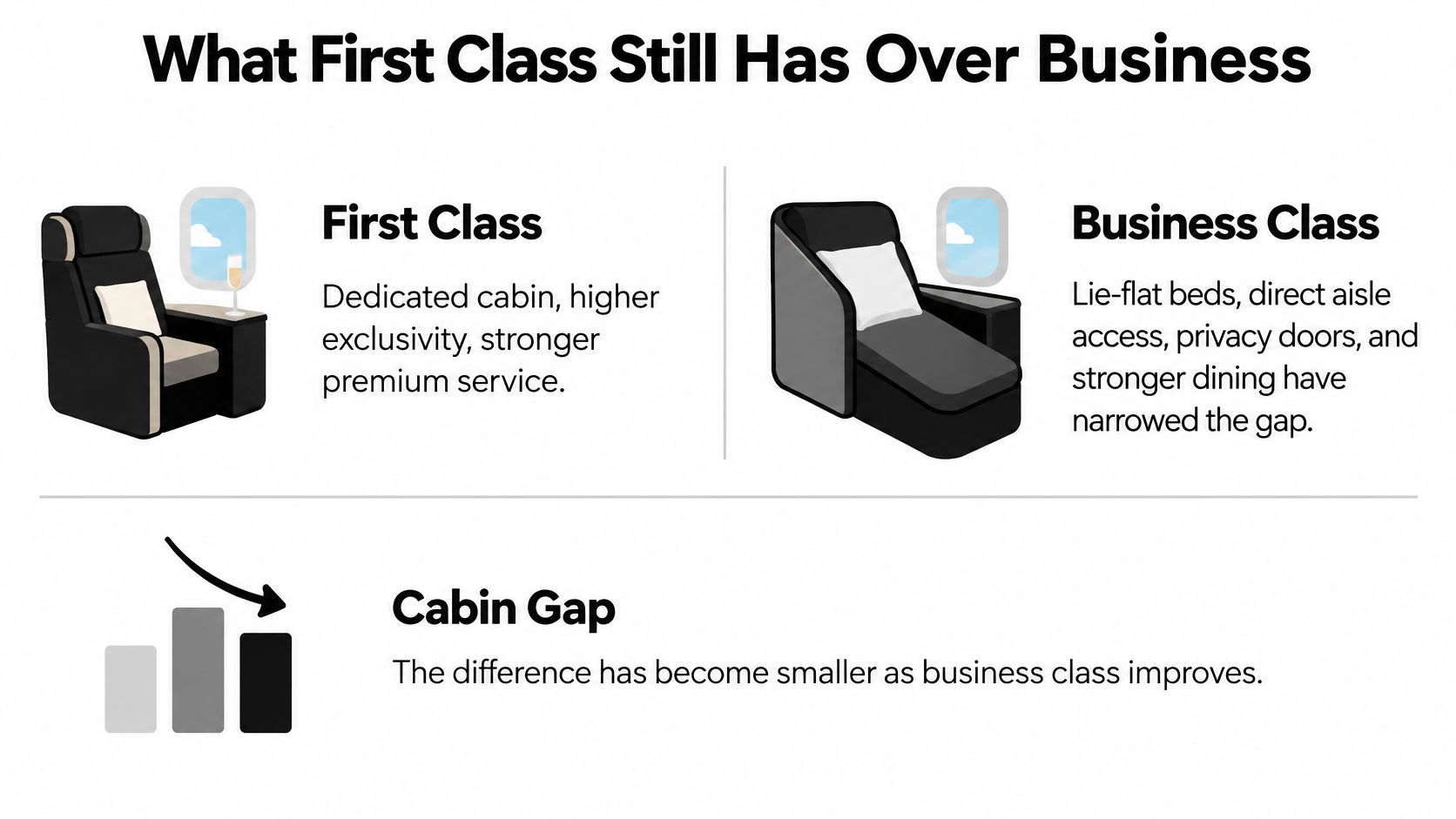
What First Class Still Has Over Business

Business class has absorbed features that once made first class distinctive. Lie-flat beds, direct aisle access, privacy doors, and improved dining increasingly appear below the top cabin, a narrowing gap discussed by Trip Jaunt.

That doesn't make first class obsolete. It makes the comparison more demanding: the question is which additional benefits you'll receive, not which cabin sounds more prestigious.

This comparison captures the broad direction, but the operating flight's inclusions should determine the verdict.

A comparison chart highlighting the narrowing differences and current advantages between airline first class and business class cabins.

First class versus a modern business suite

These are buying criteria, not promises that every airline supplies each benefit.

Benefit Typical first class Typical long-haul business Worth paying up for?
Lie-flat bed with aisle access Usually included Standard on flagship long-haul products Rarely, if business already has it
Privacy Door, high walls, or partition Door suites increasingly common Yes, if this business seat is still open
Cabin size Often a handful of seats Often a substantially larger cabin Yes, if quiet and attentive service matter
Dining Individualized, course-timed Strong but more standardized Sometimes, on overnight flagships
Ground extras First lounge, chauffeur or transfers on some carriers Business lounge Yes, when the ground service is real
Baggage and irregular operations Potentially higher allowance and rebooking priority Substantial benefits, subject to carrier rules Yes, on complex trips, after verification
Fare Large premium when both cabins are open Often the value seat; sales can undercut coach Default buy unless first's extras justify the difference

For a corporate traveler who wants to sleep immediately after departure, elaborate dining may contribute little. A quieter enclosure and flexible service could matter considerably more.

A leisure traveler may reasonably reach the opposite conclusion. If the flight is part of a special holiday, the lounge, meal, and personal attention can be worthwhile experiences rather than tools for arriving ready to work.

Put a value on the ground product

Check lounge access by airport, not just by airline. Chauffeur eligibility, terminal transfers, guest privileges, baggage allowances, and connecting-flight access can have conditions that change the value of an apparently generous package.

Priority handling also isn't immunity from disruption. Ask what assistance the carrier provides when a connection fails, and don't assume that a first-class ticket creates replacement seats on a sold-out flight.

The cabin comparison is easier to judge when you watch how the space and service work together.

Pay for the benefits you would miss in business class, not for benefits both cabins already include.

Travel managers can make that principle operational. Require an explanation tied to the actual itinerary, such as a materially better sleeping enclosure or useful ground assistance, rather than approving an upgrade solely because first class is available.

Empty Seats Versus Sellable and Discountable Seats

An open-looking seat map isn't evidence of a cheap ticket waiting to be claimed. It shows seating assignments, which aren't the same thing as the inventory an airline is prepared to sell.

Demand provides useful context: IATA reported 116.9 million international premium-class travelers in 2024, representing 6% of international passengers. That total includes business and first class, so it shouldn't be read as a count of first-class customers.

Three buckets for every fare quote

The distinction between physical seats and booking inventory is central to the premium-market problem discussed by Travel Daily Media.

Bucket What it means What to do
Empty seat A physical chair appears unassigned, without evidence that a cheap booking class is open Don't treat the seat map as a deal
Available seat A seat is being sold in some booking class, often at a high fare Compare it against the business suite on the same dates
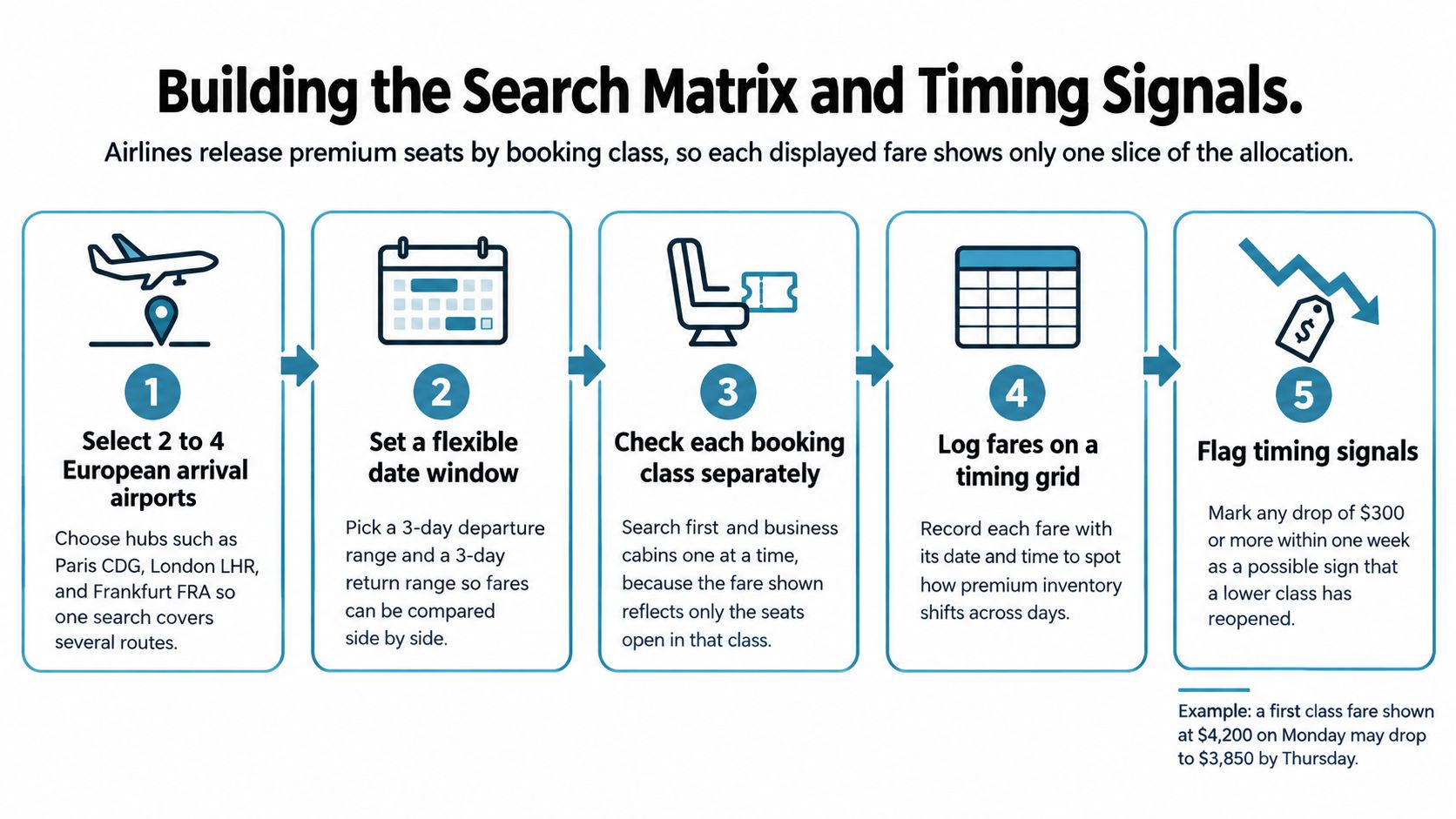
Discountable seat A seat the carrier may mark down because the cabin would otherwise depart with empty seats Watch for bursts of fare corrections and set an alert

Discountable is a possibility, not a published entitlement. An airline may prefer to hold inventory for a late-paying customer, sell an upgrade, or depart without filling the cabin rather than release a lower fare.

Consider a traveler who searches a nonstop flight and then searches the same long-haul segment as part of a connection. The quotes may differ because the airline prices the complete journey, not just the chair on the long sector. Direction, departure date, fare basis, and connecting segments can all affect what the airline offers.

Test the ticket behind the headline

A guide to business-class seat availability is useful for separating what appears on a map from what can be booked. The decisive test is whether the itinerary prices and tickets in the intended cabin under acceptable conditions.

Before treating a low quote as a buying opportunity, inspect its construction.

  • Cabin mix: Open every segment and identify where the premium cabin applies.
  • Travel window: Confirm that the advertised fare covers your usable dates, not merely an inconvenient departure.
  • Fare conditions: Read refund, change, no-show, and reissue provisions.
  • Journey structure: Compare the full round trip, including connections and airport changes.

Waiting can be sensible if your dates are flexible and acceptable alternatives remain. It can be expensive if a fixed meeting or family commitment leaves no fallback. An alert supports a buying decision; it doesn't guarantee that an airline will discount your flight before you need to book.

When Business Class Costs Less Than Coach

Business class can cost less than coach. The inversion is unusual, but it can occur when an airline discounts premium fares while economy remains expensive on the same travel dates.

A fare correction may reflect an airline's effort to stimulate demand for unsold premium seats. It may also be a broader promotion or a pricing mistake, so the low price alone doesn't establish why the airline offered it.

What published sale prices demonstrate

Going puts common long-haul business-class pricing at about $3,000–$5,000 round trip, gives a Los Angeles–Paris sale example falling from around $3,000 to approximately $2,000, and notes rare mistake fares as low as $300.

Those examples represent different buying situations. A conventional sale is a more realistic planning target than a mistake fare, which shouldn't become the assumed budget for an essential trip.

Transatlantic business-class sales regularly appear at roughly £1,200–£1,800 return, less than 40% of standard business fares, according to Airlines and Destinations. Such a discount establishes that premium pricing can move sharply, but it doesn't prove that economy was more expensive on every listed departure.

DealNews has recorded round-trip business promotions starting at $1,629 to Europe, $2,739 to Asia, and $2,129 to Africa, with advertised savings up to 70%, involving carriers including American Airlines, British Airways, Turkish Airlines, Japan Airlines, Philippine Airlines, and Emirates.

Compare the actual alternatives

The relevant comparison isn't a sale fare against an airline's expensive reference price. It's the complete premium ticket against the economy ticket you could buy for the same trip.

Comparison Why it matters
Same travel dates and airports Avoids comparing a flexible holiday fare with a fixed-date business trip
Equivalent baggage needs Economy extras can change the total
Usable connection times A cheaper ticket can impose an unacceptable layover
Relevant change conditions Flexibility may matter more than the cabin
Premium cabin on the long flight Prevents a short premium connection from disguising economy long haul

Buying insight: When a business sale undercuts your usable coach fare, compare ticket conditions before assuming the cheaper cabin is the more economical choice.

None of these published examples is a live quote or proof of a current first-class bargain. They establish a narrower, useful point: airlines don't maintain a fixed relationship between economy and premium prices.

For a traveler shopping international first class seats, that matters because the best-value correction may appear in business instead. Rejecting it solely because the original goal was first class can mean paying more without solving any additional travel need.

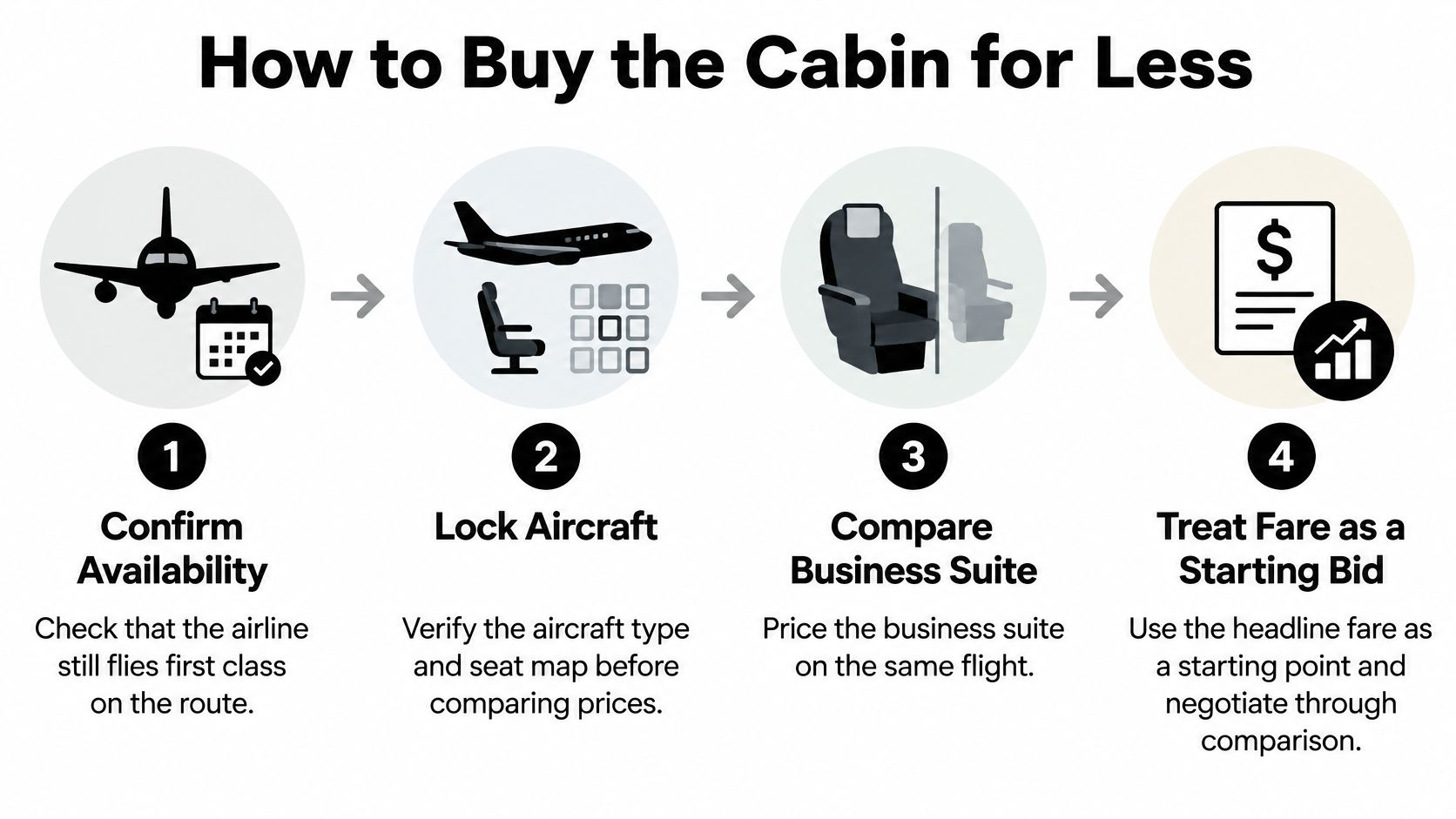
How to Buy the Cabin for Less

Treat the first price you see as a benchmark to investigate, not a value judgment. Most travelers won't negotiate directly with an airline, but they can change dates, compare products, monitor competing carriers, and buy when an acceptable fare appears.

The buying sequence starts with confirming what is for sale.

A four-step infographic explaining how to find and negotiate cheaper international first-class airline cabin fares.

Build a purchase shortlist

  1. Confirm the operating product. Find the operating carrier, aircraft type, and seat map for each long-haul segment. Record which features justify considering first class, rather than relying on the cabin name in search results.

  2. Price the business alternative. Use the same dates and acceptable airports. Keep a first-class candidate only when its additional space, service, or ground arrangements address a real preference or requirement.

  3. Choose your monitoring method. Airline alerts, flexible-date searches, and a specialist membership are options. Passport Premiere monitors premium-cabin fare cycles, fare wars, and buying events; its international first-class tracking information explains the monitoring approach, and travelers should review published membership fees before joining.

  4. Set a decision threshold. Decide which itinerary, cabin, conditions, and total price you would accept. A clear threshold helps you act on a suitable fare without buying merely because an advertisement calls it a sale.

Time the search without depending on luck

SmarterTravel identifies January and February as slower long-haul months, describes British Airways and Virgin Atlantic promotions around Black Friday and Cyber Monday, and outlines upgrade bidding on Air Canada, ANA, Cathay Pacific, Etihad, Lufthansa, Qantas, and Virgin Atlantic, with results arriving a few days before departure.

  1. Use seasonal windows as search prompts. Check departures you can use rather than reshaping the whole trip around a promotional headline. A calendar event is a reason to compare prices, not a promise of a bargain.

  2. Read the rules before payment. Verify change and cancellation terms, ticketing deadlines, baggage, lounge access, and every segment's cabin. Reject a mixed-cabin itinerary if the long flight doesn't provide the comfort you're buying.

  3. Keep upgrade bids as a backup. Eligible travelers generally buy economy, receive an invitation, and submit a bid above the carrier's minimum. Only use that route if you're willing to take the original economy seat when the bid fails.

For corporate bookings, retain the fare conditions and approval rationale with the itinerary. For leisure travel, make sure everyone in the party accepts the fallback before relying on a speculative upgrade.

Book First Class Only When the Extras Pay

Buy first class when the aircraft provides the space you want, the ticket includes useful extras, and the fare is acceptable against realistic alternatives. A discounted fare strengthens the case, but a traveler with fixed needs may reasonably pay more for certainty rather than wait for a correction that never arrives.

Apply a simple purchase test:

  • The product qualifies. The scheduled aircraft has the enclosure, sleeping surface, and layout that motivated the purchase.
  • The inclusions qualify. The lounge, transfers, service, or baggage benefits you value apply to your fare and airports.
  • The price qualifies. The difference from a suitable business ticket is worth those additional benefits to you.

For a corporate manager, the justification should be explainable to the budget owner. For a leisure traveler, enjoyment is a legitimate benefit, provided it fits the trip's spending priorities.

Don't let the search for exclusivity replace the original purpose of the journey. A convenient business suite can be a better purchase than an exceptional first-class seat attached to a poor schedule.

Make the final check before payment

Reopen the operating flight details and compare the final ticket total with your chosen alternative. Confirm the rules, save the product description, and check that the premium cabin applies where it matters.

Then book the option that wins on total value. The right purchase may be first class, but it doesn't have to be.


Passport Premiere offers premium-cabin fare monitoring and market analysis for travelers comparing international business and first class. Visit Passport Premiere to review its membership options and decide whether purchase-timing intelligence fits your next long-haul trip.

Business vs First Class International Flights Compared

The usual advice treats business vs first class international flights as a simple ladder: skip both, or pay whatever the airline asks because the front of the plane is always worth it. That advice compares the wrong tickets. It sets a restricted coach fare against a flexible premium fare, then declares a winner from the gap. On equal conditions, that gap shrinks, and on some filings it reverses, so business class cheaper than coach is a real booking outcome, not a slogan.

A premium cabin is a yield product. Airlines price it against remaining seats, corporate demand, and the rules attached to the ticket, not against the cheapest basic-economy bucket on the screen. First class is the smaller, more exclusive tier. Business class is the cabin that scales across long-haul fleets. The useful question is whether this aircraft, on this route, on this fare basis, buys a horizontal bed and a workable ground plan for less than a flexible coach ticket that already includes changes, bags, and a refund.

Business and First Class Side by Side

Business class is the mainstream premium cabin on long-haul widebody aircraft. First class is a smaller, route-specific product that offers more privacy and a richer ground package. The label on the ticket is a weak predictor. The seat map on the aircraft assigned to your flight is the one that matters.

Criterion Business Class First Class
Seat layout Lie-flat, usually 1-2-1 or staggered, direct aisle access for most seats Enclosed suite on the few airlines and aircraft that still fly it
Bed and width Seat width commonly 20–22 inches, bed length near 78 inches Wider and longer on flagship suites, unpublished as a single industry standard
Privacy Partial, sometimes a door on newer suites, denser cabin Full enclosure in most suites
Dining and service Full meal service, lounge access on most carriers Multi-course dining and more personal service on some airlines
Ground benefits Lounge access and priority check-in on most carriers Chauffeur, private lounge or shower on select airlines
Availability Nearly all long-haul widebody aircraft Shrinking, limited to a small set of aircraft and routes
Typical long-haul round-trip price Commonly $3,000 to $5,000 in published fares Above the business fare on the same route and aircraft

On a real overnight sector, the business row is a sleep product, not a bigger recliner. AeroCorner's cabin comparison describes common 1-2-1 or staggered layouts with direct aisle access, seat widths typically around 20–22 inches, and bed lengths commonly near 78 inches. Published specs still swing. Some business seats are angled-flat rather than fully horizontal, and dimensions can span roughly 18–23 inches in width and 55–65 inches of pitch or bed space.

Three checks before you trust the cabin name

Run the same three checks on every itinerary, whether the fare says business or first.

  • Horizontal surface: The bed has to go flat, not merely recline. An angled-flat seat on a 10-hour sector is a different product from a true lie-flat.
  • Aisle for every passenger: A window seat that climbs over a neighbor at 3 a.m. erases much of the sleep you paid for.
  • Aircraft type on this flight: A door suite on one airframe and an older open seat on the next departure are not the same purchase.

A newer business suite with a privacy door narrows the gap with first class, but the cabin stays denser and less individualized. First class still pulls ahead when the hard product is a fully enclosed suite, the service ratio is higher, and the ground package adds a lounge shower or a chauffeur on that airline. If you want the product definition before you price it, what first class air travel actually includes is the cleaner starting point than a brand brochure.

The first-class seat is leaving the schedule

That advantage is available on fewer departures every year. Industry coverage of fleet redesigns reports more than 40% fewer scheduled first-class seats in 2024 than in 2019, with fewer than 20 airlines still operating dedicated first-class cabins. Delta, United, Cathay Pacific, British Airways, Lufthansa, Qatar Airways, and Emirates have all cut or restricted where first class flies.

Booking rule: Compare the cabin the exact aircraft on the exact route offers. A first-class ticket can be rebooked onto a different configuration after an aircraft swap, and the suite you paid for may not be the seat you board.

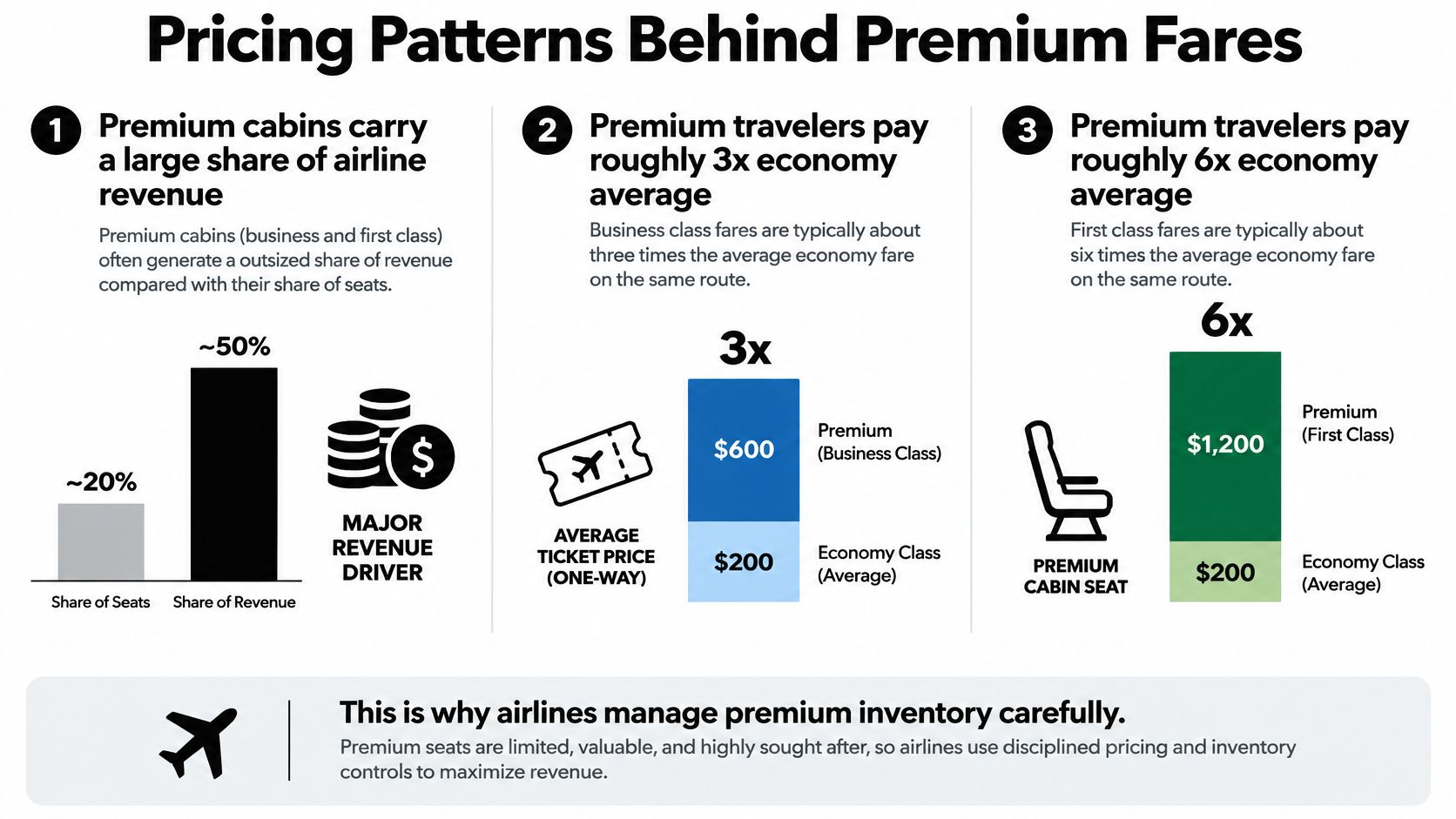
Pricing Patterns Behind Premium Fares

Premium cabins carry a share of revenue that has nothing to do with how many people sit in them. In the first eight months of 2017, premium passengers were only 5.2% of international origin-and-destination passengers but generated 25.5% of airline revenue, because those travelers paid approximately three to six times more than economy passengers on average, according to IATA's premium-demand note. That yield is why inventory is held back, not dumped into the cheapest public bucket.

An infographic showing how premium airline cabins generate significantly more revenue compared to economy class seats.

The same yield logic does not freeze the public fare. Three patterns show up in published prices: error filings, promotional sales, and ordinary routes where the gap was never wide.

Route or Scenario Premium Fare Comparable Economy What Drove the Gap
Long-haul business, standard published fare $3,000 to $5,000 round trip Often one third to one sixth of that premium fare Normal premium pricing on long-haul routes
Long-haul business, mistake fare About $300 round trip Often above $300 on the same route Airline or booking-system pricing error, may be cancelled
Chicago to London, American Airlines business $2,389 Not published next to the sale fare Promotional sale, reported less than 50% below the 2019 price
New York to Paris, La Compagnie business $1,662 Not published next to the sale fare Promotional sale, reported about 68% below the 2019 price
New York to Vienna, Austrian Airlines business $1,861 Not published next to the sale fare Promotional sale, reported about 70% below the 2019 price
Madrid to Athens, Iberia business £562 £454 Narrow normal gap of £108
Tokyo to Seoul, business About £289 above economy The lower fare on that city pair Narrow normal gap on a short premium route

Error fares undercut coach

Going's business-class fare guide puts long-haul international business class at about $3,000–$5,000 round trip in ordinary filings. A mistake fare, an accidental airline or booking-system error, can cut that to roughly $300, sometimes a discount of up to 90%. A typical economy ticket on the same route can cost more than $300, so the misfile is cheaper than coach. Airlines may cancel obvious pricing errors. Treat the ticket as unconfirmed until it tickets and stays ticketed.

A short look at how those filings move through a booking screen makes the cancellation risk easier to spot.

Sales and short-haul gaps

Promotional sales are deliberate, not errors. Lifehacker's roundup of premium sales listed Chicago–London on American Airlines at $2,389, New York–Paris on La Compagnie at $1,662, and New York–Vienna on Austrian Airlines at $1,861. Those prices sat less than 50%, about 68%, and about 70% below comparable 2019 business prices. The comparison is against older premium fares, not against that week's coach fare, so the coach gap has to be checked on the same dates.

Normal pricing can already be tight. A Holidu fare comparison found Iberia Madrid–Athens at £454 in economy and £562 in business, a difference of only £108. On Tokyo–Seoul, the business fare was only £289 more than economy. These rows mix error fares, sale fares, and ordinary published fares. They are not interchangeable, which is why the next comparison has to hold the rules constant.

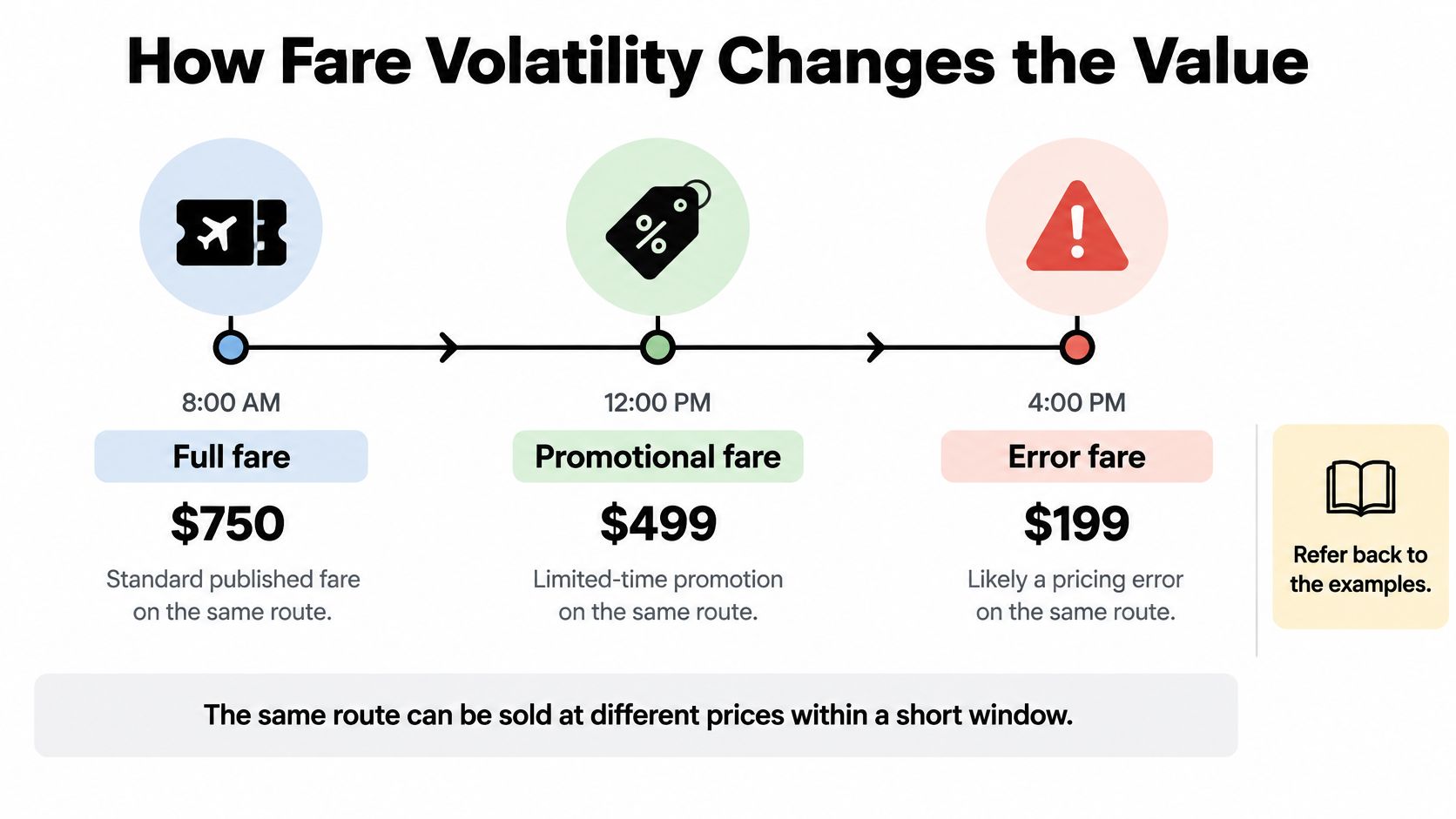
How Fare Volatility Changes the Value

A premium fare is not a posted price that sits still until you buy. The same city pair can be sold as a full fare, a promotional fare, or an error fare inside a short window. The American, La Compagnie, and Austrian business sales sat well below 2019 levels because the airlines chose to discount. An error fare is different. It can vanish, and the carrier can cancel it.

A diagram illustrating how airfare volatility changes the price of the same route over four hours.

A booking window, not a schedule

Think of one long-haul round trip over a few weeks, not a smooth curve you can time.

  1. Full fare first. Inventory opens at a published premium level. Corporate buyers who need a refundable ticket often pay here because the meeting date is fixed.
  2. A promotional window. If forward bookings look soft, the airline files a lower business bucket to fill the cabin. That window is a choice by revenue management, not a calendar you can mark.
  3. An error, if one appears. A bad filing can undercut coach for hours. It is not a sale, and it may never reticket.
  4. A late move. Close to departure the same seat can rise if the cabin fills, or fall again if it does not. Neither move is predictable from last month's price.

A full-fare economy ticket can drift toward business pricing on the same dates, because the buyer is paying for changes and bags rather than for a bed. The cheapest cabin on the screen then changes with the day and the rules, not with the word "business" or "economy" in the header.

What a lower fare cannot repair

Volatility does not fix the product after you pay. An aircraft swap can replace a door suite with an older open business seat. Rebooking rules on a discounted premium fare are often stricter than the flexible coach fare people use as the benchmark. A cheap business ticket with no changes is a different asset from a flexible one.

Waiting pays off only when the cancellation and change rules let you refund or rebook without a penalty. Fare alerts help only after the cabin and the route are already chosen.

Tools that watch those filings, including a membership fare monitor from Passport Premiere, are useful once that choice is made. They do not tell you which cabin to want. For a plain read on what a forecast can and cannot do, airline fare prediction is worth separating from a hunch that "prices always drop on Tuesday."

Which Cabin Fits Each Traveler Profile

The right cabin follows the trip's purpose and the cost of a lost productive hour, not the prestige of the boarding group. A suite that does not change how you work the next morning is an amenity. A bed that does is an operating cost.

Traveler Profile Usually Better Fit Deciding Factor
Corporate travel manager under a fare policy Business Total trip cost per productive hour and policy compliance
Frequent long-haul consultant on back-to-back meetings Business Horizontal bed and a consistent aircraft type
Overnight traveler arriving for a morning meeting First if the route offers a suite with shower or chauffeur, otherwise Business Whether ground benefits replace an expensive transfer
Leisure traveler on a celebration trip First on routes with a strong suite and ground package, otherwise Business Value of the ground package versus the fare gap
Traveler who can book a discounted business fare Business Business fare is at or below a flexible economy ticket

Where first class still clears the bar

Managers should price the whole trip, not the cabin brand. Policy compliance fails when a first-class receipt cannot be tied to a meeting that a lie-flat business seat would have covered. Consultants on back-to-back sectors care more about a horizontal bed on a consistent aircraft than about a private dining room they will sleep through.

First class is more often rational on an unusually long overnight route, where a suite plus a shower or chauffeur replaces a paid transfer and an early hotel. If business already gives a true lie-flat bed and direct aisle access, the extra spend mostly buys seclusion. Leisure trips follow the ground package. A celebration flight with a weak suite and no useful arrival service is a poor place to pay the first-class gap.

This is no longer only a corporate question. ABC News reporting on premium revenue says non-economy passengers generated nearly half of global airline industry revenue in 2025, and global searches for first- and business-class flights rose 99% year over year in the first half of 2026. More than four in ten premium bookings in the second half of that year were long-haul. Leisure and mixed-purpose trips now move the same inventory companies bid on.

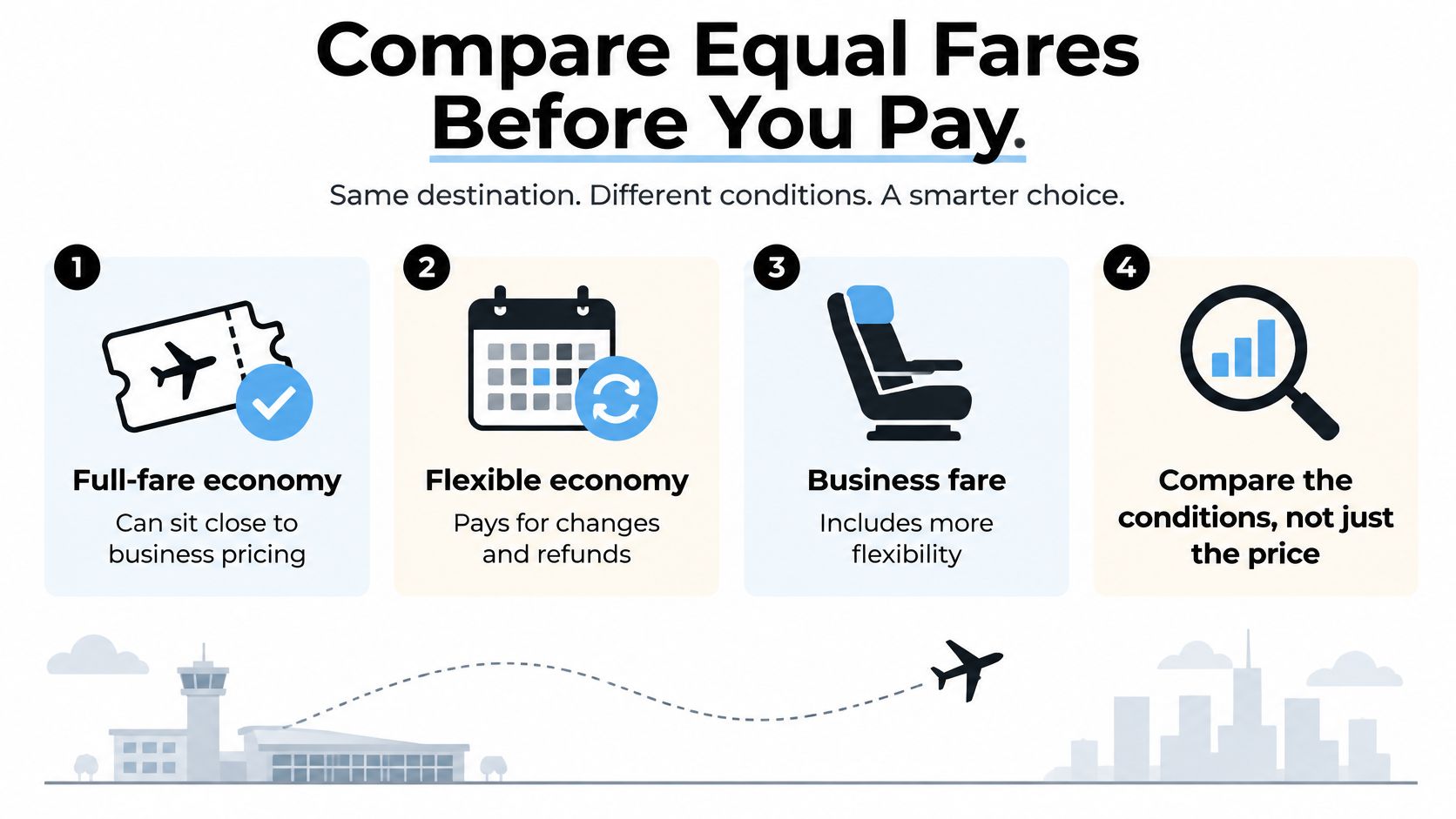
Compare Equal Fares Before You Pay

The comparison fails when the tickets carry different conditions. Point.me's fare guidance notes that full-fare economy tickets may sit very close to business fares, because the buyer pays for flexibility, changeability, baggage, and other inclusions rather than only the seat. A discounted business ticket can then cost less than unrestricted coach and still cost more than basic economy. Those are three different products.

An infographic illustrating four tips for comparing airline fare conditions, including economy and business class options.

  1. Match dates, route, and airline. A Tuesday nonstop is not a Saturday one-stop. The common error is grabbing the lowest coach fare on a different day.
  2. Match refundability and change rules. A flexible economy fare is not basic economy. People understate coach by using the restricted bucket.
  3. Confirm baggage in each cabin. A "cheap" coach fare plus two paid bags can close on a business fare that includes them.
  4. Pull the seat map for the assigned aircraft. The airline's general business-class page is not your flight. Check the tail scheduled.
  5. Read the cabin on the ticket and the swap risk. Note whether a schedule change can move you to another configuration without a refund.
  6. Add ground costs. Lounge access, transfers, an early hotel, and the value of a rested arrival belong in the total. A practical way to line those up is to budget the trip as one number, not as a fare plus surprises.
  7. Flag mistake-fare risk. If the price only exists because of a filing error, assume it can be cancelled before you build a nonrefundable hotel around it.

Choose the Cabin That Fits Your Trip

Book business when the seat is fully horizontal, every passenger has aisle access, and the fare sits within reach of a flexible economy ticket on the same dates. Book first class when that exact aircraft and route deliver a clearly better suite and a ground package that closes a real cost, such as a transfer or a lost morning. Wait for a lower fare only when the change rules allow a rebooking without a penalty.

The numbered checks above are the last pass before you pay. Once the cabin is settled, read the cancellation rules on that fare basis and set an alert on the chosen route, not on a vague "premium" search.

Arrival logistics belong in the same total. On New York trips, travelers who compare fleets for Hamptons airport transfers can see whether a chauffeur-included first-class ticket replaces a car they would have booked anyway. Make the call trip by trip. Brand loyalty and the prestige of the cabin do not price the seat.

The cabin label predicts less than the seat, the fare conditions, and the aircraft.


Passport Premiere tracks international business and first class fare cycles and shows members when a premium seat is priced below its opening ask, including cases where that seat undercuts coach on equal rules. If you are pricing a long-haul cabin against a flexible economy ticket, review the fare monitor and membership details at Passport Premiere before you lock the booking.

First Class Flight Deals to Europe: A Fare-Timing Playbook

Forget the advice to book on a particular weekday and grab any premium fare that looks discounted. Finding first class flight deals to Europe takes a more useful discipline: treat the lowest price as a hypothesis, then test it against comparable routes, ticket restrictions and the cost of a disrupted journey. A cheap seat isn't automatically a good purchase, and an expensive economy ticket isn't automatically the sensible alternative.

What a Fair First-Class Price Looks Like for Europe

The lowest premium fare is a starting point for comparison, not proof of a good deal. In Holidu's global-airline route comparison, Iberia's Madrid–Athens sample priced economy at £454 and business at £562, a £108 gap, about 24%. Across its global sample, business averaged 250.19% above economy. The contrast shows why one premium multiplier cannot set a fair price for every route.

These are business-class benchmarks, not a forecast for transatlantic first class. A separate measure offers context for corporate travel: European companies' average business-class ticket reached €3,867 in 2023, up 7% year over year, according to AirPlus figures reported by Hospitality Today.

Premium-to-coach gap on Europe-linked benchmarks

Benchmark Economy Business Gap
Madrid to Athens, Iberia sample £454 £562 £108 (about 24%)
European corporate average business ticket, 2023 Not reported €3,867 Up 7% year over year

Read the gap, not the headline

Set a route baseline by comparing the same city pair, travel dates, journey direction and currency. Price economy, business and first class as separate products, and include nonstop and acceptable connecting itineraries. A fare only looks unusually low relative to a like-for-like option.

For additional context, first class airfare ranges for 2026 and this guide to the cost of flying first class can help frame the purchase. Compare any broad range with live fares for your route, then check the fare rules and the consequences of a disruption before treating the cheapest result as a deal.

Use these working thresholds as prompts for closer review, not as statistical predictions:

  • Below 30%: Check premium availability daily.
  • At least 100%: The premium is substantial. If your schedule permits, wait for a meaningful reduction.
  • Between those thresholds: Track fares for two weeks before deciding.

Calculate the gap by subtracting economy from business, dividing by the economy fare, then converting the result to a percentage. Keep today's lowest economy fare, today's lowest business fare and the gap between them together. Recheck them when dates or routing change; a lower headline fare may come with restrictions that change its practical value.

Building the Search Matrix and Timing Signals

Airlines don't price premium cabins as a single product with a predictable markdown schedule. They allocate seats across booking classes, opening and closing lower-priced inventory as their demand forecasts change.

The ITU airline revenue-management lecture notes explain that controlled allocation approach and describe an Italian investigation in which purchases occurred, on average, more than 30 days before departure, with 60% of surveyed travelers buying more than a month ahead and 12% during the final week. Those purchasing patterns aren't a premium-fare forecasting model, but they're a useful warning against building your strategy around a last-minute rescue.

Build a grid you can actually maintain

Start with acceptable journeys, not every possible journey. An enormous spreadsheet full of airports you'd never use creates work without improving your decision.

  1. Choose arrival and departure airports. I would begin with two to four European gateways and reachable alternative origin airports. Include Paris if that's your destination, but test other gateways only when the onward journey is practical.

  2. Add competing connections. Search nonstop flights and one-stop itineraries through hubs on other alliances. Don't assume that your preferred airline's connecting fare represents the whole market.

  3. Widen the dates. Try departure and return flexibility of plus or minus three days, including a weekday shift. Keep the length of stay visible so a cheaper fare doesn't secretly require extra hotel nights.

  4. Search cabins separately. Run business and first-class searches in every usable combination. Check the cabin on each segment, especially the long-haul flight, rather than trusting an itinerary-level premium label.

  5. Record the ticket conditions. Log the lowest available booking class, changes, cancellation terms, upgrade eligibility and baggage. If the booking class isn't displayed, mark it unconfirmed and check with the airline before purchase.

  6. Repeat consistently. Price the grid at the same time of day on each run. That won't reveal a magic buying hour, but it makes your observations easier to compare.

  7. Flag the baseline difference. Mark each result above or below its comparable starting fare. Keep nonstop and connecting baselines separate so a routing change doesn't masquerade as a price cut.

Use the process graphic as a workflow reminder, not a forecast of what a particular airline will charge.

A five-step infographic showing how to build a search matrix for finding premium class flight deals.

Separate availability from affordability

An apparently empty cabin doesn't prove that a cheap booking class is available. Airlines can retain unsold seats while withholding lower fares because they expect later customers to pay more.

A seat map is particularly weak evidence. It shows seat assignments, not the complete inventory or pricing decision behind the flight.

Practical rule: Compare a purchasable fare with a comparable baseline. Don't negotiate with a seat map.

Search the entire itinerary rather than adding separately displayed segment prices. Also check the result for the full traveling party, because a fare available to a solo passenger may not price identically for everyone in a group.

Start monitoring at least a month ahead where possible, preferably before your dates become fixed. That's a planning recommendation, not a guarantee that advance purchase will produce the lowest fare. If you're already close to departure, shorten the decision process instead of assuming unsold premium seats must become cheaper.

Read calendar signals cautiously

Buying on a holiday and flying on a holiday are different decisions. A small purchase-day saving can be overwhelmed by a costly travel date.

The fare evidence summarized in Oxera's analysis of airfare drivers includes findings from almost 22 million fares: buying on a holiday was 1.8% cheaper on average, while national-holiday travel carried a 41.6%–82.0% premium and federal-holiday travel a 4.6%–35.0% premium. These are broader airfare findings, not premium-cabin-specific savings promises.

Calendar effects on premium fares

Calendar effect Research figure What to do
Buy on a holiday 1.8% cheaper on average Small effect; never buy on this alone
Travel on a national holiday 41.6%–82.0% premium Move dates off the holiday peak where the schedule allows
Travel on a federal holiday 4.6%–35.0% premium Check holiday-adjacent dates in the matrix
Sharp drop on one premium cabin Possible carrier fare correction Verify the rules, then act if it matches the baseline gap

A sudden reduction deserves investigation, but it doesn't reveal its cause. The airline may have reopened cheaper inventory, adjusted a fare or changed the available itinerary.

Check whether the operating airline, airport, cabin and ticket conditions stayed the same. Act on a timing signal only when it also produces an acceptable baseline gap, never on the calendar alone.

How to Set Alerts and Track Fare Cycles

Monitoring pays off when it reduces manual checking without stripping away context. Google Flights alerts can flag changes in supported searches, while a spreadsheet in Google Sheets or Excel preserves the detail you need to judge them.

Give each alert a decision rule

  1. Set a trigger. For example, choose an alert threshold 15% below the starting business fare, or below a rolling 30-day median once you've collected enough observations. These are sample operating settings, not proven market thresholds.

  2. Limit the active watchlist. I would keep alerts on the top two or three itinerary combinations. Leave weaker alternatives in the spreadsheet rather than filling your inbox with flights you won't buy.

  3. Log each observed change. Record the date, days before departure, weekday, cabin, booking class and final payable price. Preserve unavailable results too, because disappearing inventory matters.

  4. Review the pattern. After a sample monitoring period of four to six weeks, compare when fares dipped and whether the ticket conditions changed. Don't call an isolated reduction a dependable cycle.

  5. Validate promptly. A practical response target is to check an alert within fifteen minutes when you're available. Reprice for your party, inspect the rules and apply your prewritten purchase criteria.

An alert tells you where to look. It doesn't tell you whether the ticket is suitable.

Choose the amount of manual work

A spreadsheet is a free starting point, though you'll still need to collect and interpret the observations. As a managed option, Passport Premiere offers premium-cabin fare monitoring and market analysis; its Fare Monitor demonstration, video gallery and news discuss fare cycles and fare wars, and its website publishes membership fees. Review its approach to international first-class tracking alongside your existing tools.

No monitoring service replaces the rules check. Cached results, limited inventory and a different passenger count can all produce an alert that doesn't survive checkout.

When a Premium Fare Falls Below Coach

In 2007, travelers purchased San Francisco–New Zealand business-class tickets for about US$1,500 instead of approximately US$15,000, a 90% reduction, according to the South China Morning Post's account of mistake fares; the same report describes Cathay Pacific selling first- and business-class tickets at economy-level prices in 2019.

Business class cheaper than coach is possible, but an exceptionally low price still needs scrutiny. Incorrect currency conversions, omitted fuel surcharges and programming errors can produce fares that weren't intended as promotions.

Going's business-class guide describes mistake fares as potentially up to 90% below usual prices, with some business itineraries advertised for as little as US$300. Those examples aren't standing offers to Europe.

Respond quickly without committing blindly

  1. Compare with your baseline. An extreme outlier across otherwise comparable itineraries deserves immediate attention. Cheap alone doesn't prove an error.
  2. Read the restrictions. Check refunds, changes, passenger details and the actual cabin before paying.
  3. Book promptly if acceptable. A same-day decision is sensible because the airline can correct the fare. Don't treat availability as guaranteed while you deliberate.
  4. Save the evidence. Keep the confirmation, ticket details and a timestamped screenshot of the displayed fare.
  5. Confirm with the airline. Verify that the reservation is ticketed, check it again before departure and avoid non-refundable downstream purchases until you're comfortable with its status.

The distinction between a genuine bargain and a misleading comparison also matters when evaluating first class cheaper than economy. Compare equivalent dates and conditions, not discounted premium against an unrelated flexible coach fare.

Mistake fares are rare, short-lived and unpredictable. Keep them as an opportunistic check, not the foundation of a necessary business trip.

Judging Whether a Cheap Fare Is Really a Deal

Say the lowest business fare includes a tight connection before a client meeting. A missed flight could mean losing the meeting and paying for an overnight stay, making the headline saving irrelevant.

Evaluate the operating carrier, not just the airline selling the ticket. Then assess EU-departure eligibility, connection time against the airport's minimum connection requirements, alternative departures, rebooking options, lounge access and potential hotel support.

Price the disruption exposure

Give extra scrutiny to separate-ticket connections. Don't assume the airline operating the long-haul flight will protect an independently booked onward journey, and don't confuse lounge admission with a promise of accommodation during disruption.

Under EU Regulation 261/2004, passengers departing an EU airport generally have rights to assistance and, where applicable, reimbursement or rerouting following qualifying disruptions; the EU air-passenger-rights guide sets out conditional compensation bands of €250, €400 and €600 and explains that an airline cannot charge extra when it reroutes a passenger into a higher transport class.

EU261 fixed compensation bands by flight distance

Flight distance (EU261) Fixed compensation What to check
Up to 1,500 km €250 Confirm the departure point and operating carrier
Intra-EU flights over 1,500 km, or other flights of 1,500–3,500 km €400 Check whether rerouting reduced the arrival delay
Other flights over 3,500 km €600 Keep rebooking records and receipts

Compensation isn't automatic for every cancellation or delay. Eligibility and exceptions matter, and compensation can be reduced when rerouting limits the arrival delay, so preserve receipts, notifications and rebooking records.

Normalize the gateway comparison

Price the same city pair through competing gateways. Add positioning flights, ground transfers, baggage, change restrictions and any accommodation needed to make the routing usable.

The cheapest fare is worth paying more than only when the cheaper journey still works.

A slightly dearer nonstop or EU-origin itinerary can be the better purchase when it reduces misconnection risk and improves applicable protections. Assess each direction separately rather than assuming the entire return trip has identical coverage.

Deciding Whether to Book Now or Keep Watching

The lowest first-class fare is a hypothesis, not a verdict. For a trip from a US city to Paris, business class starts at a 180% premium over economy. The traveler compares three gateways and two date windows, then sets alerts for the two strongest combinations.

In week three, an alert shows a business fare well below its starting baseline. Before booking, the traveler checks fare rules and the long-haul cabin, then uses Passport Premiere's Fare Monitor and market analysis to judge whether the drop looks like a carrier correction and how the fare compares with the estimated market value of an empty premium seat.

Apply a purchase gate

A lower fare still has to work for the trip. Market analysis helps assess the price, while connection exposure and recovery options determine whether the itinerary is practical.

  • Book when the gap qualifies. The fare meets the threshold set before the alert arrived.
  • Require usable changes. The rules provide the flexibility the trip needs.
  • Pass the disruption check. Connections and recovery options fit the traveler's commitments.
  • Preserve planning time. Under this traveler's rule, departure is more than a month away.

If any condition fails, keep watching while an acceptable fallback remains available. Check Passport Premiere's published membership fees before joining, and leave time for organizing passports and visas before departure.

Passport Premiere provides international business- and first-class fare monitoring, market analysis and guidance on premium-cabin buying opportunities. Review its Fare Monitor demonstration and published membership fees at Passport Premiere to decide whether managed monitoring fits the trip.

SFO to HYD Business Class Fares and How to Save on Them

The usual advice for SFO to HYD is to find the cheapest fare and book before it disappears. That's incomplete advice for a journey where a poorly timed connection can undermine the comfort you paid for. The better question is what the fare buys across the entire trip: usable sleep, manageable transfers, consistent seating, and an arrival time that works.

Business class cheaper than coach. Treat that as a proposition to test, not a promise. A credible comparison uses the same itinerary and booking moment, then accounts for baggage and fare rules. Otherwise, an apparent bargain may only compare different trips.

Routings, Hubs and Connection Risk

There's no regular nonstop SFO to HYD service, and KAYAK's route guide puts the city-pair distance at roughly 8,400 miles. Every practical fare comparison therefore needs to include the connection, not just the long-haul seat.

Cathay Pacific's route page describes roughly 14 to 15 or more weekly connecting options in each direction and advertises about 21 hours 45 minutes outbound, versus about 21 hours 15 minutes returning. Those aren't nonstop frequencies, and the directional difference reflects winds and schedule construction rather than a different geographic distance.

Compare the itinerary, not just the hub

Singapore Airlines reported daily one-stop service through Singapore in 2026, with typical journey times of 21 hours 35 minutes to 22 hours 5 minutes. Treat that as a dated schedule statement, not a guarantee for every future departure.

Indian Eagle's route guide reports an average Doha connection of about 1 hour 38 minutes and identifies Dubai with the shortest average one-way journey, roughly 21 hours 45 minutes. These measures aren't interchangeable: a connection interval isn't a total journey time.

SFO to HYD routings by connecting hub

Routing via Example carriers Typical elapsed time Connection note
Hong Kong Cathay Pacific About 21 hours 45 minutes SFO to HYD Reverse about 21 hours 15 minutes
Singapore Singapore Airlines 21 hours 35 minutes to 22 hours 5 minutes Daily one-stop service reported in 2026
Doha Qatar Airways Check the complete dated itinerary Average connection about 1 hour 38 minutes
Dubai Emirates About 21 hours 45 minutes average one-way Shortest average one-way time in the cited schedule comparison
Frankfurt Lufthansa Check the complete dated itinerary European hub, check transit and visa rules
Delhi or Mumbai Air India Check the complete dated itinerary Indian domestic connection before reaching HYD
Two-stop routing Carrier combination shown at checkout Can approach 28 hours or more Greatest transfer exposure among these choices

KAYAK's connecting-itinerary guide describes one-stop elapsed journeys near 21 to 23 hours, while poorly timed two-stop itineraries can approach 28 hours or more. The table deliberately leaves unverified hub-specific durations to the dated booking results rather than assigning an unsupported average.

Doha's short transfer can be attractive when everything operates on time. It also leaves less room for an inbound delay, gate changes, or baggage transfer. Hong Kong, Singapore, and European routings may offer longer buffers, but inspect the actual flights rather than assuming the airport name guarantees an easy connection.

Protection matters more than lounge quality

A protected connection and a self-transfer aren't equivalent purchases. On a through ticket, the airline's applicable terms govern disruption handling; with separate tickets, you may have to arrange replacement travel yourself. Confirm the ticket structure rather than relying on a booking website's single checkout screen.

Use this explanation of how connecting flights work to distinguish through-ticket transfers from arrangements requiring baggage collection and recheck. For an Indian domestic connection, establish where immigration, customs, and any baggage procedures occur before judging the transfer interval.

Practical rule: A premium seat doesn't compensate for a connection you can't comfortably complete.

Before comparing prices, apply this protection checklist:

  • Elapsed time: Sort by the complete journey, including airport waits.
  • Ticket protection: Confirm the flights form a protected itinerary, not an undisclosed self-transfer.
  • Transfer buffer: Use at least two hours as a personal planning preference for international transfers, not an official airport minimum.
  • Transit eligibility: Check current requirements for your passport, terminals, and routing.
  • Checked bags: Obtain the baggage-routing instructions, including any collection requirement.
  • Overnight timing: Identify airport nights, terminal closures, and accommodation needs.
  • Arrival readiness: Leave room to reach your hotel and sleep before important work.

The best connection isn't automatically the shortest. It's the shortest one that fits your documents, baggage, tolerance for disruption, and arrival commitments.

What Business and First Class Fares Cost on SFO to HYD

Quoted fares are snapshots, not fixed prices. The observed premium-to-economy gap is substantial, but the examples don't establish what either cabin will cost for your dates.

The chart isolates an observed economy starting point rather than presenting a live fare comparison.

A horizontal bar chart showing round trip airfare costs from San Francisco to Hyderabad for various classes.

What the observations actually establish

Cathay Pacific's fare display showed economy round trips from USD 1,039 for several February to March 2027 combinations and business from USD 3,420 for November 10 to 16, 2026, about 3.3 times the economy starting fare. These are advertised travel-date examples, not forecasts or confirmed availability, and the differing dates prevent a like-for-like verdict.

Observed SFO to HYD fare points

Cabin Observed starting fare (USD) Travel dates Source
Economy round trip 1,039 Several February to March 2027 combinations Cathay Pacific SFO to HYD page
Business round trip 3,420 November 10 to 16, 2026 Cathay Pacific SFO to HYD page
Business round trip 4,294 Not specified in the quoted observation KAYAK business page, deals seen within the previous 72 hours
Business round trip, Air India 3,824 Not specified in the quoted observation KAYAK business page
First class No verified quoted fare No verified travel dates No supported first-class price observation

The KAYAK entries are recent observations, not standing tariffs. None of these examples documents business undercutting economy on an identical itinerary.

There's also no verified first-class figure to use as a benchmark. Compare the fare families offered on the booking page, and inspect what cabin each segment includes.

When a lower business fare would count

A temporary promotion, unusual inventory, or fare correction could make business cheaper than an expensive coach option. That possibility isn't evidence that it happened here. Confirm matching dates, flight numbers, baggage requirements, change conditions, and cancellation terms before declaring an undercut.

For a broader search framework, use this guide to business-class airfare to India. Keep any miles strategy separate from the cash comparison: CreditCardCult's guide to earn 110,000 United miles is a resource for evaluating the advertised offer, subject to current eligibility, spending requirements, and award availability, not proof of an available Hyderabad redemption.

The video offers additional context for evaluating premium-fare opportunities.

Record the business price, the coach price, and business divided by coach. Without those entries for the same search, a low-looking business fare remains an isolated quote.

When to Buy Premium Seats

There isn't sufficient route-specific evidence to name a cheapest month for SFO to HYD business class. Nor do the available fare observations justify assigning premium-demand peaks to festivals, university calendars, or holidays.

Expedia's SFO to HYD route page presents a market spanning Air India, Qatar Airways, Emirates, Singapore Airlines, Cathay Pacific, and Lufthansa, but doesn't establish a dependable premium-cabin buying season. Travelers are comparing different networks and products, not interchangeable seats.

Build a dated buying range

Start with the dates on which the trip can genuinely happen. Searching an unrealistically broad calendar may reveal a cheap fare you can't use, which doesn't improve the purchasing decision.

  • Choose a target window: Include your meeting schedule, hotel check-in needs, and acceptable return dates.
  • Search alternatives deliberately: Try several departure-and-return combinations, plus one or two alternate weeks as a search exercise.
  • Keep a dated log: Save each observation over several weeks when your deadline permits, including the itinerary and fare conditions.

Long-range advertised travel dates show that you can investigate future departures. They don't prove that buying farther ahead always costs less. Likewise, a recent deal observation doesn't tell you how long that fare will remain bookable.

Separate flexibility from compromise

Search flexible dates, open-jaw trips, and nearby Bay Area airports as distinct combinations. For an open-jaw itinerary, include the cost and time needed to travel between the different arrival or departure cities. For another Bay Area airport, include positioning, parking, and any additional connection.

Don't call a fare cheaper until you've priced the travel needed to use it.

Corporate travelers should set their approval deadline before monitoring. If a fare meets the approved budget and itinerary standards, booking can be more defensible than waiting for an unproven seasonal dip.

The useful purchase window is therefore personal: the period during which you can still choose among acceptable trips. Once the remaining alternatives threaten your work schedule or travel policy, the potential saving needs to justify that exposure.

How to Track Premium Fares

Build a fare log that lets you reconstruct the offer. A screenshot of a price alone won't tell you whether the same flights, cabin, or ticket conditions were available when you returned.

KAYAK's SFO to HYD business-class page reported fares from USD 4,294, an Air India option at USD 3,824, and deals available within the previous 72 hours, subject to changing price and availability. That observation window is a reason to timestamp your comparisons, not a promise that a fare lasts that long.

Use a repeatable search record

  1. Pick your exact dates. Add two alternate date sets and nearby Bay Area airports as separate search combinations. Each result must remain identifiable so you don't mistake a different departure airport or extra connection for a price reduction.

  2. Record coach for the identical itinerary. Match flight numbers, departure dates, baggage needs, and the flexibility you actually require. Keep the cheapest acceptable coach fare as your baseline, rather than selecting an unusually expensive flexible fare to make business appear attractive.

  3. Log business with a timestamp. Save the final quoted total, currency, cabin on every segment, booking channel, and fare conditions alongside the observation time. Recheck the payable total before purchase because a search result isn't a completed ticket.

  4. Set a ratio threshold. As a hypothetical personal rule, you might investigate whenever business falls below twice the comparable coach fare, rather than alerting at an arbitrary dollar amount. The KAYAK and Cathay starting prices produce a screening ratio of about 4.1, but their unmatched travel dates make that arithmetic unsuitable as a buying verdict.

  5. Choose monitoring support proportionate to the task. If you follow many international trips, a paid membership can supplement your own spreadsheet and airline searches. Compare its published fees with the savings you realistically expect, and treat a business-class fare-alert service as an option rather than a prerequisite.

The workflow below keeps the search combinations separate and the comparison repeatable.

An infographic titled How to Track Premium Fares displaying five numbered steps with icons for travel planning.

Distinguish a price move from a product change

Add a notes field for equipment, transfer length, and mixed-cabin warnings. If the newly cheaper fare replaces a lie-flat long-haul segment with economy, you've found a different product, not necessarily a better offer.

The same applies when a lower total removes cancellation flexibility that your employer requires. Preserve the original search alongside the replacement so you can identify what changed.

Comparison discipline: A drop is meaningful only when the coach baseline, product requirements, and observation time still match.

A useful alert tells you to investigate. Your saved itinerary and final booking-page checks determine whether there's anything worth buying.

Business Versus Coach on One Trip

Say a consultant is traveling to Hyderabad for a week, carrying two checked bags, and needs to arrive ready for a full working day. Their decision isn't just whether business feels better. It's whether the incremental cost purchases useful rest or avoids a more expensive disruption to the assignment.

The Cathay observations imply a USD 2,381 premium, while pairing the KAYAK business observation with the same economy starting point implies USD 3,255. These are calculations from the displayed fare points, not additional quotes, and neither pairing matches travel dates.

Use the gap as a screen

Business versus coach verdicts by gap

Scenario Coach fare (USD) Business fare (USD) Gap and verdict
Observed Cathay figures, different dates 1,039 3,420 USD 2,381; about 3.3 times coach; screening only
KAYAK listing, recent observation 1,039 4,294 USD 3,255; about 4.1 times coach; screening only
Hypothetical identical dates, same bags Live matched coach total Live matched business total Subtract coach from business; compare the identical itinerary before deciding
Business at or below coach, identical itinerary Confirmed coach total Equal or lower confirmed total No positive premium; book promptly after checking rules

For the consultant, calculate incremental fare divided by additional usable sleep or productive hours. Use a conservative estimate of what the seat and schedule can deliver, not the entire time spent aboard.

Compare that cost with the actual alternative: an extra hotel night, an earlier departure, or a working day the traveler may not be able to use effectively. Don't treat sleep as guaranteed merely because the cabin includes a bed.

Let the itinerary determine the verdict

  • Small gap, meaningful benefit: Business deserves consideration when it improves rest and arrival readiness.
  • Wide gap, little benefit: Coach or premium economy may preserve the budget without undermining the assignment.
  • Business at or below coach: After matching bags, routing, and rules, there's no reason to pay more for the lower cabin.

The ratio helps identify which offers deserve attention. The consultant's schedule, baggage costs, and ability to use the premium product determine the actual value.

Confirm the Fare and Decide Before You Book

Don't buy from the alert alone. Open the complete booking itinerary and verify that the offer you can pay for still meets the requirements you used to assess it.

A premium fare is defensible when you can explain both the price comparison and the operational benefit. A low headline price without those checks is an invitation to buy a different trip than the one you intended.

Check the ticket before payment

  • Comparable total: Match dates, routing, baggage needs, currency, and required fare flexibility against coach.
  • Journey duration: Check the complete outbound and return elapsed times, not just airborne hours.
  • Connection protection: Confirm the ticket arrangement and whether the transfer meets your planned buffer.
  • Cabin consistency: Inspect every segment for mixed cabins and verify the lie-flat product wherever you expect to sleep.
  • Change and cancellation terms: Read the applicable conditions, including any restrictions relevant to corporate approval.
  • First-class availability: Compare the actual fare families offered rather than assuming a first-class option exists throughout.
  • Final payable price: Recheck taxes, fees, and selected extras before authorizing payment.

Apply a buy-or-wait rule

Buy business when the premium is small enough for your budget or when better sleep timing, arrival readiness, and connection quality justify the additional cost. If the gap is wide and the trip gains little, choose coach or premium economy, or continue monitoring while acceptable alternatives remain.

Don't wait just because a lower fare is imaginable. Wait only when you have time, workable backup itineraries, and a threshold that the current offer hasn't met.

Save the search and keep alerts active until you purchase. Today, run the three-number record for your actual dates: coach price, business price, and business-to-coach ratio.


Passport Premiere offers membership-based international premium-fare monitoring and market analysis to help travelers evaluate when to buy. For SFO to HYD, use those signals alongside your matched coach baseline and connection checklist. Visit Passport Premiere to review its approach and membership fees before deciding whether the service fits your travel needs.

Fly Business Class to Australia for Less: A Booking Guide

The popular advice is to hunt for the cheapest business class fare to Australia and book it before it disappears. That's backwards. A low headline price tells you almost nothing until you've checked what you're comparing it against, which aircraft you'll really sit in, and whether the itinerary survives a delay.

When you fly business class to Australia, you're buying sleep, flexibility, and schedule protection on a very long trip. Sometimes business is cheaper than coach. Often it isn't. The difference is in the fare bucket, not the cabin label. Judge the fare the way you'd judge any other purchase, like for like, and walk away when the cheap option fails that test.

Is Business Class Cheaper Than Coach and When to Book

Business can cost less than coach when the comparison is with a flexible or refundable economy fare on the same route, direction, date, and change rules. Against a restricted sale fare, the result can be very different. For an international trip, judge the actual itineraries side by side rather than using domestic prices as a proxy.

Compare fare buckets for your international route

Fare bucket What to check Compare against
Restricted economy sale Changes and refunds may be barred; confirm the rules for the fare Business only if your dates are fixed
Flexible economy Price and permitted changes or refunds for your route and travel dates Business with equivalent change rules
Business sale fare Availability, travel-period restrictions, and change or refund conditions Flexible economy on the same itinerary
International business fare Operating carrier, routing, date, and fare conditions Flexible economy for the same route and dates

A domestic example shows why fare rules matter, but it does not establish what an international fare should cost. In a 2021 Sydney to Melbourne comparison, Virgin Australia business was AUD 299, matching flexible economy at AUD 299. Restricted economy was AUD 78, according to Point Hacks' comparison of airlines for business travellers. The example illustrates a like-for-like result on that route and in that period, not a current benchmark for flying to Australia.

Virgin Australia's advertised business fares are one-way, limited to selected travel periods and availability, and may sell out. Its sale page lists business fares from AUD 219 one way and economy examples from AUD 49, with conditions applying, as set out in Virgin Australia's business class fare specials and conditions. Those figures are not a same-route, same-date comparison, so don't treat them as proof that business beats economy. For an international booking, enter your exact dates and compare the business fare with flexible economy on the same itinerary.

Practical rule: If a restricted economy ticket would leave you exposed when plans change, compare business with the flexible fare you would actually buy.

When to Book

Start comparing as soon as your travel dates and routing are reasonably clear, then check fares again before paying. There is no single booking window that guarantees the lowest international business fare. Sale seats can be limited, and a fare that looks attractive may disappear or apply only to specific travel periods. Set a fare alert if available, and compare the same route and dates whenever you check, so a change in price is not confused with a change in itinerary or fare conditions.

Use this booking sequence:

  1. Set the comparison: Search business and flexible economy for matching dates, direction, and routing. Compare the total fare and change or refund rules.
  2. Check the sale conditions: Confirm travel-period restrictions, availability, and whether changes or refunds are allowed.
  3. Decide on the fare: Choose business when its price and flexibility make sense against the coach fare you would realistically purchase. If not, book the flexible economy option that fits your plans.

A cheaper headline fare is not a saving if its restrictions make it unusable. Make the decision on the ticket rules and matching itinerary, not the cabin label alone.

Routes, Gateways and Curfews That Shape the Trip

A low business fare can become an expensive choice if it sends you through the wrong gateway, leaves you with a separate domestic ticket, or arrives too close to a curfew. Compare the whole itinerary, not just the long-haul seat.

Option Cabin product Routing Best fit
Qantas Perth to London Fully flat 1-2-1 suites on A380 or 787-9 Nonstop since March 2018, about 14,498 km Europe trips that end in Perth
Qantas Sydney, Melbourne, or Brisbane long-haul Fully flat 1-2-1 on A380 or 787-9, some network routes use recliners Nonstop or one-stop by route Trips where the aircraft is checked per flight
Air New Zealand via Auckland Retrofitted 787-9 business cabin, verify the aircraft for your flight Auckland connection Trans-Tasman and onward trips
Virgin Australia via Doha Qatar Airways leased long-haul product, verify per flight Doha connection Europe-bound trips from eastern gateways
Gulf or Asian hub one-stop with separate domestic ticket Varies by operating carrier and segment Two tickets, separate bags and check-in Lowest headline fares, highest risk

Reading the Table by Trip Type

Perth to London became the first regular nonstop service between Australia and Europe in March 2018, covering roughly 14,498 kilometres, as recorded in the Australian War Memorial's aviation history notes. It can suit a trip that ends in Perth. If your meetings are in Sydney or Melbourne, though, you still need a domestic leg after the ultra-long flight. That extra flight can erase the time advantage.

From the east coast, compare a nonstop option where available with one-stop routes through Middle Eastern or Asian hubs. For broader routing context, Amex Global Business Travel's Air Monitor for Australia routing context can help frame the choices. Virgin Australia offers Doha connections using a Qatar Airways leased long-haul product. Check the operating carrier and aircraft on your specific flight rather than assuming every itinerary has the same cabin.

For North American and Asian departures, compare options from your actual origin city. Price the nonstop, then the one-stop, and check what happens after landing in Australia. A separate domestic ticket can lower the headline fare because the long-haul journey ends at the first Australian gateway. You then have separate check-in and baggage arrangements, and you may have to manage a missed onward flight yourself. The distinction between planning multiple leg flights on separate or combined itineraries matters most when you need to be at work the next morning.

A slightly higher fare through a better-timed gateway can be the more economical choice if it avoids a separate ticket and a risky arrival.

Air New Zealand's 787-9 business cabin is being retrofitted, so check the aircraft assigned to your date before paying. Until the retrofit is complete, the cabin can vary by flight. A flight number or an airline's cabin images alone won't confirm the product you'll get.

Curfews Change the Risk Math

Sydney, Adelaide, Gold Coast, and Essendon Fields operate under curfews generally covering 11:00 p.m. to 6:00 a.m. Sydney and Adelaide may allow certain pre-approved international shoulder movements between 5:00 and 6:00 a.m., according to the Australian Government airport curfew manual. Treat that early window as an exception requiring approval, not as a general extension of operating hours.

A schedule that looks efficient can be fragile when arrival sits close to a curfew. If a delay pushes a flight past its permitted window, you may face an overnight disruption. Include that risk in your fare comparison alongside the cabin and connection.

Before paying, check how close each arrival or departure is to curfew hours. Allow for the fact that a delayed flight may not be able to depart as soon as it is ready. Confirm whether an early movement has the required approval, and compare an alternate route through an airport without the same constraint if reliability matters.

For a high-value trip, a better-timed gateway and a protected connection may cost less overall than a cheaper itinerary that risks a hotel night or lost work time. The fare is only one part of the decision.

How to Verify the Cabin Before You Pay

The step-by-step visual below sums up the core check before payment.

An infographic detailing a three-step process to verify your flight cabin and seat before making payment.

Qantas long-haul flying includes fully flat 1-2-1 suites on Airbus A380 and Boeing 787-9 aircraft, while its broader network also includes business products that are recliners rather than lie-flat seats, as set out in Australian Frequent Flyer's Qantas business seat guide. The carrier name doesn't settle the product. The flight does.

The Eight Checks

  1. Write down the flight number and operating carrier because a codeshare can be sold under a different airline name. The operating carrier decides the seat you'll sit in.
  2. Open the airline seat map or aircraft-specific schedule and note the aircraft type for every segment. One unchanged segment proves nothing about the next.
  3. Confirm wide-body, 1-2-1, and fully flat together because that combination is the benchmark, not the words business class. Missing one element changes the overnight product.
  4. Confirm direct aisle access for your seat because layout alone doesn't guarantee the specific seat works as a private suite. Check the seat you've selected, not the cabin average.
  5. Check any domestic Australian leg separately because the international-grade product may not continue to your final city. A lie-flat to Sydney followed by a recliner onward is a mixed product, and you should price it that way.
  6. Inspect the connection airport and minimum connection time because a tight transfer, terminal change, or re-clearance can wipe out a superior overnight segment. This is also where checking business class seat availability segment by segment prevents a sold-out onward leg from surprising you.
  7. Recheck after ticketing because aircraft substitutions happen. A swap from a 787-9 to an aircraft with recliners is the classic failure this step catches, while there's still time to rebook.
  8. Save the operating carrier, aircraft, configuration, and change rules in your trip file because that record speeds up re-accommodation if the aircraft changes. Without it, you're reconstructing your booking on the phone.

Don't pay until steps one to four pass on the overnight segment. That's the segment you're buying business class for.

When to Buy and How to Track Fares

A cheap business-class fare is only a good buy if it beats the flexible coach fare for the same route and dates, and the cabin is worth the difference. Set that comparison before tracking prices, then use a clear trigger to decide when to book.

Situation What to check in your fare search Action Trigger to buy
A sale appears for your route and dates Compare the sale fare with flexible coach and check the fare rules Book if the product and conditions suit your trip Total cost meets your target and the rules work
School holidays or December travel Track available fares for your exact dates; don't assume a general forecast predicts peak prices Compare dates if your schedule allows Buy when an acceptable fare appears
Different aircraft or cabin options Check the operating flight and the fare for each option Choose based on the seat and price you would actually accept The fare and aircraft both meet your requirements
Nonstop flight with few options Compare the fare with alternatives that add a connection Decide whether the nonstop is worth its price The nonstop fare fits your budget and schedule
Fare changes while you track Recheck the same route, dates, cabin and fare conditions Compare like with like before acting The price is acceptable without relying on a predicted trend

What the Demand Data Suggests

Corporate travel bookings in business class rose nearly 5% from September 2024 through August 2025. Amex Global Business Travel projected a 6.1% rise in business-class fares for 2026, according to Karryon's report on travellers moving to premium cabins. That figure is a forecast, not a quote for your route or a prediction about a particular travel period. Use it as context, then make the decision from fares available for your own dates.

IATA data reported 109.7 million passengers travelled in first or business class globally in 2025, up 4.5% year over year and accounting for 5.5% of international travellers, according to Karryon's summary of IATA 2025 air transport statistics. These figures describe overall premium-cabin demand, not the price or availability of a seat on your flight.

BITRE's domestic airfare index covers Australian domestic fares, so it cannot establish whether a long-haul business-class fare to Australia is likely to rise or fall. Keep that comparison separate. Use BITRE domestic airfare data only if you are also assessing a domestic Australian leg.

Fare Versus Aircraft

A lower fare can come with a product you would not choose at the higher price. Check the fare and aircraft for the specific flight you are considering, then decide whether the cabin still meets your needs. For an overnight trip, a discounted fare is poor value if the product is one you would reject at full price.

Choose a target by comparing business class with a flexible coach fare on the same route and date. For trips more than three months away, check prices every few days and follow guidance on when to book business class flights rather than relying on one fixed booking window. Buy when the fare meets your target and its conditions suit your plans. If you are willing to wait, keep comparing the same itinerary and fare type, and be ready to book when the right combination appears.

Tactics That Lower Premium Fares

A four-point list titled Tactics That Lower Premium Fares, offering practical travel tips for finding cheaper flights.

The lowest business fare is only a good buy if it beats flexible coach on the same route and date, and the aircraft and fare rules suit your trip. Use these six tactics to test the product before paying.

  1. Price the origin airport. Compare Sydney, Melbourne, Brisbane, and Perth departures when positioning is practical. The same carrier may price gateways differently, so include the cost and time of reaching another airport in your comparison.

  2. Test one-way against return pricing. Sale business fares may be quoted one way, and a split ticket can cost less than a return on some routes. Compare full totals for identical dates, especially for one-way trips and open-jaw plans.

  3. Read what the sale includes. A reported Virgin Australia promotion offered domestic business from AUD 219 one way and golden-triangle routes at AUD 299. It included priority check-in and boarding, lounge access, reclined leather seating, and onboard dining. Economy started from AUD 49 on selected routes, according to eGlobal Travel Media's report on the Virgin Australia fare sale. Compare the business inclusions with flexible coach, not restricted economy.

  4. Act inside the sale window. Business inventory is limited, and sale fares can sell out. Before buying, confirm the operating aircraft and cabin, then compare the fare with flexible coach on the same route and date. If it passes that test, waiting risks a higher fare or a worse routing.

  5. Consider paid fare monitoring only on the numbers. Passport Premiere tracks premium-cabin fares and signals price movements. Use a service only if the likely saving exceeds its fee over the tracking period. That may suit corporate travel booked well ahead on expensive long-haul routes, but it can be poor value for a short search.

  6. Keep a fallback. Record the flexible economy fare for the same route and date, including its change rules. If the business sale sells out, you can compare the remaining options without rushing into a worse fare.

Put the video after the full list, so it doesn't interrupt the six tactics.

Match the tactics to the trip. Fixed-date corporate travel may favor a timely purchase, while flexible leisure travel can benefit from comparing gateways and one-way fares.

Book the Ticket and Manage the Fare Rules

Once the cabin is verified, the booking itself is a paperwork exercise. Do it in order and you won't create problems you'll pay to fix later.

  1. Search each fare bucket on identical dates because the comparison only holds with the same origin, destination, and direction. Run one search for flexible economy and one for business.
  2. Read the fare rules before paying because one-way or return status, change and refund conditions, and sale-period limits decide what you've bought. Don't infer flexibility from the cabin name.
  3. Choose the bucket that matches your trip because the cheapest label is the wrong buy when your dates may move. Fixed dates can accept restrictions. Uncertain dates can't.
  4. Pay only after recording the operating carrier, aircraft, and seat configuration because that trip file is your evidence if anything changes. Screenshots of the seat map help.
  5. Select seats as soon as the ticket issues because the best seats in a 1-2-1 cabin go first. Recheck direct aisle access on each segment while you choose.
  6. Confirm the issued ticket shows the same operating carrier and flight numbers because codeshare names can differ between search results and the ticket. A mismatch here is worth a call before departure, not an argument at check-in.

File it now: Save the fare rules, receipt, and seat map together, so a later change starts from documents rather than memory.

  1. When a schedule-change notice arrives, recheck the aircraft type at once because a time change often travels with an equipment change. Use the rebooking path in your trip file while alternative seats remain.
  2. For corporate trips, file the fare-rule copy and receipt with the expense claim because finance teams ask why business was cheaper, and the like-for-like comparison is your answer.

If you can show the business fare matched flexible coach, the cabin was verified fully flat, and the itinerary cleared curfew risk, you've bought well. If you can't show those three things, you've bought a story about a cheap fare.


If you'd rather not watch premium fares to Australia every few days yourself, Passport Premiere tracks international business and first class fare movements and helps members judge the market value of an empty premium seat before they buy. Bring your route, your dates, and your flexible coach benchmark, and use that tracking to time the purchase instead of guessing.

7 Business Class Discount Fares That Beat Coach

“Always book early” is too blunt a rule for business class discount fares. Business class cheaper than coach is a documented pricing outcome, not just an upgrade fantasy: a published Virgin Australia comparison showed Canberra–Melbourne economy at A$629 while business on the same departure cost A$449, according to Australian Frequent Flyer's same-flight examples.

When premium costs less than coach, don't automatically assume the airline has mispriced an empty cabin. Separate booking classes and fare restrictions can produce that result even without a mistake. Published comparisons include $575 in economy versus $471 in business, explained through fare construction and available booking inventory.

Think of these opportunities as Business Class Buying Events: periods when an available premium fare deserves comparison with coach, rather than its own previous asking price. Monitoring services, alerts, card programs, and consolidators offer different ways to find them. The following options can help identify opportunities, but none guarantees business below economy on your chosen trip.

1. Passport Premiere

Passport Premiere

Passport Premiere is the specialist monitoring option for travelers who want to understand international Business and First Class pricing before committing. Its membership combines fare monitoring, market analysis, and guidance on premium-cabin fare cycles, including fare drops and competitive fare wars.

That distinction matters because an airline's initial asking price isn't necessarily a useful benchmark. For a corporate travel manager, consultant, or frequent long-haul traveler, the more useful question is whether the available fare represents value for that route, departure period, and set of restrictions.

Monitoring the market, not just the ticket

Passport Premiere's resources include a Fare Monitor demonstration, video gallery, news, and educational material for business, leisure, and around-the-world travelers. These resources make its proposition broader than receiving an alert and immediately clicking through to book.

Its strongest use case is a traveler with recurring international premium-cabin needs who wants context around purchase timing. My assessment is that this approach is more relevant to evaluating a buying event than celebrating a reduction from an unusually high reference fare.

  • Advantages: Specialized international premium-cabin monitoring, fare-cycle analysis, and educational resources can support both corporate purchasing and personal travel decisions.
  • Limitations: Membership fees apply. Savings depend on route, dates, inventory, and timing, and there's no guaranteed below-coach outcome.
  • Evidence boundary: Website testimonials describe leisure and corporate savings, but no quantified customer results or detailed savings calculations are available in the supplied material.

Buying-event test: Compare the available business fare with the coach ticket you would actually buy, not with an unrestricted economy fare that doesn't match your needs.

For travel advisors and small-business owners, the practical value is a more informed purchase decision. Before joining, review the published membership fees and demonstration, then decide whether your international travel frequency justifies ongoing intelligence rather than occasional deal discovery.

2. Traveluent

Traveluent

Traveluent suits travelers who want premium-cabin cash-fare alerts but prefer to book independently. It covers business- and first-class opportunities departing from U.S. and Canadian airports, including domestic and international itineraries.

The free tier provides a limited selection without requiring a card. Paid membership adds the full deal feed, flash-sale alerts, error-fare alerts, and custom-route requests; Traveluent lists Premium at $59 every three months or $149 annually.

Discovery without booking assistance

The important distinction is responsibility. Traveluent supplies fare details and booking guidance, but members arrange their own tickets, and the service doesn't provide post-booking support.

  • Best fit: Travelers who can adjust dates, evaluate an alert promptly, and manage their own airline reservation.
  • Useful feature: Custom-route requests let members express a preferred itinerary, although a request doesn't guarantee a qualifying deal.
  • Main trade-off: You retain control over where you book, but you also handle ticketing decisions and subsequent changes.

For a potential below-coach event, price both cabins on the exact departure before acting. An attractive premium alert alone doesn't establish that business is cheaper than economy, particularly if the comparison involves different dates, connections, or refund conditions.

The practical complement is a purchase framework, such as Passport Premiere's guidance on how to get the best business-class fares. Use alerts to identify candidates, then assess whether the itinerary meets your schedule and flexibility requirements. Traveluent is less suitable if you need someone to own the booking process after discovery.

3. Going Elite

Going Elite

Going Elite makes more sense for a mixed-cabin traveler than a premium-only buyer. Its alerts span economy, premium economy, business, and first class, with cash fares and some points-and-miles opportunities from U.S. departure airports.

Going's Elite membership page lists $199 annually and advertises a 14-day trial for eligible new subscribers. Members follow deal instructions and book independently rather than purchasing tickets from Going.

Its Destination Watchlist lets travelers indicate preferred places. That's useful for someone who knows where they'd like to go but can move the trip to match an attractive fare.

A destination alert is an invitation to compare, not proof that your required departure has the same price.

Broader coverage, less specialization

Going publishes premium-cabin deal examples and membership information, which helps prospective members understand its offering. However, its broader cabin mix may be less focused than a dedicated international premium-fare service.

  • Strength: One membership can support different purchasing decisions, from an economy work trip to a premium-cabin vacation.
  • Constraint: Some deals may last only hours, and an alert doesn't guarantee availability for your exact dates or route.
  • Buyer responsibility: Verify the final itinerary and fare conditions before treating a published example as bookable.

My assessment is that Going Elite is a discovery choice for flexible travelers, not a substitute for route-specific monitoring when a meeting fixes your schedule. For below-coach comparisons, ignore the advertised saving against a typical premium fare and check the economy price available at the same time.

4. Thrifty Traveler Premium

Thrifty Traveler Premium

Cash fares and award seats require different comparisons. Thrifty Traveler Premium combines both, covering economy through first class and including opportunities that use airline miles or transferable credit-card points.

The service offers airport selection, deal filters, and optional text alerts for time-sensitive opportunities across many U.S. and Canadian departure airports. Thrifty Traveler lists membership at $129.99 annually, a 100-day money-back guarantee, and a subscription price-lock policy.

Keep cash and points comparisons separate

A business award that requires less cash than an economy ticket isn't automatically a business fare below coach. You're also spending points, so the decision should account for what you're giving up and whether the required award seats are available.

  • Cash-fare advantage: Premium alerts can identify tickets worth comparing directly against coach on the same itinerary.
  • Award advantage: Points-and-miles alerts provide another route to premium travel when you hold suitable balances.
  • Limitation: Award inventory may be restricted, while fixed dates and destinations can require separate route-specific tracking.

Members book independently; Thrifty Traveler doesn't act as their travel agent. That makes it more appropriate for a traveler comfortable choosing a booking channel and managing the reservation afterward.

For buyers learning how to find business-class flight deals, the useful discipline is to maintain separate cash and award comparisons. Don't label a redemption cheaper than coach solely because its immediate cash payment is lower. Conversely, don't overlook a competitive cash fare because you've accumulated points for the trip.

5. American Express International Airline Program

American Express International Airline Program

Unlike an alert subscription, the American Express International Airline Program is an eligible-cardmember booking option. It offers reduced fares on select international business-, first-, and premium-economy tickets through Amex Travel.

Eligibility is limited to qualifying Platinum and Centurion accounts, and availability depends on participating airlines, routes, dates, and seats. The traveling cardmember may include up to seven additional travelers, subject to the American Express premium-flight offer terms.

The program supports booking through Amex Travel or the card's service number. Eligible reservations may be paid partly or fully with Membership Rewards points, and eligible Platinum cardmembers may earn points on qualifying bookings, subject to program terms.

A comparison channel for existing cardmembers

The strongest case is an already-eligible traveler checking the same itinerary through another booking channel. There's no separate fare-alert subscription to add, but card eligibility remains a prerequisite.

  • Advantage: Reduced premium fares and eligible points-payment options are available within the cardmember booking process.
  • Restriction: Only selected inventory qualifies, and normal airline fare restrictions still apply.
  • Price caveat: A program discount doesn't establish that Amex has the lowest available fare, or that business costs less than coach.

Compare matching flights, cabin segments, and cancellation terms elsewhere before purchasing. For a corporate traveler, a modestly higher flexible fare may be preferable to a lower restricted ticket if the meeting could move. The program is a useful booking benchmark, not evidence that every eligible premium fare represents a buying event.

6. AirConcierge

AirConcierge

AirConcierge takes an agent-assisted approach rather than asking travelers to monitor a deal feed. Travelers request options, and the service searches for privately negotiated fares and advertises limited-time flash deals, including business- and first-class itineraries.

AirConcierge advertises discounts of up to 70%, but that's a marketing ceiling, not a guaranteed saving for your trip. No membership price is listed, and some exclusive offers reveal airline or flight details only after an itinerary request.

That changes how the offer should be evaluated. Until you have the carrier, routing, cabin, and rules, you don't have a comparable alternative to an airline's published fare.

Quote discipline: Ask for the complete itinerary and written fare conditions before deciding whether an agent's price beats a self-booked ticket.

Human assistance with terms to examine

AirConcierge may suit someone who doesn't want to conduct the search personally or who can consider alternative dates and routings. It provides a different purchasing path from self-service alert memberships, but assistance shouldn't be confused with unrestricted flexibility.

  • Potential benefit: An agent can present options for a traveler willing to consider different itineraries.
  • Exchange exposure: Published rules describe processing fees for certain exchanges when the underlying fare permits changes.
  • Service boundary: Terms indicate that some travel-product issues may need to be resolved with the travel provider.

For a suspected below-coach opportunity, obtain the complete business quote and independently price the relevant economy alternative. Include processing charges and change conditions in the decision rather than comparing headline amounts alone.

7. OneSkies

OneSkies

A multi-city itinerary calls for a different evaluation from an opportunistic destination alert. OneSkies describes itself as a U.S.-based consolidator offering quote-based assistance for international business- and first-class travel, including one-way, round-trip, and multi-city journeys.

Quote requests are free. OneSkies advertises 24/7 support and displays sample starting fares, but those examples aren't confirmed prices for a particular traveler's itinerary.

Final pricing depends on the airline, itinerary, availability, and fare rules. Some rates have limited seats, so the relevant evidence is the written quote you receive, not the lowest starting price on the website.

Evaluate the quote and the service commitment

Human-agent assistance may be useful when you want someone to assemble a more involved trip. The site also lists airline partners and provides a third-party review profile that prospective customers can consult.

  • Best application: Requesting an executable premium-cabin itinerary rather than waiting for a general alert.
  • Main limitation: You must submit a request to obtain a relevant fare, and displayed examples don't establish availability.
  • Before payment: Confirm airline identity, cabin on every segment, change options, fare rules, and ticketing details in writing.

When comparing business-class fare deals, request the same dates and routing from each booking option. Otherwise, a cheaper quote may involve a different product.

My assessment is that OneSkies is worth evaluating for itinerary assistance, while a monitoring service serves a separate purpose: judging whether the quoted price is attractive enough to buy now.

Business Class Discount Fare Comparison: 7 Services

Service 🔄 Process & effort ⚡ Cost / resources 📊 Expected outcome ⭐ Ideal use & key advantage
Passport Premiere Membership-based fare monitoring, market analysis, and educational resources; members assess deals and book. Membership fee applies; price not provided. Helps identify premium-cabin fare drops and assess fare value; savings vary and are not guaranteed. Frequent international premium-cabin travelers seeking fare-cycle guidance and market insights.
Traveluent Receive alerts and booking guidance, then arrange tickets independently; custom route requests are available. Free tier; Premium is $59 every three months or $149 per year. Access to premium-cabin cash-fare deals, including flash sales and error fares; quick action and date flexibility may be needed. Travelers departing from U.S. or Canadian airports who want a dedicated premium-fare feed.
Going Elite Deal alerts with a Destination Watchlist; travelers follow instructions and book themselves. $199 per year; advertised 14-day trial for eligible new subscribers. Alerts span economy through first class, including some points-and-miles deals; availability may be brief. Travelers open to multiple cabin classes who want destination-based tracking.
Thrifty Traveler Premium Filter alerts by airport and deal type; optional text alerts; members book independently. $129.99 per year; includes a 100-day money-back guarantee and price-lock policy. Cash and award opportunities across cabin classes; award seats depend on points and availability. Travelers comparing cash fares with points-and-miles options across many U.S. and Canadian airports.
American Express International Airline Program Eligible cardmembers search and book through Amex Travel or the card service number. Requires an eligible Platinum or Centurion account; no separate alert fee specified. Reduced fares on select international premium-cabin tickets; availability and savings vary. Eligible cardmembers booking qualifying itineraries, including trips with up to seven additional travelers.
AirConcierge Request itinerary options from an agent; some fare details are disclosed after the request. No membership price listed; processing fees may apply to certain exchanges. May find privately negotiated or flash-deal fares; advertised discounts are not guaranteed. Travelers who prefer human assistance or are flexible on dates and itineraries.
OneSkies Submit a quote request for an agent-assisted one-way, round-trip, or multi-city itinerary. Quote requests are free; final fare depends on itinerary and availability. Provides itinerary-specific fare options; sample starting prices are not guaranteed quotes. Travelers needing help with complex international itineraries and direct agent support.

Turn Fare Volatility Into Savings

Pair one monitoring service with one booking option. A monitor can help identify an attractive pricing event; an eligible card program or agent can provide an alternative purchasing channel. Comparing matching itineraries is more useful than collecting unrelated promotional prices.

Set your acceptable date flexibility before the alert arrives. Decide which departure airports, connections, and cabin combinations you'll accept, then compare the final business price with the coach fare you would otherwise purchase.

Don't mistake a lower price for lower risk

The case for market-specific monitoring is concrete. The Julius Baer report recorded a 2025 average business-class price increase of 18.2% in U.S. dollars, while Frankfurt prices declined 16.9%, illustrating sharply different conditions across departure markets in its business-class pricing analysis.

But geography isn't the only consideration. A restricted ticket can be poor value if changing the journey becomes expensive, even when its initial price is compelling.

  • Compare the product: Match dates, operating flights, cabin segments, and baggage conditions.
  • Compare flexibility: Read voluntary change and cancellation rules rather than assuming business class means refundable.
  • Compare responsibility: Establish who handles ticket changes and disruption before choosing a booking channel.

U.S. refund protections cover qualifying airline cancellations, significant schedule changes or delays, and involuntary downgrades when the passenger chooses not to travel. They don't make every voluntary cancellation refundable, as the Department of Transportation's refund guidance explains.

For a broader perspective on timing purchases around demand, Oz Coach Hire's off-peak pricing guide offers an adjacent transport-pricing comparison, not an airline booking rule. The airline decision remains itinerary-specific: verify the fare, confirm the rules, and act promptly when a genuine correction or competitive offer meets your needs.


Passport Premiere combines international Business and First Class fare monitoring, market analysis, and educational guidance to help travelers assess buying opportunities. Visit Passport Premiere to review its Fare Monitor demonstration and membership options before your next premium-cabin purchase.

7 Best First Class Flight Deals Sources for 2026

Business class can sometimes cost less than coach on the same flight. In one documented comparison, economy was $575 and business class $471, a $104 saving. The difference reflects independently priced fare buckets: the cheapest economy option can sell out while a lower business-class fare remains available, as shown in documented cases of business class undercutting economy fares. That kind of fare inversion shows why first class flight deals are a market-timing problem, not a mere coupon hunt.

Premium fares can also fall when bookings lag behind an airline's expectations. A seat's initial asking price is not necessarily the price it will sell for; fare corrections, competitive fare changes, and changing inventory can create lower offers. The practical task is to spot those buying events rather than assume the first quote is fixed.

The seven sources below serve different needs. Some track cash fares for a route you already plan to fly. Others send alerts when premium fares drop, while award-focused services monitor points bookings instead. Choose based on how you travel: a fixed destination favors route monitoring, while flexibility can make broad deal alerts more useful. If you prefer to book with points, an award-seat tracker addresses a different problem from a cash-fare service.

1. Passport Premiere

Passport Premiere

Premium fares are opening asks, not fixed market values. Passport Premiere is a membership-based airfare intelligence service for international Business and First Class, combining fare monitoring with analysis of market conditions and fare cycles. Its approach is aimed at travelers willing to time a purchase around a correction rather than buy as soon as a fare appears.

The economics explain why timing matters. First and business class travelers account for about 12% of passengers while producing approximately 40% of airline revenue across the long-haul market, according to analysis of first class capacity and premium cabin revenue. With a small share of passengers generating a large share of revenue, airlines have reason to protect premium pricing. When seats remain unsold, however, lower fares can help move inventory. A deal is therefore a fare that has corrected, not merely one marked down from an earlier price.

How the Fare Monitor Approach Works

Airlines do not rely on a fixed price list. Revenue management systems adjust which fare products are available using demand forecasts, remaining capacity, and estimates of what travelers will pay. MIT research finds that dynamic pricing through targeted increments or discounts can raise airline revenue by up to 1 to 4% versus traditional fare class revenue management, as described in MIT research on dynamic airline pricing mechanisms. The same itinerary can consequently reprice across dates, departure times, and booking windows without an announced sale.

Passport Premiere's Fare Monitor demonstration, video gallery, and member resources focus on reading those market changes. The useful question is whether a fare is close to the level at which seats on that route and in that cabin are selling, rather than whether it looks low beside yesterday's quote. Travelers building a method for how to get first class tickets can use that distinction to judge when a price correction warrants action.

  • Specialized scope: The service focuses on international Business and First Class, not general airfare deals.
  • Cycle awareness: Fare monitoring and market analysis help members identify drops and fare-war periods.
  • Education built in: A Fare Monitor demonstration and video gallery explain signals behind price changes.
  • Broad use cases: Site testimonials describe both business and leisure itineraries.

Practical rule: Compare a premium fare with what that route and cabin sell for when seats need to move, not just with their previous sticker price.

The limits matter too. Membership fees are published on the site, allowing travelers to review the cost before joining. Savings depend on route, timing, and availability, and a lower fare is never guaranteed. The service is best suited to corporate travel managers, frequent long-haul flyers, travel advisors, and luxury leisure travelers who book international premium cabins often enough for better timing to justify the membership cost.

2. Traveluent

Traveluent takes the opposite approach to fare intelligence. You don't analyze a cycle, you wait for an email. It's a membership based alert service sending hand picked business and first class cash fare deals from U.S. and Canadian airports, and you book directly with the airline when something fits.

Traveluent

That model works best when you're flexible enough to act on a fare inversion you didn't plan for. On a Virgin Australia flight from Canberra to Melbourne, economy was listed at A$629 while business class on the identical departure cost A$449, a difference of A$180 in favor of business, as reported in Australian examples of business class priced below economy. Uneven cabin demand creates those windows, economy fills while business sits open at a lower fare level, and an alert service exists to catch them before they close.

Where Traveluent Fits Best

A free plan offers a limited selection so you can test the alerts before paying. Paid plans provide earlier access to more deals and let you request monitoring for specific routes and dates, which moves it closer to a directed search. It also flags flash sales and occasional error fares, the shortest lived category of first class flight deals.

  • Free entry point: You can try alerts before committing to a paid plan.
  • Route requests on paid tiers: Members can ask for monitoring on the routes and dates they need.
  • Transparent terms: Membership prices and initial payment refund periods are published.

The trade off is timing. Free members receive only part of the deal flow and some alerts arrive delayed, which is a real handicap when a fare correction lasts hours. Availability also depends entirely on what the service finds. If you're pairing a premium fare find with on the ground planning, services built around Northern Spain Travel concierge expertise illustrate the kind of trip support flexible leisure travelers often add after booking. Traveluent suits North American departures and travelers who'd rather react to a strong fare than study a market.

3. Going Elite

You're probably familiar with Going for economy mistake fares. Going Elite is the tier that adds premium economy, business, and first class alerts based on departure airports you select. You pick where you fly from, Going sends what drops, and flexibility does the rest.

Going Elite

The reason a generalist service now sells a premium tier is simple. Premium cabins aren't a niche add on anymore. Delta reported premium seats represented 9% of seats sold in 2009, rising to 28% by 2019, and premium ticket revenue was expected to represent 35% of Delta's projected $19 billion in 2024 revenue, according to reporting on the growth of premium seat revenue at major U.S. airlines. More premium seats in the system means more premium fares to correct, and more chances for an alert service to surface one.

On a New York to Paris round trip cited in that same coverage, premium economy cost about $3,015 on Delta versus $980 for standard economy. That spread is exactly why you shouldn't assume a premium alert is automatically a deal. You still need to compare the alert price against coach on your dates before you book.

Strengths and Limits

  • Established platform: Coverage extends beyond premium cabins into Going's broader deal membership.
  • Home airport focus: Alerts are based on departure airports you choose, so they stay geographically relevant.
  • Published pricing: Membership costs are listed before you join.

Premium cabin deals require the higher priced Elite tier, and Going doesn't monitor a specific corporate itinerary for you. If your dates are fixed, many alerts won't fit, which is why travelers chasing first class last minute deals on a set schedule often need route specific monitoring instead. Going Elite suits flexible travelers who'll build a trip around a fare, not the other way around.

4. UpFront Fares

UpFront Fares narrows the alert model to one job. It watches for business and first class cash fare drops, lets you choose a home airport and preferred regions, and only alerts you when a fare clears a minimum discount threshold you set yourself. That threshold is a small feature with a big effect, because it filters out noise.

UpFront Fares

You need that filter because premium pricing is increasingly segmented rather than bucketed. In academic simulations where an airline identifies business versus leisure requests with 80% accuracy, the first mover could achieve as much as a 17% revenue gain by offering more precisely targeted prices, as shown in research on segmented continuous pricing in airline distribution. Continuous pricing lets quotes vary across a range instead of snapping to fixed booking classes. Two travelers can see different prices for the same seat.

What You Get and What You Don't

Alerts include fare details, caveats, and booking instructions, and the service says it sends them within minutes of finding a deal. You book through an airline or travel site, not through UpFront Fares itself. Setup is simple and the monthly price is clearly stated.

  • Premium only focus: Every alert is a business or first class cash fare, nothing else.
  • Threshold control: Your minimum discount setting decides what reaches your inbox.
  • Clean booking path: Purchase happens with another provider, so the alert service isn't your seller.

A low quote can vanish the moment inventory or forecast assumptions change, so an alert is a starting gun, not a reservation.

Deals, especially mistake fares, can disappear quickly, and there's no free tier shown on the pricing page to test fit first. UpFront Fares suits cash fare hunters who know their home airport and target regions, want first class flight deals without points complexity, and can book fast when an alert lands.

5. First-Class.com

Most sources on this list push deals to you. First-Class.com lets you go looking. It's a premium travel search and deals site where you compare business and first class options across multiple travel sites, browse by destination, travel month, cabin, airline, or alliance, and join a free Club membership for member only offers and email alerts.

First-Class.com

A comparison tool is only as good as your ability to compare like with like, and premium cabins make that harder than it sounds. Recent industry coverage identifies Emirates, Singapore Airlines, Lufthansa, Air France, ANA, and Cathay Pacific among airlines still maintaining distinct international first class cabins, while Delta and United no longer sell a separate international first product, as explained in guidance distinguishing domestic first, business, and true international first class. A fare labeled first class might be a domestic recliner, a lie flat business seat, or a private suite. Headline price alone tells you none of that.

Flexibility conditions distort comparisons just as much. One reported British Airways example for London Heathrow to Doha priced fully flexible economy at £4,494 while business class was available for £3,029, making business £1,465 cheaper, as detailed in analysis of why business class can undercut flexible economy fares. If you compare cabin labels without fare rules, you'll misread that result completely.

Using It Well

  • Search plus discovery: It combines direct flight comparison with browsable deal browsing.
  • Free Club membership: Member only offers and email alerts cost nothing to try.
  • Multiple providers: You can compare offers from several sellers in one place.

Some results lead to partner booking sites with varying sellers and terms, so you must verify restrictions, baggage, and final price with the booking provider. It's also less suited to fare cycle analysis or company travel needs. First-Class.com suits self directed shoppers who want to compare premium options side by side right now rather than wait for an alert.

6. Straight to the Points

Cash isn't the only currency that gets corrected. Straight to the Points alerts you to business and first class award seats, with route, dates, airline, taxes, and booking instructions, plus potential transfer partner options for paying with points. If you're holding transferable balances, this is a different market with different bargains.

Straight to the Points

Timing discipline matters even more here because the old advice to wait for last minute premium discounts is unreliable. McKinsey reports that at a large U.S. airline, roughly half of premium seats are booked more than 21 days before departure, with leisure travelers now accounting for close to half of premium bookings, according to McKinsey analysis of premium cabin booking patterns. Premium seats don't reliably sit empty until the final days. When award space appears on a route you want, waiting is usually the expensive choice.

That reality shapes how you should think about how to maximize airline miles for premium cabins. The value isn't in hoarding points for a theoretical perfect redemption. It's in converting them when a bookable premium seat shows up at a sensible rate.

Who This Serves

  • Booking guidance included: Alerts carry dates, taxes and fees, and instructions, not just a route name.
  • Free plan available: You can start without paying, with premium members getting SMS alerts and earlier access.
  • Group aware: Some alerts identify options for multiple travelers, which award hunters know is rare.

Award inventory can disappear and isn't guaranteed, and point transfers may be difficult to reverse, so you should confirm the seat exists before moving points. It's not suited to travelers seeking cash fares only. Straight to the Points suits points collectors who are comfortable with loyalty programs and want premium award space found for them rather than hunting airline calendars daily.

7. AwardFlare

AwardFlare monitors premium cabin award seats from 40 U.S. airports and sends phone push notifications, a daily email, and custom route alerts. Each alert shows points prices, taxes, and often a comparable cash price, along with potentially relevant transferable card points. That cash comparison is the detail that keeps you honest about whether an award is actually a deal.

AwardFlare

You need that comparison because cabin price relationships reverse more often than most travelers expect. A 2026 comparison of Indian domestic routes found on Delhi to Srinagar, economy increased 85.1% in June 2026 while business fell 20.1%, and on Bengaluru to Chennai economy rose 34.9% while business dropped 49.3%, as reported in data on economy fares rising while business class fares declined. Those were presented as future dated comparative figures in that coverage, but the pattern is the point. When business cash fares fall that hard, burning points at a standard rate can be the worse deal.

Strengths to Weigh

  • Value context: Taxes and cash price comparisons help you assess whether an award is worth the points.
  • Less manual searching: Monitoring reduces the need to repeatedly check airline award calendars.
  • Clear commercial terms: An annual price and a money back window are listed.

Coverage is limited to those listed U.S. departure airports, award space is limited and can disappear, and you must confirm availability before transferring points. It also requires real familiarity with loyalty programs and redemptions, so beginners may find the learning curve steep. AwardFlare suits U.S. based points holders hunting lower mileage premium awards who want push alerts and a built in cash reality check on every first class flight deal priced in points.

First-Class Flight Deal Services: 7-Way Comparison

These services address different parts of the premium-fare market: cash-price monitoring, deal alerts, flight search, or award-seat tracking. The comparison highlights how each works and which traveler is most likely to benefit. A fare alert identifies a possible buying event, but prices and availability can change before booking.

Service Fare Type & Approach 🔄 Complexity & Resources 📊 Expected Outcome 💡 Ideal Use Case & Key Advantage
Passport Premiere Cash fares; premium-fare monitoring and market-cycle guidance Medium; paid membership, with fare research and timing decisions Helps identify price drops and assess fares against market value; savings are not guaranteed Travelers seeking international business- or first-class fares and fare-market insights
Traveluent Cash fares; hand-picked business- and first-class deal alerts Low; free or paid membership, with email alerts and optional route requests Surfaces deals, flash sales, and occasional error fares; availability is not guaranteed U.S. and Canadian travelers who want alerts, with route monitoring available on paid plans
Going Elite Cash fares; premium-cabin deals from selected departure airports Low; paid Elite tier and flexibility on departure dates and destinations Provides premium-economy, business-, and first-class deal alerts Flexible travelers wanting premium deals plus broader flight-deal features
UpFront Fares Cash fares; alerts tailored by home airport, region, and discount threshold Low; paid service with basic preference setup Sends alerts for qualifying fare drops; deals may sell out or not fit chosen dates Travelers seeking focused premium-cabin cash-fare alerts and a stated discount threshold
First-Class.com Cash fares; flight search, comparison, and deal browsing Low; free Club membership optional; users verify terms with booking providers Helps compare premium-cabin offers across sites and find member deals Shoppers who want search and deal discovery in one place
Straight to the Points Award seats; business- and first-class points-and-miles alerts Medium; requires suitable points, loyalty-program knowledge, and booking steps Highlights award availability and booking details; seats can disappear Points users seeking premium award seats, including alerts with transfer options
AwardFlare Award seats; monitoring across 40 U.S. departure airports Medium; requires points knowledge and availability checks before transfers Reports points prices, taxes, and some cash-price comparisons; inventory is limited U.S.-based award travelers who want alerts and award-value details

How to Choose Your First Class Deal Strategy

A first-class deal is a market-timing problem, not a coupon hunt. Start by deciding whether you have more money, points, flexibility, or time to spend. Each source tracks a different kind of opportunity, and the wrong fit can leave you watching fares that do not match how you travel.

For straightforward cash bookings, choose an alert service based on how much control you need. Going Elite suits travelers flexible on departure airports and dates. Traveluent offers route requests on paid tiers, while UpFront Fares lets you set a discount threshold to filter alerts. First-Class.com is a better match for shoppers who prefer to search and compare offers when they are ready, rather than wait for an email.

Points-rich travelers who want to limit cash spending should focus on award alerts. Straight to the Points provides booking guidance and transfer-partner options; AwardFlare offers push notifications and cash-price comparisons for covered U.S. airports. Both require careful timing. Confirm award-seat availability before transferring points, since transfers may be difficult to reverse.

Frequent international premium travelers with limited date flexibility may benefit more from fare monitoring. Passport Premiere is designed to track fare changes and buying opportunities on routes travelers already need. That approach can suit corporate travel managers and long-haul flyers, for whom schedule certainty and fare rules matter alongside the price.

A true deal means paying below market value, not just below the sticker price the airline printed first.

Before booking, confirm the cabin on the specific aircraft and review refund, baggage, and change rules. Compare the premium fare with coach on the same flight. Independent fare buckets can produce occasions when business class costs less than coach, so the comparison is worth checking rather than assuming a premium cabin always carries a higher price. Travelers planning the full trip may also consider the ground experience, including lounges and luxury Dubai airport transfers on arrival.

Choose one source that fits your travel habits, set it up for a realistic route from your home airport, and assess the alerts during your next booking window. Signing up for every service can create noise without improving your timing. One well-matched source, checked against coach fares, can build a clearer picture of first class flight deals than random browsing.

If you fly international Business or First Class and want to pay less than an airline's initial asking price, Passport Premiere offers fare monitoring, market analysis, and member guidance focused on fare drops and corrections. Review its published membership fees and Fare Monitor demonstration before deciding whether its approach fits your routes and booking needs.

Business Class Ticket Price from India to Canada

A dated September 2026 snapshot puts the one-way business class ticket price from India to Canada at roughly US$1,700–US$4,500, with fares changing by route, timing, and inventory. Business class is cheaper than coach only in exceptional fare anomalies, not as a normal India–Canada pricing pattern.

You might be comparing a connecting departure from your home city with a nonstop from Delhi, wondering whether the difference buys meaningful convenience or an expensive search result. The useful question isn't just what business class costs. It's whether the available fare buys the routing, flexibility, and arrival schedule you need.

Why Two Business Fares Can Differ Sharply

Consider two colleagues traveling to Canada for the same meeting. One searches from Bengaluru and accepts a connection; the other searches from Delhi and wants a nonstop. Their results may be separated by thousands of dollars, even though both selected business class.

That's a hypothetical booking situation, not a customer case study. But it illustrates the central comparison problem: a cabin label doesn't make two itineraries equivalent. Departure airport, airline, connections, travel date, and ticket conditions all need to be examined before calling either quote expensive.

Compare the journey, not just the cabin

Start by separating what the traveler needs from what the airline happens to offer. A Delhi nonstop may be attractive to someone already in Delhi, but less compelling to someone who must arrange a separate journey there. Conversely, a connecting itinerary from the traveler's home airport may be more practical than its longer published duration initially suggests.

Use a short comparison sheet:

  • Starting point: Compare the full journey from your actual location, not just the international departure airport.
  • Arrival requirement: Establish whether the itinerary gets you to the meeting or hotel at an acceptable time.
  • Ticket conditions: Identify which changes and cancellations the quoted fare permits.
  • Cabin coverage: Check the booked cabin on every flight rather than relying on the search-result headline.

These checks don't predict the next price movement. They establish whether the options deserve to be compared at all.

Practical rule: Treat the first quote as an available offer, not a verdict on what the route should cost.

The broad opening benchmark is useful for orientation, but it isn't a promise that a suitable seat will be available within it. Nor should a fare outside it automatically be rejected without examining the dates and conditions.

The decision is therefore sequential: first identify acceptable journeys, then compare their live prices. That prevents an unsuitable low fare from becoming the benchmark against which every workable option looks overpriced.

Understanding the India–Canada Fare Range

Business-class inventory is easier to understand if you think of it as a small hotel inside a much larger aircraft. The aircraft may have plenty of passengers overall, while the premium cabin has only a limited collection of berths available for sale. A full-flight headline tells you little about the price of the particular space you want.

The dated fare comparison illustrates the breadth of the market. For one-way travel in September 2026, connecting itineraries were listed from approximately US$1,767 from Hyderabad, US$1,772 from Bengaluru, and US$1,873 from Mumbai; a Delhi nonstop was about US$2,470, while the highest observed fare was roughly US$4,516, approximately 83% higher than that Delhi example, according to the India–Canada business-class fare snapshot.

Those observations don't establish permanent city rankings. They combine different origins and route structures, so they can't isolate how much of the difference came from the departure city, the connection, or the inventory available when the search was made.

The route-comparison graphic provides a visual orientation, but its illustrative city-pair values shouldn't replace a dated, bookable quote.

A bar chart comparing average one-way business class flight fares from Indian cities to Canadian destinations.

Turn the range into a usable comparison

A sensible baseline needs consistent units. Keep one-way and round-trip searches separate, identify the payment currency, and record the final amount rather than a preliminary search display.

Comparison field What to record
Journey basis One-way or round trip
Currency Currency displayed and currency charged
Routing Departure city, destination, and connections
Total price Final payable amount and included services

For a closer examination of the ticket breakdown, review the explanation of carrier-imposed international surcharges alongside the airline's own checkout details. Don't infer the final payable amount from the base fare alone.

Currency also deserves a separate check when your budget, card account, and airline quote use different denominations. Africhange's guidance on how to find the best currency rates provides a useful comparison resource; use the conversion terms available to you rather than assuming a headline exchange rate will be your actual payment rate.

The analytical takeaway is straightforward: the range helps you recognize a candidate fare, while the complete quote determines whether it's valuable.

Compare Nonstop and Connecting Options

A nonstop premium is easiest to justify when a traveler has a hard arrival deadline. A connecting fare deserves closer attention when the traveler can accept a longer journey. Neither choice is automatically the better purchase.

Keep the origin-city decision separate from the routing decision. Comparing Bengaluru with a connection against Delhi nonstop changes both variables simultaneously. To understand the trade-off, search nonstop and connecting options from the same feasible origin where possible, then examine alternative departure cities separately.

Nonstop and Connecting Business-Class Decisions

Option Price Pattern Time and Convenience Key Trade-Off
Nonstop from your home city May carry a convenience premium No intermediate transfer Higher expenditure may buy a simpler journey
Connecting flight from your home city May offer a lower headline fare Requires an intermediate airport transfer Savings must justify elapsed time and connection exposure
Nonstop from another Indian city Depends on both origin pricing and the onward flight Requires reaching that departure airport Assess the complete journey, not just the long-haul sector
Longer or multiple-stop itinerary Can produce another fare option, without guaranteeing savings More stages to evaluate Additional complexity may outweigh the discount

For connecting options, examine the exact operating flights, transfer arrangements, and scheduled intervals. A business-class label alone doesn't establish that each segment offers the same experience. Use a multiple-leg flight comparison as a starting point, then verify the itinerary's actual conditions.

A consultant arriving for a fixed meeting should ask whether the cheaper itinerary leaves an acceptable margin before the appointment. A leisure traveler might make a different choice, accepting an extended journey if the saving remains worthwhile after considering the whole trip.

A nonstop is worth its premium only when the convenience it provides matters to the traveler purchasing it.

Put your own value on the difference

Don't assign a universal monetary penalty to a connection. Instead, ask the traveler or travel manager to define acceptable journey duration and arrival timing before reviewing prices.

That changes the buying question from “Which result is cheapest?” to “Which acceptable result costs least?” It also prevents a low but impractical fare from distorting a corporate approval discussion.

Where the cheaper option remains acceptable, there's no analytical reason to pay extra merely because another itinerary is nonstop. Where it fails the schedule requirement, it isn't a genuine substitute.

See How Seasonality and Demand Move Prices

Think of a fare chart as a record of offers available at different moments, not a smooth calendar-based discount schedule. The important distinction is between an observed seasonal pattern and a rule you can safely use for a future purchase.

The dated comparison cited earlier reported fares around US$3,750–US$3,813 from September through November, followed by an approximately 16% decline from December through June, with a low near US$3,195 in mid-February. Those are observations from that comparison, not permanent monthly tariffs.

The seasonal illustration below is conceptual. Its plotted values shouldn't be treated as the numerical observations described above or as a forecast for your departure.

A line graph showing the seasonal price fluctuations for business class airline tickets between India and Canada.

Why the calendar isn't enough

Airlines don't sell every business ticket under identical conditions. Academic research using international flight-level data examines how fares vary by cabin, purchase timing, market, and passenger purpose, supporting the distinction between a flexible corporate purchase and a price-sensitive leisure purchase in the Review of Economic Studies analysis of airline pricing.

For a buyer, that means a seasonal average is only background context. The relevant offer still depends on which fare conditions are available for the requested itinerary.

Consider the difference between these searches:

  • Fixed corporate trip: The traveler must arrive before a particular appointment and may need to change the return.
  • Flexible holiday: The traveler can move the departure date and accept restrictive conditions.
  • Recurring business travel: The organization can compare several future trips rather than judge each quote in isolation.

These are different purchasing requirements, even when the destination is identical. A calendar recommendation that ignores those differences isn't a reliable buying method.

Use seasonality to widen the search

The useful response to a seasonal pattern is to test alternatives, not assume the lowest observed month will repeat. Search nearby departure dates where your plans permit, then compare equivalent ticket conditions.

For December, summer travel, and holiday-linked journeys, check actual availability rather than applying a blanket low-season or high-season label. The apparent contradiction between a broad seasonal decline and an expensive individual departure disappears once you recognize that the trend and the specific flight are different things.

A seasonal trend can tell you where to investigate. It can't tell you that today's acceptable fare will still exist tomorrow.

Track Fare and Inventory Signals

Premium-seat scarcity makes small inventory changes consequential. McKinsey illustrates this with a representative transatlantic wide-body containing about 40 business seats and 200 economy seats: a five-seat forecasting error represents 12.5% of business capacity, compared with 2.5% of economy capacity, in its analysis of premium-cabin profitability.

That isn't a configuration claim about every India–Canada aircraft. It demonstrates why you should pay attention to the premium cabin specifically rather than infer business-class availability from the size of the flight.

Use the checklist graphic as a reminder of the signals to investigate, not as proof that a displayed seat map establishes sellable inventory.

A modern airplane cabin featuring business class seats with a guide on tracking flight prices and inventory.

Distinguish network growth from a fare opportunity

The market's expansion provides context. Cirium figures cited in reporting showed 39 weekly nonstop flights for December 2024, 20 more than December 2019, following the 2022 agreement allowing unlimited India–Canada flights, according to the Hindustan Times connectivity report.

Looking ahead, Air India's announced 2026–27 winter schedule projects 20 weekly India–Canada flights, including Delhi–Toronto, Mumbai–Toronto, and Delhi–Vancouver, according to its Canada winter-service announcement.

More scheduled service gives buyers additional options to investigate. It doesn't establish that the airline will release a lower business fare on the departure you need.

Build a repeatable monitoring record

Track comparable searches rather than collecting unrelated screenshots:

  • Record the fare identity: Save the booking class or fare basis where displayed, along with the ticket conditions.
  • Keep routing categories separate: Maintain distinct comparisons for nonstop and connecting journeys.
  • Check nearby dates: Look for an acceptable alternative rather than assuming a change on one flight applies broadly.
  • Log schedule changes: Reassess an offer if its operating flight or connection changes.
  • Reconfirm availability: Verify the quoted fare through the purchase stage before treating it as actionable.

A guide to business-class seat availability can help frame those checks. The underlying discipline is to distinguish a visible seat, an available fare, and a completed booking rather than treating them as interchangeable.

Buying signal: A lower price matters when it remains available for an itinerary and fare type you can actually use.

Choose When and How to Buy

The most useful purchase trigger isn't a universal advance-booking window. It's a verified fare that satisfies your travel requirements at an acceptable total cost. Waiting has a purpose only while you still have room to change plans or reject the available offers.

Before payment, bring the comparison back to the traveler and the actual journey.

A smiling traveler at an airport check-in desk handing a boarding pass to the airline staff member.

Define what makes a fare acceptable

Write down your requirements before responding to a price alert. Include acceptable routing, maximum journey duration, arrival deadline, baggage needs, lounge expectations, and required change or refund flexibility.

Then decide which requirements are nonnegotiable. A flexible ticket may be preferable when the meeting date is uncertain; a restrictive ticket may suit a settled holiday. The important point is to value the actual contract rather than assume the cheapest business fare includes everything you associate with the cabin.

Lower-priced business products can deliberately remove benefits. Reported examples include a Delta basic business fare 7% below its standard business ticket and a United Houston–Lima basic Polaris fare only US$100 below the fuller version, according to reporting on unbundled business-class fares.

Those examples aren't India–Canada price benchmarks. They demonstrate why a discount must be assessed alongside what has been removed.

The accompanying video can provide another perspective on premium-fare purchasing; apply the same itinerary and fare-rule checks to any opportunity you investigate.

Use tools without outsourcing the decision

Airline searches, fare alerts, and specialist monitoring services can supply candidate offers. None replaces your decision about whether the itinerary works, and a low-price alert shouldn't override an arrival deadline or required refund provision.

Use a clear approval process:

  • Compare equivalent offers: Keep the cabin, routing requirements, and flexibility consistent.
  • Verify the final total: Review payment currency, inclusions, and conditions at checkout.
  • Apply your purchase threshold: Buy when the offer meets budget and travel policy, rather than waiting indefinitely for an unproven low.
  • Retain the booking record: Save the ticket, itinerary, receipt, and applicable conditions for expense reconciliation.

The strongest buying method is deliberately unglamorous: monitor, evaluate, verify, and purchase. It protects against both overpaying for unnecessary flexibility and buying a bargain that fails the trip.

Can Business Class Be Cheaper Than Coach

Yes, but the reversal is exceptional. International business-class mistake fares have been identified as low as about US$300 round trip; more ordinary guidance targets a good international business deal below roughly US$2,700 round trip, against standard long-haul fares around US$3,000–US$5,000, according to Going's business-class fare guide.

Those are general international references, not promises for India–Canada. A very low business fare can undercut economy during a pricing error or unusually deep promotion, but that possibility shouldn't become your baseline expectation.

Compare against ordinary route pricing

A Toronto–Delhi reference lists typical round-trip economy at C$1,100–C$1,500 and business at C$3,000–C$5,500. It also places regular-season round-trip business tickets departing India for Canada around C$4,700–C$6,800, reinforcing the normal separation between the cabins in the India–Canada fare reference.

Even a modest premium isn't the same as business being cheaper. One sampled Iberia Madrid–Athens comparison showed £454 economy and £562 business, a £108 difference, in Euronews' business-class price comparison.

The useful distinction is between a narrow upgrade gap and an actual price reversal. Only a like-for-like comparison can establish which you've found.

Verify an apparent reversal

Before treating business class cheaper than coach as a usable opportunity, check:

  • Passenger details: Confirm spelling against the travel document.
  • Dates and airports: Verify both directions and every connection.
  • Cabin and availability: Confirm the booked class on each segment and that the quoted fare can be purchased.
  • Conditions and payment: Review baggage, refundability, change rules, currency, and final charge.

For leisure travelers, flexibility can make an unusual offer usable. Consultants should prioritize a workable arrival, while travel managers should judge the lowest compliant fare rather than the most dramatic advertised saving.

The best outcome isn't proving that business can beat coach. It's recognizing when a favorable premium fare meets your requirements, then completing the purchase without confusing an anomaly with a permanent market rule.


Passport Premiere offers membership-based international premium-fare monitoring and market analysis to help travelers assess changing business- and first-class opportunities. Visit Passport Premiere to explore its approach and consider it alongside airline searches and fare alerts when planning your India–Canada purchase.