

An Advance Purchase Excursion fare, or APEX fare, is a restricted, heavily discounted airline ticket that must be bought days or months ahead. On some long-haul routes, those rules can push business class below the price of a full-fare coach ticket.
That sounds backward because travelers usually compare cabins first and fare rules second. Airlines don't price every economy seat below every business seat, though. They price inventory according to demand, flexibility, booking timing, and restrictions. A traveler who can commit early may find a premium-cabin APEX fare that costs less than an unrestricted economy ticket, especially on long trans-Atlantic and trans-Pacific journeys.
Why Business Class Can Be Cheaper Than Coach
A business-class seat can cost less than coach when the two tickets belong to very different pricing products. A full-fare economy ticket may permit changes, refunds, or late booking, while a business-class APEX fare may require advance payment, a fixed return, a minimum stay, and strict change conditions. The cabin is better, but the contract is less flexible.
An APEX fare isn't a separate cabin. It's a discounted ticket bundled with usage conditions. The airline lowers the price because the traveler accepts limits that reduce the carrier's risk. Those limits often include advance purchase, round-trip travel, minimum and maximum stays, restricted routing, and penalties for voluntary changes or refunds. Travelport training material reflects how rule-based fare construction became embedded in airline distribution.
Why the inversion happens
Airlines may release discounted business-class inventory when premium seats remain unsold, while economy inventory continues to serve travelers who book late or need flexibility. A leisure traveler booking a fixed New York to London trip early might therefore access a restricted business fare while a corporate traveler buying a flexible economy ticket later pays more.
The same logic can appear across the Pacific. A Los Angeles to Tokyo passenger with firm dates might accept a lower business fare with a strict ticket deadline. Another passenger needing an adjustable itinerary may choose economy, but the unrestricted version can carry a higher price.
Practical rule: Compare the fare conditions across cabins, not just the cabin labels. A cheap business ticket and an expensive economy ticket may be designed for completely different travelers.
This pricing structure makes APEX useful for more than traditional vacations. It can suit a conference with fixed dates, a planned executive trip, or a long-haul holiday where comfort matters and the traveler can commit early. The important question isn't “Why is business cheaper?” It's “Which restrictions made this business fare cheaper?”
The Origin Story of the Advance Purchase Excursion Fare
APEX fares emerged when regulated airline pricing needed a way to sell empty long-haul seats without lowering every fare. In the United States, advance-purchase excursion pricing received explicit civil aviation approval in 1975. A New York Times report dated April 13 of that year said the trans-Atlantic APEX fare had been approved two weeks earlier and took effect on April 1. The contemporary report on the trans-Atlantic APEX fare records the fare's early role in commercial aviation.
The pricing problem was straightforward. Long-haul aircraft had seats to fill, yet airlines could not cut prices for everyone. A general discount might weaken unrestricted fares paid by business travelers and others who valued flexibility more than price. Carriers needed a price fence, a set of conditions that separated travelers by booking behavior and willingness to commit.
A New York to London passenger planning a round trip and booking 90 days ahead could accept that fence. The fare might require a minimum stay, a fixed return, and limited date changes. In return, the airline could offer a lower price without extending the same terms to someone booking near departure or requesting a fully flexible ticket.
That same logic later applied beyond coach. On long-haul routes, including trans-Pacific services, an airline could use advance commitment to price a restricted business-class seat below a flexible economy fare. The cabin label described the seat, while the conditions explained the price inversion.
From a fare product to a pricing model
The broader history of airline pricing connects with yield management and airline pricing. Carriers separate seats into fare products with different restrictions, much like offering several versions of the same journey to travelers with different priorities. APEX made that trade visible: accept rules the airline could verify, and receive a lower fare.
Historical APEX fares were commonly sold as round trips and frequently included minimum and maximum stay rules. They were often nonrefundable or changeable only with a penalty, and some restricted stopovers. Airlines later adapted the model beyond its original trans-Atlantic setting into branded promotional and leisure fare families.
The lasting template is simple: commit earlier, accept more conditions, pay less. The name may disappear behind a carrier's branded labels, but the underlying bargain remains.
The Rule Stack Behind Every APEX Fare
An APEX price comes from a stack of conditions. Each condition removes a form of flexibility that the airline would otherwise need to price into the ticket. The exact rule always controls, but the common structure is consistent enough to translate into practical decisions.
The purchase deadline
The most important condition is the advance-purchase window. Common thresholds include 7, 14, or 21 days, while some markets use 30-day or even 120-day lead times for deeper discounts, as described in the APEX fare overview from AltexSoft. Reservations, payment, and ticket issuance may all need to be completed before the deadline. Booking a seat without issuing the ticket may not preserve the fare.
For a New York to Paris itinerary, a rule requiring purchase 21 days before departure creates a clear cutoff. For Los Angeles to Tokyo, a deeper fare might require a longer lead time. Once the traveler misses the deadline, the airline may reprice the itinerary into a higher fare bucket.
Stay and routing conditions
A minimum stay prevents a traveler from using a leisure discount for a short, high-value business trip. A Saturday-night requirement is common in international fare construction, while other rules specify a minimum number of days. A maximum stay limits how long the discounted ticket remains valid.
Routing rules can be just as important. A fare may permit only a specific connection through an Atlantic or Pacific hub, restrict the fare to named cities, or prohibit a stopover. A New York to London APEX fare might allow one connection at the carrier's Atlantic hub but not an open-ended stop in another European city. A Los Angeles to Tokyo fare could price attractively until an added stopover or alternative routing makes it invalid.
Refund, change, and no-show exposure
The buyer usually gives up flexibility in several ways. Voluntary changes may trigger a penalty, refunds may be restricted or unavailable, and a no-show can put the remaining itinerary at risk. These conditions matter more than the headline price when dates aren't stable.
| Rule | Typical requirement | Effect on price |
|---|---|---|
| Advance purchase | Ticket issued before a stated deadline, often 7, 14, or 21 days | Rewards early commitment |
| Minimum stay | Saturday night or another stated stay condition | Separates leisure demand from short business trips |
| Maximum stay | Return within the period written in the fare rule | Limits how long the discount remains valid |
| Routing | Use permitted cities, carriers, and connections | Prevents unrestricted itinerary construction |
| Stopovers | Often none, or a tightly defined allowance | Removes flexibility that can raise the fare |
| Refunds | Often restricted or unavailable | Lowers the airline's exposure to cancellations |
| Changes | Penalty or repricing may apply | Transfers schedule risk to the traveler |
| Ticketing | Payment and issuance completed by the deadline | Prevents travelers from holding the fare without commitment |
Before booking, read the practical guide to one-way and round-trip fares alongside the airline's own rule display. APEX fares are commonly round trips, and a one-way search may hide the product entirely or return a different fare family.
The fare rule is the contract. The marketing label is only a shortcut.
Premium Cabins and the Price Inversion
A restricted business fare can fall below a flexible economy fare on the same long-haul route. That inversion follows the same APEX logic as a discounted coach ticket: the traveler accepts advance commitment, limited routing, and tighter conditions, while the airline protects demand that might otherwise go unsold.
| Route | J-class APEX | Y-class full fare | Savings vs coach | Advance window |
|---|---|---|---|---|
| New York to Paris | $2,450 business | $2,850 economy | $400 | Exact APEX rule required |
| Chicago to London | $2,120 business | $2,500 economy | $380 | Exact APEX rule required |
| New York to London | $1,900 business | $2,200 economy | $300 | Exact APEX rule required |
| Los Angeles to Tokyo | $2,500 business | $2,800 economy | $300 | Exact APEX rule required |
The New York to Paris and Chicago to London examples come from business-class fare examples on Passport Premiere. The New York to London and Los Angeles to Tokyo scenarios appear in additional international business-class pricing examples.
What the comparison does not tell you
A J, D, or R booking code does not prove that the ticket is an APEX fare. Airlines use these letters for different inventory products. The fare basis, purchase deadline, routing conditions, and penalty text determine what you are buying. A Y fare often represents a higher-priced economy product, but its published conditions remain the deciding factor.
The premium ticket may include a flat-bed seat, lounge access, priority handling, or improved onboard service. Those benefits do not remove every restriction. Seat selection may cost extra, and a change can require a penalty or full repricing. The fare's value depends on its complete rule set, not on the cabin label alone.
A trans-Pacific example shows why routing deserves close attention. A Los Angeles to Tokyo fare may require a particular gateway, forbid a stopover, or allow only one connection. Add a preferred city or change the permitted path, and the lower fare can disappear. The same issue applies across the Atlantic when a New York to London itinerary must use specified carriers or connections.
Premium pricing also varies widely. FareCompare's business-class pricing guidance says business class can range from $50 to $3,000 above economy, depending on the airline and trip length, and reports average business-class pricing at about four times coach. An inversion is therefore a fare-rule exception, not a standing promise that business class will cost less.
How to Find and Time APEX-Style Deals
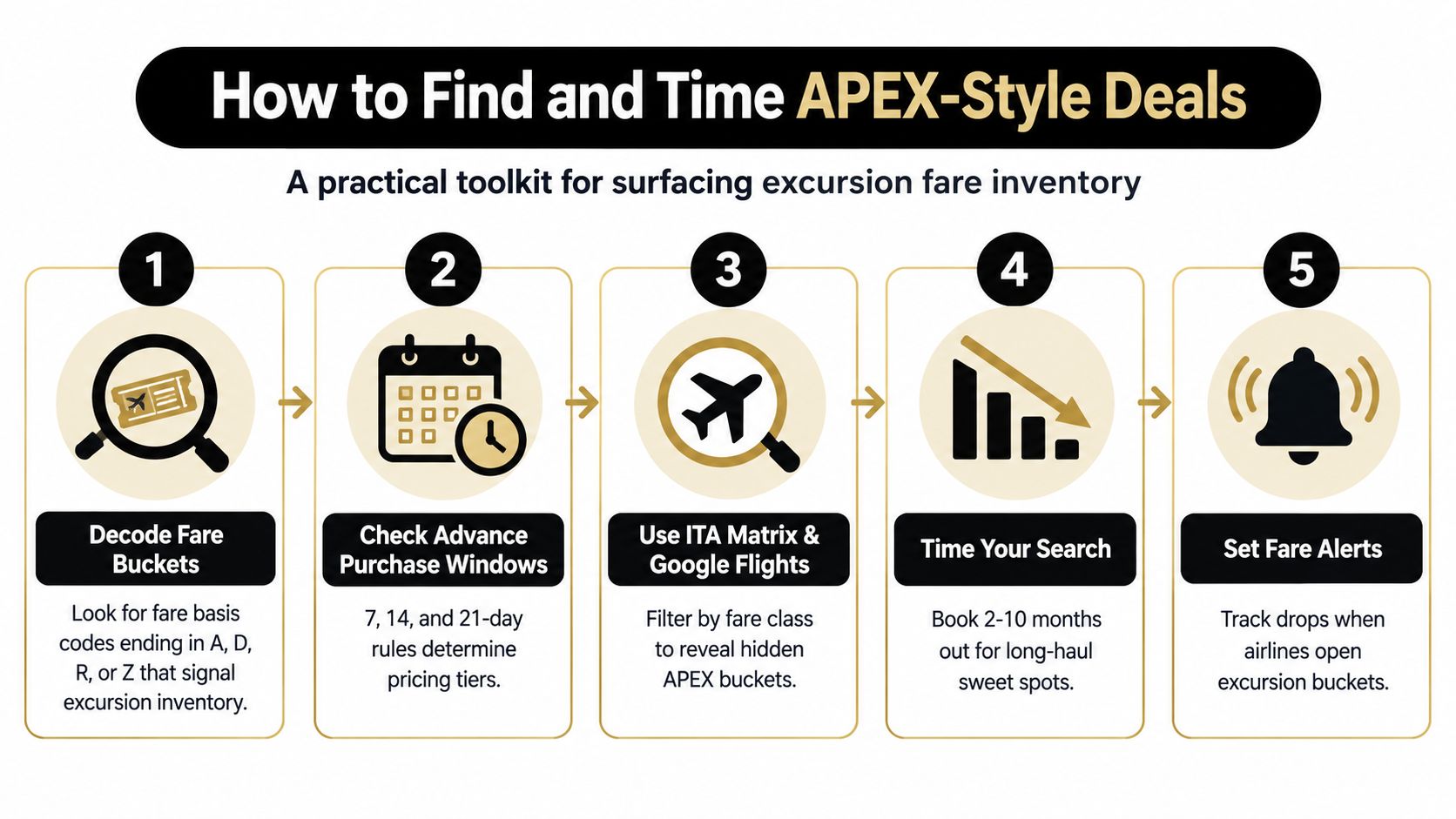
Finding an APEX-style fare requires more than sorting results from low to high. Start by identifying the fare bucket, then inspect the full rule before treating the price as usable.
Search in layers
Read the fare basis. Codes ending in A, D, R, or Z can signal excursion-style inventory, but the letters aren't proof by themselves. Open the fare conditions and confirm the advance deadline, refund rule, minimum stay, and permitted routing.
Test the purchase window. Search the same itinerary at different departure dates and compare fares that require 7, 14, or 21 days of advance purchase. International references commonly place APEX windows around 14 to 30 days, though the actual requirement varies by carrier, season, and cabin. Navan's APEX explanation describes the booking-and-payment deadline as the defining feature.
Use structured search tools. ITA Matrix can help experienced users investigate fare classes and routing combinations. Google Flights can compare dates, airlines, and connections, but you still need the carrier's fare rules before ticketing.
Monitor a long-haul horizon. For trans-Atlantic premium cabins, begin watching roughly 6 to 11 months ahead. For trans-Pacific trips, a useful observation range is roughly 4 to 7 months ahead. Treat these as search habits, not guarantees, because airlines can open or close inventory at different times.
Set alerts and watch disruptions. ExpertFlyer, AirHint, and Kayak price alerts can help you notice fare movement. A schedule change may also create an opportunity to recheck the itinerary, but don't assume a disruption guarantees access to a lower bucket.
Seasonality still matters. Shoulder periods on North Atlantic routes can produce more useful searches than peak holiday dates. For Japan, compare periods around cherry-blossom demand and Golden Week rather than assuming every calendar week behaves alike. You can also review when airlines drop prices to understand why monitoring matters more than checking once.
A Booking Playbook With Real Examples
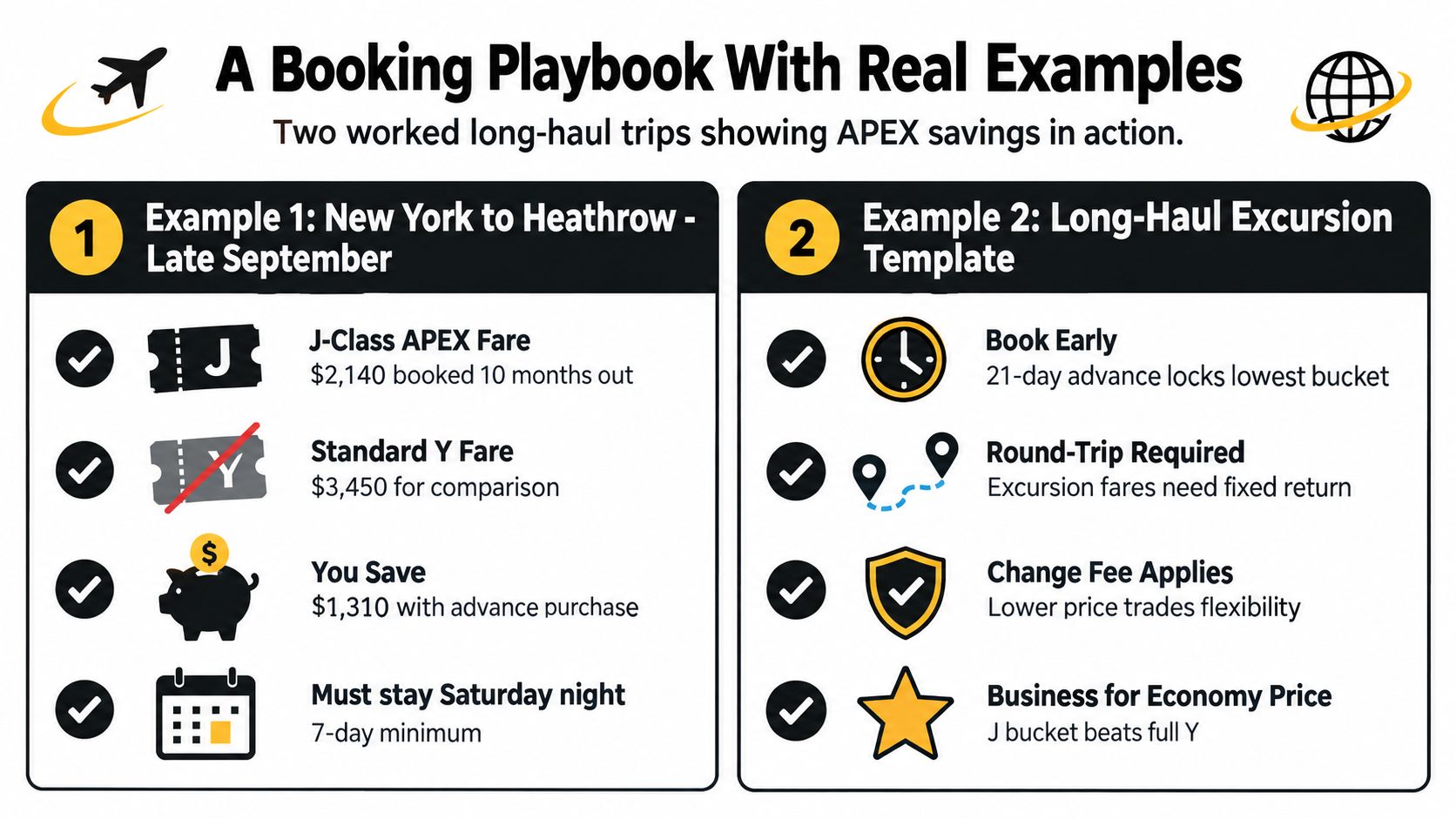
A good APEX booking starts with the fare rule, not the cabin photograph. The following examples show how the deadline, fare basis, stay requirement, routing, and price comparison fit together.
Example one, New York to Heathrow
A traveler planning a late-September New York to Heathrow round trip finds a J-class APEX fare at $2,140, booked 10 months out, compared with a $3,450 Y fare. The difference is $1,310, calculated from those two ticket prices. The premium fare example and comparison illustrate the broader price-inversion logic.
The traveler first confirms that the fare requires a Saturday-night stay and satisfies the stated 7-day minimum. The itinerary uses a single connection at the carrier's Atlantic hub, so the traveler checks that this connection is permitted rather than assuming the fare allows any route.
The timeline is important. Booking 10 months ahead provides more than enough lead time for the quoted advance-purchase condition, but early booking doesn't remove other restrictions. The traveler still needs to confirm whether the fare is refundable, what happens after a date change, and whether a voluntary change triggers a penalty or repricing.
Example two, San Francisco to Tokyo
A San Francisco to Tokyo Haneda itinerary in February shows a D-class business APEX fare at $2,880, compared with $4,100 for unrestricted economy. The comparison produces a $1,220 difference. The traveler must check the permitted stopover rule and the 12-month maximum-stay caveat, because a return beyond the allowed period can invalidate the fare.
These numbers aren't a promise that every February Tokyo itinerary will price the same way. They demonstrate the method: compare the fare basis, confirm the deadline, inspect the maximum stay, and verify that Haneda routing and any stopover fit the rule.
Use this four-step check before payment:
- Confirm the bucket. Match the displayed fare basis to the cabin and read the complete rule.
- Verify the stay. Check Saturday-night, minimum-stay, and maximum-stay requirements.
- Lock the refund class. Determine whether cancellation produces a refund, credit, or forfeiture.
- Calendar the change condition. Record the penalty and any ticketing deadline before you commit.
Rethinking What Cheap Airfare Means
Cheap airfare is not always the lowest economy fare. On long-haul routes, advance-purchase excursion fare rules can invert the expected cabin hierarchy. A traveler with fixed dates may find restricted business class priced below a flexible economy ticket, because the fare conditions, not the seat alone, determine the price.
Consider a New York to Madrid itinerary. A business APEX fare with strict conditions may compete with, or undercut, flexible economy. On a Los Angeles to Tokyo search, discounted premium inventory can create the same inversion while economy inventory remains expensive. The cabin hierarchy remains, but fare rules can rearrange the price hierarchy.
Three assumptions to reconsider
APEX is only for vacationers. A business traveler attending a fixed conference, project meeting, or client visit can use the same fare structure when the dates and routing are reliable.
Flexible tickets are always safer financially. Flexibility has value, but it is included in the fare price. A restricted ticket can be the rational choice for a firm schedule. If plans change, however, a penalty or repricing can erase the initial saving.
Coach is automatically the cheapest cabin. Economy is the usual starting point, not a guaranteed price floor. On selected trans-Atlantic and trans-Pacific itineraries, a discounted business APEX fare can cost less than flexible economy.
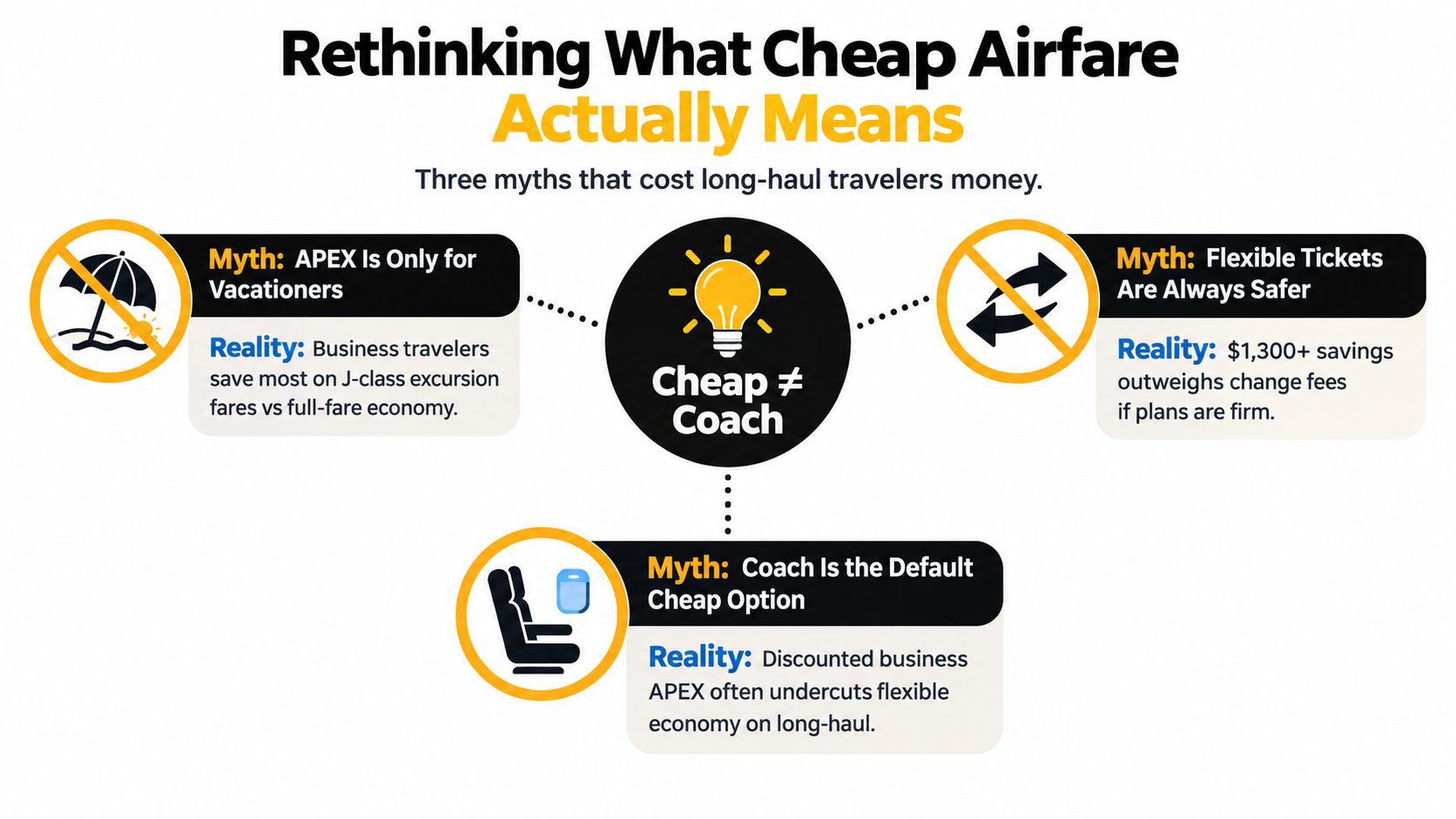
A useful definition of cheap includes the service received, the total ticket cost, and the risk created by the restrictions. A business seat below a full-fare economy ticket offers stronger value only when the traveler can follow the fare's conditions.
A business ticket priced at $2,800 can lose that advantage after a date change, particularly if the revised itinerary must be repriced. Travelers considering winter travel can also compare cheap December vacation ideas while checking whether their dates fit the airline's advance-purchase window.
Don't book an APEX fare against a schedule you can't commit to.
When APEX Pays Off and When It Does Not
APEX pays off when the traveler can commit to exact dates well ahead of departure, accepts the required stay, and has no realistic need to change or cancel. It can be especially useful for fixed business travel, shoulder-season Europe, midweek trans-Atlantic trips, and off-peak trans-Pacific itineraries where premium-cabin inventory may be priced aggressively.
It doesn't suit every traveler. A shifting client meeting, a family return date that may move, a routing requiring an unapproved stopover, or a holiday blackout period can turn the discount into a liability. The fare rule should be treated as a risk calculation, not a reward for choosing the lowest displayed number.
| Factor | APEX fare | Unrestricted fare |
|---|---|---|
| Price | Usually lower when purchased by the deadline | Usually higher because flexibility is included |
| Advance purchase | Required, with the exact window in the fare rule | Usually not required |
| Date certainty | Best for fixed plans | Suitable for uncertain plans |
| Minimum stay | May require Saturday night or another condition | Usually less restrictive |
| Routing | May limit connections and stopovers | Generally broader |
| Refunds | Often restricted or unavailable | Typically more accommodating |
| Changes | Penalty or repricing may apply | More flexible, subject to ticket terms |
| Ideal traveler | Early planner with stable dates | Traveler who values schedule control |
Use one final sequence before payment:
- Confirm the dates. Can you travel on the booked outbound and return?
- Confirm the routing. Does every connection and stopover satisfy the rule?
- Confirm refundability. Know what happens if the trip is canceled.
- Then book. Don't rely on a verbal summary when the fare conditions are available in writing.
The single rule is simple: APEX is a bargain only when the restrictions fit your trip.
Passport Premiere helps travelers evaluate international premium-cabin fare movements through fare monitoring, market analysis, and member resources focused on lower business and first-class pricing. Visit Passport Premiere to explore how its fare intelligence can help you compare APEX-style premium fares before you commit.
