

Business class can cost less than coach on select long-haul flights, with examples of economy fares at $575 versus $471 for business, and $480 versus $373 for business. Airlines sometimes discount unsold premium seats before departure, so the usual assumption that a better cabin must cost more doesn't always hold.
That pricing surprise is only part of the Airbus A380 business class story. The aircraft changed the physical experience of long-haul travel by placing passengers across two decks, giving airlines an unusually large canvas for premium seating, wider aisles, social areas, and lie-flat beds. Yet the A380 isn't one uniform product. A quiet, spacious 1-2-1 cabin can feel like a private hotel corridor, while a denser layout on the same aircraft can feel much less restful.
The key is to evaluate the airline's seat map, cabin density, bed design, and fare conditions, not just the aircraft badge on the booking page.
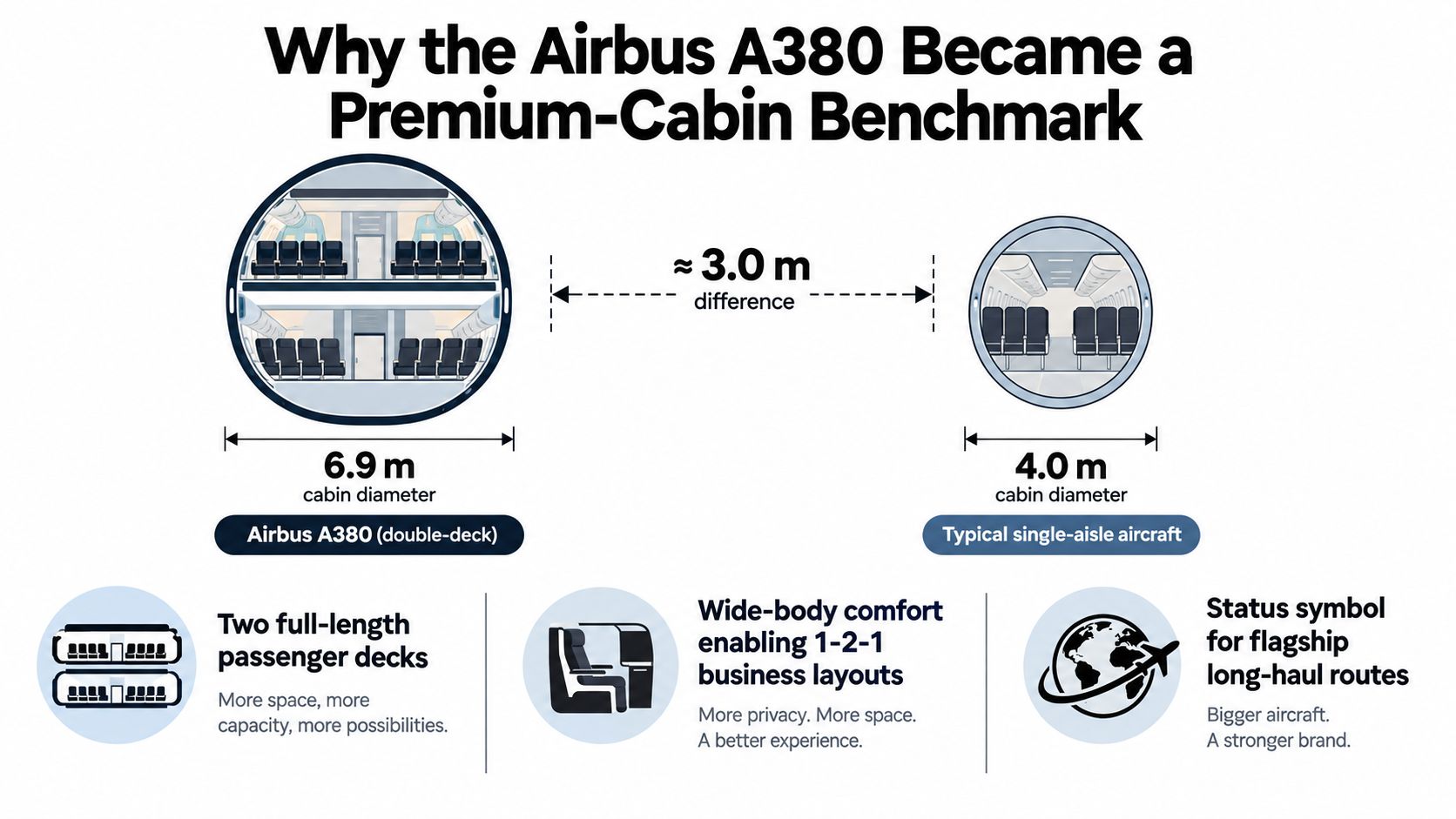
Why the Airbus A380 Became a Premium-Cabin Benchmark
The A380 entered commercial service with Singapore Airlines on 25 October 2007. Its inaugural aircraft had 60 business-class seats on the upper deck within a 471-seat, three-class layout, a configuration that immediately showed how the aircraft could separate premium passengers from the larger economy cabin below. Airbus describes the A380's scale and passenger-cabin design as a defining feature of the aircraft.
The easiest analogy is a two-story loft compared with a single-floor apartment. A conventional widebody gives the airline one main passenger level to divide among cabins. The A380 offers a full-length upper deck as another planning surface, allowing carriers to create a more distinct premium environment rather than placing business class directly beside a large economy cabin.
Airbus says the aircraft is certified for up to 853 seats, making it the only passenger jet capable of carrying more than 500 seats. That capacity matters economically. Airlines can carry a large number of passengers while reserving valuable upper-deck space for business and first class, which helps explain why the aircraft became associated with flagship routes and premium-cabin experimentation.
Why the upper deck changes the mood
The upper deck gives airlines room to create a calmer visual rhythm. Curved sidewalls, indirect lighting, and the separation from the main economy cabin can make the aircraft feel less like a tube filled with rows and more like a sequence of smaller rooms.
That doesn't guarantee good sleep. The airline still decides how many seats to install, how much space to allocate between rows, and whether passengers receive direct aisle access. The aircraft provides the opportunity, but the carrier determines whether the finished cabin feels residential or crowded.
Practical rule: Treat the A380 as a platform, not a promise. The aircraft's size creates potential for comfort, but the operator's layout decides whether you receive it.
The A380 also helped establish a modern premium benchmark through seat width and cabin scale. Singapore Airlines said its first-generation A380 business-class seat measured 34 inches wide, and described it as the widest business-class seat of its time. That detail captures the aircraft's influence. Airlines weren't merely adding a more expensive fare. They were using the superjumbo's space to make business class visibly different from the cabin behind it.
The value proposition can become even more unusual when fares are flexible. A premium seat that remains unsold may be discounted, while economy demand holds coach prices firm. In those situations, the A380's business class isn't only a luxury upgrade. It can become the rational choice for the same journey.
How Major Airlines Configure Their A380 Business Cabins
The phrase A380 business class describes several very different products. Singapore Airlines, Emirates, ANA, Lufthansa, Qatar Airways, and Qantas each use the airframe differently, and even one airline may operate more than one cabin generation.
Singapore Airlines set an early benchmark with its inaugural upper-deck business cabin. Its first A380 carried 60 business-class seats, and the airline's wide first-generation seat showed how much room could be devoted to premium passengers. That early design emphasized width and a distinctive upper-deck setting, even though newer products from other airlines later put greater emphasis on direct aisle access.
Emirates demonstrates another approach. One publicly described A380 configuration has 14 First Class suites, 76 Business Class seats, and 426 Economy seats, while a later retrofit retained 76 business seats and added Premium Economy. Airbus' Emirates fleet announcement illustrates why the A380 remains commercially useful to the carrier. The upper deck can support a substantial premium cabin, a bar or social area on selected aircraft, and a wide range of fare products.
ANA takes a more selective approach to cabin design. Its A380 seat map shows a 1-2-1-style staggered business cabin across rows 5 to 18, giving each passenger a route to the aisle without climbing over a seatmate. ANA's A380 seat map is especially useful because it shows why row position matters, not just the headline cabin name.
| Airline | Seat Count | Layout | Bed Length | Privacy Level |
|---|---|---|---|---|
| Singapore Airlines | 60 on the inaugural aircraft | Upper-deck premium layout | Not specified in the verified source | High sense of separation from economy |
| Emirates | 76 in the cited configuration | Operator-dependent, including later retrofit variations | Not specified in the verified source | Varies by seat position and aircraft |
| ANA | Rows 5 to 18 shown on the seat map | Staggered 1-2-1 style | Not specified in the verified source | Strong for solo travelers |
| Lufthansa | Reduced from 78 to 68 in the upgraded cabin | 1-2-1 | 79-inch lie-flat bed | Direct aisle access for every passenger |
| Qatar Airways | Not specified in the verified source | Operator-specific premium layout | Not specified in the verified source | Depends on pitch and seat position |
| Qantas | 70 | 1-2-1 | About 2 meters, or 80 inches | Strong individual access and privacy |
Lufthansa's retrofit shows the clearest density trade-off. The airline reduced its A380 business cabin from 78 to 68 seats when it moved from 2-2-2 to 1-2-1, pairing the new arrangement with 22.8-inch-wide seats, a 44-inch pitch, and 79-inch lie-flat beds. The change sacrifices seats to remove the need to step over a neighbor, a trade that usually benefits nighttime access and personal space.
The business-class airline comparison guide is useful when the decision involves more than aircraft type. Compare the seat map, flight timing, and fare before assuming that a familiar airline will deliver the same experience on every A380.
Seat Layouts and What They Mean for Your Experience
A seat map tells you more about sleep quality than the word “business” on the ticket. The central question is simple: Can you reach the aisle without disturbing another passenger? If the answer is yes, the cabin will usually feel more practical for solo travelers and overnight flights.
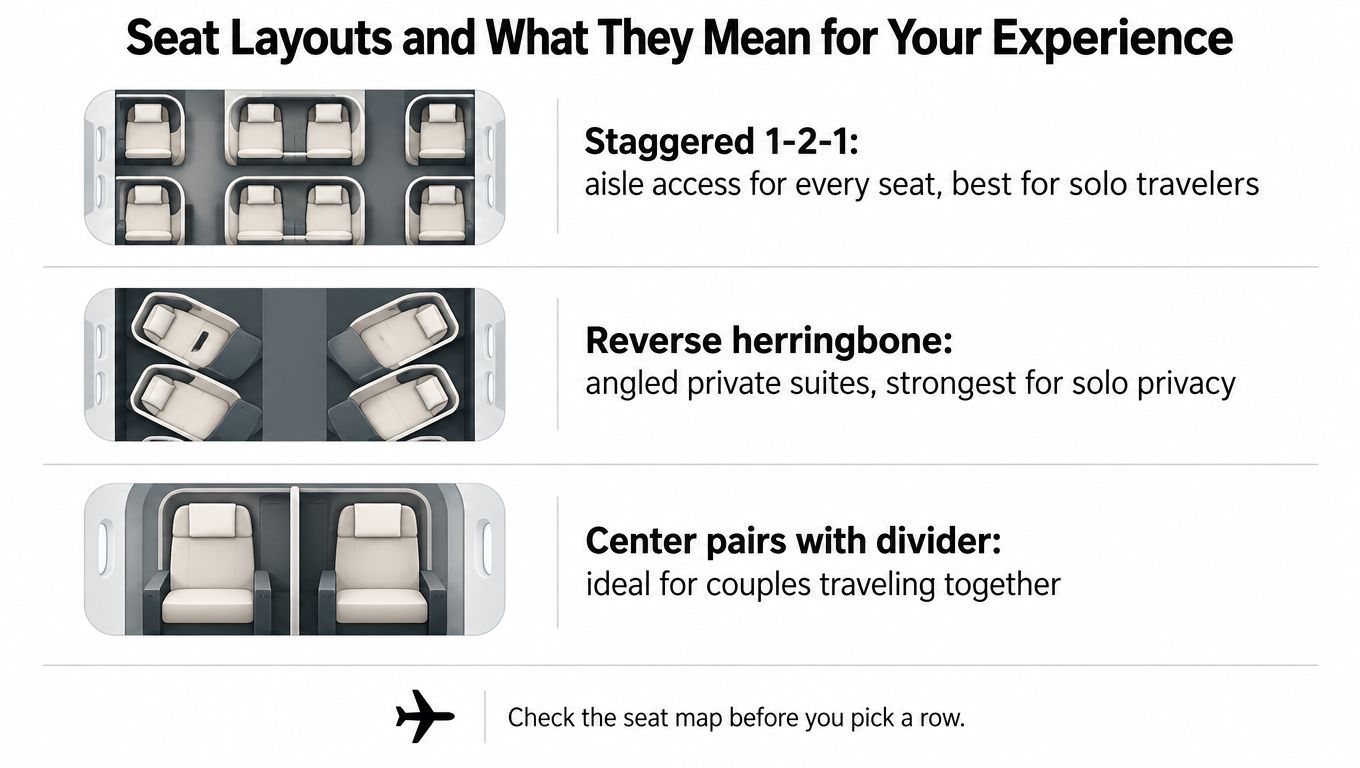
1-2-1 staggered seating
A staggered 1-2-1 layout gives every passenger direct aisle access. Seats alternate between positions closer to the aisle and positions tucked farther toward the window or sidewall. The farther seat typically offers more privacy, while the closer seat may make it easier to speak with crew or reach the aisle.
For a solo traveler, this is usually the safest layout to select. Couples can still sit together in the center section, but they shouldn't assume that two adjacent seats will feel equally connected. In a staggered pair, one passenger may be closer to the aisle and the other farther away, with a console or divider between them.
Reverse herringbone seating
Reverse herringbone seats angle toward the aisle and often place the passenger's head near the window. That geometry creates a strong private-shell effect, especially for sleeping or working. The compromise is reduced face-to-face interaction, so it suits solo travelers better than couples who want to talk during the flight.
2-2-2 seating
A 2-2-2 arrangement is friendlier for partners who want to sit side by side. It also carries a major nighttime drawback: one passenger may need to step over the other to reach the aisle. Some travelers accept that compromise for companionship, while others find it disruptive on a long overnight sector.
The same airframe can therefore produce very different results. Lufthansa's upgraded A380 cabin moved from 2-2-2 to 1-2-1 and reduced the business-class seat count from 78 to 68, specifically to provide direct aisle access for every passenger.
| Traveler type | Best starting point | What to check |
|---|---|---|
| Solo sleeper | Staggered 1-2-1 or reverse herringbone | Seat farther from the aisle, privacy shield, footwell position |
| Couple prioritizing conversation | Center pair in a 1-2-1 cabin or 2-2-2 | Divider height, seat alignment, access to shared space |
| Couple prioritizing sleep | Two seats in the same staggered center pair | Confirm that the seats are paired, not merely adjacent |
| Tall traveler | Any lie-flat product with a published bed measurement | Footwell width, bed length, and shoulder room |
| Light sleeper | A seat away from galleys, lavatories, and social areas | Cabin map, traffic patterns, and rear-cabin location |
Window-seat pairing deserves special attention. On staggered cabins, two seats beside each other on the map may not be the best pair in practice. Choose the same center pair when traveling together, and check whether one seat is exposed to the aisle while the other sits behind a console.
Storage also changes by row. Bulkhead seats may offer more open foot space but can have different personal-storage arrangements, while standard rows often provide a more predictable console and footwell. Review the A380 seat map guide before selecting a seat, especially when the flight uses an unfamiliar aircraft configuration.
Onboard Amenities and Service Features by Operator
A premium cabin is a chain of connected experiences. The seat matters most while you're sleeping, but the lounge, boarding process, meal timing, bedding, connectivity, and service rhythm determine how much of the journey feels effortless.
Lufthansa and Qatar Airways illustrate the importance of airline character. Lufthansa's A380 upgrade centers on consistent seat access and a more orderly cabin flow. Qatar Airways lists its A380 business seat at 23 inches wide with 51 to 52 inches of pitch, while its first-class cabin has a listed 90-inch pitch. Qatar's A380 fleet information makes the distinction clear. Business class can be spacious and lie-flat without being identical to first class.
The ground experience
Start with lounge eligibility, because a business-class ticket doesn't guarantee the same lounge at every airport or on every itinerary. Check the operating carrier's access rules, the departure terminal, and whether a connecting airport provides a partner lounge.
Qatar's Doha operation is associated with the Al Mourjan lounge experience, while Lufthansa travelers may encounter different lounge products in Frankfurt depending on ticket class and itinerary. Don't assume that an impressive lounge name automatically applies to every business fare. Confirm access when you book.
Dining and bedding
Meal style varies as much as seat design. Some carriers deliver a carefully timed sequence that keeps the cabin moving; others offer greater flexibility, including meals selected around the passenger's sleep schedule. Qatar is known for an à la carte, dine-on-demand approach on selected premium products, while other operators may use a more structured service flow.
Ask four practical questions before booking:
- Bed preparation: Does the crew provide a mattress pad, pillow, and separate bedding?
- Sleep timing: Can you decline the first meal and sleep immediately?
- Headphones: Are noise-cancelling headphones supplied, and can you keep them during rest?
- Power access: Is the USB or AC outlet beside the seat, under the console, or near the floor?
Entertainment screens and content libraries can make a long flight feel shorter, but screen size matters less than placement. A screen that sits directly in front of you is easier to use in bed mode than one that requires awkward viewing from an angled position. Wi-Fi packages also vary, so treat connectivity as a bonus to verify rather than a guaranteed feature.
The Emirates business-class overview can help travelers compare the carrier's A380 experience with other premium options. Emirates is particularly associated with an onboard bar and lounge on selected A380 aircraft, while other airlines use the upper deck for a quieter cabin without a social area.
| Feature | Lufthansa A380 | Qatar Airways A380 |
|---|---|---|
| Seat access | Direct aisle access in the upgraded cabin | Depends on the installed layout |
| Published business seat width | 22.8 inches in the upgraded cabin | 23 inches |
| Published business pitch | 44 inches in the upgraded cabin | 51 to 52 inches |
| Bed information | 79-inch lie-flat bed | Not specified in the verified source |
| Dining style | Confirm current flight-specific service | Flexible dining may be available on applicable products |
| Lounge access | Verify by airport and fare | Verify by airport and fare |
A380 Business Class Compared with Other Widebodies
The A380's biggest advantage is architectural rather than decorative. Its double-deck structure gives airlines more ways to separate cabins, place premium seats, and create spaces that feel less compressed. A Boeing 777 or 787 can offer an excellent business seat, but the passenger experience usually comes from a single primary cabin level.
That distinction affects the ground-level feel of the journey. The A380's main passenger deck sits lower than the upper deck, which can make boarding feel more connected to the terminal and can reduce the sense of climbing into a tall aircraft. The upper deck, meanwhile, offers the quiet, separated atmosphere that many passengers associate with premium long-haul travel.
| Feature | Airbus A380 | Boeing 777 | Boeing 787 |
|---|---|---|---|
| Cabin architecture | Two passenger decks | Single main passenger deck | Single main passenger deck |
| Premium-cabin flexibility | Extensive room for separate upper-deck products | Strong, but dependent on fuselage and operator | Strong, with emphasis on modern cabin design |
| Social areas | Available on selected A380 products | Less commonly built into business class | Less commonly built into business class |
| Window experience | Large upper-deck and main-deck cabin environment | Traditional widebody view | Larger windows are a notable design feature |
| Cabin atmosphere | Spacious and often calm | Varies widely by airline and seat density | Often feels modern and fresh |
| Best reason to choose it | Architecture, cabin scale, and distinctive premium spaces | Route availability and strong operator-specific seats | Window design and newer-aircraft feel |
The 787 has a freshness advantage for some travelers because of its larger windows and higher cabin humidity. The A380 counters with separation and interior volume. Noise is also operator-dependent, but the A380's size and divided cabin can make the aircraft feel calmer, especially when the business cabin sits away from the main economy flow.
The comparison becomes less flattering when an A380 operator installs a dense 2-2-2 business cabin and a 787 operator offers a well-designed 1-2-1 suite. In that contest, the smaller aircraft may provide better sleep. Aircraft size creates possibilities, but seat geometry remains the deciding factor.
Social spaces are where the A380 feels markedly different. An onboard bar or lounge gives passengers a place to stretch, talk, and leave the seat environment for a while. The feature isn't present on every A380 and isn't necessary for good sleep, but it changes the journey from a sequence of meals and movies into something more like a small private terminal in the sky.
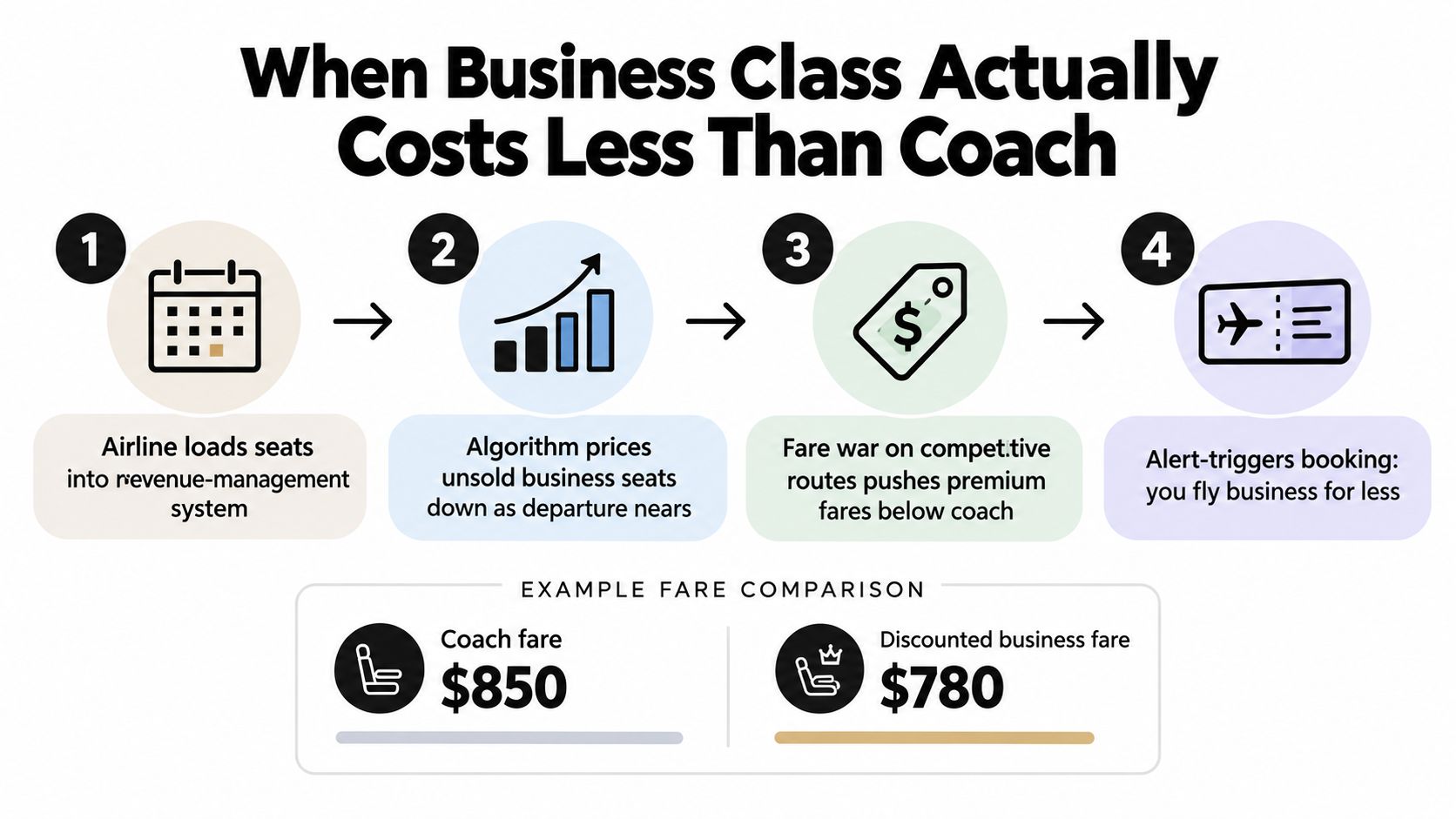
When Business Class Actually Costs Less Than Coach
The phrase “business class cheaper than coach” sounds like a pricing error, but it can happen when airlines manage seats dynamically. A flight has separate fare buckets, and the last available economy seat can remain expensive while a discounted business fare opens lower in the premium cabin.
A 2026 explanation of airline pricing describes the mechanism clearly: when lower-cabin demand catches up, the last economy seat can cost more than the first business-class seat in a particular fare combination. The important word is “particular.” This isn't a permanent rule or a guarantee on every route. The explanation of why business class can cost less than economy provides useful context for the pricing logic.
Real examples show how strange the comparison can become. One report cited economy at $575 against business at $471, and another cited economy at $480 against business at $373. The fare examples and explanation of cabin-price inversions show why travelers should compare the final prices rather than assume the cabin hierarchy determines the cost.
Why the A380 creates opportunities
The A380 was designed around exceptional scale, and operators can place a substantial number of premium seats upstairs. If demand for those seats weakens, the airline has a commercial reason to adjust fares rather than allow inventory to fly empty.
Travelers shouldn't treat every lower price as a bargain. Check the fare rules, cancellation conditions, baggage allowance, seat selection cost, lounge eligibility, and whether the ticket is a true business-class fare or a restricted premium tier. A low headline price can lose its value if the conditions are unusually restrictive.
A 2026 guide to cheap business-class tickets says mistake fares can push international business fares as low as $300, and that such prices can match or undercut typical economy fares. The guide to finding cheap business-class tickets also reinforces the need for speed, because mistake fares and competitive discounts can disappear quickly.
The best mental model is not “business is cheap.” It's “airline inventory can become irrational for a short period.” Search both cabins, compare the complete fare conditions, and be ready to book when the premium price drops below the coach alternative.
Practical Tips for Booking A380 Business Class
Booking the aircraft is only the first step. You also need to confirm that the aircraft, cabin generation, and seat map match the experience you want. Airlines can change equipment, and a familiar route can operate with more than one A380 interior.
Begin with flexible dates. Midweek departures can produce different inventory from weekend flights, while a flexible-date calendar exposes price gaps that a fixed search hides. Fare alerts are useful because most travelers won't manually check every possible departure.
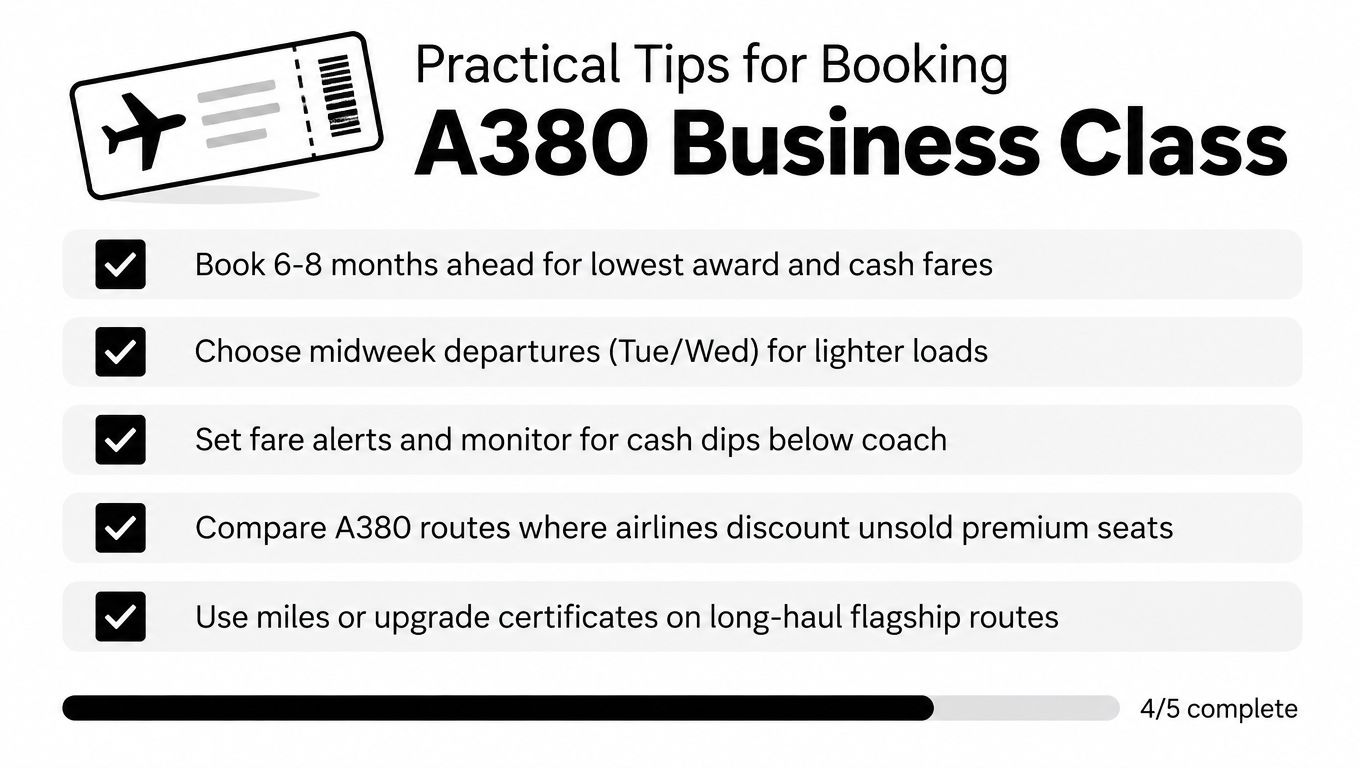
A disciplined booking process
- Confirm the aircraft: Check the booking page for the A380 designation, then verify it again before departure because equipment can change.
- Open the seat map: Look for 1-2-1, 2-2-2, staggered rows, and proximity to galleys or lavatories.
- Compare both cabins: Search economy and business on the same flight. Business class can occasionally undercut coach, especially when premium inventory is discounted.
- Check the full fare: Review changes, refunds, baggage, seat selection, lounge access, and upgrade restrictions.
- Recheck after booking: Monitor schedule changes and seat-map updates so you can react if the airline swaps aircraft or changes the cabin.
Award travelers should also compare transferable points and upgrade instruments, but don't move points until the desired seat is available and the program's cancellation rules are clear. A points booking can be excellent value, yet taxes, surcharges, and poor availability can change the calculation.
For timing and search habits, Easy Travel Bookings air hacks advice offers another perspective on choosing booking dates and monitoring fare movement. Use any booking advice as a starting point, then test it against the route, airline, and actual inventory available for your trip.
A final check prevents most avoidable mistakes: verify the aircraft type, inspect the seat-map width and layout, confirm lounge rights, and read recent reviews that identify the exact aircraft and cabin generation. Don't rely on a review of one airline's A380 if your booking uses another operator's configuration.
Passport Premiere helps travelers monitor international business and first-class fares, compare premium-cabin pricing, and identify moments when an A380 business fare may be lower than coach. Visit Passport Premiere to review its fare-monitoring service and learn how to evaluate premium tickets before you purchase.
