

Global business- and first-class traffic reached 109.7 million international passengers in 2025, up 4.5% year over year, while premium travelers represented 5.5% of international traffic, according to the IATA 2025 World Air Transport Statistics report. That scale changes what you should ask from the best airfare tracker. You're not hunting for a faster ping. You're trying to judge whether a premium seat that's still empty is priced like a scarce asset, a routine seat, or a short-lived bargain.
Most tools answer a narrower question. They tell you a price moved. They don't tell you whether the move matters for your route, your cabin, and your deadline. A leisure traveler with flexible dates can wait through noise. A corporate buyer with a fixed meeting can't. A premium-cabin buyer faces a different problem again, because the gap between business and economy isn't fixed and a small inventory change can reprice the cabin.
Judge trackers in that order. Start with the trip type, then ask whether the tool keeps enough route history to label a fare high, typical, or unusually low. Speed only helps after that judgment is sound.
Best Airfare Tracker Picks by Trip Type
There's no single winner across every trip. Choose by trip type first, then compare features, because the same person may need a free economy alert for a family holiday and a different system for a long-haul premium trip. The table below gives the pick before the rationale.
| Traveler Type | Tracker Category | Cabin Coverage | Price History | Cost Model | Best Fit |
|---|---|---|---|---|---|
| Budget leisure traveler, one route | Free search-engine alerts | Economy, some premium | Short trend view | Free | One route with flexible dates |
| Flexible leisure traveler, several airports | Dedicated alert app | Economy, some premium | Multi-month history | Free tier plus paid upgrades | Multi-route alerts, watch for noise |
| Frequent economy flyer | Dedicated alert app with price history | Economy, some premium | Multi-month history, depth varies | Free tier plus paid upgrades | Judging high versus typical fares |
| Booking-platform user | Booking-platform alerts | Mostly economy | Limited | Free | Travelers who book on one platform |
| Premium-cabin leisure traveler | Premium fare monitoring membership, such as Passport Premiere | Business and first class | Route-level fare history | Membership fee | Trip volume covers the fee |
| Corporate travel manager | Corporate platform tracking | Policy-defined cabins | Booking-level data | Contract-based | Companies with travel programs, needing approval and integration |
What Each Row Is Really Buying
A budget leisure traveler on one route usually needs coverage, not sophistication. Free search-engine alerts are enough when dates flex and the cabin is economy, because a short trend view can still stop you buying on an obviously expensive day. The weakness is context. You'll see the fare move, but you may not know whether it's low for that route in that season.
A flexible leisure traveler watching several airports trades quiet for breadth. A dedicated alert app can follow more combinations, which helps when you'll depart from two or three airports or land at alternatives. It's also noisier. More alerts don't mean more insight, and you'll need to mute routes you'd never fly.
A frequent economy flyer gets more value from history than from extra alerts. If you fly the same corridors often, a multi-month record helps you separate a typical fare from an expensive one. Check the actual depth, because providers don't hold the same history for every route and cabin.
Booking-platform alerts suit travelers who already buy through one seller. They're free and convenient, but they're limited to that seller's saved searches and inventory view. That's acceptable for simple economy trips. It's a poor basis for judging the wider market.
Where Premium and Corporate Needs Split
Premium-cabin leisure travel is where a plain alert starts to fail. Travel-industry analyst Scott Keyes reported a round-trip business-class fare from New York to Buenos Aires priced at $1,293 in August, compared with $961 for economy, a premium of $332, or about 35%, in Boomer Magazine's account of flying in style for less. That example matters because business class isn't always priced at three or four times economy. When leisure demand is strong and business travel slows, the gap can compress hard.
A premium monitoring membership is justified when your trip volume can cover the fee and you need route-level business and first-class history. One saved mistake on a long-haul fare can matter more than a year of small economy alerts. If you buy premium once every few years, the arithmetic is weaker.
Corporate travel managers need a different signal altogether. Managed platform tracking works inside policy-defined cabins and can flag negotiated fares, but it needs approval and integration with the travel program. The cost is contract-based, not a casual subscription decision.
The tracker has to support one of three decisions: book now, wait, or switch cabins. If it can't help you choose among those, it's only reporting movement.
Use the criteria later in this article to test the category you pick here. Don't start by downloading three apps and comparing alert speed.
Why Airfare Prices Move Before You Book
Airlines don't set one price for a seat and leave it there. Their revenue-management systems adjust offers according to demand, customer segments, inventory, and transaction information, as described in research on dynamic price adjustment in the Journal of Revenue and Pricing Management. That practice dates to the 1980s, when computerized inventory controls and differentiated fare classes let airlines sell seats at multiple price levels.
This short clip shows the pricing logic in motion before the details below break it down.
The first fare you see isn't the market value of the seat. It's one quote at one moment, produced for one set of conditions. The same route can carry materially different prices depending on when and how it's purchased, which is why our explanation of dynamic pricing in the airline industry treats a single search as a snapshot, not a valuation.
Why Premium Cabins Move More Sharply
Premium cabins have fewer seats split across several booking classes. When a small block sells, the next seat may come from a higher class, so the displayed price jumps rather than drifts. Demand shifts, departure gets closer, or a competitor cuts a fare, and the cabin reprices again.
That's also why comfort details shouldn't distract you from fare class. Even practical reading like a frequent flyer's guide to buckling up from Seat Belt Extenders is useful for the flight itself, but it won't tell you whether the seat is fairly priced today. You need the pricing record for that.
The dashboard below captures the working reality behind that record, inventory watched continuously rather than checked once.
The Minimum Record Worth Keeping
A tracker that can't keep these five fields can't judge a fare properly:
- Observation date: when the price was seen
- Route: the exact origin and destination
- Cabin: economy, business, or first class
- Days to departure: the booking lead time
- Fare class: the booking class behind the quote
Without days to departure, you're comparing a fare bought three months out with one bought three days out. Without fare class, you can't tell whether the price fell or the product got more restricted.
Practical rule: Place today's fare against the route's own history and label it high, typical, or unusually low before you decide anything.
That test separates routine fluctuation from a genuine discount. It's the standard every picking decision in the first table has to meet.
Buying Criteria That Separate Reliable Trackers
A single accuracy percentage doesn't prove a tracker is good. A peer-reviewed study compared three prediction platforms using daily observations over 77 days across 10 one-way routes and found no universally superior platform, because forecast accuracy varied with days remaining before departure, as reported in the Journal of Revenue and Pricing Management comparison of airfare prediction platforms. The route sample was limited, so don't treat it as a universal benchmark. Treat it as a warning against headline scores.
Inputs matter just as much as the model label. A review of forecasting research reports that models using external variables produced a mean absolute percentage error of 4.66%, compared with 5.22% for historical data alone, in a review of airfare price prediction research. Those benchmarks come from different datasets, so they aren't directly comparable. They still tell you to favor tools that use more than the last quoted fare.
| Criterion | What to Verify | Red Flag |
|---|---|---|
| Route and cabin coverage | Monitors your exact origin, destination and cabin | Only economy shown for premium trips |
| Price history depth | At least 12 months of route data | Only the current price |
| Forecast validation | Results split by 30-plus days, 8 to 30 days, and under 8 days | One headline accuracy figure |
| Alert precision | Share of alerts followed by a real fare drop | Alerts for every small price change |
| Data inputs | Days to departure, stops, departure time, holidays, seasonality | Compares only the last quoted fare |
| Fare-class clarity | Seat selection, change rules and baggage shown | Restrictions hidden until checkout |
| Cost against value | Annual fee divided by savings per trip | Fee exceeds typical savings |
How to Run the Checks
Split forecast validation into 30-plus days, 8 to 30 days, and under 8 days. A tool that's calm and accurate three months out may be useless in the final week, when premium inventory moves in steps. Ask for results by window, not blended together.
Ask for error metrics by name. You want mean absolute error, directional accuracy, and the share of alerts that preceded a meaningful fare decline. A vendor that can't define what its price is compared against hasn't given you a signal. It's given you a notification.
Check fare-class clarity before you celebrate a drop. Confirm whether the fare includes seat selection, change rules, and baggage, because a lower price on a worse product isn't a saving. This matters most when a premium fare looks suddenly cheap.
The Cost Test and a Back Test
Do the break-even arithmetic plainly. Divide the annual fee by the savings you realistically capture per trip. If you need an implausible saving on every journey to cover the fee, don't buy it, whatever the alert design looks like.
Run the tool against a route you already flew and compare its alerts with what fares actually did.
That one back test exposes noisy alerts, missing cabins, and shallow history faster than any sales page. If the tracker can't explain a fare you already understand, it won't help on one you don't.
Business Class Versus Coach Pricing
Business class can cost only slightly more than coach, and in narrow conditions you'll see business class cheaper than coach on comparable value once restrictions and timing line up. The honest version is conditional. It happens when the normal relationship between cabins breaks down, not because premium seats are secretly cheap all year.
IATA reports that premium fares average about five times economy fares overall, but business-class fares decline during summer and rebound in September and from March through May alongside the corporate travel cycle, in IATA's report on the resurgence of premium class travel. That average hides the useful part. In summer, leisure demand lifts economy while corporate demand softens, so airlines have more reason to discount unsold business inventory.
Three Ways the Gap Closes
Seasonality is the first mechanism. When business travelers stay home in midsummer or around the winter holidays, premium cabins can carry empty seats on routes where economy is full. Airlines would rather sell those seats at a compressed premium than fly them empty.
Fare brands are the second. Delta announced basic premium-cabin fares, and United introduced similar tiered products that let travelers buy a lower-priced premium seat while giving up benefits such as seat selection and lounge access, as reported in coverage of tiered premium fares in the Winnipeg Free Press. You're still in the premium cabin. You're buying fewer bundled services, so compare it against the economy fare you'd be willing to accept, not against an imaginary fully flexible ticket.
Corporate pricing is the third, and it works differently. On New York to London, a corporate-discount example showed a business fare of approximately $3,700 for a J-class ticket booked 21 days in advance, versus about $4,150 for the lowest public business fare, a $450 reduction, or roughly 10.8%, in ITILITE's comparison of corporate airline discounts and public fares. That doesn't make business cheaper than economy. It makes the negotiated premium fare cheaper than the public one, which changes the switch-cabins decision for eligible buyers.
The Same-Date Check
Run the comparison properly before you book:
- Compare same date, same route: Business on Tuesday against economy on Saturday proves nothing.
- Confirm the restrictions: Check seat selection, lounge access, changes, and baggage on both fares.
- Price the premium in dollars: Decide what the seat, sleep, and flexibility are worth on that flight length.
- Check both cabins every time: Our guide to business class vs economy pricing works from this same-date habit.
A five-times average should never stop you checking the premium cabin on a summer long-haul date.
Buy only when the premium is justified for that trip. The mistake isn't paying more for business. It's assuming the gap is fixed and never looking.
Leisure Versus Corporate Use Cases
A leisure buyer can wait. A corporate buyer usually can't. That difference in deadline, more than app design, decides which tracker is useful, because the two buyers aren't measuring value against the same fare.
| Requirement | Leisure Traveler | Corporate Buyer |
|---|---|---|
| Decision deadline | Flexible, can wait for a drop | Fixed travel dates, cannot wait indefinitely |
| Cabin priority | Economy or occasional premium | Policy-defined business class |
| Fare type | Public fares | Negotiated and qualifying fares |
| Number of travelers | One or two | Several travelers under one policy |
| Alert scope | One or two routes | Many routes across the year |
| Key tool signal | Historical low and trend | Policy-compliant fare below the negotiated rate |
A Family Trip to Europe
Say a family of four is planning a European trip and watching a premium fare for the parents while the teenagers fly economy. The leisure advantage is patience. They can set a buy threshold, watch the route history, and walk away if the fare stays high.
The catch is who gets the lower price. When our Fare Monitor detects lower pricing, additional travelers may not be able to get the same lower pricing on the same flights unless they have an active subscription. We suggest a supplemental Spousal Plan subscription when family members or co-workers plan to use Fare Monitor.
Sort that out before the first search, not after a drop appears. A family that discovers the coverage limit at the moment of booking has wasted the alert. The requirement that should decide the tool here is traveler coverage, ahead of alert speed.
A Corporate Buyer on a Fixed Date
Now take a consultant flying to a client meeting on a fixed date, in a policy-defined cabin. A public fare drop is almost irrelevant. The useful signal is whether a policy-compliant fare sits below the negotiated rate, which is the logic behind our work on corporate travel cost savings.
The common corporate mistake is relying on public-fare alerts when negotiated fares would already undercut them. The travel manager celebrates a public discount that the company could beat through its own program, and nobody checks. Approval workflow and integration look like overhead until you price that error across a year of trips.
Corporate buyers also can't wait indefinitely for a better signal. As departure approaches, the cost of an unsold seat to the airline and the cost of no seat to the traveler move in opposite directions. The tracker has to flag the decision point early enough for approval to happen.
Decision rule: Leisure buyers should let deadline flexibility pick the tool. Corporate buyers should let policy compliance pick it, and treat everything else as secondary.
Test each fare on its own route and date in both cases. Neither buyer should assume the premium gap is fixed, and neither should buy a tool whose main signal doesn't match the fare they pay.
Using Passport Premiere and Setting Your First Alert
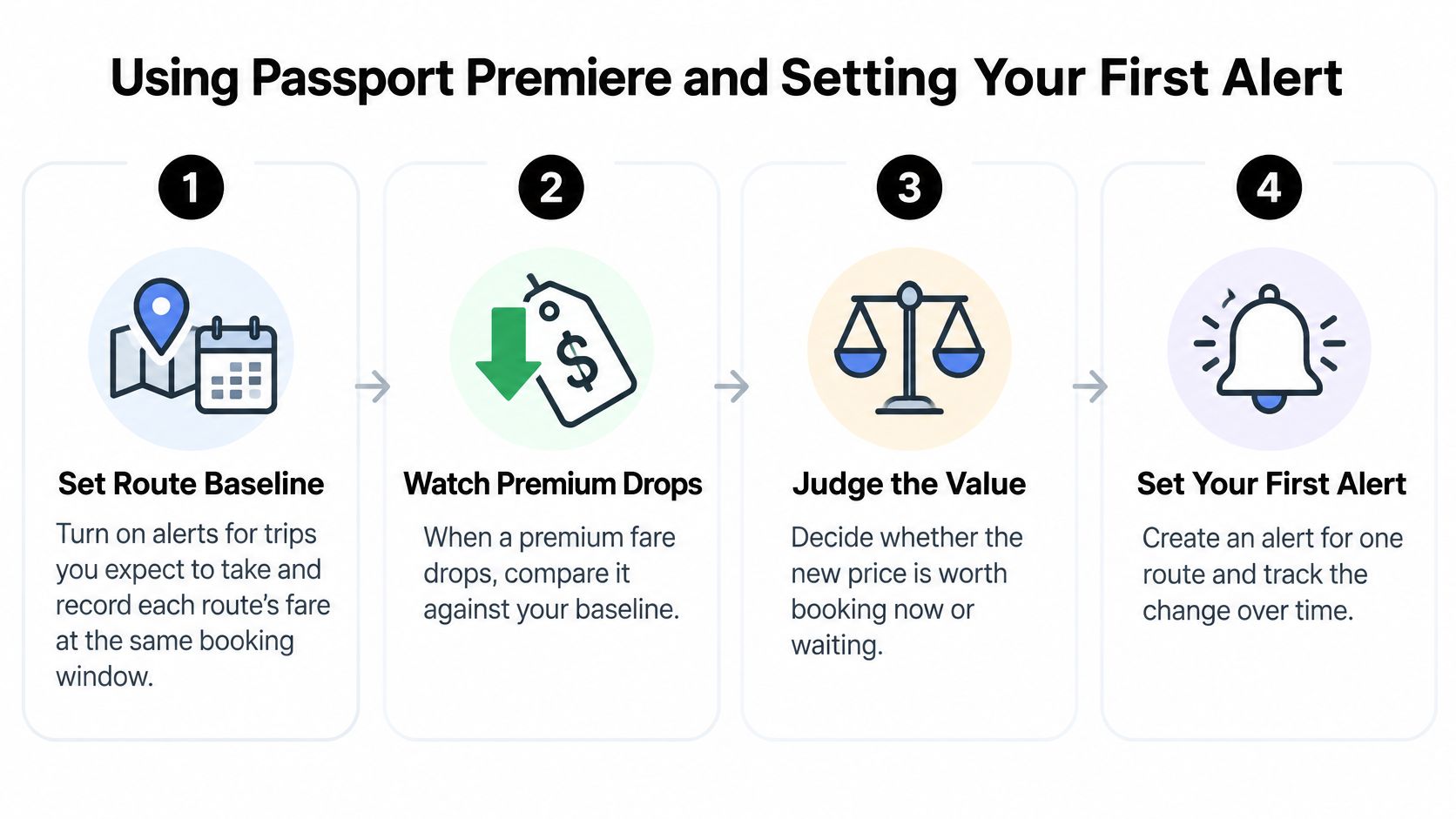
The workflow below treats an alert as the start of a judgment, not the end of one. As our fare analysis approach puts the distinction, a fare alert tells you the price moved, but only a fare analysis tells you whether the premium cabin is worth buying at that price. Follow the sequence in order.
The process in brief, before the detailed steps:
The Monitoring Workflow
- Set a route baseline: Turn on alerts for trips you expect to take and record each route's fare at the same booking window, so later prices have something honest to be compared against.
- Judge the drop: When a premium fare falls, decide whether real demand supports it or it's a speculative dip. A plain alert won't make that call for you.
- Decide between buying and holding: Our Fare Monitor watches for a lower fare after you run a trip search, and it lets you hold an itinerary and preserve current pricing while deferring purchase in anticipation of lower pricing.
- Respect the overlap rule: You may not use Fare Monitor while simultaneously holding pending or confirmed space on the same or similar flights.
- Use telephone support: After fare validation, telephone support helps you interpret BUY IT NOW or FARE MONITOR recommendations before you act.
Be candid about the limit. The value depends on how often you buy premium cabins, and this doesn't replace checking economy on the same date. If you fly business once a year on a short route, a free alert and your own same-date check may be enough.
Your First-Alert Routine
- List your next three trips: Write down cabin and dates for each, including the ones you haven't committed to yet.
- Shortlist two categories: Take them from the trip-type table, not from an app store ranking.
- Confirm the fundamentals: Check cabin coverage, twelve months of history, and lead-time validation for each option.
- Set your buy threshold early: Decide the price at which you'll book before the first alert fires, while you're calm.
- Test one premium monitor: Run it on a single trip before committing a full year of spend.
Setting the threshold in step 9 is where most travelers go wrong. They wait for an alert, then improvise a decision under time pressure, which turns the tracker into a source of anxiety. A threshold set in advance converts the alert into a yes or no.
The Cost Check Before You Start
Subscriptions are bundled with four Fare Monitor scans per year, and additional scans cost $39 per record. Subscribers who use Fare Monitor without quantifiable booking activity may be subject to subscription fee escalation, so match the plan to trips you'll book.
Count your expected premium trips against those four scans before you begin. If you'll run ten monitored trips a year, price the extra scans into the break-even. If you'll run two, you're well inside the bundle.
Start with the trip nearest to booking. Set its baseline today, set your threshold today, and let the first real alert test whether the tool earns its fee.
If you buy international business or first class more than once a year, we can monitor those routes, judge each fare against its history, and signal when a premium seat is worth its price. Start with the trip you're closest to booking and set your first baseline through Passport Premiere today.
