

The usual advice on the best flights to Europe business class is simple. Pick the best seat, then book early. I would not start there. Airlines sell an empty premium cabin against demand, and business class can cost less than coach on the same dates.
Eurostat reported that EU airports handled approximately 1.1 billion air passengers in 2024, up 8.3% from 973 million in 2023, and above the approximately 1.0 billion in 2019. Extra-EU travel was 49.3% of EU air passenger transport. A busy gateway does not mean the premium cabin is priced at the sticker.
One Iberia comparison on One Mile at a Time for Madrid–Athens put economy at $575 and business at $471, $104 less. Another put economy at $480 and business at $373. Cheap economy inventory had sold. Discounted business inventory had not.
Seven services follow. Each one is ranked by who sets the price, how much work you still do, and whether it can catch a drop before the seat is gone. Starting prices are examples, not promises. Short flights inside Europe fall outside most of these tools. The savings show up on long-haul premium seats with spare inventory.
1. Passport Premiere
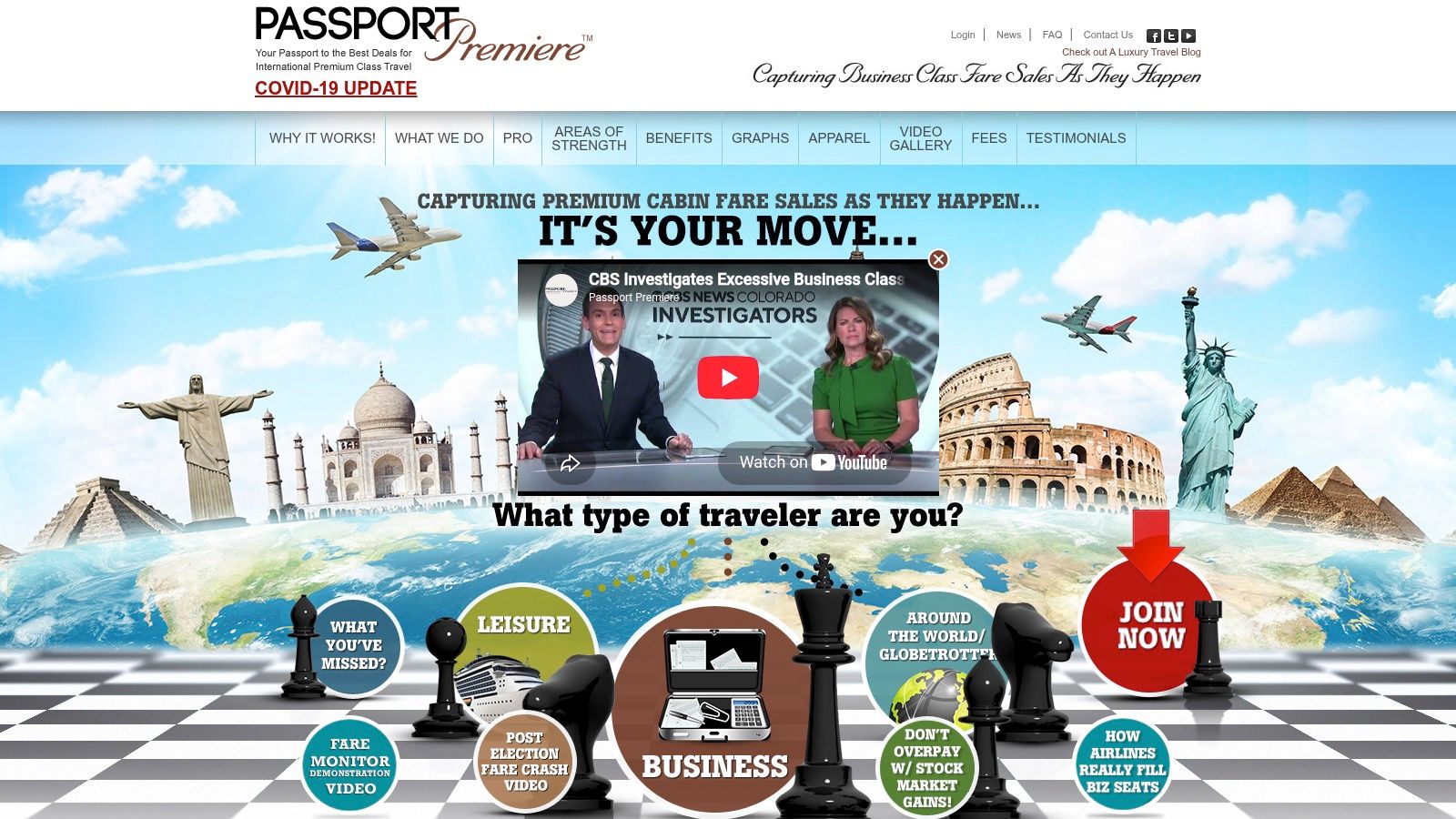
Passport Premiere is a paid membership for buyers of international business and first class who want a fare judged against the market, not against the airline's opening ask. Fewer than 15% of premium-cabin seats sell at their initial asking price. The airline still sets the fare. We tell you whether that fare is the one to pay.
Forecasting in the Air Monitor 2025-26 from American Express Global Business Travel expects only minimal growth in business-class fares for 2026. Waiting for published prices to collapse is a weak plan. Watching one route is the stronger one. We issue alerts when fare sales occur and send Member Intelligence Reports by email when market conditions move.
What you get before you pay
You receive four Fare Monitor scans for every international premium-cabin trip you buy. The system shows the lowest fare over the past year for the flight you want. It can also hold a fare while it watches for a lower one, and the held fare stays in place. Our Fare Monitor found business class fares 50% lower than a customer's initial searches on a trip to Italy. Tickets keep ordinary open-market traits, including flexibility and mileage accrual, no matter how low the final fare sits.
You still check the aircraft, the seat map, and the change rule. Membership buys the valuation work, not a promised outcome. A quote service hands you one number. This model hands you a range, then a signal when the range moves.
Buying rule: If the past-year low sits well under the fare on your screen, hold or wait. If the meeting is fixed and the aircraft is the right one, pay.
Who it fits
- Long-haul premium flyers: Benefits are strongest between the U.S. and Europe, Asia, Africa, Australia, Latin America, and the Middle East.
- Once-a-year travelers: The fit is at least one business or first class trip a year from North America to those regions.
- Small teams: A corporate membership covers up to five travelers. Larger groups need a custom setup.
- Not this product: Economy fares, U.S.–Canada, and trips inside one continent, such as London–Paris or New York–Cancun, sit outside the method.
Trade-offs
- You pay to belong: Fees are published on the site. They are not a per-ticket commission you can see at checkout.
- Nothing is guaranteed: Route, date, and leftover seats decide whether a drop appears.
- You still book with intent: Lounge access and a flat bed are standard premium services. They do not depend on how little you paid, but they also do not appear on a short-haul recliner.
Terry's note, "Saved $4000 on a single flight," is the kind of result members describe. Treat it as one itinerary, not a rate card.
2. OneSkies
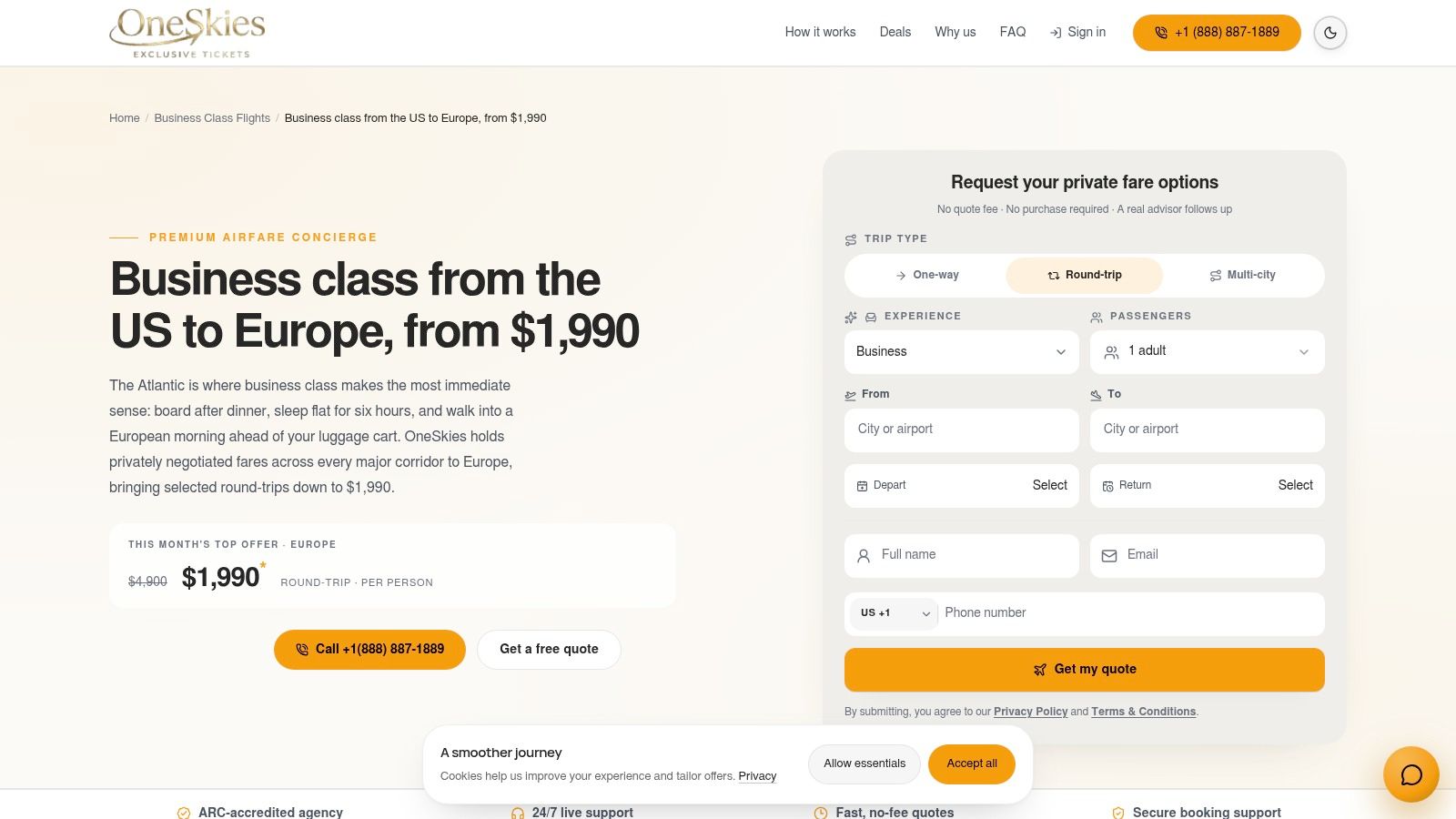
A quote is only useful if the fare rules and cabin match your trip. OneSkies lets travelers request a quote and work with an advisor on trip planning. Before paying, compare the quote with fares you can find yourself and check exactly what is included.
Public business-class fares can vary widely by route and date. Europe Flight Club's airline fare data shows a large spread between observed Washington–Amsterdam fares, with a similar pattern for Washington–Paris. The practical question is whether the quote is competitive for your dates and whether its restrictions work for you. If you want to track fare changes instead of relying on one quote, compare that approach with business class fare alerts.
What to verify before you pay
- Changes and refunds: Ask who handles changes or refund requests, and get the fare rules in writing. Check any fees and restrictions before purchase.
- The exact itinerary: Confirm the operating airline, flight numbers, and connections. A low quote may involve a routing or schedule you would not choose.
- The aircraft and seat: Check the aircraft assigned to each flight and review the seat map. Cabin layouts can vary, so confirm the features that matter to you.
A low fare with restrictive rules may cost more if your plans change. Advisor support can help with trip planning, but compare its value against the flexibility and control you need.
3. Select Business Class
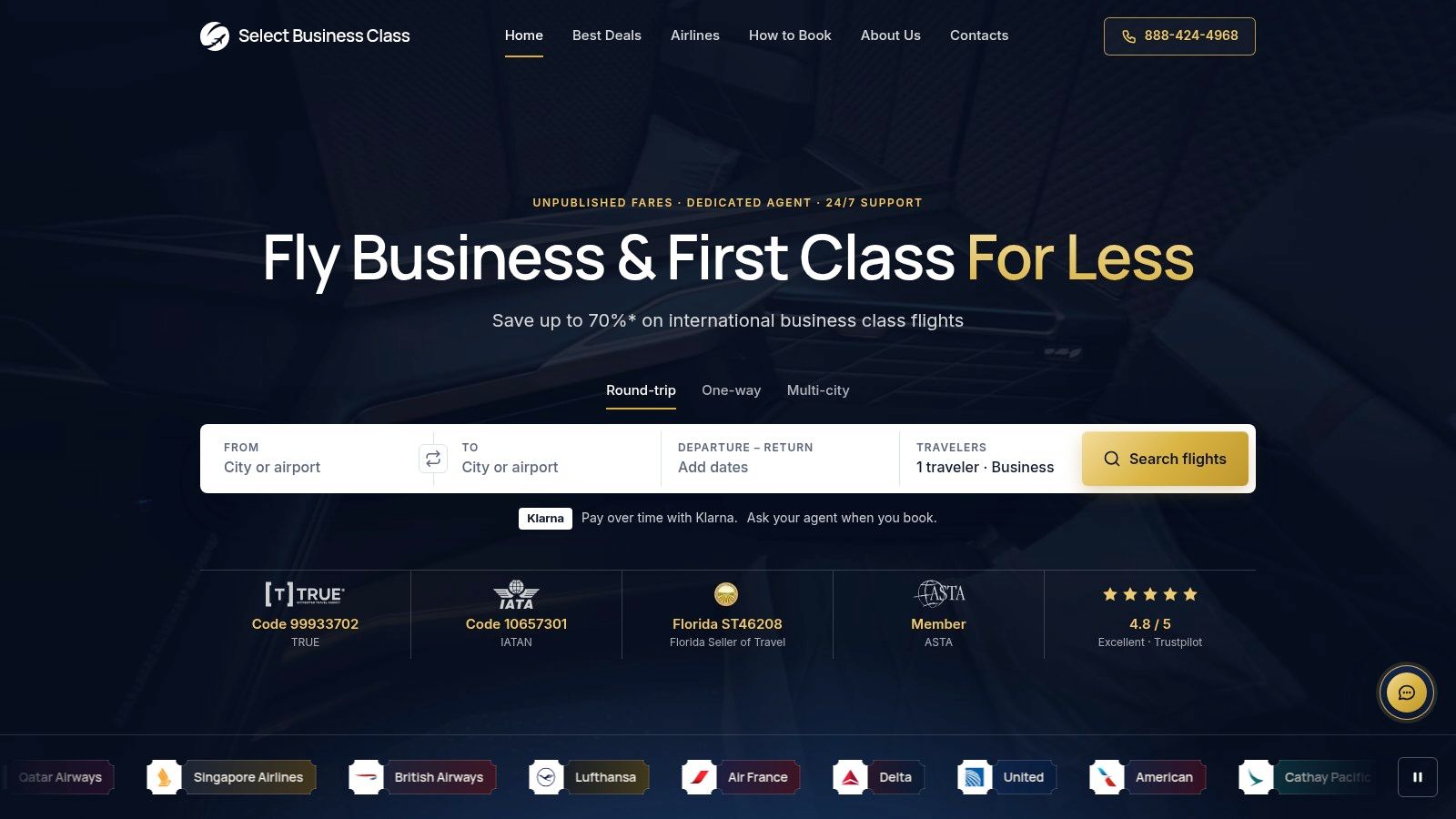
Select Business Class is an agent-led desk for business and first class, with Europe among the regions it sells. You describe the trip. The agent confirms the fare and the restrictions before you pay. The site also shows U.S.-gateway deal examples and states a price-match if you find a comparable lower fare before booking or within 24 hours, subject to its terms.
Sale levels in the open market already explain a lot of those quotes. Airlines and Destinations described transatlantic business-class sale fares commonly around £1,200–£1,800 round trip, less than 40% of a standard fare. The same piece put positioning flights from London to Amsterdam or Paris at roughly £50–£100 round trip, with onward premium fares sometimes hundreds of pounds under a Heathrow departure. Origin city, not cabin name, is doing the work.
A price match is a challenge, not a search
Displayed prices are estimates or starting fares. They are not held inventory. The match only helps if your cheaper find is comparable, and exclusions are where these policies get thin. Read what "comparable" means before you use the 24-hour window as a safety net.
Use an agent when the routing is messy and you want someone else to line up options.
Skip the quote when you only need a simple nonstop and you are willing to book a public sale yourself the hour it appears.
Check the rules on changes, refunds, and whether a lower fare from another agency even qualifies.
The savings come from the agent's access to sale inventory and from your willingness to challenge a high quote fast. They do not come from the agent watching the market for weeks after you have already paid.
4. FlyingInBusiness
FlyingInBusiness builds a search around your dates instead of handing you a self-serve grid. It advertises Europe fares from $1,595. That figure is a sample, not a quote, and the live price depends on the itinerary and on what is left. You send trip details or talk to an advisor. The company says its team stays with you through the trip, which is the part to pin down before you pay. Who reissues the ticket if the flight cancels?
Averages hide the fares worth buying. A Euronews comparison of more than 30 airlines found business class averaged 250% more than economy. The lowest overall premium in that analysis was 88%. Austrian Airlines averaged a 194.82% markup, yet Vienna–Larnaca was only 69.66% above economy and included one extra cabin bag and one extra checked bag. A $1,595 example only helps if your city pair behaves like that exception.
Where the quote model helps
- Multi-city or fixed dates: An advisor can test routings you will not grind through on a Sunday night.
- A published floor: The Europe sample gives you a number to judge the quote against.
- A real limitation: Starting prices are not inventory. Until you submit dates, you do not have a fare.
I would use this when the trip is awkward and I want one person accountable for the booking. I would not use a sample price in a travel-policy benchmark. Ask, in the same email as the quote, who handles a disruption at the airport and whether the fare earns miles. If those answers are fuzzy, the low start is not a low cost.
5. Going Elite

Going Elite sends fare alerts; you book the ticket yourself. Members choose U.S. departure airports and receive cash fares for premium economy, business, and first class, along with premium award deals. The app can also monitor a specific trip. The listed standard price is $199 a year, with a promotional first year at $179. That fee can make sense if you act on a deal. If you rarely book from alerts, it buys little.
Europe remains a large market for premium travel, so deals can draw quick interest. For a broader look at first-class flight deals to Europe, compare the options before settling on a route.
What the alert will not do
- It will not ticket you: The alert includes booking details and an estimate of how long the deal may last. You make the purchase.
- It will not cover every airport: A fare from New York does not mean the same deal is available from your city.
- Trip alerts have limits: Specific-trip alerts cover round trips and up to six travelers.
You need to be ready to book when an alert arrives. A fare can disappear before you have time to rearrange a fixed schedule. Going Elite suits travelers with flexible dates and departure airports; if your plans are set, compare available fares directly rather than waiting for an alert.
6. Thrifty Traveler Premium
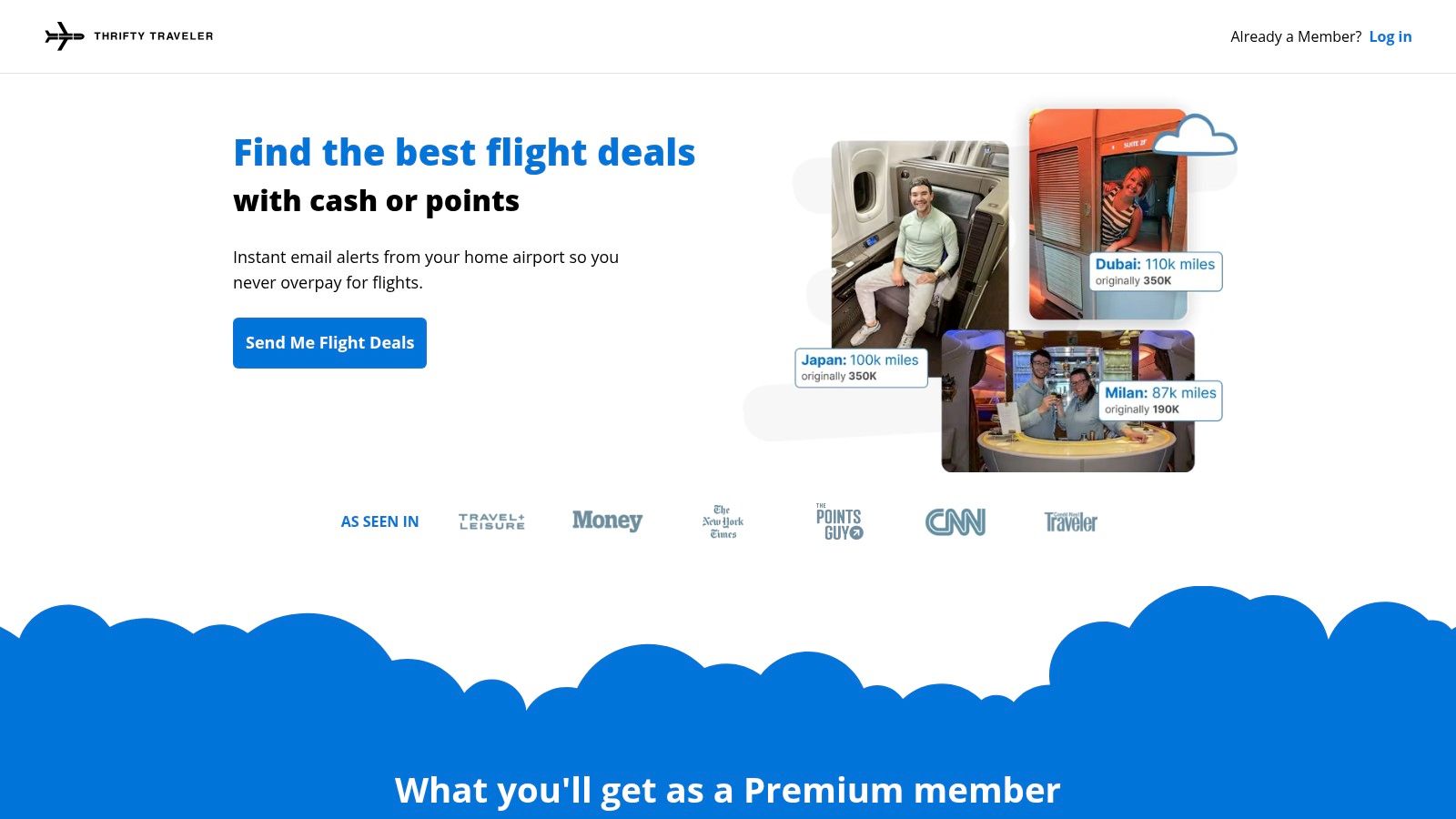
Thrifty Traveler Premium sends cash and award flight alerts. It charges an annual fee for flight deals, with a separate plan for flights and hotels. Check the current plan page before subscribing, since pricing and plan details can change. Award alerts are useful if you have transferable credit-card points in a program that can book the deal. If your points are in the wrong program, the alert may not help.
A Thrifty Traveler booking guide to business-class fares gives examples of the gap between typical fares and sale fares: Condor round trips to Europe at just over $2,500, compared with a normal price of $5,000 or more, and rarer Air France round trips below $2,000. The savings come from catching a sale while seats remain. You still book the ticket yourself, and the service does not manage it afterward.
Cash alerts versus award alerts
Cash deals can make business class worth comparing with economy when both fares are available for your dates. Check the live prices before deciding; the cabin fare order can change.
Points deals depend on award availability and the miles you already hold. An alert cannot create seats or make a short balance go further.
The hotel plan is separate. Choose it only if you also want hotel deals.
This service suits travelers who can act on an alert and shift departure by a day or two. A fixed conference week with no backup airport leaves little room to use a sale.
7. Secret Flying Premium
Secret Flying publishes airfare deals, and its paid Premium plan provides access to business- and first-class alerts. Set alerts by route and cabin, follow up to 20 departure cities and 20 specific routes, and filter by alliance and number of stops. Premium pricing is listed on the Secret Flying plans page, so confirm the current rate before subscribing. The free plan includes some economy deals, which can help you compare prices but offers less for business-class updates.
The main trade-off is control: Secret Flying sends deals, but you choose whether the itinerary works and book the ticket yourself. A nearby departure city or one-stop routing can give you more options. For a broader look at sites that search international fares, see this guide to international airfare sites.
How to set the filters
- Fix the city, flex the airport: Following nearby departure cities can surface fares you would miss with a single-airport search.
- Cap the stops: A one-stop lie-flat seat may cost less than a nonstop recliner. A two-stop overnight may not be worth the savings.
- Move quickly when a deal fits: Alerts can point you to a fare, but you still need to check dates, routing, and availability before booking.
Secret Flying works best when your dates and departure airport have some flexibility. With fixed dates, treat each alert as an option to assess, not a fare you can count on.
How the Seven Services Compare on Model, Advertised Europe Pricing, and Who Books
| Item | Service Model | Advertised Europe Price | Cost Structure | Who Books the Ticket |
|---|---|---|---|---|
| Passport Premiere | Premium-fare monitoring and guidance membership | No specific Europe fare stated | Membership fee; amount not provided | Traveler purchases the ticket |
| OneSkies | Consolidator with advisor-assisted quotes and booking | From $1,990 | Fare quoted based on itinerary; fee details not stated | OneSkies advisor assists with booking |
| Select Business Class | Agent-led premium-cabin booking | No specific Europe fare stated | Fare quote; price-match terms may apply | Agent assists with booking |
| FlyingInBusiness | Personalized travel-advisor search and booking | From $1,595 | Fare quoted based on itinerary; fee details not stated | Advisor assists with booking |
| Going Elite | Subscription-based premium fare and award alerts | No specific Europe fare stated | $199 yearly; promotional first year listed at $179 | Traveler books the ticket |
| Thrifty Traveler Premium | Subscription-based cash-fare and award alerts | No specific Europe fare stated | $129.99 yearly for flights; $189.99 yearly for flights and hotels | Traveler books the ticket |
| Secret Flying Premium | Paid premium-cabin deal alerts | No specific Europe fare stated | Premium plan price not shown in reviewed information | Traveler generally books the ticket |
Choose the Right Tool Before Your Next Europe Flight
The cheapest business-class fare depends on who sets the price, how much booking work you will do, and whether anyone can spot a drop before it disappears. Use an advisor-assisted service when you want help with a complex itinerary and booking. Choose an alert subscription if you can act quickly and book the ticket yourself. A fare-monitoring membership suits travelers who want context on whether an international premium-cabin fare is worth buying. Paying for overlapping tools can mean paying twice for similar alerts.
The cabin label alone does not tell you what the ticket includes. Business class, as a scheduled product, took shape as airlines developed distinct premium cabins. Compare the specific seat, baggage allowance, and change rules attached to each fare before you buy.
Keep a record of the fare you are considering and check it again before booking. Read the change and refund terms, too. A sale alert is a prompt to compare fares, not a guarantee that a ticket suits your trip.
Passport Premiere membership benefits apply to travelers who fly at least once a year in business or first class between North America and Europe, Africa, Asia, Australia, or South America. Its pricing methods do not apply to economy travel or premium trips within one continent, such as London to Paris. If your flying is only inside Europe, or only in economy, this membership is the wrong spend. Pack underwear styles for every trip with the overnight in mind, and put your fare budget toward the seat and ticket terms that suit your trip.
Passport Premiere monitors international business and first-class fares, provides insight into premium-seat pricing, and issues alerts when fare sales occur. If you are comparing business-class flights to Europe, review Passport Premiere to see whether its membership fits the international routes you fly.
