

“Book early” is useful advice for scarce economy seats, fixed dates, and peak travel. It's a weak standalone strategy for premium cabins. The best international airfares often appear when an airline has unsold business-class inventory, a competitor has opened lower pricing, or a route enters a short-lived fare cycle. Sometimes, business class is cheaper than coach on the same itinerary.
Premium travel is no longer a niche corner of aviation. In 2024, business and first class carried 116.9 million passengers, up 11.8% from 2023 and representing 6% of international passengers, according to premium-cabin market analysis. That scale affects inventory, competition, and upgrade decisions on long-haul routes.
The practical approach is to stop searching for a universal booking rule. Segment the route, cabin, and dates, monitor the market, compare the current fare with its recent path, and recognize when an inversion creates a genuine buying opportunity.
Why the Best International Airfares Are Not What You Expect
The assumption that business class always costs more than coach fails in real fare markets. Airlines don't price every seat according to a fixed comfort ladder. They price inventory according to demand, fare rules, competition, and the probability that a seat will sell before departure.
That can produce strange outcomes. Reporting on international fares has described a New York to London example where business fares fell to $2,800 in 2025, down 12% from 2023, while some comparable trips had business seats around $1,900 against peak-season economy around $2,200. The same analysis explains that the inversion appears when business demand weakens relative to coach demand, particularly during certain booking windows. See the detailed discussion of yield management pricing for the commercial logic behind those decisions.

The premium cabin isn't priced like a luxury product
Premium fares are valuable to airlines because a small number of travelers can contribute disproportionate revenue. Industry analysis indicates that premium-cabin fares average about five times economy fares and contribute roughly 15% of passenger revenue, even though premium travelers remain a small minority of passengers. Those economics encourage airlines to protect high fares, but they also create risk when premium seats remain empty.
Fewer than 15% of premium-cabin seats are sold at their initial asking price, according to Passport Premiere's publisher information. That doesn't mean every remaining seat will become cheap. It means the first displayed fare is a poor proxy for the eventual market value of an empty seat.
Key takeaway: The best premium fare isn't necessarily the earliest fare. It's the fare that appears when the airline's inventory, competitors, and demand cycle align.
Why generic deal hunting misses the opportunity
A static deal page can show an attractive fare without explaining whether the price is falling, stabilizing, or about to disappear. It may also use a different departure date, a restrictive fare class, or a nearby airport that changes the comparison.
The more reliable habit is route-specific monitoring. Watch a defined city pair, compare competing flights, record the cabin and conditions, and judge the quote against recent movement. That approach also helps corporate travelers separate a real fare drop from a temporary search anomaly.
The rest of the process is simple in principle, but demanding in discipline. Track fare cycles, test alternate routings, compare premium against flexible coach, and keep enough schedule flexibility to act when the cabin hierarchy briefly reverses.
How Premium Cabin Pricing Really Works
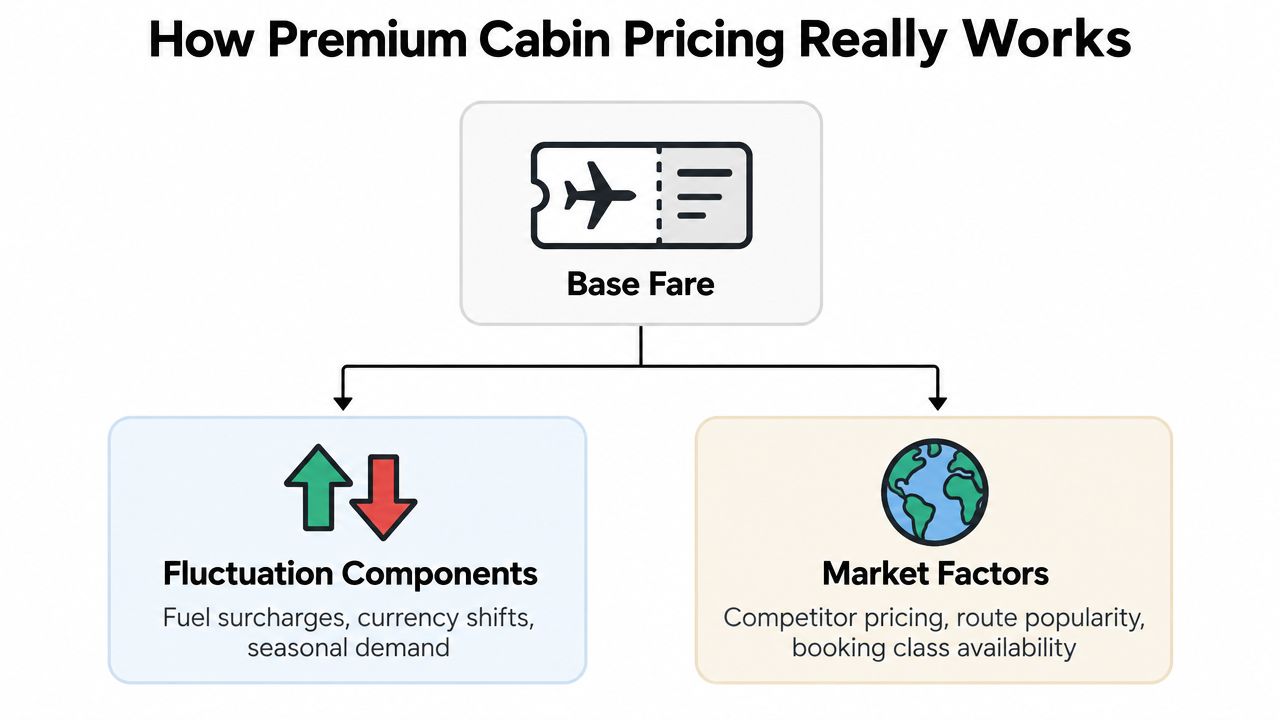
Premium fares do not follow a single booking calendar. Airlines manage them through fare classes, remaining seat inventory, competitor pricing, and the strength of demand on a specific flight. A useful model separates a relatively stable base fare from a fluctuation component. Research in a Stanford airfare study identifies unsold seats, competing-flight availability and prices, the time between booking and departure, and price changes during the prior seven days as especially informative variables.
That explains why two flights on the same route can move in opposite directions. One aircraft may have weak business-class demand and several unsold seats, while a competing service has stronger bookings and fewer discounted fare classes. Each airline adjusts its inventory pools independently, so a cheaper quote on one flight does not guarantee a similar price elsewhere.
Route matters more than a universal calendar rule
A 2026 route-level analysis of consolidator business-class floors found an average lowest accessed fare of $1,884 across 198 premium-cabin-relevant U.S.-touching city pairs. The averages varied sharply by corridor: $1,981 for transatlantic routes, $2,339 for transpacific routes, $2,087 for U.S. to Middle East routes, and $3,160 for U.S. to Oceania routes, as reported in route-level airfare trends.
Those figures are benchmarks, not promises. A fare that looks expensive on one corridor may be competitive on another. Transpacific and Oceania itineraries often need a different reference point from European routes, while Middle East pricing can reflect strong connecting competition alongside concentrated premium demand.
Premium demand also recovered faster than economy after the pandemic. By the end of 2023, premium-cabin traffic had reached 99.1% of 2019 levels, compared with 94.1% for economy. Premium-passenger volumes were 43% above January 2023 by May 2024, according to the same analysis. That stronger demand makes broad discounts less dependable, although individual flights can still develop fare pressure.
The variables behind a fare quote
A technical survey of airfare-prediction methods found that practical datasets typically use at least 12 features, including the airline, flight number, purchase date, departure date and time, arrival time, fare class, stops, price, and origin and destination airports.
For buyers, the useful application is straightforward:
- Inventory: Unsold premium seats can prompt price changes, but airlines do not publish a complete, reliable view of every inventory bucket.
- Competition: A rival flight with lower business pricing can pressure an airline to reopen or match a cheaper class.
- Time: Days until departure influence urgency, but premium cabins do not always follow economy booking behavior.
- Conditions: Refundability, changes, baggage, routing, and fare class can matter as much as the headline amount.
A premium itinerary also includes costs beyond the ticket. An expat coordinating airport transfers, remote work, or international communications may use a resource such as VoIP pricing for expats when assessing the total travel setup rather than judging airfare alone.
The practical test is specific: Is this fare below the route's recent trend, competitive with alternatives, and acceptable under the trip's flexibility requirements? That comparison is more useful than an average business fare, especially when a temporary fare inversion puts business class below coach.
Your Practical Workflow for Monitoring and Timing Purchases
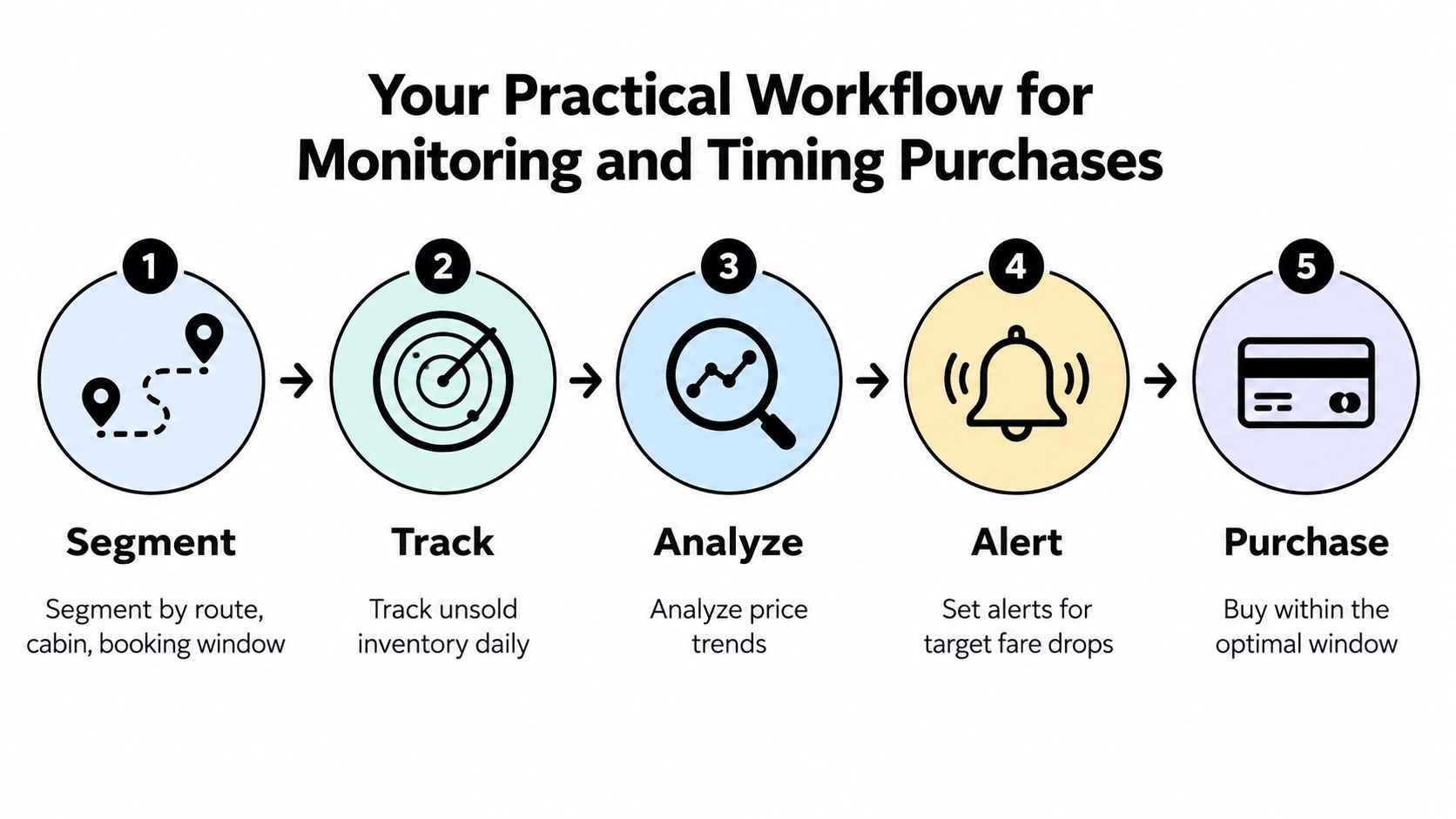
The most effective monitoring system is narrow. Don't track every destination and hope an alert produces clarity. Define the route, cabin, dates, acceptable airports, stop limit, and fare conditions first.
Start with a controlled route file
Create one record for each meaningful option. A New York to London nonstop business fare should not share a benchmark with a New York to London itinerary connecting through another city. Different airports, airlines, stop patterns, and ticket conditions produce different markets.
Record:
- Route: Include the exact departure and arrival airports.
- Cabin: Separate business, first, premium economy, and economy.
- Dates: Mark fixed dates separately from flexible date ranges.
- Window: Record how far the departure date is from each observation.
- Fare rules: Note changes, refunds, baggage, ticketing restrictions, and booking class.
- Alternatives: Add nearby airports, competing airlines, and sensible connections.
This structure prevents a common mistake, comparing a flexible business ticket with a restrictive coach ticket and calling the difference a saving.
Track movement, not isolated prices
The Stanford research cited earlier gives particular weight to recent seven-day price changes. Use that idea practically: keep a short trailing record of the fare, not just a screenshot of today's quote.
A weekly review works for trips that are still distant. Increase the frequency as the departure date approaches or when several airlines begin competing aggressively. Monitor unsold inventory where your tools expose it, but treat inventory signals as directional rather than definitive.
Practical rule: A fare drop matters more when it appears across comparable flights or follows a period of rising prices. One isolated result deserves verification.
Set a buy-or-wait rule
Buy when the fare is below your route-specific recent trend, meets your flexibility requirements, and remains competitive after taxes, fees, and positioning costs. Waiting makes more sense when the current price is above the local trend, your dates remain flexible, and competing flights still show meaningful availability.
Don't use an economy rule such as “book a set number of days before departure” for every premium itinerary. The premium-cabin overview provides useful context for why cabin class changes the pricing decision.
Tools can reduce manual work, but they don't replace judgment. A fare-alert service should let you define the route and cabin, understand the fare conditions, and see enough history to distinguish a market move from a one-off listing. Passport Premiere's business-class fare alerts are one example of a premium-focused monitoring approach.
Add the trip's ground requirements
A cheap premium ticket can become a poor decision if the itinerary creates expensive ground transport, an overnight connection, or a missed business obligation. For travelers coordinating executive arrival logistics, reviewing a resource on executive transport by flight monitoring can help connect airfare timing with the rest of the itinerary.
The workflow is therefore not “wait for the lowest number.” It is segment, observe, validate, and act when the fare satisfies both the market signal and the trip's practical requirements.
When to Buy and When Business Class Costs Less Than Coach
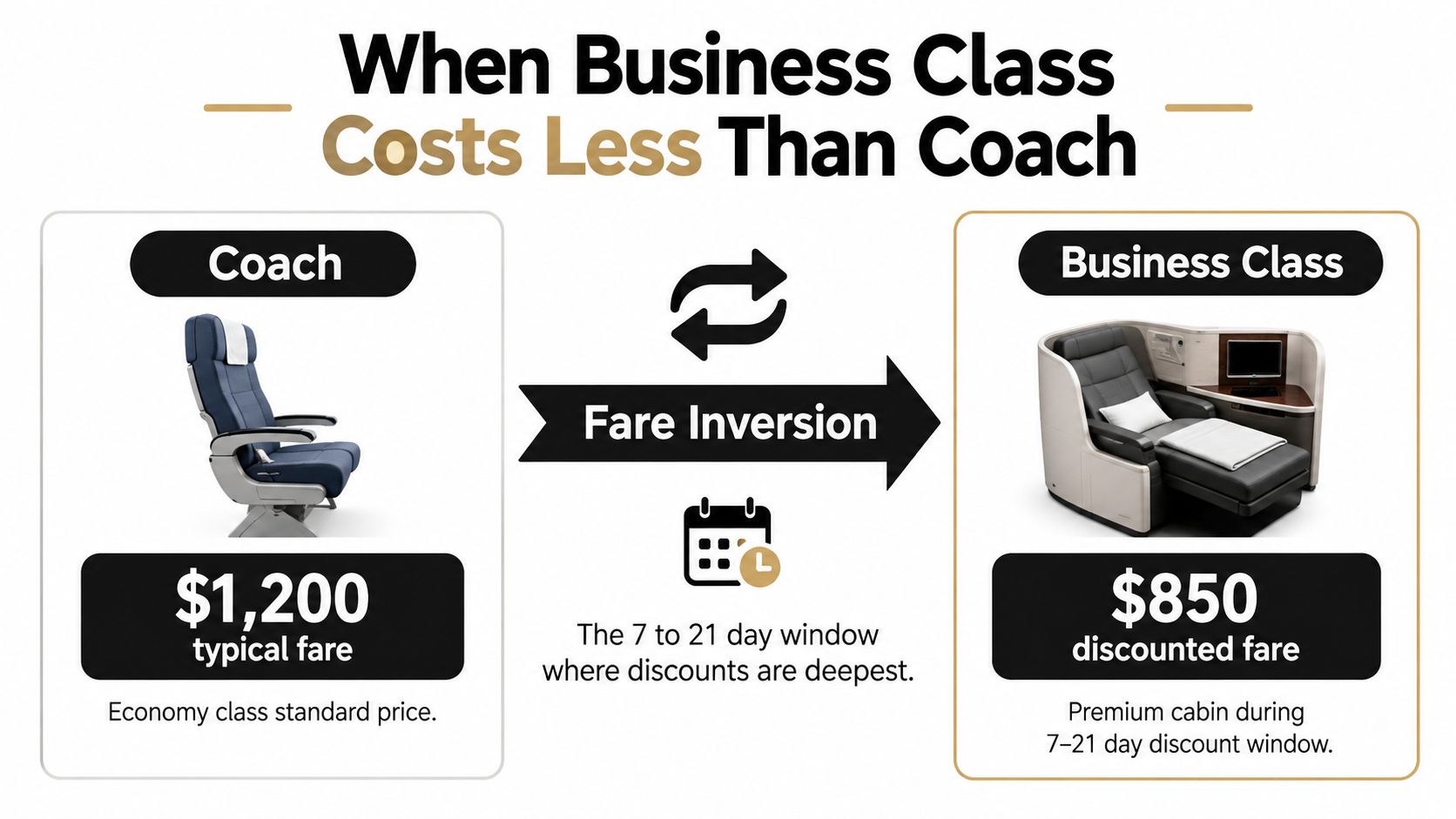
Fare inversion is the moment premium shopping becomes counterintuitive. An airline may discount business seats when corporate demand is soft, while coach remains supported by leisure travelers who have fewer alternatives. The result can be business class below economy on the same route, sometimes even on the same flight.
One reported Australian example showed Economy at $629 and Business at $449 on a Virgin Australia Canberra to Melbourne itinerary. On a Sydney to Christchurch example, Economy started at $489, while Business began at $462, demonstrating that the inversion can occur outside the competitor space and on an identical flight, as documented by Australian Frequent Flyer.
The late window requires judgment
One travel analysis identified 7 to 21 days before departure as a key discount window for some business fares. It also cited a domestic example where business tickets booked one week out averaged $228.21, 8.3% cheaper than earlier bookings, with New York to Los Angeles showing an 18.3% decline, according to last-minute business-class analysis.
That window isn't a guarantee. It works best when the airline has premium seats to move and the traveler can tolerate the possibility that the fare will rise or disappear. Fixed corporate travel dates require a stricter risk assessment than flexible leisure travel.
A separate business-class cost analysis reported transatlantic business fares averaging between $2,500 and $3,200 in 2026, about 10% below 2024 to 2025 highs. It also described a last-minute international example where discounted business at $2,100 undercut flexible coach at $2,500 or more, a difference of roughly $400.
Use the comparison below as a decision aid, not a promise of availability.
| Booking Window | Business Class Signal | Economy Signal | Action |
|---|---|---|---|
| Far from departure | Premium fare follows the route's normal pattern | Coach may offer broader schedule choice | Track and establish a benchmark |
| Within the monitored cycle | Business price falls against its recent trend | Coach remains stable or rises | Verify fare rules and compare flights |
| 7 to 21 days out | Discounted premium inventory appears | Coach may hold because leisure demand remains | Consider buying if dates and conditions work |
| Close to departure | Business can invert below coach, but inventory may vanish | Flexible coach can become expensive | Act only if the fare is validated and usable |
The right response to an inversion is not automatic purchase. Check whether the business fare is ticketable, whether the routing is acceptable, and whether the coach comparison uses equivalent flexibility.
For corporate travelers, waiting can expose the company to schedule risk. For leisure travelers, flexibility can make the late window attractive. The market signal is strongest when premium pricing falls below its own recent level and below comparable coach, not merely when a search engine displays a dramatic headline.
Real World Timelines and Corporate Booking Tactics That Save
A New York to London business trip shows why a low fare requires a decision rule, not endless searching. Start with flexible departure dates, separate nonstop business fares from connecting options, record the current price, and check competing services. If the fare reaches the route's recent low and the conditions remain usable, buy rather than wait for a theoretical bottom.
New York to London lesson: Flexibility creates value only after the traveler defines an acceptable route and maximum price.
A transpacific consultant faces a different pricing pattern. The corridor's average floor is higher than the transatlantic benchmark, so expectations based on Europe can mislead the buyer. Track the exact city pair, compare nearby departure airports where practical, and include schedule reliability in the decision. A cheaper connection can cost more through lost time and operational risk.
The route analysis found average lowest accessed fares of $2,339 for transpacific routes and $3,160 for U.S. to Oceania routes, as noted earlier. These figures provide market context, not promised quotes.
Transpacific lesson: A higher corridor benchmark does not make every discount attractive. Compare the fare with its own route history.
Luxury leisure travelers usually have more room to wait. Monitor the preferred itinerary, keep a second routing available, and watch for an inversion when business class falls below flexible coach. Validate baggage, change rights, connection quality, and the cost of positioning to another airport before purchasing.
Corporate travel managers can turn this approach into policy. Set an approved route range, allow reasonable date flexibility, define when premium upgrades qualify, and require a comparison between business class and flexible economy. Comparing business with the cheapest restricted coach can produce a misleading saving.
Membership intelligence can support the process by exposing fare cycles, market analysis, and premium-cabin alerts. It does not replace checking ticket rules, but it can help a small travel team monitor more routes than manual searches allow.
For SMB owners, consistency often creates the largest improvement. Record purchased fares and their conditions, then review where the company bought too early or ignored a competitive alternative. Over time, that internal history becomes more useful than generic advice about a particular weekday. The practical target is a repeatable record of route behavior, usable fare rules, and clear approval limits.
Putting It All Together for Consistently Lower Premium Fares
Lower premium fares come from three disciplines: route-specific tracking, cycle-aware timing, and fare-inversion recognition. None works reliably alone. A cheap-looking quote can be poor value if it uses the wrong airport, restrictive conditions, or an inconvenient connection.
Business fares also need to be read against the wider market. FCM Consulting reported that global business-class fares fell by an average of $119, or 4%, from January to May 2025 compared with the same period a year earlier, while economy fell $18, or 3%. During that period, global air travel demand rose 8.1% year over year and load factors were 80.2%, according to FCM's H2 2025 insights report. Lower averages don't guarantee cheap seats on your route, especially when discounted inventory is limited.
Start this week:
- Choose one route: Define airports, cabin, dates, and acceptable connections.
- Build a fare record: Log current prices, fare rules, and comparable competitors.
- Watch the path: Compare new quotes with the recent seven-day movement.
- Test the inversion: Compare business with flexible coach on the same itinerary.
- Set an action rule: Buy when the fare is both market-competitive and operationally suitable.
Treat every purchase as a data point. The goal isn't to predict every move. It's to recognize when the price is unusually favorable and act before the inventory changes.
Passport Premiere provides premium-fare monitoring, market analysis, member knowledge, and fare-cycle signals for international Business and First Class travel, including guidance on evaluating empty premium-cabin inventory. Visit Passport Premiere to review the available membership options and use a more disciplined process for finding business fares that can undercut coach.
