

The most popular advice about business class seat availability is wrong: an empty-looking premium cabin doesn't mean a cheap seat is available. A seat map is not a fare quote, an award calendar, or proof that the airline will sell you the lowest business-class price.
The useful question is narrower and more practical: which seat is sellable on this aircraft, on this flight, at this fare, in this booking class, right now? That shift changes how you search, when you act, and why business class can occasionally cost less than coach.
Why Empty Premium Cabins Are Not the Same as Available Seats
A seat map shows a physical layout, not the complete commercial inventory. It may display the aircraft configuration, seats already assigned to other travelers, and seats blocked for operational reasons. It usually won't tell you whether an unoccupied seat belongs to a discounted business fare, a flexible fare, an upgrade bucket, or an award class unavailable to your loyalty program.
The distinction matters because airlines sell the same cabin through separate inventory channels. A business seat might be available for a high cash fare but closed in the cheapest business booking class. It might be open for an upgrade but unavailable as an award. It could also be physically empty while the airline protects space for elite upgrades, operational recovery, or late-booking corporate demand.
Practical rule: Treat the seat map as a clue about the aircraft, never as proof that a buyable seat exists at your target price.
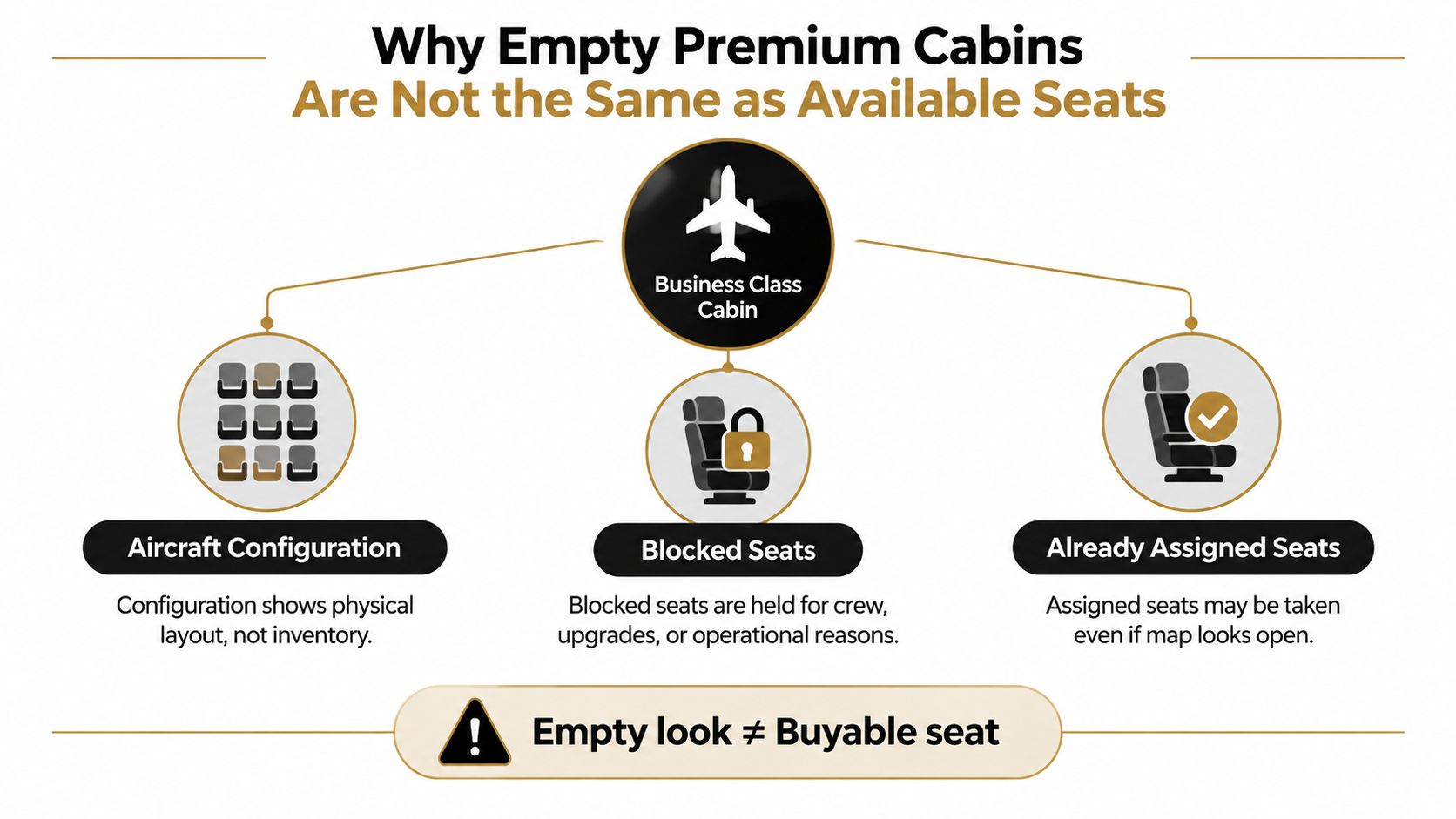
The cabin can look empty for several reasons
An airline may block seats because of crew requirements, aircraft certification, service limitations, or a late equipment change. Recent coverage described Lufthansa's Allegris 787 business cabin flying with only 4 of 28 seats bookable, while 24 seats remained blocked because of certification delays, as reported by Mainly Miles' coverage of restricted premium-cabin seating. The aircraft had seats. Travelers couldn't treat all of them as normally sellable inventory.
Singapore Airlines has also been reported to block portions of its business cabin for certain fare types until 96 hours before departure, which means access can depend on both the ticket and the time remaining before takeoff, not merely on whether the seat map looks open. The same coverage explains why seat access is becoming a revenue-management tool rather than a simple occupancy display.
The reverse can happen too. A nearly full map may still produce a late award opening or a lower revenue fare if the airline changes inventory controls. Airlines can move unsold space between fare buckets, release an award seat, or assign previously blocked seats after an operational restriction clears.
Check the product, not the pixels
Start with the exact operating flight, date, aircraft, passenger count, and cabin. Then verify the live cash price or mileage quote. A seat map won't reveal the booking code, fare restrictions, cancellation terms, or whether the visible seat can be ticketed through your chosen program.
Business class is structurally scarce. Among the world's 50 leading full-service carriers, business class represented 9.2% of installed seats, rising to 12.2% on widebody aircraft, according to Mighty Travels' analysis of long-haul business-class seat availability. That limited physical supply gives airlines room to protect premium inventory, especially on long-haul routes.
The best search habit is simple: separate visual occupancy, paid availability, and award availability. Only the final live, bookable result counts.
How to Read Business Class Seat Availability Like a Pro
Professionals don't begin with the seat map. They work through the flight in layers, because every layer can change the answer.
Start with the aircraft and operating carrier
Confirm who operates the flight and which aircraft is scheduled. A codeshare search can display one carrier's flight number while the operating airline controls the actual cabin, seat layout, and inventory. Aircraft swaps can also change the number of business seats, the seat model, and which positions are blocked.
Next, inspect the cabin itself. Look for the business-class rows, blocked positions, bassinet locations, and unusual layouts. Don't assume every premium-looking section is the same product. A true long-haul business cabin, a regional recliner product, and a converted section can appear differently in search tools while carrying very different value.
Move from the map to the fare
Compare the fare family and booking class, not just the headline price. A discounted business fare might have stricter changes, limited refundability, or weaker upgrade eligibility than a higher fare in the same cabin. Your target is the cheapest acceptable product, not merely the first business result displayed.
For a useful primer on how airline fare letters affect ticket rules and upgrade eligibility, review this guide to flight class codes. Booking codes such as J, C, D, Z, and P can indicate different inventory levels, but the meaning and conditions vary by airline.
Check the full itinerary as well. A through-ticket can contain mixed cabins, married-segment logic, or a connection where only one flight offers business class. The total fare may be attractive while one segment remains in economy.
Validate the award separately
Award availability requires its own check. Confirm the points price, taxes, transfer path, cancellation rules, and partner booking class. Then search the operating carrier and relevant partner programs, because one program may show space another can't sell.
ExpertFlyer says it can search open award and upgrade inventory by flight and class, search up to 3 days on either side of a target date, and show how many seats are open before you transfer miles or apply a certificate, as described in its airline award and upgrade search features. Use that flexibility to scan broadly, then verify the exact date before booking.
| Check | What to verify | Why it matters |
|---|---|---|
| Flight | Operating carrier, flight number, date, aircraft | Equipment and inventory can differ by flight |
| Cabin | Business rows, blocked seats, product type | A visible seat may not be commercially accessible |
| Fare | Brand, fare family, total price, restrictions | The cheapest business product may sit in another bucket |
| Booking class | Revenue or award code | The code controls availability and often ticket conditions |
| Itinerary | Every segment and cabin | Mixed-cabin or through-ticket rules can alter the result |
| Confirmation | Live price, mileage quote, seat assignment | Only a current, ticketable result proves availability |
The professional sequence is route, aircraft, cabin, fare, booking class, restrictions, confirmation. Seat-map occupancy belongs in the middle, not at the end.
Award Space Versus Revenue Seats and Why It Matters
Cash inventory and award inventory share the same physical aircraft, but they don't share the same commercial rules. The airline's pricing engine manages revenue fares, while loyalty programs receive a separate pool of redemption inventory. That's why a flight can have unsold business seats and no saver awards, or award space while the cheapest cash fare remains expensive.
Two systems, two decisions
Revenue inventory is built to maximize ticket revenue. Airlines open and close fare buckets according to demand, competition, route economics, and remaining capacity. A lower business fare can appear after the airline decides that selling at a discount is better than leaving the seat unused.
Award inventory is more restricted. The operating carrier determines what it releases, while partner programs show only the space they're permitted to sell. A calendar marked “business” may hide partner limitations, taxes, transfer friction, or a booking class that isn't available through your preferred program.
| Dimension | Revenue seats | Award space |
|---|---|---|
| Controller | Airline revenue-management system | Airline loyalty and partner inventory rules |
| Price | Cash fare by brand and booking class | Miles or points plus taxes and fees |
| Best use | Fare sales, premium discounts, unusual price gaps | High-value redemptions when cash prices are high |
| Main trap | Cheap headline fare with harsh restrictions | “Business” result that isn't accessible through your program |
| Verification | Live fare quote and fare rules | Live award quote, partner access, and transfer path |
Search both channels in parallel. For revenue tickets, compare the total price, baggage, changes, cancellation terms, and booking class. For awards, compare the mileage requirement, taxes, transfer partners, cancellation rules, and operating-carrier access.
A visible business cabin is a lead. A confirmed fare or award is the result.
Flexibility improves the search. Check nearby dates, alternate airports, and competing carriers. ExpertFlyer's ability to search nearby dates is useful when a single-day search fails, while a separate award workflow can help identify whether the right redemption is available through United or another partner. The MileagePlus upgrade and award guide is useful when you're comparing an upgrade path with a direct award.
Don't transfer points until the award is confirmed and bookable. Award inventory can change before the transfer completes, and a points balance doesn't create space that the airline hasn't released.
Routes Where Business Class Drops Below Coach
Business class can be cheaper than coach. It's unusual, but it happens when flexible economy fares rise sharply while premium seats remain unsold, as explained by Australian Frequent Flyer's analysis of business fares undercutting economy.
The mechanism is straightforward. Airlines don't price cabins in a perfectly smooth ladder. Economy may close its cheaper buckets while business retains a promotional or distressed fare. A traveler comparing only the cheapest economy headline can miss the more expensive flexible economy options that make business class the better purchase.
Look for the gap, not a mythical route list
The strongest opportunities tend to appear on competitive international routes, off-peak widebody services, and markets where airlines are fighting for premium demand. Independent commentary reports that business fares on competitive transatlantic and transpacific routes can fall to two to three times the economy price during off-peak periods, while some leisure-heavy routes can price at less than twice economy, according to Winghoppers' discussion of premium fare gaps.
A route-level example is more useful than a broad promise. Holidu found Iberia's Madrid to Athens flight priced at £454 in economy and £562 in business class, a difference of £108, as shown in its business-class bargain analysis. That's not a universal pattern, but it demonstrates how narrow the gap can become when premium inventory needs stimulation.
| Route pattern | Typical gap | Best window | Trigger |
|---|---|---|---|
| Competitive transatlantic | Business may approach two to three times economy in off-peak periods | Lower-demand travel periods | Premium fares remain flat while economy rises |
| Competitive transpacific | Business can compress toward economy when demand softens | Off-peak periods | Rival capacity or weak premium bookings |
| Leisure-heavy international route | Business can cost less than twice economy | Shoulder or off-peak periods | Unsold premium seats and aggressive competition |
| Madrid to Athens example | £108 gap in the cited fare comparison | The observed market window | Iberia business inventory priced close to economy |
The diagnostic signals matter more than the city names. Watch for an economy fare spike with no matching business increase, a new aircraft entering the route, or a schedule change that creates excess premium capacity. Don't assume more business seats guarantee a bargain. Reuters reported American Airlines increasing premium seating on 777 aircraft to 144 seats, about 44% of the aircraft, as carriers pursue higher-spending travelers, according to the Frequent Miler discussion of premium-cabin expansion. More seats can coexist with tight yield controls.
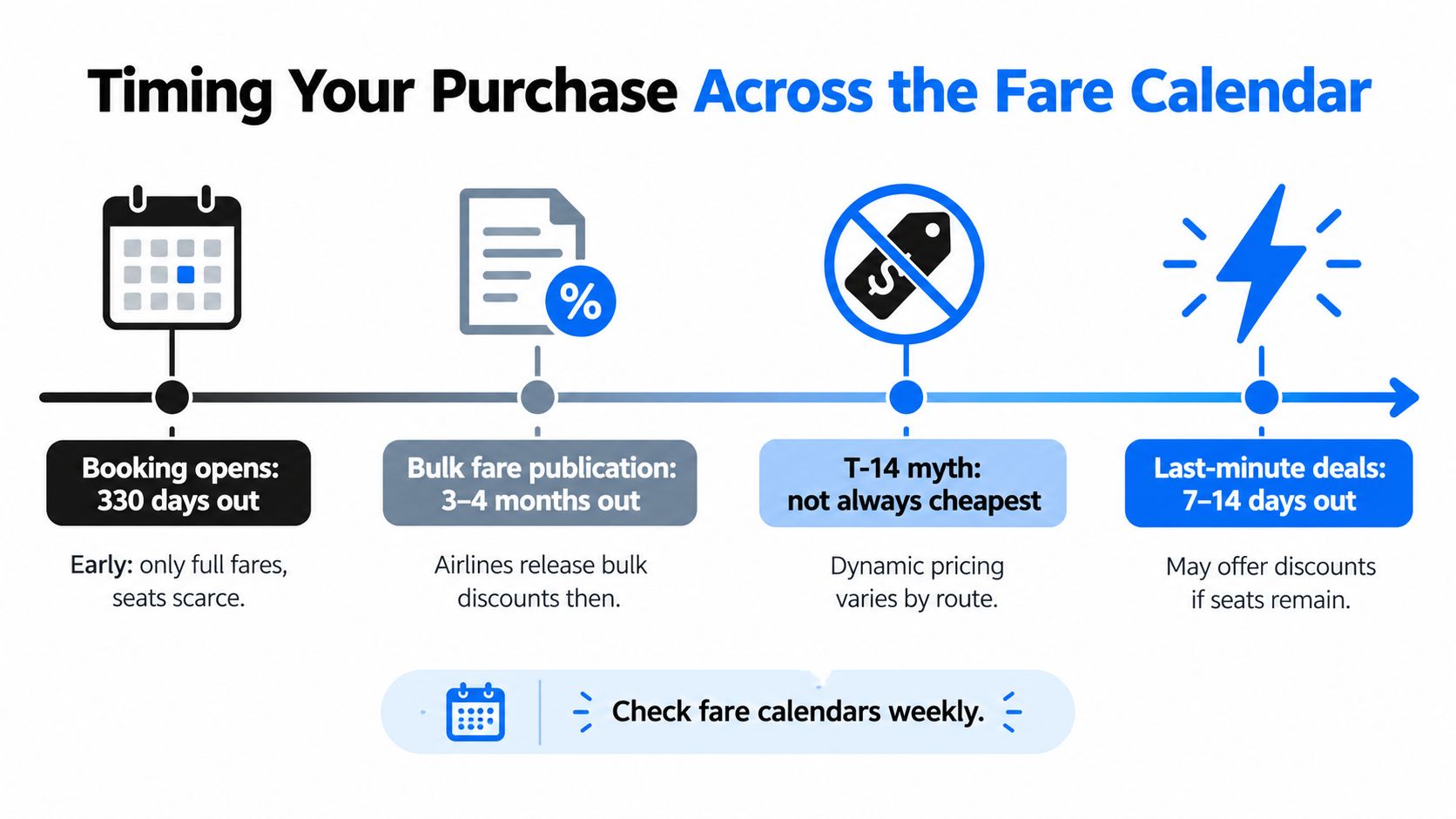
Timing Your Purchase Across the Fare Calendar
The myth that T-14 is always the cheapest window causes travelers to wait without a monitoring plan. Airlines adjust premium fares dynamically, and the right opportunity depends on the route, season, aircraft, and inventory bucket. A late discount can appear, but waiting until the final stretch can also leave you with fewer seats and harsher prices.
Start watching when the schedule opens. Don't expect the cheapest fare immediately. Early inventory may contain mostly higher-priced options, while the airline tests demand and protects premium space.
Use a horizon-based watchlist
Track the route through several windows rather than making one search on one day.
- At schedule opening: Record the aircraft, cabin size, fare families, and initial business prices. This creates a baseline and exposes later changes.
- Several months before departure: Recheck the fare calendar, especially during shoulder-season travel. Bulk discounts and competitive adjustments often appear before the final weeks.
- Inside the final weeks: Monitor every target date more closely. A lower fare can emerge if premium seats remain unsold, but scarcity risk rises as departure approaches.
- After a schedule change: Search immediately. Aircraft swaps, timing changes, and added or removed service can force an airline to rebalance inventory.
The global recovery pattern explains why patience must be selective. In 2022, global airline capacity recovered to about 86% of pre-crisis levels, while business-cabin capacity recovered to almost 84%, with another industry analysis placing business-cabin recovery at approximately 83%, according to Skift Research's premium-cabin capacity analysis. Premium supply was still lagging overall capacity, so travelers faced tighter conditions even as schedules returned.
Act immediately when the fare moves
When a useful business fare appears, don't admire it. Run this sequence:
- Verify the booking class and confirm every segment is in the intended cabin.
- Read the fare rules, including changes, refunds, baggage, and advance-purchase conditions.
- Check partner inventory if you're considering miles or an upgrade.
- Use a hold or refundable option where the airline makes one available.
- Compare the final total, then ticket before the bucket closes.
This video adds practical context for reading fare patterns and booking decisions.
Check fare calendars weekly, but increase the frequency once a target route enters an active sale or schedule-change period. The winning habit is not guessing the perfect day. It's seeing the change quickly and verifying the exact sellable product before someone else takes it.
Tools and Alerts That Catch Fare Drops First
No single tool sees every layer of premium inventory. Use each platform for the job it handles well, and assume every result needs a second verification.
Google Flights is the broad revenue-fare scanner. It's useful for comparing dates, carriers, airports, and visible business prices, but it may not expose every booking-class nuance or codeshare distinction.
ExpertFlyer is the specialist tool for flight-specific award, upgrade, and class inventory searches. Its value increases when you care about a particular flight or booking class, but it still reflects the inventory sources and programs available to it.
Seats.aero and AwardFares suit points-focused travelers scanning award calendars across programs. They can reveal patterns faster than manual searches, but partner access, married-segment rules, and final booking conditions still require confirmation.
FlightConnections is a route-discovery tool. It helps identify alternate hubs and competing carriers, not whether a particular business seat is sellable at a target fare.
Kayak price alerts are useful for broad cash-price movement. They're less precise when your strategy depends on a specific premium booking class rather than a general cabin price.
Airline-specific trackers can be valuable when you repeatedly fly one carrier, particularly if you understand its fare brands and loyalty rules. The weakness is fragmentation. You may need separate systems for revenue pricing, award space, seat maps, and partner inventory.
For travelers comparing premium trips with broader destination planning, guides for UAE adventures can help identify alternative cities and routing ideas before you begin the fare search.
| Tool | Tracks | Business coverage | Limitation |
|---|---|---|---|
| Google Flights | Cash fares, dates, carriers, airports | Broad business-fare visibility | Booking-class and partner details can be limited |
| ExpertFlyer | Flight-specific award, upgrade, and class inventory | Strong for targeted cabin checks | Requires careful interpretation of live inventory |
| Seats.aero | Award calendars and program availability | Useful for points-led scanning | Partner and segment rules still need validation |
| AwardFares | Award-space searches across programs | Helpful for comparing redemption paths | Displayed results may not equal final bookability |
| FlightConnections | Routes, hubs, and competing services | Indirect business-class value | Doesn't prove fare or award inventory |
| Kayak alerts | General cash-price changes | Useful for broad monitoring | Not designed around precise premium buckets |
| Airline trackers | Carrier-specific fares and loyalty space | Strong within one airline ecosystem | Coverage is narrow and fragmented |
Passport Premiere is one monitoring option for travelers who want premium-cabin fare alerts and notifications for situations where business class can undercut coach. Its role is to add a fare-monitoring layer to the manual checks above, not to replace live verification. Details on that approach appear in the business-class fare alerts resource.
A Repeatable Weekly Workflow for Cheaper Premium Fares
A monitoring system works only when it's repeatable. Set fixed tasks for each day, log the result, and define what deserves immediate action. The objective isn't to search every airline endlessly. It's to maintain visibility across both revenue fares and award space before a short opening disappears.
Run the same loop every week
Monday is for awards. Search ExpertFlyer and United across your preferred routes, nearby dates, and passenger counts. Check whether the result is a true business award, identify the program displaying it, and record the mileage and restrictions.
Tuesday is for cash. Scan Google Flights and ITA Matrix across your next four travel windows. Compare business against both the cheapest economy fare and the flexible economy fare. Log the fare family, booking class when available, operating carrier, and aircraft.
Wednesday is for competitors. Check SeatSpy and FareAlert, then search alliance partners on the same route. A carrier may show no useful space while a partner exposes a different award path or a competing cash fare.
Thursday is for verification. Open the operating carrier's website and inspect the seat map, fare rules, and booking class. Confirm that the result is ticketable, rather than relying on a cached alert or a codeshare display.
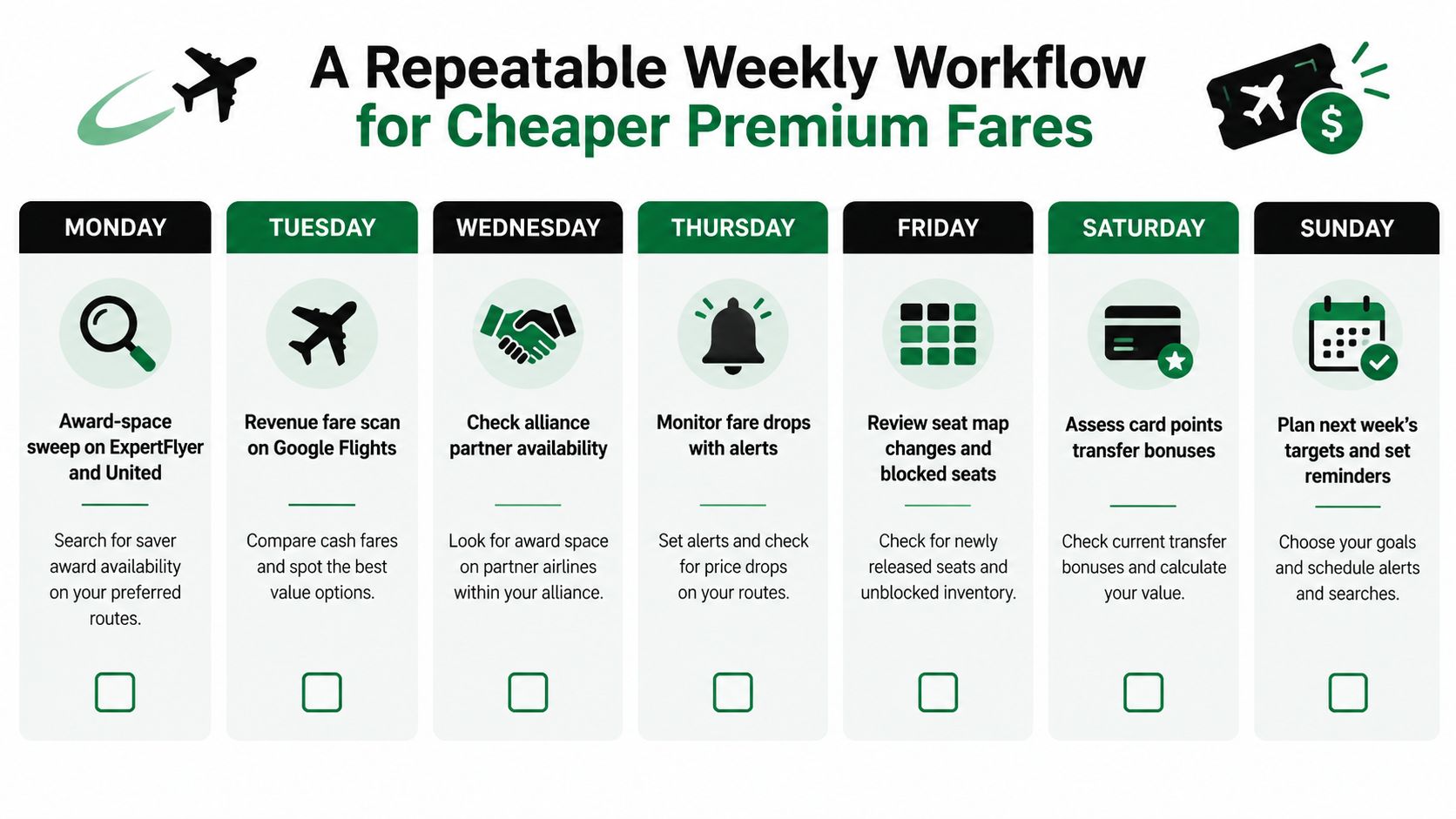
Friday is for anomalies. Review SecretFlying and relevant X accounts for mistake fares, route sales, and sudden premium-price movements. Treat every alert as unverified until the airline or booking channel produces a live fare with usable rules.
Saturday is for points. Check transfer bonuses available to your cards and compare the resulting redemption with the cash fare. Don't transfer speculatively.
Sunday is for planning. Review triggered alerts, remove dead routes, add new target dates, and set the next week's searches. A clean watchlist beats a huge one you never inspect.
Define your action threshold
Track J, C, D, Z, and P where the carrier uses those business booking classes, but don't assume the same letter means the same product across airlines. Record lower fare buckets, flexible alternatives, taxes, and the final cabin on each segment.
Act within 60 minutes when a target fare or award opens and the fare rules fit your trip. Premium inventory can change quickly, and delay is the most common reason travelers lose a verified opening.
The manual checklist should be your safety net. A monitoring service can run the background searches, surface J-class openings or revenue drops, and leave you with the decisions that require judgment: route quality, flexibility, aircraft, and ticket conditions.
Passport Premiere monitors international premium-cabin fare movements and alerts members to business-class opportunities, including cases where business class prices fall below coach. Visit Passport Premiere to add those signals to your weekly availability workflow and stop treating the seat map as the final answer.
