

“Select First Class and sort by lowest price” is incomplete advice. That filter can put a genuine international First Class itinerary beside a mixed-cabin ticket or a premium fare missing the benefits you need. The cheapest result isn't necessarily the cheapest way to travel comfortably.
A useful first class flight search compares the seat, schedule, lounge access, baggage and change rights together. Business class cheaper than coach is possible during selected sales, but that's a fare comparison to verify, not a rule to assume. Start with comparable offers, then decide whether the premium is worth paying.
Pick Channels That Show Full Premium Offers
Choose your search channels before choosing a fare. Use the operating carrier's website, one metasearch tool and one agency or corporate booking tool. Keep those channels fixed so you can distinguish a genuine price difference from a different product.
The reason goes beyond website design. IATA's New Distribution Capability fact sheet describes an API-based Offer and Order approach that lets airlines distribute differentiated fares and ancillary services. A traditional display may not represent every airline-specific inclusion clearly.
Give each channel a job
- Operating carrier: Use its website as the reference for cabin descriptions, aircraft information and published fare-brand conditions.
- Metasearch: Scan competing carriers and schedules without opening every airline website individually.
- Agency or corporate tool: Check the offers available through that channel, along with servicing arrangements and company-policy requirements.
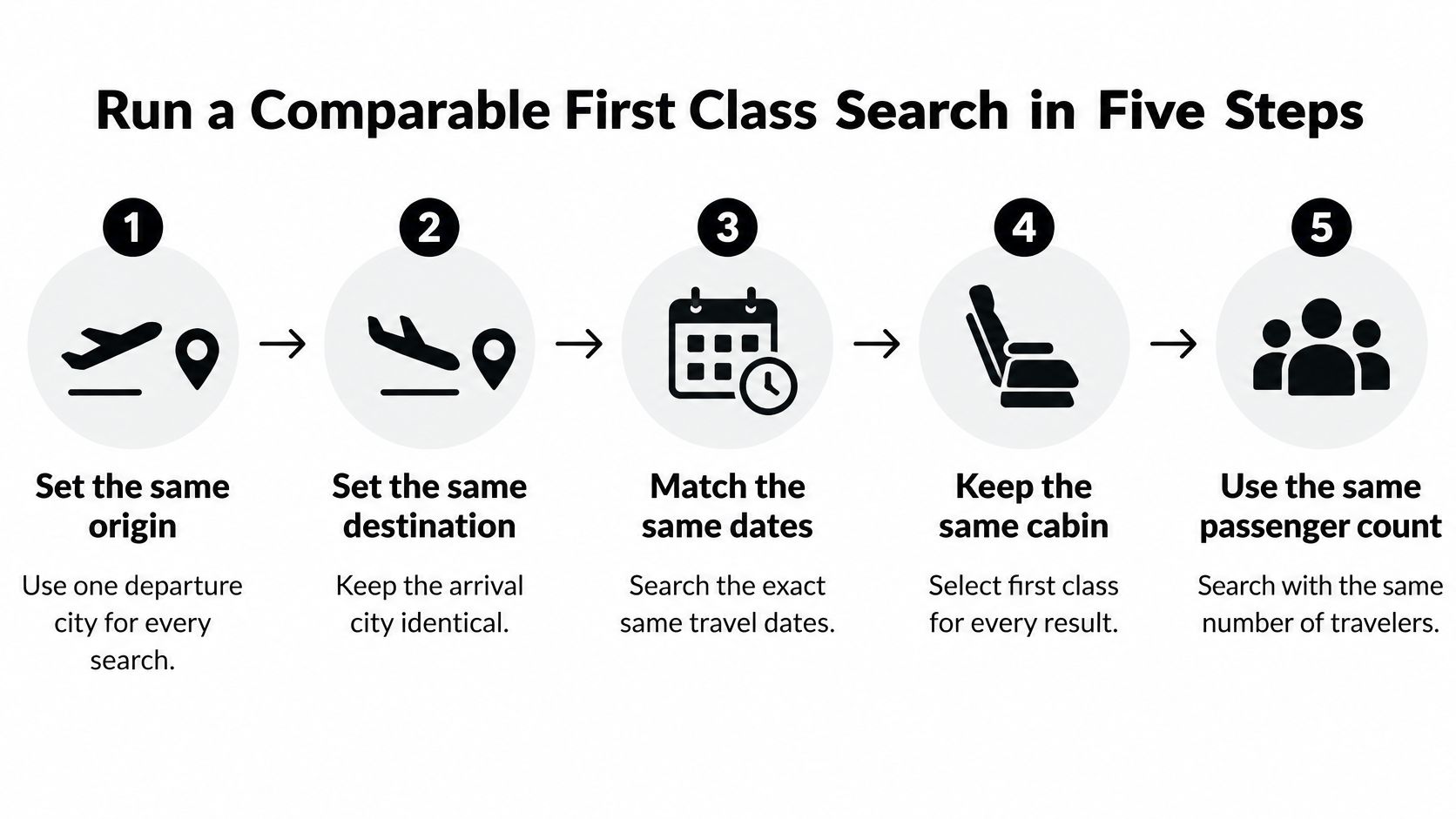
Enter identical origins, destinations, dates, cabins and passenger counts. Record the cabin wording exactly, rather than translating every premium result into First Class.
Useful search terms include first class, business class, lie-flat and fare-brand names such as Basic Business or Classic Business. These terms help identify what's being sold, but none replaces the fare conditions.
Practical rule: A channel is a place to find an offer, not proof that the offer includes everything you expect.
If an agency produces a lower result, investigate whether travel agents can get cheaper flights before treating the difference as a saving. Record the seller beside the fare, and establish who will handle changes or cancellations after purchase.
Run a Comparable First Class Search in Five Steps
A first class flight search only produces useful comparisons when every result covers the same origin, destination, dates, cabin and passenger count. Change one input deliberately, not accidentally, and give that alternative its own entry.
Build a record you can actually compare
Define the required product before searching. Write down whether you need true international First Class or whether Business Class is acceptable. Add lie-flat seating, lounge access, baggage, changeability and mileage earning to your requirements. The expensive slip is buying the cabin label when your real requirement was a bed for the overnight sector.
Search a date window, not just a departure day. Start with three days either side of your preferred date as a practical search method. Include nearby airports only when a rail connection or positioning flight is realistic. Searching a single date can leave you comparing expensive options without discovering an acceptable alternative.
Log each result on one line. Include cabin, operating carrier, aircraft, connection city, fare brand and total price including taxes. Add the seller and the time checked. Leaving out the connection city hides meaningful differences in journey length, transfer requirements and the usefulness of the schedule.
Verify the itinerary with the operating carrier. Match flight numbers, dates and cabin by segment, then inspect the carrier's offer. A third-party price isn't confirmed merely because it appears in search results. If the direct fare differs, ask the seller to validate its exact offer rather than assuming either display is wrong.
Read the ticketing deadline and cancellation conditions. Record the actual expiry shown, including its time zone, and distinguish a reservation hold from an issued ticket. If, for example, an offer gives you a 24-hour ticketing deadline, that's your comparison window, not a promise of continuing availability. Comparing a branded fare with a bare one is another costly mistake, so preserve the fare-brand name throughout.
Keep uncertainty visible
Before ticketing, you can inspect the scheduled aircraft and current fare conditions. You can't guarantee that the aircraft will remain unchanged, or that an unissued fare will survive another search. Mark missing information unconfirmed, rather than filling the gap with an assumption.
Copy this format into a spreadsheet:
Search log: Route | Dates | Travelers | Cabin by segment | Operating carrier | Scheduled aircraft | Connection | Fare brand | Seller | Total including taxes | Ticketing deadline | Checked at
A useful log isn't elaborate. It just keeps enough detail to explain why one offer costs less than another.
Flex Settings That Move Premium Prices
Premium inventory is financially important to airlines, so a change in available fare inventory can alter the price sharply. IATA's premium-travel analysis reports that premium passengers represented approximately 7% of total revenue passenger-kilometers from 2011 through 2019, yet contributed about 20% of global passenger revenue on average.
That doesn't predict your fare. It explains why you should test alternatives rather than assume the first premium quote reflects a fixed value.
Search variables and what to record
| Variable | What to Test | What to Record |
|---|---|---|
| Departure date | Three days either side of your preferred date | Lowest premium fare for each date |
| Departure airport | Main hubs in the same metro area | Fare plus surface transfer cost |
| Routing | Nonstop versus one-stop through a hub | Cabin on each segment |
| Direction | Outbound and return priced separately | Sum of legs versus round-trip fare |
| Booking window | Same search at about 3, 6 and 12 weeks out | Fare change between searches |
Test the variables in that order. A Tuesday or Wednesday departure is an alternative to check against Friday, not a guaranteed discount. For airports, count transfers and any necessary overnight stay before declaring the more distant departure cheaper.
Routing needs a separate judgment. A connection may reduce the ticket price while adding enough travel time to make it unattractive for a work trip. Pricing directions separately is also a test, not an instruction to buy separate tickets, which can introduce different conditions and servicing complications.
Separate flexibility from assumptions
The suggested booking-window checks are a monitoring schedule, not a proven cheapest-booking formula. Compare the same inputs each time, and understand flexible flight ticket options before paying extra for a fare whose flexibility you may not use.
Passport Premiere's pricing methods aren't applicable to economy travel or premium travel within one continent, including U.S.–Canada and intra-European travel. You can still compare those routes manually, but don't assume that an intercontinental premium-fare strategy applies to them.
Compare Total Value and Verify Entitlements Before Paying
Start with the branded-versus-bare fare trap. CNBC Select's premium-fare comparison gives Delta launch prices of $2,689 for Basic Business and $2,889 for Classic Business, a $200 difference, or about 7%, while its comparable United example differed by $100. Those examples illustrate how a cheaper premium seat can come without the same included services.
AP's reporting on premium-cabin segmentation describes Delta's announced lower-priced basic premium fares that may exclude seat selection and lounge access. Don't generalize one fare brand's restrictions to every airline. Read the exact offer.
Price traps and how to correct them
| Trap | What It Looks Like | Correction |
|---|---|---|
| Branded versus bare fare | Lower price from a channel that excludes seat or bags | Add seat, bag and change costs to both fares |
| Mixed-cabin itinerary | Search says First but one segment is Business or Premium Economy | Check the cabin on every segment and price each leg |
| Origin airport gap | Same route is cheaper from a different departure city | Add the cost of the positioning trip |
| Taxes and surcharges | Base fare excludes government taxes and carrier fees | Compare totals including all taxes and fees |
Where a through-ticket doesn't provide standalone segment prices, record each leg's cabin and request a comparable quote rather than inventing a breakdown. Inspect the carrier-imposed international surcharge alongside government taxes, without adding it again if it's already included.
Say two otherwise equivalent offers are $200 apart, and the cheaper one excludes lounge access. The decision is whether that access is worth the difference to you, not whether the cheaper ticket carries a premium label.
Verify the actual entitlements
- Carrier and aircraft: A marketing airline's name isn't enough. Ask who operates each sector and which aircraft is scheduled.
- Seat and selection: A generic cabin description leaves the seat uncertain. Ask whether it's lie-flat and whether choosing a seat costs extra.
- Lounge eligibility: A lounge logo isn't an access confirmation. Ask about departure, connection and arrival access for the exact fare.
- Checked baggage: An itinerary-wide summary may leave a partner sector unclear. Request the allowance and applicable charges for every segment.
- Changes and refunds: Flexible wording isn't sufficient. Ask about penalties, fare differences, same-day changes and no-show conditions.
- Connections and partner benefits: An unclear transfer or missing status benefit needs resolution. Ask whether the connection meets the applicable minimum and whether the issued ticket recognizes your status or corporate agreement.
For shared positioning plans, MyPerfectStay's guide can help you coordinate city stops with your travel group before committing to different departure cities.
Compare prices directly only when seat, bags and change terms match. Finish with a written verdict: Fare | Benefits confirmed | Benefits missing | Buy or reject.
Time Your Purchase Around Sale Fares
A single quote can make a route look permanently unaffordable. Business Class Signal's fare examples describe San Francisco–London round-trip Business Class typically around $4,500–$5,500, with published sale fares falling to $1,600–$2,200. These are reported examples, not prices you can assume are available today.
Airlines can discount premium inventory to stimulate bookings during slow sales periods. That can bring Business Class close to an expensive economy or premium-economy alternative, but it doesn't guarantee a price below every coach ticket.

Turn a promising price into a purchase
Say you're planning an Italy trip and the first premium quotes exceed your budget. Our Passport Premiere Fare Monitor system found Business Class fares 50% lower than a customer's initial searches for a trip to Italy. That outcome supports checking for changes, not expecting the same reduction on your itinerary.
Use a watch-and-buy routine:
- Set a total-trip target. Build it from the acceptable economy and premium options in your log, including positioning costs.
- Repeat the exact search every few days. Record the lowest acceptable premium offer, not the cheapest cabin label.
- Validate a qualifying drop promptly. Recheck the operating carrier's itinerary within minutes, and have the seller validate any channel-specific fare.
- Buy when the checks pass. Don't leave a verified, affordable offer unpurchased solely because another reduction might happen.
Positioning is another option to test. Airlines and Destinations' business-class guide identifies London travelers starting long-haul itineraries in Frankfurt, Amsterdam or Paris as a potential lower-fare strategy. Count the extra journey, transfer margin and hotel before accepting it.
A sale is useful only if you can take the trip under its conditions.
Sale inventory can disappear without warning. Set your threshold before finding the tempting fare, so you can act on verified value rather than debate an unknowable future price.
Decide When to Book or Keep Watching
Book when the verified total-trip price beats your benchmark and the required entitlements are confirmed. Keep watching when the price fails your test or an essential benefit remains unresolved. A missing optional benefit can be acceptable, but it needs to be a deliberate compromise.
Before paying, confirm the final operating-carrier itinerary and the seller's payable total. Don't mistake a search result, reservation reference or saved itinerary for an issued ticket.
Put the decision on one page
- Target fare: Write your preferred total-trip price and an upper limit you can justify.
- Required entitlements: Separate essentials from benefits you're willing to lose for a saving.
- Decision date: Choose a calendar date when you'll stop waiting and buy the best verified option within your acceptable ceiling.
For expats with uncertain plans, consider cancellation risk separately from airline change rights. Expat Global Medical's explanation of trip cancellation flexibility for expats is a useful starting point for reviewing coverage conditions. Insurance isn't a substitute for reading the ticket's refund rules.
Our process also has boundaries. Members are entitled to four FARE MONITOR scans for every quantifiable international premium cabin trip purchased, and may not use Fare Monitor while simultaneously holding pending or confirmed space on the same or similar flights. After we complete fare validation, telephone support helps members understand results and BUY IT NOW or FARE MONITOR recommendations.
Decision standard: Don't move your target merely because you've become tired of searching.
This week, run your first comparison using the fixed channel set and copyable log format. Put an actual decision date in your calendar before starting another round of searches.
Passport Premiere offers international Business and First Class fare monitoring, market analysis and validated buying recommendations to help you judge premium prices before purchasing. Visit Passport Premiere to explore membership and bring your route, travel dates and required benefits to a more disciplined premium-fare search.
