

Most travelers searching for flights from Newark to Shannon, Ireland start with the wrong assumption: business class is automatically too expensive. That advice is tidy, familiar, and often wrong. On a thin transatlantic route, a discounted lie-flat seat can sometimes cost less than a standard economy fare, particularly when the airline needs to reposition premium inventory before departure.
The better approach isn't to search for the cheapest seat in a fixed cabin. It's to monitor the relationship between cabins, dates, demand, and available inventory. Newark to Shannon is an unusually good market for that strategy because a single nonstop operator and a narrow schedule create fare swings that reward disciplined buyers.
Rethinking Transatlantic Premium Cabin Pricing
The old rule says comfort costs several times more than inconvenience. That rule works often enough to shape traveler behavior, but it fails when airlines price each cabin independently. Economy fares may rise because the cheaper inventory has disappeared, while business class remains discounted because premium seats are still available. The result is fare inversion, where the more comfortable option becomes the better-priced purchase.
That distinction matters on a transatlantic flight. A long-haul journey is generally defined as more than 3,000 miles or more than 7 hours, and business class has particular value on those sectors because of lie-flat beds and other long-haul amenities, as explained in this guide to transatlantic flight planning. Newark to Shannon sits firmly in that category, so the difference between a cramped overnight journey and a usable workday on arrival is substantial.
Stop comparing cabins at their usual prices
Business class commonly carries a large premium over coach. One airfare analysis places the typical difference at 4 to 10 times the economy price, while also noting that sales and last-minute upgrade pricing can narrow the gap enough for a premium option to undercut full-fare economy on some itineraries (business class and economy fare comparison). That isn't a promise that every Newark to Shannon itinerary will invert. It is a reason to check before dismissing the premium cabin.
Premium economy creates another useful comparison point. Industry fare guidance says premium economy is often about 65% less than business class and can sit anywhere from 15% to 100% above coach, depending on the itinerary and fare conditions (premium economy pricing guidance). Those relationships show why the cheapest cabin isn't always the cheapest ticket. Airlines manage each inventory bucket according to demand, restrictions, and remaining seats.
Practical rule: Search economy, premium economy, and business class together. If you search only for coach, you can miss the fare that actually offers the best value.
Treat this route as a pricing problem, not a simple transportation query. Set a comfort threshold, monitor the premium cabin, and buy when the fare relationship becomes favorable. Travelers who accept the first economy quote are behaving like retail shoppers. Corporate travel managers should behave more like market buyers.
Analyzing the Newark to Shannon Flight Market
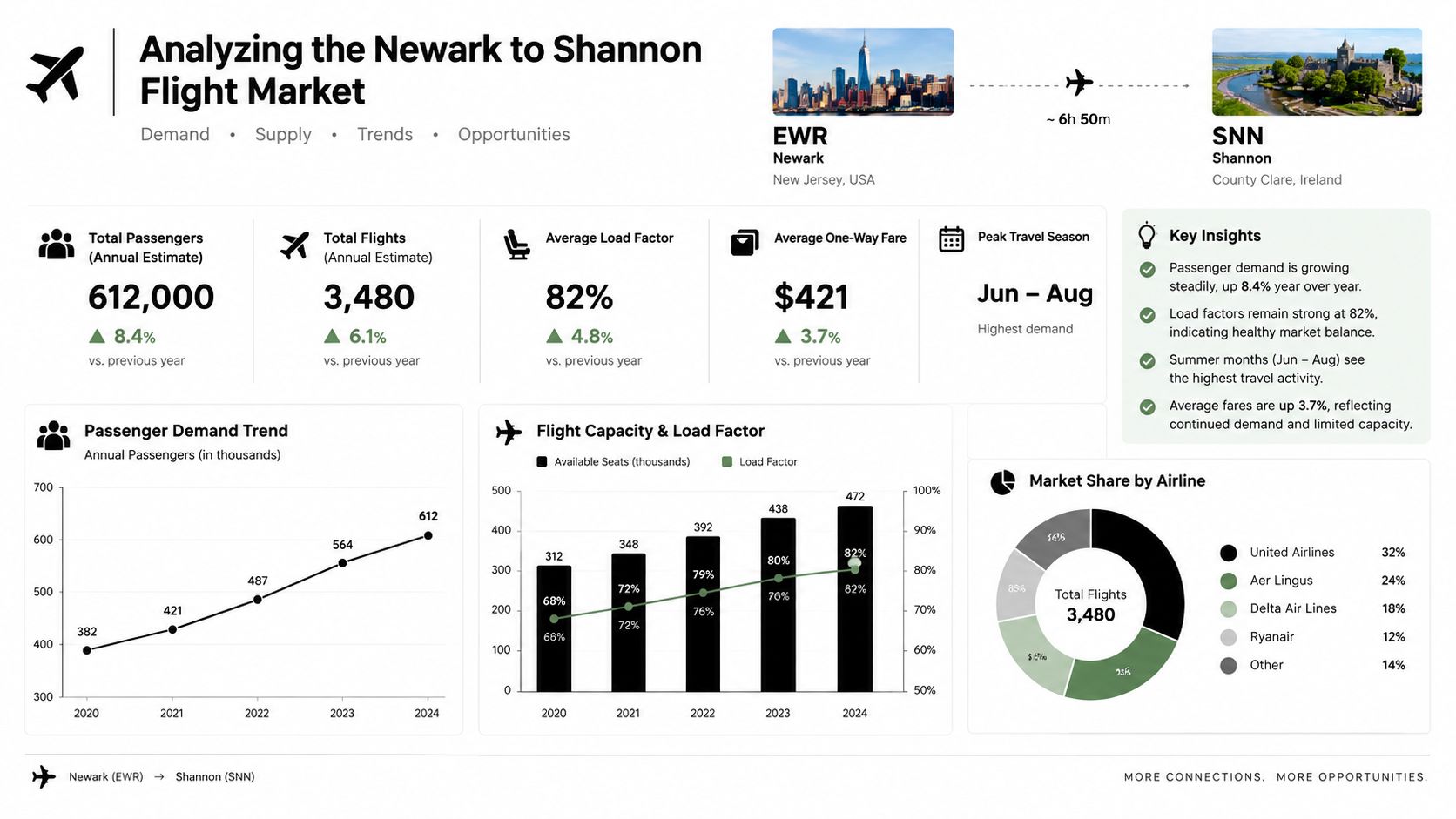
The Newark to Shannon market is small, predictable, and highly sensitive to inventory changes. Current search results show about 21 weekly flight listings, daily direct availability, and a route distance of approximately 3,085 to 3,088 miles (current Newark to Shannon flight schedules). That creates a reliable travel option, but not a deep selection of competing departures.
United operates the nonstop route 7 times per week, and route data identifies it as the only nonstop airline, with the earliest Shannon departure around 12:30 (United Newark to Shannon route information). Use that figure as the practical operating frequency. Search engines can show about 21 listings per week or roughly 3 flights per day because their schedule views may count broader itinerary or availability results rather than separate United nonstop departures.
The route's thin, single-carrier structure matters more than the headline schedule. United controls the only nonstop option, so travelers cannot use a rival nonstop airline to pressure the fare lower. When economy inventory tightens, prices can rise quickly. When business-class demand softens, United can release selected premium seats at a lower fare without reducing every cabin.
Why thin routes produce sharper fare movement
Every departure carries more pricing weight on a limited-frequency route. A traveler with fixed dates may have one practical nonstop choice, especially when avoiding a connection or preserving the overnight pattern. That concentrated demand gives the airline room to raise fares on popular dates.
The same constraint creates the opportunity for disciplined buyers. An unsold business-class seat has little value after departure, so the airline may open a targeted premium fare to stimulate demand. It can keep restricted economy inventory expensive while offering business class at a level below the standard economy fare. That is the pricing anomaly this route rewards.
Block times vary by source, from about 6 hours 25 minutes of scheduled block time to an average nonstop duration of roughly 7 hours 23 minutes to 7 hours 30 minutes. The difference reflects winds, routing, and schedule padding, not two different routes. KAYAK also places the service at roughly 3,087 miles (Newark to Shannon schedule and flight duration).
The commercial takeaway is direct: monitor premium inventory instead of accepting the first coach quote. A thin route can produce extreme fare swings because one airline manages the entire nonstop cabin mix. Travelers who regularly compare business-class flights from New York should include Newark to Shannon in that search. A larger airport does not guarantee a better nonstop fare. Here, limited competition makes fare monitoring more valuable.
Navigating Seasonality and Departure Schedules
Seasonality matters more on Newark to Shannon than on a heavily served transatlantic route. A thin, single-carrier schedule leaves fewer departures to absorb demand, so a small shift in seasonal capacity can create a sharp premium-cabin fare swing. Buyers should study the operating pattern before judging whether a quote is high or attractive.
Shannon's position on Europe's western edge has long supported its role as a transatlantic gateway, including multiple U.S. services, as described in RTÉ's Shannon gateway analysis. Seasonal changes across that network can alter total seat supply. The practical result is simple: a route that looks expensive one week may produce a valuable premium fare when schedules and demand shift.
Read the schedule before reading the fare
Newark to Shannon is built around an overnight crossing. Published schedule data places Newark departures in a narrow evening band around 22:40 to 22:50, while route information identifies the service as an evening departure designed for overnight travel (Newark to Shannon route schedule). That concentration makes the departure time convenient, but it also concentrates demand. A conference, school holiday, corporate trip, or weekend break can fill the preferred flight quickly.
Use the calendar as a demand filter:
- Peak leisure periods: Treat popular holiday and summer dates as high-risk periods for premium fare increases. Travelers competing for the same nonstop have less pricing power.
- Quieter corporate windows: Search outside obvious leisure peaks and avoid dates favored by business travelers. The goal is to find weaker demand, not to rely on a supposedly perfect month.
- Nearby departure dates: Compare adjacent dates before accepting any fare. On a low-frequency route, shifting the trip can expose a different inventory position and a materially different premium quote.
- Capacity changes: Recheck the route after seasonal schedule adjustments. Expanded service can increase available seats, while a reduction can push fares higher with little warning.
Make the overnight schedule work for you
A late Newark departure gives business class a practical advantage. A lie-flat seat can support sleep and work, while an economy seat on the same overnight sector may leave a traveler less productive on arrival. That matters for consultants, executives, and anyone scheduled for a meeting soon after landing.
Set a buying rule before searching. Check fare restrictions, baggage terms, change conditions, seat selection, and connection protection. A discounted premium fare is worth considering when the dates are stable and the cabin improves the first working day in Ireland. Do not pay a premium merely for the label, but do act quickly when a flexible search reveals business class priced below the economy options available for the same departure.
Why Business Class Can Be Cheaper Than Coach
Business class can cost less than coach on Newark to Shannon, and that is not an error in the search results. Airline pricing follows inventory rules, demand forecasts, fare restrictions, and release decisions rather than a simple ladder from economy to premium cabins. On a thin route with one nonstop carrier and limited frequency, a small change in remaining inventory can create a large price gap between cabins.
The practical trigger is economy sellout. Once the lowest coach buckets disappear, the remaining economy fare may reflect high demand, flexibility, or limited availability. Business class can then fall below that specific buyable economy option without becoming inexpensive in absolute terms. The traveler is comparing live fares, not the usual hierarchy of cabin labels.
A flexible economy ticket deserves particular scrutiny. Its price may include changeability, baggage, and other conditions that make it more expensive than a restricted business fare released for the same departure. Review the fare rules before assuming coach is the cheaper or safer choice.
The economics of fare inversion
Route-specific listings show how widely Newark to Shannon pricing can move. One-way fares have ranged from about $672 to $3,370, while round-trip listings have ranged from about $890 to $5,012 (Newark to Shannon nonstop fare listings). These figures are not a forecast. They show why a buyer should compare cabins on the exact dates, not rely on a standard business-to-economy price ratio.
A premium seat can win in three practical ways:
- It can beat full-fare economy. The traveler receives a better seat while paying less than the remaining flexible coach inventory.
- It can beat a coach-plus-upgrade plan. Buying economy first leaves the upgrade uncertain. The request may not clear, may carry a substantial co-pay, or may be unavailable on the preferred departure.
- It can protect working time. On an overnight flight, a lie-flat seat and a quieter workspace can preserve productivity on arrival. For a consultant or executive, that benefit belongs in the travel-cost calculation.
The upgrade path also changes the comparison. One published United example shows a premium-economy ticket costing $269 more than coach, while reducing the upgrade co-pay and improving upgrade priority (United upgrade pricing example). Use that example as a pricing lesson, not as a promise for every Newark to Shannon booking. Compare the premium fare, the available economy fare, the upgrade cost, and the chance of securing the desired cabin.
Newark to Shannon Fare Volatility Snapshot
| Cabin Class | Standard Pricing Model | Inverted Pricing Scenario |
|---|---|---|
| Economy | The cheapest coach inventory sells first. Remaining fares may be higher, more restrictive, or both. | The available economy fare costs more than a targeted business-class offer for the same dates. |
| Premium economy | It generally sits between coach and business class, but its position can shift by itinerary and fare rules (premium economy pricing guidance). | A reduced premium-economy fare offers a sensible compromise when business class remains above budget. |
| Business class | It normally carries a substantial premium over coach, with business fares often costing 4 to 10 times economy on many routes (business class and economy fare comparison). | A lower premium inventory release puts business class below full-fare economy or below the combined cost of coach and a later upgrade attempt. |
Use the buyable fare as the benchmark. Confirm refundability, change conditions, baggage, seat selection, and upgrade terms. If the business fare satisfies the trip requirements and undercuts the available coach alternative, book the premium cabin instead of paying more for less.
Timing Strategies to Capture Premium Fare Drops
The best fare on this route may sit in business class, not coach. Newark to Shannon has a thin schedule with a single nonstop carrier, so a small inventory change can create sharp premium-cabin price swings. Strategic buyers should monitor the relationship between cabins instead of assuming economy is always the cheaper choice.
United's published schedule shows a daily nonstop in each direction, although seasonal timetables can reduce westbound service to about four weekly departures (Newark to Shannon directional schedule). That limited frequency gives the airline less room to absorb demand spikes. It also makes last-minute flexibility valuable, because waiting for a discount on a fixed departure can leave you with no acceptable alternative.
Build a premium fare watch
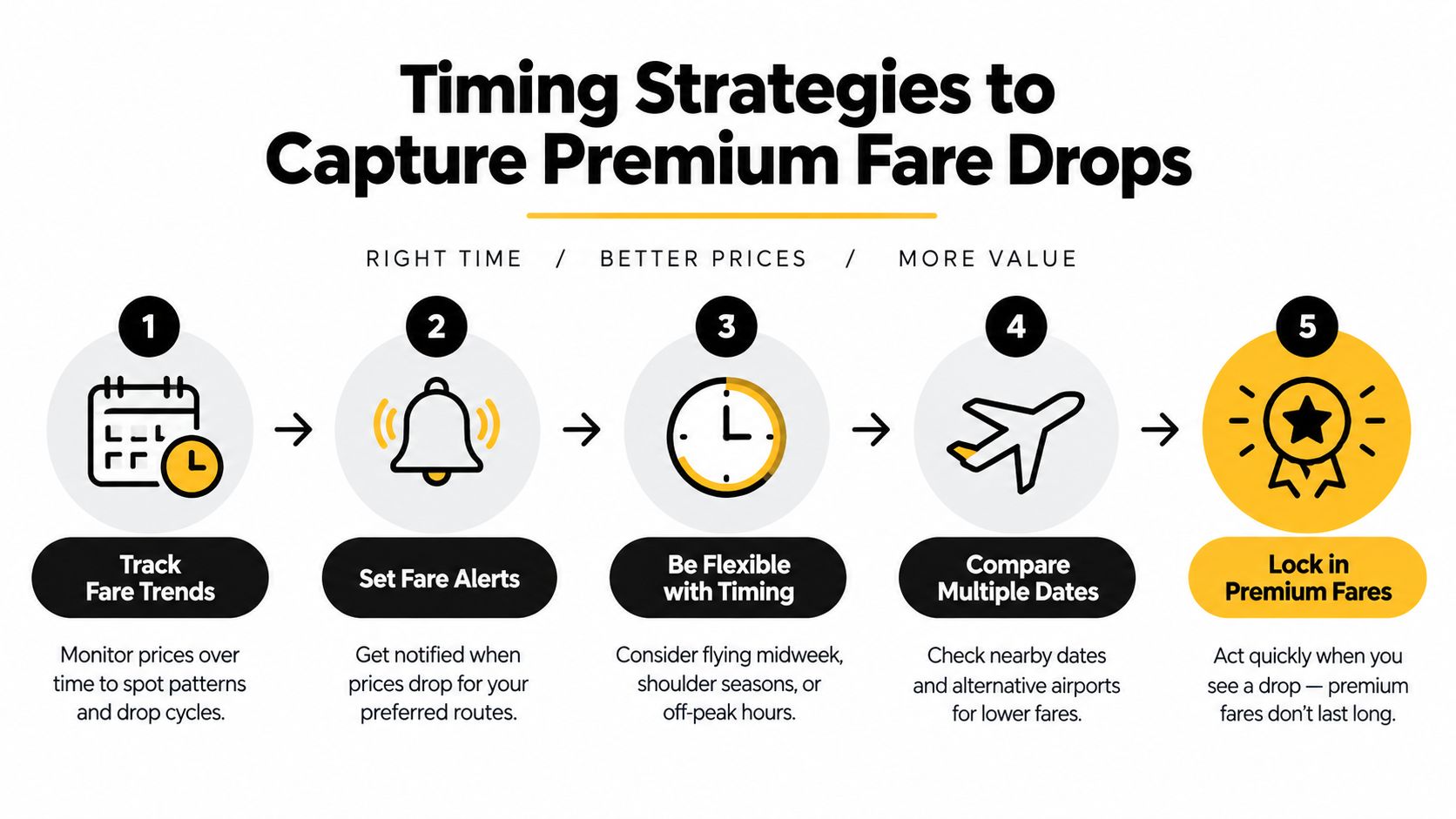
Set a date range before you search. Record economy, premium economy, and business-class prices for the same departure and return combinations, then note the conditions attached to each fare. A low headline price is irrelevant if it lacks the flexibility your travel policy requires.
Use this decision process:
- Define your trigger. Set the business-class price that beats the coach option you can buy. Include change fees, baggage, seat selection, and any potential upgrade cost.
- Track identical flights. Compare the same route, dates, and cabin over time. Random itineraries produce misleading conclusions.
- Target softer demand. Flexible dates, less popular travel periods, and departures with broader seat availability offer better opportunities than heavily booked peak dates.
- Check the rules immediately. Review refunds, changes, baggage, seat selection, and upgrade terms as soon as a premium fare appears.
- Book when the economics work. Do not wait for a theoretical lowest price. If business class costs less than the acceptable economy alternative and the conditions fit, purchase it.
A discounted premium fare is more reliable than an upgrade plan. Upgrade inventory is separate, and the later price may be high. Required points or a co-pay may fall outside policy, while upgrade priority may leave the traveler without the cabin expected. Buying business class at the lower fare removes that uncertainty from the start.
A specialized airline fare prediction service can organize this monitoring around fare behavior rather than generic lowest-price alerts. Passport Premiere presents a Video Gallery, news resources, and a Fare Monitor demonstration for travelers assessing this workflow. It cannot remove airline volatility, but it can focus attention on price movements that deserve immediate review.
Buying discipline: Never ask only, “What is the cheapest flight?” Ask, “What is the cheapest acceptable way to travel this exact departure?”
Leveraging Fare Intelligence for Discounted Fares
Manual monitoring fails for a simple reason. Corporate travelers and frequent flyers have work to do, and premium fare drops may appear in narrow inventory windows that disappear before anyone notices them. Checking several booking sites repeatedly can show the current price, but it doesn't necessarily explain whether that price is normal, inflated, or unusually favorable for the route.
A membership-based fare intelligence service can fill that gap by combining fare monitoring with market analysis. The relevant capabilities are straightforward: watch international premium cabins, compare a current offer with the route's observed pricing behavior, and send a signal when a purchase opportunity appears. That approach is more useful than a generic “cheap flights” alert because it evaluates the cabin travelers want.
What to inspect before joining
Look for practical evidence rather than broad promises. A useful service should show how its alerts work, explain fare characteristics, and help members distinguish a real premium opportunity from a low headline fare with poor conditions. Passport Premiere presents a Video Gallery, news resources, and a Fare Monitor demonstration for travelers evaluating this type of workflow.

For a corporate travel manager, the value lies in reducing the time between a fare release and a purchasing decision. A consultant flying overnight can use the same intelligence differently, prioritizing sleep and arrival readiness. A luxury leisure traveler may care more about turning a fixed travel budget into a better cabin without changing the destination.
Apply the intelligence to Newark and Shannon
Set the search around the actual business need. If the traveler must arrive for a meeting, track the nonstop overnight departure and evaluate the total value of arriving rested. If the dates are flexible, monitor a wider range and allow the fare monitor to expose dates where the premium cabin is mispriced relative to coach.
Use the resulting alert as a prompt, not an automatic booking instruction. Confirm the operating carrier, flight times, ticket conditions, baggage, seat availability, and cancellation terms. Also check whether the fare is available for the full itinerary, rather than being a limited quote that vanishes at checkout.
The central advantage is speed with context. You don't need to predict every airline move. You need to recognize when a premium fare has moved far enough to beat the alternative you were prepared to buy.
Finalizing Your Transatlantic Travel Plans
The smart way to book flights from Newark to Shannon, Ireland is to stop treating airfare as a fixed retail price. This route has regular nonstop service, but its thin schedule and single-carrier structure can make inventory unusually sensitive to travel dates. That creates risk for passive buyers and opportunity for travelers who compare cabins continuously.
Use this checklist before purchasing:
- Track the exact nonstop departures that fit the trip.
- Compare economy, premium economy, and business class on identical dates.
- Measure the premium fare against the economy fare you can buy, not an outdated starting price.
- Check flexibility, baggage, seat selection, and upgrade conditions.
- Keep alternative dates available when the schedule permits.
- Buy when the premium cabin offers the strongest total value, even if the fare doesn't look cheap in isolation.
The route can also serve as a practical entry point for a broader Ireland itinerary. Travelers continuing beyond Shannon may find a separate Dublin to Limerick 2026 guide useful when planning the ground portion of the trip. That kind of end-to-end planning matters because the cheapest flight isn't necessarily the lowest-cost journey once transfers, lost work time, and recovery after an overnight flight are included.
You don't need to accept an inflated business-class quote, and you shouldn't assume coach is automatically the economical choice. Monitor the market, compare the total fare conditions, and treat every premium drop as a buying decision with a deadline.
Passport Premiere helps travelers monitor international premium-cabin fares, interpret fare conditions, and spot buying opportunities on routes such as Newark to Shannon. Visit Passport Premiere to review the Fare Monitor, Video Gallery, and membership options before your next transatlantic booking.
