

The popular advice is to hunt for the cheapest business class fare to Australia and book it before it disappears. That's backwards. A low headline price tells you almost nothing until you've checked what you're comparing it against, which aircraft you'll really sit in, and whether the itinerary survives a delay.
When you fly business class to Australia, you're buying sleep, flexibility, and schedule protection on a very long trip. Sometimes business is cheaper than coach. Often it isn't. The difference is in the fare bucket, not the cabin label. Judge the fare the way you'd judge any other purchase, like for like, and walk away when the cheap option fails that test.
Is Business Class Cheaper Than Coach and When to Book
Business can cost less than coach when the comparison is with a flexible or refundable economy fare on the same route, direction, date, and change rules. Against a restricted sale fare, the result can be very different. For an international trip, judge the actual itineraries side by side rather than using domestic prices as a proxy.
Compare fare buckets for your international route
| Fare bucket | What to check | Compare against |
|---|---|---|
| Restricted economy sale | Changes and refunds may be barred; confirm the rules for the fare | Business only if your dates are fixed |
| Flexible economy | Price and permitted changes or refunds for your route and travel dates | Business with equivalent change rules |
| Business sale fare | Availability, travel-period restrictions, and change or refund conditions | Flexible economy on the same itinerary |
| International business fare | Operating carrier, routing, date, and fare conditions | Flexible economy for the same route and dates |
A domestic example shows why fare rules matter, but it does not establish what an international fare should cost. In a 2021 Sydney to Melbourne comparison, Virgin Australia business was AUD 299, matching flexible economy at AUD 299. Restricted economy was AUD 78, according to Point Hacks' comparison of airlines for business travellers. The example illustrates a like-for-like result on that route and in that period, not a current benchmark for flying to Australia.
Virgin Australia's advertised business fares are one-way, limited to selected travel periods and availability, and may sell out. Its sale page lists business fares from AUD 219 one way and economy examples from AUD 49, with conditions applying, as set out in Virgin Australia's business class fare specials and conditions. Those figures are not a same-route, same-date comparison, so don't treat them as proof that business beats economy. For an international booking, enter your exact dates and compare the business fare with flexible economy on the same itinerary.
Practical rule: If a restricted economy ticket would leave you exposed when plans change, compare business with the flexible fare you would actually buy.
When to Book
Start comparing as soon as your travel dates and routing are reasonably clear, then check fares again before paying. There is no single booking window that guarantees the lowest international business fare. Sale seats can be limited, and a fare that looks attractive may disappear or apply only to specific travel periods. Set a fare alert if available, and compare the same route and dates whenever you check, so a change in price is not confused with a change in itinerary or fare conditions.
Use this booking sequence:
- Set the comparison: Search business and flexible economy for matching dates, direction, and routing. Compare the total fare and change or refund rules.
- Check the sale conditions: Confirm travel-period restrictions, availability, and whether changes or refunds are allowed.
- Decide on the fare: Choose business when its price and flexibility make sense against the coach fare you would realistically purchase. If not, book the flexible economy option that fits your plans.
A cheaper headline fare is not a saving if its restrictions make it unusable. Make the decision on the ticket rules and matching itinerary, not the cabin label alone.
Routes, Gateways and Curfews That Shape the Trip
A low business fare can become an expensive choice if it sends you through the wrong gateway, leaves you with a separate domestic ticket, or arrives too close to a curfew. Compare the whole itinerary, not just the long-haul seat.
| Option | Cabin product | Routing | Best fit |
|---|---|---|---|
| Qantas Perth to London | Fully flat 1-2-1 suites on A380 or 787-9 | Nonstop since March 2018, about 14,498 km | Europe trips that end in Perth |
| Qantas Sydney, Melbourne, or Brisbane long-haul | Fully flat 1-2-1 on A380 or 787-9, some network routes use recliners | Nonstop or one-stop by route | Trips where the aircraft is checked per flight |
| Air New Zealand via Auckland | Retrofitted 787-9 business cabin, verify the aircraft for your flight | Auckland connection | Trans-Tasman and onward trips |
| Virgin Australia via Doha | Qatar Airways leased long-haul product, verify per flight | Doha connection | Europe-bound trips from eastern gateways |
| Gulf or Asian hub one-stop with separate domestic ticket | Varies by operating carrier and segment | Two tickets, separate bags and check-in | Lowest headline fares, highest risk |
Reading the Table by Trip Type
Perth to London became the first regular nonstop service between Australia and Europe in March 2018, covering roughly 14,498 kilometres, as recorded in the Australian War Memorial's aviation history notes. It can suit a trip that ends in Perth. If your meetings are in Sydney or Melbourne, though, you still need a domestic leg after the ultra-long flight. That extra flight can erase the time advantage.
From the east coast, compare a nonstop option where available with one-stop routes through Middle Eastern or Asian hubs. For broader routing context, Amex Global Business Travel's Air Monitor for Australia routing context can help frame the choices. Virgin Australia offers Doha connections using a Qatar Airways leased long-haul product. Check the operating carrier and aircraft on your specific flight rather than assuming every itinerary has the same cabin.
For North American and Asian departures, compare options from your actual origin city. Price the nonstop, then the one-stop, and check what happens after landing in Australia. A separate domestic ticket can lower the headline fare because the long-haul journey ends at the first Australian gateway. You then have separate check-in and baggage arrangements, and you may have to manage a missed onward flight yourself. The distinction between planning multiple leg flights on separate or combined itineraries matters most when you need to be at work the next morning.
A slightly higher fare through a better-timed gateway can be the more economical choice if it avoids a separate ticket and a risky arrival.
Air New Zealand's 787-9 business cabin is being retrofitted, so check the aircraft assigned to your date before paying. Until the retrofit is complete, the cabin can vary by flight. A flight number or an airline's cabin images alone won't confirm the product you'll get.
Curfews Change the Risk Math
Sydney, Adelaide, Gold Coast, and Essendon Fields operate under curfews generally covering 11:00 p.m. to 6:00 a.m. Sydney and Adelaide may allow certain pre-approved international shoulder movements between 5:00 and 6:00 a.m., according to the Australian Government airport curfew manual. Treat that early window as an exception requiring approval, not as a general extension of operating hours.
A schedule that looks efficient can be fragile when arrival sits close to a curfew. If a delay pushes a flight past its permitted window, you may face an overnight disruption. Include that risk in your fare comparison alongside the cabin and connection.
Before paying, check how close each arrival or departure is to curfew hours. Allow for the fact that a delayed flight may not be able to depart as soon as it is ready. Confirm whether an early movement has the required approval, and compare an alternate route through an airport without the same constraint if reliability matters.
For a high-value trip, a better-timed gateway and a protected connection may cost less overall than a cheaper itinerary that risks a hotel night or lost work time. The fare is only one part of the decision.
How to Verify the Cabin Before You Pay
The step-by-step visual below sums up the core check before payment.
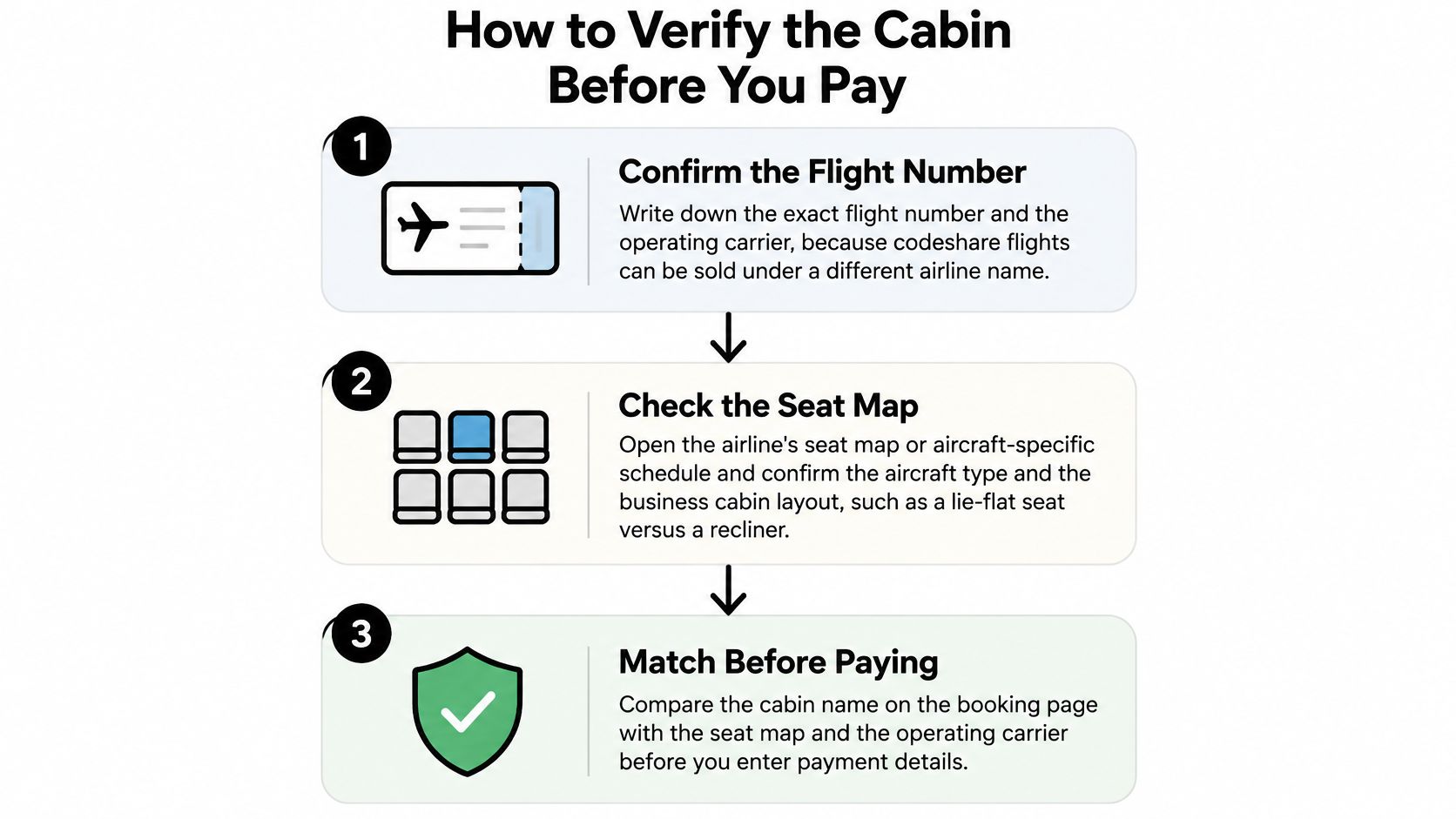
Qantas long-haul flying includes fully flat 1-2-1 suites on Airbus A380 and Boeing 787-9 aircraft, while its broader network also includes business products that are recliners rather than lie-flat seats, as set out in Australian Frequent Flyer's Qantas business seat guide. The carrier name doesn't settle the product. The flight does.
The Eight Checks
- Write down the flight number and operating carrier because a codeshare can be sold under a different airline name. The operating carrier decides the seat you'll sit in.
- Open the airline seat map or aircraft-specific schedule and note the aircraft type for every segment. One unchanged segment proves nothing about the next.
- Confirm wide-body, 1-2-1, and fully flat together because that combination is the benchmark, not the words business class. Missing one element changes the overnight product.
- Confirm direct aisle access for your seat because layout alone doesn't guarantee the specific seat works as a private suite. Check the seat you've selected, not the cabin average.
- Check any domestic Australian leg separately because the international-grade product may not continue to your final city. A lie-flat to Sydney followed by a recliner onward is a mixed product, and you should price it that way.
- Inspect the connection airport and minimum connection time because a tight transfer, terminal change, or re-clearance can wipe out a superior overnight segment. This is also where checking business class seat availability segment by segment prevents a sold-out onward leg from surprising you.
- Recheck after ticketing because aircraft substitutions happen. A swap from a 787-9 to an aircraft with recliners is the classic failure this step catches, while there's still time to rebook.
- Save the operating carrier, aircraft, configuration, and change rules in your trip file because that record speeds up re-accommodation if the aircraft changes. Without it, you're reconstructing your booking on the phone.
Don't pay until steps one to four pass on the overnight segment. That's the segment you're buying business class for.
When to Buy and How to Track Fares
A cheap business-class fare is only a good buy if it beats the flexible coach fare for the same route and dates, and the cabin is worth the difference. Set that comparison before tracking prices, then use a clear trigger to decide when to book.
| Situation | What to check in your fare search | Action | Trigger to buy |
|---|---|---|---|
| A sale appears for your route and dates | Compare the sale fare with flexible coach and check the fare rules | Book if the product and conditions suit your trip | Total cost meets your target and the rules work |
| School holidays or December travel | Track available fares for your exact dates; don't assume a general forecast predicts peak prices | Compare dates if your schedule allows | Buy when an acceptable fare appears |
| Different aircraft or cabin options | Check the operating flight and the fare for each option | Choose based on the seat and price you would actually accept | The fare and aircraft both meet your requirements |
| Nonstop flight with few options | Compare the fare with alternatives that add a connection | Decide whether the nonstop is worth its price | The nonstop fare fits your budget and schedule |
| Fare changes while you track | Recheck the same route, dates, cabin and fare conditions | Compare like with like before acting | The price is acceptable without relying on a predicted trend |
What the Demand Data Suggests
Corporate travel bookings in business class rose nearly 5% from September 2024 through August 2025. Amex Global Business Travel projected a 6.1% rise in business-class fares for 2026, according to Karryon's report on travellers moving to premium cabins. That figure is a forecast, not a quote for your route or a prediction about a particular travel period. Use it as context, then make the decision from fares available for your own dates.
IATA data reported 109.7 million passengers travelled in first or business class globally in 2025, up 4.5% year over year and accounting for 5.5% of international travellers, according to Karryon's summary of IATA 2025 air transport statistics. These figures describe overall premium-cabin demand, not the price or availability of a seat on your flight.
BITRE's domestic airfare index covers Australian domestic fares, so it cannot establish whether a long-haul business-class fare to Australia is likely to rise or fall. Keep that comparison separate. Use BITRE domestic airfare data only if you are also assessing a domestic Australian leg.
Fare Versus Aircraft
A lower fare can come with a product you would not choose at the higher price. Check the fare and aircraft for the specific flight you are considering, then decide whether the cabin still meets your needs. For an overnight trip, a discounted fare is poor value if the product is one you would reject at full price.
Choose a target by comparing business class with a flexible coach fare on the same route and date. For trips more than three months away, check prices every few days and follow guidance on when to book business class flights rather than relying on one fixed booking window. Buy when the fare meets your target and its conditions suit your plans. If you are willing to wait, keep comparing the same itinerary and fare type, and be ready to book when the right combination appears.
Tactics That Lower Premium Fares
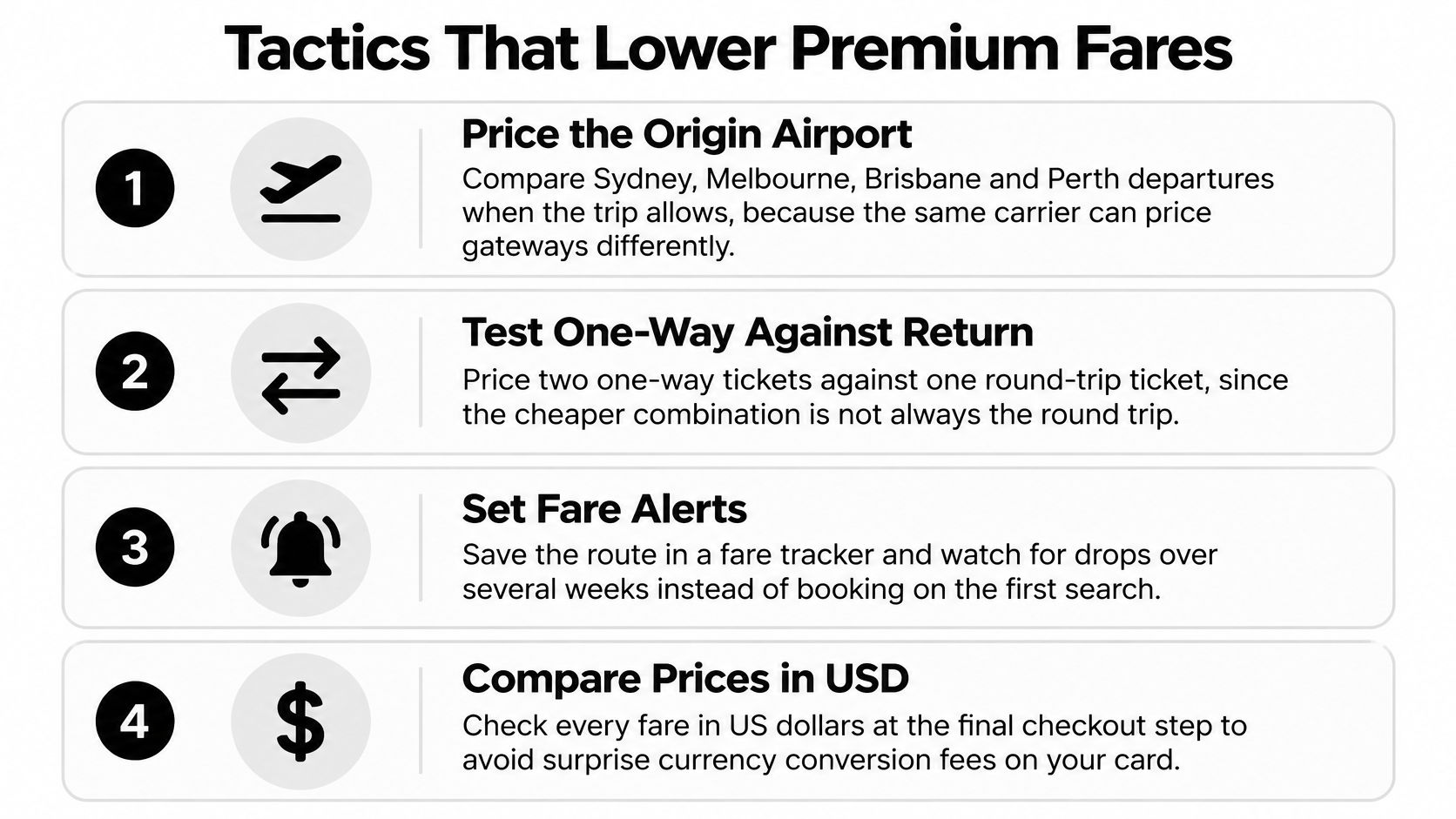
The lowest business fare is only a good buy if it beats flexible coach on the same route and date, and the aircraft and fare rules suit your trip. Use these six tactics to test the product before paying.
Price the origin airport. Compare Sydney, Melbourne, Brisbane, and Perth departures when positioning is practical. The same carrier may price gateways differently, so include the cost and time of reaching another airport in your comparison.
Test one-way against return pricing. Sale business fares may be quoted one way, and a split ticket can cost less than a return on some routes. Compare full totals for identical dates, especially for one-way trips and open-jaw plans.
Read what the sale includes. A reported Virgin Australia promotion offered domestic business from AUD 219 one way and golden-triangle routes at AUD 299. It included priority check-in and boarding, lounge access, reclined leather seating, and onboard dining. Economy started from AUD 49 on selected routes, according to eGlobal Travel Media's report on the Virgin Australia fare sale. Compare the business inclusions with flexible coach, not restricted economy.
Act inside the sale window. Business inventory is limited, and sale fares can sell out. Before buying, confirm the operating aircraft and cabin, then compare the fare with flexible coach on the same route and date. If it passes that test, waiting risks a higher fare or a worse routing.
Consider paid fare monitoring only on the numbers. Passport Premiere tracks premium-cabin fares and signals price movements. Use a service only if the likely saving exceeds its fee over the tracking period. That may suit corporate travel booked well ahead on expensive long-haul routes, but it can be poor value for a short search.
Keep a fallback. Record the flexible economy fare for the same route and date, including its change rules. If the business sale sells out, you can compare the remaining options without rushing into a worse fare.
Put the video after the full list, so it doesn't interrupt the six tactics.
Match the tactics to the trip. Fixed-date corporate travel may favor a timely purchase, while flexible leisure travel can benefit from comparing gateways and one-way fares.
Book the Ticket and Manage the Fare Rules
Once the cabin is verified, the booking itself is a paperwork exercise. Do it in order and you won't create problems you'll pay to fix later.
- Search each fare bucket on identical dates because the comparison only holds with the same origin, destination, and direction. Run one search for flexible economy and one for business.
- Read the fare rules before paying because one-way or return status, change and refund conditions, and sale-period limits decide what you've bought. Don't infer flexibility from the cabin name.
- Choose the bucket that matches your trip because the cheapest label is the wrong buy when your dates may move. Fixed dates can accept restrictions. Uncertain dates can't.
- Pay only after recording the operating carrier, aircraft, and seat configuration because that trip file is your evidence if anything changes. Screenshots of the seat map help.
- Select seats as soon as the ticket issues because the best seats in a 1-2-1 cabin go first. Recheck direct aisle access on each segment while you choose.
- Confirm the issued ticket shows the same operating carrier and flight numbers because codeshare names can differ between search results and the ticket. A mismatch here is worth a call before departure, not an argument at check-in.
File it now: Save the fare rules, receipt, and seat map together, so a later change starts from documents rather than memory.
- When a schedule-change notice arrives, recheck the aircraft type at once because a time change often travels with an equipment change. Use the rebooking path in your trip file while alternative seats remain.
- For corporate trips, file the fare-rule copy and receipt with the expense claim because finance teams ask why business was cheaper, and the like-for-like comparison is your answer.
If you can show the business fare matched flexible coach, the cabin was verified fully flat, and the itinerary cleared curfew risk, you've bought well. If you can't show those three things, you've bought a story about a cheap fare.
If you'd rather not watch premium fares to Australia every few days yourself, Passport Premiere tracks international business and first class fare movements and helps members judge the market value of an empty premium seat before they buy. Bring your route, your dates, and your flexible coach benchmark, and use that tracking to time the purchase instead of guessing.
