

Most travel advice starts with the airfare. That's the wrong starting point. A cheap ticket can become an expensive trip once you add baggage, seat selection, airport transfers, overnight accommodation, restrictive change rules, lost work time, and the cost of arriving exhausted. In some cases, business class is cheaper than coach on a total-trip basis, even when its headline fare is higher.
The right question isn't, “What's the lowest ticket price?” It's, “What will this itinerary cost from departure to return, and what risks can still change that number?” That distinction matters for leisure travelers, consultants, corporate travel managers, and anyone booking an international itinerary where fares, hotels, currency, and ground transport can move independently.
Why the Ticket Price Is the Wrong Place to Start
Airfare is visible, easy to compare, and emotionally compelling. That makes it a poor proxy for the cost of travel. A restrictive economy fare may require paid baggage, a seat fee, an inconvenient connection, and a hotel night near the airport. A premium fare may include more of the services you'd otherwise buy separately, while also protecting your schedule and productivity.
That doesn't mean business class is normally inexpensive. SmarterTravel's analysis of discounted business fares notes that business class typically costs two to three times more than coach, and can cost three to six times more than nonrefundable economy. The exception matters because budget decisions should be based on the itinerary's total economics, not on a blanket rule that premium cabins are always wasteful.
Price the whole journey
Start with the full transportation burden. In 2024, U.S. households spent an average of $13,318 on transportation, making it the second-largest household expenditure category after housing, according to the U.S. Bureau of Transportation Statistics. That figure includes the broader cost of mobility, not just airfare, which is exactly why a travel budget needs a wider lens.
The same data shows that transportation represented 30.6% of before-tax income for households in the lowest income quintile, compared with 9.6% for the highest. Rural households spent $14,418, compared with $13,057 for urban households. Your travel ceiling therefore has to reflect disposable income, household obligations, origin airport, and local transportation needs.
Practical rule: Never approve an itinerary from the airfare line alone. Add baggage, seats, transfers, ground transport, lodging caused by the schedule, insurance, and a reserve before comparing fares.
The main volatility often sits outside the ticket. Hotels can surge during events, ground transport can become expensive when a property sits far from the client or airport, and meals can run beyond policy when schedules change. Currency movements, fuel-related costs, schedule changes, and client-driven extensions create additional uncertainty.
For international travel, divide the budget into fixed commitments, flexible costs, and an uncertainty reserve. Fixed commitments include nonrefundable tickets and deposits. Flexible costs include meals, local transport, activities, and room selection. The reserve protects the trip from changes you can't price accurately at booking.
A category-first method gives you a more useful answer than a fare search. Price the whole trip first, then chase the fare.
Setting a Realistic Trip Budget by Category
A workable budget begins with the trip's purpose. Define the objective, traveler count, duration, destination structure, and date flexibility before you search. A three-night client visit needs a different budget from a multi-city leisure itinerary, even if both use the same airports.
Set the total envelope first. Then assign a ceiling to each category and convert the variable categories into daily limits. Don't start with whatever airfare appears in a search result. That approach lets one attractive fare dictate the rest of the trip.
Use a category allocation model
A practical allocation model gives the largest share to transportation and lodging, while protecting daily operating costs and uncertainty. The exact split should change with the trip, rather than follow a universal percentage rule.
| Category | Allocation approach | Total budget | Per day |
|---|---|---|---|
| Fares and transportation | Set the required ceiling first | Your approved trip ceiling | Not applicable |
| Lodging | Reserve against destination and date volatility | Your approved lodging limit | Nightly target |
| Ground transport | Price airport, hotel, meeting, and local movement | Separate transport cap | Daily operating limit |
| Meals and incidentals | Set a policy or personal daily allowance | Daily allowance multiplied by trip days | Fixed daily limit |
| Contingency | Protect against changes, fees, and currency movement | Reserve outside operating spend | Not for routine use |
This table deliberately uses policy-defined amounts instead of invented universal dollar figures. A sound budget must fit the traveler's income, company rules, destination, and purpose. The Divvy shared trip budget guide is useful for organizing shared costs, especially when several travelers need to agree on who pays for lodging, transport, activities, and optional upgrades.
For an international itinerary, transportation should include airfare, airport transfers, baggage, seat fees, ground transportation, and possible exchange-rate effects. A multi-city trip deserves a larger reserve than a single-destination stay because every additional movement creates another point of failure.
Build the budget from evidence
Review prior trips by category, not just by total. If lodging regularly exceeds expectations while airfare comes in below them, move money toward hotels instead of celebrating the cheap ticket. Adjust for destination, seasonality, traveler count, trip length, and whether the itinerary includes client extensions or weekend stays.
Travelers comparing international fares can also use this guide to saving money on international flights as a research reference. The key is to treat savings as available budget only after the reserve remains intact. A lower fare doesn't justify a more expensive hotel, extra stopover, or unplanned activity until the complete itinerary still fits the envelope.
Breaking Down the Cost Categories That Actually Move
Every category needs its own decision rule. A budget fails when travelers treat airfare, lodging, meals, and ground transport as one undifferentiated pool. That hides the trade-offs and encourages false savings.
Fares and ancillaries
Compare the full fare family, not just the cabin label. Economy may look attractive until you add bags, seat selection, onboard connectivity, and change restrictions. Premium economy can make sense when the traveler needs more space but doesn't need a lie-flat bed. Business class deserves consideration when arrival time, sleep, lounge access, baggage, and schedule flexibility affect the value of the trip.
First class should face an even higher burden of proof. It can be rational for a highly time-sensitive traveler, but comfort alone doesn't justify moving money out of lodging, contingency, or client-facing needs.
Ancillaries deserve their own line. Include bags, seat selection, lounge access, Wi-Fi, meals, and change fees before comparing cabin prices. If a cheaper fare creates a long overnight layover, price the hotel, transfer, meals, and lost productivity it causes.
Lodging and location
A lower room rate can be a false saving. A hotel that requires a long airport transfer, expensive rideshare trips, or daily parking may cost more than a central property. Compare the room, taxes, breakfast, resort or facility fees, cancellation terms, internet, parking, and transport to the actual destination.
Use a simple test: if the cheaper hotel creates extra transfers or adds meaningful travel time each day, calculate the complete stay before booking. A premium is easier to justify when it reduces movement, protects meeting punctuality, or eliminates a late-night arrival risk. It isn't justified when the property offers no location, schedule, or operational advantage.
Ground transport and meals
Choose rideshare, rental car, rail, or public transport based on the itinerary, not habit. A rental car may be inefficient in a dense city once parking, fuel, insurance, and time are included. Rail may cost more than a local bus but save a costly airport transfer or a lost work block.
Meals need a clear control method. Use a per diem when simplicity and predictable reimbursement matter. Use actual spend with a cap when client dinners, destination pricing, or team travel makes a flat allowance unrealistic. Include tips, service charges, and meals created by schedule changes.
Soft costs and reserves
Visa fees, travel insurance, currency conversion, document replacement, connectivity, and emergency changes are easy to omit because they don't appear in the first fare search. Add them before approval.
Recent corporate data reinforces the need for category-level control. Emburse reports that average negotiated corporate airfares declined 4.6% year over year to $602 through May 2025, while negotiated hotel rates reached $209 and increased 1.4%. A cheaper airfare doesn't guarantee a cheaper trip when lodging and destination spending move in the opposite direction.
When Business Class Is Cheaper Than Coach
Business class cheaper than coach is real, but it's an exception created by route conditions, fare construction, pricing errors, or the total value of the itinerary. Don't build a budget assuming it will happen. Do build a process that can detect it.
The first scenario is a mistake fare. Currency-conversion errors, omitted fuel surcharges, or an incorrectly entered digit can create an extraordinary premium fare. CEO Flights describes rare pricing errors that can reduce business-class prices by as much as 90%. These fares can disappear quickly, and you shouldn't rely on them until the ticket is issued and confirmed.
The second is a short-haul competitive route. A comparison of selected airlines found Iberia's Madrid to Athens fare at £454 in economy and £562 in business, a difference of £108, according to Holidu's fare comparison. That isn't cheaper on the ticket itself, but it shows why route length and competition can bring the cabins unusually close.
| Scenario | Coach position | Business position | Decision trigger |
|---|---|---|---|
| Standard economy | Lowest headline fare, often with restrictions | Usually materially higher | Compare total ancillaries and schedule cost |
| Promotional business | Coach may still win on price | Sale narrows the gap | Buy when the premium fits the protected envelope |
| Mistake fare | Normal economy reference | May fall below ordinary economy | Verify ticketing before committing to the itinerary |
| Short-haul competitive route | Economy and business can be close | May offer better value for a modest difference | Compare baggage, seat, lounge, and time savings |
| Corporate or negotiated inventory | Published coach may not reflect contracted options | Company terms can change the comparison | Check approved inventory and total policy cost |
Promotional timing can also narrow the gap. Skyscanner identifies Black Friday, Cyber Monday, and Travel Tuesday as periods when airlines may discount business seats, and gives an example of a Los Angeles to Paris fare falling from about $3,000 to $2,000 during a sale. The comparison still has to be made against the economy fare available for the same dates.
Check advance-purchase requirements, route competition, fare restrictions, baggage, seat fees, lounge access, and the cost of lost productivity. A premium fare wins when the complete itinerary costs less or produces materially more usable time, not merely because the cabin looks attractive.
Building a Forecasting and Approval Workflow
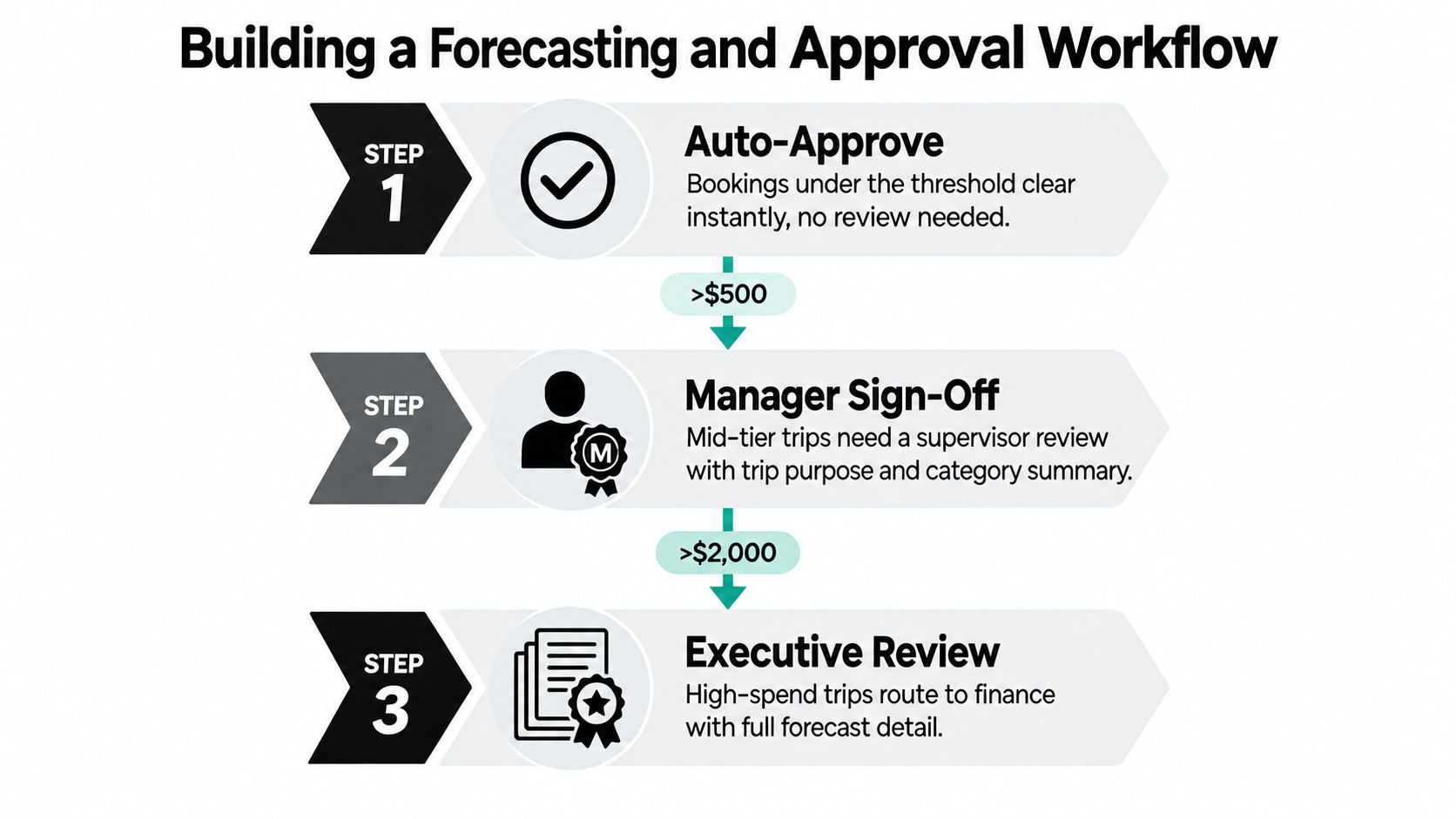
A travel policy should make the correct decision easy before departure. Last-minute approvals create rushed purchases, weak documentation, and unnecessary premium spend. A tiered workflow gives travelers speed on routine trips while sending unusual spend to the people who need to review it.
Set three approval levels
Under-threshold bookings should auto-approve when they use preferred vendors, permitted cabin classes, and documented traveler details. Mid-tier trips should require manager sign-off with the business purpose, traveler, dates, destination, and category summary. High-spend trips should route through finance with the full forecast, alternatives considered, reserve treatment, and a clear commercial or operational justification.
The thresholds should be set by the company, not copied from another organization. The useful distinction is governance intensity. Routine travel needs speed. Unusual travel needs evidence.
A forecast should contain a baseline category estimate, a historical variance adjustment, a seasonal review, and a contingency rule. For corporate programs, Deloitte reports that 54% of travel managers ranked costs among their top three restrictions in 2025, up from 48% in 2024, while cost controls increasingly targeted lodging and in-destination spend. Read the Deloitte corporate travel survey for the broader context.
Use policy language people can apply
A concise policy might read:
Employees may book the cabin permitted for the trip duration and business purpose. Travelers must use preferred vendors where practical, follow the applicable per-diem cap, document exceptions before purchase, and submit receipts and itinerary changes through the approved expense workflow. Premium-cabin exceptions require written business justification and category-level budget approval.
Keep the forecast in a spreadsheet or travel platform with one row per category and one field for the reserve. Record the approved amount, actual amount, variance, approver, and reason for exception. Guidance on why objective budgeting matters can help teams separate desired outcomes from unstructured spending requests.
For companies managing recurring international travel, corporate travel expense management should connect booking data, approval records, receipts, and policy exceptions. The workflow matters more than the software brand. If nobody can see why a trip exceeded its forecast, the next forecast won't improve.
Timing the Purchase Without Watching It Full Time
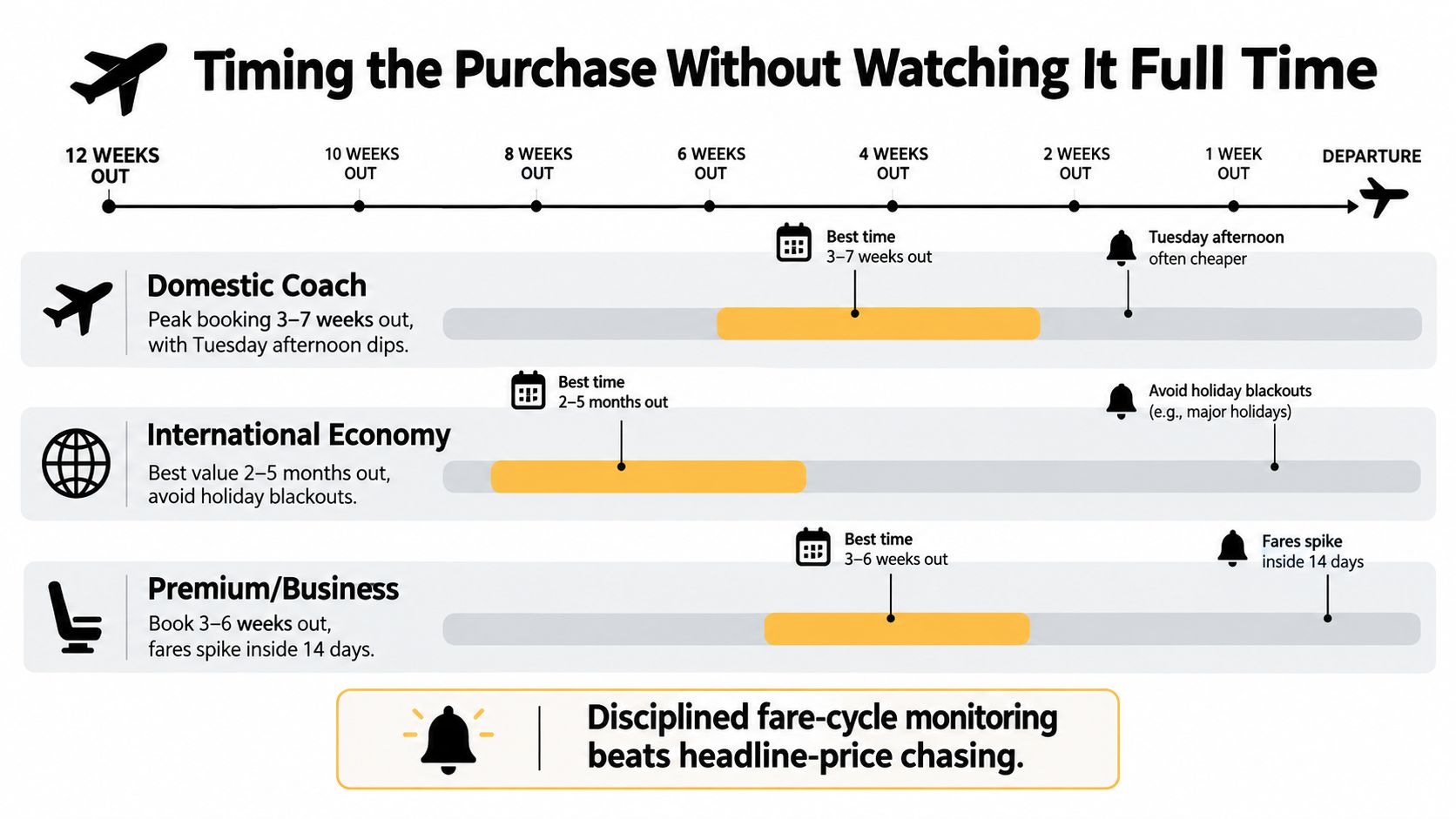
Disciplined monitoring beats headline-price chasing. Travelers who search constantly often react to noise, while travelers who never check again miss a fare that fits their target. Set a watch window, define a buy threshold, and review the itinerary on a schedule.
The timing rules in the supplied visual provide a useful starting point for different fare types. Use them as monitoring windows, not promises. A route can behave differently because of seasonality, competition, capacity, and cabin demand.
Build a simple fare watch
Google Flights and Hopper can monitor routes and dates. ITA Matrix is useful for advanced routing queries, fare rules, and connection analysis, although you'll still need to complete the purchase through an airline or agency. Set alerts around your acceptable total-trip price, not just the fare.
For premium cabins, watch the gap between business and economy on the same dates. A fare sale can narrow the difference, while a mistake fare can create a much sharper anomaly. Passport Premiere is one option for travelers who want premium-fare monitoring and route analysis instead of checking manually.
Buy immediately when: The fare meets your approved total-trip ceiling, the ticket is confirmed, and waiting creates more risk than savings.
Sales cycles around Black Friday, Cyber Monday, Travel Tuesday, Memorial Day, and Prime Day can justify a focused review, but a calendar event isn't a guarantee of value. Compare the current fare with your own route history and the complete itinerary before buying.
A practical weekly routine takes about fifteen minutes:
- Review the alert: Check the fare, cabin, baggage, restrictions, and flight schedule.
- Reprice the itinerary: Compare one-stop and nonstop options, alternate airports, and nearby dates.
- Update the total: Add hotels, transfers, meals, and any overnight costs created by the flight.
- Decide once: Buy when the itinerary meets the budget, or record the reason for waiting.
The objective isn't to find the theoretical lowest fare. It's to secure an itinerary that remains economical after every category is counted.
A Repeatable Checklist for Your Next Trip
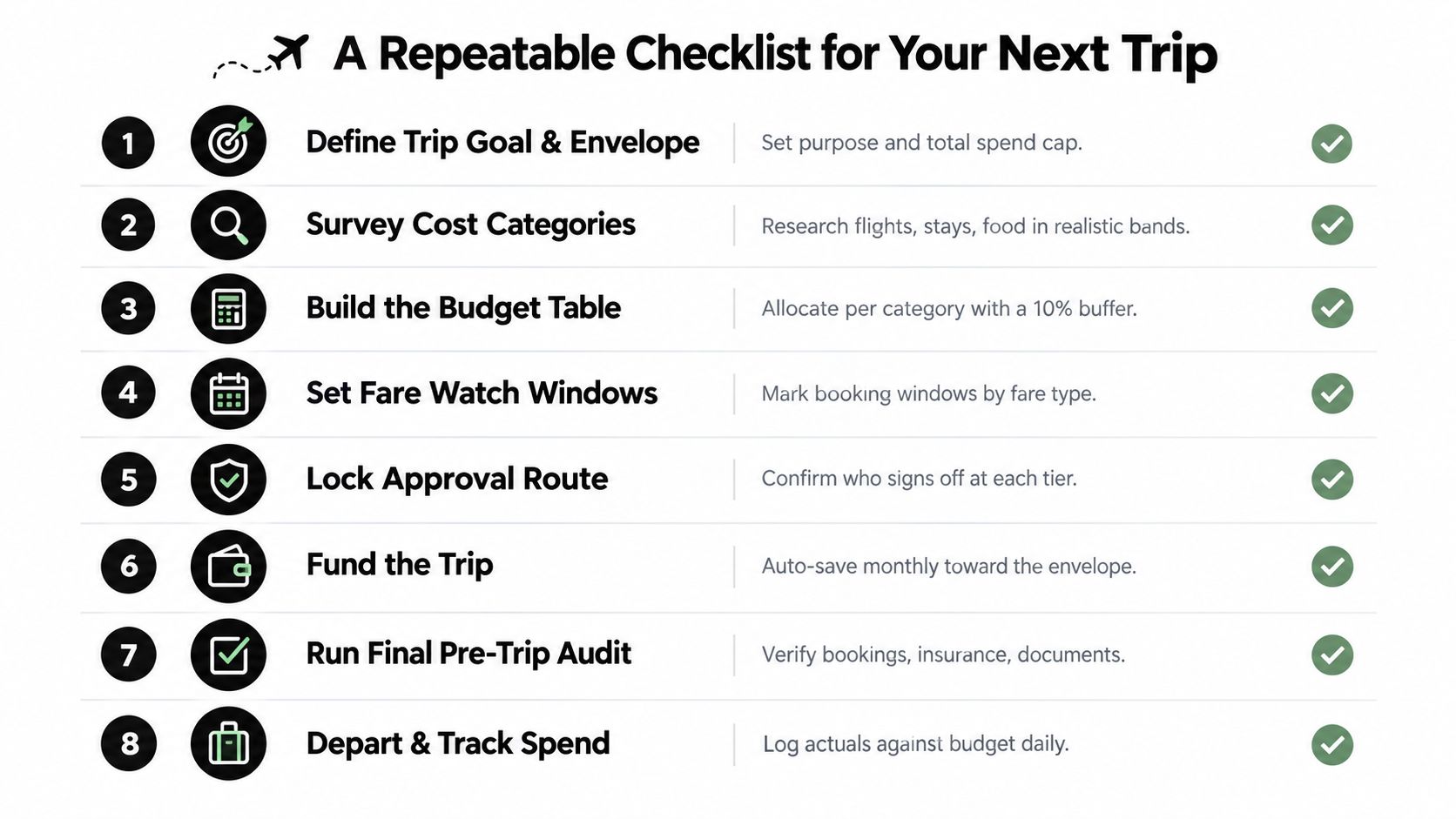
A good travel budget is a decision tool, not a prediction carved in stone. Run the same sequence for a corporate visit, a premium leisure trip, or a group itinerary, then adjust the inputs for purpose and risk.
- Define the trip goal and envelope. State why you're traveling, who is going, how long you'll stay, and the maximum complete-trip spend.
- Survey every cost category. Price fares, lodging, transfers, ground transport, meals, activities, insurance, fees, and currency exposure.
- Build the budget table. Assign a ceiling to each category and keep the contingency reserve outside routine spending.
- Screen cabin options. Compare economy, premium economy, business, and first on the same dates. Look specifically for short-haul competition, promotions, and pricing anomalies.
- Set the approval route. Identify whether the booking can auto-approve, needs a manager, or must reach finance.
- Create the fare watch. Use route alerts, a target price, preferred dates, and a clear buy decision.
- Run the final audit. Confirm ticketing, baggage, seat assignments, hotel cancellation rules, transfers, insurance, visas, and payment requirements.
- Track actual spend. Compare daily costs with the approved category limits and record changes while they're still easy to explain.
The most expensive budgeting mistake is fixation on the ticket. A low fare can force expensive choices elsewhere, while a premium fare can occasionally deliver better total economics through included services, a better schedule, or an unusual market opportunity. Your checklist should make those comparisons visible before you commit.
Use the process for group travel as well. Agree in advance who pays for shared lodging, transfers, meals, optional upgrades, and emergencies. For corporate programs, keep air, lodging, meals, and ground transport as separate forecast lines so savings in one category don't conceal overruns in another.
Review the completed trip afterward. Record the expected and actual amount by category, note why the variance happened, and update the next forecast. That feedback loop turns travel budgeting from guesswork into a repeatable operating system.
Passport Premiere helps travelers and corporate teams evaluate international premium-cabin fares through fare monitoring, market analysis, and purchase-timing signals. Visit Passport Premiere to assess premium fares against the full trip budget and identify opportunities where business class may cost less than coach.
