

Business class can be cheaper than coach. That sounds backwards until you look at real fare inversions: one published example showed economy at $575 while business class was $471, and another had economy at $480 while business class was $373 on the same trip (One Mile at a Time example). Another reported set of fares showed Canberra to Melbourne economy at $629 while business was $449, plus Sydney to Christchurch economy at $489 while business was $462, driven by the fact that flexible economy buckets can price above the cheapest business bucket (Australian Frequent Flyer examples).
Still overpaying happens because they shop for premium cabins the same way they shop for coach. They look once, trust a generic booking rule, and assume the published business fare reflects real value. It often doesn't. Premium cabins are small inventories with aggressive repricing, and the opportunity comes from catching empty-seat value, route competition, and short-lived fare drops before corporate demand tightens the market.
Why Business Class Can Cost Less Than Coach
The biggest mistake I see is treating premium cabins like a luxury retail item with a fixed markup. Airlines don't price business class that way. They price it like perishable inventory, and when the right booking bucket opens or economy tightens first, the price ladder can flip.
Empty seats matter more than brochure pricing
A business seat that goes out empty earns nothing. That matters more than the aspirational fare you see far out on the calendar. Passport Premiere notes that fewer than 15% of all premium cabin seats are sold at their initial asking price, which fits what seasoned premium flyers already know from watching fare cycles: opening prices are often speculative, not final market value.
If you want to understand why that happens, it helps to know how airlines manage cabin inventory and demand across fare buckets. This overview of airline capacity management is useful background because it shows why carriers will protect high fares in one phase, then release lower-priced premium inventory in another.
Practical rule: The first business-class fare you see is often a placeholder for optimism, not a signal to buy.
What a real buying event looks like
A real opportunity usually has one of these patterns:
- Economy is constrained: Flexible or late-booked coach inventory can climb above lower business-class buckets.
- Premium inventory is lagging: The airline would rather fill seats at a lower premium fare than fly them empty.
- A competing carrier moved first: One route cut can force matching behavior across a corridor.
- A connecting itinerary changes the baseline: The cheapest business seat is often hidden on a one-stop routing, not the nonstop everyone starts with.
What doesn't work is waiting for a coupon code or assuming a holiday sale will solve the problem. Premium fares move more from inventory pressure than from retail-style promotions.
The mindset shift that saves money
The useful question isn't “How do I get a discount code for business class?” It's “What is this seat worth on this route, in this season, with this inventory?” That's the frame that changes buying behavior.
I don't treat business class as a prestige purchase. I treat it as a market with mispriced inventory. Once you do that, the search gets sharper. You stop anchoring on list price, you stop chasing generic hacks, and you start watching for the moments when a premium seat is priced like distressed inventory instead of a flagship product.
How Premium Cabin Pricing Really Moves
Premium cabin pricing follows seat value under pressure. Airlines are not pricing a business-class seat as a luxury object first. They are pricing a perishable asset against demand on a specific route, in a specific season, with specific inventory still unsold.
Seasonality follows corporate traffic more than vacation demand
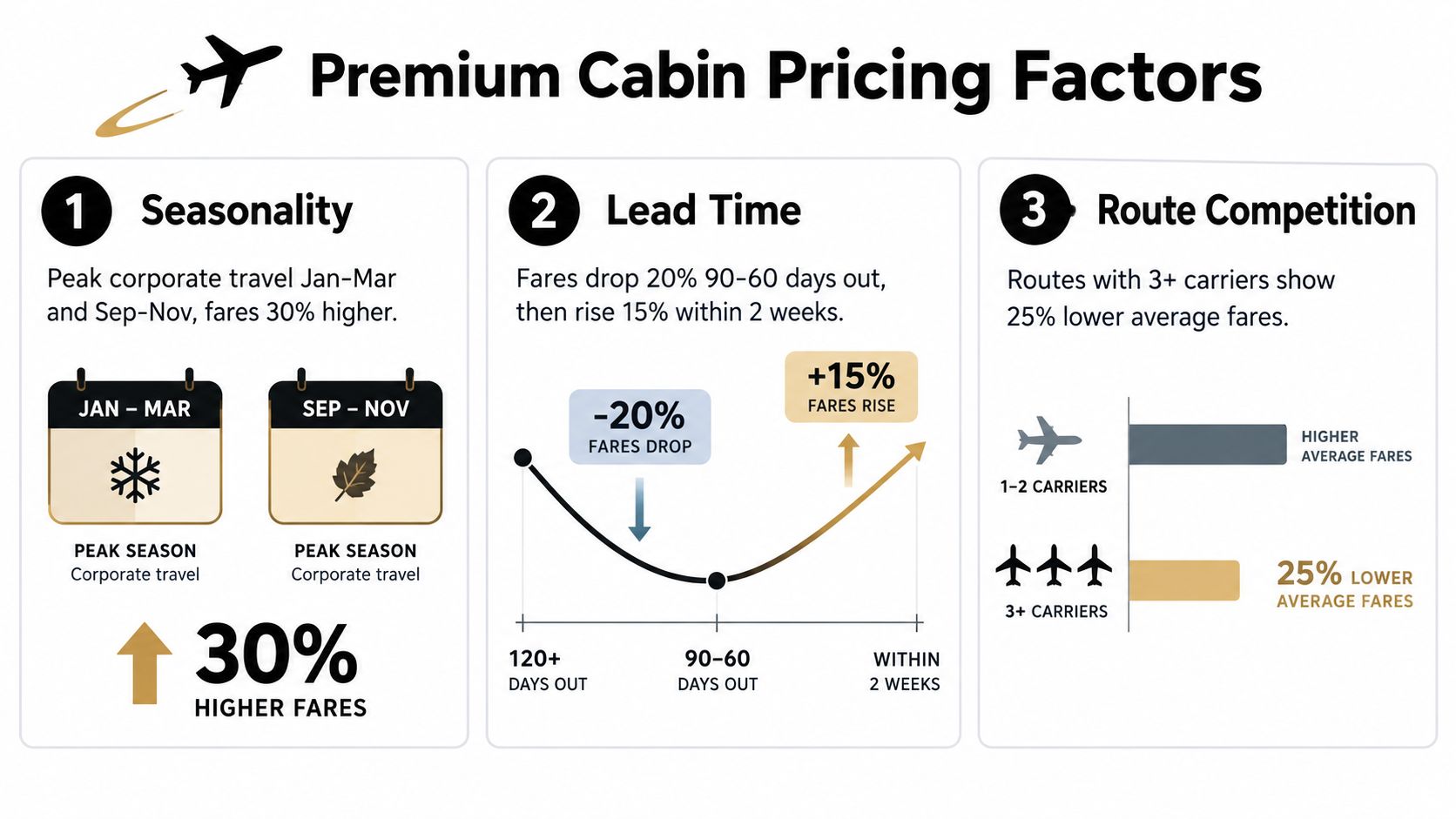
Premium demand on long-haul routes often rises and falls with business travel calendars, not with the assumptions leisure travelers bring from economy pricing. IATA reported that business-class fares typically soften in summer, then firm up in September and again in March through May, which tracks the corporate travel cycle more closely than school holidays do (IATA premium travel analysis).
That difference matters. New York to London can weaken when corporate travel pauses, even if Europe is busy with tourists. A leisure-heavy route can do the opposite. The route mix decides the pattern.
Corridor floors matter more than headline averages
Published “average business-class fare” numbers are usually too broad to help with a buying decision. What matters is the floor for the corridor you are flying, because that tells you what the market can realistically clear at when carriers need to fill premium seats.
Independent fare-market tracking for 2026 found a mean lowest accessed consolidator business-class fare of $2,139 across long-haul routes, with transatlantic averaging $1,981, transpacific averaging $2,339, and U.S.↔Oceania at $3,160 (corridor-specific fare floor analysis).
Those numbers explain why travelers get confused. Someone who learns to buy business class to Europe for around two thousand dollars can badly misjudge Asia or Australia. The market floor is different before timing even enters the picture.
| Market view | What it tells you | Why it matters |
|---|---|---|
| Transatlantic | Lower long-haul fare floor | Often the easiest corridor for fare wars and oversupplied premium inventory |
| Transpacific | Higher baseline | Discounts exist, but the starting point is less forgiving |
| U.S. to Oceania | Much higher premium floor | Routing choices and alternate gateways often matter more than waiting |
Fare buckets move faster than booking folklore
Airlines reprice premium cabins by opening and closing fare buckets, not by following a simple calendar rule. The practical model is yield management. Sell high while demand is healthy, then drop into lower buckets if premium seats are still sitting empty close enough to departure to become a problem. This explainer on yield management pricing lays out the mechanics behind those swings.
That is why fixed advice like “always book on Tuesday” wastes time in business class. A fare can drop because a competitor filed a lower price, because the airline is behind on premium sales for that departure, or because a one-stop itinerary opens access to a cheaper booking class. None of those changes care what day of the week it is.
Premium pricing is route-first, inventory-first, and competition-driven.
I have found that the cleanest way to read business-class pricing is to ask one question: is the airline still selling a flagship seat, or is it trying to avoid flying that seat empty? When that answer changes, the fare can move fast.
Timing Your Purchase and Monitoring Fare Drops
Business class bargains usually come from mispriced empty-seat risk, not from promo codes. If a carrier is behind on premium sales, or a competitor files a lower fare in the same market, the drop can appear for a short stretch and then disappear just as fast.
The booking window that matters
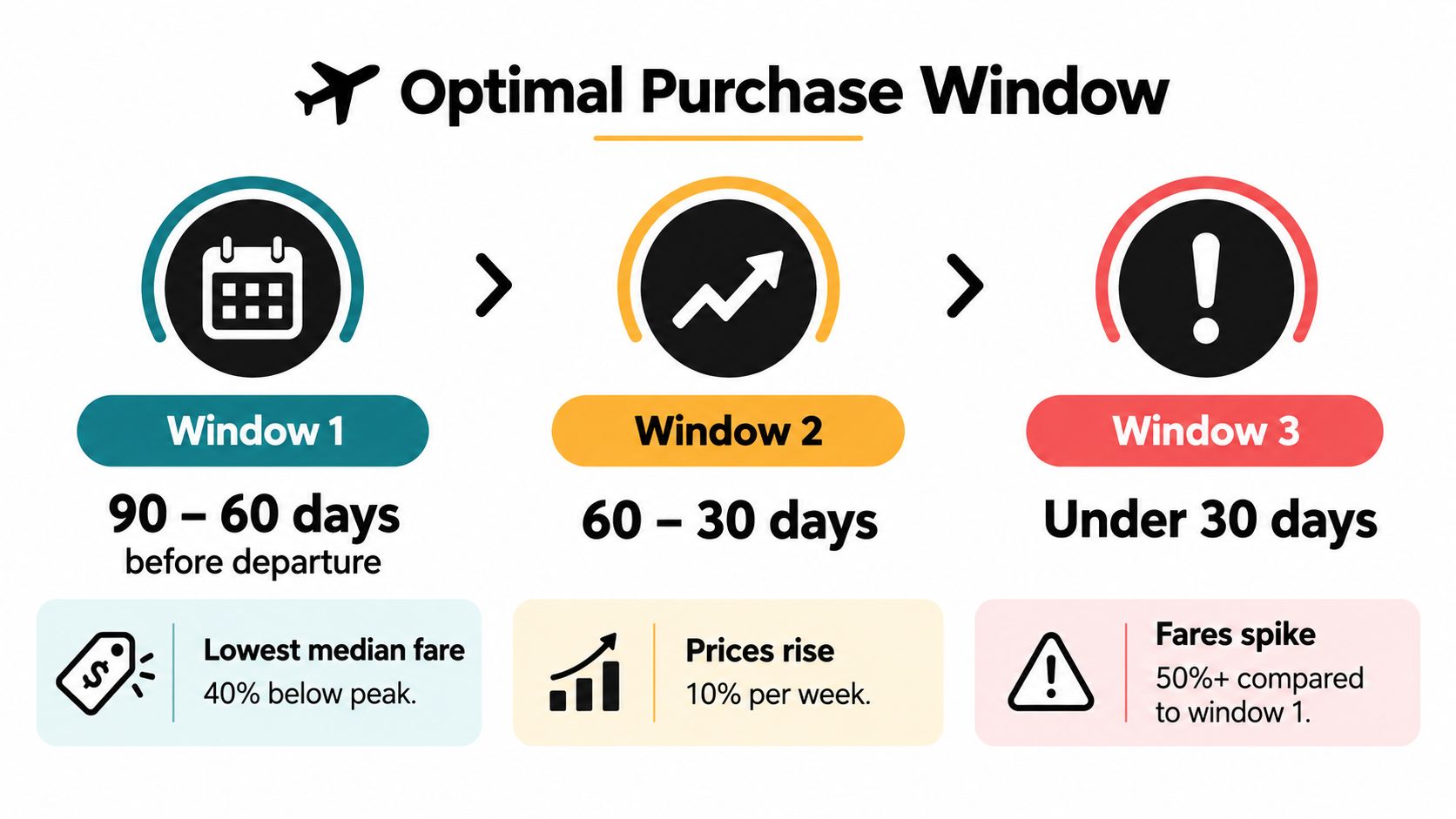
Timing still matters, but not in the simplistic "book on this exact day" sense. On routes with heavy corporate demand, airlines have less reason to discount late because business travelers keep buying close to departure. A University of North Carolina working paper on international airline markets found that markets with more business travelers tend to show higher average fares and steeper increases as departure approaches (UNC airfare working paper).
That is why last-minute waiting works far less often than people hope on core routes like New York to London or major U.S. to Germany markets.
The better target is the middle window, after the first high launch fares but before late corporate demand starts pushing prices up again. On some routes, that is where airlines start pricing for seat fill instead of pricing for urgency.
What to monitor instead of guessing
Calendar folklore wastes time. Repeated observation works better.
One data set of verified business-class alerts showed discounted premium fares surfacing in every month of the year, with meaningful variation between the cheapest and dearest periods (verified business-class alert data). The useful takeaway is not the exact spread. It is that premium deals are not confined to one "best month." They appear whenever sales pace, competition, and inventory line up.
I use a simple monitoring setup:
- Benchmark one route at a time. Track the exact city pair, cabin, and rough travel dates you would realistically book.
- Check nearby gateways. A departure from a different hub, or an arrival into a second airport in the same region, often reveals a lower premium fare floor.
- Set alerts and keep receipts. Save screenshots or notes so you can tell the difference between a real drop and random search noise.
- Book quickly when the price breaks range. Lower premium buckets can close within hours.
If you want a cleaner system, this guide to setting up airline price drop alerts covers the alert workflow well.
Mid-range often beats very early and very late
The expensive mistake I see most often is buying at the two ends of the curve. Some travelers book the day schedules open, when premium cabins are still priced for high-yield demand. Others wait until the final weeks, when business-heavy routes can climb hard.
The better buying window is often somewhere in between. As noted earlier, route-level examples show that some major transatlantic business-class fares bottom out in the two- to four-month range rather than at launch or right before departure.
The goal is to catch the point where the airline starts valuing sold seats more than protecting a high published fare.
That is the shift worth watching. Once you see it, business class stops looking like a coupon hunt and starts looking like inventory timing.
Smarter Routing and Alliance Strategies That Lower Fares
Routing changes the fare more than seat alerts do once you know your travel window. The biggest premium-cabin savings often come from buying the right city pair and connection pattern, not from chasing promo codes.
One stop can reset the whole premium fare
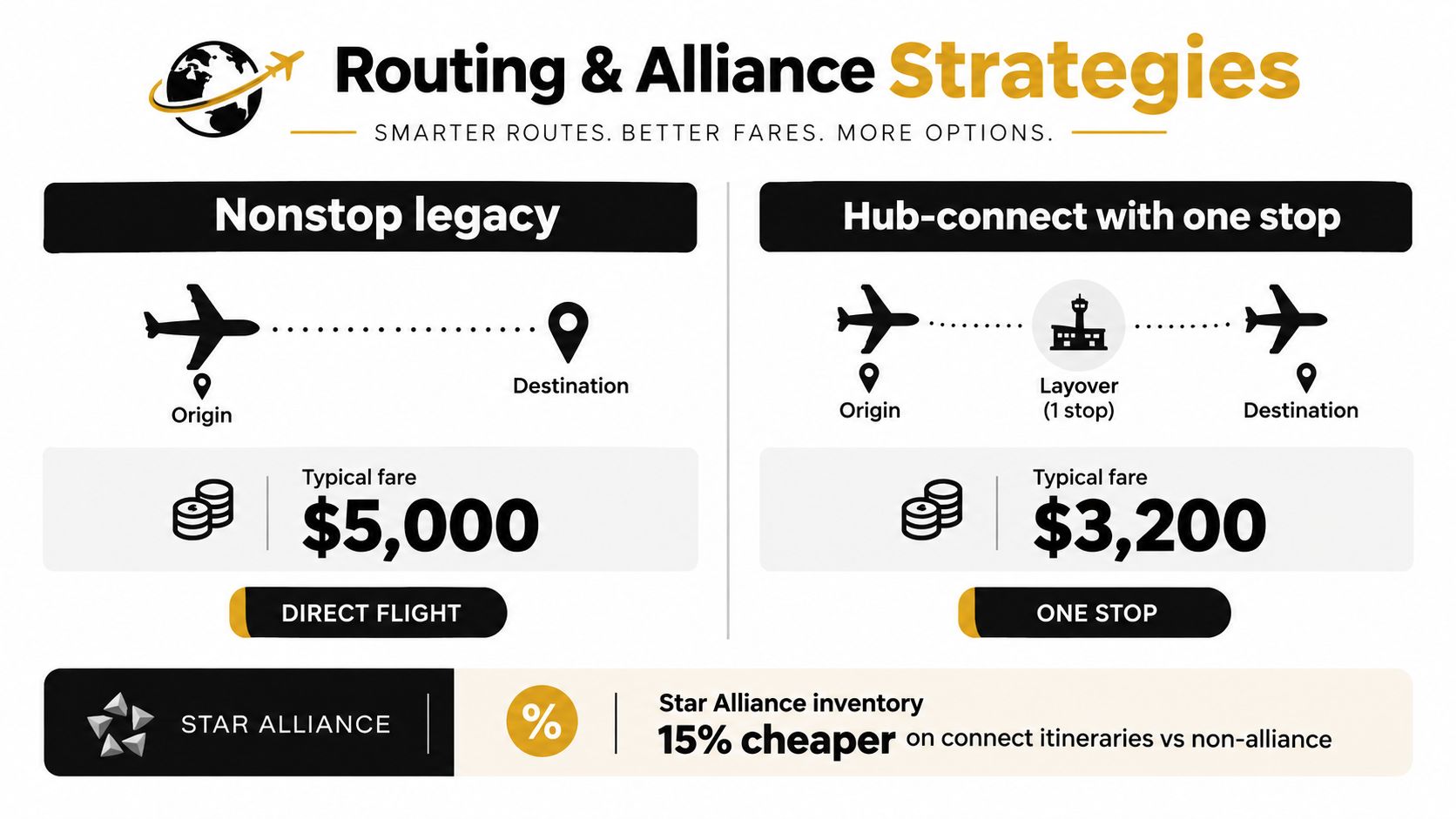
On many long-haul routes, a one-stop business-class itinerary through a competitive hub comes in below the obvious nonstop. In practice, hub-connect options and value-oriented carriers often undercut nonstop pricing by a noticeable margin, especially where multiple airlines are fighting for transfer traffic.
That matters because airlines do not price business class around distance alone. They price around demand, competition, and how badly they want to fill premium seats on a specific route. A nonstop from your home airport may carry a convenience premium all year. A connection through a strong hub can tap into a much lower fare structure for the exact same long-haul crossing.
I see this regularly on routings through IST, DOH, HEL, and MAD. Those hubs often produce lower business-class combinations than the nonstop from a large North American gateway, even after you add the extra segment.
Alliance logic matters, but fare logic matters more
Alliance coverage helps, but it is not the main event. The useful move is checking whether a partner airline prices the trip from a different hub more aggressively than the nonstop carrier prices it from yours.
For example, the same alliance can show a high nonstop fare on one carrier and a lower connecting fare on a partner because they are solving different inventory problems. One airline is protecting local nonstop demand. The partner is trying to fill premium seats with connecting traffic. That is why alliance shopping works best when you compare actual routing economics, not just logos.
The trade-off is time, risk, and trip purpose
A lower fare is only good if the itinerary still fits the trip.
For a same-day meeting or a short premium work trip, I usually pay more for a nonstop if the schedule protection is better and the missed-connection risk drops. For a leisure trip, or any long-haul where saving a meaningful amount buys an extra hotel night or a better room, one stop is often the smarter buy.
Use this filter:
| Routing Choices That Change Your Business Class Fare Floor | Typical Fare Impact | Best Use Case |
|---|---|---|
| Nonstop on a legacy carrier | Usually higher fare floor | Tight schedules, same-day meetings, minimal complexity |
| One-stop via a major hub | Can materially lower the fare floor | Price-sensitive long-haul trips where time flexibility exists |
| Value carrier in business class | Often lower entry pricing | Travelers willing to trade some brand preference for fare savings |
| Nearby departure gateway | Can reset the whole search | Travelers who can start from an alternate airport |
How to compare routing options without wasting time
- Run the nonstop first. That gives you the baseline you are trying to beat.
- Check nearby gateways and hub connections on the same dates. The goal is to find a lower fare structure, not just a different schedule.
- Compare alliance partners separately. Shared networks do not mean shared pricing.
- Read the fare rules before you get excited. A cheap business ticket with harsh change rules can be wrong for work travel.
- Price the full trip cost. Add positioning flights, lounge access gaps, and the cost of a bad layover before calling it a deal.
Cheap business class is usually a routing problem first. The best fares show up where airlines need help filling premium seats, and that is often on connecting flows through competitive hubs, not on the nonstop everyone searches first.
Paid Fares Versus Points and When Each Wins
Cash, miles, and consolidator pricing solve different problems. The trick is to compare them against the same trip, not in isolation. A lot of bad premium-cabin decisions happen because travelers fixate on “using points” without checking whether the cash fare is already unusually low.
Compare cabins before you compare payment methods
One underused move is checking business class against premium economy and economy on the exact same route before you decide how to pay. In a 2026 projection, global premium fares were forecast to rise 9.5% to $4,488, while economy was projected to rise 8.7% to $536. The same forecast used a New York to London example where a restricted business fare was $4,490 versus $5,390 for refundable business, showing how fare rules alone can create several-hundred-dollar gaps inside the same cabin (GBTA 2026 travel price forecast).
That means your first comparison isn't always “cash or miles.” Sometimes it's “restricted business, refundable business, premium economy, or coach.”
When paid business wins
Paid business tends to win when a route drops into a real fare event. One industry guide notes that business-for-economy pricing is rare, but it can happen when a sale or mistake fare drops an international business-class ticket to as low as $300, and it also says a “good deal” on an international business-class ticket is generally under about $2,700 (Going guide to business-class deals).
Cash also wins when:
- The fare rules fit your trip: A lower business fare with acceptable change terms can beat using a large balance of miles.
- You need to earn miles or status credit: Award seats usually don't help there.
- The business fare is already compressed: If the paid premium is unusually low versus premium economy, using points may be poor value.
One practical example outside premium cabins, but useful for thinking through redemption strategy, is this write-up on an Orlando trip with points. The value isn't the route itself. It's the decision process of comparing cash cost, points cost, and trip flexibility before booking.
When points or specialist monitoring win
Points often make more sense when paid business stays stubbornly high, especially on routes where premium demand fills seats without discounting. They can also win when you have date flexibility and can wait for award space instead of forcing a bad cash purchase.
Specialist monitoring can help in the middle ground. Services such as Google Flights alerts, airline-specific notifications, and Passport Premiere's fare monitoring are useful when you already know the route and need help catching downward repricing rather than manually refreshing the same search every day.
The wrong move is treating points as automatically smarter than cash. The right move is comparing all-in value on the route in front of you, with fare rules included.
Your Practical Playbook for Consistently Lower Premium Fares
Lower premium fares don't come from one trick. They come from a repeatable process. If you want a clean system for how to get best business class fares without overpaying, keep it disciplined.
The weekly operating routine
Use a simple checklist:
- Set a route benchmark: Know whether you're shopping transatlantic, transpacific, or a structurally expensive market before you react to any fare.
- Monitor the middle booking window: Don't assume the opening fare is good, and don't count on a last-minute rescue.
- Price nonstop against one-stop: Especially through major hubs when the schedule allows.
- Compare fare rules inside business class: Restricted and refundable business can be far apart even on the same flight.
- Check business against premium economy and economy: Sometimes the premium gap is rational. Sometimes it isn't.
- Act fast on real drops: Good premium inventory doesn't wait for a committee meeting.
What wastes time
I'd skip a few habits entirely:
- Blindly following “best day to book” myths
- Searching only from one home airport
- Ignoring connecting options on premium-heavy routes
- Assuming miles are always the better deal
- Treating the first published fare as the market price
What consistently works
The travelers who pay less usually do three things well. They benchmark by route, they monitor instead of guessing, and they buy according to inventory conditions instead of ego.
Cheap business class is usually a timing problem or a routing problem. Sometimes it's both.
That's the durable advantage. You don't need secret coupons. You need better timing, cleaner comparisons, and enough patience to let the market show its hand before you buy.
Passport Premiere tracks international business and first-class fare cycles, highlights when premium pricing drops toward real market value, and gives travelers practical tools to follow those moves instead of guessing. If you want a more structured way to monitor premium fare volatility and avoid paying list price for comfort, visit Passport Premiere.
