

The most popular advice about the price of a first class ticket is also the least useful: compare it with economy, see a huge gap, and assume the premium cabin is automatically bad value. That approach misses how airlines sell seats. Premium fares move with route competition, cabin inventory, corporate demand, fare rules, and the cost of economy extras.
A first-class fare can command a substantial premium, but it can also compress sharply against business class or coach. On some itineraries, business class has even appeared below economy after airlines clear premium inventory or economy fees change the calculation. The smart buyer doesn't ask for one universal average. They compare the total trip cost, the exact route, the aircraft, the inclusions, and the market conditions at the moment of purchase.
Understanding the True Price of a First Class Ticket
The advertised price of a first class ticket can mislead buyers in both directions. Commercial first class has traditionally sat well above economy and business class. On long-haul intercontinental round trips, fares regularly exceeded $10,000 or €10,000 per person, while international business class often ranged from $4,000 to $5,000 and economy commonly fell between $300 and $2,000, according to historical fare tracking from Fare Detective. Those benchmarks describe the old luxury-airfare hierarchy, not a guaranteed value premium.
Airlines continually open and close fare buckets as bookings develop. They protect scarce seats for high-value travelers, respond to competitors, and clear inventory that may otherwise depart empty. A weakly demanded first-class seat can fall into a lower bucket, while the same seat on a constrained corporate route can remain expensive until departure.
Practical rule: Treat premium airfare like a volatile commodity, not a fixed luxury product.
Fare compression creates the buying opportunity. The gap narrows when economy inventory becomes expensive, premium cabins are discounted, or unsold first-class seats are released. Independent analysis places first class at roughly 1.5x to 3x the cash fare of business class, with examples ranging from about $3,820 to $14,763 on premium transcontinental and intercontinental services. Mighty Travels' route analysis reinforces the right search method: compare specific city pairs and fare bands instead of trusting a headline average.
The counterintuitive result is that a premium cabin can occasionally cost less than economy after inventory clearing and ancillary fees change the total. That is yield-management arbitrage, not a permanent repricing of luxury travel. Compare the complete trip cost before assuming the higher cabin is irrational.
For travelers who want the premium experience visible beyond the journey, a buy first class ticket iPhone case is a playful accessory. It does not alter the fare economics. Savings come from identifying the price gap before another buyer takes the inventory.
Before approving a purchase, compare dates, connection points, aircraft, included services, and fare conditions. The first-class flying cost guide offers useful context, but the final decision should come from a live comparison of the exact itinerary.
How Airlines Calculate Premium Cabin Fares
Airlines price premium seats with the same basic objective they apply across the aircraft, maximize revenue from a perishable seat before departure. A first-class seat that leaves the gate empty produces no future revenue. Yet selling it too cheaply can displace a later booking from a traveler or company willing to pay much more.
IATA reports that premium fares contribute about 15% of passenger revenue, while Apex-linked data places business class at around 7x economy and first class around 13x economy on average. Those figures explain why a small premium cabin can carry disproportionate financial importance for an airline. IATA's analysis of premium-class travel also clarifies why airlines price premium seats through revenue controls rather than just adding the cost of a larger seat to an economy fare.
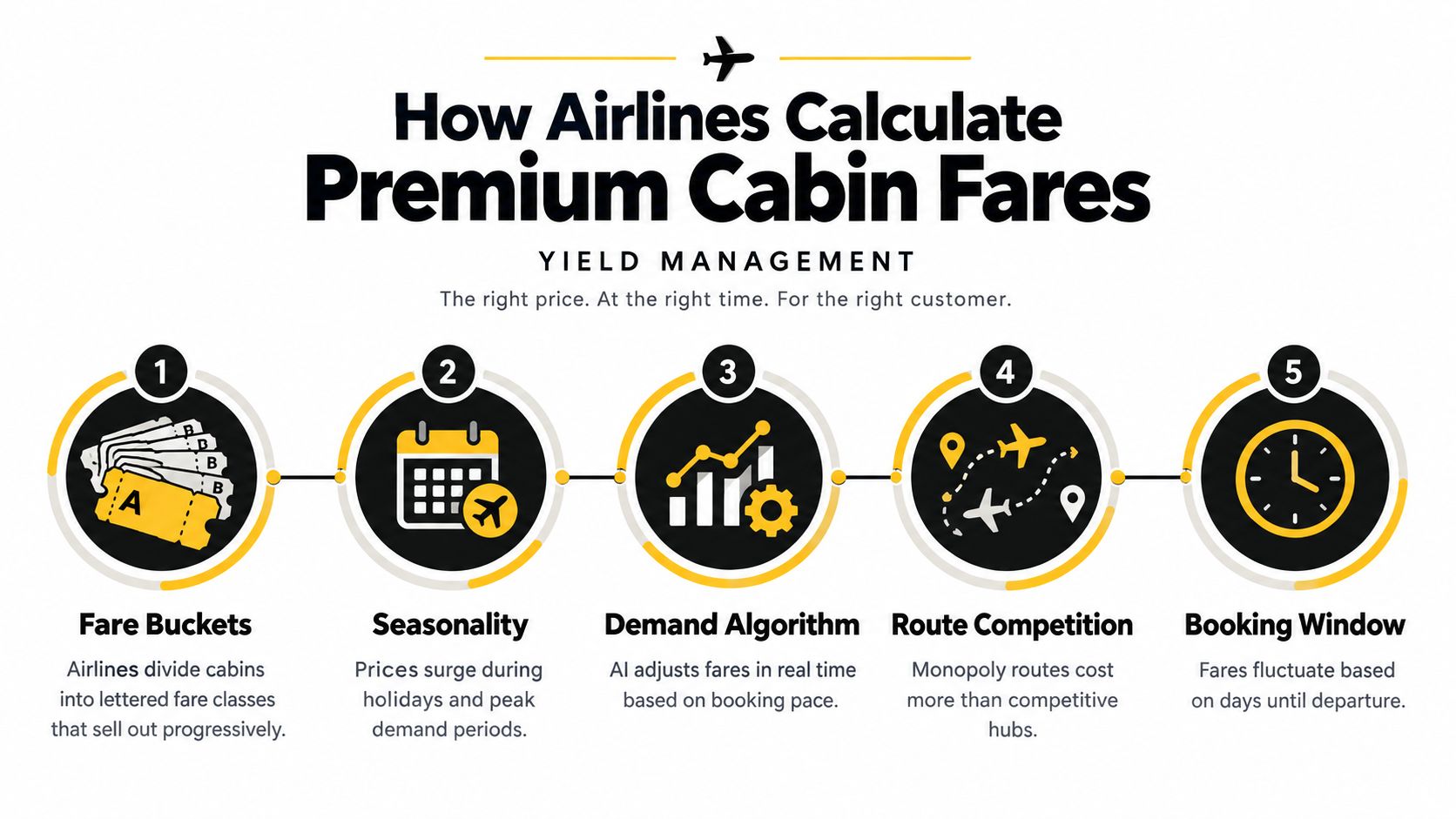
The five controls that matter most
- Fare buckets: Airlines divide each cabin into lettered fare classes. Lower-priced buckets sell progressively, leaving higher-priced inventory available when booking pace strengthens.
- Seasonality: Holidays, major events, school breaks, and corporate travel peaks can push fares higher because more buyers compete for limited premium seats.
- Demand algorithms: Pricing systems assess booking pace, remaining capacity, historical demand, and competitor pricing. They can change the fare after a search, although a displayed change doesn't guarantee that your search caused it.
- Route competition: A route served by several strong competitors gives airlines less pricing power than a monopoly or highly constrained connection. Routing through a competitive hub can produce a lower premium fare.
- Booking window: Prices can move repeatedly as departure approaches. An airline may protect inventory for late corporate bookings, then reduce selected fares if the expected demand doesn't materialize.
The key mistake is assuming first class has a fixed relationship with business class. Independent tracking found first class selling at roughly 1.5x to 3x the business-class cash fare, with examples spanning $3,820 to $14,763. The premium can therefore be modest in one market and extreme in another. This explanation of yield-management pricing helps buyers understand why route selection and flexibility often matter more than loyalty to a particular cabin.
Corporate demand complicates the picture. Airlines may hold attractive premium inventory for business travelers who book late and need specific schedules. Leisure travelers who search only one date and one airport are likely to encounter the protected, expensive fare. Buyers who can shift dates, use alternative gateways, or accept a different aircraft participate in a broader pool of inventory.
That makes flexibility a pricing tool, not merely a convenience. You're not negotiating with a ticket agent. You're choosing among different versions of the airline's inventory system.
Why Business Class Can Be Cheaper Than Coach
Business class cheaper than coach sounds like a pricing error, but it can be a rational result of airline inventory and fare construction. Economy fares are often split into a low base price plus charges for checked luggage, seat selection, flexibility, and other services. A discounted business fare may include benefits that an economy traveler would otherwise purchase separately.
The comparison must therefore use the total trip cost. A cheap-looking economy fare can lose its advantage once the traveler adds baggage, a preferred seat, change protection, and the practical cost of an uncomfortable overnight journey. Conversely, a business fare with restrictive rules may look attractive while offering less flexibility than its cabin label suggests.
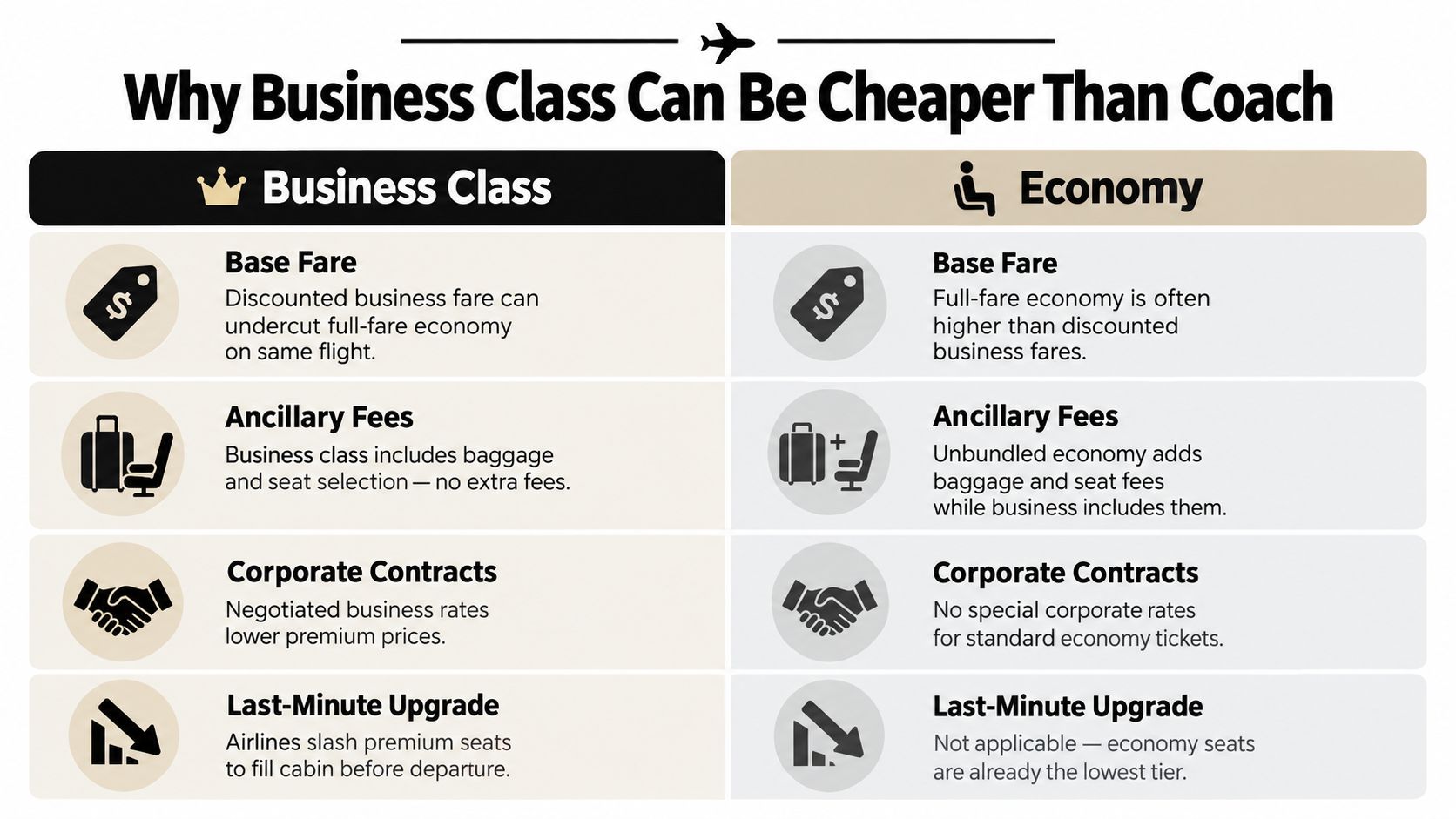
Four reasons the hierarchy can invert
Base fare compression occurs when an airline has unsold business inventory but limited availability in the cheapest economy buckets. The system doesn't need to preserve the traditional order. It needs to sell the remaining seats at the strongest available price.
Ancillary fees can erase the economy advantage. Baggage and seat charges belong in the comparison before you decide that coach is cheaper. Business class may include those services in its fare, making the premium cabin the more rational purchase for a traveler who needs them anyway.
Corporate contracts can lower the effective price of premium travel for eligible buyers. Negotiated rates and selected fare agreements can create business-class options that aren't visible in the same way to every customer. Corporate travel managers should compare contracted inventory with public economy fares rather than treating the latter as the automatic baseline.
Last-minute inventory clearing can push premium fares downward. If an airline expects empty business seats close to departure, it may discount them or offer upgrade paths to improve cabin utilization. That doesn't mean every late booking will be cheap. It means the price hierarchy can break when inventory and demand move out of alignment.
The documented examples are compelling. The Points Guy reported that Alaska, American, Delta, and United have displayed extra-legroom economy, premium economy, and first or business-class awards below economy on some itineraries. It also cited a cash example on LATAM's once-weekly Easter Island to Papeete route where business class was priced at or below economy. The reported premium-award anomalies show why sorting results only by cabin can hide value.
A separate Delta scenario cited an upgradeable coach fare at $3,256 or more, compared with a discount business-class fare at $3,347. The comparison of business class and coach pricing demonstrates how little separation can remain once fare types and upgrade eligibility enter the calculation.
Buyer's test: Price the itinerary you need, then price the cabin you assume you can't afford. The result may contradict the hierarchy.
Typical First Class Price Ranges by Route
A first-class fare has no reliable “average.” The city pair often matters more than the cabin label, and the same aircraft can sell at sharply different prices across destinations. A 2026 analysis of Lufthansa's 747-8 first-class fares found prices from about $10,100 to $14,842, a spread of more than $4,600. West Coast U.S. and Tokyo routes ranked at the top of that sample, while Buenos Aires was at the bottom. The Lufthansa 747-8 fare comparison confirms the commercial reality: network structure and city pair drive the fare.
| Route destination | Aircraft type | Approximate fare range | Pricing driver |
|---|---|---|---|
| West Coast U.S. to Europe | Lufthansa Boeing 747-8 | About $10,100 to $14,842 in the 2026 sample | Strong premium demand and constrained flagship inventory |
| Tokyo to Europe | Lufthansa Boeing 747-8 | About $10,100 to $14,842 in the 2026 sample | Long-haul luxury demand and route-specific scarcity |
| Buenos Aires to Europe | Lufthansa Boeing 747-8 | About $10,100 to $14,842 in the 2026 sample | Lower sampled premium pricing within the same network |
| Premium transcontinental and intercontinental markets | Carrier and aircraft vary | About $3,820 to $14,763 in tracked examples | Competition, routing, aircraft, and fare-bucket availability |
Use the table as a comparison framework, not a quotation. Search the actual city pair and travel dates before setting a budget. Broad market ranges such as $3,000 to $15,000 or $8,000 to $32,000 show how widely first-class fares can vary, but they do not identify the routes at the low end or confirm which services the ticket includes.
Route choice beats brand loyalty
Luxury pricing concentrates on routes with strong corporate demand, wealthy leisure traffic, limited flagship inventory, or a highly valued aircraft. Elsewhere, airlines may carry more premium seats than the market can absorb. Inventory clearing and bundled ancillary fees can then narrow the gap with economy, turning a supposedly expensive cabin into a yield-management opportunity.
Emirates shows how wide the spread can be. Sampled 2026 return fares on nonstop Dubai routes ranged from roughly $3,939 to $16,443, according to industry coverage. The report on changing first-class pricing and product design makes the pricing point clear: “Emirates first class” is not a single product price. Route, timing, aircraft, inventory, and included services determine the offer.
Corporate buyers should test nearby departure cities and compare nonstop with connecting itineraries, while checking the aircraft and fare conditions before approving the purchase. Luxury travelers should select the service standard they want, then identify the market where that product is priced most competitively. Brand loyalty should come after the fare and product comparison, not before it.
Proven Strategies to Lower Your Premium Airfare
Savings come from expanding the search, not from waiting for an airline to behave generously. The strongest strategies give the pricing system more ways to offer you an available premium fare.
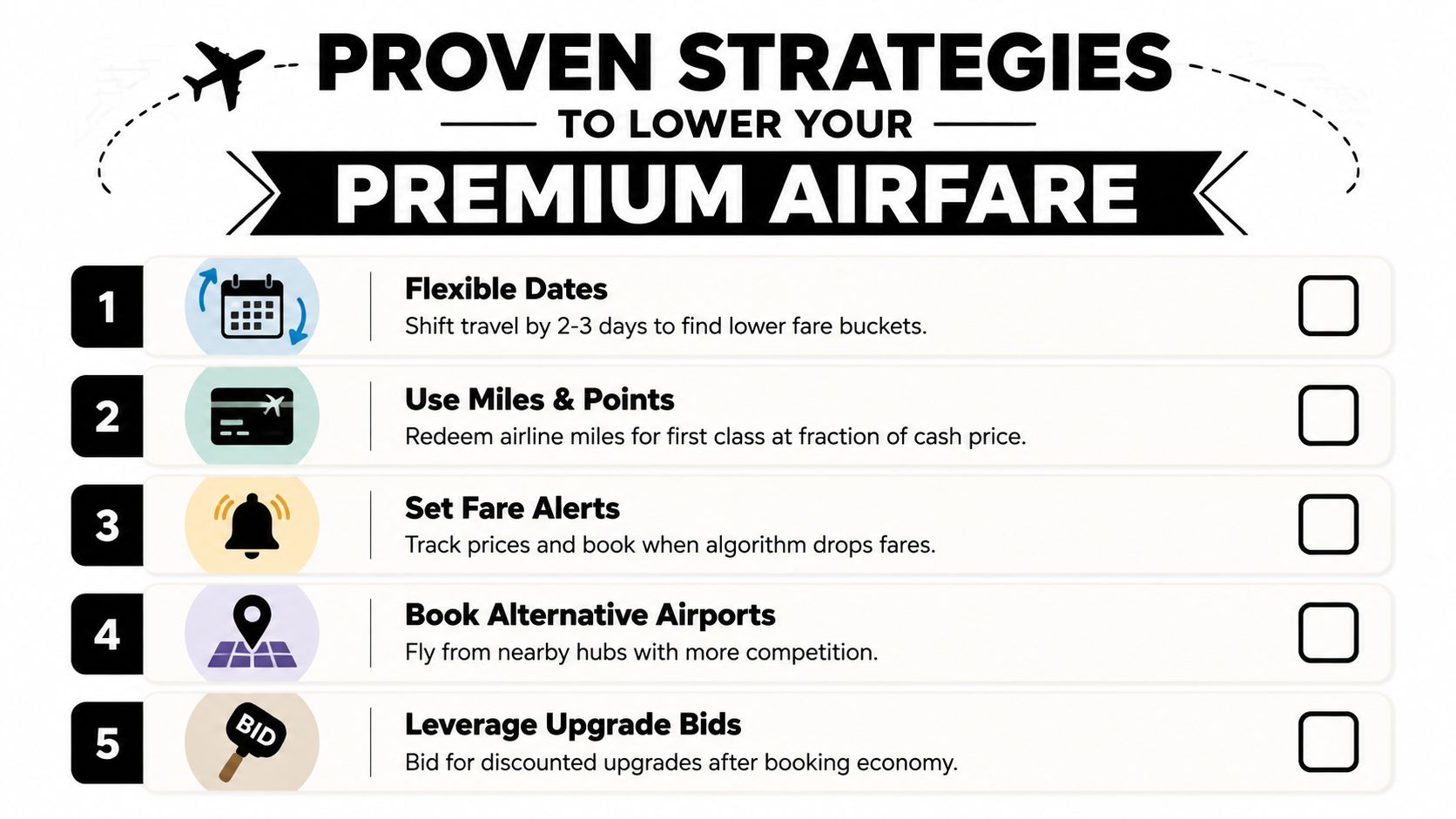
Start with a wider search brief
Move the dates: Search nearby departure and return dates instead of locking onto one calendar combination. Even a small shift can expose a different fare bucket, particularly when corporate demand is concentrated around specific weekdays.
Use miles and points carefully: Award inventory can make first class accessible at a lower cash outlay, but availability and redemption pricing vary. Compare the value of the miles with the cash fare, taxes, and the opportunity cost of using the balance for another trip.
Set fare alerts: Monitoring matters because premium prices can fall and disappear quickly. Alerts work best when you define acceptable routes and cabin requirements in advance, rather than reacting to every low-looking headline fare.
Check alternative airports: Nearby hubs may have more competition, more aircraft choices, or more premium inventory. Include the ground-transport cost and time before declaring the alternate airport a saving.
Review upgrade bids: Some airlines let passengers request a paid upgrade after buying economy. Treat the bid as a possible discount, not a guaranteed path to first class. Confirm the final cabin, baggage treatment, lounge access, and refund rules.
The most effective tactic for corporate travel is often a consolidated or negotiated fare. A specialist can sometimes access premium inventory or fare structures that a standard public search doesn't present clearly. That doesn't remove the need to compare terms. A low fare with restrictive changes may cost more than a higher fare when meetings shift.
Positioning flights can also work. A traveler may begin at a competitive hub rather than the closest airport, but the positioning leg needs its own protection. Avoid creating a fragile connection that turns an airfare saving into a missed long-haul departure.
Passport Premiere is one monitoring option for international Business and First Class buyers. Its service combines fare monitoring, market analysis, alerts, route comparisons, and guidance intended to identify fare drops and assess the market value of an empty premium seat.
Corporate rule: Set the acceptable cabin, route, schedule, and total budget before a fare appears. Speed matters when the inventory is genuinely attractive.
Use the embedded guide as a practical reference while building that search process:
Timing Your Purchase and Monitoring Fare Drops
Premium airfare changes as airlines balance unsold seats against late demand from high-value travelers. Booking too early can mean paying to protect scarce inventory. Waiting too long can leave only expensive fare buckets. No universal purchase day overrides route competition, cabin demand, or the airline's yield-management decisions.
Use continuous monitoring instead. Set a target fare, track the exact itinerary and acceptable alternatives, and investigate each price movement before purchasing. A lower fare may reflect released inventory, a competitor response, or a revised product with fewer included services. The opportunity is yield-management arbitrage, not a promise that every premium seat will be discounted.
Unbundling changes the meaning of cheap
Recent industry coverage described carriers selling first-class seats for less by separating selected perks from the headline fare. Overall airfare pressure can coexist with a cheaper, stripped-down premium product. The coverage of fare unbundling and changing first-class prices helps explain why a lower sticker price does not necessarily represent better value.
Audit the fare before booking:
- Included ground services: Check lounge access, transfers, priority handling, and airport assistance.
- Onboard inclusions: Confirm meals, drinks, bedding, and the specific seat or suite.
- Change and cancellation rules: A restrictive fare can cost more when business plans change.
- Aircraft and routing: Verify the operating carrier, cabin layout, and connection points.
- Upgrade treatment: Confirm status credit and whether the ticket can be changed into a higher cabin.
Record more than the price. Save the fare basis, baggage rules, seat type, operating aircraft, and booking deadline with each alert. This history separates a genuine inventory release from a fare that moved services outside the base price.
For frequent-travel teams, a Google Flights scraper tool can collect displayed fare information in a structured format for analysis. Verify the final fare directly with the airline or booking channel before payment.
The workflow is simple: monitor, validate, compare, then book. An airline price-drop alert system can organize the process when several travelers or city pairs require ongoing checks. Use the alert as a trigger for review, not as proof that the fare remains available.
Final Thoughts on Booking Premium Cabins
The price of a first class ticket is a moving target, not a fixed cost. Airlines adjust it through cabin scarcity, route competition, fare buckets, corporate demand, aircraft availability, and inventory-clearing decisions. Booking the first displayed fare gives away your strongest advantage, comparison.
Traditional first class can exceed $10,000 or €10,000 on long-haul intercontinental round trips. Route-specific findings place first class at roughly 1.5x to 3x business class, with sampled fares from about $3,820 to $14,763. As noted earlier, Fare history from Fare Detective and independent premium-cabin analysis show why averages hide major route differences.
The counterintuitive opportunity is yield-management arbitrage. Business class can drop below coach when airlines clear premium inventory, while economy surcharges and ancillary fees raise the final coach cost. That inversion does not make every premium seat cheap. It makes rigid cabin hierarchies a poor buying rule.
Corporate travel managers should set route and fare alerts before trips become urgent. Luxury travelers should define the features that justify first class, then search routes where those features are competitively priced. Monitor, verify, and compare before booking.
Passport Premiere helps travelers monitor international Business and First Class fares, identify fare drops, and compare premium routes with coach costs. Visit Passport Premiere to review its fare-monitoring approach before paying the first price shown.
