
Business class can cost less than coach, even on the same route. A documented London–Doha comparison priced fully flexible economy at £4,494 and business class at £3,029, a £1,465 saving, because the tickets carried different restrictions, as explained in Oliver's revenue-management analysis. The cheaper cabin label wasn't the cheaper ticket.
That changes the question behind purchase in advance. Rather than asking only how early to book, buyers need to ask what price is available, which inventory remains, and whether the fare rules fit the trip. A corporate traveler with an immovable meeting and a leisure traveler who can shift departure dates shouldn't necessarily make the same decision.
When International Premium Fares Are Lowest
The lowest average international fare occurred approximately 171 days before departure, while travelers bought their international tickets an average of 59 days ahead, according to an Airlines Reporting Corporation analysis presented by Hochschule Nordhausen. That review covered approximately 130 million U.S.-purchased tickets over 19 months and found the relatively stable, lowest-price band 225 to 150 days before departure, averaging 24% below the period mean.
The distinction matters: when people buy isn't necessarily when prices are lowest. For an international premium itinerary, start watching early enough to recognize the route's normal asking price. Treat the roughly five-to-seven-month interval as a useful observation period, not an instruction to purchase on a particular calendar day.
International advance-purchase baseline windows
| Window before departure | Price pattern | What the airline is doing | Practical read |
|---|---|---|---|
| 225 to 150 days | Lowest band, about 24% below the period mean; minimum near 171 days | Early low fares stimulate price-sensitive demand | Best place to record a baseline for international itineraries |
| About 150 to 60 days | A middle monitoring period, not a separately established low-price band; average international purchase is 59 days out | Updating demand forecasts and allocating inventory | Reasonable buy zone if the fare matches the observed baseline |
| 21 to 60 days | Reference band in the full-service study discussed below | Managing availability before identifiable close-in step-ups | Fixed-date trips should be priced against this band |
The middle row needs caution. The ARC findings establish the earlier low band, but they don't establish that every subsequent international fare remains stable. Likewise, this broad international benchmark isn't a business-class-only price forecast.
Route competition, season, cabin, departure airport, and remaining inventory can all change the useful buying point. A premium fare from a competitive gateway may behave differently from a nonstop departure with few substitutes. Compare like with like: the same routing, cabin, baggage allowance, and flexibility.
A baseline belongs to a flight, not just a destination
A peer-reviewed study of Taipei–Macau booking behavior examined 134,820 transactions across 1,044 flights during 2011 and found that travelers tended to purchase earlier for morning departures and during the hot season. That regional evidence doesn't prescribe a long-haul premium booking date, but it demonstrates why departure-time preferences and seasonality belong in a purchase decision.
Record the all-in fare alongside the operating flight, departure time, fare brand, and cancellation terms. Keep alternate airports or connections in separate comparisons rather than blending them into an apparently cheaper route average.
Baseline test: A lower price is useful only if it buys an itinerary you can actually use.
For approval, compare today's all-in quote with the route's observed baseline. Don't authorize an expensive premium ticket merely because it's early, and don't reject a workable fare merely because a broad market average suggests another buying window.
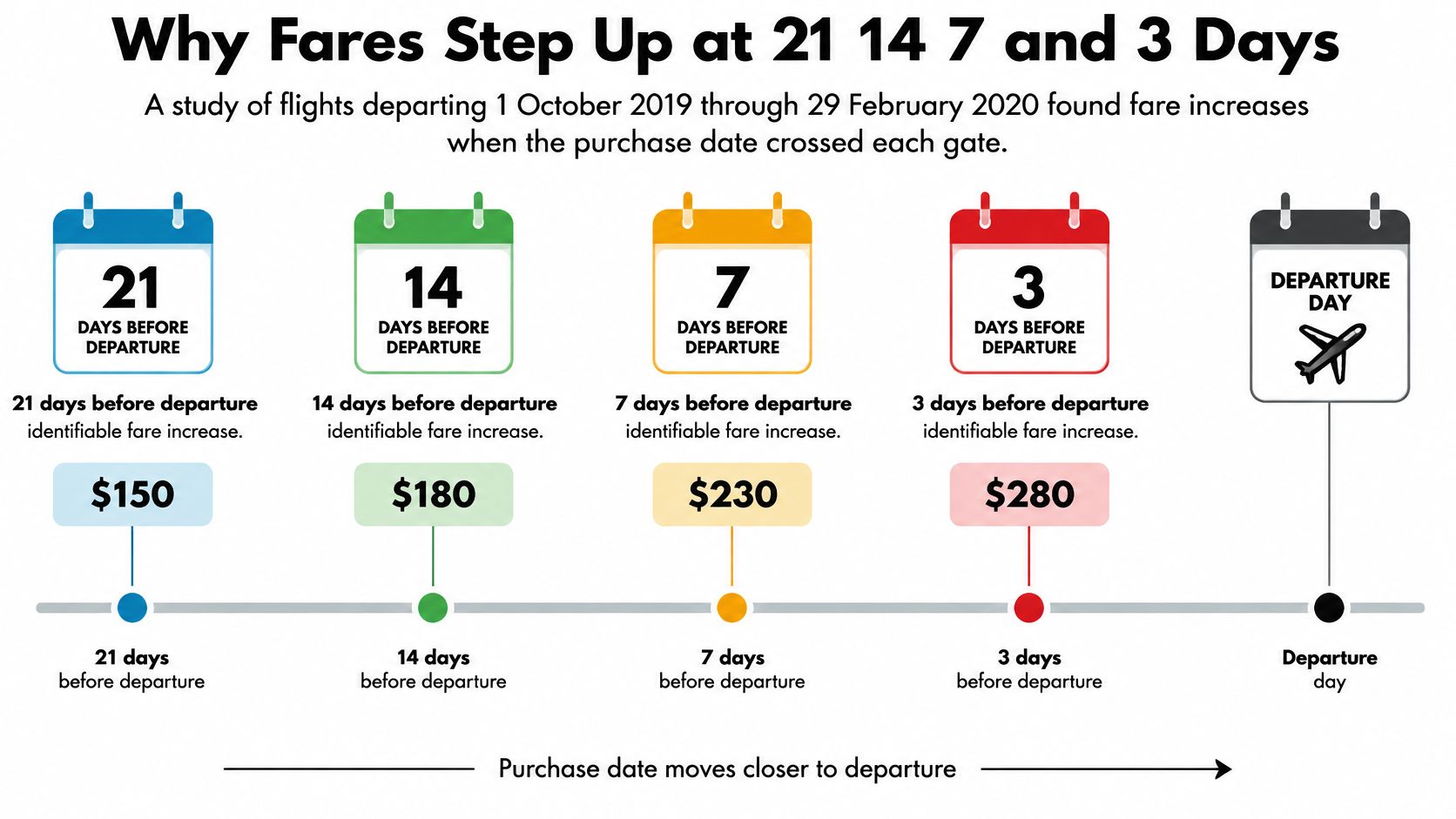
Why Fares Step Up at 21 14 7 and 3 Days
A study of full-service airline pricing, covering flights departing October 1, 2019, through February 29, 2020, found that purchases made 14 to 20 days before departure averaged 10.7% higher than the 21 to 60 day reference band, rising to 35.5% higher at 7 to 13 days, 76.8% higher at 3 to 6 days, and 128.2% higher at 1 to 2 days; the close-in routing split showed larger nonstop increases, with 84.8% versus 53.7% for connections at 3 to 6 days and 144.2% versus 87.6% at 1 to 2 days.
The trigger points were clean: 21, 14, 7, and 3 days before departure. The reference was tickets bought 21 to 60 days ahead, so the percentages describe escalation from an already earlier purchase band, not the cheapest fare ever filed.
Full-service fare step-ups by purchase window
| Purchase window | Fare vs 21-60 day band |
|---|---|
| 14 to 20 days | 10.7% higher |
| 7 to 13 days | 35.5% higher |
| 3 to 6 days | 76.8% higher |
| 1 to 2 days | 128.2% higher |
The purchase checkpoints are easier to follow as a timeline.
Price before the deadline, not after approval stalls
The step-up pattern is a fare-rules problem before it is a seat-count problem. Lower fare levels generally carry more restrictive terms, including an advance purchase or minimum stay, so the quote can change when the day count crosses a filing condition even if the cabin still looks available.
For a fixed-date premium trip, run the fare check before the next threshold, not after the meeting agenda is finished. Put the approval owner, ticketing contact, and deadline in one message so an acceptable quote does not expire between departments.
The routing gap deserves a real comparison. A connection can look attractive when nonstop convenience is the expense pushing the trip beyond policy, but it is not automatically the better buy. Compare elapsed travel time, arrival reliability for the meeting, and the cost of an added overnight stay before accepting it.
These percentages describe full-service advance-purchase behavior in that sample. They do not promise the same increase in every international business-class market, and a fare sale can still interrupt the pattern.
How Booking Classes Make a Low Fare Vanish
Say a traveler saves a business-class quote, requests approval, and returns to find a higher price. The seat map still shows open seats. Nothing about that display proves the cheaper fare remains available.
An airline manages inventory of prices, not just inventory of physical seats. Several booking classes can deliver substantially the same onboard seat while carrying different prices and eligibility conditions.
The seat remains while the offer changes
In a semi-restricted fare structure, the carrier can sell similar onboard products to customers with different priorities. One buyer accepts a minimum stay and limited changes; another needs the freedom to move a meeting.
An airline revenue-management paper incorporating MIT simulation work found that hybrid forecasting, separating product-oriented demand from passengers choosing only the lowest available fare, improved simulated network revenue by about 3% compared with traditional forecasting. Fare-adjustment and path-categorization methods produced further gains.
That's a simulation result, not a prediction of a passenger's savings. Its practical significance is that airlines have a financial reason to forecast demand by fare class and control access to each price.
When expected willingness to pay rises, the carrier can close a discounted class without selling every business-class seat. Understanding the flight class code helps buyers distinguish the cabin they'll occupy from the booking category used to price it.
Read the conditions before routing approval
A fare screenshot should accompany the rules that make the price usable:
- Refundability: Establish whether cancellation returns money, produces a credit, or forfeits value.
- Changes: Record both the change penalty and the requirement to pay any fare difference.
- Minimum stay: Check whether the trip's return date qualifies.
- Advance purchase: Confirm when ticketing must be completed.
- Competing deadlines: Identify whether a reservation deadline or another more restrictive condition controls issuance.
Lower fare levels generally carry tighter advance-purchase or minimum-stay conditions. For a meeting likely to move, a bargain premium fare may therefore be less useful than a more flexible alternative, even before any change occurs.
Ask the approver to evaluate the cost of a usable ticket, not just the cheapest displayed amount. A traveler who must return immediately after a meeting can't use a discount that requires a longer stay without changing the economics of the trip.
If the seat is open but yesterday's fare basis is gone, you lost access to a booking class, not necessarily to the cabin.
When Business Class Costs Less Than Coach
Business class cheaper than coach is a documented pricing outcome. One Mile at a Time's same-flight comparisons showed economy fares of $575 and $480, while business class on those respective flights cost $471 and $373.
Two itineraries establish a narrow point rather than a universal discount: economy and business inventory don't have to maintain a fixed price hierarchy. When the discounted business booking class stays open after the cheap economy categories sell out, the bigger seat can carry the smaller number.
Cases where a premium fare undercut coach or a richer business brand
| Comparison | Lower fare | Higher fare | What the gap bought or removed |
|---|---|---|---|
| Two same-flight itineraries | Business $471 and $373 | Economy $575 and $480 | Cheaper business seat open in a different booking class |
| London–Doha | Business £3,029 | Fully flexible economy £4,494 | £1,465 saved by accepting stricter business rules |
| Melbourne–Paris brand pair | Business Lite A$9,640 return | Business Standard A$470 more | The Standard brand over Lite on the same fare family |
| Second long-haul brand pair | Business Lite A$8,715 | Business Classic A$10,036 | The Classic brand over Lite, at A$1,321 more |
| Singapore–Copenhagen | Business Light A$5,955 | Classic about A$332 more | Classic added two 32 kg bags, lounge access, priority check-in and boarding, and one free change |
The London–Doha pair compares flexibility as well as cabins. A buyer who requires a refund might reasonably prefer the dearer economy ticket; a buyer with firm dates might value the lower business fare more.
The international brand comparisons come from a WAtoday report on cheaper business-class fare families. They price business products against one another rather than business against economy, and the Singapore–Copenhagen row shows why the exercise is worth doing: a modest step up in fare returned baggage, lounge, and change privileges that the Light version lacked. Where a brand family lists several tiers, the right question is what each step adds, not which label sounds premium.
A cheaper seat isn't always the same package
Unbundling is a separate mechanism from a sold-out economy discount. According to CNBC Select's account of basic-business products, Delta and United introduced offerings that keep the larger business-class seat while potentially excluding lounge access, additional checked bags, advance seat selection, free changes or cancellations, priority services, and some mileage or upgrade benefits.
Not every exclusion applies to every fare, so the brand conditions for the operating carrier and itinerary define the package. The useful comparison is the total cost of the benefits the trip requires. A traveler checking equipment may value the baggage allowance above lounge access; a traveler booking around an unsettled schedule may value free changes above both.
When weighing why to fly business class, separate the onboard seat from the ground-service and flexibility package attached to the fare. Price every cabin on the exact flights before ticketing, then check what each brand includes at that price. A restricted business fare wins only when its restrictions fit. If they don't, the apparently cheaper ticket can be the wrong purchase.
What an Early Purchase Protects and Misses
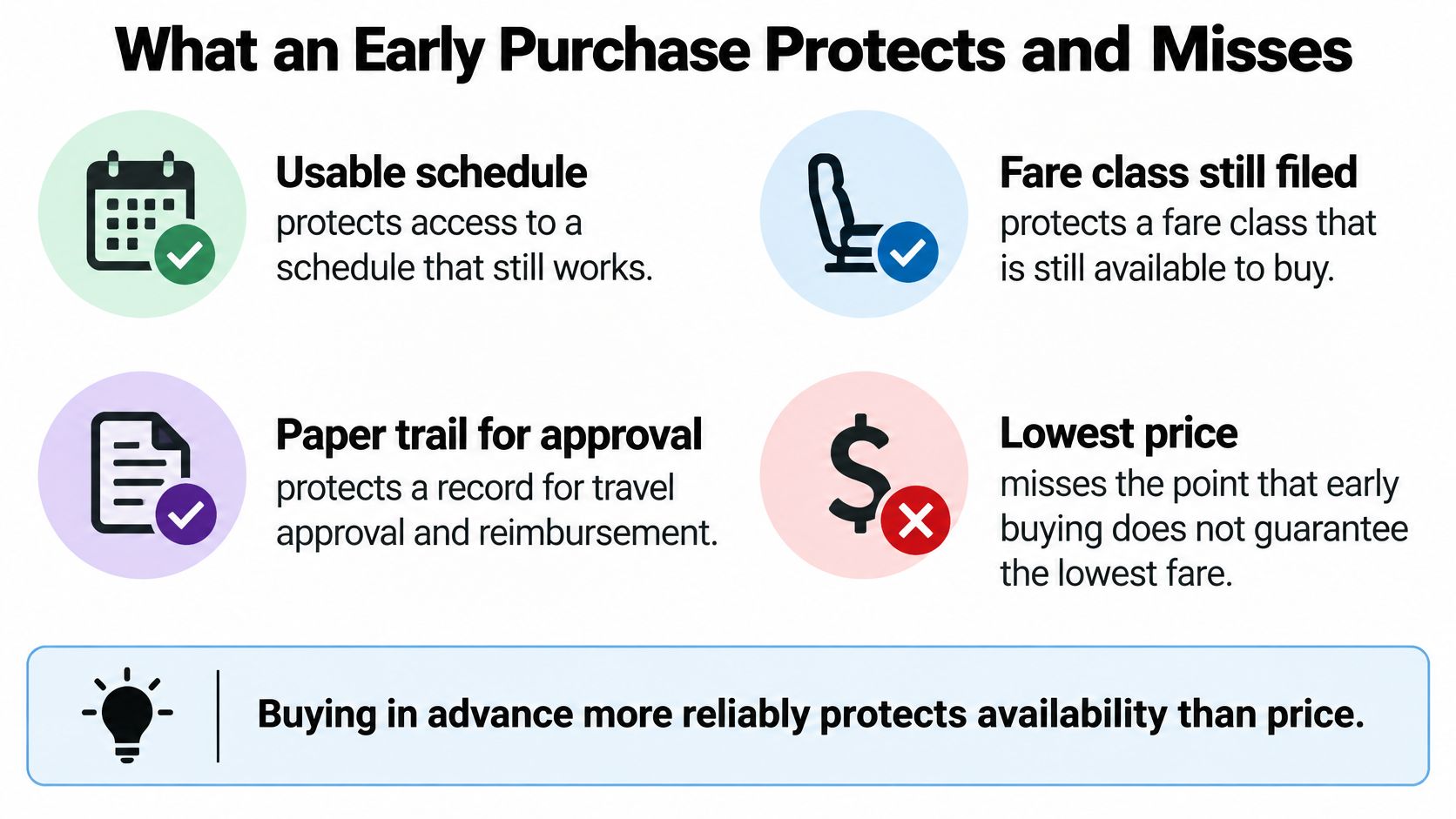
Buying early doesn't guarantee the lowest price. It more reliably preserves a workable schedule, access to currently available inventory, and a documented basis for travel approval.
The U.S. Department of Transportation's ticket-buying guidance says that for qualifying airline purchases made at least seven days before departure, airlines must offer either a 24-hour penalty-free cancellation/refund option or a 24-hour hold at the quoted price. Airlines don't have to provide both, and the requirement doesn't generally apply to tickets booked through third-party agents.
A hold and a ticket do different jobs
A hold preserves a reservation or quote for a stated period under its conditions. Ticketing completes the purchase and makes the ticket's refund and change provisions central to what happens next.
Published fare conditions can require ticketing within two days of reservation or by an advance-purchase cutoff, with the most restrictive condition prevailing. An approval email isn't a substitute for completed issuance.
Keep these distinctions visible when comparing flexible flight tickets. Flexibility should be established in the fare rules, not inferred from an expensive price or a premium cabin label.
The protection checklist separates availability from a lowest-price promise.
Attach the terms to the approval
- All-in quote: Include mandatory taxes, fees, and carrier-imposed surcharges, as required in advertised airfare.
- Fare identification: Save the fare basis, cabin, brand, and included benefits.
- Clock: Record hold expiration and the ticketing deadline separately.
- Changes and cancellation: Preserve the penalty, refund rule, and credit conditions.
- Eligibility: Confirm the minimum stay and any restrictions affecting the planned itinerary.
Keep optional trip costs separate from the airfare comparison. For a European itinerary, reviewing European travel eSIM options from RedSim can help organize connectivity alongside transfers and accommodation without confusing those expenses with the airline's all-in ticket price.
Early purchase can reduce uncertainty and deadline risk. It buys certainty and compliance, not a promise that no cheaper fare will appear later.
How Each Traveler Type Should Time the Buy
Published booking behavior describes different travelers, not a single optimal buying day. The Skyscanner Horizons Spring Outlook reports that globally 53% book more than a month ahead, 31% book 31–90 days ahead, and nearly 20% book within seven days.
The same outlook includes Sabre figures placing 52% at three to six months and 14% at six months or more, alongside an approximately 43-day business-traveler lead time and an 85-day international purchase path. These measures shouldn't be combined as though they describe an identical sample or question.
Different travel purposes require different decisions.

Match the decision to the trip
Fixed-date corporate travel. Put the itinerary into approval while there's still room to act before close-in restrictions remove options. Once the fare meets policy, the schedule works, and the change terms fit the meeting risk, buy.
Flexible leisure travel. Compare neighboring dates and departure airports while building a premium-fare baseline. If the current quote is above that baseline and changing the trip remains easy, watch.
Peak-season and morning departures. Give these flights earlier attention, particularly when the preferred schedule has few substitutes. Don't extend a regional booking-behavior finding into a guaranteed long-haul discount, but when losing the departure would disrupt the whole itinerary, buy.
The accompanying video offers another way to consider premium-fare timing.
Premium-cabin purchases. Compare the actual fare brands across cabins before committing. If the premium quote is unsupported by the route's observed prices and the traveler can change dates or routing, wait.
Don't confuse planning behavior with savings
The outlook also reports that in MENA, 59% book less than 30 days before departure and 24% within seven days. A booking habit drawn from another market shouldn't become a universal corporate policy.
Likewise, ARC's average international purchase timing and the outlook's international purchase path answer different questions. The former measures U.S.-purchased international tickets; the latter describes traveler behavior, so they aren't interchangeable targets.
Longer lead time demonstrates planning. It doesn't, by itself, demonstrate a lower fare.
The practical trade-off remains price, remaining inventory, schedule certainty, cancellation flexibility, and company policy. Give each traveler a decision rule that reflects the trip they're taking.
Buy Hold or Wait on the Current Fare
Buy when the all-in premium fare meets the route's observed baseline, the itinerary fits, and the fare basis supports the traveler's likely changes. An approaching advance-purchase deadline strengthens the case for action, but it doesn't excuse buying an unusable ticket.
Check the same-flight economy alternative before authorizing payment. If business costs less and its restrictions work, the cabin label shouldn't prevent a sensible purchase.
Hold an acceptable offer while resolving uncertainty
Hold when the price is acceptable but a remaining approval or schedule question prevents immediate ticketing. Use an airline's available hold under its stated terms, and record the expiration rather than treating the reservation as a completed purchase.
Our Fare Monitor allows a member to hold an itinerary and preserve current pricing while deferring purchase in anticipation of lower pricing. Members may not use Fare Monitor while simultaneously holding pending or confirmed space on the same or similar flights.
Wait when the traveler retains genuine flexibility and the quote sits well above the route's observed baseline. Waiting should have a reason and an exit condition, such as an approval deadline, disappearing schedule options, or an acceptable fare becoming available.
Make the next check reproducible
Before the next review, save the fields that determine whether the offer is still usable:
- Price and product: All-in total, cabin, fare brand, and included benefits.
- Rules: Fare basis, refund conditions, change terms, and minimum stay.
- Deadlines: Hold expiration, ticketing cutoff, and the person authorized to approve.
We help members assess whether premium fares are supported by legitimate demand or speculation, capture short-term downward moves when they happen, and issue alerts when fare sales occur. Recheck the saved fields whenever the quote changes, then make a fresh decision rather than relying on yesterday's approval.
Passport Premiere combines international premium-fare monitoring with market analysis to help travelers decide whether to purchase in advance or preserve room to wait. Visit Passport Premiere to review membership options and put your next business- or first-class itinerary under a more disciplined buy, hold, or wait process.
