
Florida's airport network handled passenger volumes on a remarkable scale: Orlando International Airport recorded approximately 28 million departing passengers in 2024, while Miami International recorded 26,588,002, according to the FAA's 2024 enplanement statistics. Those figures count departing passengers, not total airport traffic, but they show why Florida's major airports offer very different choices for reaching the same destination. MIA stands out for international connectivity, MCO for Central Florida access, and airports such as Tampa, Fort Lauderdale, and Fort Myers can offer more convenient alternatives depending on where your trip starts.
This list of Florida airports looks beyond names and locations. It considers which airports make sense for international routes, premium-cabin searches, regional access, and comparisons with nearby hubs. Passenger volume can help indicate a market's scale, but it doesn't tell you whether a particular airline serves your destination nonstop, whether a premium cabin is available, or whether the fare is competitive. For premium-cabin shoppers, compare business and economy prices on the same itinerary. Business class can sometimes be cheaper than coach when fare inventory and demand shift, making active fare monitoring more useful than assuming a fixed price gap.
1. Orlando International Airport (MCO)
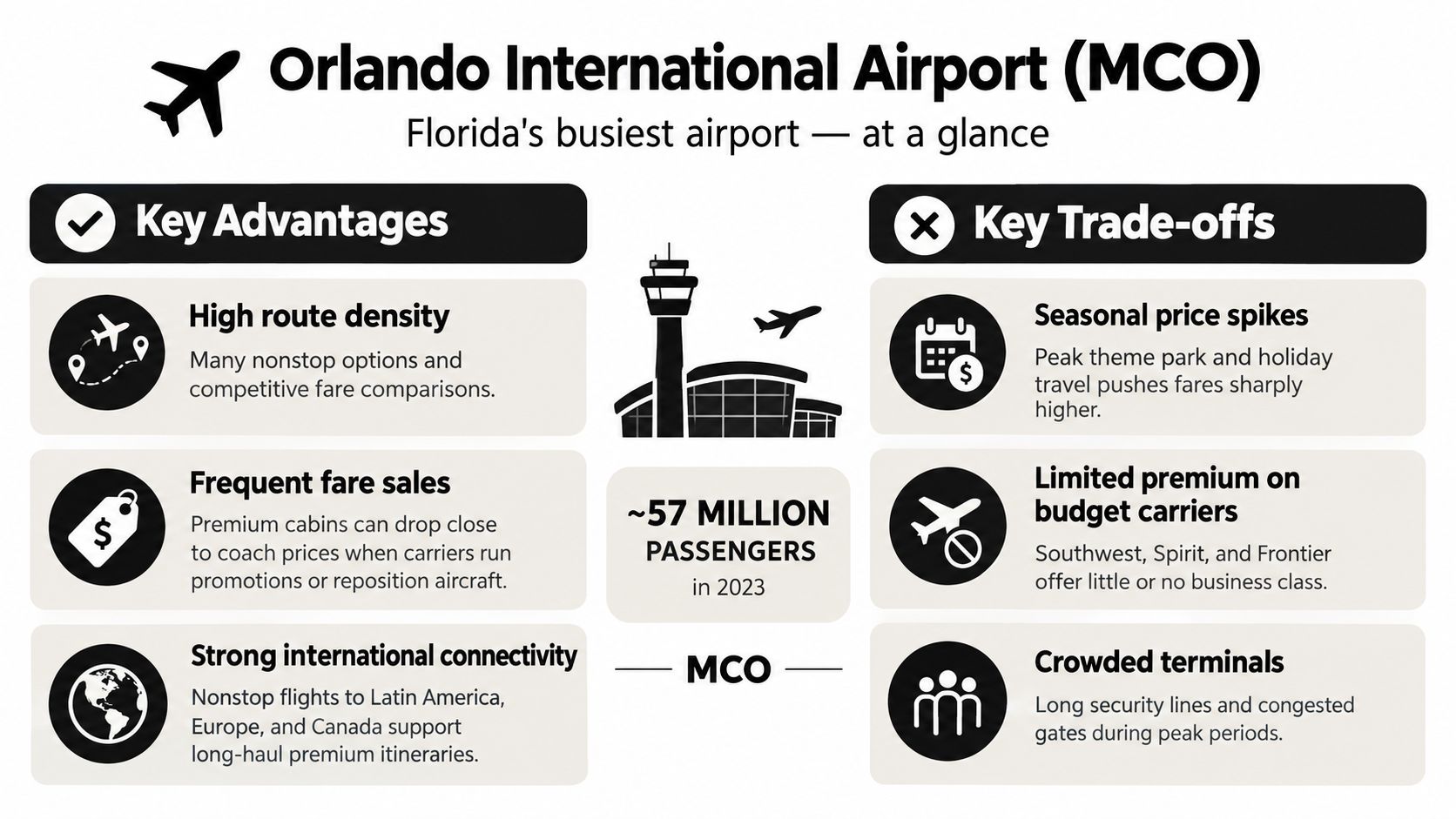
Orlando is a natural starting point for Central Florida trips, especially when your destination is the region's tourism market. The airport's scale is substantial: the FAA recorded approximately 28 million enplanements in 2024, placing MCO among Florida's largest passenger airports. Enplanements count departing passengers, so they aren't a measure of total arrivals and departures.
For a traveler, MCO's size can mean more flight choices, but a large airport doesn't guarantee the lowest fare or a nonstop route to every destination. Families planning a theme-park trip may value reaching Orlando directly, while a Central Florida business traveler might care more about whether a convenient connection and premium seat are available on the days they need to fly.
Fare rule: Search Business and Economy for the same dates. If economy's lower-priced inventory has sold through while a discounted premium seat remains, business class can occasionally cost less than coach. That's a temporary fare inversion, not a dependable pricing pattern.
Set alerts for both cabins and compare MCO with Sanford and Tampa when the ground journey makes those alternatives practical. Shoulder-season dates may also be worth checking, but compare the full itinerary, not just the ticket. For broader route planning, see flights from Florida. A useful comparison is whether the fare difference buys a meaningfully better schedule, cabin, or connection, rather than a different airport code.
2. Miami International Airport (MIA)
Miami International is the clearest choice on this list for travelers who need a major international gateway. Its 2025 report lists 55,314,661 total passengers, including 24,850,064 international passengers, as well as 2,894,496 tons of total cargo. That international passenger volume and cargo activity make MIA relevant not only to vacationers, but also to companies whose travel and trade needs extend across borders. The airport's 2025 traffic report provides useful context for comparing airports beyond passenger totals alone.
For consultants handling multi-stop trips in Latin America or the Caribbean, MIA may be a practical place to begin searching because an international gateway can offer more routing possibilities than a regional airport. Still, check the specific destination and travel date. Airport scale doesn't tell you which carrier operates your flight, whether a premium cabin is sold on that route, or whether a connection is worth its extra time.
Compare Business and Economy on identical dates, then check both one-way and round-trip options. A discounted premium fare can narrow the usual cabin gap, while separate tickets may introduce connection risks that outweigh a lower price. Build enough time into international connections to handle terminal changes and other airport processes.
Travelers combining a flight with a sailing can also compare airport access against their cruise itinerary. For planning a trip that begins in South Florida, see Royal Caribbean cruises from Miami. The right choice depends on the complete journey, not on the airport's reputation alone.

3. Fort Lauderdale-Hollywood International Airport (FLL)
FLL handled 32.2 million passengers in 2025 and ranked 14th among U.S. airports for international passenger traffic, according to the airport's year-end traffic summary. Those figures make it a substantial alternative to Miami, but passenger volume alone does not show whether FLL serves a particular destination nonstop or offers a suitable connection.
For travelers in Broward County, FLL may reduce ground-transfer time compared with MIA. The better departure point depends on the route, however. Compare nonstop availability, connection points, schedules, and the full fare from both airports. A Caribbean-bound traveler may find a more convenient itinerary at one, while a business-class fare that costs less than coach may appear at the other. Check the cabin and fare rules before deciding.
Leisure demand and seasonality can affect fares, so compare economy and premium cabins for the same dates rather than assuming one airport is consistently cheaper. If a cruise is part of the trip, include the airport-to-port transfer and enough time for delays. For premium travel, assess the whole itinerary, especially the cabin on the longest flight segment, instead of choosing by the first fare shown.

4. Tampa International Airport (TPA)
Tampa International serves travelers on Florida's Gulf Coast and is a significant commercial airport in its own right. The FAA recorded 12,075,591 enplanements in 2024, a useful measure of departing passenger activity, not total traffic. TPA can make sense for a traveler whose home or destination is in the Tampa Bay area, even when another airport appears to offer a tempting fare.
Compare TPA with Orlando for a shared destination, but include the drive, parking, and schedule in the decision. A lower ticket price from MCO might not compensate for a longer trip to the airport or a less suitable departure time. Likewise, a traveler connecting to an international flight should check whether TPA offers a practical itinerary or whether another gateway provides a more convenient route.
A premium fare only counts as a deal if the itinerary works. Check the cabin, connection, baggage terms, and airport transfer before comparing the headline price.
Search the actual carrier and cabin combination rather than assuming every airline offers the same premium product. When business class appears close to coach, compare the fare rules and seat details before deciding. If you're trying to identify a lower-cost Florida arrival point, this guide to Florida airport comparisons can complement a direct fare search.
For corporate travelers, TPA is best assessed by the route in question: a convenient local departure may be more valuable than a theoretical fare advantage at a distant hub. The same comparison applies to leisure trips along the Gulf Coast.
5. Southwest Florida International Airport (RSW)
Located in Fort Myers, Southwest Florida International Airport is an important option for travelers heading to Southwest Florida. Its scale has grown well beyond that of a minor local airfield: RSW handled a record 11,154,458 passengers in 2025, according to the airport information cited in its traffic overview). That record makes it worth checking directly rather than treating Tampa or Miami as the automatic choices for every Gulf Coast trip.
RSW can be especially practical for travelers whose plans center on Fort Myers and nearby communities. The trade-off is that regional convenience and international route depth aren't the same thing. Check whether your destination is reachable on a useful nonstop or connection, and compare the total travel time with an itinerary through Tampa or Orlando.
Premium-cabin shoppers should confirm that the carrier sells a premium product on the route being considered. Some itineraries may offer a more comfortable seat on one segment but not another, while a connection through a larger hub could change both the fare and the cabin options. Search the same dates across nearby airports and include the cost and time of reaching each one.
Seasonal travel can affect availability, so travelers with fixed dates should compare early and revisit fares as plans develop. A lower fare through another airport may not be worthwhile if it adds a long ground transfer or awkward connection. The best RSW itinerary is the one that fits the destination and schedule, not just the one with the lowest initial price.

6. Palm Beach International Airport (PBI)
Palm Beach International is a useful alternative for travelers whose starting point is in Palm Beach County. Its strongest practical case is local access: a traveler may prefer a departure nearby over a longer drive to Fort Lauderdale or Miami. That convenience can matter for business trips, visits with fixed schedules, and premium-cabin journeys where a complicated airport transfer would erase the benefit of a favorable ticket.
PBI should be compared with FLL and MIA for the actual destination and dates. A smaller airport may suit a domestic itinerary but offer fewer workable options for an international journey. Before booking, check the full route, connection time, cabin availability, and whether the same premium fare is available from a larger gateway.
For example, a Palm Beach traveler planning a long-haul trip can search PBI, FLL, and MIA on the same day, then weigh any fare difference against the drive and schedule. If business class is close to economy on one option, verify the terms and seat rather than assuming the cabin label guarantees a particular experience. The comparison should also include what happens if the first flight is delayed, especially when separate tickets are involved.
PBI can be a sensible starting point when local convenience is the priority. It's not automatically the cheapest or most internationally connected choice, so compare airport alternatives before committing. Travelers with flexible dates can also monitor how fares change, since a nearby airport's best option may differ from one trip to the next.
7. Jacksonville International Airport (JAX)
Jacksonville International Airport is a practical starting point for Northeast Florida and travelers near the Georgia border. Its role is different from Miami's: JAX may work well for domestic trips and connections, while long-haul travelers should check whether their destination requires a connection through another airport. A regional airport can still be the most efficient choice when it avoids a lengthy drive to a larger hub.
A business traveler heading overseas might compare a connection from JAX with driving to Orlando or another major gateway. The answer depends on the flight schedule, fare, and ground journey. A connection can be more convenient than a long drive, but it can also add time and make the itinerary more sensitive to delays.
Compare the same destination from JAX, Orlando, and other realistic nearby airports. Check premium fares across the complete itinerary, since the lowest-priced premium seat may appear on a connecting route rather than a nonstop. If economy prices rise while discounted business inventory remains, the cabin difference may shrink or occasionally reverse, but verify baggage rules, change terms, and connections before booking.
Travelers building a trip around Northeast Florida can also consider local activities when setting their airport and schedule. For a coastal outing, see kayak rentals near Big Talbot Island. The practical question is whether JAX gives you a workable route while keeping the journey to and from the airport manageable.
8. St. Pete-Clearwater International Airport (PIE)
PIE is a Tampa Bay-area option that can be useful for travelers whose plans are closer to Clearwater or St. Petersburg. It shouldn't be treated as a direct substitute for Tampa International on every trip. The airports serve overlapping geography, but the route and cabin options available for a specific destination may differ.
Leisure travelers can compare PIE and TPA for the same dates and destination, then factor in the drive and any connection. For a premium-cabin trip, first check whether the itinerary from PIE offers the cabin you want. If it doesn't, compare the total cost of reaching TPA against booking a different cabin or connecting through another airport.
A traveler planning an overnight flight should also weigh departure time and arrival timing alongside the fare. This guide to what a red-eye flight means can help when comparing overnight schedules. A low-cost fare on an inconvenient schedule may not be the best deal if it disrupts a workday or adds an overnight stay.
Route availability can change, so don't rely on a previous search as proof that the same flight will operate on your dates. Search both airports close to booking and compare the full itinerary. PIE is most valuable when its schedule and location fit the trip, not because it's the smaller airport.
9. Orlando Sanford International Airport (SFB)
Sanford serves as an alternative for Orlando-area travelers, but its route coverage differs from MCO's. The airports are not interchangeable, particularly for international itineraries. Sanford recorded 11,595 international passengers in 2025, according to Orlando Sanford International Airport. That figure points to a more limited international passenger profile than travelers would expect from a major gateway, so check for an operating route before building an itinerary around SFB.
For domestic leisure travel, compare SFB and MCO on the same dates and destination. A lower Sanford fare may lose its advantage once you include ground-transfer time and cost. Your destination within Central Florida matters too: choose the airport that makes the onward trip more practical.
Check carrier and cabin availability alongside the fare. Sanford's schedule may offer fewer connections or premium-cabin choices for a particular trip, while MCO may provide a routing that better fits your plans. Search both airports for Business and Economy fares. If business class costs less than coach on the itinerary, confirm the price applies to the full journey and review the fare conditions before booking.
SFB makes sense when its flight times, available route, and location suit the trip. For international travel, verify the specific service rather than relying on the airport's name. Compare the complete fare and ground journey, not just the ticket price.
10. Tallahassee International Airport (TLH)
Tallahassee International Airport serves travelers whose plans begin in Florida's capital and surrounding North Florida. For government, education, and business travel, departing locally may be more practical than driving to a larger airport. But travelers should check the full itinerary carefully, particularly when a trip requires an international connection or a specific arrival time.
A traveler heading overseas can compare a connection from TLH with departures from Jacksonville or Tampa. A larger airport may offer a different choice of routes and premium cabins, while the local departure can save substantial ground travel. The ticket price alone won't settle the decision: include connection time, transfer costs, and the risk of separate tickets in your comparison.
Premium fares on a smaller market's routes can vary with availability. Search Business and Economy together, and compare the complete connected itinerary rather than only the first segment. If business class is cheaper than coach on a particular booking, check that it applies to the entire journey and that the fare conditions suit the traveler.
Florida has 128 public-use airports, according to the Florida Department of Transportation's airport data viewer. That inventory includes facilities with different roles, so a public-use airport isn't automatically a scheduled passenger alternative. For a TLH-based traveler, the useful comparison is among airports and routes that serve the destination.
Florida Airports: Top 10 Comparison Table
| Florida Airport | Premium-Cabin Opportunity | International Connectivity | Fare Dynamics & Value | Best For |
|---|---|---|---|---|
| Orlando International (MCO) | ★★★★☆ Strong route competition; premium sales may bring fares near coach | Europe, Latin America, Canada | 💰 High comparison potential; avoid holiday and theme-park peaks | 👥 Leisure and business travelers across Central Florida |
| Miami International (MIA) | ★★★★★ Deep premium inventory and multiple carriers on many routes | ✨ Major gateway to Latin America and the Caribbean; extensive Europe service | 💰 Many fares to compare, but high volatility and peak-season sellouts | 👥 Long-haul, multi-city, and corporate travelers |
| Fort Lauderdale-Hollywood (FLL) | ★★★☆☆ Select international premium options; fewer long-haul choices | Caribbean, Latin America, select Europe | 💰 Competitive Caribbean fares; watch winter demand | 👥 Broward and Palm Beach travelers, cruise passengers |
| Tampa International (TPA) | ★★★☆☆ Domestic premium deals; limited long-haul inventory | Select international routes; fewer options than MCO or MIA | 💰 Compare with MCO and RSW for better-value fares | 👥 Gulf Coast business and leisure travelers |
| Southwest Florida International (RSW) | ★★☆☆☆ Limited traditional premium-cabin availability | Mostly domestic; seasonal Canada service | 💰 Compare with TPA or MCO; seasonal fares can swing | 👥 Southwest Florida residents |
| Palm Beach International (PBI) | ★★★☆☆ Select domestic premium options; inventory tight in winter | Limited international service | 💰 Spring and fall may offer better availability and value | 👥 Luxury leisure and business travelers seeking a smaller airport |
| Jacksonville International (JAX) | ★★★☆☆ Some competitive domestic premium fares; connections often needed | Limited nonstop international service | 💰 Compare connecting routes and nearby airports | 👥 Northeast Florida and Southeast Georgia travelers |
| St. Pete-Clearwater International (PIE) | ★★☆☆☆ Premium cabins are limited | Few international or long-haul connections | 💰 Check premium availability before comparing low-cost fares | 👥 Tampa Bay leisure travelers |
| Orlando Sanford International (SFB) | ★★☆☆☆ Limited premium options; pair searches with MCO | Primarily leisure-focused domestic service | 💰 Lower base fares may not include premium-cabin choices | 👥 Price-sensitive travelers with flexible schedules |
| Tallahassee International (TLH) | ★★☆☆☆ Scarce premium inventory; hub connections may help | Limited nonstop and international options | 💰 Compare connecting itineraries with JAX and TPA | 👥 Government, education, healthcare, and business travelers |
Choose the Airport That Fits the Route and the Deal
A useful airport decision starts with the route, not a statewide ranking. For international travel, MIA stands out for its passenger and cargo scale, while MCO offers one of Florida's largest departure markets. TPA can be a practical Gulf Coast hub, and FLL, PBI, JAX, and RSW may save time when they're closer to home or the destination. Those roles aren't guarantees of a particular nonstop flight or cabin, so check the route and schedule for your dates.
Compare nearby airports before booking, especially when a longer drive could open up a better fare or a more convenient connection. Include ground transfers, departure times, and the complete itinerary. A low ticket price can become less attractive when it requires extra travel or creates a tight connection, while a local airport can be worth choosing even if the fare isn't the absolute lowest.
For premium travel, search business and economy on the same route and dates. Business class can occasionally be cheaper than coach when airlines have different fare inventory available across cabins, but that's an exception rather than a rule. One documented fare comparison found economy at $575 and business class at $471, and another showed economy at $480 against business class at $373 (fare comparison examples). Those examples illustrate why checking the actual itinerary is more useful than applying a standard cabin-price multiplier.
A wider comparison found business class averaged 250.19% more than economy across its sampled airlines and routes, but on Iberia's Madrid–Athens route the cited economy fare was £454 and business was £562 (international fare comparison). Sale fares can narrow the gap further: one example described Los Angeles to Paris business class dropping from $3,000 to about $2,000, while another cited transatlantic sale fares of £1,200–£1,800 round trip (business-class sale examples). Treat these as examples, not predictions for a Florida itinerary.
Passport Premiere monitors premium-cabin fare cycles and analyzes pricing so travelers can assess whether a fare is competitive before buying. Whether you're arranging corporate travel or planning weekend escapes for rental owners, compare the airport, route, and cabin together, then act when the itinerary and price make sense.
Passport Premiere helps travelers monitor international Business and First Class fares, evaluate premium-seat pricing, and spot fare changes across routes. If you're comparing Florida airports for your next trip, visit Passport Premiere to explore its fare-monitoring and market-analysis membership.
