Cheap Business Class to Japan: A Playbook That Works

You're staring at a $7,000 Tokyo business-class fare, wondering whether comfort is worth accepting a fourteen-hour economy flight instead. That price is real, but it isn't the market. Cheap business class to Japan appears when route capacity, demand, fare inventory, and airline competition line up. The traveler who waits for that alignment can sometimes find a premium seat priced close to, or even below, what coach costs on the same journey.

The mistake is treating airfare as a fixed product with a fixed price. It's an event-driven market. Your advantage comes from identifying the fare cycle, monitoring several origin and destination combinations, and acting when the right inventory opens.

Why Cheap Business Class to Japan Is Real

A Tokyo business-class seat can show $5,000 or more on Monday and fall below $2,000 when the airline needs to stimulate demand. That swing is not an error. It reflects changing booking classes, route competition, departure dates, and the amount of premium inventory still available. Cheap business class to Japan exists, but only during specific points in the fare cycle.

Airlines price these routes around strong corporate demand and uneven capacity. ANA, JAL, United, Delta, and their alliance partners adjust fares in response to one another, often creating brief discounts on city pairs that otherwise command premium prices. A published fare shows what the airline wants at that moment, not the lowest price it will accept later.

Route capacity adds pressure to the market. Fewer available seats can support high fares, while extra flights or weaker demand can force carriers to open cheaper booking classes. Wide-body aircraft also devote a substantial share of their cabins to business class, giving airlines a large block of high-value inventory to manage. Route capacity and Japan fare analysis illustrates how capacity and cabin mix influence the fare cycle, but treat its route figures as directional rather than definitive.

The headline fare isn't the target

Fare distributions show why a single search produces the wrong conclusion. Observed round-trip business-class fares to Japan have reached $758, while another market summary reports a low of $1,137 and an average of $5,473. The cheapest fare seen in the prior two weeks was $1,820, compared with an average near $4,335. Those figures describe volatility, not a price guarantee.

Practical rule: Treat a high fare as a timing signal, not a verdict. If your dates can move, keep watching.

Track fare cycles instead of relying on one flexible-date calendar. Compare East Coast and West Coast origins, test cash and award options, and check HND, NRT, KIX, and FUK rather than treating Japan as one market. Set a ceiling before searching, then book when the fare reaches it.

Random searches rarely beat a monitoring process. Search engines show the inventory available now, not whether the fare is unusually high or a cheaper booking class may return. Monitor several origin, destination, and travel-date combinations. The same cabin can move from a sub-$2,000 opportunity to a $5,000-plus fare while you wait. The timing window, not the headline price, determines whether the deal is real.

Reading the Price Spread the Right Way

The spread between the observed low of $758 round trip and the reported $5,473 average isn't a promise that every traveler can buy the lowest fare. It's evidence that Japan business-class pricing is volatile. Buyers should read that distribution as a map of possible market conditions, not as a normal price range available on demand.

A fare moves because airlines open and close booking classes, competitors react, and demand changes by travel date and departure airport. A nonstop from an East Coast gateway may carry a large premium over a one-stop itinerary from the West Coast. A Tuesday departure can behave differently from a Saturday departure even when the aircraft and cabin are identical.

The left tail is where the opportunity lives

Travelers usually miss the lowest fares for predictable reasons:

  • They search once: A one-time result captures one inventory state, not the route's full cycle.
  • They search too early: Peak-season fares can remain expensive months before departure, especially when demand is obvious.
  • They ignore gateways: A nearby positioning flight can expose a cheaper fare market.
  • They insist on nonstop service: One-stop itineraries often create more pricing competition.
  • They focus only on HND: NRT, KIX, and FUK can carry different inventory and demand patterns.

The verified fare data supports a sharp conclusion. One neutral fare index places average U.S.-Japan business-class pricing around $3,716 to $4,271, depending on market and sample, while another route comparison showed Tokyo fares starting around $2,914 against a typical fare near $8,102. A route-level comparison of Japan business fares makes a sub-$3,000 itinerary look like what it is, an outlier that generally requires flexible dates, a lower-yield origin, or unusually favorable inventory.

Route Observed Low (RT) Average (RT) Peak (RT)
U.S. to Japan route family $758 $5,473 $8,102 typical Tokyo fare

The precise timing of every drop can't be guaranteed, and you shouldn't build a plan around an invented “magic day.” The practical approach is to watch for repeated movement across your chosen route family. When a fare falls sharply below its recent level, verify the cabin, fare rules, connection quality, and ticketing deadline immediately.

Timing Your Booking Window

A Tokyo business-class seat can move from about $1,650 to above $4,800 without changing aircraft or cabin. The difference is often the booking window, demand period, and fare inventory available when you search. For shoulder-season trips, start monitoring roughly 10 to 16 weeks before departure, then act when the fare breaks below its recent range. A Japan business-class booking guide also identifies Tuesday and Wednesday departures as generally cheaper than Friday and Saturday, with West Coast gateways often pricing below East Coast nonstops.

Use a shorter window for quieter dates and a longer one for predictable demand. Late January and mid-November departures can justify searches about six to ten weeks out. Spring travel deserves attention around four to six months ahead because cherry blossom demand and Golden Week can remove attractive inventory early.

Monitor early Monitor later
Cherry blossom travel: Peak spring dates. Search around four to six months ahead because demand concentrates quickly. Late February and early March: Begin watching around 10 to 16 weeks out, then compare each fare against its recent movement.
Golden Week: April 29 through May 5. Treat this as a pressured period and search well before ordinary shoulder-season timing. June: Often a quieter period for Japan travel. Watch for drops rather than assuming a particular booking day will produce one.
Obon: Mid-August, plus New Year from December 28 through January 4. Expect tighter inventory and monitor earlier than usual. October: Start tracking early, but wait for a meaningful fare break instead of buying solely because the month is traditionally cheaper.

A San Francisco to Tokyo Haneda itinerary for early March shows why volatility matters. A fare found about 56 days before departure could land near $1,650, while the same flight booked 120 days out for peak cherry blossom week could exceed $4,800. Treat that comparison as a timing pattern, not a promised quote. Date, fare class, and availability still have to align.

For a clearer explanation of booking-window mechanics, read this guide to when to book business-class flights.

Rebooking move: If changes are permitted, secure a workable fare, keep monitoring, and reissue when the same inventory drops by more than $400. Confirm the fare difference, ticketing deadline, and change conditions first.

Award Miles vs Cash Fares

Cash and points solve different problems. Cash fares usually offer better flexibility, simpler ticketing, and more useful one-way options. Awards become more valuable when peak-season cash pricing rises past $4,000, because the mileage requirement may remain comparatively stable even while the retail fare becomes unreasonable.

The award strategy must be route-specific. ANA Mileage Club round trips from the United States can price at 88,000 to 95,000 miles in business class, United MileagePlus can reach 70,000 to 80,000 miles with careful routing, and Aeroplan can fall within 55,000 to 75,000 points through partner carriers. These figures come from the supplied booking framework, so verify the live award calendar, taxes, carrier charges, and routing rules before transferring anything.

Strategy Typical Cost Best For Watch Out For
Cash fare Varies by inventory and route Flexible dates, last-minute availability, one-way travel Retail prices can surge during peak demand
ANA award 88,000 to 95,000 miles round trip Travelers targeting ANA availability Award space can be limited
United MileagePlus 70,000 to 80,000 miles Careful partner and hub routing Dynamic pricing and routing differences
Aeroplan partner award 55,000 to 75,000 points Partner availability and planned trips Taxes, fees, and transfer timing
Hybrid itinerary Cash positioning plus an award Travelers near a saver gateway Separate-ticket connection risk

JAL Mileage Bank and Asia Miles can be difficult during peak periods because premium-cabin award space is scarce. JAL's North America to Japan business awards were also revised upward in 2025, so old redemption advice can be dangerously stale.

When hybrid wins

A hybrid itinerary uses a cheap cash flight to a gateway such as Vancouver or Honolulu, followed by an award segment to Japan. It can reveal saver space that isn't available from your home airport, but separate tickets require generous protection against missed connections, baggage complications, and schedule changes.

A useful comparison is a Tokyo summer itinerary booked 11 months ahead for 75,000 Aeroplan miles, versus the same date at $5,200 cash. The award isn't automatically superior. Taxes, fees, transfer risk, and the value of your points still matter. But during peak demand, the stability of a confirmed award can beat waiting indefinitely for a cash sale.

Before moving points, review this MileagePlus upgrade and award guide and confirm that the specific itinerary fits your account and travel needs.

Routing Tricks That Lower the Fare

A Tokyo business-class seat can swing from $1,950 to $5,200 on the same broad route. The airport pair and connection plan often matter more than the airline you prefer. West Coast gateways such as LAX, SFO, SEA, and YVR usually price better than eastern origins because they sit closer to Japan and face heavier transpacific competition. A positioning flight to Los Angeles can beat a JFK to Haneda itinerary, provided you leave enough time between separate tickets.

Vancouver can expose Air Canada and ANA inventory, while Toronto may offer seasonal ANA nonstop options. Some travelers also test Mexico City or MEX to IAH to Japan through United. Each additional segment raises the risk of misconnection, schedule disruption, and baggage problems, so compare the saving against the operational burden.

Build the comparison around gateways

Start with a small route matrix, then narrow it to fares that survive a real trip:

  • West Coast origin: Search LAX, SFO, SEA, and YVR to HND, NRT, KIX, and FUK.
  • Home airport versus positioning: Compare your full itinerary through a U.S. hub with a separate ticket to the gateway.
  • Asian connection: Test Taipei, Seoul, and other regional hubs before Japan.
  • European connection: Check Istanbul or Helsinki only when the fare reduction justifies the extra travel time.
  • Open-jaw itinerary: Arrive in Tokyo and leave from Osaka, or reverse the pattern. An open-jaw flight planning resource can help organize those combinations.

Connections through Istanbul, Helsinki, or Taipei can sometimes cut $800 or more from the fare. Taipei to Narita on JX and Seoul to Narita on OZ may also expose lower-priced premium inventory. Osaka can price 15% to 25% below Tokyo on comparable searches, which suits itineraries that already include Kyoto or western Japan. Treat these as search signals, not guarantees. Inventory changes quickly.

One comparison shows the tradeoff clearly. A SEA to IAH to HND itinerary could appear near $1,950 round trip, while a comparable JFK to HND nonstop could sit around $3,400. The cheaper ticket costs more time and adds connection exposure. That can still be the right decision when the savings cover a positioning flight, a buffer night, or the inconvenience of a longer journey.

Route discipline: Compare total travel time, airport changes, connection protection, baggage rules, and the aircraft assigned to every premium segment, not just the displayed fare.

Search each arrival and departure combination separately. The cheapest Tokyo fare may become more useful when you return from Osaka, and a slightly longer route can beat a nonstop once the fare difference is large enough.

Monitoring Fare Volatility
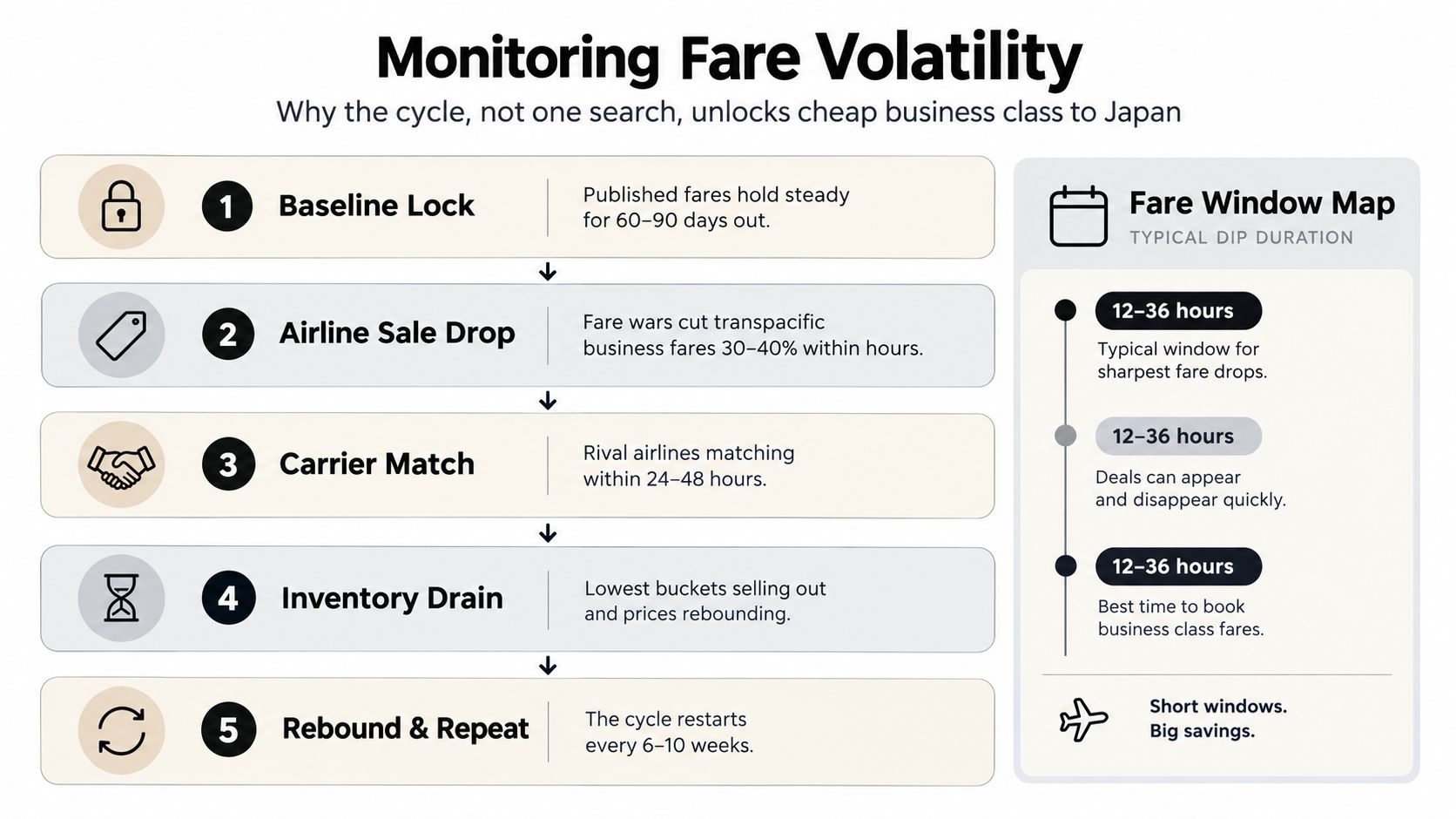
An infographic titled Monitoring Fare Volatility explaining the five-step cycle for finding cheap business class flights to Japan.

A Tokyo business-class seat can sit near $1,950, then climb above $5,000 after the lower booking classes disappear. A single search captures only today's price. Tracking the movement shows whether you are seeing a real opportunity or a temporary gap.

Airlines commonly adjust transpacific fares in response to competitors and booking activity. One carrier loads a lower fare, another matches it, and the cheapest inventory can vanish as seats sell. Our monitoring framework models this movement as a cycle that may develop over 6 to 12 weeks, with worthwhile drops appearing briefly. The cycle includes baseline pricing, a sale, a competitor match, inventory depletion, and a rebound that may return every 6 to 10 weeks, as shown in the fare-volatility infographic.

The practical rule is simple: record the fare before judging it. A price that looks low in isolation may be ordinary for that route, while a brief drop against its recent baseline deserves immediate review.

Build a watch system, not a larger spreadsheet

A weekly matrix can cover home airports, positioning gateways, four Japanese airports, multiple travel dates, and nonstop or connecting routes. It teaches you the market, but manual searching still misses changes that appear overnight or disappear before the next check.

Set up monitoring around the decisions that affect the ticket:

  1. Group routes: Include home airports, positioning gateways, and Japanese alternatives.
  2. Use flexible dates: Track a range rather than one departure and return pair.
  3. Specify the cabin: Confirm that alerts target business inventory, not premium economy.
  4. Set a ceiling: Compare new fares with your recorded baseline before calling them bargains.
  5. Verify quickly: Check the airline site, fare basis, operating carrier, aircraft, connection, baggage, and ticket rules.

Passport Premiere fare monitoring and deal signals can identify Japan-related premium-cabin drops by routing class and booking bucket. Use it to spot movement, then validate the actual ticket before transferring points or booking.

When an alert arrives, inspect the itinerary immediately. Confirm the cabin and fare basis, save the result, and act while the lowest class remains available. The objective is not endless searching. It is recognizing a meaningful Tokyo fare drop before the market resets.

Your Cheap Business Class Playbook in Action

Turn the strategy into a routine you can run every week. Start with a 14-day rolling date search across three origin gateways, then compare the same dates through awards and positioning airports. Don't wait for a perfect result from one city pair. The cheapest business class to Japan ticket often appears only after you widen the map.

The Monday routine

  1. Define flexibility: Choose your acceptable travel period, cabin, maximum connection time, and Japanese arrival airports.
  2. Set the baseline: Record current cash fares for your three origin groups and your preferred destination airports.
  3. Layer awards: Search partner programs on the same routes before transferring points.
  4. Set the ceiling: Create a fare alert tied to your actual budget and route tolerance.
  5. Watch movement: Treat a 20% drop versus the trailing average as a trigger to investigate, not as an automatic purchase.
  6. Validate directly: Recheck the airline calendar, operating carrier, aircraft, baggage, and cancellation terms.
  7. Act quickly: Book the cash fare or transfer points within 24 hours when the itinerary passes your checks.
  8. Walk away deliberately: If the cabin is wrong, the connection is unsafe, or the terms undermine the savings, keep monitoring.
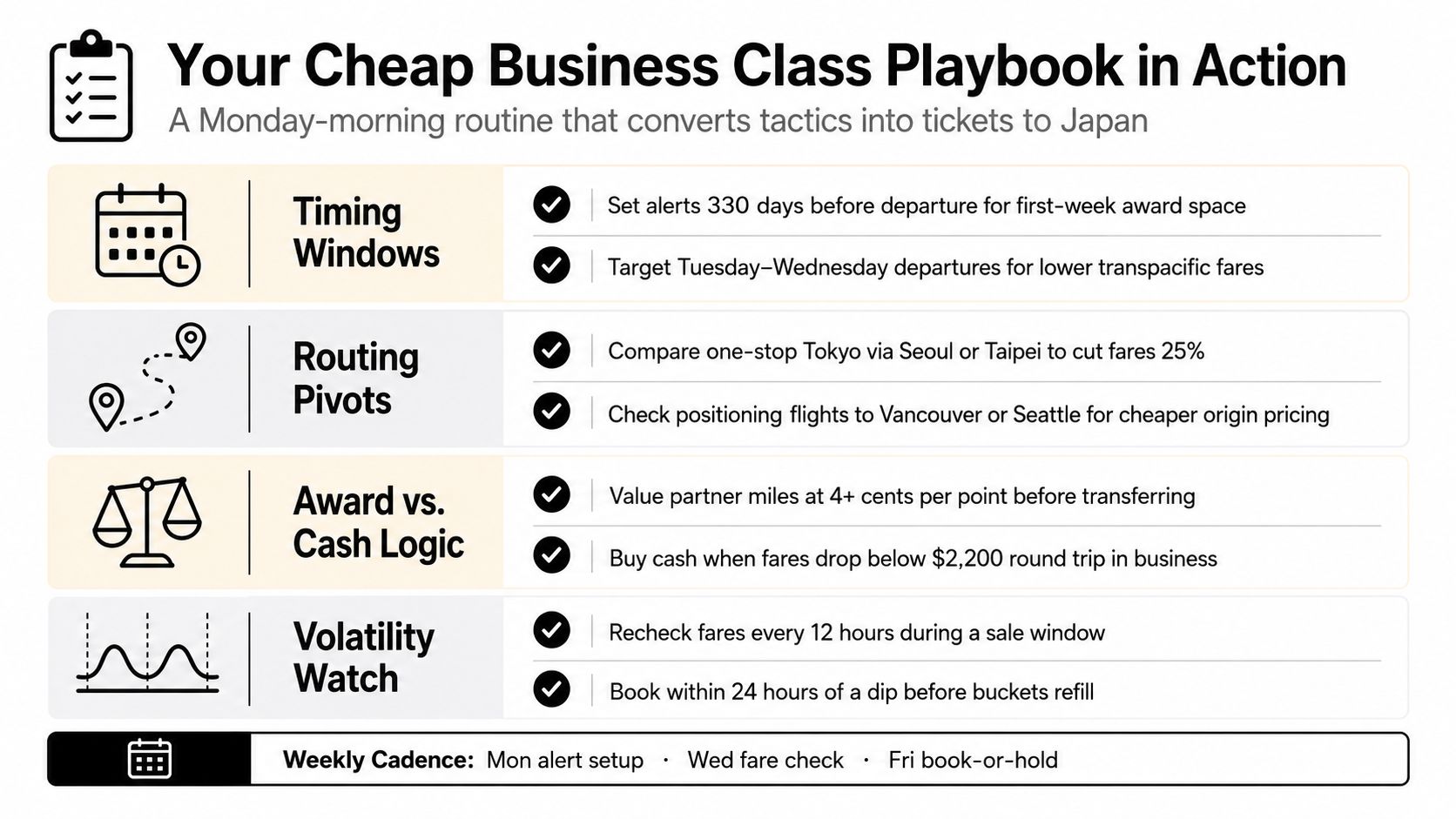
A structured playbook infographic outlining strategies for booking affordable business class airfare to Japan.

Build comfort into the operating plan

Long-haul comfort doesn't end at the seat. If you're repositioning, connecting, or working across time zones, small practical choices can protect the value of the itinerary. Travelers who want to reduce neck strain during airport waits and flights can browse travel neck pillows at SunnyBay as part of their preparation.

Keep the cadence consistent. Monday is for alert setup, Wednesday is for checking fare movement, and Friday is for deciding whether to book or hold. Your records should show the route, date, cabin, price, and reason for rejecting an offer. That history makes the next alert easier to judge.

Cheap business class to Japan isn't a lucky search. It's a repeatable purchasing system built around route flexibility, award awareness, and fast responses to temporary inventory. The traveler who watches the cycle has a better chance of buying the seat when the airline is discounting it, rather than when the airline is testing the highest price the market will tolerate.


Passport Premiere tracks premium-cabin fare cycles, price drops, and Japan-related business-class opportunities so you can judge whether a fare is attractive before booking. Visit Passport Premiere to explore its fare monitoring and market-intelligence membership, then set your Japan routes and price ceiling before the next drop appears.
Business Class Seat Availability and How to Track It

The most popular advice about business class seat availability is wrong: an empty-looking premium cabin doesn't mean a cheap seat is available. A seat map is not a fare quote, an award calendar, or proof that the airline will sell you the lowest business-class price.

The useful question is narrower and more practical: which seat is sellable on this aircraft, on this flight, at this fare, in this booking class, right now? That shift changes how you search, when you act, and why business class can occasionally cost less than coach.

Why Empty Premium Cabins Are Not the Same as Available Seats

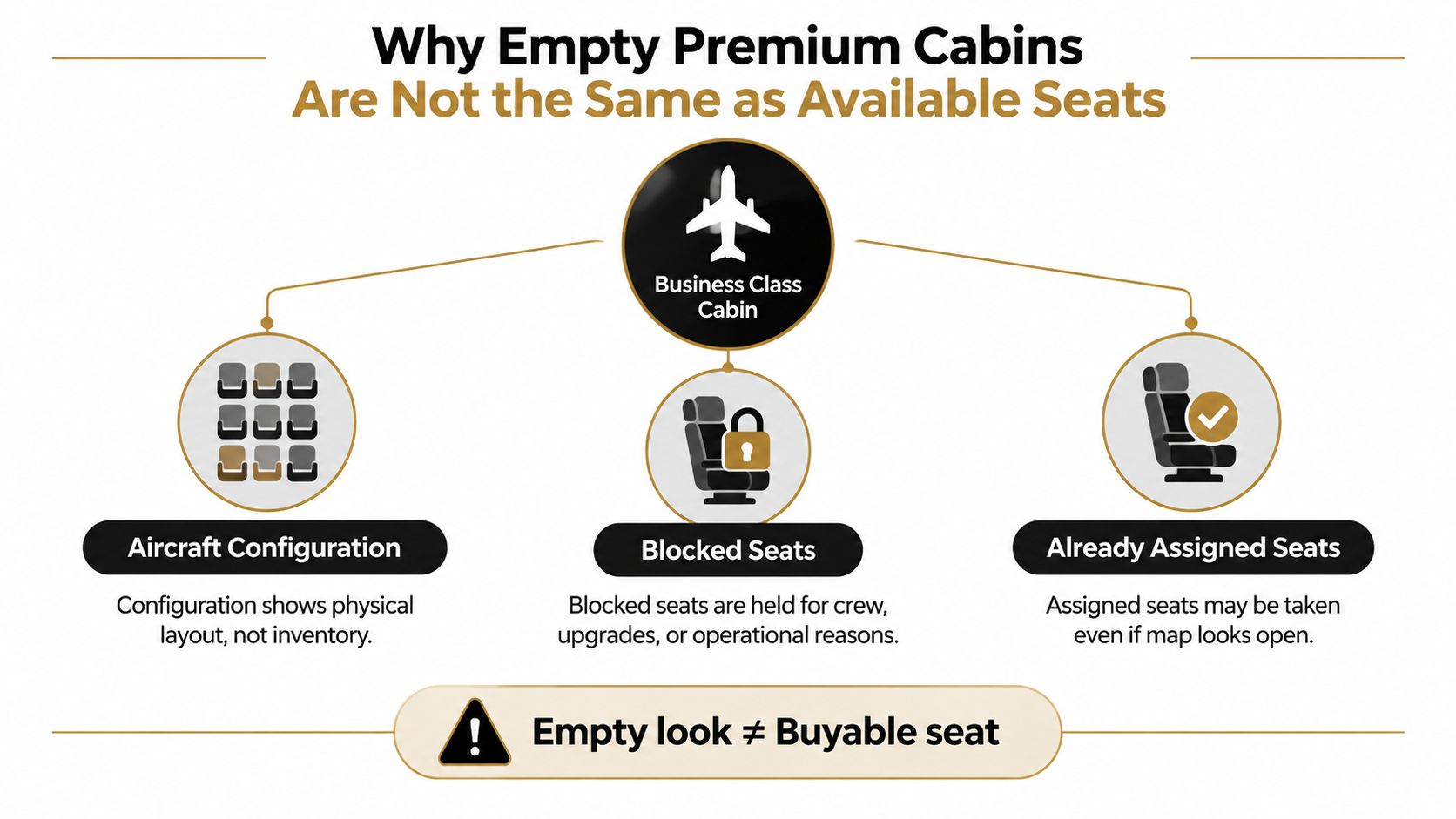
A seat map shows a physical layout, not the complete commercial inventory. It may display the aircraft configuration, seats already assigned to other travelers, and seats blocked for operational reasons. It usually won't tell you whether an unoccupied seat belongs to a discounted business fare, a flexible fare, an upgrade bucket, or an award class unavailable to your loyalty program.

The distinction matters because airlines sell the same cabin through separate inventory channels. A business seat might be available for a high cash fare but closed in the cheapest business booking class. It might be open for an upgrade but unavailable as an award. It could also be physically empty while the airline protects space for elite upgrades, operational recovery, or late-booking corporate demand.

Practical rule: Treat the seat map as a clue about the aircraft, never as proof that a buyable seat exists at your target price.

An infographic explaining why empty premium cabin seats displayed on maps may not be available for purchase.

The cabin can look empty for several reasons

An airline may block seats because of crew requirements, aircraft certification, service limitations, or a late equipment change. Recent coverage described Lufthansa's Allegris 787 business cabin flying with only 4 of 28 seats bookable, while 24 seats remained blocked because of certification delays, as reported by Mainly Miles' coverage of restricted premium-cabin seating. The aircraft had seats. Travelers couldn't treat all of them as normally sellable inventory.

Singapore Airlines has also been reported to block portions of its business cabin for certain fare types until 96 hours before departure, which means access can depend on both the ticket and the time remaining before takeoff, not merely on whether the seat map looks open. The same coverage explains why seat access is becoming a revenue-management tool rather than a simple occupancy display.

The reverse can happen too. A nearly full map may still produce a late award opening or a lower revenue fare if the airline changes inventory controls. Airlines can move unsold space between fare buckets, release an award seat, or assign previously blocked seats after an operational restriction clears.

Check the product, not the pixels

Start with the exact operating flight, date, aircraft, passenger count, and cabin. Then verify the live cash price or mileage quote. A seat map won't reveal the booking code, fare restrictions, cancellation terms, or whether the visible seat can be ticketed through your chosen program.

Business class is structurally scarce. Among the world's 50 leading full-service carriers, business class represented 9.2% of installed seats, rising to 12.2% on widebody aircraft, according to Mighty Travels' analysis of long-haul business-class seat availability. That limited physical supply gives airlines room to protect premium inventory, especially on long-haul routes.

The best search habit is simple: separate visual occupancy, paid availability, and award availability. Only the final live, bookable result counts.

How to Read Business Class Seat Availability Like a Pro

Professionals don't begin with the seat map. They work through the flight in layers, because every layer can change the answer.

Start with the aircraft and operating carrier

Confirm who operates the flight and which aircraft is scheduled. A codeshare search can display one carrier's flight number while the operating airline controls the actual cabin, seat layout, and inventory. Aircraft swaps can also change the number of business seats, the seat model, and which positions are blocked.

Next, inspect the cabin itself. Look for the business-class rows, blocked positions, bassinet locations, and unusual layouts. Don't assume every premium-looking section is the same product. A true long-haul business cabin, a regional recliner product, and a converted section can appear differently in search tools while carrying very different value.

Move from the map to the fare

Compare the fare family and booking class, not just the headline price. A discounted business fare might have stricter changes, limited refundability, or weaker upgrade eligibility than a higher fare in the same cabin. Your target is the cheapest acceptable product, not merely the first business result displayed.

For a useful primer on how airline fare letters affect ticket rules and upgrade eligibility, review this guide to flight class codes. Booking codes such as J, C, D, Z, and P can indicate different inventory levels, but the meaning and conditions vary by airline.

Check the full itinerary as well. A through-ticket can contain mixed cabins, married-segment logic, or a connection where only one flight offers business class. The total fare may be attractive while one segment remains in economy.

Validate the award separately

Award availability requires its own check. Confirm the points price, taxes, transfer path, cancellation rules, and partner booking class. Then search the operating carrier and relevant partner programs, because one program may show space another can't sell.

ExpertFlyer says it can search open award and upgrade inventory by flight and class, search up to 3 days on either side of a target date, and show how many seats are open before you transfer miles or apply a certificate, as described in its airline award and upgrade search features. Use that flexibility to scan broadly, then verify the exact date before booking.

Check What to verify Why it matters
Flight Operating carrier, flight number, date, aircraft Equipment and inventory can differ by flight
Cabin Business rows, blocked seats, product type A visible seat may not be commercially accessible
Fare Brand, fare family, total price, restrictions The cheapest business product may sit in another bucket
Booking class Revenue or award code The code controls availability and often ticket conditions
Itinerary Every segment and cabin Mixed-cabin or through-ticket rules can alter the result
Confirmation Live price, mileage quote, seat assignment Only a current, ticketable result proves availability

The professional sequence is route, aircraft, cabin, fare, booking class, restrictions, confirmation. Seat-map occupancy belongs in the middle, not at the end.

Award Space Versus Revenue Seats and Why It Matters

Cash inventory and award inventory share the same physical aircraft, but they don't share the same commercial rules. The airline's pricing engine manages revenue fares, while loyalty programs receive a separate pool of redemption inventory. That's why a flight can have unsold business seats and no saver awards, or award space while the cheapest cash fare remains expensive.

Two systems, two decisions

Revenue inventory is built to maximize ticket revenue. Airlines open and close fare buckets according to demand, competition, route economics, and remaining capacity. A lower business fare can appear after the airline decides that selling at a discount is better than leaving the seat unused.

Award inventory is more restricted. The operating carrier determines what it releases, while partner programs show only the space they're permitted to sell. A calendar marked “business” may hide partner limitations, taxes, transfer friction, or a booking class that isn't available through your preferred program.

Dimension Revenue seats Award space
Controller Airline revenue-management system Airline loyalty and partner inventory rules
Price Cash fare by brand and booking class Miles or points plus taxes and fees
Best use Fare sales, premium discounts, unusual price gaps High-value redemptions when cash prices are high
Main trap Cheap headline fare with harsh restrictions “Business” result that isn't accessible through your program
Verification Live fare quote and fare rules Live award quote, partner access, and transfer path

Search both channels in parallel. For revenue tickets, compare the total price, baggage, changes, cancellation terms, and booking class. For awards, compare the mileage requirement, taxes, transfer partners, cancellation rules, and operating-carrier access.

A visible business cabin is a lead. A confirmed fare or award is the result.

Flexibility improves the search. Check nearby dates, alternate airports, and competing carriers. ExpertFlyer's ability to search nearby dates is useful when a single-day search fails, while a separate award workflow can help identify whether the right redemption is available through United or another partner. The MileagePlus upgrade and award guide is useful when you're comparing an upgrade path with a direct award.

Don't transfer points until the award is confirmed and bookable. Award inventory can change before the transfer completes, and a points balance doesn't create space that the airline hasn't released.

Routes Where Business Class Drops Below Coach

Business class can be cheaper than coach. It's unusual, but it happens when flexible economy fares rise sharply while premium seats remain unsold, as explained by Australian Frequent Flyer's analysis of business fares undercutting economy.

The mechanism is straightforward. Airlines don't price cabins in a perfectly smooth ladder. Economy may close its cheaper buckets while business retains a promotional or distressed fare. A traveler comparing only the cheapest economy headline can miss the more expensive flexible economy options that make business class the better purchase.

Look for the gap, not a mythical route list

The strongest opportunities tend to appear on competitive international routes, off-peak widebody services, and markets where airlines are fighting for premium demand. Independent commentary reports that business fares on competitive transatlantic and transpacific routes can fall to two to three times the economy price during off-peak periods, while some leisure-heavy routes can price at less than twice economy, according to Winghoppers' discussion of premium fare gaps.

A route-level example is more useful than a broad promise. Holidu found Iberia's Madrid to Athens flight priced at £454 in economy and £562 in business class, a difference of £108, as shown in its business-class bargain analysis. That's not a universal pattern, but it demonstrates how narrow the gap can become when premium inventory needs stimulation.

Route pattern Typical gap Best window Trigger
Competitive transatlantic Business may approach two to three times economy in off-peak periods Lower-demand travel periods Premium fares remain flat while economy rises
Competitive transpacific Business can compress toward economy when demand softens Off-peak periods Rival capacity or weak premium bookings
Leisure-heavy international route Business can cost less than twice economy Shoulder or off-peak periods Unsold premium seats and aggressive competition
Madrid to Athens example £108 gap in the cited fare comparison The observed market window Iberia business inventory priced close to economy

The diagnostic signals matter more than the city names. Watch for an economy fare spike with no matching business increase, a new aircraft entering the route, or a schedule change that creates excess premium capacity. Don't assume more business seats guarantee a bargain. Reuters reported American Airlines increasing premium seating on 777 aircraft to 144 seats, about 44% of the aircraft, as carriers pursue higher-spending travelers, according to the Frequent Miler discussion of premium-cabin expansion. More seats can coexist with tight yield controls.

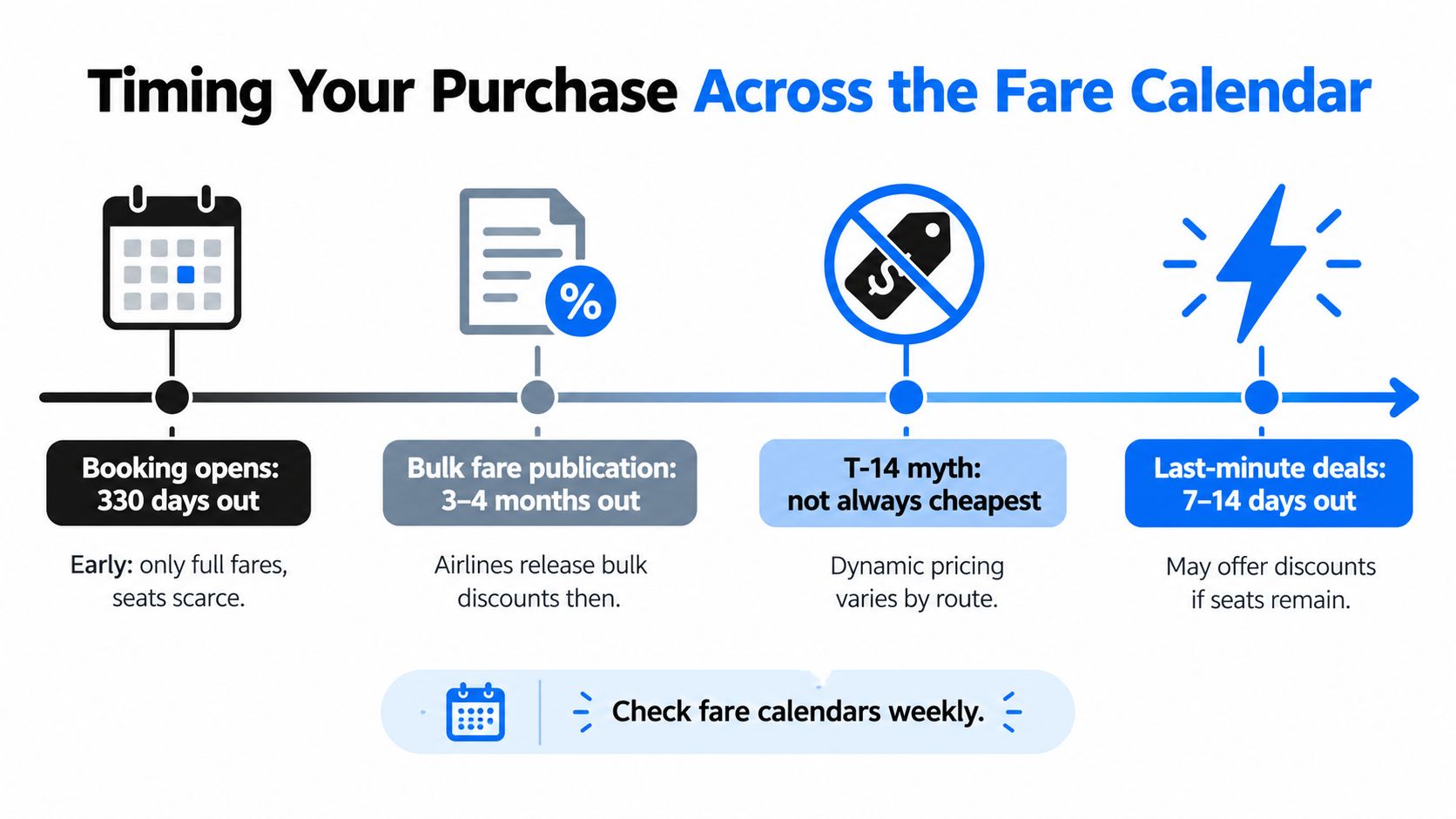
Timing Your Purchase Across the Fare Calendar

The myth that T-14 is always the cheapest window causes travelers to wait without a monitoring plan. Airlines adjust premium fares dynamically, and the right opportunity depends on the route, season, aircraft, and inventory bucket. A late discount can appear, but waiting until the final stretch can also leave you with fewer seats and harsher prices.

Start watching when the schedule opens. Don't expect the cheapest fare immediately. Early inventory may contain mostly higher-priced options, while the airline tests demand and protects premium space.

Use a horizon-based watchlist

Track the route through several windows rather than making one search on one day.

  • At schedule opening: Record the aircraft, cabin size, fare families, and initial business prices. This creates a baseline and exposes later changes.
  • Several months before departure: Recheck the fare calendar, especially during shoulder-season travel. Bulk discounts and competitive adjustments often appear before the final weeks.
  • Inside the final weeks: Monitor every target date more closely. A lower fare can emerge if premium seats remain unsold, but scarcity risk rises as departure approaches.
  • After a schedule change: Search immediately. Aircraft swaps, timing changes, and added or removed service can force an airline to rebalance inventory.

The global recovery pattern explains why patience must be selective. In 2022, global airline capacity recovered to about 86% of pre-crisis levels, while business-cabin capacity recovered to almost 84%, with another industry analysis placing business-cabin recovery at approximately 83%, according to Skift Research's premium-cabin capacity analysis. Premium supply was still lagging overall capacity, so travelers faced tighter conditions even as schedules returned.

An infographic showing the timeline for booking flight tickets to find the best business class seat availability.

Act immediately when the fare moves

When a useful business fare appears, don't admire it. Run this sequence:

  1. Verify the booking class and confirm every segment is in the intended cabin.
  2. Read the fare rules, including changes, refunds, baggage, and advance-purchase conditions.
  3. Check partner inventory if you're considering miles or an upgrade.
  4. Use a hold or refundable option where the airline makes one available.
  5. Compare the final total, then ticket before the bucket closes.

This video adds practical context for reading fare patterns and booking decisions.

Check fare calendars weekly, but increase the frequency once a target route enters an active sale or schedule-change period. The winning habit is not guessing the perfect day. It's seeing the change quickly and verifying the exact sellable product before someone else takes it.

Tools and Alerts That Catch Fare Drops First

No single tool sees every layer of premium inventory. Use each platform for the job it handles well, and assume every result needs a second verification.

Google Flights is the broad revenue-fare scanner. It's useful for comparing dates, carriers, airports, and visible business prices, but it may not expose every booking-class nuance or codeshare distinction.

ExpertFlyer is the specialist tool for flight-specific award, upgrade, and class inventory searches. Its value increases when you care about a particular flight or booking class, but it still reflects the inventory sources and programs available to it.

Seats.aero and AwardFares suit points-focused travelers scanning award calendars across programs. They can reveal patterns faster than manual searches, but partner access, married-segment rules, and final booking conditions still require confirmation.

FlightConnections is a route-discovery tool. It helps identify alternate hubs and competing carriers, not whether a particular business seat is sellable at a target fare.

Kayak price alerts are useful for broad cash-price movement. They're less precise when your strategy depends on a specific premium booking class rather than a general cabin price.

Airline-specific trackers can be valuable when you repeatedly fly one carrier, particularly if you understand its fare brands and loyalty rules. The weakness is fragmentation. You may need separate systems for revenue pricing, award space, seat maps, and partner inventory.

For travelers comparing premium trips with broader destination planning, guides for UAE adventures can help identify alternative cities and routing ideas before you begin the fare search.

Tool Tracks Business coverage Limitation
Google Flights Cash fares, dates, carriers, airports Broad business-fare visibility Booking-class and partner details can be limited
ExpertFlyer Flight-specific award, upgrade, and class inventory Strong for targeted cabin checks Requires careful interpretation of live inventory
Seats.aero Award calendars and program availability Useful for points-led scanning Partner and segment rules still need validation
AwardFares Award-space searches across programs Helpful for comparing redemption paths Displayed results may not equal final bookability
FlightConnections Routes, hubs, and competing services Indirect business-class value Doesn't prove fare or award inventory
Kayak alerts General cash-price changes Useful for broad monitoring Not designed around precise premium buckets
Airline trackers Carrier-specific fares and loyalty space Strong within one airline ecosystem Coverage is narrow and fragmented

Passport Premiere is one monitoring option for travelers who want premium-cabin fare alerts and notifications for situations where business class can undercut coach. Its role is to add a fare-monitoring layer to the manual checks above, not to replace live verification. Details on that approach appear in the business-class fare alerts resource.

A Repeatable Weekly Workflow for Cheaper Premium Fares

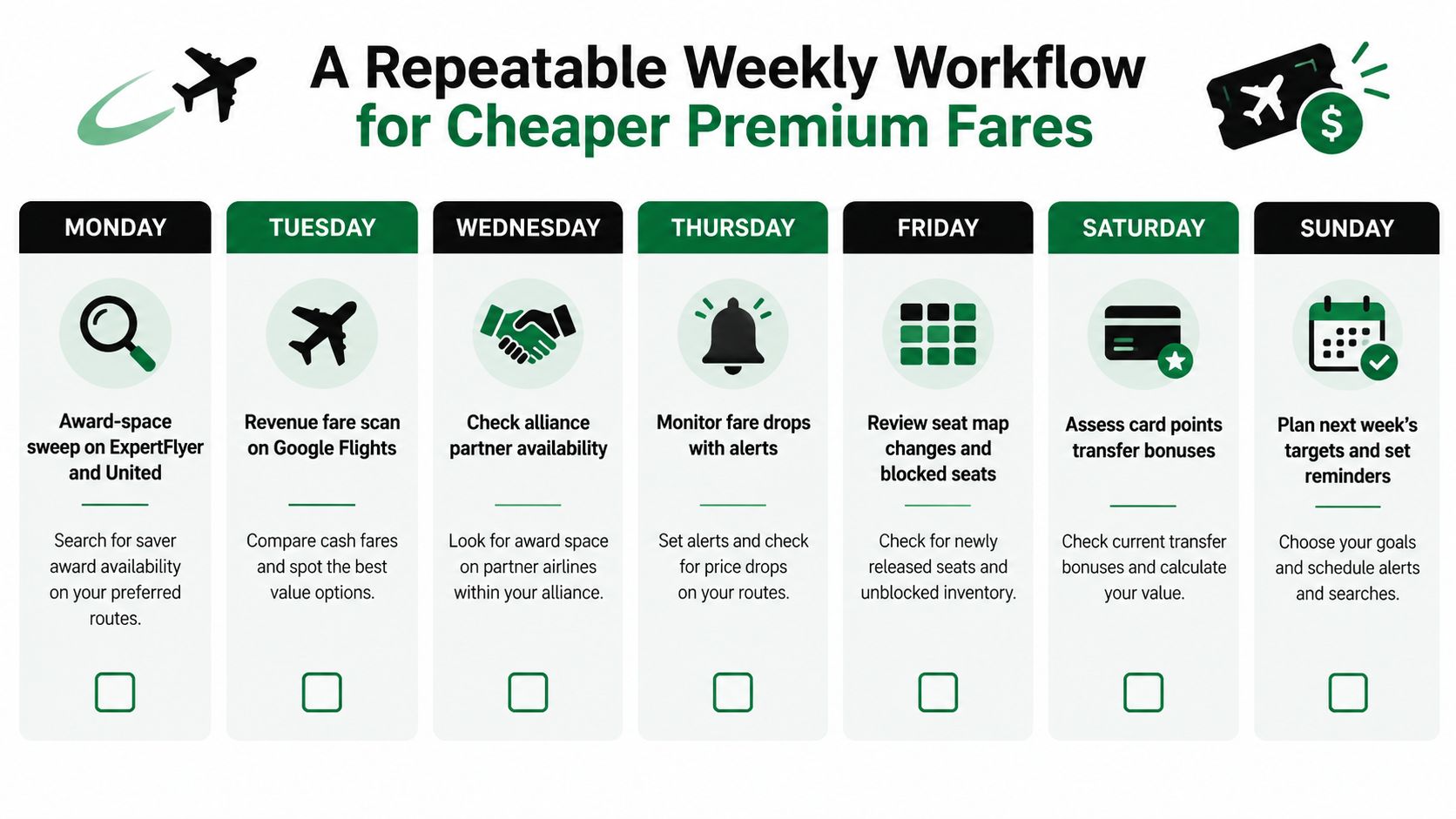
A monitoring system works only when it's repeatable. Set fixed tasks for each day, log the result, and define what deserves immediate action. The objective isn't to search every airline endlessly. It's to maintain visibility across both revenue fares and award space before a short opening disappears.

Run the same loop every week

Monday is for awards. Search ExpertFlyer and United across your preferred routes, nearby dates, and passenger counts. Check whether the result is a true business award, identify the program displaying it, and record the mileage and restrictions.

Tuesday is for cash. Scan Google Flights and ITA Matrix across your next four travel windows. Compare business against both the cheapest economy fare and the flexible economy fare. Log the fare family, booking class when available, operating carrier, and aircraft.

Wednesday is for competitors. Check SeatSpy and FareAlert, then search alliance partners on the same route. A carrier may show no useful space while a partner exposes a different award path or a competing cash fare.

Thursday is for verification. Open the operating carrier's website and inspect the seat map, fare rules, and booking class. Confirm that the result is ticketable, rather than relying on a cached alert or a codeshare display.

A weekly infographic guide showing daily tasks to find cheaper premium flight fares and seat availability.

Friday is for anomalies. Review SecretFlying and relevant X accounts for mistake fares, route sales, and sudden premium-price movements. Treat every alert as unverified until the airline or booking channel produces a live fare with usable rules.

Saturday is for points. Check transfer bonuses available to your cards and compare the resulting redemption with the cash fare. Don't transfer speculatively.

Sunday is for planning. Review triggered alerts, remove dead routes, add new target dates, and set the next week's searches. A clean watchlist beats a huge one you never inspect.

Define your action threshold

Track J, C, D, Z, and P where the carrier uses those business booking classes, but don't assume the same letter means the same product across airlines. Record lower fare buckets, flexible alternatives, taxes, and the final cabin on each segment.

Act within 60 minutes when a target fare or award opens and the fare rules fit your trip. Premium inventory can change quickly, and delay is the most common reason travelers lose a verified opening.

The manual checklist should be your safety net. A monitoring service can run the background searches, surface J-class openings or revenue drops, and leave you with the decisions that require judgment: route quality, flexibility, aircraft, and ticket conditions.


Passport Premiere monitors international premium-cabin fare movements and alerts members to business-class opportunities, including cases where business class prices fall below coach. Visit Passport Premiere to add those signals to your weekly availability workflow and stop treating the seat map as the final answer.

When to Book Business Class Flights to Save the Most

Business class regularly prices below coach on real routes, and the winning window is 60 to 120 days before departure. If you wait for the “book early” crowd to feel safe, you usually miss the fare drop that happens when airlines finally admit an empty premium seat needs a price cut.

That's the part most travelers get wrong. They treat business class like economy, where early booking often helps, but premium cabins are managed through inventory pressure, fare cycles, and last-minute corporate demand. The first published fare is often just an opening number, not the market's true answer.

Why the First Price You See Is Almost Never the Best One

The standard advice to book as early as possible sounds disciplined, but it's usually wrong for business class. Airlines don't publish one honest price and keep it there. They load cabins with forecast pricing, then adjust as booking velocity and cabin fill rates change, which is why the first fare you see can be a placeholder rather than a deal.

That's also why business class cheaper than coach isn't a gimmick. It happens when premium inventory sits unsold and airlines would rather move the seat than protect a higher theoretical price. Once a cabin stays light, the price starts bending toward reality, especially in the middle months before departure, not on day one.

If you want a clean framing, stop asking, “How early should I book?” and start asking, “When does the seat look empty enough to get discounted?” That's the logic behind the airfare guide by MLR Worldwide Service, which fits the same market behavior you see in premium cabins. For a deeper look at the pricing logic itself, the mechanics of yield management pricing explain why airlines keep changing the number until demand becomes clearer.

Practical rule: the first fare is often the airline testing the market, not rewarding the traveler.

The best evidence in the brief points to repeated discount cycles, not one magic release day. One dataset recorded 250 verified business-class alerts in the last 12 months and about 20 alerts per full month, which is exactly what you'd expect from a market that reprices over and over instead of settling on one annual sale date. That's why waiting for the right cabin state matters more than celebrating an early purchase.

The 60 to 120 Day Sweet Spot for International Business Class

For most long-haul international trips, the cleanest answer is simple, book 60 to 120 days before departure. That's the band where airlines have enough visibility to price intelligently, but not so much final demand that they can squeeze you for every last dollar. Independent guidance also points to 3 to 6 months before departure for long-haul business class, and another source describes the international sweet spot as 2 to 4 months ahead, which lands in the same practical zone.

A timeline graphic illustrating the ideal 60 to 120-day booking window for international business class flights.

The way to use that window is straightforward. Start watching fares well before you're ready to buy, then be ready to act once the cabin enters the middle of that band. Booking earlier than four months usually means you're paying forecast pricing, not true market value, while waiting inside 60 days often means the cheapest fare buckets are already disappearing.

A useful mental model is that airlines are balancing two clocks at once. One clock is inventory release, the other is real demand from corporate travelers and flexible leisure buyers. When the cabin is still thin, the airline can afford to drop fares without surrendering control, but once the last seats start going, the price tightens fast.

Bottom line: if your route is normal long-haul, don't chase the earliest fare. Chase the middle of the curve.

For shorter trips, the calendar tightens. Long-haul international still favors the broader 60 to 120 day band, while short-haul business class behaves more like a 4 to 8 week play. If you're booking an international lie-flat seat, anchor your countdown to the middle window, then trade a little seat choice for a better fare if the numbers are strong.

The travel planning guidance at Passport Premiere's international flight timing guide fits this same logic, especially for travelers who'd rather watch fare movement than guess at a perfect date. The advantage comes from treating the booking window as a range, not a single day.

Route, Season, and Departure Day That Shift the Window

The right window changes by route, and that's where most generic advice falls apart. Transatlantic business class often peaks around 6 to 10 weeks before departure, while many Asia routes price best at 8 to 14 weeks. Short-haul business class runs on a tighter 4 to 8 week rhythm, so the route matters just as much as the calendar.

Route Best Booking Window Strongest Months Cheapest Departure Days
Transatlantic 6 to 10 weeks before departure January to March, May, September to November Tuesday, Wednesday
Asia 8 to 14 weeks before departure January to March, May, September to November Tuesday, Wednesday
Short-haul 4 to 8 weeks before departure January to March, May, September to November Tuesday, Wednesday

Seasonality is the other lever. Several analyses point to January to March, May, and September to November as lower-fare periods on transatlantic routes, while June to August and late December are usually more expensive. If your trip overlaps peak summer or the holiday rush, book earlier, because the cheap middle window gets crowded fast.

Departure day matters too. Tuesday and Wednesday flights tend to be cheaper than Friday, Sunday, or Monday departures because they dodge the heaviest business-travel demand. If you can move both the purchase date and the flight date, you're stacking the odds in your favor instead of relying on one lucky search.

Practical rule: route first, season second, weekday third. That order matters.

For buyers who want a cleaner shortcut, think like this. On transatlantic routes, start hunting in the middle of the market, then lean toward midweek departures. On Asia routes, give yourself a slightly longer runway. On short-haul premium cabins, don't wait around for months, because the best price cycle is much tighter.

The best-time-to-book business class guidance for UK travelers lines up with that route-specific approach, which is exactly why one universal rule never works.

Cash Fares Versus Award Tickets and How to Time Each

Cash fares and award tickets follow different clocks, so don't treat them like substitutes that peak at the same time. Revenue fares respond to cabin fill pressure and the 60 to 120 day cycle, while award space depends on when the airline releases saver-level inventory. That's why the cheapest cash fare and the cheapest mileage redemption rarely show up together.

A comparative infographic showing differences between cash fares and award tickets for booking travel.

Cash wins when a route is already discounted in the middle booking window and the award price is still stubbornly high. Miles win when saver space opens on a route you want and the cash fare hasn't dropped enough to justify paying out of pocket. If you're sitting on transferable points, the decision should be based on the actual cash fare, not the fantasy of “free” business class.

A good discipline is to keep both options in view at the same time. Watch cash prices during the 60 to 120 day band, and watch award availability on the same route, because one may move before the other. That matters even more if your dates are flexible, since award space can thin out quickly as departure gets closer.

Use miles when the seat is scarce and the cash fare is still stubborn. Use cash when the airline is clearly trying to move empty premium inventory.

If you're considering a transfer, do it only when the redemption is clearly better than the current cash offer. Otherwise, hold the points and keep monitoring. The point is not to burn miles just because you have them, it's to use them when the airline is still pricing the seat like a premium product instead of a nearly empty one.

Monitoring Fares, Alerts, and Buying Events That Actually Move Prices

If you want to book business class well, you need a routine, not a panic search. Set alerts on the exact cabin you want, check fare calendars for midweek departures, and ignore the tiny dips that don't change the bigger picture. Most of the savings come from catching the right cycle, not from refreshing a search engine all day.

The screenshot below is a good reminder that travel deals move in waves, not in one neat drop.

Screenshot from https://www.passportpremiere.com

The signals worth respecting are the ones that show real inventory behavior. A fare alert tells you when the published price moves. A fare calendar shows whether Tuesday or Wednesday is undercutting the weekend. A buying event tells you the airline is probably clearing unsold premium seats before the cabin gets tighter. If you're searching manually, that's the pattern to watch.

The Passport Premiere fare alert page fits this process because it focuses on timing premium-cabin purchases around airfare weakness. That's the right idea, regardless of which tool you use. You're not hunting every fluctuation, you're waiting for the point where the airline blinks first.

A few alerts are enough if you keep them disciplined.

  • Track the right cabin: Set alerts for business class, not generic premium results, or you'll miss the price you care about.
  • Watch the weekday spread: If Tuesday and Wednesday are cheaper, compare them before chasing a one-day fare drop.
  • Treat small changes as noise: A tiny dip that doesn't change the overall pattern isn't the same as a real cabin reset.
  • Stay ready for correction windows: When a fare suddenly drops on a route that's been expensive for weeks, that's the moment to act.

Business-class buying events usually matter most when a route has been sitting unsold and the airline wants the cabin moving. That's where monitoring pays off, because the fare can change before the seat map looks obviously empty. If you're not watching, you see the drop after everyone else does.

Decision Checklists for Leisure, Frequent Flyers, and Corporate Travel

Leisure travelers should buy around the trip, not around ego. If the route is long-haul, aim for the 60 to 120 day band, but move earlier for peak summer, Christmas, and major events. If the trip is on a shorter route, compress the search and start getting serious closer to 4 to 8 weeks out.

Frequent flyers need a different rule. Keep cash and awards in view together, because the right answer changes by day and by route. If the cash fare drops into the middle window and award space is thin, pay cash. If saver space opens and the cash fare is still stubborn, use miles and keep your cash for the next trip.

Corporate travel managers should build policy around fare timing instead of only around approved vendors. That means watching negotiated routes inside the favored booking band, leaning into midweek departures when schedules allow, and using alert systems before a seat gets too expensive. It also means accepting that premium cabins can occasionally price below coach on a live route, which is exactly why broad assumptions cost money.

The checklist below is the one I'd use.

  • Leisure traveler: Watch the route-specific window, then book when the fare settles into the middle of the curve.
  • Frequent flyer: Compare cash and award pricing side by side, and don't redeem points just because the trip feels urgent.
  • Corporate traveler: Set route alerts, review departure-day flexibility, and keep policy aligned with real market timing instead of old rules.

A travel booking checklist infographic showing recommended strategies for leisure travelers, frequent flyers, and corporate travelers.

The travel planning resources at Northern Spain Travel are a useful complement if you're comparing premium-cabin timing with broader trip planning. Good booking habits don't start with the flight search alone, they start with how early you're willing to watch the market.

Putting Timing, Monitoring, and Discipline Together

The mistake is thinking timing alone will solve business class pricing. It won't. The travelers who win are the ones who pair the 60 to 120 day sweet spot with disciplined monitoring, because that's when empty premium seats start looking cheap enough for airlines to move them.

Start this week with one habit, set alerts on your next international route and check them once a day. Use one rule to decide, if you're inside the favorable window and the fare drops into the range you'd be comfortable paying, book it instead of waiting for a perfect fantasy price. Hold out only when the route is still clearly overpriced and the cabin has room to soften.

That mindset changes everything. You stop treating business class like a fixed retail product and start reading it as unsold inventory that gets repriced until the airline likes the load factor. Once you think that way, you'll spot the buying windows faster and ignore the noise.

Passport Premiere is built for travelers who want to time premium-cabin purchases around fare weakness instead of overpaying for the first number on the screen. If you want a sharper read on when business class is worth buying, visit Passport Premiere and start tracking the fare cycles that matter.