
Business class can sometimes cost less than coach. On one London Heathrow to Doha itinerary, the remaining economy seats were priced at GBP 4,494, while business class cost GBP 3,029, making the premium cabin cheaper by GBP 1,465 (published fare example). That isn't a normal outcome, but it reveals how airline pricing really works: your cabin doesn't always determine your price. Inventory, timing, fare rules, and the sales channel can matter more.
A business class consolidator helps travelers access that less visible side of the market. Rather than selling an inferior version of the cabin, a legitimate consolidator sells the airline's same business-class seat through negotiated wholesale or private fares. The opportunity is strongest on long-haul international routes, but the cheapest quote isn't automatically the best choice if you may need to change plans.
This guide explains the model from the ground up. You'll learn why consolidator prices swing, when business class can beat coach, how to compare cash fares with points or upgrades, and which restrictions deserve attention before payment. The practical objective is simple: reduce premium-cabin costs without trading away the reliability and flexibility your trip requires.
Introduction to Business Class Consolidators
A business class consolidator can make premium travel cheaper than economy, but only when timing, inventory, and fare rules align. Two travelers may search the same long-haul flight, see different prices, and still receive the same airline seat. One accepts the public economy fare. The other asks an accredited seller to check private or negotiated options, then weighs the lower business-class quote against its restrictions.
Airline pricing works less like a fixed menu and more like a room inventory system. Seats are grouped into fare buckets, each with its own price and conditions. As cheaper inventory sells, the remaining economy seats can rise above a business-class fare filed for a different bucket or sales channel. A public search shows one part of that market, not every available combination.
The surprising part of premium pricing
Business class usually has a higher public price than economy, yet the Heathrow to Doha example shows why that relationship can reverse. After much of the cheaper economy inventory had disappeared, the remaining coach seats cost more than the business-class fare available on the same flight (the fare comparison).
The example is useful because it separates cabin value from price logic. A consolidator does not guarantee an outcome like this, and a private fare is not automatically a bargain. Its advantage is access to another search channel, where timing and less visible inventory may produce a better match for a traveler's needs.
The comparison is broader than the headline fare. Check the public business-class price, the available economy options, points or upgrade paths, and the consolidator's change, cancellation, ticketing, and seat-selection rules. A lower price with severe restrictions may offer less practical value than a higher fare with room to adjust.
Who benefits most
Corporate travel managers may value lower international trip costs while still meeting company policy. Consultants and executives can justify premium-cabin comfort when a public fare exceeds their budget. Leisure travelers may also benefit when a long flight makes comfort important and their dates are firm.
The strongest candidates usually share three traits:
- Long-haul travel: Negotiated premium pricing tends to matter more on intercontinental routes than on short journeys.
- Date discipline: Travelers who can keep specific dates are better positioned to accept tighter fare conditions.
- Comparison habits: Buyers who compare public fares, points, upgrades, and consolidator quotes can judge value instead of chasing a discount label.
You do not need to represent a corporation to use this channel. You do need to know what the ticket permits, who handles changes, and whether the savings justify reduced flexibility and exposure to shifting inventory.
What a Business Class Consolidator Really Does
A business class consolidator changes the buying route, not the onboard product. It works much like a wholesaler: an intermediary obtains access to commercial terms that individual shoppers may not see, then sells the resulting ticket through its own agency channel. The seat, aircraft, lounge access, baggage allowance, and mileage treatment still depend on the airline and the specific fare rules.
Business class consolidators are accredited travel agencies that sell premium-cabin inventory through negotiated bulk or wholesale arrangements rather than ordinary public retail channels. Industry explainers describe some consolidator fares as 40% to 60% below published prices, particularly on long-haul international routes (consolidator fare mechanics). Treat that range as an example of possible pricing, not a standing promise. The advantage is access to another inventory channel, where timing and less visible fares can sometimes make business class cost less than a public coach option.
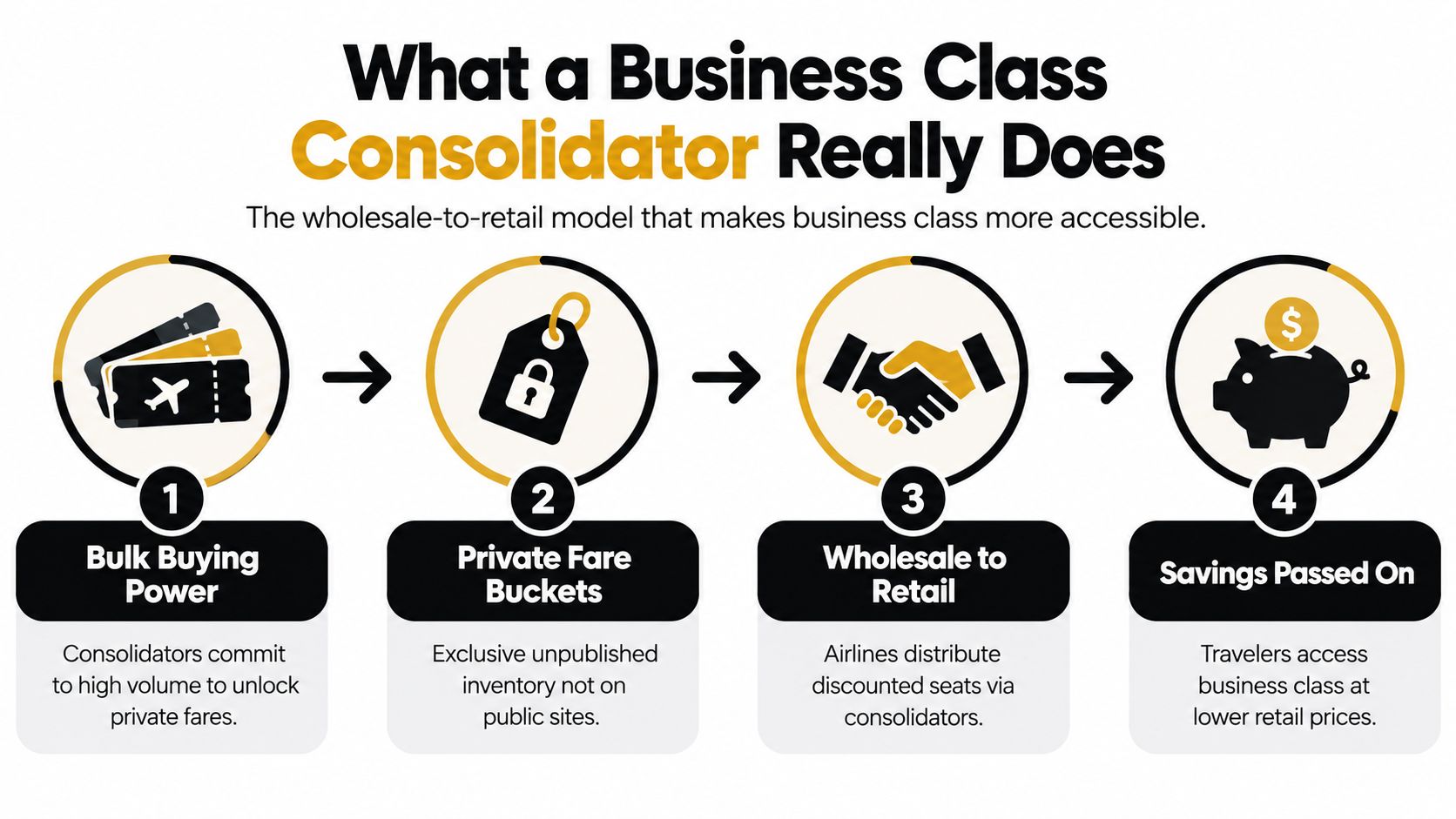
The four-part process
The seller negotiates access. An accredited agency may commit to volume or operate under negotiated airline agreements. That relationship can provide fare conditions absent from the airline's standard booking path.
The airline files private fares. The airline sets net fares or restricted booking classes with rules covering refunds, changes, routing, and advance purchase. Business class describes the cabin, not the flexibility of the ticket.
The consolidator presents the option. The agency quotes the itinerary, airline, cabin, price, and restrictions. The fare may appear lower because it travels through a controlled distribution channel instead of public advertising.
The traveler receives the airline's normal premium product. The commercial path changes, while the flight experience follows the airline's aircraft, seat, lounge, baggage, and mileage policies. A consolidator ticket is not automatically a lower-grade version of business class.
What the model doesn't mean
A private fare is not automatically a secret upgrade or a guaranteed bargain. The airline controls the schedule, aircraft, and disruption response. The agency matters most when you request a voluntary change, refund, reissue, or explanation of a complex condition.
Terms such as net fare, private fare, and contracted fare describe distribution, not a separate cabin. To compare agency models, review a first-class travel agency and ask who issued the ticket, who services changes, and what flexibility you surrender for the lower quote.
Practical rule: Judge the ticket by its fare rules, servicing process, and exposure to changing inventory, not by the discount label alone.
How Consolidators Source Premium Fares and Why Prices Swing
A consolidator is not selling a cheap seat. It is matching airline inventory with the right buyer at the right moment. Airlines want to fill premium cabins, while protecting the higher public fare that some travelers may still pay. Private distribution helps them pursue both goals by releasing selected inventory to an intermediary without lowering the fare shown to every shopper.
The relationship may involve a volume commitment or negotiated commercial arrangement. The consolidator can then access private fare filing, restricted booking classes, or net pricing. It quotes those fares to eligible customers, while the airline keeps tighter control over where and how the offer appears.
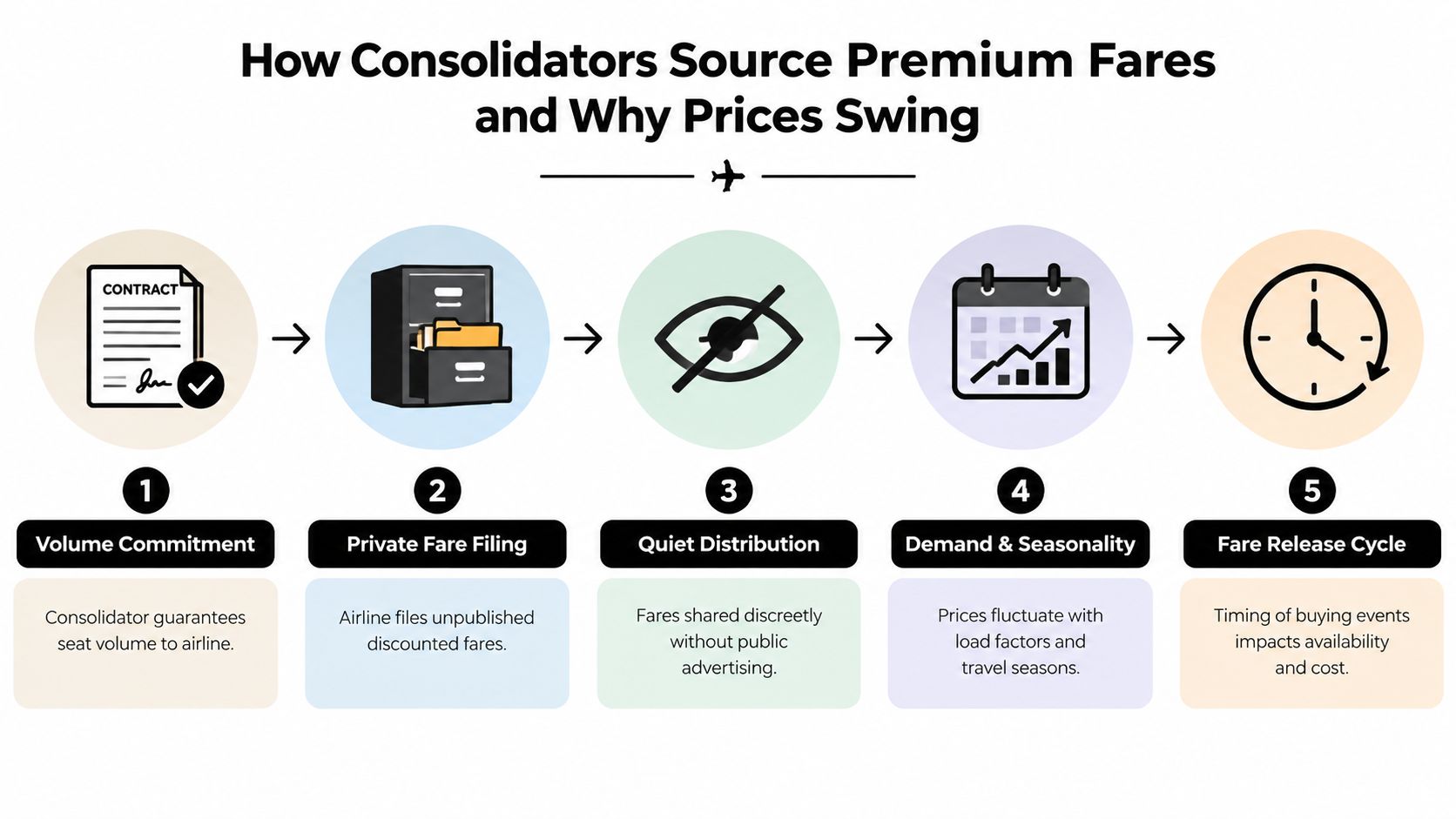
Why the same seat changes price
The seat is physical, but its price behaves more like a limited inventory slot. Several conditions can change the quote:
- Load factors: If premium seats remain unsold, the airline has more reason to distribute restricted inventory through a partner.
- Seasonality: Holidays, major events, and busy corporate-travel periods can reduce availability and raise prices.
- Route competition: Multiple carriers can create more private-fare opportunities. A dominant carrier may retain greater control over pricing.
- Timing: A private fare may appear, disappear, or change as the airline updates inventory and the departure date approaches.
- Rules attached to the fare: The lower price may require particular travel dates, advance purchase, a minimum stay, or limited change rights.
A market dashboard covering 158 long-haul routes, 58.35 million annual passengers, and 252,450 scheduled flights reported a mean lowest accessed consolidator business-class fare of $2,139. Corridor averages ranged from $1,981 on transatlantic routes to $3,160 on US–Oceania routes (premium-cabin route data). These figures are reference points, not promises for a specific itinerary. They show why geography can matter as much as timing.
Concentration changes the negotiating environment
The same route analysis found that 75 of 158 routes, or 47%, had a single carrier serving at least 50% of passengers, while only 3 routes, or 2%, qualified as competitive with the top carrier below 30%. On a concentrated route, the dominant airline may have more control over public pricing. Competitive corridors can offer consolidators a wider range of fare sources.
Understanding yield management pricing clarifies the mechanism. Airlines price more than the seat itself. They assess the chance that someone will buy it later, through a particular channel, under specific restrictions, and at a level shaped by demand.
The practical test is simple: compare the quote with its timing, inventory, restrictions, and flexibility. A lower fare can reflect smart inventory arbitrage, but market volatility means the same route may not produce the same result tomorrow.
Benefits Risks and Real World Price Examples
A business class consolidator can make a premium cabin affordable by matching travelers with private inventory at the right time. Industry reporting places consolidator-sourced premium tickets most commonly within 30% to 70% off published fares, with the largest gaps often appearing on long-haul international routes (reported consolidator discount ranges).
Published business-class fares around USD 5,000 to 6,000 have been cited at roughly USD 1,850 to 3,500 through consolidator channels. These figures illustrate possible inventory and timing advantages, not guaranteed prices for every itinerary. Season, routing, remaining seats, and ticket restrictions can change the outcome.
The price isn't the whole product
A cheaper fare can carry stricter refund and change rules than a standard published ticket. That trade-off matters if a corporate meeting might move, a visa could be delayed, or a family itinerary remains uncertain. Confirm what the quoted price includes, especially baggage, seat selection, and support, because business-class benefits do not automatically make every fare flexible.
A digital ticket is only useful when its underlying rules are clear. Before payment, ask for the issued itinerary and review the details of electronic flight tickets alongside the fare conditions.
| Fare Channel | Typical Price Range | Flexibility and Rules |
|---|---|---|
| Consolidator fare | Often materially below the published premium fare, with reported discounts commonly 30% to 70% | Restrictions may be tighter, including limited refunds or costly changes |
| Public airline fare | Set by the airline's retail pricing | Rules vary, but the conditions are usually visible during the airline booking process |
| Points or award booking | Depends on the program and award availability | Requires usable points, and availability may be limited |
| Upgrade offer | Depends on the original ticket and airline offer | May require eligible fare conditions, miles, or additional payment |
Request the fare rules in writing before paying. The agent should explain refundability, change costs, ticketing deadlines, baggage, mileage eligibility, and who handles support during a disruption. If those answers remain vague, the advertised saving does not show the full value.
When business class beats coach
The strongest comparison may appear when economy inventory is nearly sold out. On the Heathrow to Doha example, business class was GBP 3,029, while remaining economy was GBP 4,494, a GBP 1,465 difference (London to Doha comparison). That result is unusual, not a standard benchmark. It shows why comparing cabins matters more than assuming coach will always cost less.
A similar situation occurs when an upgradeable economy fare approaches a discounted business fare. On one Delta itinerary, upgradeable coach cost $3,256 plus 50,000 miles, while discount business class cost $3,347 (coach and business comparison). The small difference made the cash business fare worth serious consideration, particularly for travelers who valued a confirmed premium seat over uncertain upgrade availability.
How to Evaluate and Choose a Trustworthy Consolidator
A trustworthy consolidator makes the ticket understandable before it makes the sale. You should be able to verify who is selling the fare, what airline issued it, what restrictions apply, and how support works if the itinerary changes.
The industry model generally involves an accredited travel seller negotiating private fare buckets or net fares directly with airlines, then reselling those seats below public business-class pricing. It also commonly involves tighter refund conditions than standard published fares, so accreditation and rule transparency deserve equal attention (consolidator structure and fare conditions).
A practical vetting checklist
- Verify accreditation: Ask for relevant industry accreditation and confirm that the seller can issue an official airline ticket.
- Identify airline relationships: Find out whether the quote comes from a direct contracted relationship, a partner, or another intermediary.
- Demand a written fare breakdown: The quote should identify the itinerary, cabin, total price, taxes, fees, baggage, and ticketing deadline.
- Read the change language: Ask whether changes are permitted, whether the airline or agency processes them, and what happens after a schedule disruption.
- Test the support promise: A polished website doesn't prove that someone will help when a flight is canceled. Ask how after-hours assistance works.
- Check payment protections: Use a payment method with appropriate consumer protections, and avoid rushing because an agent claims the fare will disappear immediately.
Match the seller to the trip
A simple route with firm dates may only require a clear written quote and responsive support. A complex itinerary with multiple connections, mixed cabins, or a high likelihood of changes requires deeper advice. In that situation, a slightly lower price may be less valuable than an advisor who can manage the booking when the plan breaks.
Look for evidence of process rather than slogans. A reliable provider should explain how it monitors fares, compares channels, and identifies the restrictions attached to each option.
Before payment, ask for the fare rules, ticketing deadline, baggage allowance, and servicing contact in one written record.
Best Practices for Working With a Consolidator
A consolidator quote becomes useful only when it matches your priorities. Treat the seller as a source of market access and timing insight, not as a button that guarantees the lowest fare.

Start with a complete brief
Give the advisor more than your origin, destination, and dates. State whether you need a refundable ticket, whether connections are acceptable, whether you require a particular aircraft or seat layout, and whether mileage earning matters. These details separate a usable fare from one that is merely cheaper on paper.
Ask for a public comparison and a private option when possible. The purpose is not to negotiate over one headline number. It is to judge whether the restrictions are worth the cash difference. A lower fare may lose its value if it cannot be changed, carries limited baggage, or requires a difficult routing.
Use timing as part of the decision
Premium inventory changes with demand, seasonality, and the seats an airline still needs to sell. Flexible dates give a consolidator more room to find an opening. Ask about alternate departure days and nearby airports, then compare the added travel time with the savings.
Fixed dates require a different test. Instead of pursuing a theoretical low fare, decide whether the current quote fits your budget and tolerance for restrictions. A fare monitor can provide useful context by showing when premium prices move downward. Passport Premiere combines fare monitoring, market analysis, and member guidance to help travelers assess timing and unpublished premium-fare opportunities. Treat an alert as a reason to verify the itinerary and rules, not as an automatic purchase signal.
Compare cash, points, and upgrades
Dynamic pricing and loyalty-program changes can make points less predictable than expected. Compare the total cash price, points required, taxes, upgrade eligibility, and the value of keeping your points for another trip. An upgrade offer may seem inexpensive until you include the underlying economy fare and the possibility that the upgrade will not confirm.
The Heathrow to Doha comparison discussed earlier illustrates why route-specific checking matters. Business class was cheaper than the remaining economy fare on those dates, with a difference of GBP 1,465. That outcome is possible when inventory and timing align, but it is not a standing rule. Compare the cabins available for your itinerary rather than relying on the usual relationship between economy and business pricing.
Booking rule: Decide which restrictions you can accept first, then use price and timing to choose among fares that fit.
Making Business Class Affordable for Your Next Trip
A business class consolidator is most useful when you view it as an inventory and timing channel. It can expose negotiated premium fares that aren't presented through ordinary retail searches, but it can't remove the need to inspect fare rules or compare alternatives.
The decision path is straightforward. Corporate managers should define acceptable change and refund conditions before requesting quotes. Frequent travelers should compare consolidator cash prices with public fares, upgrade offers, and points. Leisure travelers should focus on date flexibility, route alternatives, and whether the comfort benefit justifies committing to a restricted ticket.
The central lesson is counterintuitive but practical: business class can be cheaper than coach when inventory and timing align. A consolidator may help you find that alignment, while fare monitoring and market context can help you recognize whether a quote reflects a real opportunity or merely a lower-looking price with costly limitations.
Start by tracking your route, establish the public fare, and request a written consolidator quote with every restriction disclosed. If the private fare offers meaningful savings and the rules fit your plans, book with confidence. If it doesn't, wait or compare again rather than assuming the word “consolidator” guarantees value.
Passport Premiere offers members fare monitoring, market analysis, and alerts for downward movements in international business- and first-class prices. Visit Passport Premiere to review how its membership can help you evaluate timing and identify premium fares without sacrificing the clarity you need before booking.
