
The most popular advice for a Business Class Flight USA to India is also the least useful. Book two or three months ahead, grab the nonstop before it disappears, and treat any fare below last year's price as a win. That advice fails in 2026 because it ignores the two variables that decide value now. Capacity changed sharply, and airlines price each fare class, gateway, and connection separately.
A cheaper quote isn't a saving until you know what you're giving up. You need a personal ceiling based on current bands, a fair comparison against the flexible coach fare you'd buy, and a check of the aircraft and rules behind the price. Businesses that skip those steps often buy a restrictive ticket, an older cabin, or a fragile connection and call it a business class cheaper than coach result. It isn't.
2026 Fare Bands for USA to India Business Class
Start with a band before you collect quotes. Reported 2026 round trip ranges put shoulder-period business class at approximately USD 3,200 to 5,400, with peak periods such as December holidays and May to June travel pushing fares above USD 6,000, according to NRI Information's 2026 USA to India business class guide. Within that band, Delhi often prices below Mumbai, and West Coast departures generally run higher because stage lengths are longer and routings are more frequently one stop. Origin, destination, and aircraft move the fare as much as the cabin name does.
Set your ceiling before you search. An East Coast traveler bound for Delhi outside peak weeks shouldn't anchor on a West Coast to Mumbai peak fare, and a California traveler shouldn't reject a protected one stop merely because it prices above an East Coast nonstop quote from a different week. A ceiling built for the wrong coast, city pair, or season corrupts every comparison that follows.
What the Market Snapshot Proves
A single search result doesn't define the market. KAYAK's business class United States to India route page reported an average round trip business class fare to India of about $4,425, a cheapest observed fare during the preceding two weeks of $2,340, and 25% of users finding round trips at $3,887 or less. The roughly $2,085 spread between average and cheapest is the signal: low-end inventory exists at times, but it isn't the normal price and it may not match your dates or routing.
Read the three markers separately. Treat $2,340 as a sale signal rather than a floor you can demand. Treat $3,887 or less as a practical good-deal line for many shoulder searches. Treat $4,425 as the midpoint that tells you whether a quote is ordinary. A fare near the top of the shoulder band needs a justification such as a nonstop on the right aircraft, protected connections, and change terms that fit the trip. Price alone doesn't supply one.
| Situation | Round-trip band | What usually drives it | How to use it |
|---|---|---|---|
| Shoulder, East Coast to Delhi | USD 3,200 to 5,400, often the low end | Shorter nonstop options and more competition | Set the first ceiling here |
| Shoulder, West Coast origins | Upper part of USD 3,200 to 5,400 or higher | Longer stage length and more one-stops | Compare a protected connection before paying up |
| Peak, December and May to June | Often above USD 6,000 | Holiday and summer demand | Expect fewer cheap fare classes |
| Recent market average | About $4,425 | KAYAK average business round trip to India | A midpoint, not a quote to accept |
| Recent observed low | $2,340 | Cheapest business fare KAYAK found in two weeks | A sale signal, not a guaranteed floor |
| Better-than-most marker | $3,887 or less | Fare found by 25 percent of KAYAK users | A practical good-deal line |
Build One Baseline Quote
Save one complete baseline before chasing drops. Record the dates, nonstop or one stop status, operating carrier, aircraft, lie-flat long haul segment, baggage, lounge access, and change rules. Score every later quote against that sheet. A lower fare that converts your nonstop into an overnight connection isn't cheaper on the same terms. A higher fare that removes a separate-ticket risk can be the better value.
Analyst rule: Circle your ceiling first, then judge quotes. If you set the ceiling after seeing a price, the airline has set it for you.
The August 2026 supply shock explains why bands can jump between searches. Reported weekly nonstop frequencies dropped sharply from the prior year's level, so a route that looked plentiful in one season can tighten within months. The correct response is monitored patience against a written baseline. Reduced capacity raises prices; it does not make the first business fare you see a good one. The comparison that decides value is all-in trip cost against the flexible coach fare you would otherwise buy for the same trip, not a stripped-down Basic Economy quote. If you want support comparing your baseline against later inventory, premium travel planning with MyAirlinesTrip is one resource to review alongside your own fare sheet, provided you still verify the operating carrier and rules yourself.
Write the ceiling down. For a shoulder East Coast to Delhi trip, that means buying promptly at or below the good-deal line when the product passes your checklist, scrutinizing anything near the average, and waiting or rerouting above the band. For peak travel, raise the ceiling deliberately and record why. That discipline turns a volatile search page into a decision you can defend to a finance manager.
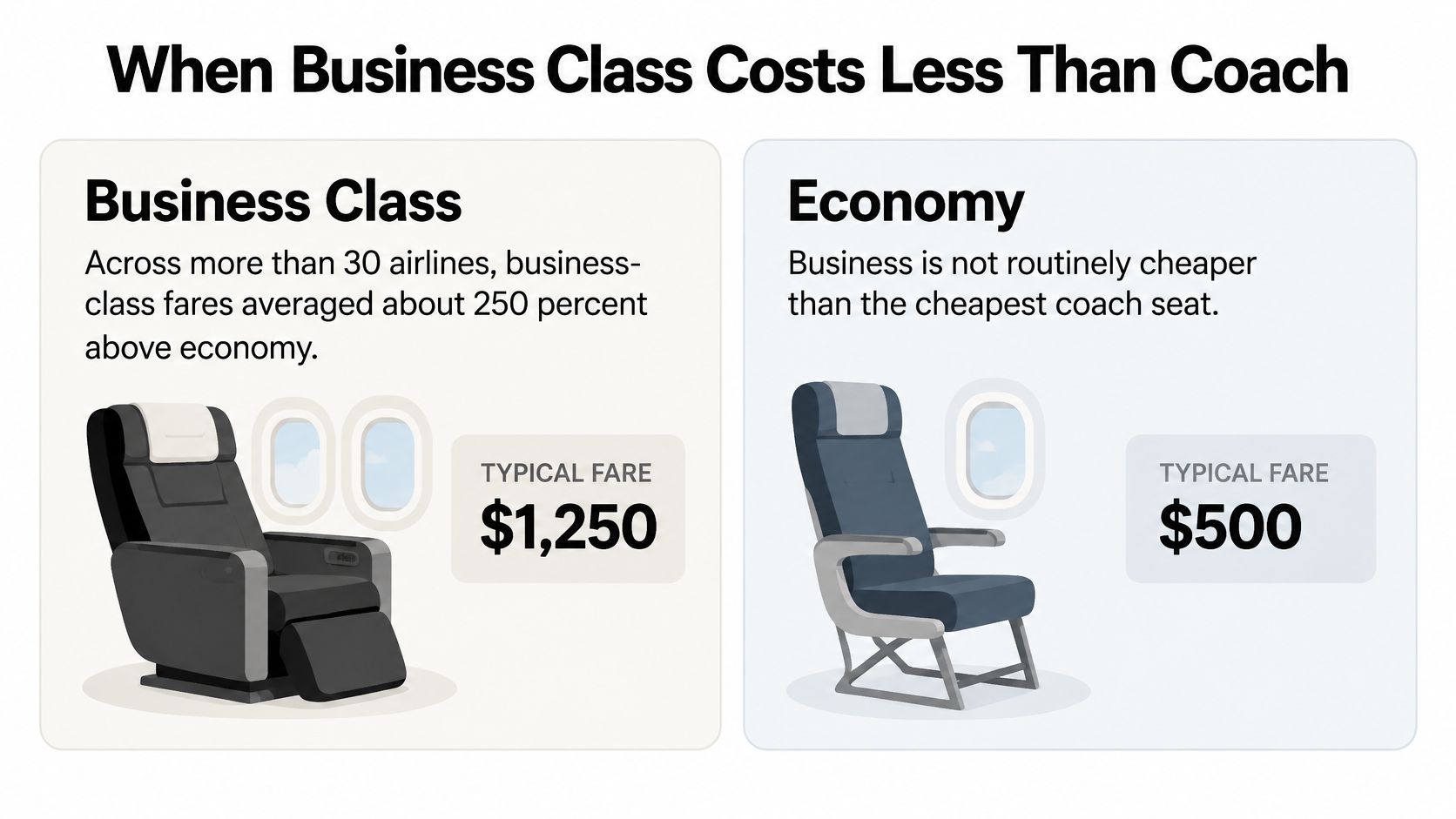
When Business Class Costs Less Than Coach
Business class does not routinely beat coach. A fare analysis covering more than 30 major airlines found business class tickets cost about 250% more than economy on average, according to Euronews reporting on affordable business class options. Anyone who promises that business is normally cheaper than the cheapest coach seat is selling you a headline, not analysis. The genuine opportunity is narrower and more useful.
The gap closes because airlines don't sell one economy price. They sell several coach products with different restrictions, and they discount business inventory at different times. A discounted business fare can therefore land near, or occasionally below, the flexible coach fare a corporate traveler would purchase. It rarely beats a highly restricted discount economy fare on the same flights. That distinction decides whether the claim is true.
The Fare Ladder Behind the Claim
The structure becomes clear in Travel Statistics Bureau first class flight research, covering 906 markets with all four contract fare categories. Median one way prices were $298.50 for capacity controlled discount economy, $751.50 for unrestricted economy, $1,800 for premium economy, and $4,000 for business. Business was therefore about 5.32 times the unrestricted economy median, while discount economy was less than half the unrestricted economy price.
Those medians aren't USA to India quotes, and you shouldn't budget from them directly. They explain the mechanism. When a traveler needs changes, bags, and a ticket that won't collapse if a meeting moves, the relevant coach comparator climbs fast. When a business fare is corrected downward or a lower fare class opens, the distance between that business quote and flexible coach can shrink to a few hundred dollars. At that point the lie-flat seat, lounge, and baggage can make business the rational purchase even under a tight policy.
| Fare product | Reference price | What is usually included | Valid comparison |
|---|---|---|---|
| Discount economy | $298.50 one-way median | Tight inventory and restrictions | Business almost never undercuts this |
| Unrestricted economy | $751.50 one-way median | Changes and fewer add-on traps | The coach fare to compare |
| Premium economy | $1,800 one-way median | More space, not a full lie-flat | Check whether the sale still justifies business |
| Business, typical | $4,000 one-way median | Premium cabin when the aircraft matches | About 5.32 times unrestricted economy |
| Business on a fare correction | Below the flexible coach total on that itinerary | Same cabin rules if the fare is not basic-style | Can undercut flexible or peak coach |
Avoid the Basic Economy Trap
Displayed coach prices create a second trap. United's India to United States deals page states its displayed economy prices may be Basic Economy, its most restrictive economy product, and additional baggage and optional service charges may apply. Comparing a full business fare with that headline understates the coach total and overstates the business premium. It also compares products a business traveler often can't use.
Run the same itinerary test instead. Use the same cities, same dates, same baggage need, and change terms you'd accept in coach. Add seat selection, bags, and any fee to protect the schedule. Then compare the business total on identical terms.
- Buy the cabin: The discounted business fare lands within a few hundred dollars of flexible coach and keeps a lie-flat long haul.
- Keep searching: Business beats only a restricted basic fare you wouldn't buy for work.
- Reject the quote: The business fare carries basic style penalties that erase the cabin advantage if plans change.
The conclusion changes here. You aren't hunting for business below every coach price on the internet. You're hunting for business below the all in cost of acceptable coach on your route. That's a smaller target, but it's real, auditable, and worth monitoring.
Time Your Search Without a Fixed Booking Date
A fixed booking window sounds tidy. It doesn't survive revenue management. Airlines open and close fare classes as bookings build, competitors move, and aircraft or schedules change. A traveler who buys only because a calendar says day sixty has arrived may purchase after the right fare class closed, or wait while the only acceptable nonstop loses its lower inventory.
Replace the date with a routine you can repeat each week. You're looking for a pattern on your route and season, then a quote that meets a threshold you set in advance. That approach works whether departure is months away or close enough that options are narrowing.
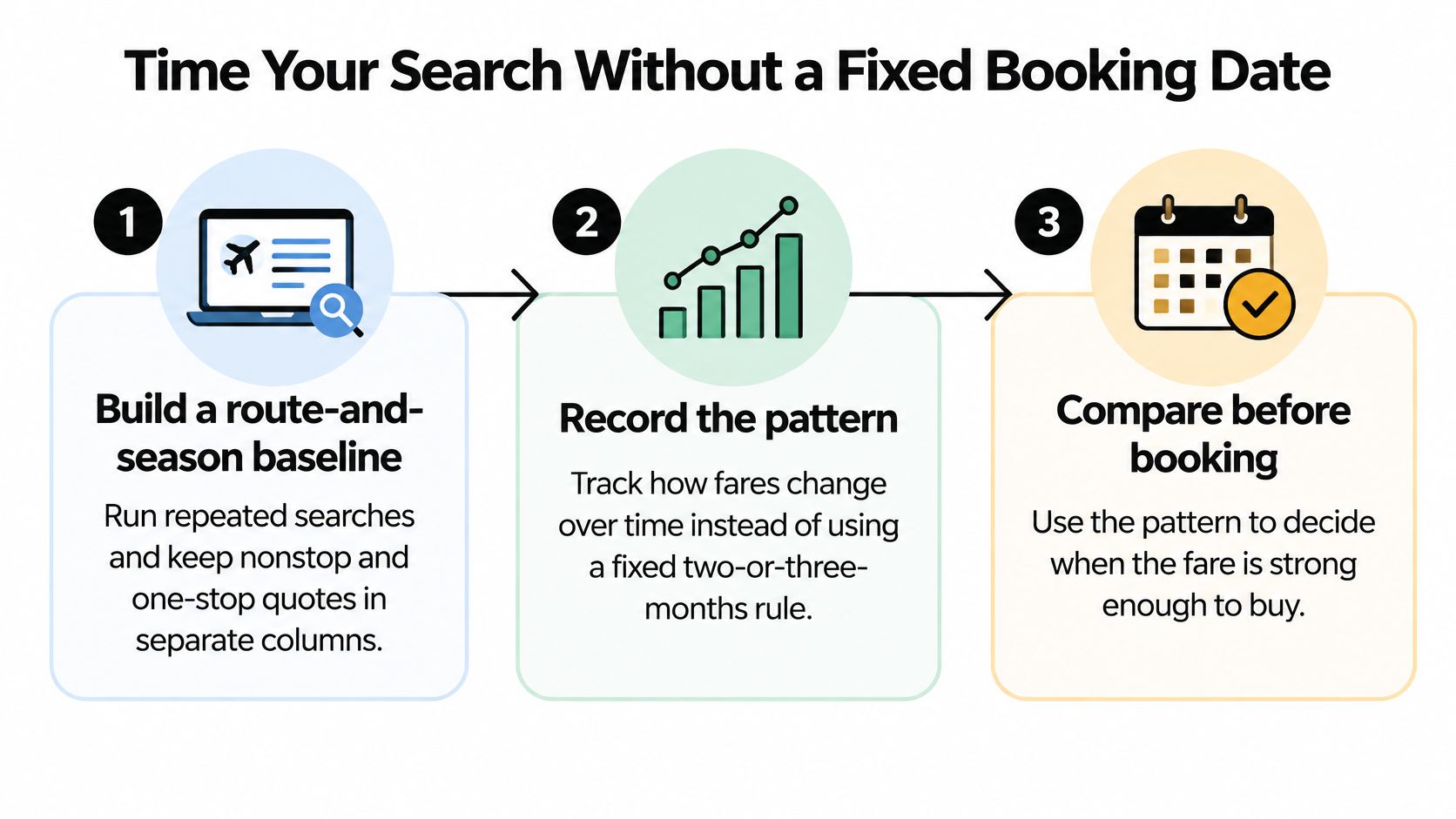
A Five Step Monitoring Routine
- Build a route and season baseline: Search the same city pair repeatedly and keep nonstop and one stop quotes in separate columns. Mixed averages hide the price of convenience.
- Record the right low fare: Log the lowest appropriately changeable business fare with a lie-flat long haul, not the cheapest use of the business label.
- Watch inventory signals: Note fare class changes, schedule changes, and seat map changes. A new aircraft or a disappearing nonstop can matter more than a small price move.
- Respect the late close: Expect cheaper inventory to tighten as departure nears, especially on business oriented flights.
- Treat a sudden drop as a signal: Log the quote, screenshot the rules if your process allows it, and verify before you celebrate.
Industry revenue management documentation in Aircraft Commerce Issue 34 on revenues describes airlines closing cheaper inventory roughly 5 to 12 days before departure on business oriented flights to protect late booking demand. The same source framework supports separating nonstop and one stop distributions and monitoring fare class availability. It also reports research in which, with 80% accuracy in distinguishing business from leisure requests, a simulated first mover airline achieved as much as a 17% revenue gain, primarily by offering lower leisure fares nearer departure.
That last finding explains why prices can move in ways that look irrational. The airline isn't pricing a seat in isolation. It's pricing your likely willingness to pay, flexibility, and channel. A colleague may see a different result for a similar search. A historical low therefore doesn't guarantee recurrence, and a price that's lower than yesterday isn't automatically low enough.
Set a Buy Threshold, Not a Hope
Define the threshold from three inputs. First, your ceiling from the current band. Second, your replacement cost if you wait and must buy flexible coach or a worse connection. Third, your minimum product standard, which should include a lie-flat bed on the long haul and a protected ticket. Buy when all three pass together. Wait when the price passes but the product fails.
A fare can be cheaper than yesterday and still be a bad purchase. Compare it with your threshold, not with your frustration.
Economy softness is another weak reason to delay. FCM Travel India's business travel insight reported international economy fares from India fell by an average of 4% in April to June 2024, while international business class fares fell by 1.5%. Coach moving down doesn't mean premium inventory will follow at the same pace. Track the cabin you'll buy.
Use practical tools to keep the log honest. A simple spreadsheet with date searched, travel dates, carrier, stops, aircraft, fare, and rules is enough for most travelers. Teams that want a structured view of how pricing may move can review airline fare prediction concepts and then apply that thinking to their own observed baseline. The tool doesn't replace the threshold. It helps you notice when a quote deserves immediate verification.
Finally, decide how often you'll search. Weekly checks suit early planning. Move to more frequent checks when schedules change, when a route loses frequency, or when your travel dates firm up. Consistency matters more than intensity. Ten scattered searches across different routings teach you less than five comparable searches on the itinerary you'd fly.
Choose a Gateway After the 2026 Capacity Cut
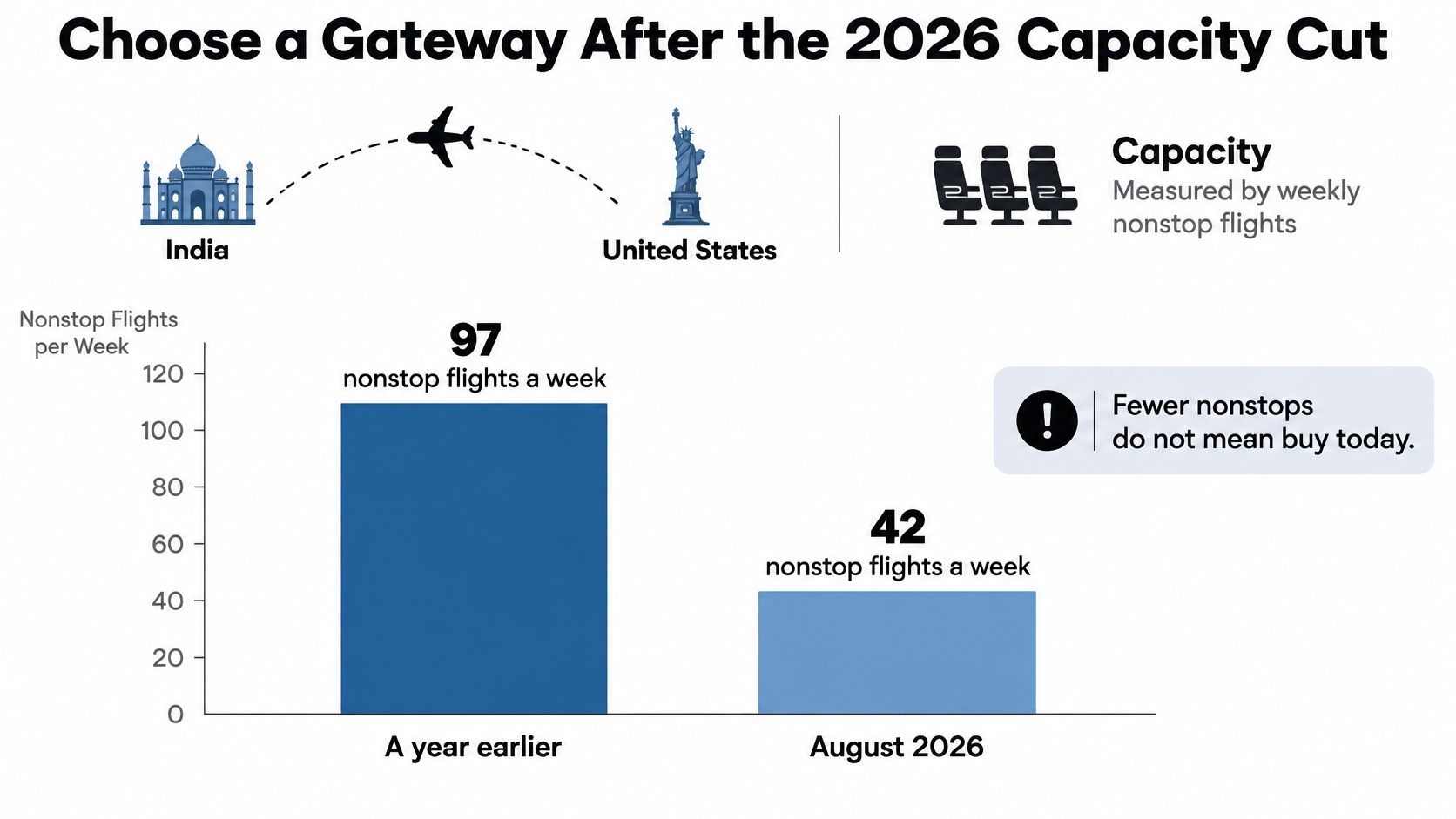
Fewer nonstops change the gateway decision. They don't create an order to buy the first premium fare you see. Rediff reporting on US visa pause travel disruption reported airlines operating 42 nonstop flights per week between India and the United States in August 2026, compared with 97 per week in August 2025, a reduction of roughly 56.7%. Weekly seat capacity fell from 28,860 to 12,096, a decline of 16,764 seats or approximately 58.1%, and the reduction was attributed entirely to Air India as its weekly flights decreased from 69 to 14.
Premium cabins amplify that shock because they contain far fewer seats than economy. Remove a frequency and you may remove a meaningful share of the lie-flat inventory on that city pair, even if total demand moves less. Remaining business seats can sell into higher fare classes sooner. But scarcity on one nonstop doesn't prove every one stop is expensive, and it doesn't make a fragile repositioning plan wise.
Where Demand Concentrates
New York is the practical center for many buyers. Skylux Travel's 2025 India business class trends analysis found New York accounted for 22.55% of business class departures to India in its 2025 booking analysis. That concentration supports more comparison options, but it doesn't guarantee your date has the right nonstop or aircraft. Verify the schedule for your week before ranking gateways.
Flight time also changes the value calculation. AirTripMaker's India to USA business class route guidance indicates approximately 15 to 16 hours each way for nonstop New York to Delhi or Mumbai to New York services, with Delhi to San Francisco taking roughly 17 hours nonstop. On sectors that long, a lie-flat bed and a protected itinerary aren't luxuries. They're the product you're paying to secure.
Compare Three Scenarios Honestly
Say you're based near Chicago and the nonstop isn't scheduled in your week. Option one is a one stop on a single ticket with a lie-flat long haul. Option two is a separate domestic ticket to JFK, then a nonstop. The second option can look cheaper until you price a misconnection. If the domestic flight is late, the long haul carrier on a separate ticket may treat you as a no show. Add a hotel, a new ticket at walk up prices, and a missed meeting, and the saving disappears.
California travelers face a similar trade. A West Coast nonstop, when scheduled, saves a connection but may command a premium. A one stop through Europe, the Gulf, or the East Coast on one ticket protects the connection and may offer a better cabin. Reject a cheaper alternative that requires an overnight you didn't budget, drops the lie-flat segment, or depends on a same day separate ticket. Those aren't minor inconveniences. They're unpriced risk.
| Traveler | Strong default | Cheaper alternative | Cost that can erase the saving |
|---|---|---|---|
| New York area | Nonstop JFK to Delhi, about 15 to 16 hours, when scheduled | A one-stop only if the long-haul is lie-flat and protected on one ticket | A long connection or a non-lie-flat sector |
| Chicago or Washington | Whichever nonstop is scheduled that week | Reposition to JFK on one protected itinerary | A same-day domestic connection or a separate ticket |
| California | Nonstop only when a West Coast flight is actually scheduled | One-stop via Europe, the Gulf, or the East Coast on a single ticket | A separate domestic ticket, an overnight stay, or a schedule change |
Price the reposition in full before you rank it. Include the domestic fare, checked bag transfer risk, an extra night if you protect yourself properly, ground transport, and the business cost of arriving a day late. Many travelers discover the protected one stop is cheaper once risk is priced. Others find the nonstop premium is justified because arrival time drives revenue or family obligations. Either conclusion can be right. The error is comparing only headline fares.
Capacity discipline also helps travel managers explain choices. Reviewing airline capacity management principles can clarify why frequency cuts tighten some fare classes faster than others. Apply that logic route by route. A gateway with fewer flights but strong one stop competition may still produce a fair business fare. A gateway with a single remaining nonstop may require earlier action once your threshold is met.
Gateway rule: Never let a separate ticket carry the risk for a long haul meeting you can't miss. Buy protection on one ticket or build a buffer night into the true cost.
Check each gateway on your exact dates, not from memory. Schedules after a cut can differ by weekday, and aircraft swaps can change the cabin. The best gateway is the one that delivers a lie-flat, protected itinerary inside your ceiling with the least failure cost. Sometimes that's JFK. Sometimes it's a disciplined one stop from home.
Check the Fare and Decide Before You Buy
Assume the price already looks attractive. Now test everything else, because premium inventory can move while you deliberate. The Tribune's report on India's IATA 2024 statistics reported that of 1.95 billion international passengers in 2024, 116.9 million, approximately 6%, traveled in first or business class. Premium travelers are a thin slice of total traffic. A good business fare class can close while economy still looks wide open, so your checks need to be fast and ordered.
Verification starts before payment, while you still have a choice between the quote and your baseline.
Five Pass or Fail Checks
1. Operating carrier matches the product you priced. A marketed flight number can hide a partner operated segment with a different seat, lounge arrangement, or service standard. Read the operating carrier on every leg, especially the long haul. If the operator changes, restart the product check for that aircraft. Don't assume alliance membership makes cabins interchangeable.
2. Seat map proves the bed. Look for a lie-flat 1-2-1 layout with direct aisle access on the long haul aircraft scheduled for your date. Older 2-2-2 or 2-3-2 layouts can force climbing over a neighbor and reduce privacy on an overnight sector. The business label alone doesn't guarantee bed length, storage, or aisle access. Check the exact aircraft again after any schedule change, because equipment swaps can downgrade the experience without changing the cabin name.
3. Fare construction is confirmed. Read the ticketing time limit, refundability, advance purchase rule, and minimum or maximum stay. A low quote with a short ticketing deadline may vanish before approval. A fare that requires a stay pattern your trip can't meet isn't available to you in any practical sense. Note the fare basis in your log so a later agent or approver can see what you priced.
4. Included items match your needs. Confirm checked baggage, lounge access, seat selection, and change penalties on that exact fare. Some lower premium fares restrict changes more than travelers expect. Others include services a company would otherwise buy separately. Tickets bought through Passport Premiere have characteristics consistent with open market terms, including flexibility and mileage accrual, regardless of final fare level, but you should still confirm the specific fare in front of you before relying on any general description.
5. A change won't reprice the whole trip unexpectedly. Ask how a date change is calculated. Some itineraries reprice the entire journey at current levels when one segment changes, which can turn a modest penalty into a large fare difference. Review the carrier imposed international surcharge treatment in the total as well, so taxes and surcharges don't surprise you when comparing a reissue quote with the original purchase.
Watch the Product Before You Commit
A short video walkthrough can help you visualize what to verify on the seat map and booking screen before you pay.
Use the video as a prompt, not as proof for your flight. Your proof is the aircraft type, seat map, and fare rules attached to your reservation. If a seller can't identify the operating carrier or shows a generic cabin photo instead of your flight's layout, pause. A Business Class Flight USA to India is too long and too expensive to buy on a stock image.
The Three Part Buy Rule
Buy only when three tests pass together. First, the round trip sits inside the ceiling you set from the shoulder or peak band. Second, the itinerary keeps a lie-flat long haul on one ticket with a connection time and arrival pattern you can survive if the first flight runs late. Third, the change, refund, and baggage rules match the flexible coach fare you were willing to buy. If all three pass, waiting for a slightly lower number exposes you to inventory loss for limited upside.
If any test fails, keep the baseline and wait. A lower number that adds an overnight, removes the bed, or imposes a basic style penalty isn't a saving. Write down which test failed. That note prevents you from re-litigating the same quote tomorrow under deadline pressure and helps a manager understand why you didn't buy the cheapest result.
Member experience shows why the comparison must stay on acceptable terms. One customer said, “I used Passport Premiere for an international flight between Melbourne and New York and managed to obtain a business seat for the price of an economy.” That outcome is plausible under the flexible coach test. It isn't a guarantee for India, and it shouldn't set your ceiling. Passport Premiere members receive the greatest benefits for business class travel between the U.S. and Europe, Asia, Africa, Australia, Latin America and the Middle East, which includes the USA to India corridor, but route, date, and inventory still decide each result.
Final check: If you can't name the operator, aircraft layout, and change cost in one sentence each, you aren't ready to buy.
Your next action is concrete. Log today's best baseline itinerary with its ceiling, product standard, and rules. Set your search cadence. When a quote hits the ceiling, run the five checks in order and buy only if the three tests pass together. That process won't make every business fare cheap, and it won't make business beat discount coach. It will stop you overpaying for the wrong premium ticket, and it will let you recognize the occasional fare that beats acceptable coach when it appears.
Set your ceiling, log one protected lie-flat baseline for your USA to India dates, and let Passport Premiere help you monitor premium fares against that standard so you can act when a qualifying drop appears. Visit Passport Premiere to review how its membership based fare monitoring and market insight can support your next business class purchase without asking you to accept the first quote.
