
Fewer than 15% of premium-cabin seats sell at their initial asking price, and business class can cost less than coach on specific routes. Airline revenue management creates these buying events by adjusting fare classes, restrictions, and seat availability rather than following a simple cabin-wide price ladder.
That sounds counterintuitive after years of seeing business-class fares displayed at several times the economy price. Yet the cheapest seat isn't always in the cheapest cabin. A flexible economy ticket can remain expensive while a restricted business fare opens at a lower price, especially when an airline needs to improve premium-cabin occupancy.
The important question for business class flights to the Philippines is not just when to book. It is which fare bucket is open, which gateway you're using, and what the ticket includes.
Why Business Class Flights to the Philippines Can Be Cheaper Than Coach
Airlines don't price every seat according to comfort alone. They divide the aircraft into booking classes, attach different restrictions to each class, and release inventory according to expected demand. A business cabin with unsold seats near departure may therefore contain a lower-priced fare while economy inventory remains available only at a higher flexible rate.
A published pricing illustration shows the mechanic clearly. A full-fare economy ticket in booking class Y may cost $2,000, while a discounted business ticket in class I or Z may cost $1,500, making the business fare $500, or 25%, cheaper. That example isn't a guaranteed Philippines fare, but it demonstrates why cabin labels alone don't determine the final price. Fare class, advance-purchase rules, and remaining inventory matter just as much. The fare-class illustration explains this economy-versus-business relationship.
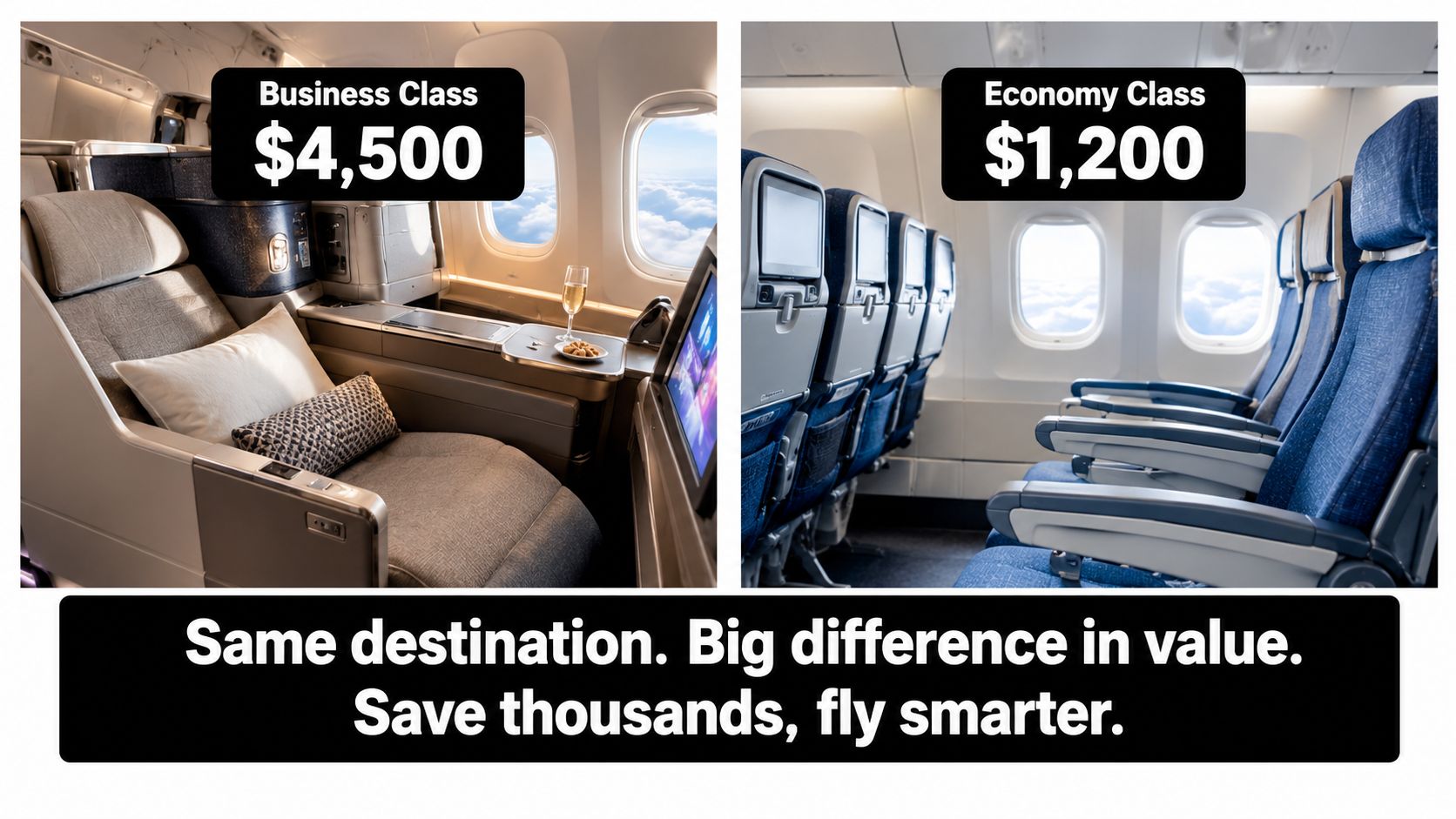
The fare bucket matters more than the cabin label
Philippine Airlines publishes multiple economy and business booking classes on Philippines to Korea itineraries. Economy includes O and U for Economy Supersaver, T, E, and K for Economy Saver, X, B, V, and Q for Economy Value, and H, M, L, S, and Y for Economy Flex. Business includes Z and I for Business Value, plus D, C, and J for Business Flex. The airline's published fare rules show the separate booking classes and conditions.
That structure creates the opportunity. A lower business bucket can be open while the cheapest economy buckets have sold out. The reverse can also happen, so there isn't a universal rule that business will undercut coach. You need to compare the live product, not just the displayed cabin name.
The cheaper business fare usually carries a trade-off. It may require advance purchase, restrict changes, offer limited refunds, or have less favorable upgrade and mileage treatment. A flexible economy fare may cost more because you're paying for freedom, not because the seat itself is more valuable.
Practical rule: Compare the complete fare product, including baggage, change conditions, refundability, connection quality, and fare class. A lower headline price isn't a saving if the ticket fails your travel requirements.
Airlines also use premium inventory strategically. A revenue-management model studied 10 fare classes, with four assigned to premium inventory and six assigned to economy. In the tested scenario, the lowest premium class overlapped with higher economy classes, while some economy classes remained available until departure. The airline revenue-management study details how fare-class overlap can occur.
The result is a different buying mindset. Don't ask whether business class is normally expensive. Ask whether a particular business fare is temporarily misaligned with the economy inventory on your route.
Mastering the Fare Monitoring Workflow
A good fare search is a record-keeping exercise, not a sequence of emotional checks after midnight. For Manila, Cebu, or another Philippine destination, start by defining the acceptable origin airports, arrival gateways, travel dates, and minimum cabin standard. Then track the same product over time.
A rolling benchmark should begin at least 21 days before departure for Manila-bound corporate travel. Airlines commonly use advance-purchase restrictions ranging from zero to 21 days, so this window helps reveal whether a fare is responding to a meaningful inventory change or merely appearing under different conditions. The airline-search research discusses premium pricing, advance-purchase controls, and late-search behavior.
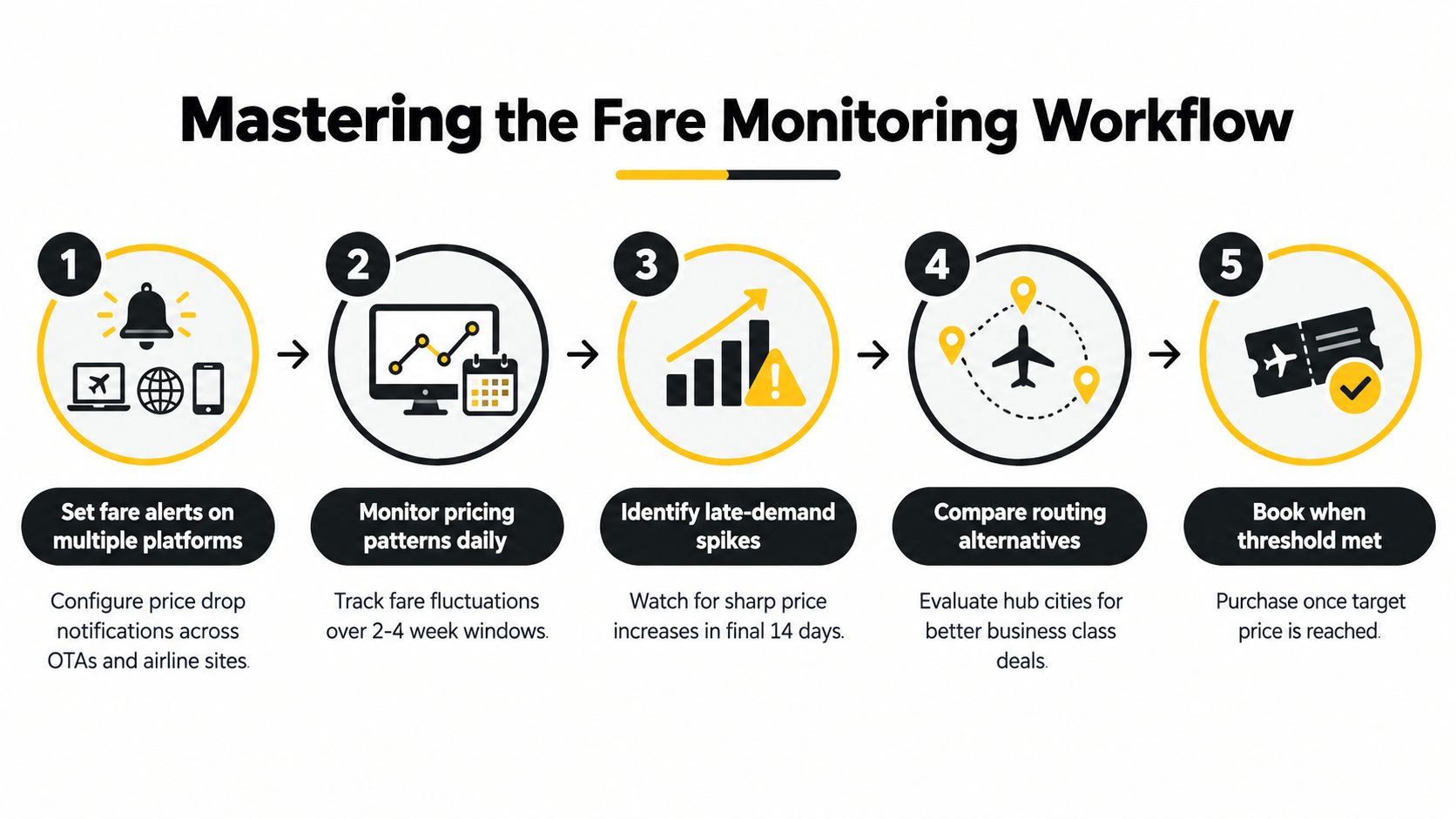
Build a like-for-like comparison
Record the lowest all-in fare for each travel date, then attach the details that make the comparison meaningful. A cheap fare with a long overnight connection isn't equivalent to a higher fare on a protected daytime itinerary.
Use a simple tracking sheet with columns for:
- Travel date: Record the outbound and return dates, not just the search date.
- Routing: Note nonstop, one-stop, and multi-airport options separately.
- Fare class: Capture the booking code where the airline or agency displays it.
- Baggage: Confirm the allowance rather than assuming every business ticket has identical terms.
- Rules: Record change fees, fare difference provisions, refund conditions, and no-show restrictions.
- Connection quality: Track elapsed time, airport changes, terminal transfers, and whether the airline protects the onward sector.
- Seat and aircraft: Check whether the long sector has the expected premium product.
Recheck the same fare basis across multiple departure windows. A Tuesday departure and a Friday departure may expose different inventory, but comparing them only makes sense when you know whether the fare rules and routing are equivalent.
Read late demand correctly
Premium-cabin searches rise as departure approaches, and late premium searches can convert at rates up to five percentage points higher than earlier searches. That pattern is a warning that inventory may tighten. It isn't evidence that waiting will produce a discount.
Buy when the fare is materially below your recent route benchmark and the itinerary meets your minimum standards. Don't wait for a mythical perfect low if the current fare already fits the budget and policy. Conversely, don't buy a nominal bargain that removes baggage protection or creates an unsafe connection.
A practical threshold might include a maximum acceptable elapsed time, a protected connection, and a minimum change policy. Corporate travelers should also note whether the fare can support schedule disruption, client changes, or an unexpected return date. The best buying event is useful only when the ticket remains operationally suitable.
Optimizing Routing Hubs and Gateway Selection
Manila is the obvious starting point, but it isn't always the best ending point. The Philippines' international demand is distributed across major regional corridors, and many travelers ultimately need Cebu, Davao, or another domestic destination. A lower fare to Manila can become an inferior trip after a domestic transfer, terminal change, or unprotected connection.
The Philippines' international aviation market shows why hub selection matters. In 2023, international traffic represented 30% of all origin-destination passenger departures, or 12.3 million departing passengers. Asia-Pacific destinations accounted for approximately 7.9 million, or 65% of the international total. North America represented about 1.7 million passengers, with a 14% share, while the Middle East accounted for roughly 1.5 million, or 12%. IATA's Philippines aviation analysis identifies these principal demand corridors.
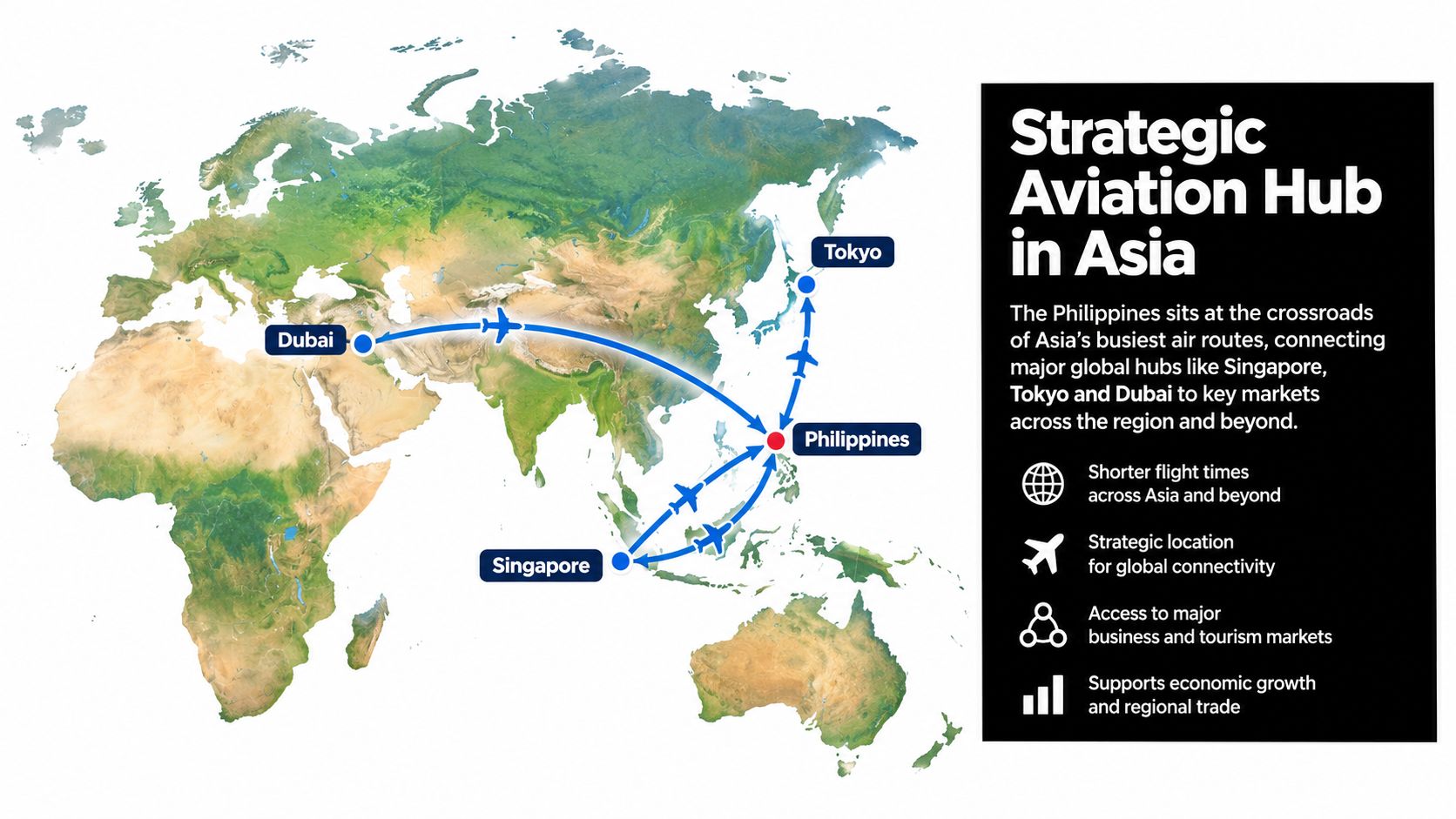
Regional hubs often deserve the first search
Singapore, Hong Kong, Tokyo, Seoul, and Bangkok can provide more than an alternative flight path. They may expose a different set of airline fare classes, aircraft, schedules, and premium inventory. For a traveler originating in Asia-Pacific, a one-stop itinerary through one of these hubs may deliver a better business-class product than a supposedly direct option from a less competitive market.
North American gateways serve a different purpose. They can make sense when the origin is already in the United States or Canada, or when a through-ticket protects the entire journey to Manila. Middle Eastern hubs can be useful for travelers connecting onward to Europe, Africa, or destinations beyond the Philippines, although total elapsed time and transit requirements must be checked carefully.
NAIA remains the central reference point for international premium travel. Passenger traffic reached 47.9 million in 2019, after growing at a compound annual rate of 7% from 2014 through 2019, while the airport's stated annual capacity was 33.2 million. NAIA handled 50,356,465 passengers in 2024, compared with 45,299,607 in 2023 and 30,961,467 in 2022. The airport's traffic and network history illustrates Manila's scale and capacity pressure.
That scale doesn't automatically make Manila the right gateway. It makes Manila the airport you should benchmark against.
Compare the whole journey, not just the long sector
A traveler bound for Cebu might compare a through-ticket to Manila with a routing through Tokyo, Seoul, Hong Kong, or Singapore. The right choice depends on protected connections, domestic-sector cabin quality, baggage transfer, terminal movement, and whether the schedule forces an overnight stay.
An open-jaw itinerary can also reduce backtracking when the trip begins and ends in different Philippine gateways. This guide to open-jaw flights is useful when a single return airport creates unnecessary domestic travel.
Check these factors before accepting a lower fare:
- Protected connection: A through-ticket generally offers stronger disruption protection than separate tickets, though the exact terms still need review.
- Airport transfer: A connection requiring a terminal or airport change can erase the comfort advantage of a premium seat.
- Domestic segment: Don't assume a short Philippine sector offers the same business-class experience as the international flight.
- Total elapsed time: Compare door-to-door productivity, not only airborne time.
- Duty of care: Corporate policy may favor a slightly higher fare if it reduces self-transfer exposure and makes disruption handling clearer.
A video walkthrough can help visualize the geography and connection patterns before you compare live fares.
Navigating Paid Fares Versus Award Strategies
Cash and miles solve different travel problems. A discounted paid business fare can be the better choice when it falls below your route benchmark, earns useful status credit, includes the baggage and flexibility you need, and is available on a dependable itinerary. An award may offer more value when cash prices remain high, the date is fixed, or premium seats are scarce during a peak period.
The mistake is valuing miles alone. Compare the points required, taxes, carrier charges, cancellation rules, award availability, and the cash fare those points would replace. Cash can also suit corporate travelers who need a conventional receipt, predictable changes, or a booking that fits the employer's approved channel.
When a mistake fare changes the calculation
Mistake fares are rare pricing errors caused by an incorrect fare filing or another airline pricing problem. Reports of mistake fares describe reductions as high as 90%, with business-class error fares occasionally appearing for under $300, as explained in Going's guide to the mechanics and risks of business-class mistake fares.
Treat these fares as opportunities rather than dependable inventory. Check the ticketed itinerary, passenger names, cabin, fare conditions, baggage, cancellation terms, and ticket issuance before making plans. A reservation that appears in a booking system may not be a confirmed ticket. Do not schedule a client meeting around an unissued fare.
A simple cash-versus-award decision
Use cash when:
- The paid fare is below the route benchmark: A genuine buying event can preserve miles for a harder redemption.
- The itinerary is operationally strong: A protected connection and workable schedule can justify paying instead of chasing award space.
- The ticket rules matter: Corporate travelers may need change or refund provisions unavailable on the cheapest award.
Use miles when:
- Cash inventory is unusually expensive: Awards can preserve value while paid fares remain high.
- The date is inflexible: A confirmed redemption may be safer than waiting for a cash drop that never arrives.
- The premium cabin is constrained: Miles can provide an option when no sensible paid fare exists.
The better strategy depends on the complete trip cost, including fees, flexibility, time, and the value of the points surrendered. A low cash fare is not automatically better, and a low mileage price is not automatically a bargain. Check the product, restrictions, and operational reliability before choosing.
Leveraging Intelligence Services for Corporate Travel
Manual monitoring can work for one important trip. It becomes difficult when a travel manager supports consultants, executives, and recurring international routes at the same time. The challenge is not just finding a low fare. It is determining whether the price reflects a genuine buying event, a temporary inventory release, or a different and more restrictive product.
Revenue-management systems constantly adjust fares by route, cabin, booking class, departure date, and remaining inventory. A specialized service can combine fare monitoring, market analysis, and member knowledge into a repeatable signal. Passport Premiere, for example, monitors international premium fares and helps members identify discounted business-class opportunities, including routes involving Manila and North American gateways. Its practical value is surfacing fare changes, booking classes, and restrictions that a busy traveler may miss during routine airline searches.
What a buying event should prove
A useful alert should provide enough detail to support a decision, not merely announce a low number. Before sending the fare for approval, confirm:
- Is this the same cabin and fare class?
- Does the ticket include the required baggage and change conditions?
- Is the route protected from origin to destination?
- Does the fare work with corporate booking and approval rules?
- Is the price low enough to act on now, rather than continue watching?
The phrase Business Class Buying Event works when it identifies a specific opportunity to purchase premium inventory at an unusually favorable fare. It should not suggest that every alert will beat economy or that an airline has promised a discount. Revenue-management conditions change quickly, and inventory may disappear before a traveler completes approval or ticketing.
For travel managers, corporate travel cost savings guidance becomes useful when translated into policy. Set an approved fare ceiling, define acceptable gateways, require protected connections for critical trips, and document when an employee may select business class instead of a cheaper itinerary that creates a material scheduling or operational problem.
For policy owners: Measure the itinerary against total travel value, not cabin price alone. A fare that protects a consultant's working day may be preferable to a cheaper ticket that creates an overnight connection or an exposed self-transfer.
Membership-based monitoring still has clear limits. No service can guarantee inventory, remove fare restrictions, or force an airline to keep a price available. The case for using one is time and pattern recognition. If it helps a team spot the right fare class before it disappears, it can support disciplined purchasing while leaving approval authority with the company.
Avoiding the Hidden Costs of Premium Cabin Travel
The lowest business-class fare can still carry expensive trade-offs on the ground. A connection may require a terminal change, a second security screening, or an overnight wait. For a Philippines itinerary, compare those costs with the value of the lie-flat sector before approving the fare.
NAIA's scale makes terminal position, lounge capacity, and connection timing practical cost checks. NAIA's published traffic history provides the airport context. Check whether the itinerary leaves enough time for immigration, baggage, and a protected onward sector, rather than assuming a low fare includes a workable transfer.
Lounge access also depends on the fare and operating airport. Philippine Airlines says eligible international business-class passengers may use Mabuhay Lounges, but travelers must verify the applicable flight, airport, facility, and operating hours. The airline's lounge guidance explains the conditions travelers need to verify.
Before ticketing, confirm whether the lounge is operated by the airline, a partner, or a contract provider. Check guest rules, terminal location, opening hours, showers, workspace, and whether another security check is required. A codeshare can also change lounge eligibility after the fare appears attractive.
The final test: Choose the itinerary that minimizes total friction, not the one with the lowest cabin price.
For travelers continuing beyond Manila, baggage protection and domestic-sector quality may matter more than another meal choice. Corporate travelers should also weigh connection reliability, productive work time, and duty of care. A Business Class Buying Event can reduce the cabin price, but it does not remove ground costs or operational risk.
Passport Premiere monitors international business and first-class fares and tracks fare cycles. Visit Passport Premiere to review its fare-monitoring approach for Philippines routes and corporate travel policies.
