
A dated September 2026 snapshot puts the one-way business class ticket price from India to Canada at roughly US$1,700–US$4,500, with fares changing by route, timing, and inventory. Business class is cheaper than coach only in exceptional fare anomalies, not as a normal India–Canada pricing pattern.
You might be comparing a connecting departure from your home city with a nonstop from Delhi, wondering whether the difference buys meaningful convenience or an expensive search result. The useful question isn't just what business class costs. It's whether the available fare buys the routing, flexibility, and arrival schedule you need.
Why Two Business Fares Can Differ Sharply
Consider two colleagues traveling to Canada for the same meeting. One searches from Bengaluru and accepts a connection; the other searches from Delhi and wants a nonstop. Their results may be separated by thousands of dollars, even though both selected business class.
That's a hypothetical booking situation, not a customer case study. But it illustrates the central comparison problem: a cabin label doesn't make two itineraries equivalent. Departure airport, airline, connections, travel date, and ticket conditions all need to be examined before calling either quote expensive.
Compare the journey, not just the cabin
Start by separating what the traveler needs from what the airline happens to offer. A Delhi nonstop may be attractive to someone already in Delhi, but less compelling to someone who must arrange a separate journey there. Conversely, a connecting itinerary from the traveler's home airport may be more practical than its longer published duration initially suggests.
Use a short comparison sheet:
- Starting point: Compare the full journey from your actual location, not just the international departure airport.
- Arrival requirement: Establish whether the itinerary gets you to the meeting or hotel at an acceptable time.
- Ticket conditions: Identify which changes and cancellations the quoted fare permits.
- Cabin coverage: Check the booked cabin on every flight rather than relying on the search-result headline.
These checks don't predict the next price movement. They establish whether the options deserve to be compared at all.
Practical rule: Treat the first quote as an available offer, not a verdict on what the route should cost.
The broad opening benchmark is useful for orientation, but it isn't a promise that a suitable seat will be available within it. Nor should a fare outside it automatically be rejected without examining the dates and conditions.
The decision is therefore sequential: first identify acceptable journeys, then compare their live prices. That prevents an unsuitable low fare from becoming the benchmark against which every workable option looks overpriced.
Understanding the India–Canada Fare Range
Business-class inventory is easier to understand if you think of it as a small hotel inside a much larger aircraft. The aircraft may have plenty of passengers overall, while the premium cabin has only a limited collection of berths available for sale. A full-flight headline tells you little about the price of the particular space you want.
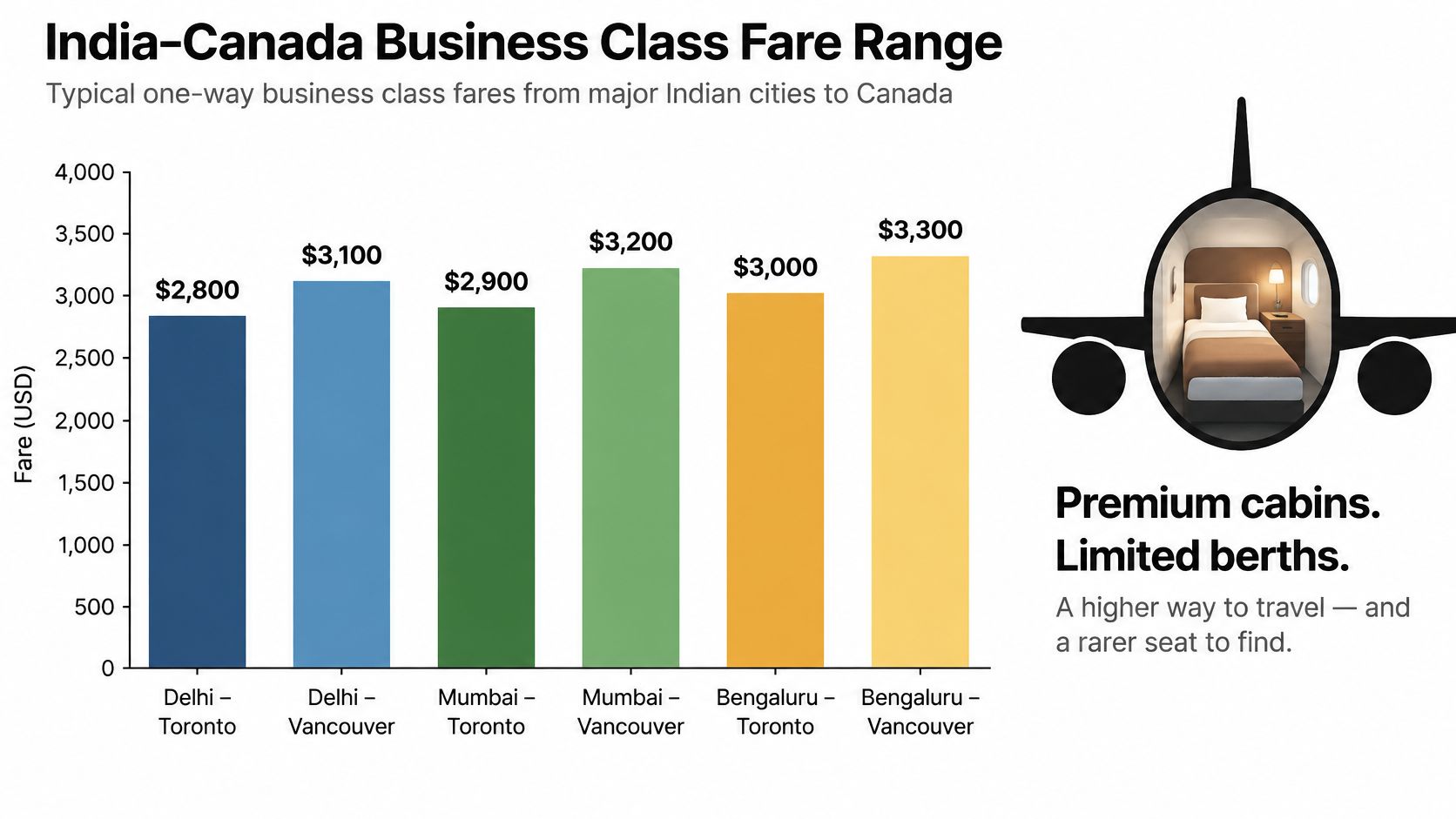
The dated fare comparison illustrates the breadth of the market. For one-way travel in September 2026, connecting itineraries were listed from approximately US$1,767 from Hyderabad, US$1,772 from Bengaluru, and US$1,873 from Mumbai; a Delhi nonstop was about US$2,470, while the highest observed fare was roughly US$4,516, approximately 83% higher than that Delhi example, according to the India–Canada business-class fare snapshot.
Those observations don't establish permanent city rankings. They combine different origins and route structures, so they can't isolate how much of the difference came from the departure city, the connection, or the inventory available when the search was made.
The route-comparison graphic provides a visual orientation, but its illustrative city-pair values shouldn't replace a dated, bookable quote.
Turn the range into a usable comparison
A sensible baseline needs consistent units. Keep one-way and round-trip searches separate, identify the payment currency, and record the final amount rather than a preliminary search display.
| Comparison field | What to record |
|---|---|
| Journey basis | One-way or round trip |
| Currency | Currency displayed and currency charged |
| Routing | Departure city, destination, and connections |
| Total price | Final payable amount and included services |
For a closer examination of the ticket breakdown, review the explanation of carrier-imposed international surcharges alongside the airline's own checkout details. Don't infer the final payable amount from the base fare alone.
Currency also deserves a separate check when your budget, card account, and airline quote use different denominations. Africhange's guidance on how to find the best currency rates provides a useful comparison resource; use the conversion terms available to you rather than assuming a headline exchange rate will be your actual payment rate.
The analytical takeaway is straightforward: the range helps you recognize a candidate fare, while the complete quote determines whether it's valuable.
Compare Nonstop and Connecting Options
A nonstop premium is easiest to justify when a traveler has a hard arrival deadline. A connecting fare deserves closer attention when the traveler can accept a longer journey. Neither choice is automatically the better purchase.
Keep the origin-city decision separate from the routing decision. Comparing Bengaluru with a connection against Delhi nonstop changes both variables simultaneously. To understand the trade-off, search nonstop and connecting options from the same feasible origin where possible, then examine alternative departure cities separately.
Nonstop and Connecting Business-Class Decisions
| Option | Price Pattern | Time and Convenience | Key Trade-Off |
|---|---|---|---|
| Nonstop from your home city | May carry a convenience premium | No intermediate transfer | Higher expenditure may buy a simpler journey |
| Connecting flight from your home city | May offer a lower headline fare | Requires an intermediate airport transfer | Savings must justify elapsed time and connection exposure |
| Nonstop from another Indian city | Depends on both origin pricing and the onward flight | Requires reaching that departure airport | Assess the complete journey, not just the long-haul sector |
| Longer or multiple-stop itinerary | Can produce another fare option, without guaranteeing savings | More stages to evaluate | Additional complexity may outweigh the discount |
For connecting options, examine the exact operating flights, transfer arrangements, and scheduled intervals. A business-class label alone doesn't establish that each segment offers the same experience. Use a multiple-leg flight comparison as a starting point, then verify the itinerary's actual conditions.
A consultant arriving for a fixed meeting should ask whether the cheaper itinerary leaves an acceptable margin before the appointment. A leisure traveler might make a different choice, accepting an extended journey if the saving remains worthwhile after considering the whole trip.
A nonstop is worth its premium only when the convenience it provides matters to the traveler purchasing it.
Put your own value on the difference
Don't assign a universal monetary penalty to a connection. Instead, ask the traveler or travel manager to define acceptable journey duration and arrival timing before reviewing prices.
That changes the buying question from “Which result is cheapest?” to “Which acceptable result costs least?” It also prevents a low but impractical fare from distorting a corporate approval discussion.
Where the cheaper option remains acceptable, there's no analytical reason to pay extra merely because another itinerary is nonstop. Where it fails the schedule requirement, it isn't a genuine substitute.
See How Seasonality and Demand Move Prices
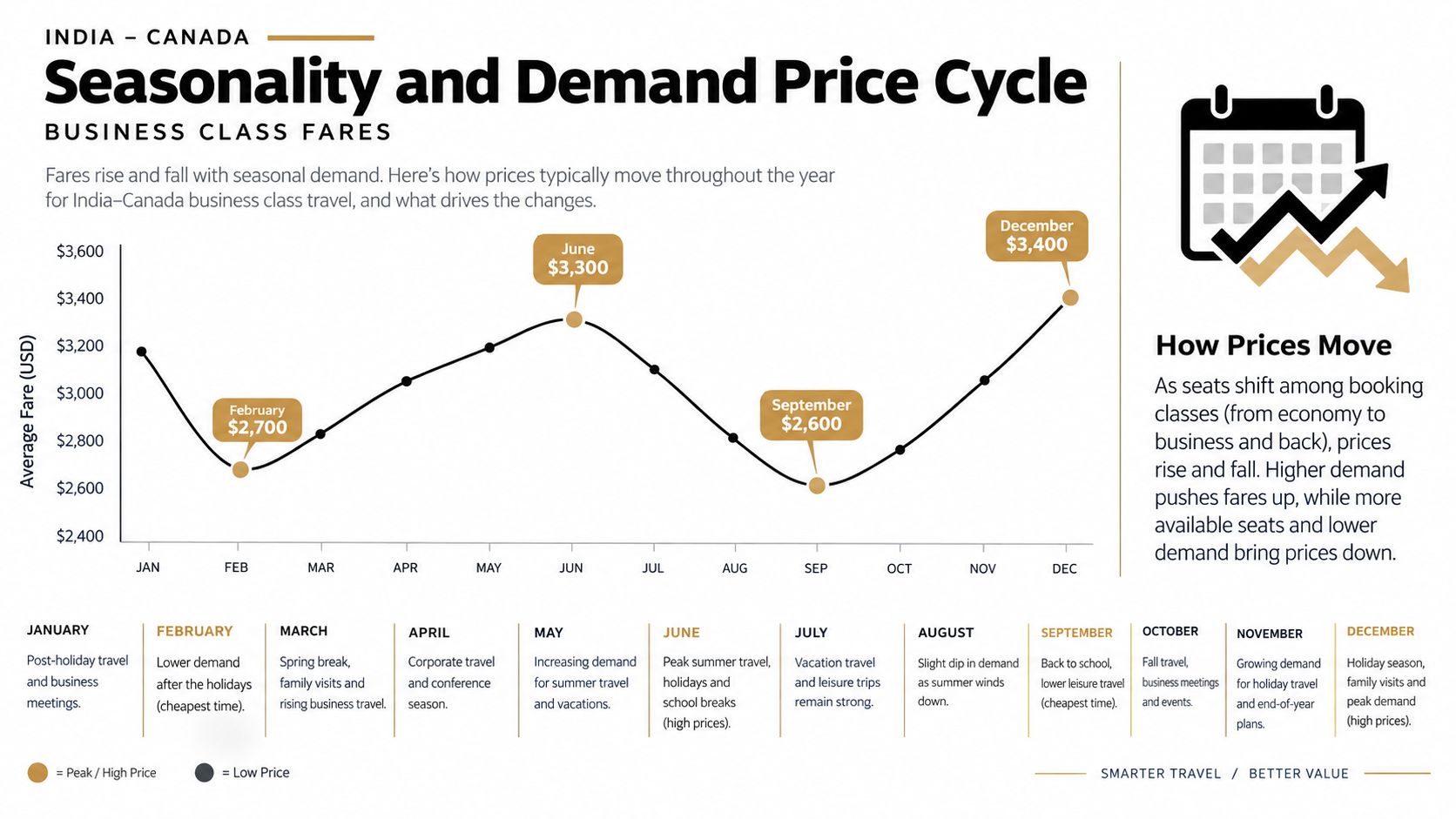
Think of a fare chart as a record of offers available at different moments, not a smooth calendar-based discount schedule. The important distinction is between an observed seasonal pattern and a rule you can safely use for a future purchase.
The dated comparison cited earlier reported fares around US$3,750–US$3,813 from September through November, followed by an approximately 16% decline from December through June, with a low near US$3,195 in mid-February. Those are observations from that comparison, not permanent monthly tariffs.
The seasonal illustration below is conceptual. Its plotted values shouldn't be treated as the numerical observations described above or as a forecast for your departure.
Why the calendar isn't enough
Airlines don't sell every business ticket under identical conditions. Academic research using international flight-level data examines how fares vary by cabin, purchase timing, market, and passenger purpose, supporting the distinction between a flexible corporate purchase and a price-sensitive leisure purchase in the Review of Economic Studies analysis of airline pricing.
For a buyer, that means a seasonal average is only background context. The relevant offer still depends on which fare conditions are available for the requested itinerary.
Consider the difference between these searches:
- Fixed corporate trip: The traveler must arrive before a particular appointment and may need to change the return.
- Flexible holiday: The traveler can move the departure date and accept restrictive conditions.
- Recurring business travel: The organization can compare several future trips rather than judge each quote in isolation.
These are different purchasing requirements, even when the destination is identical. A calendar recommendation that ignores those differences isn't a reliable buying method.
Use seasonality to widen the search
The useful response to a seasonal pattern is to test alternatives, not assume the lowest observed month will repeat. Search nearby departure dates where your plans permit, then compare equivalent ticket conditions.
For December, summer travel, and holiday-linked journeys, check actual availability rather than applying a blanket low-season or high-season label. The apparent contradiction between a broad seasonal decline and an expensive individual departure disappears once you recognize that the trend and the specific flight are different things.
A seasonal trend can tell you where to investigate. It can't tell you that today's acceptable fare will still exist tomorrow.
Track Fare and Inventory Signals
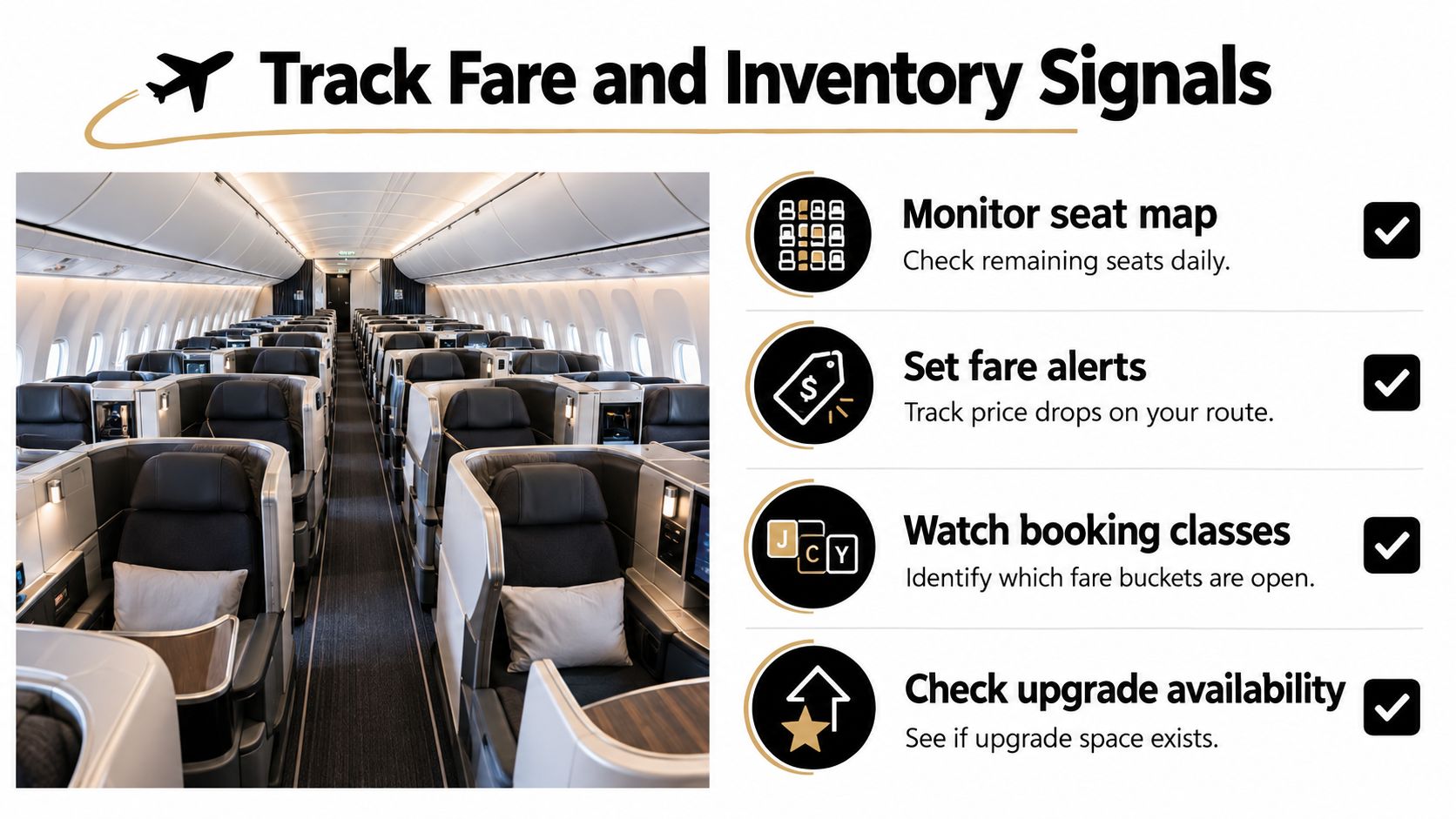
Premium-seat scarcity makes small inventory changes consequential. McKinsey illustrates this with a representative transatlantic wide-body containing about 40 business seats and 200 economy seats: a five-seat forecasting error represents 12.5% of business capacity, compared with 2.5% of economy capacity, in its analysis of premium-cabin profitability.
That isn't a configuration claim about every India–Canada aircraft. It demonstrates why you should pay attention to the premium cabin specifically rather than infer business-class availability from the size of the flight.
Use the checklist graphic as a reminder of the signals to investigate, not as proof that a displayed seat map establishes sellable inventory.
Distinguish network growth from a fare opportunity
The market's expansion provides context. Cirium figures cited in reporting showed 39 weekly nonstop flights for December 2024, 20 more than December 2019, following the 2022 agreement allowing unlimited India–Canada flights, according to the Hindustan Times connectivity report.
Looking ahead, Air India's announced 2026–27 winter schedule projects 20 weekly India–Canada flights, including Delhi–Toronto, Mumbai–Toronto, and Delhi–Vancouver, according to its Canada winter-service announcement.
More scheduled service gives buyers additional options to investigate. It doesn't establish that the airline will release a lower business fare on the departure you need.
Build a repeatable monitoring record
Track comparable searches rather than collecting unrelated screenshots:
- Record the fare identity: Save the booking class or fare basis where displayed, along with the ticket conditions.
- Keep routing categories separate: Maintain distinct comparisons for nonstop and connecting journeys.
- Check nearby dates: Look for an acceptable alternative rather than assuming a change on one flight applies broadly.
- Log schedule changes: Reassess an offer if its operating flight or connection changes.
- Reconfirm availability: Verify the quoted fare through the purchase stage before treating it as actionable.
A guide to business-class seat availability can help frame those checks. The underlying discipline is to distinguish a visible seat, an available fare, and a completed booking rather than treating them as interchangeable.
Buying signal: A lower price matters when it remains available for an itinerary and fare type you can actually use.
Choose When and How to Buy
The most useful purchase trigger isn't a universal advance-booking window. It's a verified fare that satisfies your travel requirements at an acceptable total cost. Waiting has a purpose only while you still have room to change plans or reject the available offers.
Before payment, bring the comparison back to the traveler and the actual journey.

Define what makes a fare acceptable
Write down your requirements before responding to a price alert. Include acceptable routing, maximum journey duration, arrival deadline, baggage needs, lounge expectations, and required change or refund flexibility.
Then decide which requirements are nonnegotiable. A flexible ticket may be preferable when the meeting date is uncertain; a restrictive ticket may suit a settled holiday. The important point is to value the actual contract rather than assume the cheapest business fare includes everything you associate with the cabin.
Lower-priced business products can deliberately remove benefits. Reported examples include a Delta basic business fare 7% below its standard business ticket and a United Houston–Lima basic Polaris fare only US$100 below the fuller version, according to reporting on unbundled business-class fares.
Those examples aren't India–Canada price benchmarks. They demonstrate why a discount must be assessed alongside what has been removed.
The accompanying video can provide another perspective on premium-fare purchasing; apply the same itinerary and fare-rule checks to any opportunity you investigate.
Use tools without outsourcing the decision
Airline searches, fare alerts, and specialist monitoring services can supply candidate offers. None replaces your decision about whether the itinerary works, and a low-price alert shouldn't override an arrival deadline or required refund provision.
Use a clear approval process:
- Compare equivalent offers: Keep the cabin, routing requirements, and flexibility consistent.
- Verify the final total: Review payment currency, inclusions, and conditions at checkout.
- Apply your purchase threshold: Buy when the offer meets budget and travel policy, rather than waiting indefinitely for an unproven low.
- Retain the booking record: Save the ticket, itinerary, receipt, and applicable conditions for expense reconciliation.
The strongest buying method is deliberately unglamorous: monitor, evaluate, verify, and purchase. It protects against both overpaying for unnecessary flexibility and buying a bargain that fails the trip.
Can Business Class Be Cheaper Than Coach
Yes, but the reversal is exceptional. International business-class mistake fares have been identified as low as about US$300 round trip; more ordinary guidance targets a good international business deal below roughly US$2,700 round trip, against standard long-haul fares around US$3,000–US$5,000, according to Going's business-class fare guide.
Those are general international references, not promises for India–Canada. A very low business fare can undercut economy during a pricing error or unusually deep promotion, but that possibility shouldn't become your baseline expectation.
Compare against ordinary route pricing
A Toronto–Delhi reference lists typical round-trip economy at C$1,100–C$1,500 and business at C$3,000–C$5,500. It also places regular-season round-trip business tickets departing India for Canada around C$4,700–C$6,800, reinforcing the normal separation between the cabins in the India–Canada fare reference.
Even a modest premium isn't the same as business being cheaper. One sampled Iberia Madrid–Athens comparison showed £454 economy and £562 business, a £108 difference, in Euronews' business-class price comparison.
The useful distinction is between a narrow upgrade gap and an actual price reversal. Only a like-for-like comparison can establish which you've found.
Verify an apparent reversal
Before treating business class cheaper than coach as a usable opportunity, check:
- Passenger details: Confirm spelling against the travel document.
- Dates and airports: Verify both directions and every connection.
- Cabin and availability: Confirm the booked class on each segment and that the quoted fare can be purchased.
- Conditions and payment: Review baggage, refundability, change rules, currency, and final charge.
For leisure travelers, flexibility can make an unusual offer usable. Consultants should prioritize a workable arrival, while travel managers should judge the lowest compliant fare rather than the most dramatic advertised saving.
The best outcome isn't proving that business can beat coach. It's recognizing when a favorable premium fare meets your requirements, then completing the purchase without confusing an anomaly with a permanent market rule.
Passport Premiere offers membership-based international premium-fare monitoring and market analysis to help travelers assess changing business- and first-class opportunities. Visit Passport Premiere to explore its approach and consider it alongside airline searches and fare alerts when planning your India–Canada purchase.
