Business Class Fare Alerts That Save Real Money

The most popular advice about business class fare alerts is incomplete: set a notification, wait for a price drop, and book when the email arrives. That approach treats every lower fare as a bargain. It ignores the only question that matters, lower than what, on which route, for which dates, and under which fare rules?

A business-class alert isn't a coupon. It's a route-specific verdict. Premium-cabin prices can move sharply because airlines manage limited, perishable inventory through fare classes, competitive filings, and changing demand. On some flights, business class can even cost less than coach, particularly when economy inventory sells out first. One cited London Heathrow to Doha example showed business class at GBP 3,029, while the remaining economy seats cost GBP 4,494, making business class GBP 1,465 cheaper on the same flight (Passport Premiere's analysis of discounted business-class fares).

The right alert helps you recognize that mismatch. The wrong one delivers noise.

What Business Class Fare Alerts Really Tell You

A useful alert doesn't announce that business class is cheap everywhere. It tells you that a particular origin-and-destination pairing has entered an unusual pricing range.

That distinction matters because premium seats behave like perishable inventory. Once the aircraft departs, an unsold business-class seat has no value. Airlines therefore adjust fare availability through booking classes, timing, competitor responses, and inventory controls. A lower fare may appear because seats have moved into a cheaper business-class bucket, because another carrier filed a matching fare, or because the airline is trying to stimulate demand on a specific departure.

Coach pricing often feels more fluid because airlines reprice large volumes of seats through automated systems. Business class has fewer seats and more differentiated fare conditions. A sharp fall on one transatlantic corridor may be normal mid-cycle pricing, while a smaller change on another city pair may signal a genuine anomaly. Don't judge the percentage in isolation.

Read the route before the price

Start with the exact city pair, departure pattern, cabin, and carrier combination. Then ask whether the fare sits below that route's ordinary range. A price that looks spectacular against a generic international average may be unremarkable for the corridor you're considering.

Large-scale fare data makes this comparison possible. OAG says it collects 4 billion fare observations daily and retains more than 10 years of historical fares, with cabin-class and route-level filtering available (OAG airfare insights data). That scale matters because premium monitoring needs to distinguish a meaningful route movement from ordinary noise.

Historical research also shows why waiting for context is essential. One study of international airline markets found that, by departure date, the interquartile range of the ratio between current and initial fare ran from 0.75 to 1.85, meaning fares could finish 25% below or 85% above their starting price depending on conditions (research on airline price discrimination and volatility).
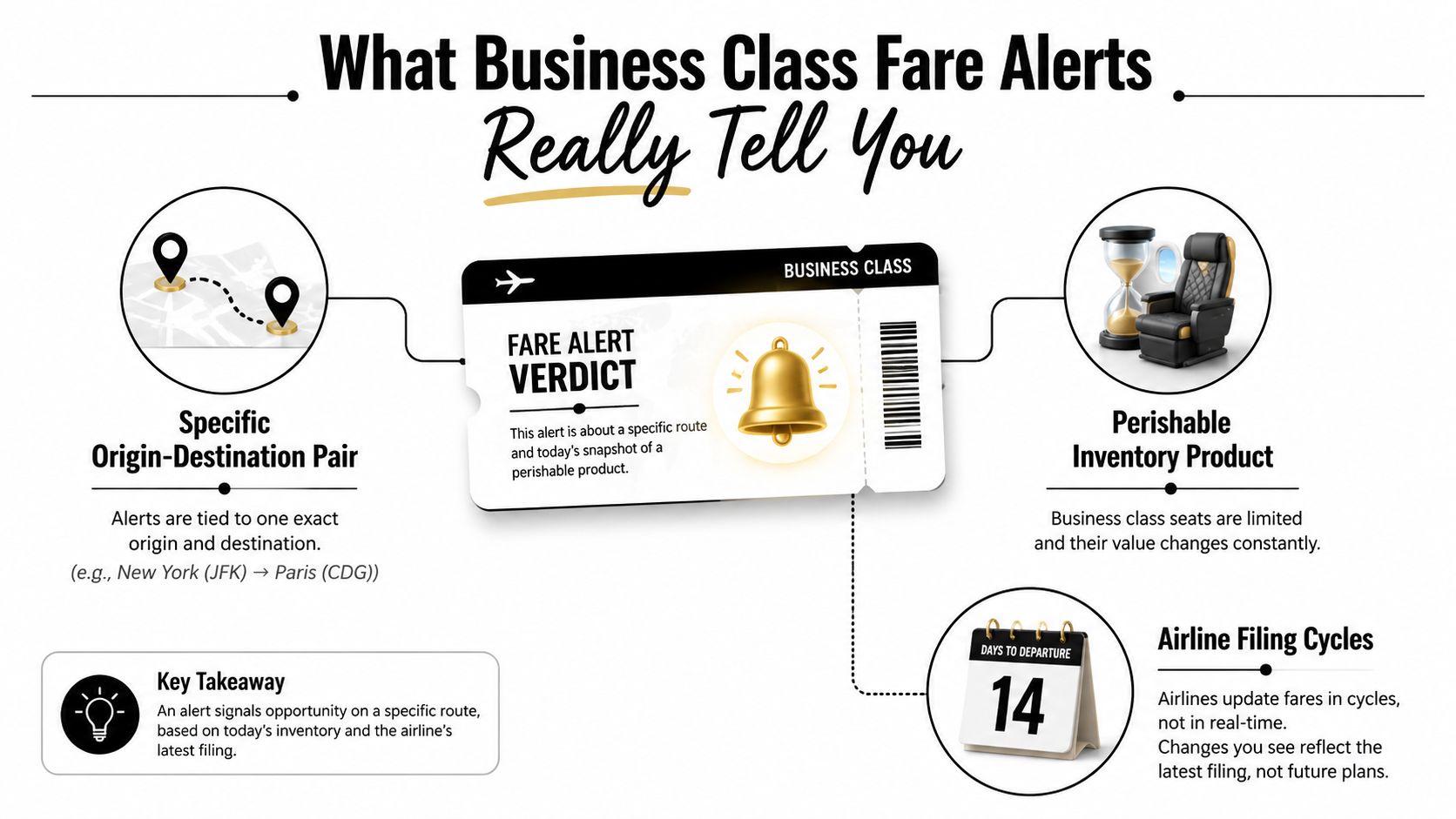
An infographic explaining how business class fare alerts work, including route details, inventory, and airline filing cycles.

Practical rule: Treat the alert as a diagnosis of one route, not proof of a global sale.

How Fare Monitoring Systems Detect a Real Drop

A credible monitoring system starts with more than the headline price shown in a search result. It needs repeated access to fare data from airline direct channels and distribution systems, then it must distinguish the available business-class booking class from the public cabin label.

The next step is comparison. Strong systems don't fire merely because today's price is lower than yesterday's. They compare the fare with a route-specific historical baseline, account for date patterns and seasonality, and identify whether the price has crossed a meaningful threshold. A January fare to Frankfurt shouldn't automatically be treated as a breakthrough if winter pricing is usually soft on that corridor.

The mechanics align with the broader principles described in this guide to airline pricing strategy. Airlines use changing inventory, demand signals, and fare structures to manage revenue, so a monitoring tool must evaluate the conditions behind the displayed amount. Readers who want more background on the airline-side discipline can also review how yield management pricing works.

Three checks separate a signal from noise

A trustworthy alert should combine three tests:

  1. Historical route band: Is the fare unusually low for this city pair, cabin, departure period, and carrier mix?
  2. Fare-class movement: Did the available booking class change, and do its rules affect flexibility, mileage earning, or upgrade eligibility?
  3. Availability depth: Can the fare be found across multiple acceptable dates, or does it exist on one fragile departure?
Signal Component What It Measures
Route baseline Whether the current fare sits below the corridor's normal range
Fare class The inventory bucket, conditions, and earning characteristics attached to the price
Date coverage Whether the fare appears on several dates or one isolated flight
Carrier mix Whether a competitor or partner filing changed the market
Bookability Whether the fare remains available through checkout

The timing near departure deserves particular attention. Research on airline markets found that volatility remained fairly stable until approximately 2 weeks before departure, then increased significantly (airline price volatility research). That doesn't mean you should always wait. It means the final booking window can contain more dramatic movement, alongside greater risk that inventory disappears.

Business-class demand also responds materially to price. An airline-based multilevel study reported an average airfare price elasticity of -0.8, associating a 1% fare increase with roughly a 0.8% decline in demand (NASA-hosted airline pricing study). That sensitivity helps explain why carriers may adjust premium fares when demand weakens.

Rule-Based, AI-Driven, and Manual Monitoring Compared

Your monitoring method should match the way you travel. A consultant watching a recurring international route needs a different system from a leisure traveler searching for one specific date and airport.

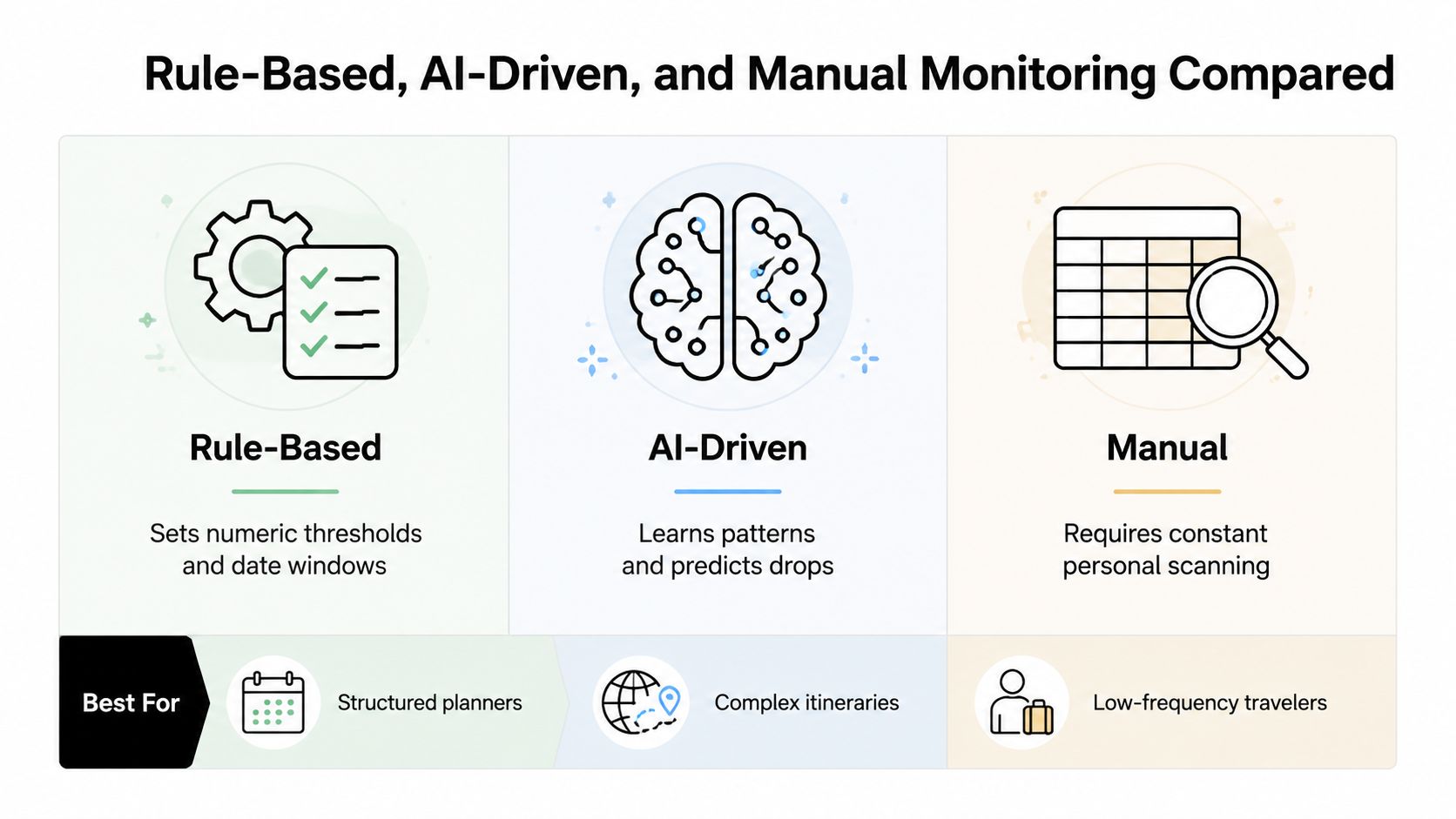
Rule-based monitors are the clearest starting point. You set the route, date window, cabin, carrier preferences, and target price. The system then alerts you when the defined condition is met. That transparency is valuable because you can see why the alert fired, but rigid rules can generate false positives when surcharges, routing changes, or unusual fare filings distort the comparison.

AI-driven tools look for patterns across a larger fare history. Instead of relying only on one fixed threshold, they can assess what an unusual fare looks like for a particular city pair and date pattern. That can reduce noise, but the trade-off is opacity. You may receive a better-ranked signal without knowing exactly which variables influenced it, and advanced services often carry a subscription cost.

Manual monitoring remains useful for narrow searches. If you need one seat on one date to a smaller airport, a person can inspect the schedule, connection quality, aircraft, fare rules, and operating carrier in a way a broad alert may not. The drawback is obvious. Manual scanning consumes attention, and you can miss a short-lived fare while you're working.

Match the method to the trip

Monitoring Style Strength Weakness Best Fit
Rule-based Transparent controls and simple setup Can overreact to noisy price changes Structured planners
AI-driven Finds patterns and route-specific anomalies Less transparent and may cost more Complex itineraries
Manual Human judgment for unusual requirements Time-intensive and easy to interrupt Low-frequency travelers

A comparison chart showing the differences between rule-based, AI-driven, and manual flight price monitoring methods.

My recommendation is a hybrid. Use AI-driven monitoring for broad route discovery, rule-based alerts for routes you fly repeatedly, and a manual review before booking an expensive or complicated itinerary. Don't let automation make the final decision on a fare with a long connection, restrictive rules, or an unfamiliar carrier combination.

Reading an Alert Like a Route Specialist

An alert is a lead, not a verdict. It confirms only that a monitored fare crossed a preset trigger. Your job is to decide whether that price fits this route, this cabin, and this trip.

Start with the corridor's normal premium-cabin range, using comparable departures rather than a broad global average. Then check the current fare class and available inventory, not merely the words “business class.” Confirm the operating carrier, marketing carrier, aircraft, and total price, including surcharges and currency conversion.

A route-specific reading matters more than the headline percentage. A 30% drop on JFK to Frankfurt in February could reflect ordinary seasonal pricing, while the same drop on SFO to Tokyo during peak cherry-blossom week would be far less routine. The percentage is evidence. It is not the decision.

Verify before you click buy

Signal in the Alert Specialist Verification
Large price reduction Compare with the route's normal premium-cabin range
Business-class cabin label Confirm the booking class and seat availability
Partner itinerary Identify the operating carrier and aircraft
Low total fare Check fuel surcharges, taxes, and currency conversion
Limited travel dates Look for nearby departures with the same conditions
“Sale” language Read the fare rules instead of trusting the label

Check blackout dates and advance-purchase requirements. A low fare may apply only to dates you cannot use, or it may restrict changes and refunds. A surcharge mismatch can also make one itinerary look cheaper when the underlying fare is comparable.

The best alert is actionable before checkout. If it doesn't show the fare class, routing, dates, and basic rules, it hasn't given you enough information to decide.

Approval time creates another risk. If your employer, partner, or travel department needs to review the booking, calculate the cost of waiting before you forward the alert. A fare can disappear while the decision sits in an inbox, leaving you with a higher premium fare or a less suitable itinerary. For a route you know well, set a personal booking threshold and define the acceptable trade-offs in advance. Then act when the alert meets those conditions, rather than reopening the entire evaluation under pressure.

A Business Class Fare That Beat Coach on the Same Flight

Business class cheaper than coach isn't a myth. It happens when the lower cabins sell first and the airline leaves a higher cabin with more attractive remaining inventory.

Consider the cited London Heathrow to Doha itinerary. Business class was listed at GBP 3,029, while the remaining economy seats on the same flight were GBP 4,494, a difference of GBP 1,465 in favor of business class (Passport Premiere's example of business class pricing below economy). The alert mattered because it exposed the relationship between the cabins. A traveler comparing only business-class prices with other business-class prices might still have missed the most compelling fact, the premium seat was cheaper than coach.

What the comparison should include

The traveler shouldn't stop at the headline amount. They should confirm that both options are on the same flight, compare baggage and seat conditions, inspect the business-class fare rules, and verify whether lounge access and the premium seat are included. They should also check whether the economy fare is a restricted remaining bucket rather than a normal reference point.

The same logic applies beyond one itinerary. A premium fare can fall even while coach remains expensive, and historical industry coverage reported that the average transatlantic business-class fare in 2023 was 3% lower than in 2019 (Passport Premiere's discussion of discounted business-class tickets). That doesn't make every business fare attractive. It does prove that premium pricing can move independently of the lower cabin.

For airport connections, practical execution matters too. Travelers handling a complicated terminal transfer may benefit from understanding Waymap's airport wayfinding approach, especially when a low fare includes an unfamiliar connection. Before booking, use a structured guide to finding hidden airfare deals to broaden the search, then return to the exact alert itinerary and verify its rules.

Setting Up Alerts That Match How You Travel

A useful alert begins with your actual travel behavior, not an imaginary version of it. Corporate planners should map recurring origins, destinations, preferred connection points, acceptable airports, and policy limits. Leisure travelers should identify the trips they'd book if the right fare appeared.

Build the alert in layers

  1. Map routes and dates. Start with exact city pairs, then add nearby airports only when you'd realistically use them. Use a date range for flexible trips, but keep fixed dates for mandatory meetings.
  2. Set cabin expectations. Choose business class explicitly. If you're willing to mix cabins on short segments, define that before alerts begin.
  3. Add departure flexibility. Include acceptable connection times, alternate airports, and alliance preferences. A low price with an unusable routing isn't a useful signal.
  4. Choose a threshold strategy. Use a broad watchlist for exploratory travel, a tighter threshold for known dates, and a separate watch for upgrade space. Compare each trigger with the route's own baseline.
  5. Define the response channel. Send alerts to email for individual trips, Slack for a corporate travel team, or a shared spreadsheet when approvals and ownership matter.
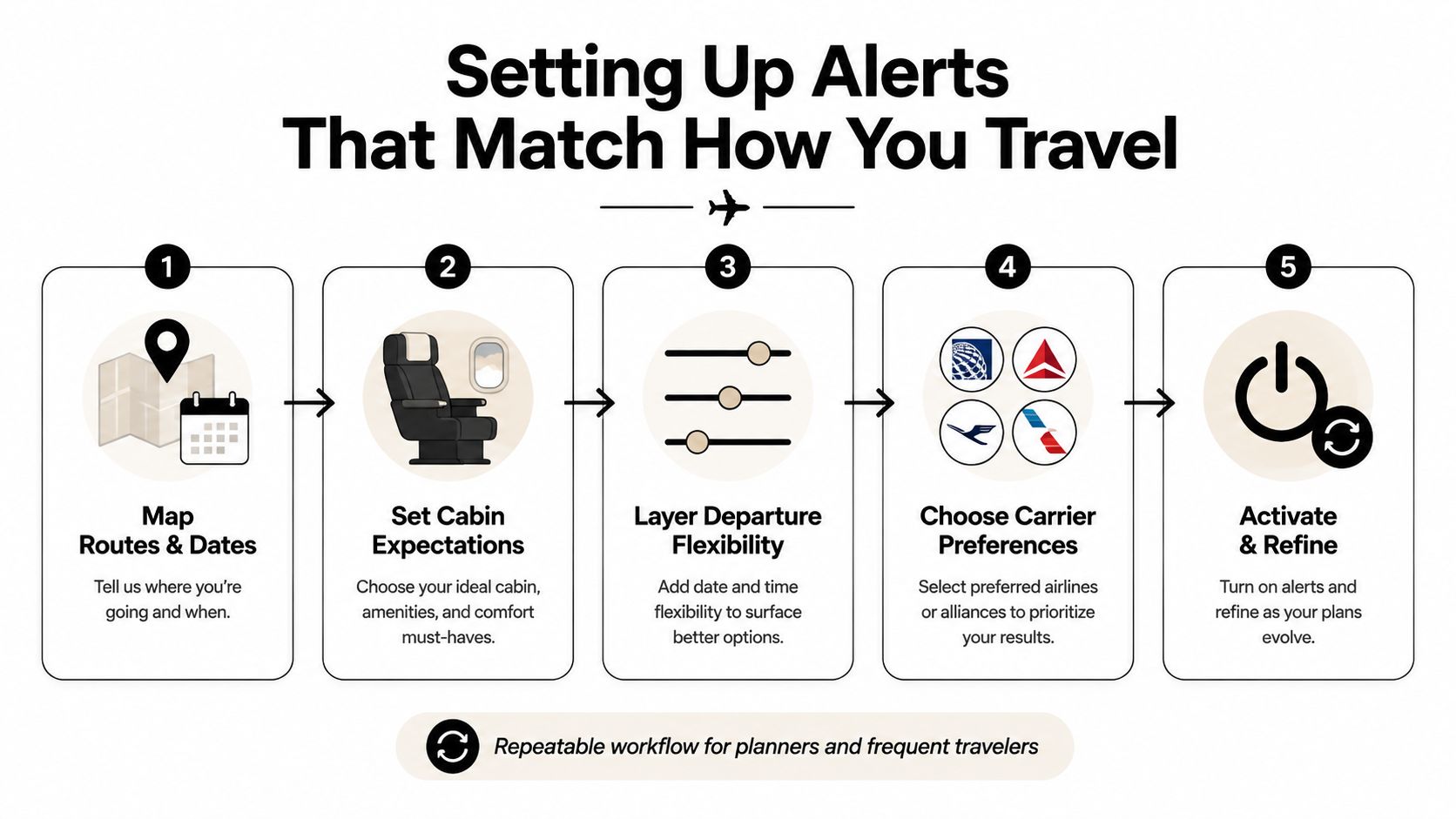
A five-step infographic showing how to set up travel alerts for flights based on personal preferences.

Every alert should preserve the information needed for a fast decision. Record the fare class, refundability, change conditions, routing, and a screenshot of the displayed price. A screenshot won't hold the fare, but it gives your team a reference when the price changes during approval.

Maintain the system

Review active alerts monthly. Retire routes you no longer expect to fly, adjust date windows after each trip, and reset thresholds when the route's normal pricing changes. For a broader explanation of how price-drop notifications fit into a booking workflow, see airline price-drop alerts.

Don't create dozens of alerts just because setup is easy. A smaller list of routes you can book quickly will outperform a crowded inbox that teaches you to ignore every notification.

Why Serious Travelers Outgrow DIY Monitoring

DIY monitoring works for one straightforward trip. It starts failing when your portfolio grows, because a premium fare is a verdict on a specific route, not a generic price drop. A thirty percent fall on one corridor may be ordinary pricing on another.

The workload grows quickly. You may run separate searches for origin airports, carrier combinations, cabin policies, and date windows. Then you must verify that a displayed fare is real, confirm the inventory is bookable, and respond before the price disappears during approval.

Where manual systems break

  • Rules multiply: Every corridor needs its own threshold and acceptable-routing logic.
  • Phantom drops distract: A displayed fare can vanish before checkout.
  • Fare changes spread across carriers: One airline's move may prompt partner airlines to match it, which a single-carrier watch can miss.
  • Maintenance consumes attention: Old routes and expired dates keep producing alerts until someone removes them.
  • Human review arrives late: As searches accumulate, evaluating each route-specific signal promptly becomes harder.
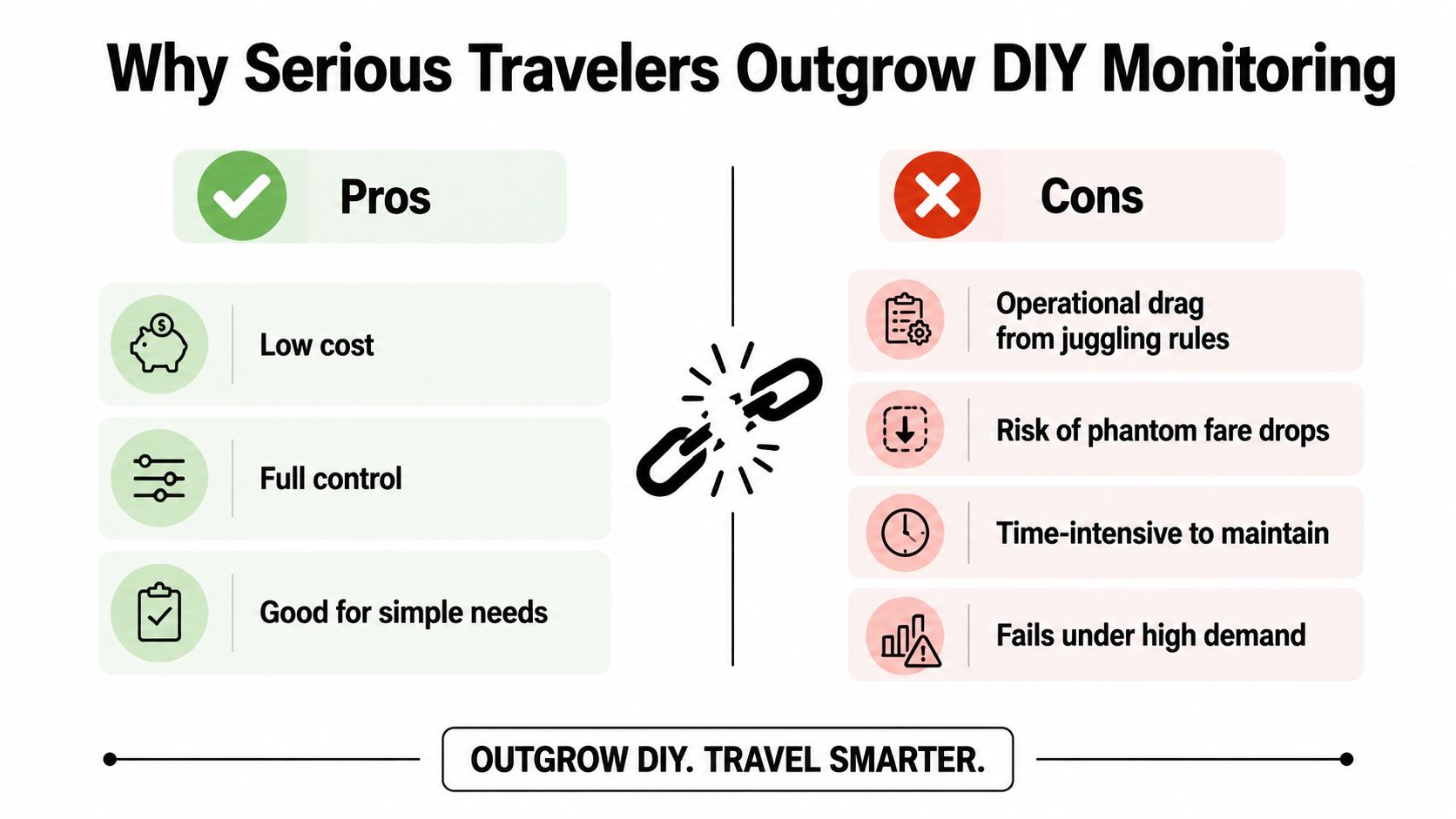
A comparison infographic showing the pros and cons of DIY travel monitoring versus professional travel solutions.

A specialist premium-cabin service makes sense when missed opportunities cost more than monitoring. Executives, consultants, and travel teams managing 40-plus annual segments need consistent route interpretation, timely fare signals, and a repeatable decision process for buying or holding.

Passport Premiere is one membership-based option that combines premium-cabin fare monitoring with market analysis and member guidance. Passport Premiere tracks business and first-class fare changes on specific routes and provides market context to help members decide whether to buy or hold.

DIY remains reasonable for one simple route. Once routes, travelers, and approval requirements multiply, specialized monitoring gives you cleaner route decisions and an easier process to manage.

Turning Alerts Into Lower Premium-Cabin Bills

Use this sequence before your next international booking:

  1. Set the baseline. Judge the alert against typical business-class pricing for that exact route, not against coach.
  2. Check the window. Premium inventory can change quickly, so act while the fare is still available and the itinerary still works.
  3. Verify the fare class. Confirm flexibility, refundability, earning conditions, and the operating carrier before checkout.
  4. Compare the full trip. Include baggage, seat conditions, surcharges, connection quality, and the possibility that business class is cheaper than the remaining economy inventory.
  5. Hold the fare when possible. Secure the price before seeking companion credits, corporate approval, or other payment adjustments.

The common mistakes are predictable. Travelers delay until the fare disappears, ignore surcharge differences, or assume every notification represents a real win. Don't do any of those things. An alert is a prompt to investigate, not permission to abandon judgment.

If you're building a broader professional workflow, practical tips for freelance video pros can also be useful when thinking about how alerts, approvals, and travel logistics fit around demanding work schedules. The booking principle remains the same: monitor intelligently, verify quickly, and buy when the route-specific evidence supports the fare.


Passport Premiere offers targeted business and first-class fare alerts, route monitoring, market context, and guidance on whether to buy or hold. Visit Passport Premiere to view the live Fare Monitor demonstration and join a premium-cabin workflow built to help lower international travel bills, including cases where business class costs less than coach.

Multiple Leg Flights Strategies for Cheaper Business Class

A lot of travel managers still treat connecting premium itineraries as a compromise and direct premium itineraries as the benchmark. That's expensive thinking. On competitive long-haul routes, deeply discounted business class can come in below last-minute full-fare economy, which changes the conversation from “Can we afford business class?” to “Did we search the route structure correctly?”

That matters most when direct fares are hard to justify, approvals slow down, and travelers still need rest, productivity, and flexibility on arrival. Multiple leg flights often create the pricing distortions that open those opportunities. They also create more risk, more decision points, and more ways to make a bad booking if you don't understand how airlines file fares.

Business class cheaper than coach isn't a gimmick. It happens in specific market conditions, usually when routing complexity, timing, and inventory pressure line up. The teams that capture those fares don't rely on luck. They compare direct versus connecting premium, test single-ticket versus split-ticket options, and accept that the cheapest fare isn't always the safest one.

Why Multiple Leg Flights Matter for Premium Travelers

A familiar pattern shows up in corporate travel reviews. A consultant needs to cross the Atlantic or Pacific, the direct business class fare comes back far above policy comfort, and someone suggests premium economy or even economy “just this once.” Then a connecting option appears and suddenly the economics shift.

That shift is why multiple leg flights deserve more attention from premium travelers. They aren't just a workaround for unavailable nonstops. They're often where airlines expose weaker pricing logic, especially when a carrier needs to move premium inventory across connecting banks rather than on a marquee direct route.

The practical appeal is straightforward:

  • Budget pressure drops: A connecting premium itinerary can price more favorably than the nonstop the traveler originally requested.
  • Approvals get easier: Finance teams respond better when the premium choice is defensible against high coach fares.
  • Network access improves: Some business destinations work better through hubs than through idealized nonstop search habits.

Premium travel strategy starts to improve when you stop asking only, “Is there a nonstop?” and start asking, “How is this market priced through the hubs?”

The trade-off is real. More legs mean more things can go wrong. You may add layover time, increase misconnection exposure, and create tougher rebooking scenarios if the ticket is structured badly. But for international travelers who care about both comfort and cost control, complex routing isn't edge-case behavior. It's often where the best premium value hides.

Understanding Multiple Leg Flights

A multiple leg flight is one trip made up of two or more flight legs between your starting point and final destination. That distinction matters because airlines, booking tools, and travelers often use leg, segment, layover, and stopover loosely, even though each one affects pricing, protection, and upgrade odds in different ways.

A diagram explaining multiple leg flights as a journey with distinct segments, similar to a road trip.

How a multi-leg itinerary actually works

The easiest comparison is driving with planned stops. You still have one overall trip, but each part has its own timing, constraints, and risk. In air travel, each leg has separate inventory, aircraft assignment, and operational exposure, which is why a premium itinerary with one connection can price very differently from a nonstop on the same city pair.

A basic structure usually looks like this:

  1. Origin to hub: The first leg feeds you into the airline's network.
  2. Hub to long-haul gateway or final destination: The second leg carries the highest pricing sensitivity, especially in business class.
  3. Optional feeder or regional connection: A third leg often appears when the final destination lacks direct long-haul service.

That last point matters more than many travelers realize. In premium cabins, the extra leg is sometimes the reason the fare drops. Airlines may discount a connecting business class routing to fill inventory across the full path, even when the nonstop in coach remains expensive.

The terms that matter

Clear definitions save money.

  • Leg: One takeoff-to-landing flight movement.
  • Segment: The portion of the trip sold in the reservation system.
  • Layover: A short connection between flights that keeps the trip in transit status.
  • Stopover: A longer break that can trigger different fare rules, taxes, or ticket pricing.

That difference is practical, not academic. A traveler who confuses a layover with a stopover can misread fare rules, miss baggage implications, or compare the wrong options. This explainer on what a layover means in practical booking terms is useful if you need the booking distinction clarified quickly.

Why premium travelers should care about the definition

On complex itineraries, the labels affect more than scheduling. They influence whether the airline prices the trip as one market, whether a connection remains protected on a single ticket, and whether a split-ticket strategy is worth the risk. I pay close attention to this in corporate bookings because the cheapest premium option is not always the safest one, especially if the trip depends on a short hub connection before a long-haul business class leg.

Airports add another layer. Terminal changes, security re-checks, and minimum connection times can turn a cheap fare into a weak choice if the connection is unrealistic. For travelers passing through large hubs, tools that enhance airport accessibility can make a connection-heavy itinerary easier to handle.

A multiple leg itinerary is best understood as a fare and risk structure at the same time. Once that clicks, it becomes easier to spot when an extra connection is just inconvenience and when it is the reason business class prices below an overpriced nonstop coach fare.

How Airlines Construct Fares on Multi-Leg Routes

Airlines don't price complex itineraries by adding one flight to another and calling it done. They apply fare rules to a routing, not just to distance or cabin. That's why a connecting business class itinerary can look irrational compared with either the nonstop or the sum of its parts.

In flight operations, a single flight number can include multiple takeoff-to-landing pairs, while a segment is the sellable portion of the trip, which creates a distinction that matters for pricing, as explained in this flight leg glossary from AltexSoft.

A flowchart explaining how airlines construct fares for multi-leg flights, comparing flight legs with individual segments.

What airlines are really pricing

A premium fare on a multi-leg itinerary usually reflects several layers at once:

  • Routing logic: The carrier files a price based on permitted paths between city pairs.
  • Cabin inventory: Business class inventory can differ by leg even inside one itinerary.
  • Connection value: Airlines know some travelers will pay more to avoid awkward transfers.
  • Restrictions and add-ons: Change conditions, combinability rules, and surcharges can reshape the final price.

This is why two itineraries that look nearly identical to a traveler may price very differently. The published fare isn't only paying for seat space. It's paying for the exact rule set attached to the route.

Why one flight number can still hide extra cost

A useful operational example is a service flown under one number across multiple physical sectors. The traveler may see one marketed journey, but the airline still has to account for several takeoffs, landings, crews, timing dependencies, and aircraft utilization decisions.

That's where many buyers get tripped up. They assume a bundled itinerary should produce smooth, efficient pricing. Sometimes it does. Sometimes the rule set makes the bundle less efficient than expected.

Practical rule: Don't judge a multi-leg premium fare by the map alone. Judge it by the fare construction, because that's what the airline is selling.

For travelers comparing one-way versus round-trip structures, this becomes even more important. Different fare construction behavior often appears when you test one-way and round-trip airfare logic instead of accepting the first bundled result.

Single Booking vs Separate Tickets on Multi-Leg Flights

One of the most expensive assumptions in premium travel is that splitting a trip into separate tickets always lowers the price. It can. It can also create a worse total fare and much more operational risk.

A key pricing wrinkle is that single-PNR complex itineraries can be 20% to 40% more expensive due to aggregated surcharges and restrictions, even though many travelers expect one booking to be the simpler bargain, as discussed in this analysis of pricing distortions around complex premium routing.

Where a single booking wins

A single PNR usually works best when schedule protection matters more than experimentation. If the first leg runs late, the airline has a clearer obligation to deal with the downstream impact when all flights sit on one ticket. That matters for client-facing trips, conferences, and international arrivals with tight meeting windows.

Single-ticket bookings also reduce admin friction. One receipt, one fare rule set, one reissue path. For managed travel programs, that simplicity has real value.

Where separate tickets can outperform

Separate tickets become useful when one carrier dominates the long-haul premium segment but another carrier prices the short-haul feeder more competitively. They also help when the published through-fare is clearly inflated by fare construction rather than by actual cabin value.

But separate tickets shift risk back to the traveler. If the inbound leg fails and the second ticket is on a different booking, the next airline may treat the missed flight as your problem.

Comparing Single-PNR Multi-Leg vs Separate Tickets

Criteria Single-PNR Multi-Leg Separate Tickets
Price Sometimes higher because of bundled surcharges and rule combinations Sometimes lower when you can mix carriers or isolate overpriced sectors
Rebooking ease Usually cleaner within one reservation Often fragmented across different tickets
IRROPS protection Stronger when delays affect onward flights on the same ticket Weaker if one ticket disruption causes a missed flight on another
Flexibility Good if the full trip should stay intact Better when each leg may need different timing or carriers
Admin overhead Lower for reporting and traveler support Higher because receipts, rules, and changes multiply

Separate tickets are a pricing tactic, not a default strategy. Use them only when the savings justify the loss of protection.

A good rule is to split only when you can absorb the downside. If a missed connection would trigger hotel cost, lost meeting time, or same-day walk-up rebooking pain, the cheaper structure may stop being cheaper.

Pricing Patterns and Risks on Complex Itineraries

Premium-cabin pricing on complex routes rarely moves in a straight line. Airlines adjust inventory across connecting banks, watch how direct routes are selling, and respond to weak demand on less attractive timings. That's why multi-leg business class can look overpriced one day and oddly reasonable the next.

One of the most useful signals is this: fewer than 15% of premium cabin seats are sold at their initial asking price, and multi-leg routes with extended layovers often trigger deeper discounts to fill unsold seats, according to this industry note on multileg inventory behavior.

Why connecting premium fares swing more

Direct premium routes usually attract travelers who value convenience first. Complex routings attract more comparison shopping. That makes the inventory less stable.

Several conditions tend to pressure fares downward:

  • Awkward connection timing: Long waits or off-pattern connections reduce traveler appeal.
  • Uneven cabin demand by leg: One sector may sell well while another lags.
  • Schedule synchronization risk: Tight inter-airport timing leaves less room for operational disruption.
  • Inventory abandonment: Travelers often start premium searches, then drop out when the route looks cumbersome.

Those pressures don't guarantee a cheap fare. They do create more volatility than many travelers expect.

The risks that erase the savings

In such instances, booking discipline matters. A low premium fare can still be a bad buy if the itinerary is fragile.

Watch for these failure points:

  • Misconnection exposure: Short legal connections aren't always comfortable real-world connections.
  • Reissue complexity: A cheap fare may come with painful change rules.
  • Layover fatigue: Added transit can negate part of the premium-cabin comfort advantage.
  • Airport transfer friction: Some city pairs route through airports that look close on paper but behave poorly in practice.

If a premium itinerary only works when every leg runs perfectly, it isn't a bargain. It's a gamble with a glossy cabin.

Travel managers should also separate “cheap” from “bookable.” Some connecting fares are worth approving only if the traveler has schedule slack, carry-on discipline, and a clear fallback plan. The right fare is the one that survives disruption without blowing up the trip budget.

Smart Strategies to Book Premium Cabins on Multi-Leg Flights

Premium-cabin savings on multi-leg trips usually come from fare construction, timing, and a willingness to test more than one ticketing setup. Travelers who only price the obvious through-fare miss the part of the market where business class can occasionally undercut expensive coach, especially on long-haul routings with uneven demand by segment.

The practical objective is simple. Stop shopping one itinerary. Start comparing fare logic.

An infographic detailing two key strategies for booking premium cabins on multi-leg flights: optimal timing and fare monitoring.

Build the trip from the long-haul leg outward

On premium multi-leg bookings, the long-haul sector usually determines whether the whole trip is attractive. I start there, then add the feeder leg and compare what changes.

Run the search in at least three versions:

  1. Through-ticket in business class
  2. Long-haul business class plus a separate feeder ticket
  3. A different hub, even if it adds a modest detour

This is also where itinerary shape matters. A traveler flying into one city and home from another can open cheaper premium combinations that never appear in a standard round-trip search. If that structure fits the trip, review how open-jaw flights work before comparing options.

Watch for pricing cycles, not travel approval dates

Airlines do not discount every premium connection the same way. One hub may stay expensive for weeks while another suddenly softens because the carrier needs help filling a specific long-haul cabin. That is the pricing cycle worth tracking.

The pattern I watch for is narrower than “book early” or “book late.” Look for moments when:

  • The nonstop premium fare stays high but one-stop business class begins to separate downward
  • Premium economy remains firm while business class drops close enough to justify the upgrade
  • One leg appears to be carrying too much of the total fare

That last point matters more than many travelers realize. On multi-leg itineraries, one segment often distorts the whole fare. If the long-haul business seat is reasonably filed but the short feeder is overpriced inside the through-ticket, the published itinerary can hide a better structure.

A short video can help travelers think more clearly about premium fare hunting in practice:

Split tickets only when the math beats the operational cost

Ticket splitting is one of the few tactics that can produce an unusually good premium result. It is also one of the fastest ways to create self-inflicted disruption if used carelessly.

Use it when a separate feeder flight materially reduces the total cost, or when it gets access to a strong long-haul business fare that the through-ticket does not price cleanly. I would not use it to save a trivial amount on a tightly timed same-day connection.

Check these points before booking:

  • Minimum buffer that works in real operations, not just on paper
  • Whether bags must be collected and rechecked
  • Whether the second carrier will protect the traveler after a delay
  • What each ticket costs to change if the first leg shifts

For managed travel programs, this is usually the dividing line. A split ticket can be smart for an experienced traveler with carry-on only and meeting flexibility. It is often the wrong call for a rigid schedule, checked luggage, or a high-cost missed meeting.

Track fare movement like inventory, not like a one-time sale

Premium fares on complex itineraries move in bursts. A quick search on Monday and a booking on Thursday can produce a very different result, even with the same flights.

A disciplined process helps:

  • Save the same itinerary across several hubs
  • Check nearby departure dates, not just one day
  • Compare the price of the long-haul leg alone against the full itinerary
  • Recheck after schedule changes or aircraft swaps, which sometimes reset availability

The goal is not to chase every dip. The goal is to identify the point where the premium fare is cheap enough, and stable enough, to justify the extra connection or the extra ticketing complexity.

Cheap premium inventory disappears. Bookable premium value is rarer. The difference is whether the itinerary still works when the day goes slightly wrong.

Real Examples of Business Class Savings on Multi-Leg Itineraries

The most useful real-world lesson isn't a flashy success story. It's seeing how the decision process changes the outcome.

Example one

A corporate traveler needs a long-haul international trip and initially prices a direct economy ticket late in the booking cycle. The walk-up coach fare looks painful. A separate search through a major hub shows a business class itinerary with a connection, and the premium option comes in lower than the unrestricted economy fare.

That's not unusual on competitive long-haul routes. It aligns with the known pattern that discounted business class can undercut last-minute full-fare coach when airlines need to fill empty premium seats on specific routings. The savings came from accepting a connection, not from chasing a mythical universal “cheap business class” rule.

Example two

A traveler finds a published multi-leg business fare that looks high relative to the route. Instead of booking the through-ticket immediately, they compare the same trip as separate legs. The split version reveals that one segment is carrying much of the pricing distortion.

The key lesson is not that separate tickets always win. They don't. The lesson is that published multi-leg premium fares can hide inefficient construction. In practice, the winning move was comparing structures, then deciding whether the lower price justified the extra operational risk.

What these examples actually prove

Both cases point to the same operating principle:

  • Routing changes price
  • Ticket structure changes risk
  • Timing changes whether the deal is worth taking

That's how business class cheaper than coach becomes possible on certain itineraries. Not because premium is universally cheap, but because airline pricing is inconsistent enough to reward travelers who test alternatives methodically.

Summary and Travel Manager Checklist

Multiple leg flights matter because they expose fare behavior that direct-route shopping often hides. For premium travelers, the opportunity isn't 'take a connection and save money.' It's knowing when routing complexity, premium inventory pressure, and fare construction combine to create a bookable advantage.

The strongest programs don't chase every low fare. They balance three things at once: cabin value, disruption risk, and internal approval logic. That's especially important on international trips where a cheaper ticket can still be the wrong choice if it collapses under a delay or change request.

Travel manager checklist

  • Compare the route, not just the city pair: Check nonstop premium against one-stop and two-stop premium before rejecting business class as too expensive.
  • Test ticket structure: Price the itinerary as a single booking and as separate legs when the through-fare looks inflated.
  • Review connection quality: Look at transfer practicality, not just minimum legal connection time.
  • Audit fare rules: Confirm change conditions, reissue pain points, and whether the savings survive a disruption.
  • Build approval notes around value: If premium undercuts expensive coach, document that clearly for finance or policy review.
  • Use itinerary type strategically: Open-jaw and hub-based routing can improve premium economics when standard round trips don't.
  • Protect the traveler on critical trips: If the meeting can't move, favor stronger ticket protection over experimental savings.
  • Prepare the ground segment too: For trips that continue beyond the flight itself, practical destination transport planning matters. A detailed expert guide to Slovenia outdoor travel is a good example of the kind of logistics resource that helps travelers think beyond the airfare alone.

A disciplined travel manager treats multiple leg flights as a controlled lever, not a desperate workaround. That's when premium booking becomes more consistent, more defensible, and sometimes surprisingly cheaper than coach.


Passport Premiere helps travelers identify when premium-cabin pricing is weak, monitor fare swings, and act before those windows disappear. If you want a smarter way to secure international Business and First Class fares, sometimes even cheaper than coach, explore Passport Premiere.