
You've just landed, the seat-belt sign has barely gone off, and the departure board says your next flight leaves from Gate B14. Your inbound aircraft arrived late, the terminal map looks like a maze, and you're trying to decide whether to sprint or ask for help. That stressful few minutes is the part most travelers associate with a connecting flight, but the actual outcome was often decided when the ticket was booked.
So, how do connecting flights work? The answer depends on more than the gap between landing and takeoff. Your ticket structure, the airport's minimum connection time, baggage rules, customs process, security layout, and the airline's responsibility all determine whether the transfer feels effortless or turns into an expensive scramble.
What a Connecting Flight Actually Is
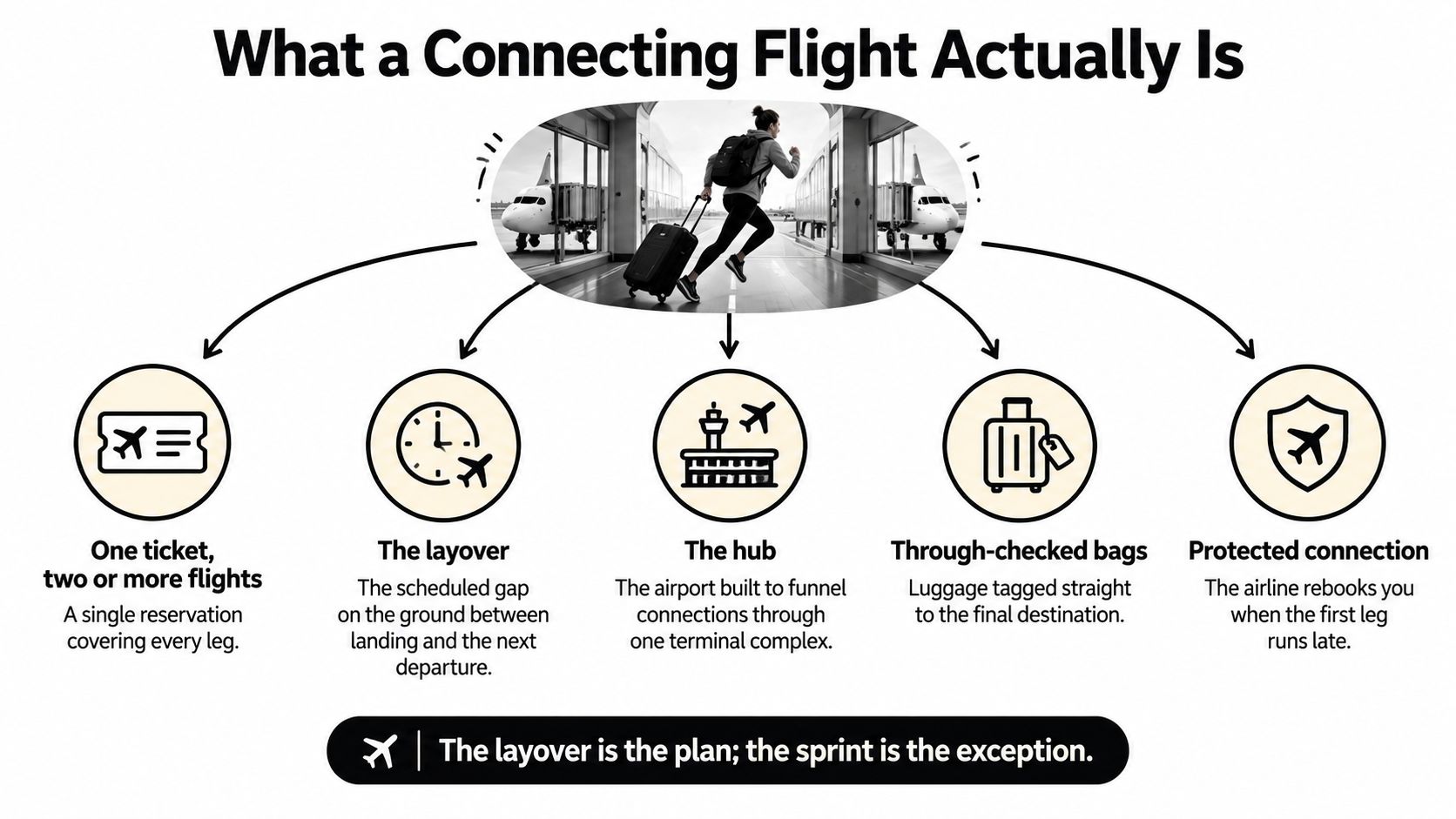
A connecting flight is an itinerary that uses two or more flight numbers to move you from your origin to your final destination. You may change aircraft at a hub airport, wait in a terminal, and board a second flight, but the journey can still exist as one reservation with one ticket and, in many cases, one luggage tag showing the final city.
That's what the traveler at Gate B14 is trying to complete. The first aircraft brought them to the hub. The second aircraft will carry them onward. The time between those flights is the layover, which is just the scheduled period on the ground between arrival and departure. A deliberately long layover can sometimes be booked as a stopover, depending on the fare rules and itinerary design. For a clearer distinction, see this explanation of what a layover means.
A direct flight is different from a non-stop flight. A direct flight generally keeps the same flight number from origin to destination, even if the aircraft touches down at an intermediate airport. You might remain on the plane, or the airline might use the same flight number across a scheduled stop. A non-stop flight has no intermediate landing at all.
The five parts of the journey
Most connecting itineraries have five practical elements:
- One reservation: The booking may cover every leg, even when partner airlines operate some of them.
- Two or more flights: Each leg has its own departure, arrival, flight number, and boarding process.
- A hub: Airlines funnel passengers through major airports so one aircraft can feed many onward routes.
- Through-checked bags: When the ticket and airline relationship allow it, your bag can be tagged to the final destination.
- A protected connection: When the itinerary is covered by the airline's connection obligations, the carrier generally helps if its delay causes a missed onward flight.
Long-distance international travel commonly relies on this hub model. One aviation study found connecting itineraries represented 85% of sampled itineraries, while another study found that 33% of passengers traveled on connecting itineraries in 2010 and that the airline itinerary network was 87% connecting itineraries. Those figures come from different datasets, but they point to the same practical reality: connections are a central part of modern airline planning, not an unusual workaround. (Aviation itinerary research)
The layover is the plan. The sprint is the exception.
How Minimum Connection Times Set the Whole Itinerary
Think of Minimum Connecting Time, or MCT, as a kitchen timer the airport has already set. The timer starts with the scheduled arrival of your first flight and ends with the scheduled departure of the next. If the gap is shorter than the airport and airline allow, the booking system generally won't sell that combination as a valid connection.
MCT accounts for the practical work between flights. That can include walking from one gate to another, changing terminals, riding an airport train, moving checked baggage, and passing through customs or immigration. The threshold varies by airport, airline relationship, terminal pair, and whether the transfer is domestic, international, or a mixture of both.
IATA's interline baggage guidance emphasizes that the airport default should allow bags to move reliably, not merely give a passenger enough time to walk. That's why a connection can look comfortable on a map yet remain fragile when the inbound flight arrives late or the bags require additional handling. The IATA baggage standards guidance explains the operational relationship between baggage flow and connection timing.
Read the timetable without trusting it blindly
A booking system may sell a connection close to the published minimum because the itinerary is technically permitted. That doesn't mean it's a good choice for your trip. The published number assumes a normally operating airport, a gate that's available on schedule, no unusual queue, and an inbound flight that arrives when planned.
“Minimum” is a legal and operational floor, not a comfort recommendation.
Some market examples fall in the 30-to-90-minute range for domestic connections, while international transfers can extend to roughly two to three hours, depending on customs, immigration, and terminal changes. These are broad examples, not universal rules. The same airport can use different thresholds for different flight combinations.
Here's how to investigate before paying:
- Check the airport and terminal pair. A same-terminal transfer is not the same as a cross-terminal transfer.
- Identify the arrival category. International-to-domestic transfers often involve more steps than domestic-to-domestic connections.
- Look for the connection time in the confirmation. The booking shows the scheduled arrival and departure, but it may not explain every movement required.
- Add personal buffer. A traveler with mobility needs, checked sports equipment, a critical meeting, or a separate ticket should avoid treating MCT as the target.
- Ask the airline about the itinerary. The carrier or its transfer desk can clarify whether the bags are interlined and whether a terminal move is required.
Some travelers also use airport fast-track services to reduce queue exposure, but fast track won't remove a customs requirement, a terminal transfer, or a late inbound flight.
A practical MCT comparison
The table below uses qualitative examples because actual MCT values are airport- and itinerary-specific.
| Hub Airport | Domestic to Domestic | Domestic to International | International to Domestic | Terminal Change Required |
|---|---|---|---|---|
| Major hub airport | Often the simplest airside transfer | May require movement to an international concourse | May require immigration, baggage handling, and security | Check the exact terminal pair |
| Large multi-terminal hub | Can include an airport train or shuttle | Time depends on terminal and airline relationship | Often more demanding than the reverse direction | Treat as a separate transfer task |
| International gateway | Usually follows domestic transfer signage | May remain airside when the airport supports it | Customs and re-screening can determine feasibility | Confirm before selecting a tight itinerary |
Airlines may also create more practical breathing room during irregular operations by rerouting passengers, changing gates, or holding an aircraft in limited circumstances. None of that is guaranteed. The safest interpretation is simple: the MCT tells you the itinerary can be sold under stated conditions, not that it will remain comfortable after a delay.
Single Ticket vs Separate Tickets and Why It Matters
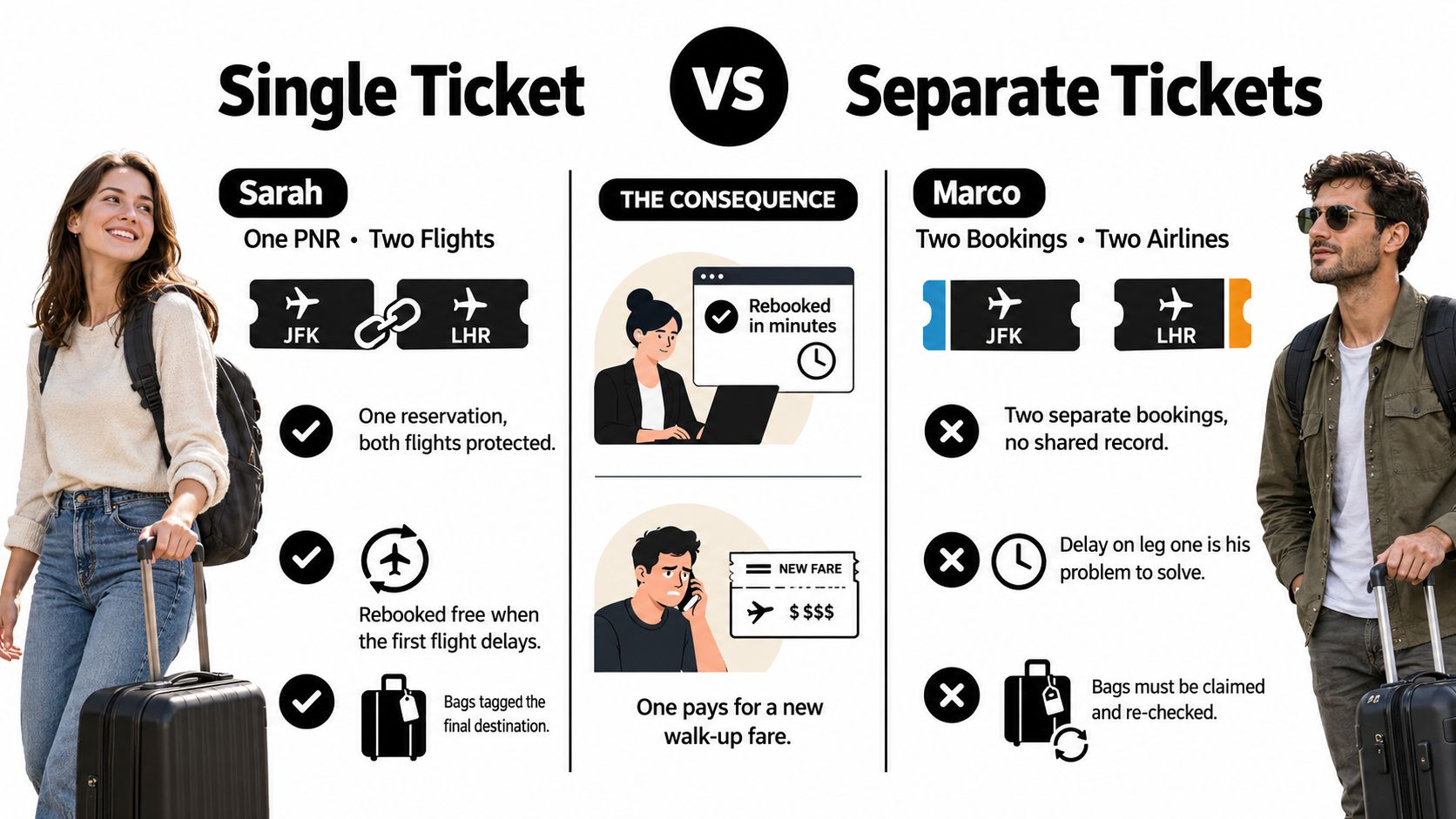
Sarah and Marco are traveling to the same final city. Sarah bought one reservation covering both legs. Marco found a lower combined price by booking the first flight with one airline and the second with another, using two independent confirmation numbers.
Their first flight is delayed. Sarah reaches the transfer desk, explains the missed connection, and is generally handled as a passenger whose airline-owned itinerary has broken. The carrier can rebook her on the next available service, usually without charging a new fare when the disruption is the airline's responsibility. Her checked bag is also usually interlined to the final destination when the ticket and carrier relationship support that process. (Connection flight protections)
Marco has a different problem. The second airline may see only a passenger who failed to show up for a separate booking. It doesn't automatically treat the delay on the first ticket as its responsibility, and Marco may need to buy a replacement ticket, collect his bag, and start the check-in process again. Independent guidance on self-connecting flights highlights this central gap between a protected itinerary and a self-made connection.
What one ticket changes
A single ticket gives the airlines a shared operational record. It usually means:
- One itinerary: The carrier's system recognizes the onward flight as part of the same journey.
- Coordinated baggage handling: Bags are often tagged through when interline rules, customs, and the route permit it.
- A rebooking pathway: If the airline causes the misconnection, staff generally look for another way to complete the ticket.
- Partner coordination: A codeshare or alliance partner may operate one leg while the marketing airline sells the complete journey.
The operating carrier flies the aircraft. The marketing carrier may display its own flight number and sell the seat. Those roles can differ, but the ticket conditions and interline agreement determine how the airlines handle the complete itinerary. Always check the “operated by” wording rather than assuming the airline logo on the search page tells the whole story.
Why travelers still choose self-transfer
Separate tickets can be appealing. They may combine airlines that don't sell a joint itinerary, create access to a cheaper fare, or provide access to a premium-cabin opportunity on one leg. A traveler might also prefer different departure times or use a low-cost carrier for the short segment.
The tradeoff is that you become the connection manager. You need to allow time for delays, baggage collection, re-check-in, terminal movement, and security. A single-ticket itinerary can be inconvenient when the fare is higher, but a separate-ticket itinerary can become much more expensive after one missed segment. Learn the mechanics of multiple-leg flights before treating a self-transfer as an ordinary connection.
What Happens to Your Bags, Passport, and Security
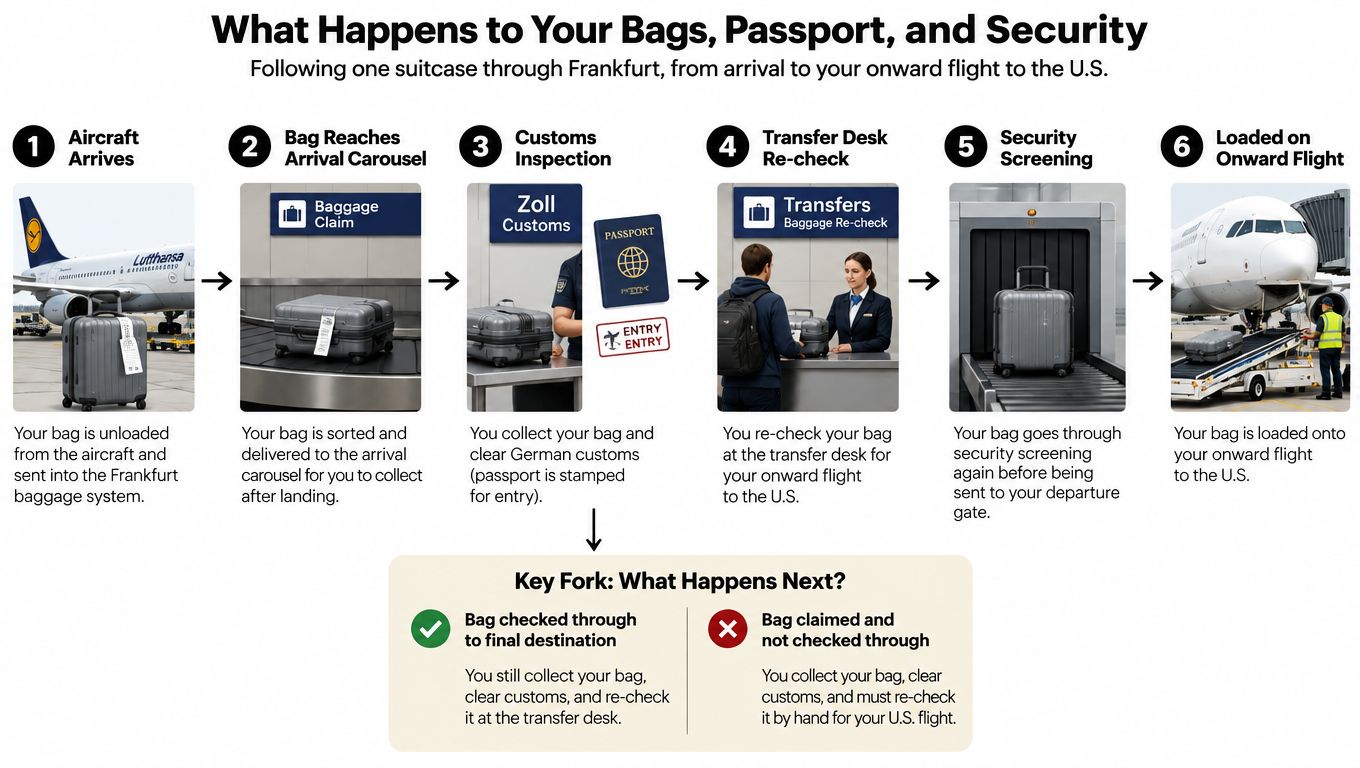
Take a suitcase that begins in Frankfurt and is booked onward to the United States. At the first airport, the agent checks the bag against the itinerary and prints a tag. The key question is what that tag says and what the transfer country requires, not just whether both flights appear in the same search result.
If the bag is checked through, it may travel onward without appearing at the intermediate carousel. If customs rules require the passenger to take possession of it, the traveler follows the arrival signs, completes immigration, collects the suitcase, presents it for customs inspection, and takes it to the transfer or re-check point. The passenger then follows signs toward the onward gate and completes any required security screening.
The connecting-flight baggage guide describes the important exceptions. A single ticket often supports through-checked baggage, but some international arrivals still require passengers to claim and re-check bags before a domestic connection. Airport design and national border procedures decide the result.
The route matters more than the label
A domestic-to-domestic connection often lets you remain inside the secure area. You may walk, ride a train, or move between concourses without collecting baggage. Terminal changes can break that pattern if the airport requires passengers to leave the secure zone.
An international-to-domestic transfer is more complicated in many countries. In the United States, international arrivals commonly claim bags, pass customs, and re-clear security before the onward domestic flight. San Francisco International Airport recommends allowing two to three hours for this process, a recommendation reported in the linked guidance above. A short connection that looks reasonable for domestic travel can therefore be unsuitable after an international arrival.
The same principle applies in Canada and elsewhere. Some airports maintain sterile transit corridors, while others require a landside handoff. Dubai and Doha are examples of airports where certain international transfers may remain airside, but the exact process still depends on the route, terminal, passport, and ticket.
Passports and boarding passes
Your passport may be checked at departure, during transit, and at the destination. A TSA PreCheck indication on one boarding pass doesn't guarantee the same treatment after a foreign arrival, because the next screening point follows the rules of that airport and country. Facial-recognition gates and other biometric processes may change how officers verify identity, but they don't eliminate immigration requirements or baggage inspections.
Before departure, ask three concrete questions:
- Is my bag tagged to the final city?
- Must I collect it at the connection airport?
- Will I leave the secure area and pass security again?
Don't rely on the color or appearance of a baggage tag alone. Read the destination code, confirm the instructions at the transfer desk, and keep essential medication and valuables in your cabin bag.
When a Business Class Connecting Fare Beats Coach
The phrase business class cheaper than coach sounds like a fare-display error. Sometimes it isn't. Premium seats are not always sold at their original full-fare asking price. On many international routes, fewer than 15% of premium-cabin seats sell at the original full-fare asking price, with other inventory moving through promotions, corporate agreements, or different sales channels. (Premium fare pricing)
That creates a strange comparison. A restrictive economy ticket on a popular single-airline route may rise when demand tightens, while a business-class seat on a connecting itinerary may be discounted to attract passengers through another hub. One travel-industry analysis reported that premium seats can cost 65% less than business class in some cases, while full business-class tickets can still be four to ten times the price of economy on typical routes. (Cabin fare differences)
The practical lesson isn't that business class is usually cheap. It's that fare families don't move in lockstep.
Compare the whole itinerary
Suppose two tickets use a one-stop routing. The economy option has a restrictive fare, limited baggage, and a connection that still exposes you to the same missed-flight risk. The business option uses the same general transfer structure but adds lounge access, a more comfortable seat, better onboard service, and premium baggage allowances. You need to compare the final price, fare flexibility, connection quality, and baggage rules together.
| Feature | Discounted Business Connecting | Economy Connecting |
|---|---|---|
| Seat | More space and, on some long-haul aircraft, a lie-flat product | Standard economy seat |
| Airport experience | Lounge access may be included | Lounge access usually requires another eligibility method |
| Baggage | May include a higher allowance, depending on fare rules | Allowance varies by fare and route |
| Connection risk | Still depends on the same airport and schedule | Still depends on the same airport and schedule |
| Price | Can undercut a restrictive economy fare in specific markets | Can become expensive when demand rises |
| Protection | Exists only when the itinerary is ticketed and protected | The same single-ticket rule applies |
A 2026 industry article quoted a pricing expert saying premium fares can be only a couple hundred dollars above coach on some domestic flights. The same article reported that Delta said premium seating generated as much revenue as economy sales in the first two quarters of 2026. (Premium seating and fare trends) Those claims describe selected markets and airline-reported results, not a universal pricing rule.
The tradeoffs remain real. A connecting business fare can mean longer travel time than a non-stop coach option, a second boarding process, and another meal service. It also doesn't protect a self-transfer. If the premium segment and the coach segment sit on separate tickets, the cabin upgrade changes your comfort, not your legal connection protection.
The Most Common Layover Mistakes Travelers Make
Most missed connections don't begin with a dramatic airport closure. They begin with a booking that leaves no room for ordinary friction.
MCT mismatch
The traveler sees an itinerary that the booking engine permits and assumes the transfer will be easy. The inbound arrives a little late, the gate is at the far end of the terminal, and the published minimum leaves no practical recovery time.
Prevention: Treat MCT as the floor, then choose a longer gap when the trip matters.
Terminal-change errors
A connection can require a train, shuttle, immigration checkpoint, or a full exit from the secure area. A gate change can make the original plan even less comfortable, especially at a sprawling hub where two concourses look close on a screen but aren't close on foot.
Prevention: Check the airport map and terminal pair before booking, not after landing.
Visa and transit surprises
A self-transfer through the United Kingdom, Canada, or a Schengen country may require a transit authorization or visa depending on your passport, route, and whether you must pass border control. A traveler who stays airside on a protected itinerary may face a different process from someone who must collect baggage and check in again.
Prevention: Verify entry and transit-document rules for every country where you might leave the secure area.
Separate-ticket exposure
Two independent reservations may look like one journey in a search result. They aren't one airline obligation. If the first flight arrives late, the second carrier may mark you as a no-show rather than rebook you.
Prevention: Buy one protected ticket when arriving on time matters, or budget substantial time and a financial fallback for a self-transfer.
The missing boarding pass
Some itineraries issue both boarding passes at the first airport. Others require a passenger to visit the partner airline's desk or a transfer counter before the second coupon appears. Mobile apps can also show incomplete information when the operating carrier uses a different reservation system.
Prevention: Confirm that you have a boarding pass for every leg before leaving the first airport.
The overnight hotel trap
An airport hotel may sit outside the secure zone. Leaving the terminal can mean immigration, customs, a shuttle ride, and another security check in the morning. That plan may be perfectly workable, but it isn't the same as sleeping beside the gate.
Prevention: Confirm whether the hotel is airside or landside and check the next flight's check-in requirements.
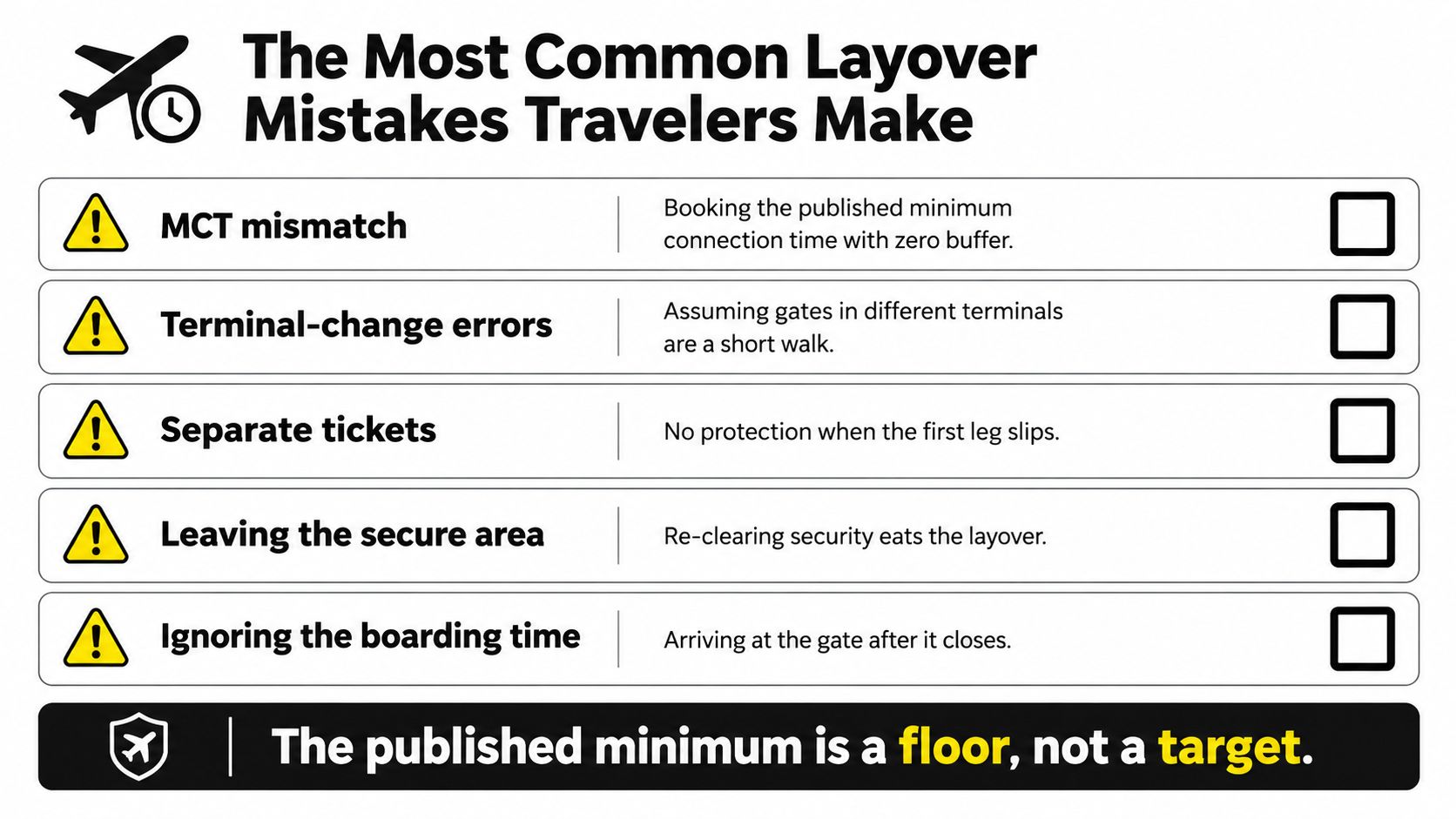
One more mistake deserves attention: forgetting boarding time. The departure time isn't the moment you should arrive at the gate. Airlines can close boarding before the scheduled departure, and a traveler who reaches the gate after closure may lose the seat even if the aircraft is still visible.
Prevention: Treat the gate closing time and the airport's walking distance as part of the connection, not as optional details.
A Pre-Booking Checklist for Every Connecting Trip
A connecting itinerary is only as strong as its weakest link, and the booking screen is where that link is created. Before clicking purchase, run the trip through the same sequence every time.
First, confirm the ticket structure. Look for one ticket number or one reservation covering all legs, not merely a search page that displays the flights together. If the flights have separate confirmation numbers, assume you carry the risk unless the airlines explicitly provide a connection arrangement.
Next, inspect the airport and terminal pair. Compare the scheduled layover with the applicable MCT, then add time for walking, trains, border checks, baggage collection, and security. A legal connection can still be a bad connection when you have an important meeting, mobility constraints, or a late-day arrival.
Then, audit the baggage path. Ask whether the bag will be tagged to the final city, whether you must claim it during an international transfer, and whether customs requires a re-check. Keep documents, medication, electronics, and a change of clothes where you can reach them without the checked suitcase.
Check transit documents before paying. A self-transfer can turn a simple airport change into an entry-control event. Review the requirements for your passport, every transit country, and the final destination, especially when the itinerary touches the United Kingdom, Canada, or the Schengen area.
Finally, compare fare classes across the whole route. Search the economy and premium cabins, inspect baggage and flexibility, and compare the full ticket price rather than assuming coach must be cheaper. Premium inventory can be discounted enough to reverse the usual hierarchy, but the connection still needs to work operationally.
Use a three-second filter before every booking:
- Protect yourself: Is this one ticket with a clear rebooking path?
- Buffer the time: Can you complete the transfer if the first flight is late?
- Check the money: Does a premium fare offer better value than restrictive coach?
That filter works for domestic travel, international travel, and carefully planned self-transfers. It won't eliminate delays, but it will make the consequences much easier to manage.
Passport Premiere helps travelers compare international premium-cabin fares, monitor fare movements, and evaluate multi-city itineraries that may include connecting segments. If you're checking whether business class could cost less than a restrictive coach ticket on your next route, visit Passport Premiere and review the available fare guidance.
