
The popular advice is simple: book directly with the airline for the lowest fare. That advice is useful, but incomplete. Travel agents aren't automatically cheaper, and an online travel agency won't always beat an airline's own website. Question is more precise: which fare inventory is available, through which channel, and at what moment?
A large 2023 comparison across 30 routes found that online travel agencies averaged $972.20 for a return trip, compared with $1,083.22 when booking directly with airlines, a difference of $111.02, or about 10.2% (IATA). Booking.com averaged 11.1% cheaper than direct booking in that sample, while Expedia and Agoda also came in below direct-airline pricing. Yet the same analysis found one important exception, Air France was cheaper than the OTAs on the routes studied.
That contrast explains why the answer to “can travel agents get cheaper flights?” is neither a universal yes nor a no. Short-haul economy fares often behave like transparent retail prices. Long-haul international routes, business class, first class, corporate travel, and complex itineraries can expose more opportunities for an agent to use consolidator, negotiated, or private inventory.
The most surprising possibility is that business class can sometimes cost less than coach. That doesn't mean airlines routinely price comfort below economy. It means fare buckets, demand, timing, route competition, and premium-cabin inventory can create unusual gaps. A traveler who compares only the cheapest economy listing may miss a business-class fare that has dropped into a different pricing window.
This guide breaks down the mechanics without treating agents as holders of magical secret codes. You'll learn how airline inventory works, where agency access can help, how fees affect the final price, why timing matters as much as the booking channel, and when booking direct or through an online travel agency makes more sense.
Introduction Why Cheaper Flights Are Not Always What They Seem
A low price on a search screen can be misleading if it represents a different product. One fare may include a checked bag, changes, seat selection, or better protection during disruptions. Another may be cheaper only because it has restrictive rules, a less convenient connection, or a separate-ticket structure that creates risk.
Travel agents can sometimes produce a lower valid fare, but their advantage usually comes from access and interpretation, not a universal discount. Agency systems may expose fare rules and inventory that differ from the consumer-facing search path. Agents can also compare combinations that automated tools may not present clearly, especially on international itineraries with multiple airlines, open-jaw routing, or premium cabins.
The strongest opportunities tend to appear where pricing is complicated. Long-haul international flights have more fare conditions, more cabin inventory to manage, and more room for negotiated or consolidator rates. Premium cabins also behave differently from standard economy because airlines may lower prices to fill seats that would otherwise depart empty.
That's where the phrase business class cheaper than coach stops sounding impossible and starts making sense. A business-class fare can fall below a particular economy fare when the economy inventory available at that moment is expensive, while a discounted business-class bucket remains open. The comparison isn't between comfort in the abstract. It's between two specific fare buckets offered under different rules.
The practical question: Don't ask only whether an agent is cheaper. Ask whether the agent can access a better fare type, a more suitable rule set, or a better timing window.
The sections ahead compare published, consolidator, and negotiated fares, then examine fees and real booking situations. The goal is a usable decision process. You should be able to compare an agent quote with an airline or OTA price without comparing unlike products.
How Airline Pricing Really Works Behind the Scenes
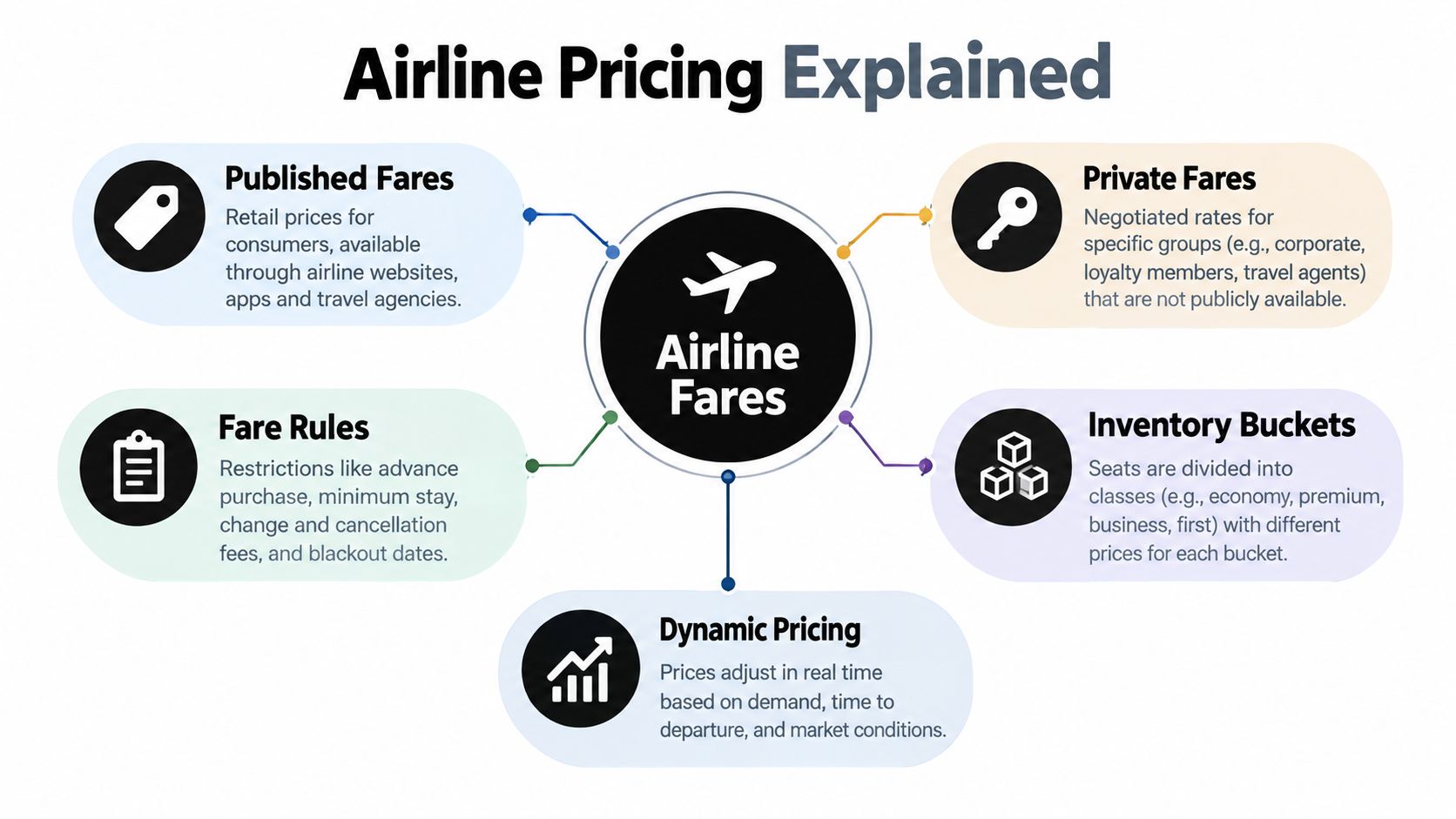
Airline pricing makes more sense if you think of the airline as a retailer with several storerooms. The public website is the front shop. A global distribution system, or GDS, is closer to a professional sales terminal used by agencies and corporate travel teams. Both may sell seats on the same flight, but they can display different fare products, rules, and combinations.
Airlines don't create one price for every seat. They file multiple fares, each linked to conditions such as advance-purchase requirements, permitted travel dates, refundability, change rules, routing, and booking class. The airline also controls how many seats are available in each inventory bucket. When one bucket closes, the search system may show a higher fare even though seats remain in the cabin.
You can explore the broader commercial logic in this explanation of yield management pricing. The important idea is that the airline is managing expected revenue across a flight, not assigning one permanent price to every seat.
The same seat can have different prices
Suppose two travelers sit next to each other. One bought a restrictive fare several weeks ahead. The other paid more for a flexible ticket closer to departure. The physical seat is similar, but the airline sold two different bundles of rights.
Those rights can include:
- Refund rules: Whether the ticket can be refunded, and under what conditions.
- Change rules: Whether dates or flights can be changed, and what fare difference applies.
- Advance purchase: Whether the traveler must ticket before a stated deadline.
- Routing limits: Which connections or partner airlines are permitted.
- Booking class: The inventory bucket attached to the fare.
Travelers often mistake a fare bucket for a separate seat. It's usually better understood as a pricing category attached to seats in a cabin. An airline can open a lower-priced bucket when demand is weaker, then close it when bookings accelerate.
Why agency searches can differ
Agency booking systems can access airline-distributed inventory and ticketing rules that don't always appear in the same way on consumer sites. Major carriers instruct agents to use real-time fares in their GDS and make clear that a fare isn't guaranteed until ticketing. That means the displayed price can change between search, reservation, and issuance (Garuda Indonesia booking and ticketing policy).
An agent may also reprice an itinerary against a newly filed fare before final ticketing, provided the fare rules and ticketing deadline allow it. This isn't a guaranteed secret discount. It's a timing advantage created by monitoring inventory, reading rules correctly, and completing the ticket before the lower fare disappears.
A reservation is not the same as an issued ticket. Until ticketing is complete, price and availability can change.
Published Consolidator and Negotiated Fares Compared
“Special fare” can describe several different pricing paths, not one universal discount. A published fare is available to ordinary shoppers through an airline website or online travel agency. A consolidator fare travels through an agency channel and may reflect wholesale-style inventory. A negotiated or private fare usually depends on an agency relationship, corporate agreement, booking code, or another eligibility condition.
The useful question is not whether an agent has a secret price. It is whether the agent can access a different fare inventory, apply different rules, or spot a better timing window. If the agent is quoting the same published fare available to you, the booking channel alone may save nothing. If the agent can compare agency-distributed options, the result may differ.
GDS platforms such as Amadeus, Sabre, and Galileo help agencies search and ticket complicated combinations. Access does not guarantee a lower price. Route, cabin, fare class, ticketing deadline, and restrictions decide whether an agent's quote improves on retail. Travelers comparing premium options can also review business class consolidator fares as one possible agency-distributed category.
Fare Types at a Glance
| Fare Type | Who Can Access | Typical Savings vs Retail | Best For |
|---|---|---|---|
| Published fare | Any traveler through public airline or OTA channels | May be higher or lower depending on the site and itinerary | Straightforward economy trips and travelers who want direct control |
| Consolidator fare | Agencies with access to wholesale-style or agency-distributed inventory | A quoted example described a $500 public fare dropping to about $380 to $400, implying roughly 15% to 25% in some cases (News18) | Long-haul international travel and selected premium-cabin routes |
| Negotiated or private fare | Eligible agencies, corporate accounts, or travelers booked under applicable codes or contracts | Varies by route, cabin, contract, and availability | Corporate travel, premium cabins, and itineraries needing specific rule sets |
The savings range is an example, not a promise. A private fare may be unavailable on your dates, carry stricter change conditions, or lose its advantage after service fees. A business-class fare can sometimes cost less than a published economy fare when the underlying fare construction, routing, or inventory differs. The cabin label alone does not determine the final price.
Where the agency edge is strongest
Long-haul international and premium-cabin itineraries often give agents more options because their fare construction is more involved. A corporate traveler may value a negotiated fare with change flexibility over a slightly cheaper restricted ticket. A leisure traveler may accept different dates or routing to reach a lower premium-cabin price.
Fare monitoring still matters. An agent may identify a qualifying agency fare, while an airline alert or comparison tool helps reveal when public inventory changes. Using both approaches works like checking two markets for the same item. Neither guarantees a bargain, but together they reduce the chance of judging one fare against an unsuitable alternative.
Airline reporting also shows that agencies remain a major airfare channel. U.S. travel agency air ticket sales reached a record $99.2 billion in 2024, according to Airlines Reporting Corporation data cited in the cost analysis of online travel agencies versus direct booking. The figure does not prove an agent will beat your next quote. It does show that agencies continue to handle substantial airfare volume, including complex and higher-value trips.
What Travel Agents Charge and When Fees Still Save You Money
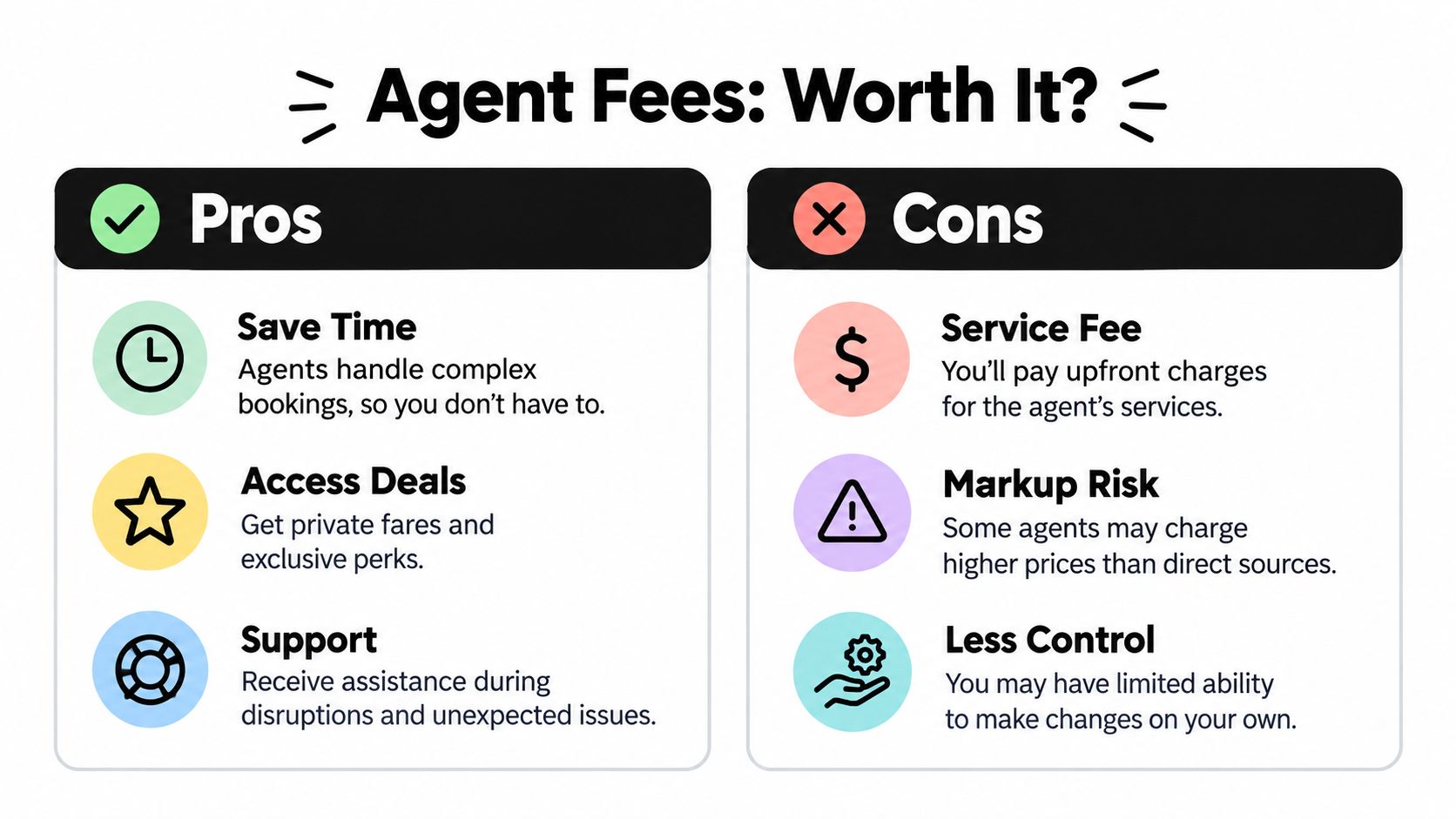
An agent quote should be judged by total cost, not just the fare printed beside the itinerary. Agencies may earn commission from a supplier, charge a service fee, add a ticketing fee, apply a markup, or combine several of these approaches. Some agents may charge for changes or reissues even when the initial booking fee is modest.
A fee doesn't automatically make an agent more expensive. If the underlying fare is lower, the final amount can still beat a public price. The same is true in reverse. A discounted-looking quote can become less attractive after service charges, payment fees, seat costs, baggage, or restrictive change terms are included.
Use a simple comparison:
Agent total = quoted fare + taxes + agency fees + paid extras
Compare that figure with the airline or OTA total for the same flights, cabin, baggage, flexibility, and passenger details. Don't compare a refundable or changeable agent ticket with a basic economy fare that has different restrictions.
What to ask before paying
Request a written breakdown before authorizing the ticket. You should know whether the quoted amount includes the agency's compensation and what happens if the airline changes the schedule.
Ask these direct questions:
- What is the total amount charged today? Ask for fare, taxes, and every agency fee.
- Who issues the ticket? Confirm the airline, agency, or consolidator responsible for ticketing.
- What does a change cost? Separate the airline's fare difference and penalty from the agency's handling fee.
- Is the fare refundable? Ask whether refunds return to the original payment method.
- What happens during disruption? Clarify who handles rebooking if the airline cancels or significantly changes the flight.
For a clearer background on how intermediaries are compensated, review this guide to understanding OTA fee structures from Samba. OTA economics and traditional agency fees aren't identical, but the comparison helps explain why the displayed fare isn't always the full cost of a booking relationship.
Break-even rule: An agent earns your business when the combined price and service value exceed what you'd receive by booking alone.
A complex international trip may justify a fee because one knowledgeable person can manage ticket rules, connections, and reissue work. A simple nonstop economy flight may not. Travelers seeking premium support can also compare what a first-class travel agency includes before deciding whether its service model fits the itinerary.
Real World Examples When Agents Beat Online Prices
Consider a leisure traveler searching for a transatlantic trip. The cheapest visible economy fare is high because the lower economy buckets have closed. An agent checks the same dates, nearby departures, and business-class inventory, then finds a discounted business fare still open through an agency channel.
The result can look backward on the screen: business class costs less than coach. The agent hasn't changed the laws of pricing. The traveler is comparing a higher cabin in a lower-priced fare bucket with an economy cabin whose cheaper inventory is no longer available.
The lesson is narrow but valuable. This opportunity is most plausible when the traveler can consider long-haul routes, flexible dates, or alternative connections. It isn't a reason to assume every business-class ticket should cost less than economy.

A corporate traveler values rules, not just price
A consultant traveling internationally may need the ability to move a return date after a client meeting changes. A public fare can look cheaper until the traveler needs to modify it. An agent with access to a corporate or negotiated fare may find a better overall arrangement because the ticket's conditions fit the business requirement.
The saving here isn't necessarily a dramatic reduction in the initial fare. It may come from avoiding an unsuitable ticket, finding a permitted routing, or preserving flexibility that a low public fare doesn't provide. Corporate travel managers should compare the complete policy outcome, including support and change handling.
When an agent adds little
Now consider a short-haul economy traveler with fixed dates, one airline, and a nonstop flight. The traveler checks the airline website and an OTA, finds the same fare conditions, and sees no agency-only inventory. In that situation, an agent may still save time, but the booking channel may not lower the fare.
The 2023 fare comparison mentioned earlier illustrates why travelers should check multiple channels. OTAs averaged lower prices than direct airline booking across the sample, but one airline was cheaper than the OTAs. No channel wins every route.
The strongest agent examples combine a difficult itinerary, meaningful flexibility needs, or access to non-public inventory. Simplicity reduces the value of specialized booking access.
How to Get the Best Premium Cabin Deals With or Without an Agent
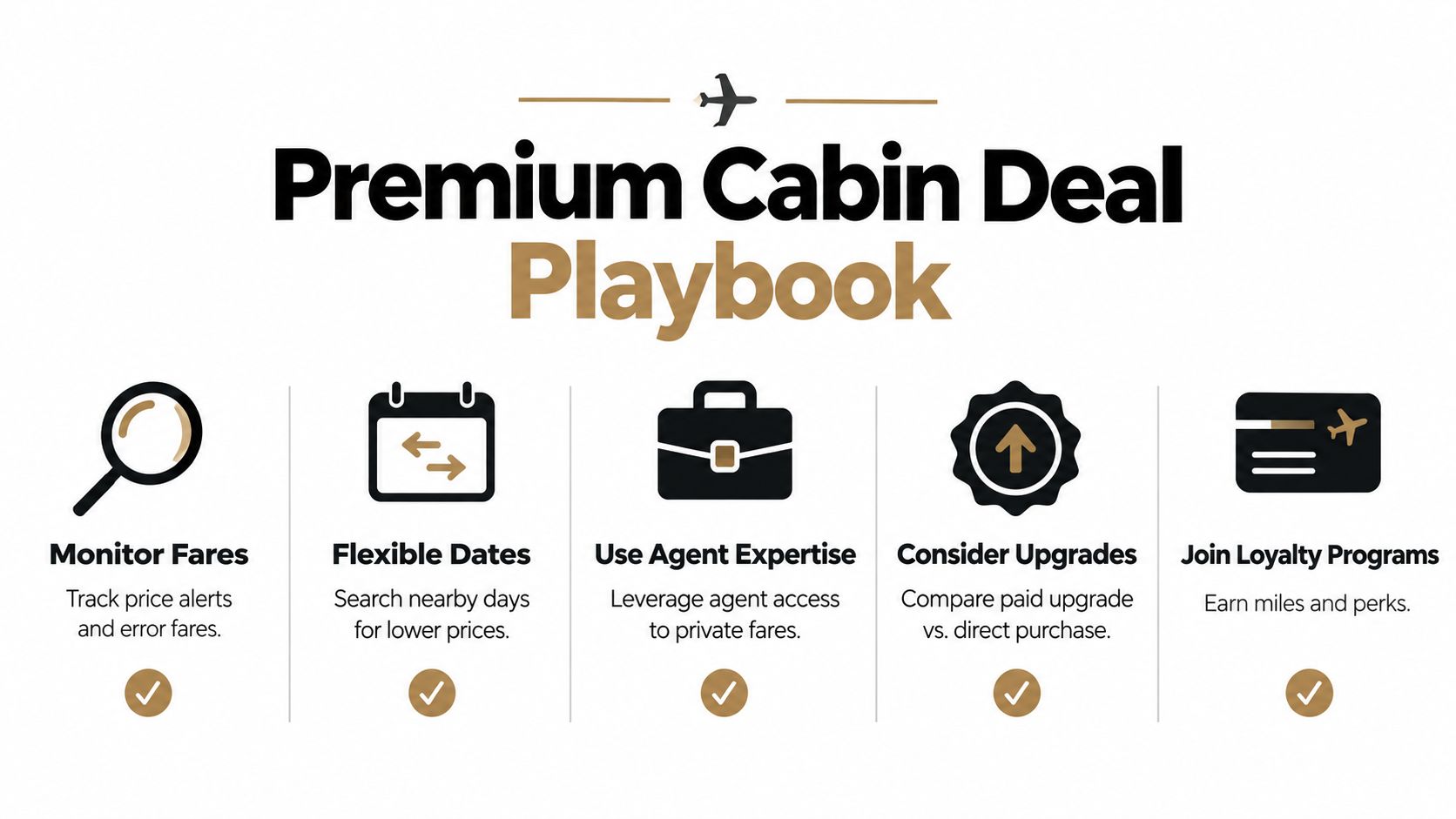
The most effective strategy combines fare monitoring with expert ticketing. An agent can search agency inventory and interpret restrictions, while a monitoring service or disciplined traveler can identify when the market has moved into a favorable window. Neither approach replaces the other.
Start with the itinerary rather than the cabin label. Decide which dates, nearby airports, connections, and minimum flexibility you can accept. A traveler who can shift the trip or consider an alternative routing gives the search more opportunities to find a lower fare.
Build a repeatable search habit
Monitor the route instead of checking once. Premium fares can move when airlines adjust inventory, respond to competition, or try to fill seats. Fare monitoring helps you recognize a genuine drop rather than treating every displayed price as equally meaningful.
Then ask an agent to check the fare's conditions and ticketing deadline. A low fare that disappears before issuance isn't a saving. The agent should confirm whether the fare is public, consolidator, private, or corporate, and whether the lower price changes refund or rebooking rights.
Premium economy deserves attention too. It generally costs 20% to 80% more than economy and about 50% to 70% less than business class on the same flight, according to NerdWallet's cabin comparison. That middle position can make it a useful benchmark when business class is priced unusually close to economy or when the traveler wants more comfort without paying the normal business-class premium.
Use timing as a second source of leverage
Published market coverage shows that airfare conditions don't move uniformly. One business-travel projection expected global average airfares to decline 2.2% in 2025 after a 4.8% rise in 2024, while projected 2025 intercontinental business-class changes varied by region, including 2.7% in North America, 1.2% in Europe, and 7.8% in Australia (TRRIPAH). These are projections, not guarantees for an individual route.
Expedia's 2026 air-hacks data also indicates that the cheapest month and weekday can change by market and year, so timing advantages are volatile rather than permanently tied to one booking channel (Seattle's Travels). Treat fare monitoring as market observation, not a promise of a specific discount.
For premium international travel, compare any membership or monitoring fee with the likely value of the trip, then verify the final ticket conditions before purchase. The useful combination is clear: monitor for the opening, use an agent to validate and ticket the right inventory.
Making the Right Choice for Your Next Flight Booking
Choose the booking channel according to the trip, not according to a slogan.
Book direct when the itinerary is simple, the airline's price is competitive, and you value direct control over changes. Check an OTA when you're comparing straightforward public fares across several airlines. Use an agent when the routing is complex, the cabin is premium, the trip is international, or the fare rules matter enough that a mistake could cost more than the agency fee.
A practical final checklist:
- Match the itinerary: Confirm flights, cabin, baggage, seats, connections, and operating carriers.
- Compare the complete total: Include agency fees, OTA charges, seat costs, and other paid extras.
- Read the rules: Check changes, refunds, cancellation conditions, and ticketing deadlines.
- Ask about inventory: Find out whether the quote is published, consolidator, negotiated, or corporate.
- Check timing: If the price looks unusually good, verify how long the fare can be held and when it must be ticketed.
- Confirm the ticket: After issuance, verify the ticket number and itinerary with the operating airline.
The central answer is conditional. Travel agents can get cheaper flights when their access or expertise reaches a fare product you can't see, or when they catch a better timing window. They won't always beat an airline or OTA, and business class won't routinely undercut coach. But when premium inventory is weakly demanded and economy pricing is constrained, business class cheaper than coach can be a legitimate market outcome.
Passport Premiere offers membership-based fare monitoring, market analysis, and guidance for international Business and First Class purchases, including signals designed to help members identify favorable fare movements. Visit Passport Premiere to review how its monitoring approach can complement an agent search and help you judge premium-cabin value before ticketing.
