
Last-minute business class can be cheaper than coach on the right international routes. A 2025 airline study found last-minute one-way tickets averaged $228.21, and some carriers priced them 8.3% below advance fares, while others raised prices sharply near departure.
That sounds backward because most travelers associate late booking with panic pricing. Yet airlines sometimes need to clear unsold premium seats, particularly on competitive transatlantic and Pacific routes. A fare-pricing analysis found that carriers may slash business-class prices close to departure to avoid flying empty high-value seats, creating the unusual situation where a last-minute business-class ticket costs less than economy on the same aircraft. Passport Premiere's analysis of last-minute business-class fares documents this buying-event logic.
The answer to how do you get last minute flight deals isn't “wait until the day before and hope.” It's to identify routes where premium inventory can soften, monitor the fare against route history, and set a purchase threshold before the airline removes the opportunity.
What Last Minute Flight Deals Actually Mean in 2026
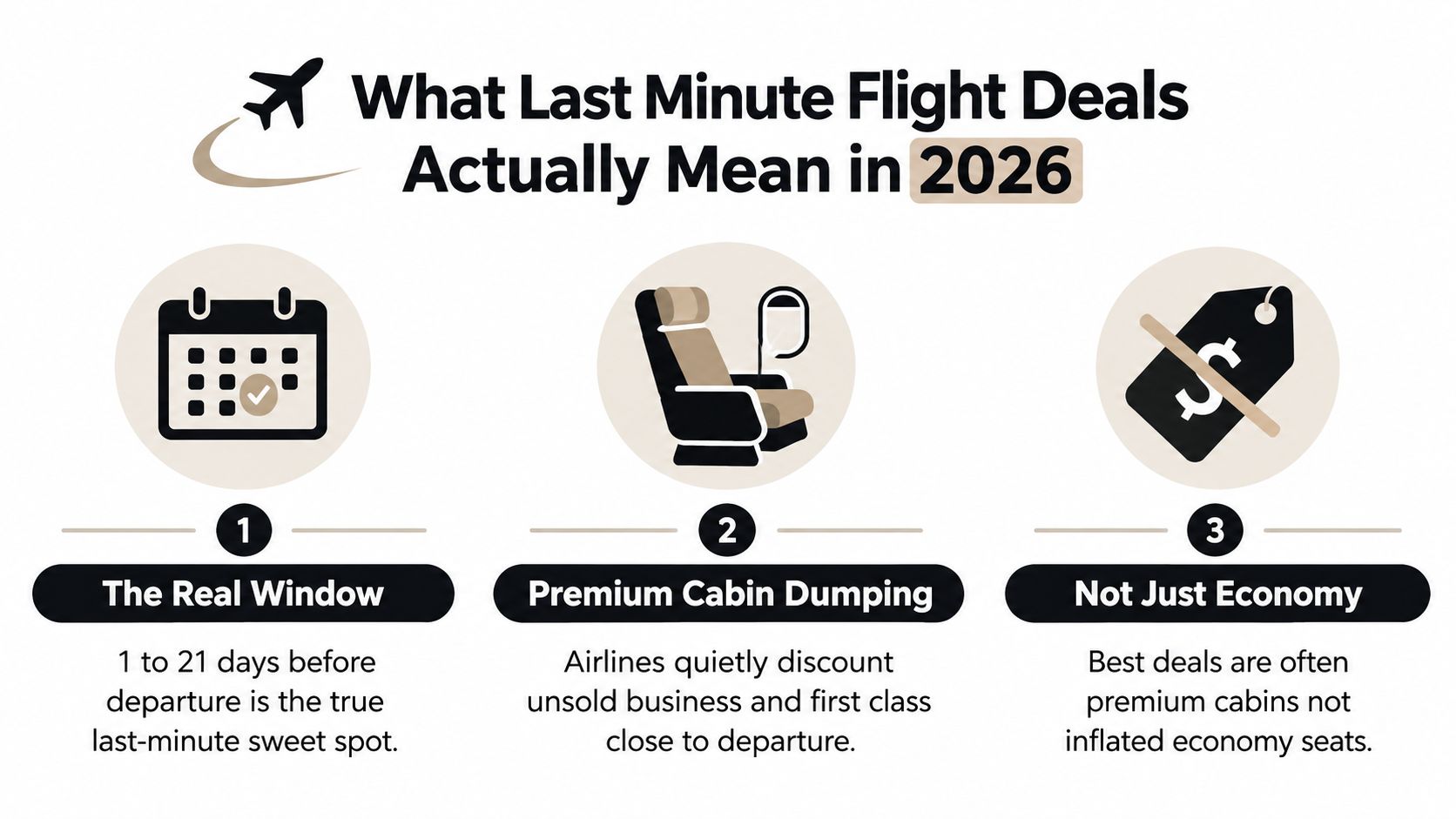
Last-minute airfare is a premium-cabin buying event, not a universal economy strategy. For domestic economy travelers, booking late usually means accepting rising fares and fewer choices. For international business-class buyers, it can create a short opportunity to purchase unsold premium inventory before departure.
Use one to 21 days before departure as the practical international last-minute window. The strongest premium-cabin period is narrower, roughly four to 14 days before departure. Airlines still have time to fill empty seats, while urgent business travel, schedule changes, and spontaneous trips generate late demand.
Carrier behavior varies sharply. A 2025 study of major airlines found Spirit averaged $151.53 for the analyzed last-minute one-way tickets, compared with $160.89 for Frontier. JetBlue's last-minute fares were 29.9% higher than its advance fares, while United's were 15.6% higher. The airline-by-airline fare comparison supports a strict rule: wait only on routes and carriers with a history of late fare softness.
The premium opportunity
A widebody with empty business-class seats creates a different pricing decision. The airline may prefer a discounted premium sale to flying valuable inventory unused. Routes such as JFK to London, SFO to Tokyo, or LAX to Sydney can produce this opportunity, but none should be treated as a guaranteed pattern. Passport Premiere's analysis describes this buying-event logic and the conditions that can make last-minute business class attractive.
Set a route-specific fare threshold, then monitor premium inventory against the economy price. If business class approaches or falls below coach, buy before the airline removes the remaining seats.
Domestic routes require a separate policy. Fare-history guidance places stronger domestic and short-haul opportunities in the broader three-week to 2.5-month window, not necessarily the final days. The same guidance reports that some large datasets showed their lowest average fares around 42 to 54 days before departure, while fares in the final six days could be materially higher. Travel Agent Central's fare-timing analysis supports a firm operating rule: do not gamble on a same-day economy fare unless the schedule and budget can absorb a poor result.
Practical rule: Treat last minute as a premium-inventory strategy. Book economy earlier when the route's fare history shows late prices rising.
The Booking Curve and Why Last Minute Is Not One Window
Airfare behaves differently by market. Domestic North American pricing usually becomes less forgiving as departure approaches, especially after the main advance-purchase period. International premium cabins can follow a more uneven curve because airlines are balancing corporate demand, connecting traffic, loyalty inventory, and the cost of flying an empty business-class seat.
The useful comparison is not “early versus late.” It's today's fare versus the route's own history. Consumer tools can show about 60 days of recent price movement for a specific itinerary, while U.S. government aviation datasets offer decades of route-level history. This fare-history guidance explains why a current price needs context before you call it a deal.
A practical fare-position framework
The table below is deliberately qualitative. The available verified evidence supports distinct behavior by market, but it doesn't provide a standardized index for each booking window.
| Booking Window | Domestic Fare Index | International Business Fare Index |
|---|---|---|
| More than two months out | Often reasonable, but not automatically lowest | Useful for establishing a baseline |
| About three weeks to 2.5 months out | Frequently the strongest monitoring period | Monitor, but don't assume the lowest premium fare appears here |
| Seven to 21 days out | Usually rising or volatile | A possible buying-event period on competitive long-haul routes |
| Final six days | Often materially above the optimum window | Can produce a premium dip, but inventory risk is high |
| Same day | A poor economy strategy | A specialist opportunity only when availability and fare rules are favorable |
For domestic travel, start monitoring before the final month and act when the fare reaches a defensible level. A major study found that the lowest fare for a given flight changed an average of 71 times before departure, roughly every 4.5 days, with each move averaging about $33 up or down. That volatility favors regular checking over a single late search.
For international business class, establish a longer baseline, then watch closely inside the final three weeks. The right question is whether the fare has entered a historically favorable band, not whether the calendar says “last minute.” The guide to when airlines drop prices is useful for building that route-specific monitoring habit.
Setting Up Fare Alerts That Catch Real Drops
A fare alert is only useful when it's designed around the fare you want. Most travelers configure alerts for the cheapest economy result, then miss a premium-cabin buying event because the business-class price remains above an unrealistic general-market threshold.
Start 21 to 30 days before departure for an international premium search. Track the exact route, nearby airports, one-way combinations, and business-class cabin separately. Google Flights is useful for the broad market view, Hopper can provide movement notifications, and Scott's Cheap Flights, now operating under the Going brand, can surface broader sale activity. Use Kayak when you want another price-history perspective.
Set a percentage-based trigger rather than a fixed dollar amount. A 15% or larger drop is a sensible alert threshold for a premium fare because the value of the event depends on the route's baseline. A modest absolute reduction can matter on a low fare, while a larger premium ticket may move meaningfully without reaching the lowest economy price.
Read the graph before you react
A single downward tick isn't enough. Compare the current result with the recent pattern and ask:
- Is the route falling broadly? A genuine market dip usually appears across nearby dates or competing carriers.
- Is the change isolated? One low result may reflect a restrictive fare, a long connection, or an airport mismatch.
- Does the fare class have real space? Booking buckets such as G, R, and Z can help you distinguish a genuine premium availability signal from a display that disappears at checkout.
- Are the rules acceptable? A cheap business fare with severe change restrictions may not suit a corporate traveler.
Layer a route-specific alert with a trusted sale newsletter. Short-lived premium buying events can vanish before a routine daily email reaches you, so mobile notifications and an approval process matter. Corporate travelers should also decide in advance who can authorize a purchase when the fare appears.
For a more specialized monitoring workflow, review airline price-drop alerts alongside the general-purpose tools. The point isn't to subscribe to every service. It's to create overlapping coverage without confusing a marketing notification with a bookable fare.
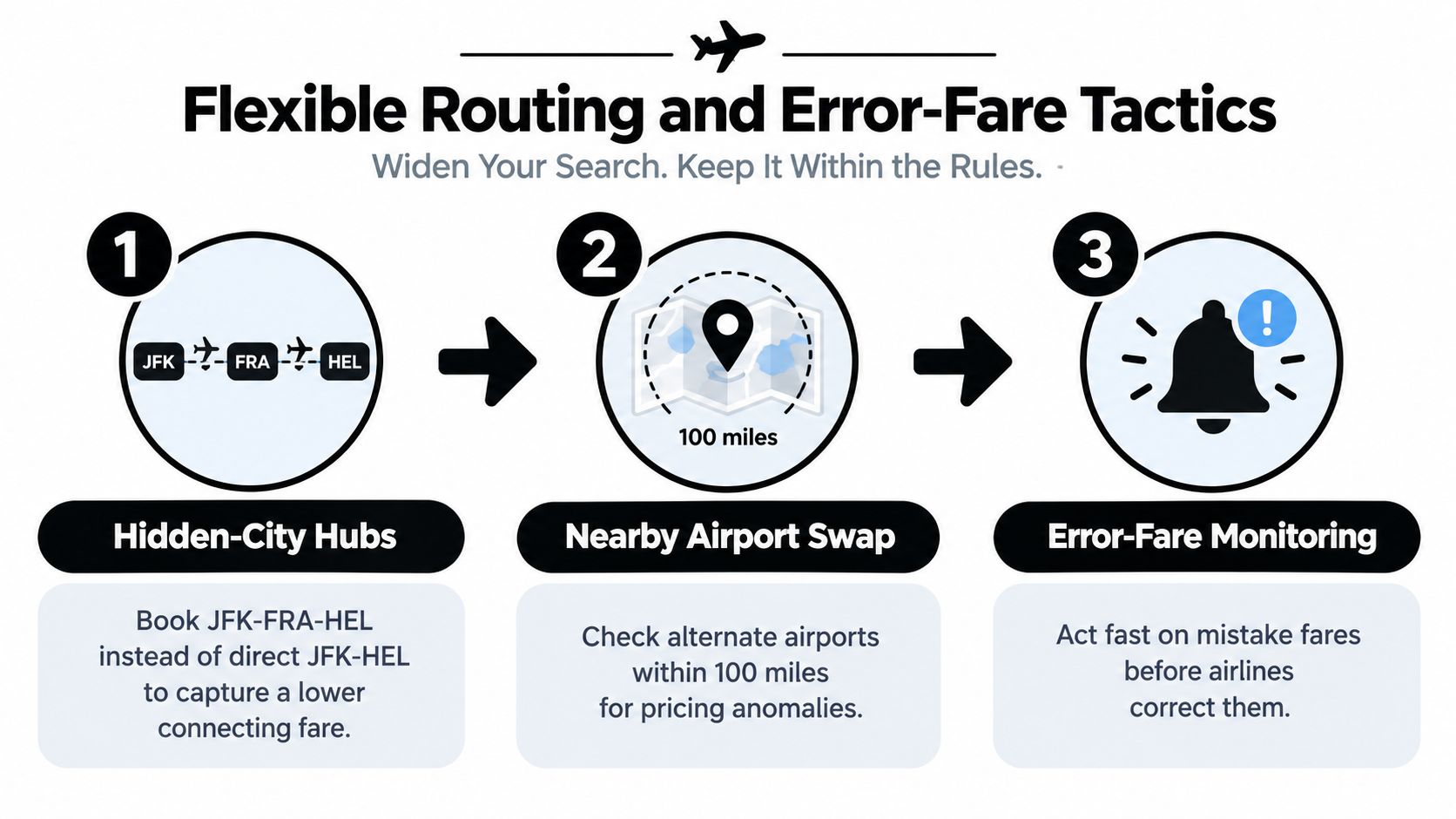
Flexible Routing and Error-Fare Tactics
Flexible routing can uncover value, but it also introduces operational risk. Search the itinerary a corporate traveler can manage, then test alternatives separately rather than accepting every cheap construction the search engine displays.
The first tactic is hidden-city ticketing, such as searching JFK to FRA to HEL instead of a direct JFK to HEL itinerary. The second is throwaway ticketing, where a traveler buys a longer itinerary because the airline prices the desired first segment more cheaply inside that structure. The third is self-connecting across separate tickets, potentially combining different carriers or airports.
These methods can work, but they're unsuitable for checked bags, missed-connection protection, or complex corporate itineraries. This guide to multiple-leg flights is useful when comparing separate-ticket constructions with a conventional through fare.
How error fares appear
Error fares can result from human pricing mistakes, currency-conversion glitches, or fuel-surcharge calculations that post incorrectly. They often disappear once the airline or distribution system corrects the filing. Routes that attract attention include long-haul low-cost-carrier services, transpacific itineraries, and Latin America positioning flights.
Use a disciplined sequence:
- Monitor discovery channels. Check Secret Flying, Fly4Free, and the @SecretFlying and @seats31 feeds.
- Rebuild the itinerary. Use an ITA Matrix search to verify that the fare exists beyond a single affiliate display.
- Confirm the booking class. Call the carrier and ask whether the displayed class is available.
- Check the contract. Review cancellation, change, baggage, and ticketing conditions before payment.
- Use a protected card. Choose a credit card with strong travel protections appropriate to the itinerary.
Airlines may honor an error fare, void the booking, or offer credit instead of a refund. Don't issue nonrefundable hotels, ground transport, or client commitments until the ticket is secure.
Hidden-city tickets carry an additional warning. Skiplagged-style itineraries can violate airline contract-of-carriage clauses and may lead to cancellation of later segments, including a return flight. Use them only when you understand the risk, preferably on a refundable or one-way ticket, and never with checked baggage.
For a separate destination where routing complexity matters, the Maximum Adventure Trails budget guide offers a useful example of why airport choice and ground transport must be evaluated together, not as isolated airfare tricks.
Loyalty Inventory and Premium-Cabin Buying Events
Cash pricing is only one pool of premium availability. Airlines may also release award seats close to departure when a business-class cabin risks flying empty. Corporate cancellations, partner allocations, and negotiated channels can expose inventory that never appears in a standard economy search.
The release pattern depends on the airline and program. Lufthansa may open more First Class award space inside 14 days of departure. Singapore Airlines is associated with premium award waves at T-355, T-30, and T-3. Air France-KLM Flying Blue Promo Rewards can place one-way business-class awards to Europe below 60,000 miles around two weeks before departure. These examples come from the cited industry guidance, and availability can disappear quickly. Going's 2026 travel report also distinguishes late award-seat availability from cash-fare behavior, an important distinction for premium searches.
Where to look
Use ExpertFlyer's award and upgrade screens, Seats.aero's alliance search, and the airline's own fare calendar. Filter for the relevant cabin and fare family instead of searching only for the lowest published result.
| Airline or program | Award release wave | Sweet spot for business class | Typical one-way miles |
|---|---|---|---|
| Lufthansa | More First Class availability within 14 days | Near departure, when award space appears | Varies by program and route |
| Singapore Airlines | T-355, T-30, and T-3 | Monitor each release wave | Varies by program and route |
| Air France-KLM Flying Blue | Promo Rewards can appear around two weeks out | Short-notice Europe travel | Under 60,000 miles in qualifying examples |
Passport Premiere's buying-event framework adds a cash-fare perspective. When a corporate block is canceled inside the final two weeks, an airline may need to clear premium seats through public, corporate, or consolidator channels. A business-class fare can then undercut a constrained coach fare, especially on a competitive long-haul route.
The baseline price gap explains why this feels so dramatic. A 2025 comparison reported that business class often costs five to 10 times more than economy, so a discounted premium fare can still be lower than a walk-up coach fare when economy inventory has tightened. The business-class versus coach comparison provides that baseline.
Hold a refundable coach ticket when the trip is unavoidable and premium availability is uncertain. Switch only after confirming the premium ticket's refund, change, baggage, and seat conditions.
When to Buy and When to Stop Waiting
For last-minute premium travel, waiting for the theoretical bottom is usually the wrong decision. Set a price threshold, then buy when the fare compensates for the risk of losing the seat. Passport Premiere's buying-event framework is useful here: a canceled corporate block can leave premium seats to be cleared publicly, through corporate channels, or via consolidators. On a competitive long-haul route, business class may briefly cost less than the remaining coach inventory.
For international premium cabins, watch the final 31 to 45 days closely. Published fare guidance reports a possible saving of about $190 compared with booking more than six months out, while also warning that last-minute discounts remain unusual. Prices commonly rise during the final two to three weeks, as airlines protect seats for late-booking business travelers. The premium-cabin booking guidance supports early monitoring followed by selective purchase.
Use a hard purchase rule
Buy as soon as one of these conditions is met:
- The fare enters a historically cheap band for that route.
- The current price sits clearly below its recent moving average.
- Business class costs less than the available coach alternative.
- The fare rules work, but remaining inventory looks fragile.
- The itinerary is a competitive transatlantic or Pacific route where premium inventory can soften.
Fare drops often create a short buying window, not a long decline. Analysis of fare movements found that 75% of fare drops recovered within 24 hours, while the average meaningful drop was $38. The fare-movement analysis makes hesitation hard to justify when the current fare already meets the company's requirements.
The best deal is the fare you can verify, approve, and ticket before the inventory disappears.
Corporate travel managers should predefine an acceptable premium fare, maximum connection time, and required refund policy. Approval speed then becomes an operating advantage. Your team can act on a genuine drop instead of reopening the entire decision whenever the price changes.
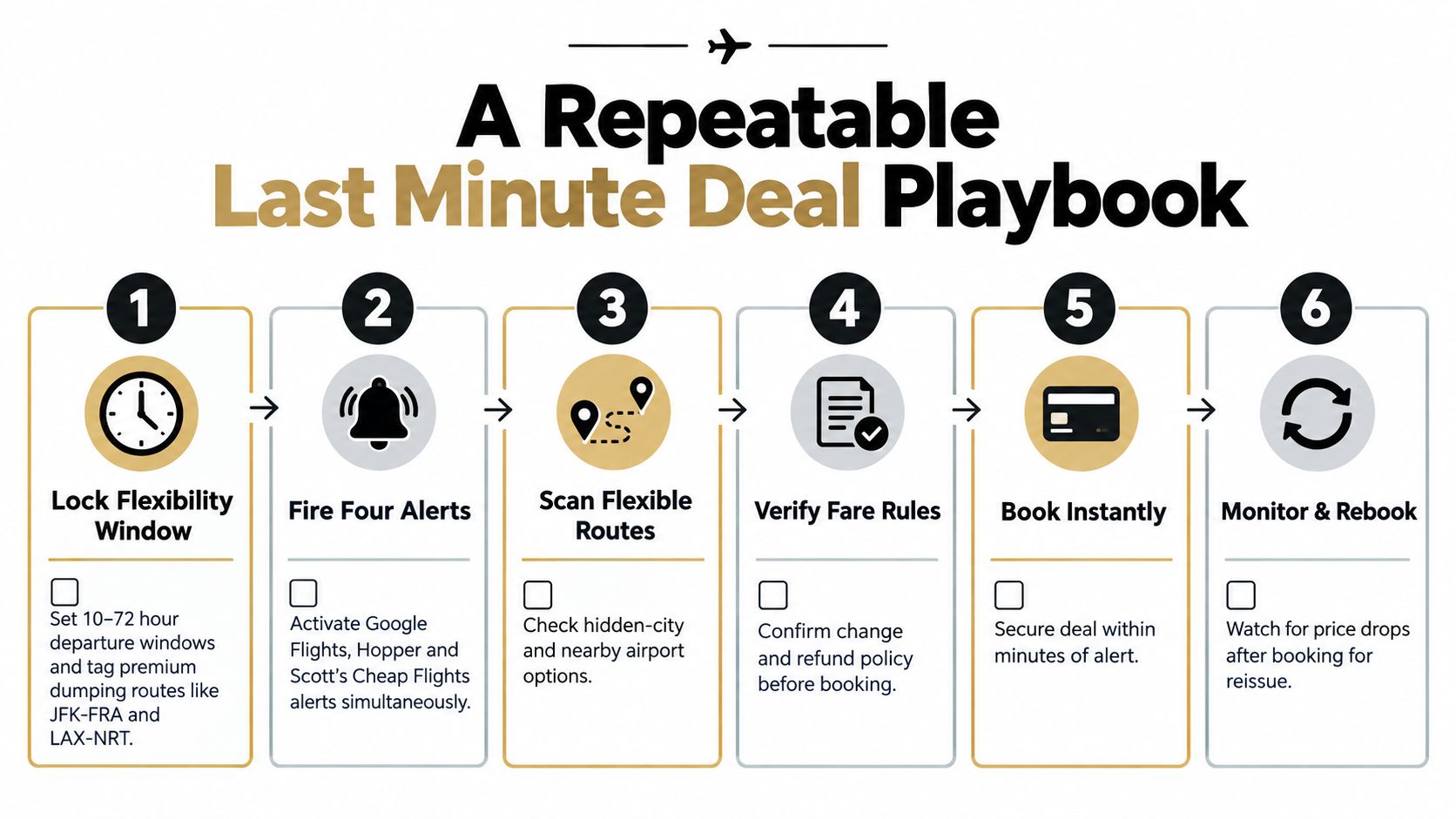
A Repeatable Last Minute Deal Playbook
Use the same operating rhythm on every international booking. Consistency prevents the two common failures, searching too late and hesitating after a viable fare appears.
The six-step workflow
- Lock the flexibility window. Mark the dates and times you can move, then tag routes where premium inventory may soften, including JFK to Frankfurt and LAX to Tokyo. For urgent travel, preserve flexibility across departure times and nearby airports.
- Fire four alerts. Use Google Flights, Hopper, Kayak, and Scott's Cheap Flights, or Going, for the same route. Save price-history screenshots so your team can compare the new fare with the prior baseline.
- Scan flexible constructions. Check nearby airports, one-way combinations, and hidden-city possibilities. Use a hidden-city option only without checked bags and only when you can accept the contract and missed-segment risks.
- Verify the fare rules. Confirm the booking class, baggage allowance, change terms, refund conditions, and any applicable 24-hour cancellation or hold policy before issuing the ticket.
- Query award and buy-up inventory. Search United Polaris, ANA First, and Virgin Atlantic Upper Class through partner tools, then compare the miles requirement with the airline's published premium fare.
- Book when the evidence is sufficient. Don't chase a phantom drop after a fare has already entered your acceptable range. Check the ticket immediately, capture the fare basis, and communicate the decision to the traveler.
A checklist for the travel desk
| Action | Tool or evidence | Time to action |
|---|---|---|
| Set route and cabin alerts | Google Flights, Hopper, Kayak, Going | Early in the monitoring period |
| Compare recent movement | Saved fare-history screenshots | At every alert |
| Validate unusual pricing | ITA Matrix and airline confirmation | Immediately |
| Review award inventory | ExpertFlyer, Seats.aero, airline calendars | During the premium search |
| Approve and ticket | Fare rules and corporate policy | As soon as the threshold is met |
| Recheck the itinerary | Airline account and ticket record | After booking |
The workflow works because it separates discovery from judgment. Alerts find movement, historical data tells you whether the movement matters, and fare rules determine whether the apparent bargain is usable.
Passport Premiere offers members real-time premium-fare monitoring, downward fare alerts, international Business and First Class combinations, and a BUY IT NOW option for short-notice travelers who need immediate confirmation. If your team regularly books international travel inside the final weeks, visit Passport Premiere to evaluate whether its fare intelligence fits your approval and booking process.
