Business Class Flight Booking: How to Pay Less

“Book early” isn't a complete strategy for buying business class. Neither is waiting until departure approaches and hoping the airline discounts empty seats. Both approaches ignore what you're buying: a particular itinerary, a particular set of fare conditions, and access to inventory that can change while you're deciding.

Good business class flight booking starts with a better question: which available ticket delivers the strongest total trip value? Sometimes that's a discounted premium seat. Sometimes it's flexible economy, or premium economy with a confirmed upgrade. The cabin label alone won't tell you which purchase makes sense.

Why Business Fares Sometimes Drop Below Coach

A business class ticket can cost less than economy when the cheapest economy fares have sold and a lower-priced premium fare is still available. One comparison found economy at $575 and business class at $471, a $104 difference; another showed economy at $480 and business at $373, a $107 difference, according to One Mile at a Time's examples of business fares below economy.

The cabin label is only one part of the decision. Compare the fare rules, itinerary, and services included before treating a lower price as better value.
A woman looks at flight prices on her laptop while sitting at an airport terminal gate.

Separate cabins, separate fare buckets

Airlines sell seats through different booking classes, often called fare buckets. When the lower-priced economy inventory closes, the next available economy fare can jump even while a cheaper business class fare remains for sale.

Yahoo's explanation of changing flight prices illustrates the mechanics with 60 economy seats divided into 10 price tiers of six seats each. As each tier sells, the available price rises. The example describes one possible pricing structure, not a fixed allocation used by every airline.

An empty seat on the seat map does not show which fares are available for sale. Airline capacity management explains why seat availability and fare availability are not the same thing.

Practical rule: Compare every acceptable cabin and itinerary before paying. An economy-only search can miss a lower-priced premium fare.

Why airlines manage premium seats closely

Premium fares can contribute a larger share of passenger revenue than their share of traffic. IATA reported that premium traffic represented 7% of global revenue passenger-kilometers during 2011–2019 and generated approximately 20% of passenger revenue in its analysis of premium traffic and revenue. That revenue difference gives airlines a commercial reason to manage premium inventory carefully.

For a leisure trip, include accommodation and meals in the comparison. A package such as pacchetti all inclusive per le Canarie can make the full-trip cost a more useful benchmark than the flight fare alone.

Treat a low premium fare as an opportunity tied to the available inventory and fare conditions. Judge its value against the full set of acceptable options, including restrictions and how well the itinerary fits the trip.

How to Monitor Fares and Set a Target Price

A useful monitoring process separates what you need, what you're willing to pay, and when you must decide. Without those boundaries, alerts produce activity rather than better purchases.

Use the workflow below to organize your searches before a tempting fare appears.
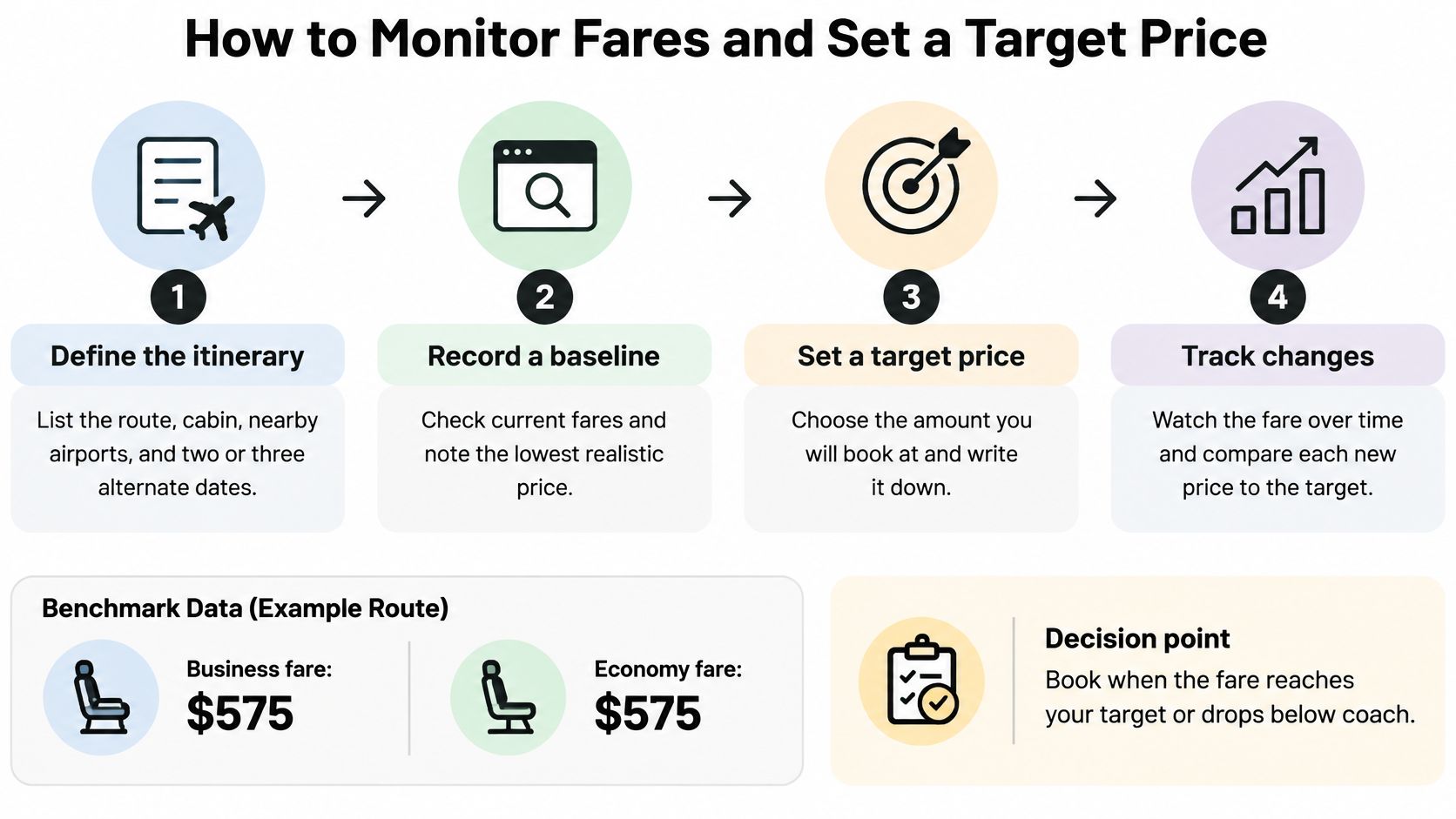
An infographic showing a four-step guide on how to monitor airline fares and set target prices.

Build a repeatable search routine

  1. Define the acceptable itinerary and cabin. List departure and arrival limits, nearby airports, and two or three alternate dates. Specify the seat product you require on the long-haul sector so a mixed-cabin result doesn't pass as an equivalent offer.

  2. Record a baseline by checking the cheapest acceptable business and economy fares for each date over several days. Save the complete trip price, including taxes and required extras, rather than a headline amount that disappears at checkout.

  3. Set your target from the baseline. Choose a purchase threshold supported by comparable itineraries, not the highest quote you've encountered. A cheaper connection isn't a saving if it makes the trip operationally unsuitable.

  4. Watch booking-class availability as well as the displayed price. Record the booking code and fare basis where available, and ask your booking agent to check relevant inventory rather than interpreting the seat map yourself.

  5. Recheck before your decision deadline. Compare nearby departure dates and acceptable connections, not just the same flight number. Airlines can reopen or close booking classes as their demand forecasts change, so an earlier search isn't a standing offer.

  6. Buy when the fare meets your target and its conditions are acceptable. Otherwise, continue monitoring only until your written deadline, with an agreed fallback that meets the trip's essential requirements.

The underlying principle is consistent with academic work on dual-cabin revenue management: airlines balance perishable premium inventory against the risk of displacing higher-value demand. That doesn't create a dependable last-minute discount calendar for buyers.

Common mistakes are narrower than most booking advice suggests. Comparing a single flight number excludes substitutes; ignoring nearby dates hides useful price differences; assuming a low remaining-seat count guarantees a sale confuses availability with the airline's willingness to discount.

Use advance-purchase averages as context

Advance purchase benchmarks for corporate long-haul bookings

The AirPlus travel trends report provides the following purchase-timing benchmarks, including an intercontinental average of 44 days in 2024 and regional averages of 39.2 days in Belgium and 34.8 days in the Netherlands in 2025.

Market Average days before departure Year Note
Intercontinental corporate flights (all markets) 44 2024 More than 10 days earlier than in 2019
Belgium corporate travel 39.2 2025 Regional average
Netherlands corporate travel 34.8 2025 Regional average

These are observations of buying behavior, not optimal-booking deadlines. The regional figures also shouldn't be treated as interchangeable with the intercontinental measure.

Begin watching before your organization's normal purchase point. Keep long-haul and short-haul records separate, and group comparisons by route, cabin, season, and trip purpose.

A mean hides the spread. Track the median, useful percentiles, and minimum acceptable fare alongside the observation date, routing, fare conditions, and days remaining before departure.

Record unsuccessful searches too. A spreadsheet containing only bargain tickets leaves out trips where waiting never produced an acceptable fare, making the strategy look more reliable than it was.

For a visual companion to your booking review, use this video alongside your own quote log.

Reading Fare Rules Before You Pay

A cheap business ticket can be a stripped-down product, not a fully flexible premium fare. Air France, KLM, Emirates, Finnair, and Qatar Airways sell unbundled business products with names such as Business Light, Business Class Special, and Business Class Lite; Executive Traveller describes examples priced about $350 below regular business fares on Asia–London routes and Qatar discounts of up to $1,500 one way from Australia to Europe.

Those examples establish that restrictions can buy a meaningful discount. They don't establish identical benefits or restrictions across airlines, routes, or products.

Check the contract behind the cabin

Lower fare levels generally contain more restrictive terms, including an advance purchase or minimum stay. Our explanation of an advance purchase excursion fare helps distinguish these eligibility conditions from the onboard cabin itself.

Fare rule checks before buying a premium fare

Rule What to verify Why it matters
Change fees and refund rules Cost and conditions of changes, fare differences, and refunds Schedule changes can cancel out the fare saving
Seat selection Whether seats are chosen free or for a fee Affects comfort on long-haul legs
Lounge access Whether lounge entry is included Part of total premium value
Baggage Allowance per passenger Adds cost to economy comparisons
Mileage accrual Whether miles are earned on the fare Affects loyalty value
Advance purchase Minimum days before departure Limits last-minute changes
Minimum stay Required length of stay Constrains itinerary planning
Fare basis Matches the full itinerary including connections A mismatch can invalidate the fare

Don't attach a restriction to a product merely because another airline uses a similar name. Read the conditions attached to the actual quote, including the return journey and any connecting sectors.

Ask the booking agent to identify the applicable fare basis for each fare component. Save the rules with the approval record, then confirm the issued ticket matches the approved itinerary and conditions.

Compare unlike fares honestly

Say a discounted business ticket is nonrefundable, while the available economy alternative permits a refund. If the meeting might be canceled, the economy ticket's flexibility has real value even though the seat is less comfortable.

If the travel dates are firm, the restricted business fare may still be the better purchase. Don't assign an invented monetary value to comfort just to make the approval arithmetic work; document the overnight journey, arrival commitments, and actual price difference.

Compare fare rules first and cabin labels second.

A premium label doesn't make a ticket flexible. Equally, a restriction doesn't automatically make a low business fare poor value.

Routing, Date Shifts and Sale Windows

A headline sale price is useful only if the itinerary works and the fare rules fit the trip. Reported examples show the potential range: Condor offered round-trip business tickets to European destinations for slightly more than $2,500, compared with typical fares of $5,000 or more. Thrifty Traveler's business-class booking guide also reported Air France business round trips below $2,000 and JetBlue Mint fares around $2,000 round trip on selected Europe routes.

These are past sale examples, not current quotes or a promise of what your itinerary will cost. Use them as context, then compare the actual fare, routing and restrictions against your trip's needs.

Reported sale fares against normal premium prices

Fare example Sale price Normal price Note
Condor business round trip, Europe Slightly above $2,500 $5,000 or more About 50% below normal fare
Air France business round trip, Europe Below $2,000 Not reported Selected Europe routes
JetBlue Mint business, Europe Around $2,000 round trip Not reported Selected Europe routes

Compare routing savings with operational cost

Use a nonstop itinerary as the operational reference, then price acceptable connecting alternatives. A connection may reduce the fare, but adds travel time and another point where disruption could affect arrival.

Check alternate gateway cities and nearby airports at both ends. Include positioning transport, any required overnight stay and the risk of separate tickets before counting an alternative as cheaper. For a closer look at multiple-leg flight routing, check which sectors are in business class, especially when a search combines cabins.

Dates can affect sale eligibility. Shift departure and return dates by a few days, but reject options that add unnecessary hotel nights or conflict with the trip's purpose.

Make the decision before inventory changes

A sale's booking window does not guarantee the lowest fare will remain available for every eligible departure. The airline may sell the available inventory or close the booking class before the promotion ends.

Compare the quote with your target and acceptable itinerary. A large discount on a routing that adds too much time, cost or approval friction is not necessarily good value.

  • Recheck the fare basis. A change in routing or dates can change the conditions.
  • Search one-way legs separately. Use the results to understand pricing, then compare the complete round trip with the one-way options.
  • Keep each quote. Record the time, routing, cabin by sector and total payable amount.
  • Confirm sale coverage. Check the origin, travel dates and cabin rather than relying on the promotion headline.

Choose the itinerary on its total trip value, not the largest advertised discount.

Upgrades, Awards and Corporate Approval

A low business-class fare can still be the wrong purchase if its restrictions conflict with the trip or company policy. Compare the full cost, conditions, and approval fit, not just the cabin price.

A businesswoman comparing business class flight fares on her laptop while reviewing her trip itinerary at her desk.

Put each purchase method through the same test

Premium trip options compared on total value

Option Headline price Flexibility Policy fit
Discounted business fare Often the lowest premium-cabin price among comparable offers May have restrictive change, refund, or advance-purchase terms Check approval threshold and restrictions
Premium economy plus paid upgrade Compare the combined ticket and upgrade cost with direct business booking Check the base ticket and upgrade terms separately Check upgrade reimbursement rules
Full-fare business Often higher than discounted business fares Confirm the fare rules; a higher price alone does not establish flexibility Check cabin and budget authorization

These are comparison categories, not a fixed price ranking. Price each option for the same itinerary and check its conditions before approval.

A paid upgrade can make sense when the combined cost compares favorably with a direct business-class booking and the upgrade is confirmed on the required sector. A possible offer later is not a reason to buy a base fare that fails the traveler's needs.

Check what happens to the upgrade payment if the traveler changes flights or cancels. The base ticket's rules do not automatically determine how a separate upgrade payment is handled.

Test miles against the actual cash alternative

There is no universal miles-versus-cash rule. To estimate value per mile, subtract award taxes and fees from a comparable cash fare, then divide the remaining amount by the miles required.

Use a cash fare the company would consider buying. Check award change rules, confirm the premium seat on the same flight, and inspect each sector for mixed-cabin travel.

Record any upgrade against the trip even when the employee pays personally. The approval file should distinguish employer cost, personal contribution, and total travel cost.

Approval test: Authorize the complete trip cost and conditions, including any upgrade, rather than approving a base fare without documenting the rest.

Include emissions and operational needs in the decision. Set out how connections, comfort, arrival readiness, and duty of care affect approval. Clear criteria help managers compare fares consistently and explain why a higher-priced option may better fit the trip.

Decide Whether a Fare Monitor Fits Your Trips

A fare monitor fits the route and cabin, not just the number of trips you take. Passport Premiere membership benefits apply to travelers flying at least once a year between North America and Africa, Asia, Australia, Europe, or South America in business or first class.

Its pricing methods do not apply to economy travel or premium trips within one continent, such as flights between the U.S. and Canada or within Europe. Frequent short-haul travel alone is not a reason to join.
A man searching for international flights on his laptop with a passport and notepad on the desk.

Fit monitoring into the purchasing workflow

Passport Premiere's Fare Monitor watches for lower fares after a trip search, alerts members when fare sales occur, and lets a member hold an itinerary at its current price while deferring purchase. The hold can give a booking desk time to seek approval while watching for a later fare drop.

Assign someone to review alerts and obtain approval. A lower fare matters only if the traveler can use it and the company can authorize the purchase before availability changes.

Members may not use Fare Monitor while holding pending or confirmed space on the same or similar flights. Members also may not use their membership to create duplicate bookings.

Verify the operating rules before relying on it

  • Existing space: Check for pending or confirmed reservations on the same or similar flights before using Fare Monitor. This includes space arranged by a travel agency or assistant.
  • Additional travelers: Travelers without an active subscription may not be able to get the same lower pricing on the same flights. Account for this when budgeting for a family or team.
  • Booking activity: Subscribers who use Fare Monitor or access Member Intelligence Reports without quantifiable booking activity may be subject to subscription fee escalation. Active participation means at least one international premium-cabin air purchase per year, or three hotels booked and used through Passport Premiere in a year.

These rules affect the booking process and the total cost. Reconcile existing reservations, traveler participation, and approval authority before starting.

Decide against a clear travel requirement

Set a target price and record a baseline search. Then compare any lower fare against the trip's actual needs, including fare restrictions, approval timing, and flexibility if meeting dates change.

Assess whether your eligible trip volume justifies specialist monitoring, alongside the work your booking desk already does. A lower cabin price is not automatically better value if its restrictions make the itinerary unsuitable.

Keep the purchase deadline in view. The aim is a fare the traveler can use and the company can approve, not a theoretical low price that arrives too late.

Passport Premiere provides international business- and first-class fare monitoring and market intelligence. Review Passport Premiere's membership information and assess the service against an eligible itinerary, its fare rules, and your target price.
Advance Purchase Excursion Fare: How It Works

An Advance Purchase Excursion fare, or APEX fare, is a restricted, heavily discounted airline ticket that must be bought days or months ahead. On some long-haul routes, those rules can push business class below the price of a full-fare coach ticket.

That sounds backward because travelers usually compare cabins first and fare rules second. Airlines don't price every economy seat below every business seat, though. They price inventory according to demand, flexibility, booking timing, and restrictions. A traveler who can commit early may find a premium-cabin APEX fare that costs less than an unrestricted economy ticket, especially on long trans-Atlantic and trans-Pacific journeys.

Why Business Class Can Be Cheaper Than Coach

A business-class seat can cost less than coach when the two tickets belong to very different pricing products. A full-fare economy ticket may permit changes, refunds, or late booking, while a business-class APEX fare may require advance payment, a fixed return, a minimum stay, and strict change conditions. The cabin is better, but the contract is less flexible.

An APEX fare isn't a separate cabin. It's a discounted ticket bundled with usage conditions. The airline lowers the price because the traveler accepts limits that reduce the carrier's risk. Those limits often include advance purchase, round-trip travel, minimum and maximum stays, restricted routing, and penalties for voluntary changes or refunds. Travelport training material reflects how rule-based fare construction became embedded in airline distribution.

Why the inversion happens

Airlines may release discounted business-class inventory when premium seats remain unsold, while economy inventory continues to serve travelers who book late or need flexibility. A leisure traveler booking a fixed New York to London trip early might therefore access a restricted business fare while a corporate traveler buying a flexible economy ticket later pays more.

The same logic can appear across the Pacific. A Los Angeles to Tokyo passenger with firm dates might accept a lower business fare with a strict ticket deadline. Another passenger needing an adjustable itinerary may choose economy, but the unrestricted version can carry a higher price.

Practical rule: Compare the fare conditions across cabins, not just the cabin labels. A cheap business ticket and an expensive economy ticket may be designed for completely different travelers.

This pricing structure makes APEX useful for more than traditional vacations. It can suit a conference with fixed dates, a planned executive trip, or a long-haul holiday where comfort matters and the traveler can commit early. The important question isn't “Why is business cheaper?” It's “Which restrictions made this business fare cheaper?”

The Origin Story of the Advance Purchase Excursion Fare

APEX fares emerged when regulated airline pricing needed a way to sell empty long-haul seats without lowering every fare. In the United States, advance-purchase excursion pricing received explicit civil aviation approval in 1975. A New York Times report dated April 13 of that year said the trans-Atlantic APEX fare had been approved two weeks earlier and took effect on April 1. The contemporary report on the trans-Atlantic APEX fare records the fare's early role in commercial aviation.

The pricing problem was straightforward. Long-haul aircraft had seats to fill, yet airlines could not cut prices for everyone. A general discount might weaken unrestricted fares paid by business travelers and others who valued flexibility more than price. Carriers needed a price fence, a set of conditions that separated travelers by booking behavior and willingness to commit.

A New York to London passenger planning a round trip and booking 90 days ahead could accept that fence. The fare might require a minimum stay, a fixed return, and limited date changes. In return, the airline could offer a lower price without extending the same terms to someone booking near departure or requesting a fully flexible ticket.

That same logic later applied beyond coach. On long-haul routes, including trans-Pacific services, an airline could use advance commitment to price a restricted business-class seat below a flexible economy fare. The cabin label described the seat, while the conditions explained the price inversion.

From a fare product to a pricing model

The broader history of airline pricing connects with yield management and airline pricing. Carriers separate seats into fare products with different restrictions, much like offering several versions of the same journey to travelers with different priorities. APEX made that trade visible: accept rules the airline could verify, and receive a lower fare.

Historical APEX fares were commonly sold as round trips and frequently included minimum and maximum stay rules. They were often nonrefundable or changeable only with a penalty, and some restricted stopovers. Airlines later adapted the model beyond its original trans-Atlantic setting into branded promotional and leisure fare families.

The lasting template is simple: commit earlier, accept more conditions, pay less. The name may disappear behind a carrier's branded labels, but the underlying bargain remains.

The Rule Stack Behind Every APEX Fare

An APEX price comes from a stack of conditions. Each condition removes a form of flexibility that the airline would otherwise need to price into the ticket. The exact rule always controls, but the common structure is consistent enough to translate into practical decisions.

The purchase deadline

The most important condition is the advance-purchase window. Common thresholds include 7, 14, or 21 days, while some markets use 30-day or even 120-day lead times for deeper discounts, as described in the APEX fare overview from AltexSoft. Reservations, payment, and ticket issuance may all need to be completed before the deadline. Booking a seat without issuing the ticket may not preserve the fare.

For a New York to Paris itinerary, a rule requiring purchase 21 days before departure creates a clear cutoff. For Los Angeles to Tokyo, a deeper fare might require a longer lead time. Once the traveler misses the deadline, the airline may reprice the itinerary into a higher fare bucket.

Stay and routing conditions

A minimum stay prevents a traveler from using a leisure discount for a short, high-value business trip. A Saturday-night requirement is common in international fare construction, while other rules specify a minimum number of days. A maximum stay limits how long the discounted ticket remains valid.

Routing rules can be just as important. A fare may permit only a specific connection through an Atlantic or Pacific hub, restrict the fare to named cities, or prohibit a stopover. A New York to London APEX fare might allow one connection at the carrier's Atlantic hub but not an open-ended stop in another European city. A Los Angeles to Tokyo fare could price attractively until an added stopover or alternative routing makes it invalid.

Refund, change, and no-show exposure

The buyer usually gives up flexibility in several ways. Voluntary changes may trigger a penalty, refunds may be restricted or unavailable, and a no-show can put the remaining itinerary at risk. These conditions matter more than the headline price when dates aren't stable.

Rule Typical requirement Effect on price
Advance purchase Ticket issued before a stated deadline, often 7, 14, or 21 days Rewards early commitment
Minimum stay Saturday night or another stated stay condition Separates leisure demand from short business trips
Maximum stay Return within the period written in the fare rule Limits how long the discount remains valid
Routing Use permitted cities, carriers, and connections Prevents unrestricted itinerary construction
Stopovers Often none, or a tightly defined allowance Removes flexibility that can raise the fare
Refunds Often restricted or unavailable Lowers the airline's exposure to cancellations
Changes Penalty or repricing may apply Transfers schedule risk to the traveler
Ticketing Payment and issuance completed by the deadline Prevents travelers from holding the fare without commitment

Before booking, read the practical guide to one-way and round-trip fares alongside the airline's own rule display. APEX fares are commonly round trips, and a one-way search may hide the product entirely or return a different fare family.

The fare rule is the contract. The marketing label is only a shortcut.

Premium Cabins and the Price Inversion

A restricted business fare can fall below a flexible economy fare on the same long-haul route. That inversion follows the same APEX logic as a discounted coach ticket: the traveler accepts advance commitment, limited routing, and tighter conditions, while the airline protects demand that might otherwise go unsold.

Route J-class APEX Y-class full fare Savings vs coach Advance window
New York to Paris $2,450 business $2,850 economy $400 Exact APEX rule required
Chicago to London $2,120 business $2,500 economy $380 Exact APEX rule required
New York to London $1,900 business $2,200 economy $300 Exact APEX rule required
Los Angeles to Tokyo $2,500 business $2,800 economy $300 Exact APEX rule required

The New York to Paris and Chicago to London examples come from business-class fare examples on Passport Premiere. The New York to London and Los Angeles to Tokyo scenarios appear in additional international business-class pricing examples.

What the comparison does not tell you

A J, D, or R booking code does not prove that the ticket is an APEX fare. Airlines use these letters for different inventory products. The fare basis, purchase deadline, routing conditions, and penalty text determine what you are buying. A Y fare often represents a higher-priced economy product, but its published conditions remain the deciding factor.

The premium ticket may include a flat-bed seat, lounge access, priority handling, or improved onboard service. Those benefits do not remove every restriction. Seat selection may cost extra, and a change can require a penalty or full repricing. The fare's value depends on its complete rule set, not on the cabin label alone.

A trans-Pacific example shows why routing deserves close attention. A Los Angeles to Tokyo fare may require a particular gateway, forbid a stopover, or allow only one connection. Add a preferred city or change the permitted path, and the lower fare can disappear. The same issue applies across the Atlantic when a New York to London itinerary must use specified carriers or connections.

Premium pricing also varies widely. FareCompare's business-class pricing guidance says business class can range from $50 to $3,000 above economy, depending on the airline and trip length, and reports average business-class pricing at about four times coach. An inversion is therefore a fare-rule exception, not a standing promise that business class will cost less.

How to Find and Time APEX-Style Deals

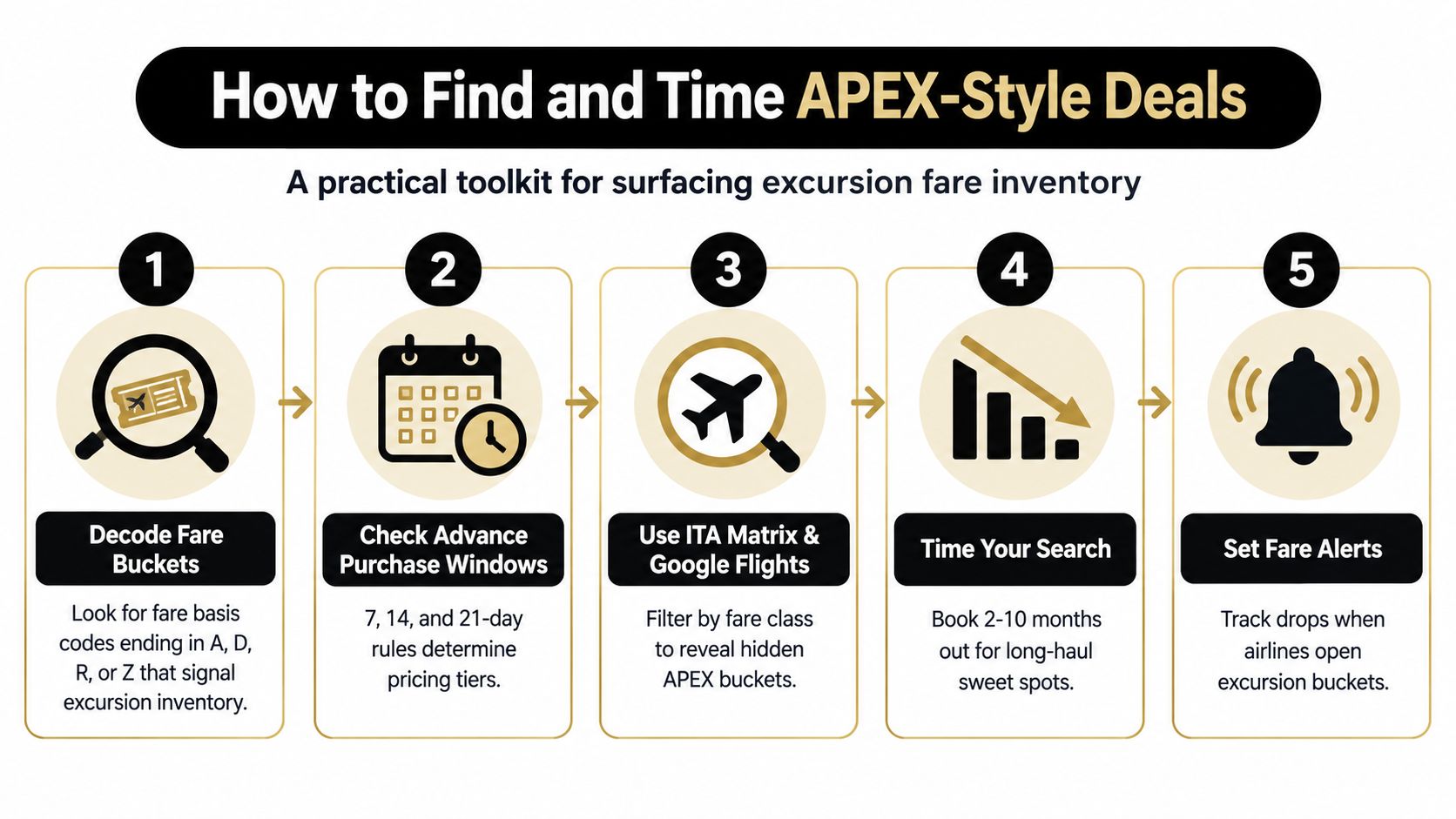
Finding an APEX-style fare requires more than sorting results from low to high. Start by identifying the fare bucket, then inspect the full rule before treating the price as usable.

Search in layers

  1. Read the fare basis. Codes ending in A, D, R, or Z can signal excursion-style inventory, but the letters aren't proof by themselves. Open the fare conditions and confirm the advance deadline, refund rule, minimum stay, and permitted routing.

  2. Test the purchase window. Search the same itinerary at different departure dates and compare fares that require 7, 14, or 21 days of advance purchase. International references commonly place APEX windows around 14 to 30 days, though the actual requirement varies by carrier, season, and cabin. Navan's APEX explanation describes the booking-and-payment deadline as the defining feature.

  3. Use structured search tools. ITA Matrix can help experienced users investigate fare classes and routing combinations. Google Flights can compare dates, airlines, and connections, but you still need the carrier's fare rules before ticketing.

  4. Monitor a long-haul horizon. For trans-Atlantic premium cabins, begin watching roughly 6 to 11 months ahead. For trans-Pacific trips, a useful observation range is roughly 4 to 7 months ahead. Treat these as search habits, not guarantees, because airlines can open or close inventory at different times.

  5. Set alerts and watch disruptions. ExpertFlyer, AirHint, and Kayak price alerts can help you notice fare movement. A schedule change may also create an opportunity to recheck the itinerary, but don't assume a disruption guarantees access to a lower bucket.

A five-step infographic guide on how to find and time APEX-style airline excursion fare deals effectively.

Seasonality still matters. Shoulder periods on North Atlantic routes can produce more useful searches than peak holiday dates. For Japan, compare periods around cherry-blossom demand and Golden Week rather than assuming every calendar week behaves alike. You can also review when airlines drop prices to understand why monitoring matters more than checking once.

A Booking Playbook With Real Examples

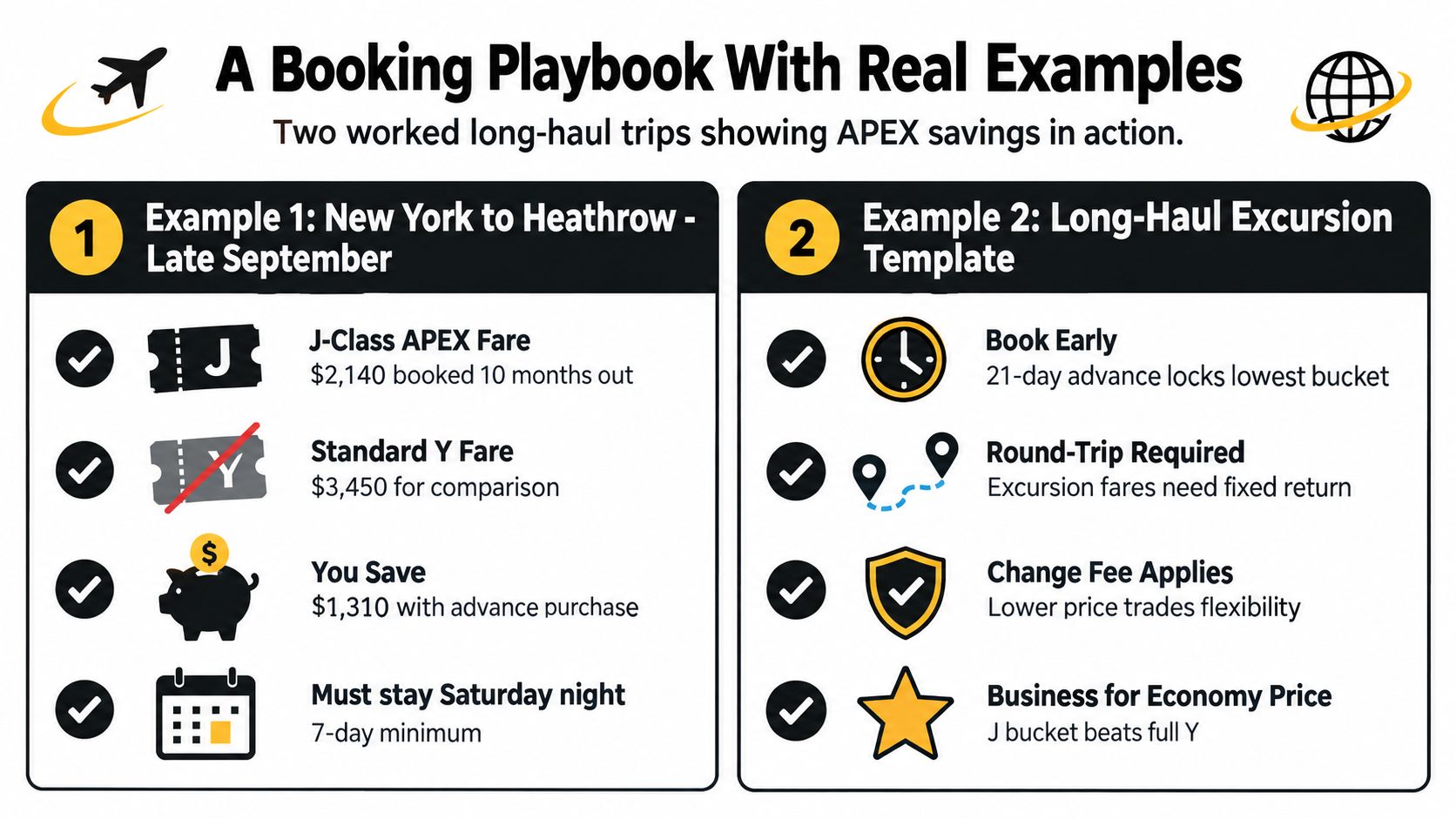
A good APEX booking starts with the fare rule, not the cabin photograph. The following examples show how the deadline, fare basis, stay requirement, routing, and price comparison fit together.

Example one, New York to Heathrow

A traveler planning a late-September New York to Heathrow round trip finds a J-class APEX fare at $2,140, booked 10 months out, compared with a $3,450 Y fare. The difference is $1,310, calculated from those two ticket prices. The premium fare example and comparison illustrate the broader price-inversion logic.

The traveler first confirms that the fare requires a Saturday-night stay and satisfies the stated 7-day minimum. The itinerary uses a single connection at the carrier's Atlantic hub, so the traveler checks that this connection is permitted rather than assuming the fare allows any route.

The timeline is important. Booking 10 months ahead provides more than enough lead time for the quoted advance-purchase condition, but early booking doesn't remove other restrictions. The traveler still needs to confirm whether the fare is refundable, what happens after a date change, and whether a voluntary change triggers a penalty or repricing.

Example two, San Francisco to Tokyo

A San Francisco to Tokyo Haneda itinerary in February shows a D-class business APEX fare at $2,880, compared with $4,100 for unrestricted economy. The comparison produces a $1,220 difference. The traveler must check the permitted stopover rule and the 12-month maximum-stay caveat, because a return beyond the allowed period can invalidate the fare.

These numbers aren't a promise that every February Tokyo itinerary will price the same way. They demonstrate the method: compare the fare basis, confirm the deadline, inspect the maximum stay, and verify that Haneda routing and any stopover fit the rule.

An infographic titled A Booking Playbook With Real Examples showing strategies for saving on long-haul airline tickets.

Use this four-step check before payment:

  1. Confirm the bucket. Match the displayed fare basis to the cabin and read the complete rule.
  2. Verify the stay. Check Saturday-night, minimum-stay, and maximum-stay requirements.
  3. Lock the refund class. Determine whether cancellation produces a refund, credit, or forfeiture.
  4. Calendar the change condition. Record the penalty and any ticketing deadline before you commit.

Rethinking What Cheap Airfare Means

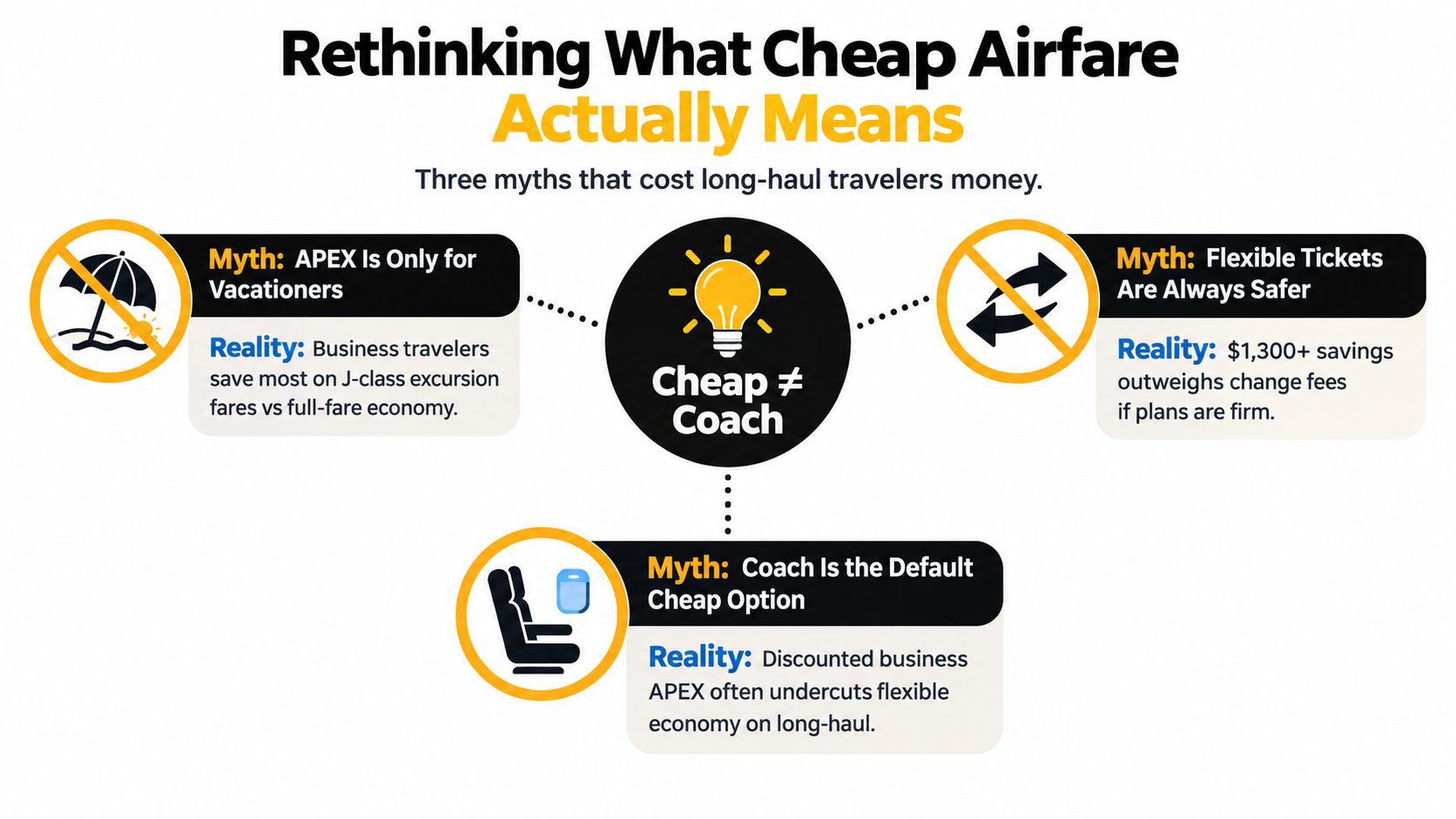
Cheap airfare is not always the lowest economy fare. On long-haul routes, advance-purchase excursion fare rules can invert the expected cabin hierarchy. A traveler with fixed dates may find restricted business class priced below a flexible economy ticket, because the fare conditions, not the seat alone, determine the price.

Consider a New York to Madrid itinerary. A business APEX fare with strict conditions may compete with, or undercut, flexible economy. On a Los Angeles to Tokyo search, discounted premium inventory can create the same inversion while economy inventory remains expensive. The cabin hierarchy remains, but fare rules can rearrange the price hierarchy.

Three assumptions to reconsider

  • APEX is only for vacationers. A business traveler attending a fixed conference, project meeting, or client visit can use the same fare structure when the dates and routing are reliable.

  • Flexible tickets are always safer financially. Flexibility has value, but it is included in the fare price. A restricted ticket can be the rational choice for a firm schedule. If plans change, however, a penalty or repricing can erase the initial saving.

  • Coach is automatically the cheapest cabin. Economy is the usual starting point, not a guaranteed price floor. On selected trans-Atlantic and trans-Pacific itineraries, a discounted business APEX fare can cost less than flexible economy.

An infographic titled Rethinking What Cheap Airfare Actually Means, illustrating three common myths regarding long-haul travel bookings.

A useful definition of cheap includes the service received, the total ticket cost, and the risk created by the restrictions. A business seat below a full-fare economy ticket offers stronger value only when the traveler can follow the fare's conditions.

A business ticket priced at $2,800 can lose that advantage after a date change, particularly if the revised itinerary must be repriced. Travelers considering winter travel can also compare cheap December vacation ideas while checking whether their dates fit the airline's advance-purchase window.

Don't book an APEX fare against a schedule you can't commit to.

When APEX Pays Off and When It Does Not

APEX pays off when the traveler can commit to exact dates well ahead of departure, accepts the required stay, and has no realistic need to change or cancel. It can be especially useful for fixed business travel, shoulder-season Europe, midweek trans-Atlantic trips, and off-peak trans-Pacific itineraries where premium-cabin inventory may be priced aggressively.

It doesn't suit every traveler. A shifting client meeting, a family return date that may move, a routing requiring an unapproved stopover, or a holiday blackout period can turn the discount into a liability. The fare rule should be treated as a risk calculation, not a reward for choosing the lowest displayed number.

Factor APEX fare Unrestricted fare
Price Usually lower when purchased by the deadline Usually higher because flexibility is included
Advance purchase Required, with the exact window in the fare rule Usually not required
Date certainty Best for fixed plans Suitable for uncertain plans
Minimum stay May require Saturday night or another condition Usually less restrictive
Routing May limit connections and stopovers Generally broader
Refunds Often restricted or unavailable Typically more accommodating
Changes Penalty or repricing may apply More flexible, subject to ticket terms
Ideal traveler Early planner with stable dates Traveler who values schedule control

Use one final sequence before payment:

  1. Confirm the dates. Can you travel on the booked outbound and return?
  2. Confirm the routing. Does every connection and stopover satisfy the rule?
  3. Confirm refundability. Know what happens if the trip is canceled.
  4. Then book. Don't rely on a verbal summary when the fare conditions are available in writing.

The single rule is simple: APEX is a bargain only when the restrictions fit your trip.


Passport Premiere helps travelers evaluate international premium-cabin fare movements through fare monitoring, market analysis, and member resources focused on lower business and first-class pricing. Visit Passport Premiere to explore how its fare intelligence can help you compare APEX-style premium fares before you commit.

E Tickets for Flights: A Practical Guide to Managing Them

Business class can be cheaper than coach on the same route, and that's exactly why e tickets for flights matter to anyone buying international air travel for a team. The fare that looks “premium” on the screen is only useful if the ticketing record supports it, the segment is eligible, and the carrier can issue it. In airline terms, the receipt in your inbox is just the surface. The asset is the digital ticket record sitting in the carrier's system, tied to a ticket number, fare rules, and the operational data that decides whether a seat can be changed, reissued, or refunded.

Why Your E Ticket Matters More Than You Think

The first mistake many buyers make is treating an e-ticket like a booking confirmation. It's not. An e-ticket is the technical record that proves the seat has been ticketed, and that difference becomes important the moment a carrier opens a premium cabin at a lower fare than coach.

Why price alone can mislead

When business class prints below coach, the visible fare is only one layer of the transaction. The ticket record also carries the fare class, the routing logic, and the rule set that controls changes later. A travel manager who only compares the headline price can miss the decision point, which is whether that lower fare can be ticketed cleanly and used without friction.

That matters because e-tickets became the industry standard after a long transition away from paper. One industry history places the first paperless e-ticket in 1994, notes that IATA had already established global e-ticket standards by 1997, and shows adoption still lagging with only 19% of global tickets electronic by May 2004. By 2005, airlines were still issuing a record 285 million paper tickets, which shows how large the paper-based system remained just before the transition finished. Those milestones show why the document itself carries operational weight, not just booking convenience. The history of travel tickets

Practical rule: Treat the ticket record as the thing you manage, not the email you forward.

What corporate buyers miss

Corporate programs often negotiate around policy, cabin class, and schedule, but the actual ticket record decides whether the fare can be used as intended. If the business-class fare has a restrictive bucket and the coach fare does not, the cheaper-looking option can be the riskier one after ticketing. The reverse also happens, where a premium cabin ticket gives better flexibility than a stripped-down coach fare.

That's why e-ticket literacy gives a travel manager an advantage. You can compare not only prices, but also the underlying fare rules that determine whether a trip can survive schedule changes, traveler name corrections, or a voluntary reissue. In a volatile premium-cabin market, that's the difference between buying a seat and buying a liability.

What an E Ticket Actually Is

An airline e-ticket is not a PDF sitting in someone's inbox. It's a digital record stored in the airline's reservation and ticketing systems, linked to the traveler's booking data and verified against the carrier's back-end record. In standard implementations, it's tied to a 13-digit ticket number, where the first three digits are the airline's IATA prefix and the remaining digits identify the document inside that carrier's system. LOT's electronic flight ticket guide

A diagram explaining that an airline e-ticket is a digital record stored in a secure reservation system.

The reason that matters is simple. A PDF can be copied, edited, or forwarded. A ticket record can be checked against the carrier's reservation database and the passenger's ticketing history, which is a major anti-fraud control. The passenger-facing email is just a wrapper around the live record.

The industry standard changed the mechanics

IATA's 100% electronic ticketing mandate took effect on June 1, 2008, which means member airlines issue e-tickets instead of paper tickets. That standardization made digital ticketing the norm across the industry, and it's what supports online check-in, automated itinerary handling, and the transfer of ticket data between carriers when interline agreements exist. eSky's e-ticket explainer

What lives inside the record

The ticket record isn't just a proof of purchase. It holds the airline-side details that let airport and reservations systems recognize the traveler, validate eligibility, and reconcile the trip later. That's why the e-ticket matters more than the confirmation email and more than a static PDF attachment.

An internal overview of airline e-ticketing structures is also useful for teams that want a deeper process view, and this reference keeps the terminology close to how airline systems work: airline e-ticket structure overview. When a program understands that an e-ticket is a live system record, it stops treating ticketing as paperwork and starts treating it as controlled inventory.

E Ticket, Itinerary, and Boarding Pass Explained

A lot of gate confusion comes from mixing up three separate documents. They travel together in practice, but they do different jobs. The itinerary shows what was bought, the e-ticket proves the seat is ticketed, and the boarding pass gets the traveler through security and onto the aircraft.

A simple airport-day sequence makes the distinction easier. A traveler books, receives an itinerary receipt by email, checks in online, and then downloads a boarding pass. At the airport, the boarding pass is what gets scanned, while the itinerary and ticket details remain the reference point for the booking file. The U.S. Department of Transportation also notes that airlines are not required to provide travelers with the documents needed to complete international travel, which is why the broader document chain matters so much for cross-border trips. U.S. Department of Transportation guidance on buying a ticket

What each document actually proves

E-ticket: Proof that the fare has been ticketed in the airline's system.
Itinerary receipt: A passenger-facing summary of the trip, usually emailed after purchase.
Boarding pass: The day-of-travel document used for security and boarding.

Those distinctions sound obvious until a traveler shows up with the wrong document. A printout of an itinerary can be helpful, but it doesn't replace a valid boarding pass. A boarding pass also doesn't prove the fare was properly ticketed if the back-end record is missing or invalid.

A valid ticket doesn't make a journey valid if the passport, visa, or transit paperwork is wrong.

International trips add another layer

For premium and international travelers, the document chain isn't complete until the passport, visa, and any transit rules are satisfied. That's the blind spot in many consumer explainers. A ticket can be fully valid in airline systems and still be unusable at departure if entry documents aren't in order.

If you're also managing residency-linked or onward-travel documentation, a dedicated reference like US to Spain travel documentation guidance can be useful because it frames the trip as an entire document set, not just a flight booking. For corporate travel managers, that mindset reduces airport surprises and saves time at check-in.

How to Read Every Line on an E Ticket Receipt

A serious travel manager should be able to read an e-ticket receipt the way an operations agent does. The receipt isn't decoration. It's a compact view of the booking's identity, routing, commercial restrictions, and service entitlements.

A person holding a smartphone displaying a SriLankan Airlines digital flight boarding pass e-ticket.

Start with identity fields

The first things to verify are the passenger name, the booking reference, and the 13-digit ticket number. The booking reference, often called the PNR or record locator, is the file name in the airline's system. The ticket number is the separate document number that proves the itinerary has been ticketed.

After that, look for the operating carrier, flight numbers, airports, and times. Those fields tell you which airline flies the segment and whether the booking matches the intended routing.

Then read the commercial fields

The most consequential line for a travel manager is usually the fare class letter, which sits in the fare basis or booking class area. That single character can affect upgrade eligibility, mileage earning, and how much flexibility the ticket has if a change becomes necessary. Two business class fares can look identical to a casual buyer and still sit in different buckets with very different rules.

Also check the baggage allowance, seat assignment, and fare rules. Premium-cabin tickets often embed baggage, change, and refund logic directly in the record, which means the headline fare is only part of the value. A lower fare can be cheaper for the company and harsher for the traveler if the restrictions are tight.

A working reading order

  1. Confirm the traveler and ticket number. Make sure the name and ticket number match the booking file.
  2. Verify each segment. Check the carrier, flight number, date, and route.
  3. Read the fare basis and booking class. Flexibility usually lives here.
  4. Check the baggage and fare rules. These fields decide what happens later.

If you're dealing with a trip that includes residency, return-trip, or destination-document concerns, a support page such as US to Spain travel document planning can help travelers think about the complete trip record rather than just the fare.

The point is not to memorize airline jargon. It's to know which line to inspect before you approve a change, a mileage claim, or a premium-cabin purchase. Once you can read the receipt, you can spot when a business-class fare is the better operational buy.

Name Corrections, Refunds, and Reissues

Post-ticketing problems usually fall into three buckets, and they don't cost the same. A minor name correction is one thing. A voluntary change is another. A refund request is often the most restrictive path of all, because the fare rule category inside the ticket record decides what the carrier will allow.

Name correction is not the same as name change

A small typo, like a missing letter or an accidental swap of adjacent characters, is usually handled as a correction if caught early. That's an operational fix, not a new trip. Once the ticket has the wrong traveler identity in a way the carrier won't accept, the issue can become much harder to untangle.

Reissue versus refund

A reissue means the airline cancels the original ticket and issues a new one, usually in the same PNR. That's the normal workflow when a traveler changes dates, routings, or some fare components but still wants to travel. A refund means the original ticket is voided and the money is returned to the original form of payment, but only if the fare rules allow it.

The hard part is that the rules are already embedded in the ticket. If the fare basis is restrictive, the system may permit a reissue only with additional payment, or it may block a refund entirely. That's why a travel manager should never assume a premium-cabin fare is flexible just because it's premium.

Practical rule: Read the fare rules before you promise a traveler that a ticket can be changed.

Common E Ticket Service Actions Compared

Action Typical Cost Fare Rule Impact Documentation Needed
Name correction Often minimal if the error is minor Usually limited if caught early Ticket receipt, passport, booking reference
Voluntary change Change fee plus any fare difference New itinerary must satisfy fare rules Ticket receipt, revised itinerary
Refund request Depends on fare category and carrier policy Only allowed when rules permit Ticket receipt, payment details, booking record
Reissue Administrative handling plus fare difference if applicable Original ticket is replaced Original ticket data, new itinerary

The operating logic is straightforward even when the pricing is not. If the airline can preserve the ticketed value and maintain the booking record, it may reissue. If the fare rules don't allow that, refund or forfeiture can become the only options.

When Business Class Prints Cheaper Than Coach

Airlines sometimes price premium cabins below coach on specific routes, and that's not a typo in the abstract. It's usually a mix of route strategy, cabin inventory, and the carrier's need to move empty premium seats before departure. The e-ticket is the mechanism that turns that temporary fare condition into a real, boardable booking.

A flowchart explaining why business class flights can sometimes be cheaper than coach class tickets for travelers.

Why the fare can drop

A premium cabin with too much inventory can force the airline to open a lower booking bucket. That drop may appear briefly, and then the carrier may adjust it once the fare is noticed or the cabin starts to fill. The buying window is what matters, not the theory.

The technical details still have to line up. The segment must be e-ticket eligible, the fare class has to be accepted, and the itinerary must satisfy the carrier's ticketing rules. IATA's BCBP workflow also matters at the airport because the ticket record must connect cleanly to the boarding pass and manifest flow used for check-in and boarding. IATA BCBP implementation guide

Where managers get the edge

If business class is priced below coach, the question isn't just whether the fare is cheap. The question is whether it can be ticketed, whether the fare class supports the trip purpose, and whether the change rules are acceptable if plans move. That's where premium-cabin fare monitoring becomes useful.

Passport Premiere is one example of a service built around tracking international premium-fare cycles, comparing fare characteristics, and surfacing when business and first class pricing moves into an unusual range. For corporate buyers, that kind of visibility is useful when a seat needs to be both comfortable and defensible in policy.

Empty premium seats create opportunity, but only the ticket record turns that opportunity into an actual booking.

Best Practices for Travel Managers and Frequent Flyers

A clean ticketing process saves more money than most expect, because it prevents avoidable reissues and bad fare assumptions. It also makes premium-cabin decisions easier to defend when a route is mispriced or when a traveler's itinerary changes after purchase.

An infographic showing four best practices for travel managers and frequent flyers regarding e-ticket management.

Build a short audit routine

Start with the issued ticket list. Check the passenger name, fare class, and route, then flag any itinerary with unusually restrictive rules before the traveler departs. That one habit catches most avoidable problems early.

  • Audit issued e-tickets monthly. Compare the booking record against the ticket receipt and confirm that the itinerary still matches the traveler's needs.
  • Flag restrictive fare classes. Any ticket with tight change or refund rules should be visible to both the travel desk and finance.
  • Document everything at booking. Name accuracy, passport name order, and trip purpose should be locked in before ticketing.
  • Review before travel. Reconfirm the ticket, boarding pass, and international documents before departure.

For teams formalizing their process, a reference like corporate travel policy best practices can help structure an internal SOP around reissue and refund decisions without making the policy bloated.

Keep the value conversation separate from the cabin label

Premium cabin value should be measured against the actual fare rules, not the brand name on the seat. A business class ticket that is easier to change can be more useful than a cheaper coach fare that traps the traveler. If your program buys international premium travel regularly, that distinction should be written into policy.

For travelers who like a tactile reminder to check trip documents, even small trip accessories can help keep the ticket packet organized, and a practical browse like browse leather luggage tags is a simple example of that mindset. The bigger point is process discipline, not gear.

Passport Premiere fits into that process as a monitoring layer for premium-cabin fare cycles, helping members watch for lower business and first class pricing before they buy. If you want to compare those fare swings against your own policy and recurring routes, visit Passport Premiere and review how its fare monitoring and ticket intelligence can support your travel program.