
The most popular advice about premium airfare is also the least reliable: business class costs more than coach. Usually, it does. But airline capacity management creates exceptions that make the rule far less useful for people who buy international travel.
A premium cabin is a fixed pool of seats on a specific aircraft, operating at a specific time, on a specific route. If an airline misjudges demand, a business-class seat can become a problem the revenue system needs to solve. The resulting fare may fall sharply, sometimes below the price of the most expensive economy options.
That's why travel managers and frequent flyers should watch aircraft changes, schedule decisions, cabin inventory, and fare-class behavior, not just cabin labels.
When Business Class Costs Less Than Coach
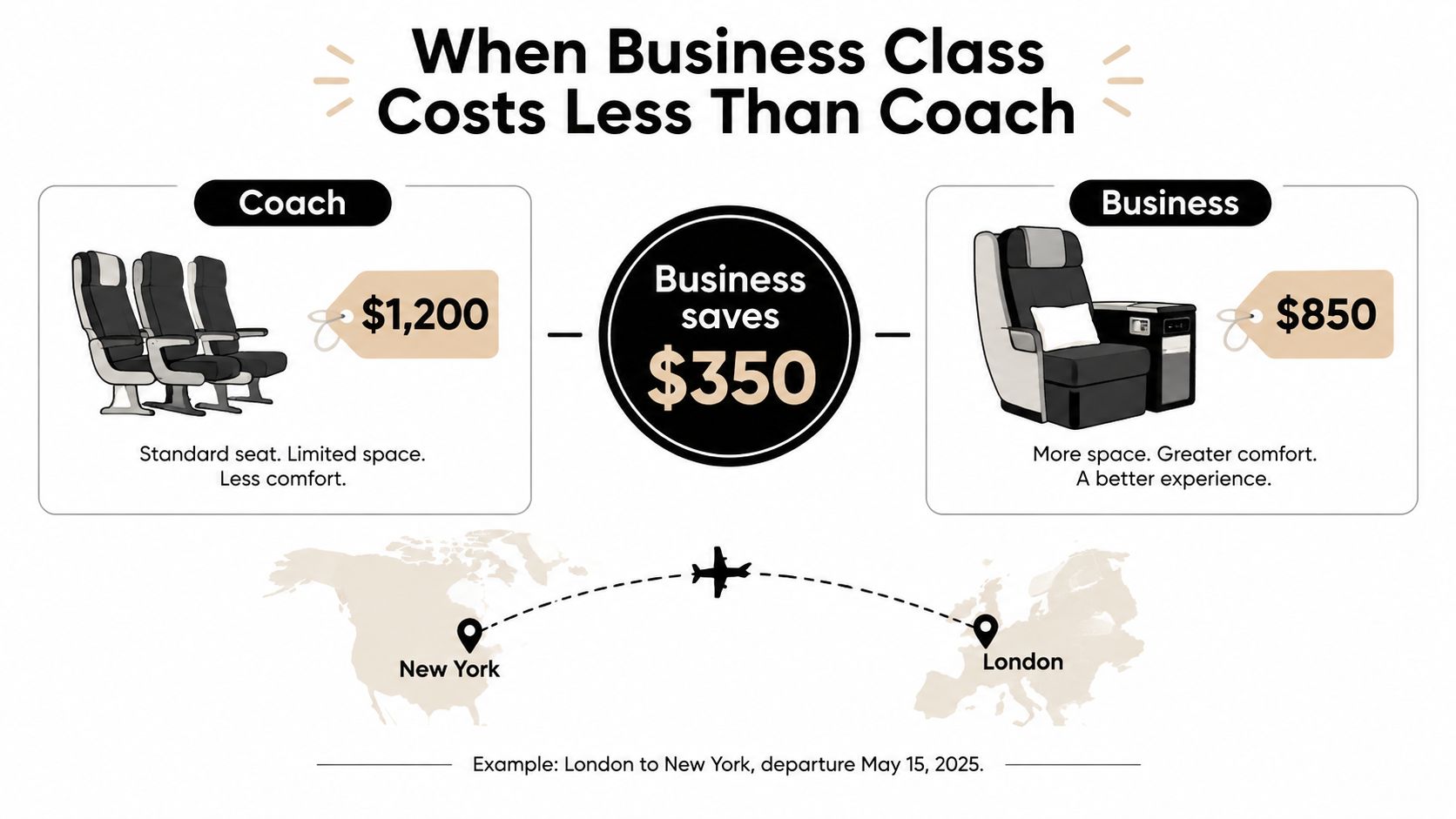
A transatlantic fare comparison documented an apparent pricing reversal. On Chicago to London, ORD–LHR, a discounted business-class ticket was listed at $1,850, while a coach itinerary reached $1,950 after baggage and seat-selection costs. On Los Angeles to Tokyo, LAX–NRT, business class appeared at $2,300, compared with $2,400 for coach after comparable extras. The examples are described by Passport Premiere's analysis of discounted business-class tickets.
A buyer seeing that result might suspect a mistake. Is the business ticket really valid? Does it exclude a connection, baggage, or a critical restriction? That suspicion is sensible because the normal price hierarchy points the other way. Yet a lower business fare can be a legitimate result of an airline trying to sell seats that would otherwise depart empty.
The anomaly has an operational explanation
Suppose an airline adds capacity to a departure that attracts weak demand. It might use a larger aircraft, retain a flight after reducing other frequencies, or place more premium seats on the route than local demand can absorb. Several weeks before departure, the business cabin remains undersold.
The revenue-management system then faces a choice. It can protect a high premium fare and risk flying with empty seats, or open lower premium fare classes to stimulate bookings. At the same time, the remaining economy inventory may sit in a higher-priced bucket because coach demand is stronger or because the cheaper economy classes have already closed.
That's how business class can undercut coach without the airline abandoning pricing logic. The airline isn't claiming that the premium seat has less value. It's responding to the value of an unsold seat on one particular departure.
Practical rule: Compare the total, valid fare for each cabin on the same itinerary. Don't assume the cabin with the higher list price is the cheaper purchase.
Four operational levers usually sit behind the decision:
- Fleet: Which aircraft operates, and how many seats does it provide?
- Schedule: How many flights run, and at what times?
- Seat allocation: How much of the aircraft is assigned to business, premium economy, and coach?
- Revenue management: Which fare classes are available today?
Understanding those levers turns a strange fare into a readable capacity signal.
What Airline Capacity Management Really Means
Airline capacity management starts with a straightforward question: how much sellable transport should an airline place in each market? The answer isn't just a seat count. It includes the aircraft type, route, departure time, flight frequency, cabin layout, and number of seats offered in each fare class.
The decisions work across different time horizons.
Fleet planning sets the physical limits
Fleet planning determines which aircraft an airline owns or leases and where those aircraft can operate. A larger wide-body aircraft can provide more seats on a long-haul route, while a smaller aircraft may better fit a market with uncertain demand. Aircraft availability also matters. Delivery delays, maintenance needs, and engine shortages can force an airline to keep existing aircraft in service or redeploy them between routes.
Schedule planning decides when capacity appears
A seat only produces revenue if the flight operates at a useful time. Schedule planners choose frequencies, departure windows, connection opportunities, and seasonal service patterns. Adding a second daily flight can attract customers who can't use the first departure, but it can also divide demand between two aircraft.
Seat allocation shapes the product
Airlines decide how many seats belong to each cabin. A route serving corporate customers may justify more business-class seats, while a leisure route may need a larger coach cabin. The physical layout affects the number of seats available and the mix of fares the airline can sell.
Revenue management controls access
Revenue managers release inventory through booking classes. Each class carries its own price, rules, flexibility, and eligibility conditions. The system watches booking pace, remaining capacity, fare demand, and competitive conditions, then opens or closes classes.
These decisions form one connected system. A fleet swap changes seat supply. That changes the expected load factor. The schedule may then need a frequency adjustment, while revenue management changes the fare buckets available for each cabin.
For a buyer, every fare quote is a snapshot of those decisions combined. A business-class price isn't determined by comfort alone. It reflects the aircraft, the departure, the cabin mix, the remaining inventory, and the airline's estimate of what customers will pay.
The Four Levers Airlines Pull Every Day
Capacity management becomes easier to understand when each lever is connected to a buyer-visible outcome. The airline may describe the decision operationally, but the traveler experiences it as seat availability, schedule choice, or fare movement.
| Lever | Planning Horizon | Example Decision |
|---|---|---|
| Fleet | Long term and seasonal | Assign a smaller or larger aircraft to a long-haul route |
| Schedule | Seasonal and weekly | Add, remove, or retime departures |
| Seat allocation | Fleet configuration and seasonal planning | Adjust the number of premium and coach seats |
| Revenue management | Continuous and departure-sensitive | Open or close fare classes as bookings develop |
Fleet changes alter the size of the problem
A swap between aircraft families can change total seats, cabin proportions, cargo capability, operating cost, and the number of premium seats available. A larger aircraft may lower the cost per seat when it fills well, but it also creates more inventory that the airline must sell on every departure.
A smaller aircraft can protect the airline from weak demand, yet it may leave high-value customers without enough seats during a strong period. Fleet planners therefore balance physical capacity with demand patterns rather than choosing the aircraft with the most seats.
Schedules concentrate or dilute demand
Cutting a route from seven weekly departures to five changes the buyer's choices immediately. Some travelers may move to the remaining flights, improving their booking pace. Others may choose a competitor or change dates. The airline then has fewer departures to fill, but it may also lose customers who require the removed schedule.
A schedule change can therefore tighten premium inventory on one day while leaving another departure soft. The route headline alone doesn't tell you which flight has pricing pressure.
Cabin mix determines what “full” means
A flight can have plenty of open coach seats and still face a shortage of business inventory. The reverse can also happen. An aircraft configured with a larger premium cabin creates more high-value inventory to sell, but a market with limited corporate demand may not support that mix.
Travel buyers who want to understand the pricing logic behind yield management and airline pricing should separate total seats from seats by cabin. A route's total capacity can rise while premium availability becomes tighter, or total capacity can remain stable while a cabin mix changes.
Revenue management makes the daily adjustment
Fare-class inventory behaves like a set of valves. The airline may close a low economy class when bookings accelerate, then reopen a premium class later if the business cabin trails expectations. The exact trigger depends on the carrier's forecasts and commercial rules.
A hypothetical 30 percent premium-fare reduction is not a verified industry-wide pattern, so it shouldn't be treated as a standard rule. The reliable principle is qualitative: when premium bookings lag and departure approaches, airlines may release lower business-class inventory to attract demand, while strong booking pace can cause those classes to disappear.
The buyer sees only the output, but the output reflects all four levers working together.
Reading the Numbers Without Being an Analyst
You don't need an airline forecasting model to recognize capacity pressure. You need to understand what the main traffic measures describe and ask whether supply and demand are moving in the same direction.
Available Seat Miles, or ASM, measures the seats an airline offers over distance in U.S. reporting. International reporting often uses Available Seat-Kilometers, or ASK, which applies the same basic idea with kilometers. Revenue Passenger Miles, or RPM, measures passenger travel over distance, while Revenue Passenger-Kilometers, or RPK, is the comparable international measure.
Load factor connects them. It is calculated as passenger traffic divided by available capacity, expressed through RPM/ASM or RPK/ASK. Industry material defines the measure this way and reports global pre-pandemic load factors at roughly 82% to 84%, while low-cost carriers often operated around 90% to 94%. Those figures are available in the airline capacity and load-factor training material.
Read the direction, not just the headline
A reported load factor of 78% isn't automatically good or bad. It becomes a planning signal when you compare it with the prior period, the same season, the route's aircraft size, and the airline's capacity growth.
A two-point fall on a long-haul route can matter more than the headline suggests if the airline has many premium seats to sell and limited opportunities to replace weak demand with another departure. Conversely, a lower figure on a flight with a predominantly leisure cabin may produce a different fare response.
Block hours per aircraft add operational context. If an aircraft is flying fewer hours, the airline may be dealing with weak demand, maintenance, schedule disruption, or a strategic redeployment. You should not infer the cause from that measure alone.
| Metric | What It Measures | Where to Find It | What a Buyer Should Watch |
|---|---|---|---|
| ASM or ASK | Offered seat capacity over distance | Airline traffic reports and industry trackers | Capacity growth, reductions, and aircraft changes |
| RPM or RPK | Passenger travel over distance | Airline traffic reports | Whether traffic is keeping pace with capacity |
| Load factor | Share of offered capacity used by passengers | Airline and industry reports | Falling values alongside added capacity |
| Block hours | Time an aircraft spends in operation | Operational filings and fleet reporting | Reduced utilization or redeployment signals |
Monthly traffic reports, IATA capacity material, and U.S. Department of Transportation T-100 data can help buyers compare carriers. The useful question is not “Which airline has the highest load factor?” It is “Which airline is adding seats without matching passenger demand on my route?”
Tools that help with forward-looking decisions, including airline fare prediction methods, are most useful when paired with schedule and aircraft information. A schedule cut announced during a quarter may precede tighter fares on the remaining flights, while an upgauge can create more inventory and increase the chance of discounting.
How Capacity Discipline Creates Premium Fare Drops
Premium fare drops usually begin before the buyer sees a lower price. The airline has already made a capacity decision, and the cabin's booking pace has failed to support the original fare structure.
An aircraft change is one common trigger. A larger aircraft can put additional premium seats into a route without creating new demand. A frequency change can have the opposite effect, concentrating customers on fewer departures and making premium inventory scarcer on the flights that remain.
Passport Premiere research has discussed a Frankfurt example in which a 787 swap to a higher-density 777 increased the number of seats requiring sale, including business-class inventory. That kind of substitution can create pressure when the market doesn't generate enough premium bookings. The buyer may later see lower business fares, but the visible discount is the final step in a longer operational chain.
Five signals connect the aircraft to the fare
- Monitor capacity. Check the planned aircraft and seat supply by cabin.
- Identify excess premium inventory. Look for a business cabin that appears weak relative to the route's normal demand.
- Watch pricing actions. A lower fare as departure approaches can indicate that the airline is stimulating bookings.
- Cross-check fare classes. Confirm that the lower price is a legitimate premium booking class with the required rules.
- Act when the economics work. Compare the premium fare with the complete coach cost, flexibility, baggage, and schedule.
A Tokyo example from the same body of research describes a carrier that relied heavily on reflagging wide-body aircraft. Repeated changes to the aircraft and cabin supply can dilute premium revenue if the airline keeps presenting more premium seats than the market can absorb.
The revenue system doesn't need to label the route “overcapacity” for the buyer to notice. It may gradually extend lower business-class inventory, respond to competitor pricing, or protect higher classes if late corporate demand remains possible. Competitive international markets can accelerate the process because carriers watch one another's fares. Passport Premiere's explanation of discounted business-class pricing describes how unsold premium seats and fare competition can place lie-flat business seats below last-minute economy prices.
A fare drop is never guaranteed by an aircraft swap. The airline may remove the flight, move the aircraft again, or find stronger demand. Capacity is a signal, not a promise.
The operational chain is still useful: more premium seats, slower bookings, open lower fare classes, buyer-visible discount.
The embedded video offers another visual way to follow the connection between capacity decisions and fare behavior:
Turning Capacity Signals into Buying Opportunities
Travel buyers can turn capacity information into a repeatable monitoring routine. The aim isn't to predict every fare movement. It's to identify routes where the airline has a reason to stimulate premium demand and then verify whether the fare system has responded.
A practical monitoring cycle
- Review monthly capacity information: Compare planned seat supply, aircraft assignments, and route frequencies.
- Flag schedule changes: A cut can concentrate demand, while an upgauge can create additional inventory.
- Check the cabin separately: Total flight availability can hide a weak or constrained business cabin.
- Set fare alerts: Track the same itinerary across business and coach, including baggage and seat costs.
A travel manager can assign this work to a weekly review. Start with the routes where the company has flexible travel dates. Then compare departures rather than relying on a route-wide average. A soft midweek flight may behave very differently from a peak departure, even when both use the same aircraft type.
Shoulder periods often provide more room for fare movement because leisure demand is less concentrated. Right-sized aircraft can also produce a cleaner capacity picture. But no calendar rule guarantees a discount. Corporate events, competitor exits, disruptions, and schedule changes can overwhelm normal seasonality.
The most important timing signal is a change in inventory, not a particular weekday. If a lower business fare appears, verify the fare rules, connection, cancellation terms, and ticketing deadline before treating it as a saving.
Corporate teams that spend digital assets on plane tickets should add payment method and accounting controls to that review. A lower fare only helps if the booking process, reconciliation, and traveler policy support it.
For the final availability check, compare cabin inventory through a specialist tool or business-class seat availability resource. The purpose is simple: distinguish an open premium fare from a headline price that has no usable seats or restrictive conditions.
Smarter Premium Cabin Buying in Practice
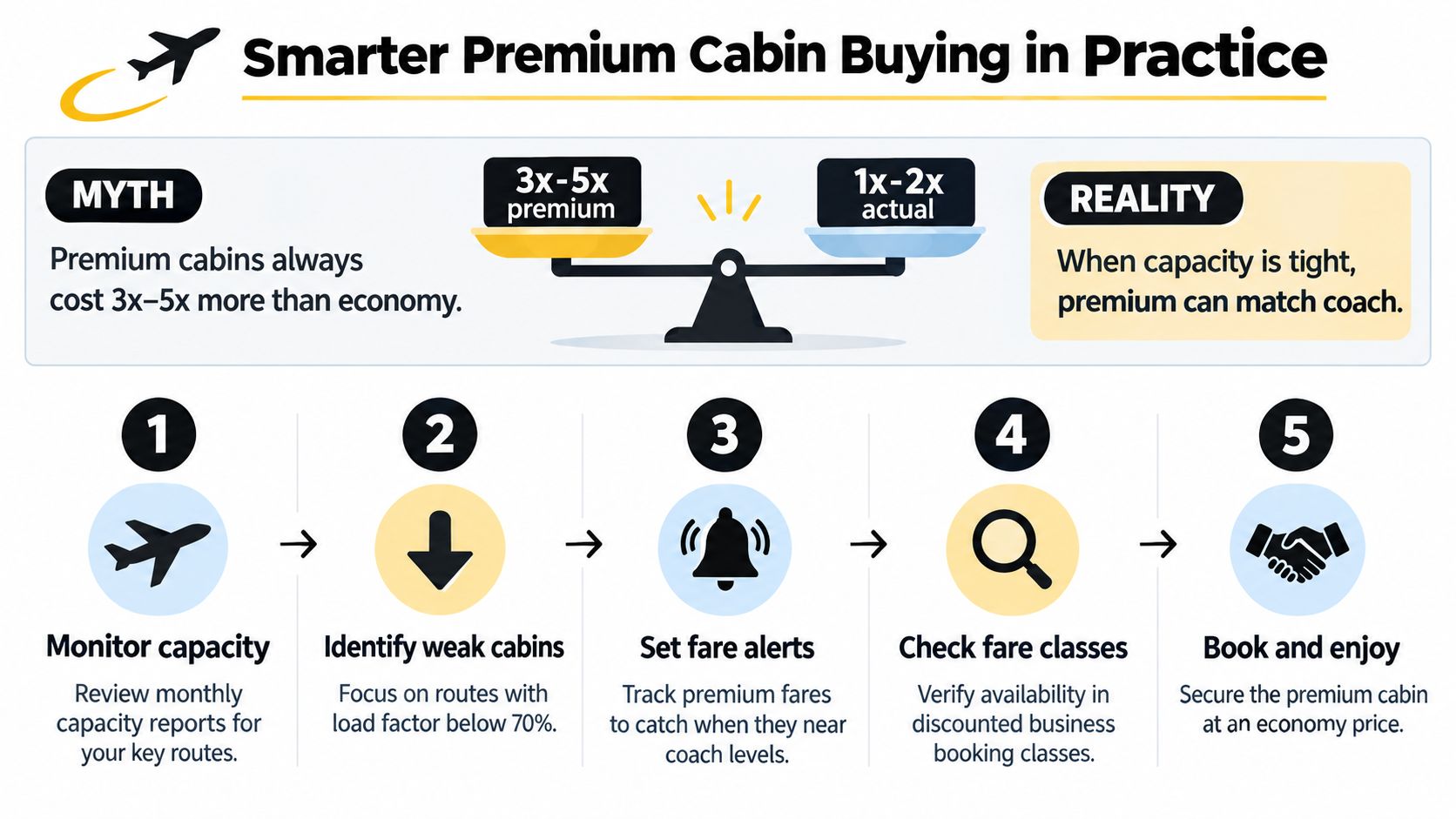
The idea that premium cabins always cost three to five times coach is too crude to guide a purchase. Verified examples show that business can sometimes fall below coach when airlines discount unsold premium seats, as the ORD–LHR and LAX–NRT comparisons demonstrate. The price relationship depends on the departure, inventory, fare rules, and total trip cost.
A repeatable buyer routine
- Monitor the route. Track aircraft assignments, frequency changes, and capacity announcements.
- Identify soft demand signals. Prioritize departures where premium inventory appears plentiful or booking pace looks slow.
- Create fare alerts. Watch business and coach together instead of setting a premium-only threshold.
- Verify the fare class. Check rules, baggage, changes, refunds, connections, and ticketing requirements.
- Recheck before committing. If the fare is valid and the itinerary works, compare the complete value rather than waiting for a theoretical bottom.
A short checklist keeps the process grounded:
- Seasonality: Favor flexible dates outside the strongest demand periods.
- Route maturity: New or changing routes may have unstable cabin demand.
- Equipment swaps: A larger premium cabin can create more inventory to sell.
- Competitive activity: New or aggressive competitors can pressure fares.
- Schedule reliability: A cheap fare isn't useful if the itinerary no longer meets the travel requirement.
Premium travel also includes the ground experience. Travelers comparing lounge access should understand eligibility rules, guest policies, and operating restrictions, including practical guidance on who gets into first-class lounges.
Passport Premiere offers fare monitoring and market analysis focused on international business- and first-class pricing. If you want to apply airline capacity signals to real itineraries, visit Passport Premiere to review its fare-monitoring resources and membership options, then compare any alert against your company's travel policy and total trip cost.
