
Best International First Class: 7 Ways to Fly for Less

The best international first class seat isn't necessarily the one with the grandest suite. It may be the one you bought after its fare fell. Passport Premiere says fewer than 15% of premium-cabin seats sell at their initial asking price, and a badly aligned fare bucket can put business class below coach: on two Iberia Madrid–Athens flights, business class cost $471 versus $575 for economy on one, and $373 versus $480 on another, as One Mile at a Time's fare comparison shows.

The trick is finding those prices before the inventory disappears, then checking whether the ticket's rules and route suit your trip. Below are seven practical tools and strategies, from fare intelligence and alerts to advisors and booking platforms. Each fits a different kind of traveler, and each has a trade-off. For long-haul comfort, the seat is only part of the calculation. Even practical tips for avoiding neck pain while traveling can help you make the most of the flight you book.

1. Passport Premiere
Passport Premiere

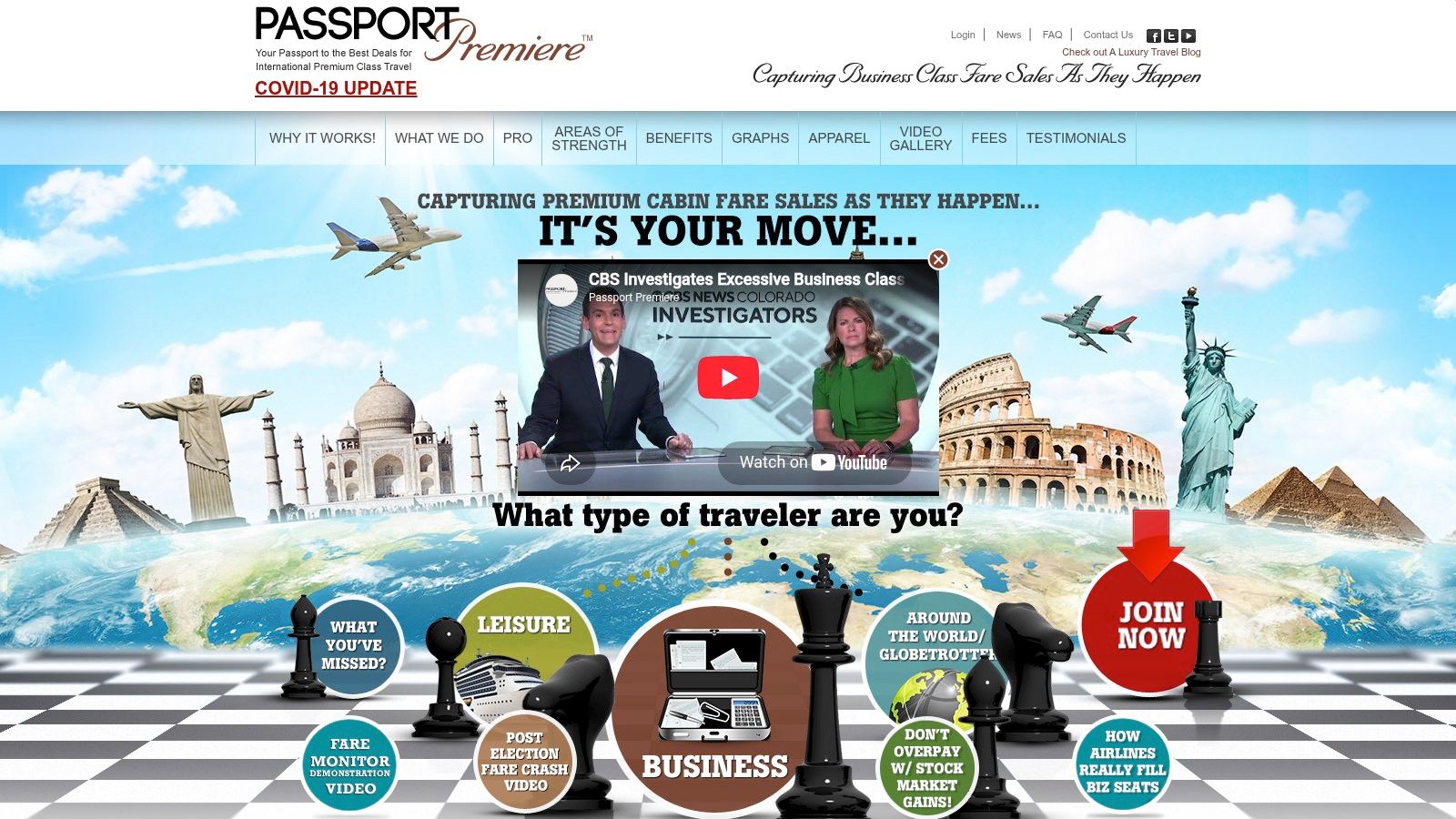
A premium fare is easier to judge when you can compare it with more than the price currently on screen. Passport Premiere is a membership-based airfare intelligence service focused on international business and first class. It combines fare monitoring with market analysis and guidance on fare cycles, helping members assess whether a fare looks competitive or may have room to fall.

That makes it a different tool from a simple deal email. Rather than only reacting to a fare alert, members can use its Fare Monitor demonstration, video gallery, news, and fare information to understand how premium prices move. The service is designed for frequent international business travelers, corporate travel managers, luxury leisure travelers, and travel advisors who want more context before committing.

Best use: Make the membership part of a regular fare-checking routine, not a promise that a particular route will be cheap.

The trade-off is straightforward. Membership fees apply, and while the site publishes them, specific amounts aren't stated in the information available here. Savings aren't guaranteed, either. Route, timing, demand, and seat availability all matter, so a traveler taking occasional short-haul trips may not get the same value as someone who regularly buys international premium-cabin tickets.

For a useful baseline, compare the fare with recent pricing for the same route and cabin, then check what the ticket includes. Premium-cabin services such as lounge access and flat beds don't depend on the fare paid, according to the service. If you carry travel documents often, a passport wallet for everyday travel is a practical companion, but it won't replace fare analysis.

2. Traveluent
Traveluent

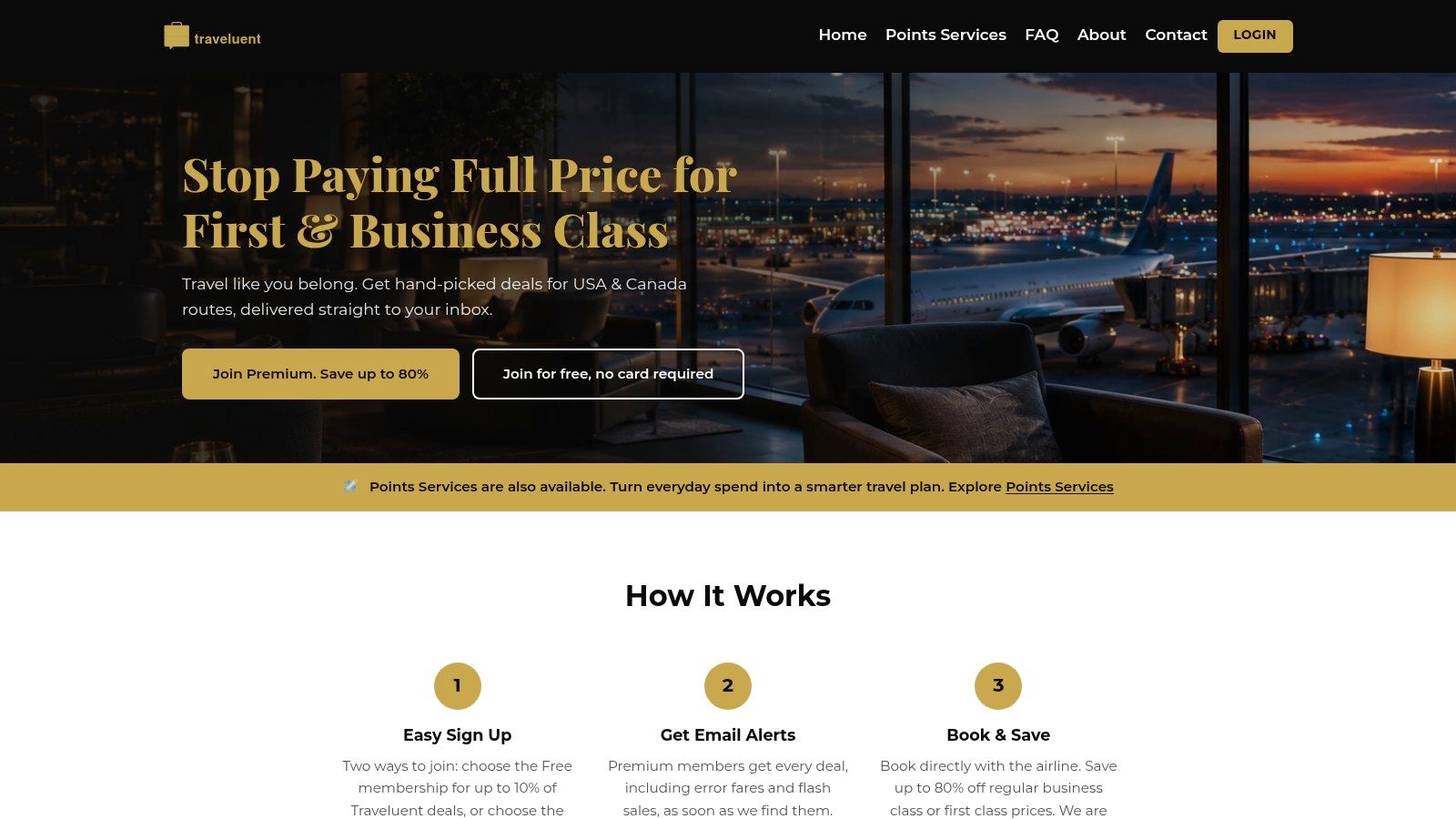
Traveluent sends curated alerts for discounted international business- and first-class cash fares departing from airports in the United States and Canada. The service says its deals are personally reviewed. Paid members receive qualifying alerts, early access, flash sales, occasional mistake fares, and the option to request monitoring for particular routes.

A free tier lets you try the service before paying. Premium membership costs $59 every three months or $149 per year, according to Traveluent's membership information. Route monitoring is most useful if you have a destination in mind and can shift your dates.

Mistake fares are a bonus, not a booking strategy. They can disappear quickly or be canceled. Going's guide to business-class flights describes rare international business-class fares as low as $300, against typical long-haul business-class round trips of roughly $3,000–$5,000. Treat those figures as examples of pricing errors, not fares to expect.

Choose this if: You have flexible dates, can act promptly, and are comfortable booking your own ticket.

Alerts do not guarantee a fare for your route or dates. Check availability, restrictions, and ticketing details before buying. If you prefer hands-on booking help, compare Traveluent with an advisor-assisted first-class travel option, such as OneSkies or Fly First Class International.

3. Good Flight

Good Flight's Trip Watch feature makes it the most trip-specific option in this list. Enter a destination, approximate travel dates, cabin, and optional target price, then receive an email when fares from selected departure airports meet the service's deal criteria. The alert includes a booking link, but you complete the purchase with the airline or ticketing provider.

The service monitors business and first class and checks fares daily from its selected airports. Airport coverage varies, so confirm yours is included before choosing a plan. Unlike a renewing membership, Good Flight sells one-time plans for an individual traveler, two travelers, or a household of up to six, with a 30-day money-back guarantee, according to Good Flight's plan details.

That structure suits a traveler who has a defined trip but doesn't want another subscription. It also limits what the tool can do: Good Flight doesn't book, rebook, or manage your flights, and an alert may be stale by the time you open it. Have your passenger details and payment method ready, then check the final fare and rules directly before buying.

A practical test: Set a target you'd genuinely pay, not an aspirational price that would make every alert irrelevant. If your dates are fixed, treat Trip Watch as a way to catch an opportunity, not as a substitute for confirming that a seat is still available.

4. OneSkies
OneSkies

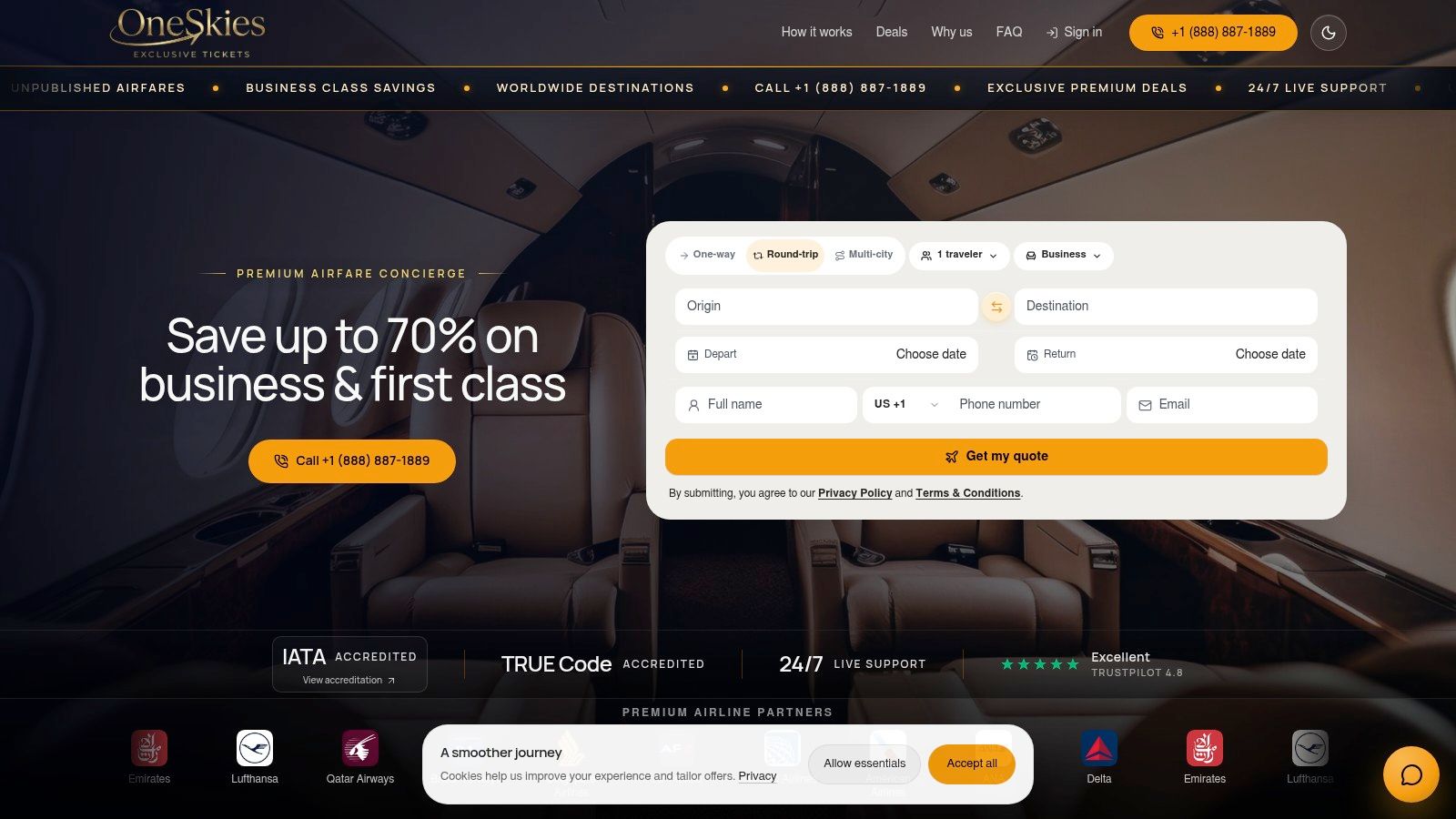
Some itineraries are awkward to compare through search results alone. OneSkies is a US-based premium-fare consolidator that offers advisor-assisted quotes for international business- and first-class trips. Submit your route and preferences, review the options an advisor finds, and decide whether to book. Requesting a quote is free, and the company advertises 24/7 human support and corporate accounts.

The useful distinction is between an advertised starting fare and a ticket you can buy for your dates. OneSkies says its published starting fares are estimates that include taxes and fees, but final pricing and fare rules depend on the itinerary and available inventory. Ask for the full terms before paying, especially if the trip involves connections, a tight schedule, or a change in plans.

The company identifies itself as IATA-accredited, but that doesn't mean every itinerary is the best value. Some airline or itinerary details may not be publicly disclosed, and advertised savings aren't guaranteed for a particular route. Compare the quote with a direct airline fare and make sure you understand the ticket's change and refund conditions.

Use an advisor when the itinerary is complicated, not just because the cabin sounds exclusive.

OneSkies is the better fit for travelers who want a person to help assemble options. If you prefer to track prices yourself before asking for a quote, use a premium airfare tracker as a separate part of your search.

5. Fly First Class International
Fly First Class International

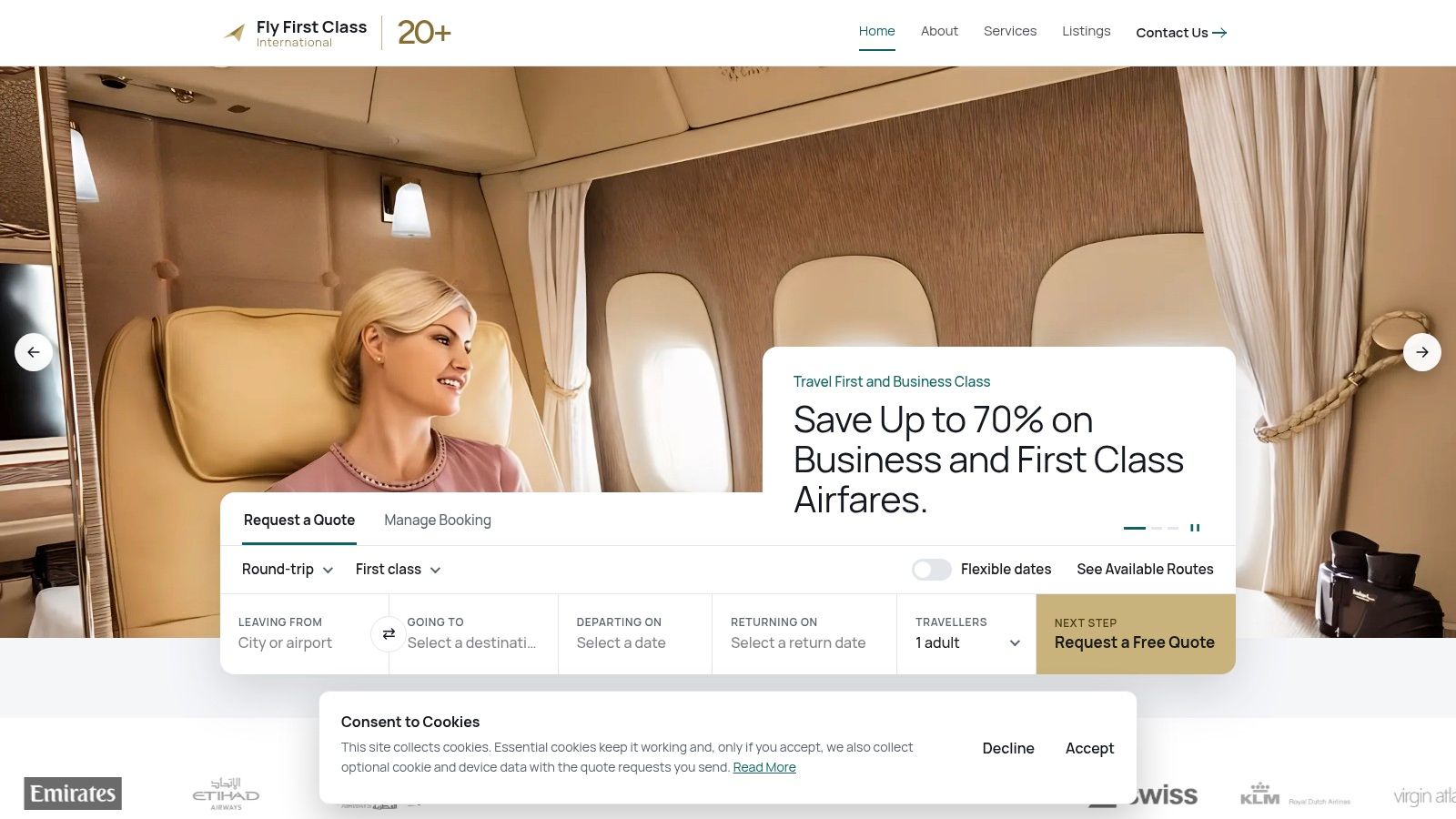
Fly First Class International is a specialist agency for long-haul international business- and first-class bookings. You request a quote, then an advisor presents available fares and explains the rules. The company says it has worked in this segment since 1998, and offers support for corporate travel, ticket changes, and upgrades through its international premium-cabin booking service.

This approach works best when you want a human to handle the details rather than chase alerts and ticket the flight yourself. The website includes sample fares for some routes, which can help you decide whether it's worth requesting a quote. The advisor can also explain how the ticket behaves if your schedule changes, a detail that matters more than a glossy cabin photo when a work trip is still in flux.

The drawbacks are the lack of a fixed public service price and the need to assess each quote on its own terms. Discount ceilings don't guarantee savings on your route. The company says tickets are nonrefundable, while changes depend on availability and the ticket rules, so read those conditions before purchase.

Before you approve a quote, confirm the operating airline, flight numbers, cabin on every leg, baggage allowance, and change fees. If your priority is choosing a particular seat or checking cabin availability, review the airline's seating options with an international first-class seat guide as part of your comparison.

6. Business-Class.com

Business-Class.com combines online premium-fare search with support from a sales team. It handles business- and first-class tickets for one-way, round-trip, multi-city, and open-jaw itineraries, and says a personal agent is assigned to bookings. Travelers can contact the service through 24/7 channels, and payment options include cards, bank transfer, and Affirm for eligible customers, according to Business-Class.com.

The broad itinerary support makes this platform worth considering when a simple return search doesn't fit the trip. Some route pages show sample prices, giving you a starting point for comparison. Still, a sample fare is not a ticketed quote. Prices can change before ticketing, and some partner or itinerary details may not be publicly identified.

Fare family matters, too. A low business-class fare may strip out benefits or flexibility that another fare includes. For example, a CNBC report on premium fare tiers listed United's Newark–London Heathrow basic Polaris round trip at $4,490, compared with $4,890 for standard and $5,390 for flexible refundable. The basic option excluded access to United's Polaris lounge.

Read the conditions before choosing the cheapest result. Business-Class.com notes that fares may be nonrefundable and nontransferable. Agent support can help you through the booking, but it doesn't remove the need to verify exactly what you're buying.

7. Basis

Basis offers an online way to search and book business- and first-class fares, with concierge support when a trip needs more attention. You can search and book one-way and round-trip itineraries without creating an account. For multi-city trips, you'll need to contact the team rather than complete the whole booking online.

That division is convenient for straightforward trips. Search first, then reach out if your routing needs a custom arrangement or if you have questions about the fare. Basis says payment is charged after the ticket is issued and confirmed, a useful point to understand before you enter the booking process. The company's booking FAQ also explains that fares can't currently be held before booking.

There's no fixed membership fee listed; the traveler pays for the selected itinerary. That makes Basis a tool for a specific purchase, not an ongoing alert service. Before you submit payment, confirm the exact flights, cabin, ticket rules, and whether the itinerary is refundable or changeable. If you need a multi-city route, contact the team early enough to compare the proposed fare with other options.

Basis works best for travelers who want a relatively direct online booking path but still value access to human support. It's less suited to someone who needs a fare held while coordinating a group or waiting for internal approval.

Best International First Class Fare Services at a Glance

Service How It Works Pricing Model Best For
Passport Premiere Monitors premium fares and shares fare-cycle insights and alerts. Paid membership; specific fees not provided. Travelers seeking international business- or first-class fare insights.
Traveluent Sends email alerts for discounted premium-cabin cash fares; members book themselves. Free tier; Premium is $59 every three months or $149 per year. Flexible travelers ready to book quickly without using points.
Good Flight Checks selected airports daily and sends fare alerts or trip-specific watches with booking links. One-time plans; exact prices not provided. Travelers targeting specific routes, dates, or prices.
OneSkies Advisors find premium-cabin options and provide trip-specific quotes. Free quote requests; fare prices depend on itinerary. Travelers who want human help with premium or complex itineraries.
Fly First Class International Advisors provide quotes, explain fare rules, and can manage booking and support. No fixed public service price; fares are quoted. Travelers seeking hands-on help with international premium-cabin bookings.
Business-Class.com Search or book premium fares online, with personal-agent support available. Fare-based pricing; quoted prices may change before ticketing. Travelers wanting booking assistance and varied itinerary options.
Basis Search and book premium fares online, with concierge support for questions and custom trips. Pay for the selected itinerary; no fixed membership price listed. Travelers who want online booking with access to human support.

Pick Your Tool, Then Wait for the Fare to Move

Choose a tool based on how you buy, not how impressive its marketing sounds. Passport Premiere fits regular international premium travelers who want timing guidance and fare analysis. Traveluent and Good Flight suit flexible, self-booking flyers who can act when an alert arrives. OneSkies, Fly First Class International, Business-Class.com, and Basis are better for complex itineraries or travelers who'd rather have an advisor or booking platform handle more of the process.

Then apply the same discipline no matter which service you use. Watch fare cycles before buying, compare the current price with its recent low, and check the rules attached to the fare. A first-class label alone doesn't tell you whether the ticket is a good deal, and a cheap business-class fare can be a poor fit if its restrictions clash with your plans.

For a route to Italy, Passport Premiere's Fare Monitor system found business-class fares 50% below a customer's initial searches. The system also lets a customer hold a fare while it monitors for a lower one, preserving the held fare. One member reported flying Melbourne–New York in a business seat for the price of economy. These examples show why monitoring and comparison can matter, but they aren't guarantees for your trip.

For corporate buyers, that same process helps separate a genuine travel need from a premium fare that's expensive. For leisure travelers, it creates room to choose a better departure or cabin without paying the first price presented. If the fare doesn't justify the upgrade, take business class, premium economy, or a mixed-cabin itinerary instead. The best international first class is the one that earns its place in your budget.

Choose one service, define your route and cabin, and let the fare come to you.


Passport Premiere combines international premium-fare monitoring, market analysis, and fare-cycle guidance to help travelers assess prices before booking. If you want a more informed way to pursue business and first class for less, visit Passport Premiere and see whether its membership fits the routes you fly.
First Class Flight Deals to Europe: A Fare-Timing Playbook

Forget the advice to book on a particular weekday and grab any premium fare that looks discounted. Finding first class flight deals to Europe takes a more useful discipline: treat the lowest price as a hypothesis, then test it against comparable routes, ticket restrictions and the cost of a disrupted journey. A cheap seat isn't automatically a good purchase, and an expensive economy ticket isn't automatically the sensible alternative.

What a Fair First-Class Price Looks Like for Europe

The lowest premium fare is a starting point for comparison, not proof of a good deal. In Holidu's global-airline route comparison, Iberia's Madrid–Athens sample priced economy at £454 and business at £562, a £108 gap, about 24%. Across its global sample, business averaged 250.19% above economy. The contrast shows why one premium multiplier cannot set a fair price for every route.

These are business-class benchmarks, not a forecast for transatlantic first class. A separate measure offers context for corporate travel: European companies' average business-class ticket reached €3,867 in 2023, up 7% year over year, according to AirPlus figures reported by Hospitality Today.

Premium-to-coach gap on Europe-linked benchmarks

Benchmark Economy Business Gap
Madrid to Athens, Iberia sample £454 £562 £108 (about 24%)
European corporate average business ticket, 2023 Not reported €3,867 Up 7% year over year

Read the gap, not the headline

Set a route baseline by comparing the same city pair, travel dates, journey direction and currency. Price economy, business and first class as separate products, and include nonstop and acceptable connecting itineraries. A fare only looks unusually low relative to a like-for-like option.

For additional context, first class airfare ranges for 2026 and this guide to the cost of flying first class can help frame the purchase. Compare any broad range with live fares for your route, then check the fare rules and the consequences of a disruption before treating the cheapest result as a deal.

Use these working thresholds as prompts for closer review, not as statistical predictions:

  • Below 30%: Check premium availability daily.
  • At least 100%: The premium is substantial. If your schedule permits, wait for a meaningful reduction.
  • Between those thresholds: Track fares for two weeks before deciding.

Calculate the gap by subtracting economy from business, dividing by the economy fare, then converting the result to a percentage. Keep today's lowest economy fare, today's lowest business fare and the gap between them together. Recheck them when dates or routing change; a lower headline fare may come with restrictions that change its practical value.

Building the Search Matrix and Timing Signals

Airlines don't price premium cabins as a single product with a predictable markdown schedule. They allocate seats across booking classes, opening and closing lower-priced inventory as their demand forecasts change.

The ITU airline revenue-management lecture notes explain that controlled allocation approach and describe an Italian investigation in which purchases occurred, on average, more than 30 days before departure, with 60% of surveyed travelers buying more than a month ahead and 12% during the final week. Those purchasing patterns aren't a premium-fare forecasting model, but they're a useful warning against building your strategy around a last-minute rescue.

Build a grid you can actually maintain

Start with acceptable journeys, not every possible journey. An enormous spreadsheet full of airports you'd never use creates work without improving your decision.

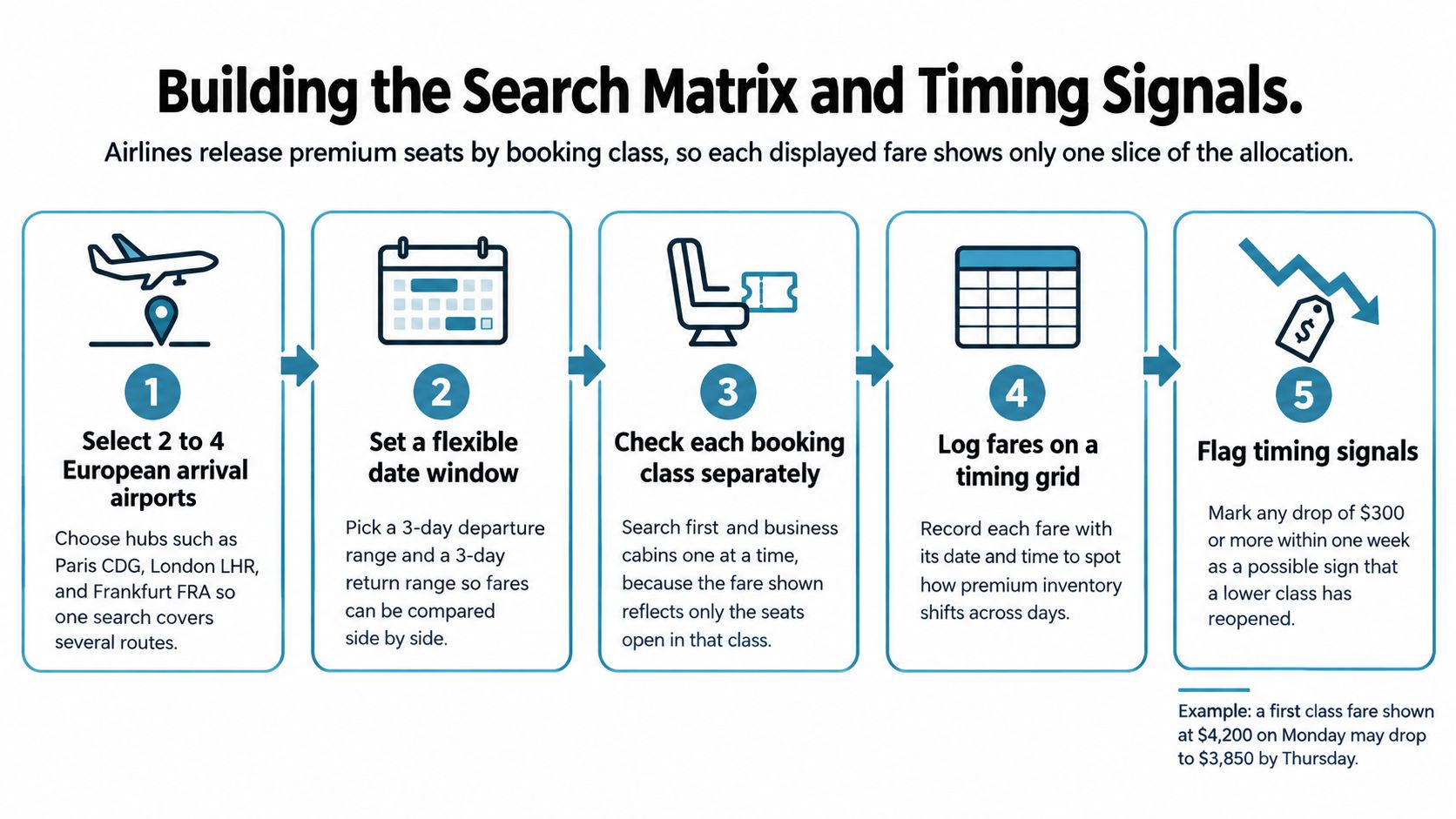
  1. Choose arrival and departure airports. I would begin with two to four European gateways and reachable alternative origin airports. Include Paris if that's your destination, but test other gateways only when the onward journey is practical.

  2. Add competing connections. Search nonstop flights and one-stop itineraries through hubs on other alliances. Don't assume that your preferred airline's connecting fare represents the whole market.

  3. Widen the dates. Try departure and return flexibility of plus or minus three days, including a weekday shift. Keep the length of stay visible so a cheaper fare doesn't secretly require extra hotel nights.

  4. Search cabins separately. Run business and first-class searches in every usable combination. Check the cabin on each segment, especially the long-haul flight, rather than trusting an itinerary-level premium label.

  5. Record the ticket conditions. Log the lowest available booking class, changes, cancellation terms, upgrade eligibility and baggage. If the booking class isn't displayed, mark it unconfirmed and check with the airline before purchase.

  6. Repeat consistently. Price the grid at the same time of day on each run. That won't reveal a magic buying hour, but it makes your observations easier to compare.

  7. Flag the baseline difference. Mark each result above or below its comparable starting fare. Keep nonstop and connecting baselines separate so a routing change doesn't masquerade as a price cut.

Use the process graphic as a workflow reminder, not a forecast of what a particular airline will charge.

A five-step infographic showing how to build a search matrix for finding premium class flight deals.

Separate availability from affordability

An apparently empty cabin doesn't prove that a cheap booking class is available. Airlines can retain unsold seats while withholding lower fares because they expect later customers to pay more.

A seat map is particularly weak evidence. It shows seat assignments, not the complete inventory or pricing decision behind the flight.

Practical rule: Compare a purchasable fare with a comparable baseline. Don't negotiate with a seat map.

Search the entire itinerary rather than adding separately displayed segment prices. Also check the result for the full traveling party, because a fare available to a solo passenger may not price identically for everyone in a group.

Start monitoring at least a month ahead where possible, preferably before your dates become fixed. That's a planning recommendation, not a guarantee that advance purchase will produce the lowest fare. If you're already close to departure, shorten the decision process instead of assuming unsold premium seats must become cheaper.

Read calendar signals cautiously

Buying on a holiday and flying on a holiday are different decisions. A small purchase-day saving can be overwhelmed by a costly travel date.

The fare evidence summarized in Oxera's analysis of airfare drivers includes findings from almost 22 million fares: buying on a holiday was 1.8% cheaper on average, while national-holiday travel carried a 41.6%–82.0% premium and federal-holiday travel a 4.6%–35.0% premium. These are broader airfare findings, not premium-cabin-specific savings promises.

Calendar effects on premium fares

Calendar effect Research figure What to do
Buy on a holiday 1.8% cheaper on average Small effect; never buy on this alone
Travel on a national holiday 41.6%–82.0% premium Move dates off the holiday peak where the schedule allows
Travel on a federal holiday 4.6%–35.0% premium Check holiday-adjacent dates in the matrix
Sharp drop on one premium cabin Possible carrier fare correction Verify the rules, then act if it matches the baseline gap

A sudden reduction deserves investigation, but it doesn't reveal its cause. The airline may have reopened cheaper inventory, adjusted a fare or changed the available itinerary.

Check whether the operating airline, airport, cabin and ticket conditions stayed the same. Act on a timing signal only when it also produces an acceptable baseline gap, never on the calendar alone.

How to Set Alerts and Track Fare Cycles

Monitoring pays off when it reduces manual checking without stripping away context. Google Flights alerts can flag changes in supported searches, while a spreadsheet in Google Sheets or Excel preserves the detail you need to judge them.

Give each alert a decision rule

  1. Set a trigger. For example, choose an alert threshold 15% below the starting business fare, or below a rolling 30-day median once you've collected enough observations. These are sample operating settings, not proven market thresholds.

  2. Limit the active watchlist. I would keep alerts on the top two or three itinerary combinations. Leave weaker alternatives in the spreadsheet rather than filling your inbox with flights you won't buy.

  3. Log each observed change. Record the date, days before departure, weekday, cabin, booking class and final payable price. Preserve unavailable results too, because disappearing inventory matters.

  4. Review the pattern. After a sample monitoring period of four to six weeks, compare when fares dipped and whether the ticket conditions changed. Don't call an isolated reduction a dependable cycle.

  5. Validate promptly. A practical response target is to check an alert within fifteen minutes when you're available. Reprice for your party, inspect the rules and apply your prewritten purchase criteria.

An alert tells you where to look. It doesn't tell you whether the ticket is suitable.

Choose the amount of manual work

A spreadsheet is a free starting point, though you'll still need to collect and interpret the observations. As a managed option, Passport Premiere offers premium-cabin fare monitoring and market analysis; its Fare Monitor demonstration, video gallery and news discuss fare cycles and fare wars, and its website publishes membership fees. Review its approach to international first-class tracking alongside your existing tools.

No monitoring service replaces the rules check. Cached results, limited inventory and a different passenger count can all produce an alert that doesn't survive checkout.

When a Premium Fare Falls Below Coach

In 2007, travelers purchased San Francisco–New Zealand business-class tickets for about US$1,500 instead of approximately US$15,000, a 90% reduction, according to the South China Morning Post's account of mistake fares; the same report describes Cathay Pacific selling first- and business-class tickets at economy-level prices in 2019.

Business class cheaper than coach is possible, but an exceptionally low price still needs scrutiny. Incorrect currency conversions, omitted fuel surcharges and programming errors can produce fares that weren't intended as promotions.

Going's business-class guide describes mistake fares as potentially up to 90% below usual prices, with some business itineraries advertised for as little as US$300. Those examples aren't standing offers to Europe.

Respond quickly without committing blindly

  1. Compare with your baseline. An extreme outlier across otherwise comparable itineraries deserves immediate attention. Cheap alone doesn't prove an error.
  2. Read the restrictions. Check refunds, changes, passenger details and the actual cabin before paying.
  3. Book promptly if acceptable. A same-day decision is sensible because the airline can correct the fare. Don't treat availability as guaranteed while you deliberate.
  4. Save the evidence. Keep the confirmation, ticket details and a timestamped screenshot of the displayed fare.
  5. Confirm with the airline. Verify that the reservation is ticketed, check it again before departure and avoid non-refundable downstream purchases until you're comfortable with its status.

The distinction between a genuine bargain and a misleading comparison also matters when evaluating first class cheaper than economy. Compare equivalent dates and conditions, not discounted premium against an unrelated flexible coach fare.

Mistake fares are rare, short-lived and unpredictable. Keep them as an opportunistic check, not the foundation of a necessary business trip.

Judging Whether a Cheap Fare Is Really a Deal

Say the lowest business fare includes a tight connection before a client meeting. A missed flight could mean losing the meeting and paying for an overnight stay, making the headline saving irrelevant.

Evaluate the operating carrier, not just the airline selling the ticket. Then assess EU-departure eligibility, connection time against the airport's minimum connection requirements, alternative departures, rebooking options, lounge access and potential hotel support.

Price the disruption exposure

Give extra scrutiny to separate-ticket connections. Don't assume the airline operating the long-haul flight will protect an independently booked onward journey, and don't confuse lounge admission with a promise of accommodation during disruption.

Under EU Regulation 261/2004, passengers departing an EU airport generally have rights to assistance and, where applicable, reimbursement or rerouting following qualifying disruptions; the EU air-passenger-rights guide sets out conditional compensation bands of €250, €400 and €600 and explains that an airline cannot charge extra when it reroutes a passenger into a higher transport class.

EU261 fixed compensation bands by flight distance

Flight distance (EU261) Fixed compensation What to check
Up to 1,500 km €250 Confirm the departure point and operating carrier
Intra-EU flights over 1,500 km, or other flights of 1,500–3,500 km €400 Check whether rerouting reduced the arrival delay
Other flights over 3,500 km €600 Keep rebooking records and receipts

Compensation isn't automatic for every cancellation or delay. Eligibility and exceptions matter, and compensation can be reduced when rerouting limits the arrival delay, so preserve receipts, notifications and rebooking records.

Normalize the gateway comparison

Price the same city pair through competing gateways. Add positioning flights, ground transfers, baggage, change restrictions and any accommodation needed to make the routing usable.

The cheapest fare is worth paying more than only when the cheaper journey still works.

A slightly dearer nonstop or EU-origin itinerary can be the better purchase when it reduces misconnection risk and improves applicable protections. Assess each direction separately rather than assuming the entire return trip has identical coverage.

Deciding Whether to Book Now or Keep Watching

The lowest first-class fare is a hypothesis, not a verdict. For a trip from a US city to Paris, business class starts at a 180% premium over economy. The traveler compares three gateways and two date windows, then sets alerts for the two strongest combinations.

In week three, an alert shows a business fare well below its starting baseline. Before booking, the traveler checks fare rules and the long-haul cabin, then uses Passport Premiere's Fare Monitor and market analysis to judge whether the drop looks like a carrier correction and how the fare compares with the estimated market value of an empty premium seat.

Apply a purchase gate

A lower fare still has to work for the trip. Market analysis helps assess the price, while connection exposure and recovery options determine whether the itinerary is practical.

  • Book when the gap qualifies. The fare meets the threshold set before the alert arrived.
  • Require usable changes. The rules provide the flexibility the trip needs.
  • Pass the disruption check. Connections and recovery options fit the traveler's commitments.
  • Preserve planning time. Under this traveler's rule, departure is more than a month away.

If any condition fails, keep watching while an acceptable fallback remains available. Check Passport Premiere's published membership fees before joining, and leave time for organizing passports and visas before departure.

Passport Premiere provides international business- and first-class fare monitoring, market analysis and guidance on premium-cabin buying opportunities. Review its Fare Monitor demonstration and published membership fees at Passport Premiere to decide whether managed monitoring fits the trip.