
Most advice on first class flights to Ireland starts with “search Dublin and book early.” That's too simplistic. The smarter play is to compare the full journey across Dublin, Shannon, and Cork, then check Business Class with the same discipline. Business class can be cheaper than coach when airline fare buckets move in opposite directions, and the lowest ticket price often isn't the lowest total trip cost.
Ireland's premium market rewards travelers who inspect the aircraft, fare rules, connection, airport transfer, and cabin inventory instead of trusting a search-result label. Treat the trip like a corporate travel purchase, not a luxury impulse.
Rethinking the Dublin Default for Premium Travel
Dublin is the obvious gateway, but it isn't automatically the right one. Ireland's 2025 airport traffic shows why the default exists: Dublin handled 36.4 million passengers, compared with 3.46 million at Cork and 2.24 million at Shannon, while Dublin accounted for 83% of flights at Ireland's five main airports. Those figures come from the Central Statistics Office aviation data.
That scale gives Dublin the strongest schedule depth and the broadest choice of connecting itineraries. It can also mean a busier arrival, a longer onward transfer, and more exposure to missed-connection or baggage complications when your final destination lies far from the capital. A fare that looks cheaper into Dublin may stop being cheaper once you add a positioning flight, rail ticket, private transfer, parking, or an extra hotel night.
Practical rule: Choose the airport that minimizes total trip cost and operational risk, not merely the one with the lowest fare display.
Match the gateway to the destination
Shannon deserves serious attention for western Ireland, particularly travelers heading toward Clare, Galway, Kerry, or nearby corporate locations. Cork can be more logical for southern destinations and for passengers whose final business is in or around Cork. Dublin remains the strongest choice for many central and eastern itineraries, but its connectivity shouldn't end the search.
Compare each option on four measures:
- Ticket cost: Include the complete round trip and every paid add-on.
- Ground journey: Price the transfer from the arrival airport to the actual destination.
- Cabin continuity: Check whether the long-haul segment is genuinely in Business or First.
- Recovery options: Favor routes with practical alternatives if a delay disrupts the itinerary.
Seasonality matters too. Travelers planning outdoor meetings, road travel, or leisure extensions should also review what to expect in an Irish summer before choosing dates and arrival points. Weather, daylight, and local travel conditions can change how valuable a smooth regional arrival feels.
The right question isn't “Which airport has the lowest premium fare?” It's “Which routing gets me to the door with the least expense, friction, and uncertainty?”
Mapping Airport Pairings and Transatlantic Routes
A serious search starts with airport pairs, not a single city-to-city query. Test Dublin, Shannon, and Cork against your principal origin airport, then add major transatlantic gateways and one-stop European connections. This exposes fare differences that a narrow “New York to Dublin First Class” search can miss.
Ireland's official Airport Pairings Database provides monthly passenger volumes for every direct airport pair into and out of the country, with data available from January 2006. Use it to understand whether a proposed direct pairing is a regular market or a thin schedule that requires careful date verification.

For each quote, build a comparison record rather than relying on screenshots. Capture the operating carrier, aircraft type, cabin on every sector, connection airport, connection time, booking class, baggage allowance, lounge access, and change conditions. A codeshare isn't extra capacity, and a premium-looking booking interface doesn't prove that the transatlantic flight has an international First cabin.
Use route data without mistaking it for product data
Passenger volumes help explain connectivity, but they don't tell you how many First seats remain or whether a fare is attractive. Treat the database as a route-planning tool, then verify the actual flight schedule and seat map with the airline or booking platform.
A Newark to Shannon search can be especially useful for travelers bound for western Ireland, but the airport's convenience depends on the final destination and onward transport. Review flights from Newark to Shannon, Ireland alongside Dublin alternatives, then add the practical ground cost before deciding.
The same discipline applies inside the aircraft. Confirm that the long-haul sector offers a flat bed if that matters to you, identify whether the seat is true First or Business, and check whether a short connecting sector is being marketed as premium while the principal flight remains in a lower cabin. For practical comfort planning, a guide to travel accessories for long flights can help you prepare for the parts of the journey that the fare brand won't improve.
Here's the visual overview of the experience many travelers are trying to buy:
The route with the most prestigious cabin isn't necessarily the best route. The winning itinerary is the one that delivers the required comfort while keeping the connection, transfer, and recovery plan under control.
Building a Robust Purchase Evaluation Benchmark
Headline fare is a poor purchasing benchmark. A low-priced First ticket with an awkward connection, a mixed-cabin return, and restrictive change rules can be worse value than a more expensive Business itinerary that provides a flat bed on both long-haul sectors and arrives closer to the final destination.
Start with the calculation specified in Ireland's aviation background notes: divide the total fare by scheduled door-to-door travel time, then adjust for the number of long-haul sectors operated in the purchased cabin. The Central Statistics Office methodology also makes an important distinction. Airport totals describe passengers and flights, not First Class availability or premium-fare success rates.
Build the comparison sheet
Record at least three observations for each route across different departure dates. One displayed fare isn't a dependable market benchmark because airlines open and close booking classes independently.
Your worksheet should include:
| Field | What to verify |
|---|---|
| Total fare | Round-trip price, taxes, fees, and paid extras |
| Cabin by sector | First, Business, Premium Economy, or Economy on every flight |
| Aircraft | Actual aircraft scheduled, not only the marketing carrier |
| Fare rules | Changes, cancellation, refund, and no-show conditions |
| Airport access | Lounge eligibility, transfer time, and ground cost |
| Travel time | Scheduled door-to-door duration |
| Risk profile | Tight connections, separate tickets, and limited alternatives |
Then inspect the seat map. International First normally has a distinct seat product, while Business Class may offer a similar flat-bed experience on some aircraft. Don't pay a First premium until the seat, dining, lounge access, privacy, and service differences are clear.
Separate demand from product quality
A route can have heavy passenger traffic yet offer poor premium value on your dates. Conversely, a smaller airport may show fewer flight choices but provide a cleaner arrival and a more suitable ground journey. These are separate decisions.
A fare becomes valuable only after you know exactly what cabin, aircraft, schedule, and restrictions you're buying.
Look at the return flight with equal care. Travelers often find a premium outbound and an economy return presented as one “premium” result. That may be acceptable for a short trip, but it isn't a true First Class itinerary and should be priced accordingly.
When Business Class Costs Less Than Coach
This isn't an urban legend. Business class can cost less than economy when airlines manage the two cabins through separate inventory systems. If discounted economy booking classes disappear while lower Business booking classes remain open, the Business fare can undercut the remaining coach price.
One documented comparison recorded economy at $575 and Business Class at $471, while another showed economy at $480 and Business Class at $373. The figures are reported in this analysis of Business Class pricing. They aren't a standing promise, but they demonstrate the mechanism travelers should actively test.
Why the inversion happens
Airlines don't price every seat from one simple ladder. Revenue managers control fare buckets by cabin, demand, departure date, route, and restrictions. A flight can have scarce discounted economy inventory while still carrying unsold Business seats filed at a lower promotional level.
A second cause is the difference between a flexible coach fare and a restricted premium fare. Near departure, the only available economy option may permit changes or refunds, while the cheaper Business product may be nonrefundable and locked to the selected flight. Comparing only the cabin label hides that trade-off.
Mistake fares create another, rarer opportunity. A pricing error involving a filed fare, currency conversion, or booking system can push international Business Class dramatically below its normal level. Such fares can disappear quickly, and travelers should treat the booking as uncertain until the airline has issued the ticket.
Compare the restrictions, not just the cabin
Before booking an apparent bargain, verify:
- Changeability: A cheaper Business fare may allow no changes.
- Refundability: Check whether cancellation produces cash, credit, or nothing.
- Cabin consistency: Confirm that the long-haul sector, not only a short feeder flight, is in Business.
- Ticket status: Don't make nonrefundable hotel or rail plans until the ticket is issued.
- Baggage and lounge terms: Premium branding doesn't eliminate fare-specific exclusions.
For Ireland, search Business Class beside Economy every time. The correct workflow is to price the same dates, same airports, same connection, and same baggage needs across both cabins. If Business wins, confirm the restrictions and book the product, not the fantasy of an upgrade.
Timing Purchases with Fare Monitoring Signals
Standard search engines show what exists now. They don't always tell you whether today's fare is normal, inflated, or a temporary drop. That matters most for premium cabins, where airlines can change inventory without moving every cabin together.
The practical signal is not a vague promise that fares will fall. It's a combination of route, cabin, date, fare rules, and available inventory. A strong monitoring process records those variables over time, then identifies a price that makes sense for the itinerary rather than chasing an arbitrary “cheap” label.
What to monitor
Set alerts around the route combinations that survived your airport comparison:
- Origin and gateway pair: Include Dublin, Shannon, and Cork where practical.
- Cabin: Monitor First and Business separately.
- Operating carrier: Track the airline flying the long-haul sector.
- Fare conditions: Flag refundable, changeable, and restricted products separately.
- Date flexibility: Watch nearby departures and returns without assuming they have identical inventory.
Passport Premiere is one option for this workflow. Its Fare Monitor tracks international Business and First fares, including premium routes from North America to Europe, while its market analysis and analyst support help members assess when a purchase may be timely. Use international timing guidance to frame the decision around fare behavior rather than a single search result.
The key is to define your buy point before the alert arrives. Decide which cabin, airport, connection, and restrictions you'll accept, then act when the complete itinerary meets that standard. Otherwise, monitoring just creates more browsing and no decision.
Don't assume a flash fare is useful because the number looks dramatic. A lower fare into Dublin may lose its advantage after a long transfer to western Ireland. A slightly higher fare into Shannon may produce a better total result if it removes a separate positioning journey and reduces connection exposure.
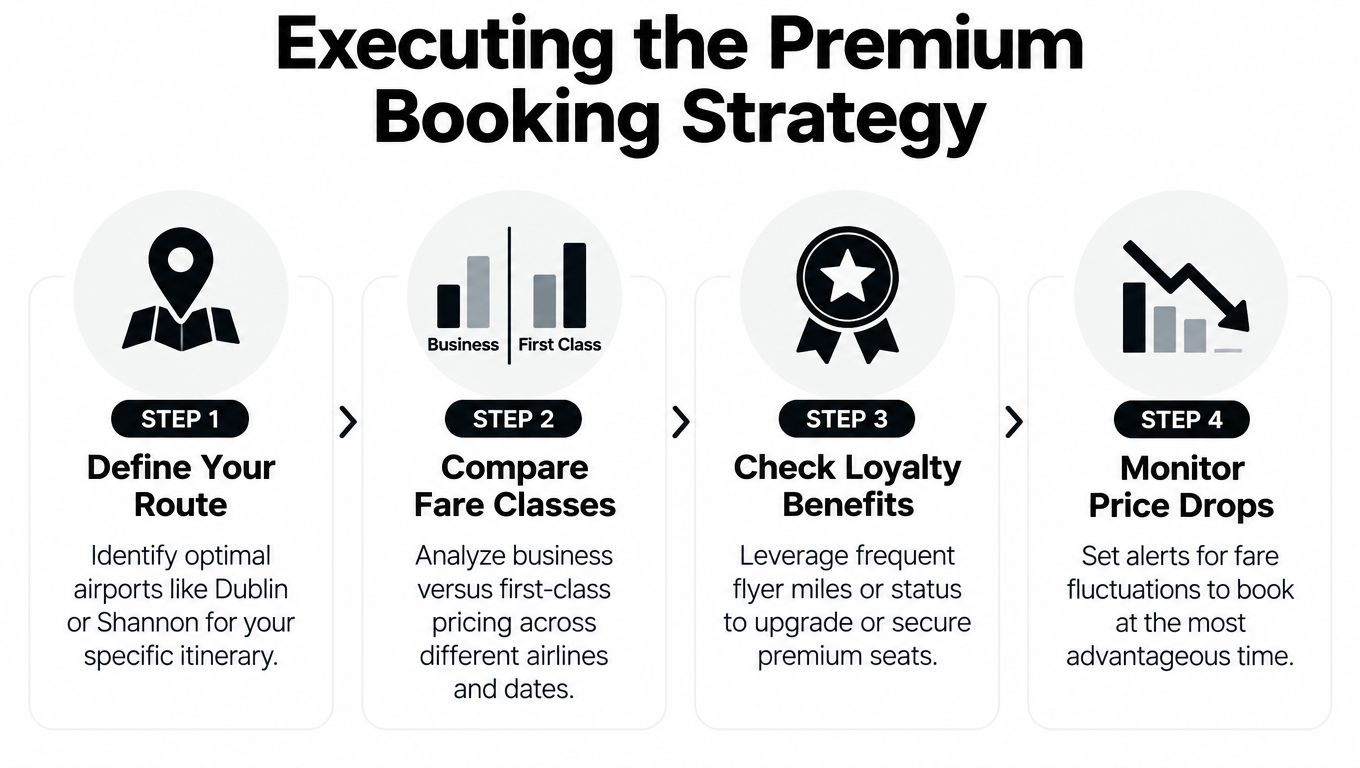
Executing the Premium Booking Strategy
A practical booking scenario starts with a traveler heading to western Ireland for meetings and a short leisure extension. Instead of searching only for first class to Dublin, the traveler compares Dublin, Shannon, and Cork, checks Business alongside First, and prices the onward journey to the actual destination.
The first attractive result is a Business fare with a sensible transatlantic schedule. A separate First result costs more but uses a mixed cabin on the return, while a cheaper economy fare includes a restrictive connection and a longer ground transfer. The traveler rejects the apparent bargains because neither provides the promised product consistently across the itinerary.
The final booking check
Before payment, run this checklist:
- Route: Does the arrival airport suit the final destination?
- Aircraft: Is the promised cabin installed on the long-haul sector?
- Fare: Are the change, cancellation, baggage, and seat rules acceptable?
- Journey: Have you included ground transport, positioning flights, and recovery costs?
- Timing: Is the fare a monitored opportunity or just the first result displayed?
If the fare is an inventory anomaly, move quickly, but don't skip ticket verification. If you're still comparing cabin products, use this guide to get First Class tickets as a practical reference, then return to the fare rules and aircraft map before purchasing.
The seasoned approach is simple. Search broadly, compare Business against coach, verify every sector, calculate the door-to-door value, and buy only when the itinerary survives the full-cost test.
Passport Premiere offers fare monitoring, market analysis, and member guidance for international Business and First Class purchases, including premium routes to Europe and Ireland. Visit Passport Premiere to track fare drops, assess the true value of a premium seat, and stop paying more for comfort than the itinerary requires.
