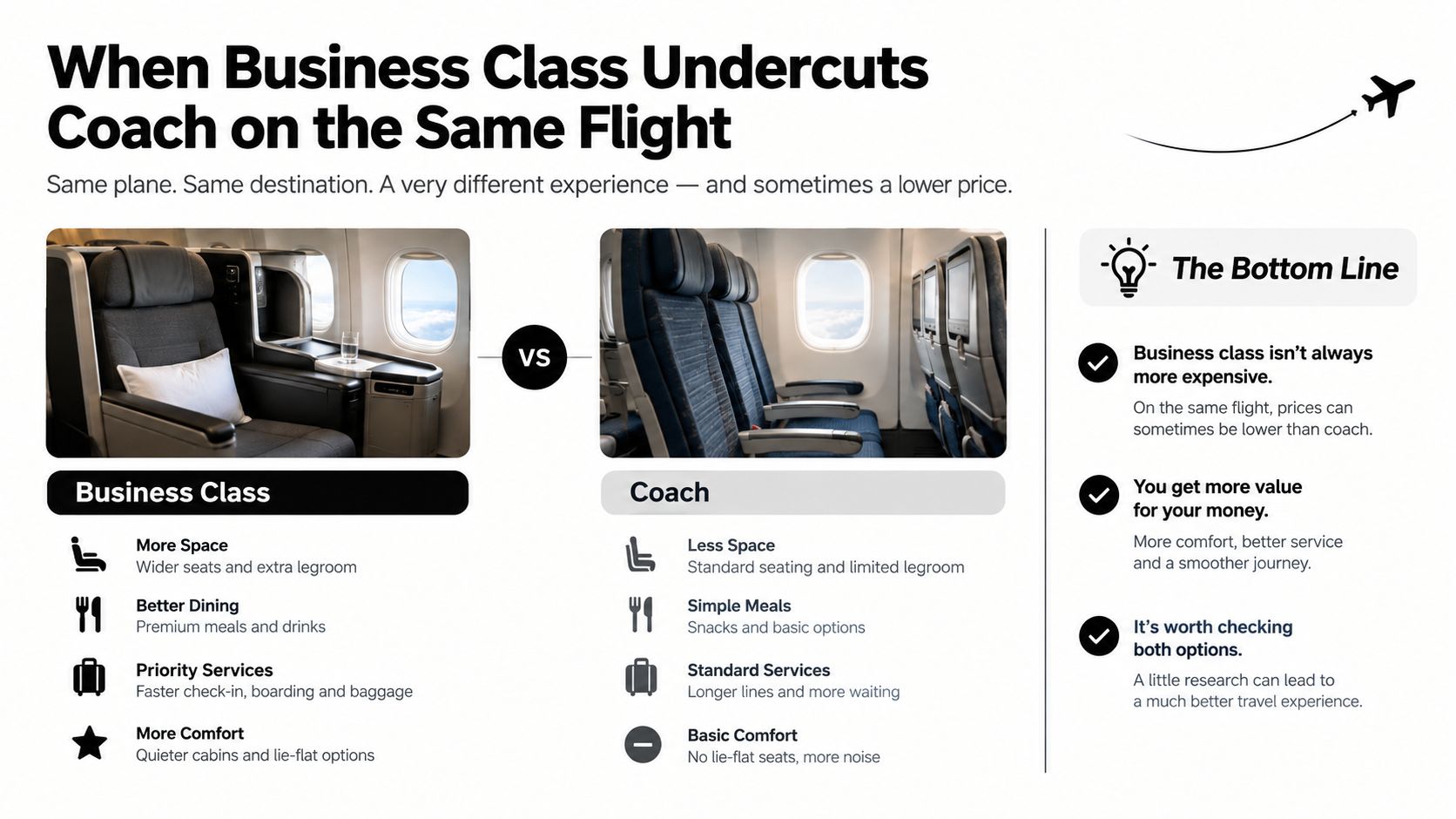
Business class can cost less than coach on the same itinerary, and premium international travel reached 116.9 million passengers in 2024, or 6% of all international passengers. A premium cabin is the group of seats above standard economy, but its pricing behaves like a separate market, so comfort and price don't move together.
That's the point most airline explainers miss. Premium cabin means premium economy, business class, and first class, sometimes with airline-specific products such as Comfort+ or Premium Plus folded into the mix. The seat may offer more space, better food, priority handling, lounge access, or a bed, but none of those benefits guarantees a higher fare than coach.
I watch premium pricing as a fare problem first and a comfort problem second. Airlines divide cabins into booking inventories, forecast demand, and adjust prices according to what they believe each seat is worth at that moment. If the premium inventory is weak and economy inventory is constrained, a lie-flat seat can become the better-priced product.
Why Premium Cabins Can Cost Less Than Coach
The belief that business class always costs more than economy is wrong. Airline pricing doesn't follow a simple ladder where every better seat must carry a higher price. It follows fare rules, inventory, demand forecasts, and the restrictions attached to each ticket.
A documented example came from LATAM's once-weekly flight between Easter Island and Papeete. On that route, business-class cash fares were equal to or lower than economy fares, showing that the cabin label alone doesn't determine the final price. You can review the route example in this report on premium-cabin bargains.
Why the inversion happens
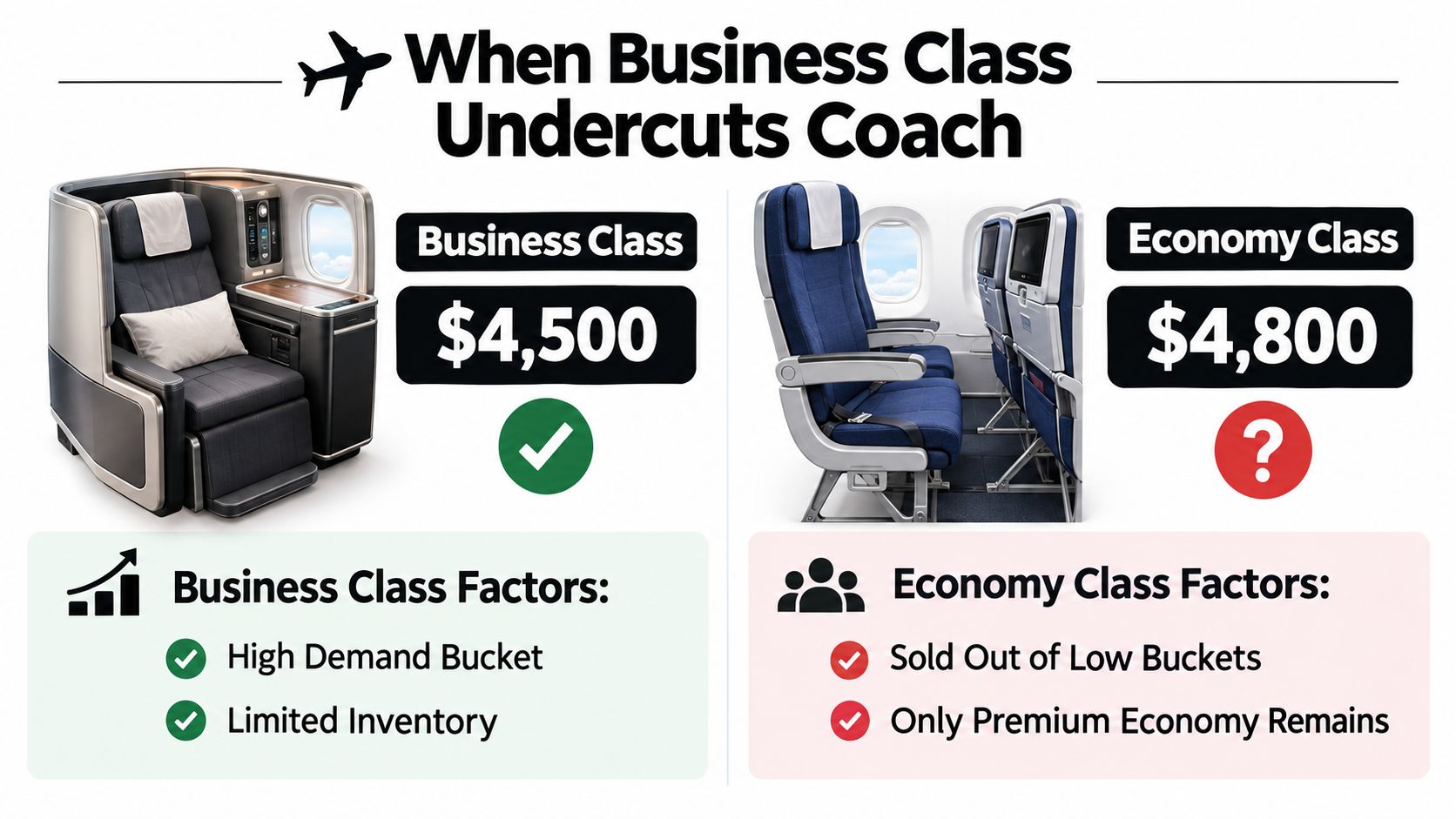
Airlines file several fare classes inside each cabin. A business-class ticket may have a cheaper, more restrictive fare available while the remaining economy seats are being sold in a higher fare bucket. The traveler sees “business” and “economy,” but the airline sees separate products with separate rules.
That distinction creates the inversion:
- Economy inventory tightens: The lowest coach fares disappear as demand fills the cabin.
- Premium inventory remains: Business seats stay available because fewer travelers are willing to pay the initial premium.
- The airline recalculates: The carrier may reduce a premium fare to stimulate demand rather than operate with an unsold seat.
- The buyer compares the wrong labels: A restricted business fare can undercut a flexible economy fare on the same itinerary.
A 2025 analysis of business-class and premium-economy pricing makes the same core point, fare rules and inventory can matter more than the seat label. Another review from Map Happy reported that, in random tests on major international routes, business class was cheaper than or within a small percentage of premium economy more than 40% of the time. Those findings don't mean every route offers a bargain. They mean you should compare cabins before assuming coach is the cheapest option. See the analysis of why business class can price below economy and the Map Happy pricing review.
Practical rule: Search premium cabins every time. Don't decide that coach is cheaper before the fare display proves it.
Real examples of premium cabin pricing falling below coach
| Route | Cabin Priced Below Coach | Premium Fare Seen | Coach Fare Seen | Airline & Window |
|---|---|---|---|---|
| Easter Island to Papeete | Business class | Equal to or less than economy | Higher than or equal to business | LATAM, once-weekly service cited in a 2019 report |
| Major international routes | Business class | Cheaper than or close to premium economy in tested searches | Compared separately by itinerary | Multiple airlines, random tests reported in 2025 |
The foundation is simple: premium fares follow their own demand curve. That's why fare monitoring, flexible dates, and mixed-cabin searches can beat an automatic economy booking.
What Counts as a Premium Cabin
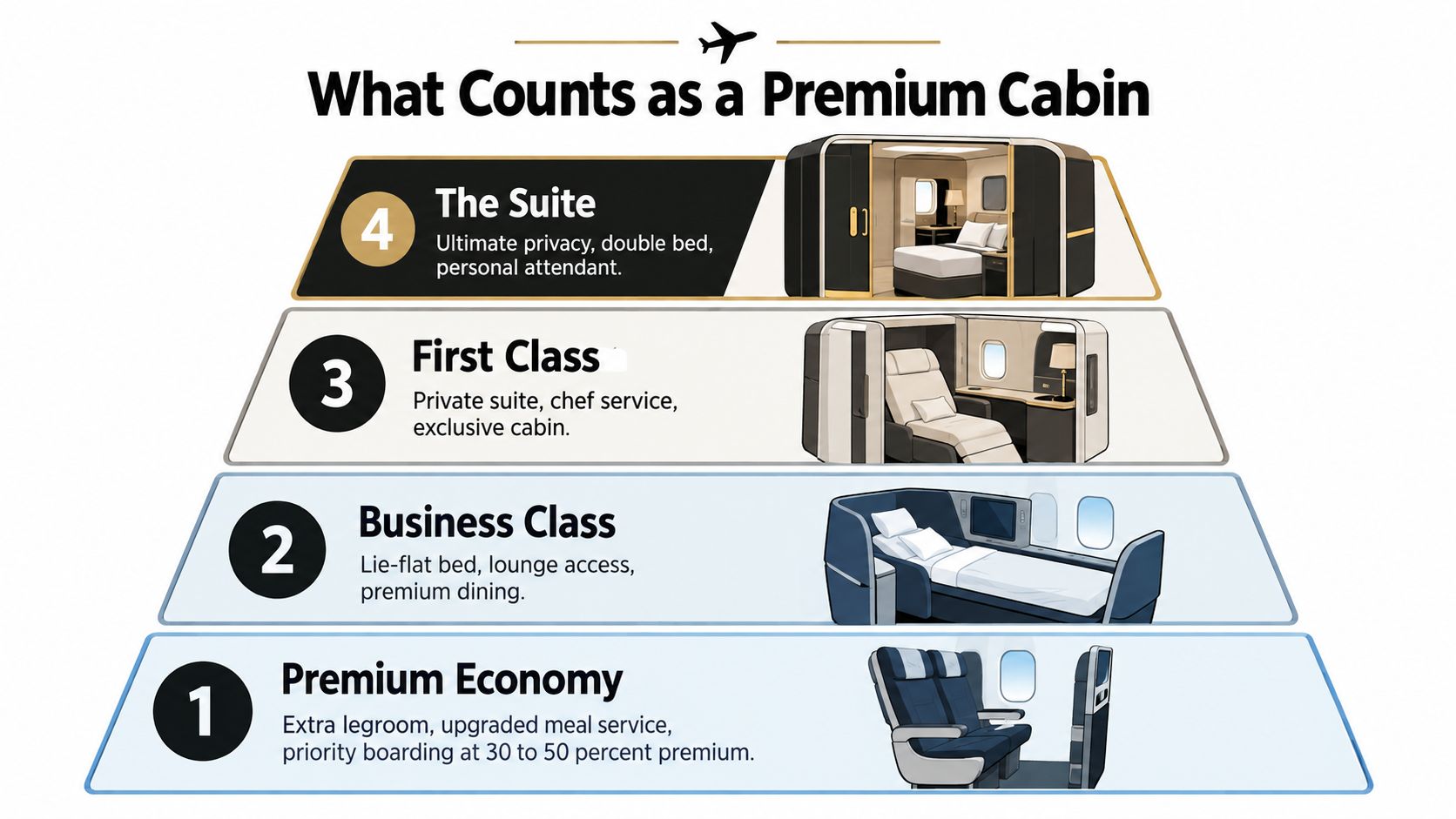
So, what is premium cabin in practical terms? It's any cabin sold above standard economy, but the experience changes substantially from one tier to the next. Don't confuse an exit-row seat with a premium cabin. Extra legroom can improve the flight, but it doesn't automatically include the service, baggage, or airport benefits associated with a separately marketed cabin.
Premium economy sits closest to coach
Premium economy usually adds a wider seat, more legroom, an improved meal or service presentation, and priority treatment at selected points in the journey. Typical specifications are about 36 to 38 inches of pitch and 18 to 20 inches of width, compared with a standard economy product that generally offers materially less personal space. These specifications are outlined in Fodor's guide to airline cabins.
Airlines may call similar products Premium Plus, Comfort+, or Premium Class. Read the inclusions, not just the name. One carrier may provide a larger seat and upgraded dining, while another may mainly sell extra legroom and priority boarding.
For a direct product comparison, use this guide to premium economy versus business class.
Business class changes the purpose of the seat
Business class is usually a genuine service tier, especially on international long-haul routes. Depending on the aircraft and airline, it can include a lie-flat bed, lounge access, priority check-in and boarding, enhanced meals, greater baggage allowances, and dedicated cabin service.
Long-haul business class may also provide direct aisle access and on-demand entertainment. The key distinction is the bed. A seat that lets you sleep horizontally can preserve your productivity after an overnight flight, while a wider recliner may only make the same journey less uncomfortable.
First class is not one uniform product
Domestic first class often means a wider recliner, complimentary drinks, more attentive service, and sometimes a meal. It can be a meaningful improvement over coach, but it isn't automatically comparable to international first class.
International first class may include an enclosed suite, highly private seating, chef-led dining, premium lounge access, and ground services. Some airlines market an even more private enclosed product as a suite. Treat “first” as a broad label, then inspect the aircraft, seat map, and service description before paying for it.
Premium Cabin vs Coach at a Glance
Coach is a transportation product. Premium cabins are transportation plus space, time protection, and service. The value depends on the route and the fare gap, but the physical difference can be obvious before the aircraft leaves the gate.
A standard economy seat commonly has around 31 to 32 inches of pitch, while premium economy commonly provides about 36 to 38 inches of pitch and 18 to 20 inches of width. Business class can offer roughly 55 to 80 inches of pitch-equivalent space, often arranged as a lie-flat bed. Those cabin distinctions are summarized in this airline-cabin overview.
| Feature | Economy | Premium Economy | Business Class | First Class |
|---|---|---|---|---|
| Seat space | Standard pitch and width | More pitch and width | Much greater personal space, often lie-flat | Largest seat or private suite, depending on aircraft |
| Recline | Upright or modest recline | Deeper recline | Lie-flat on many international aircraft | Lie-flat, often with more privacy |
| Sleep | Difficult on overnight flights | Better for resting, not a bed | Bed-like surface on suitable aircraft | Bed or enclosed sleeping space on selected products |
| Meals | Standard service | Upgraded presentation on many routes | Enhanced meals and beverages | Highest service tier, varying by airline |
| Airport handling | Standard queues and boarding | Priority may be included | Priority handling and lounge access often included | Dedicated premium treatment, subject to airline |
| Best use | Short trips and price-led travel | Daytime long-haul or moderate upgrade | Overnight and long-haul work trips | Privacy-led travel where the product justifies the fare |
What you're really buying
The seat is only one part of the purchase. Business and first class can reduce friction through lounge access, priority check-in, earlier boarding, priority baggage handling, and more generous baggage rules. Premium economy may offer only some of those advantages, so you need to read the fare conditions instead of assuming the full premium package applies.
Service also matters. A dedicated forward-cabin crew can make meal timing, requests, and disruption handling smoother, but the experience varies by carrier and aircraft. A premium label doesn't rescue a dated seat or weak schedule.
Advisor's view: Pay for premium when the seat solves a real problem, especially overnight sleep, working space, or recovery after a long journey. If the fare gap is large and the flight is short or daytime, coach may be the rational choice.
The correct comparison isn't “business versus economy.” It's total trip value versus the actual fare difference. Since premium inventory can move independently, check the higher cabin before you accept the lower one by default.
Why Premium Cabins Drive Airline Revenue
Premium cabins matter because airlines earn a disproportionate amount of revenue from a relatively small part of the aircraft. IATA-based analysis reports that business and first-class passengers account for about 7% of total traffic but around 20% of passenger revenue for full-service carriers. The revenue comparison is detailed in this analysis of premium-cabin economics.
| Cabin | % of Seats | % of Revenue | Avg Fare Premium vs Economy |
|---|---|---|---|
| Business and first combined | About 7% of total traffic | Around 20% of passenger revenue for full-service carriers | Not specified in the verified data |
| Economy and other cabins | Remaining traffic | Remaining passenger revenue | Not specified in the verified data |
That imbalance explains airline behavior. Carriers assign lie-flat aircraft to routes where premium demand can support the investment, protect forward-cabin inventory during strong booking periods, and use fare rules to separate corporate buyers from price-sensitive leisure travelers.
What revenue management controls
Airline pricing teams manage several levers at once:
- Fare filing: The carrier publishes different prices with different change, refund, and minimum-stay conditions.
- Inventory control: The airline opens or closes booking classes according to expected demand.
- Seat allocation: Aircraft layouts determine how much capacity is reserved for premium travelers.
- Partnership economics: Corporate contracts, alliance connections, and connecting traffic influence which premium seats remain available.
This is the practical meaning of airline yield management and pricing. The system isn't merely asking what an empty seat costs. It's estimating what a buyer might pay later, then deciding whether selling now would sacrifice a higher-value booking.
For corporate travelers, that produces a familiar frustration. Fewer premium seats may be available on the dates that matter, cheap fare classes can vanish without warning, and last-minute fares can remain high even when some seats are empty. For leisure travelers, the same system creates opportunity when a premium cabin fails to attract enough demand.
Recent reporting says premium cabins have become a larger part of airline economics in North America and Europe. McKinsey's review of 2019 to 2025 describes business and first class contributing a growing share of passengers and an even faster-growing share of revenue on selected domestic, European, and transatlantic markets. Read the McKinsey analysis of premium-cabin profitability.
How Premium Fares Actually Move
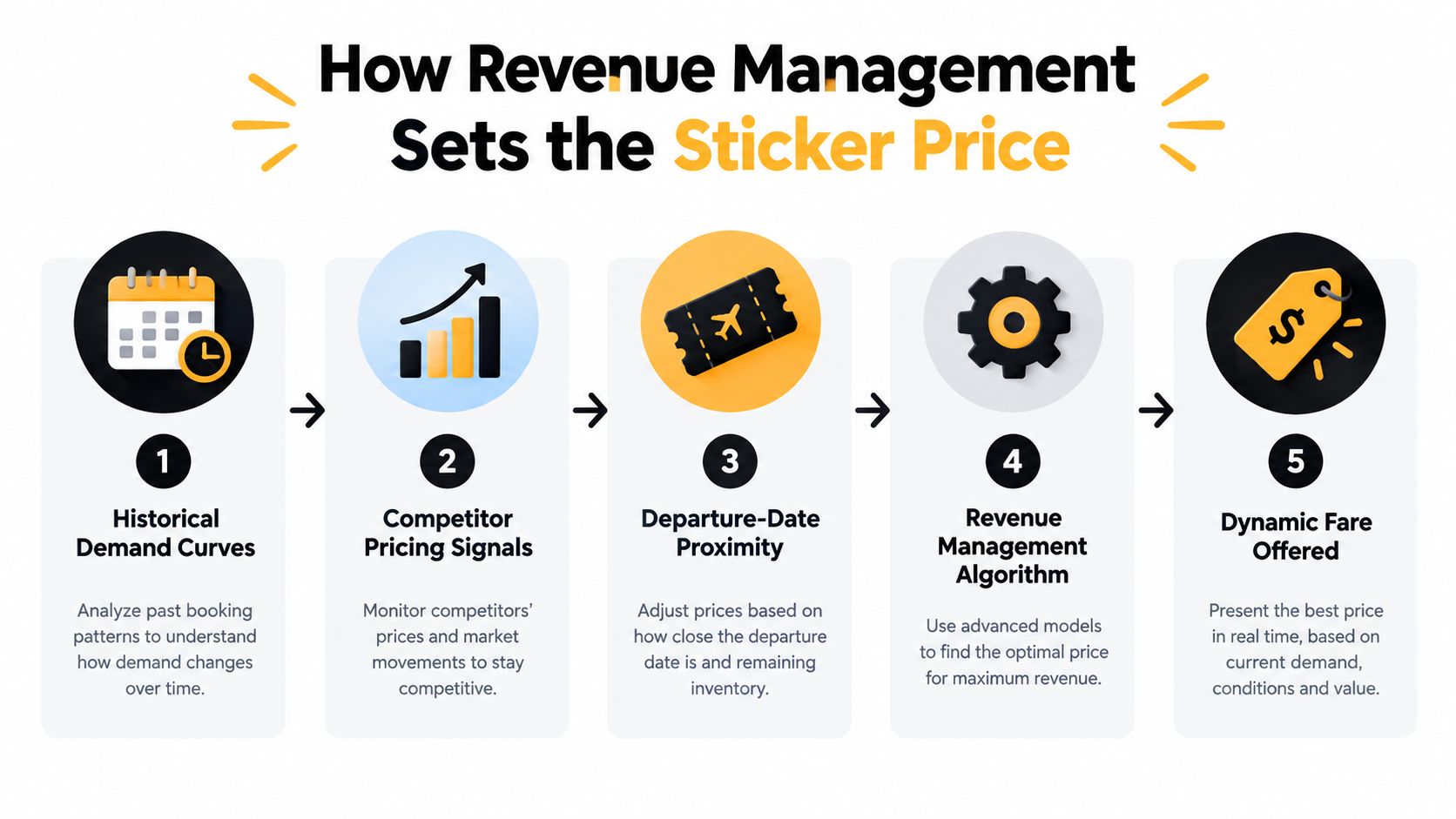
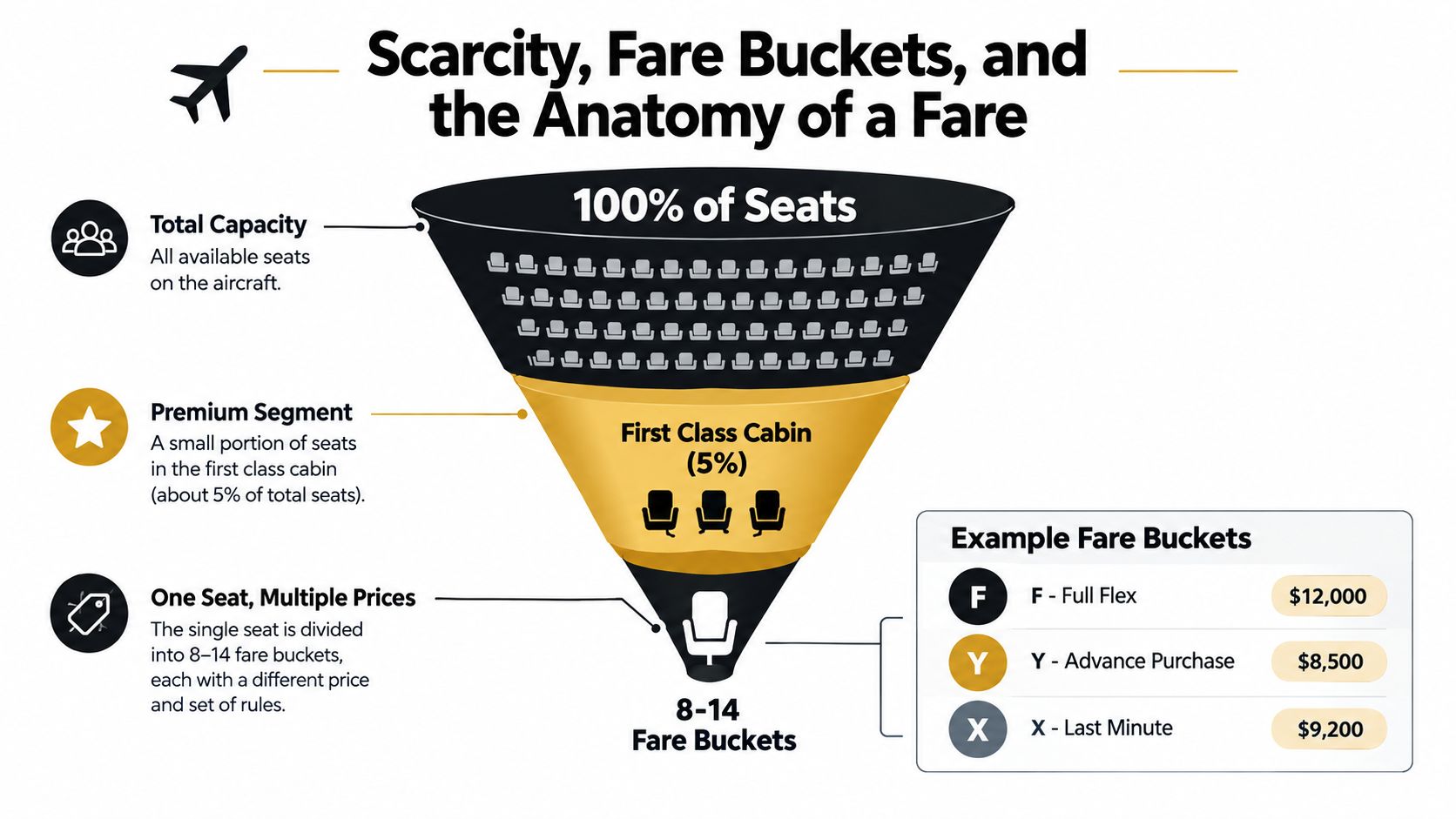
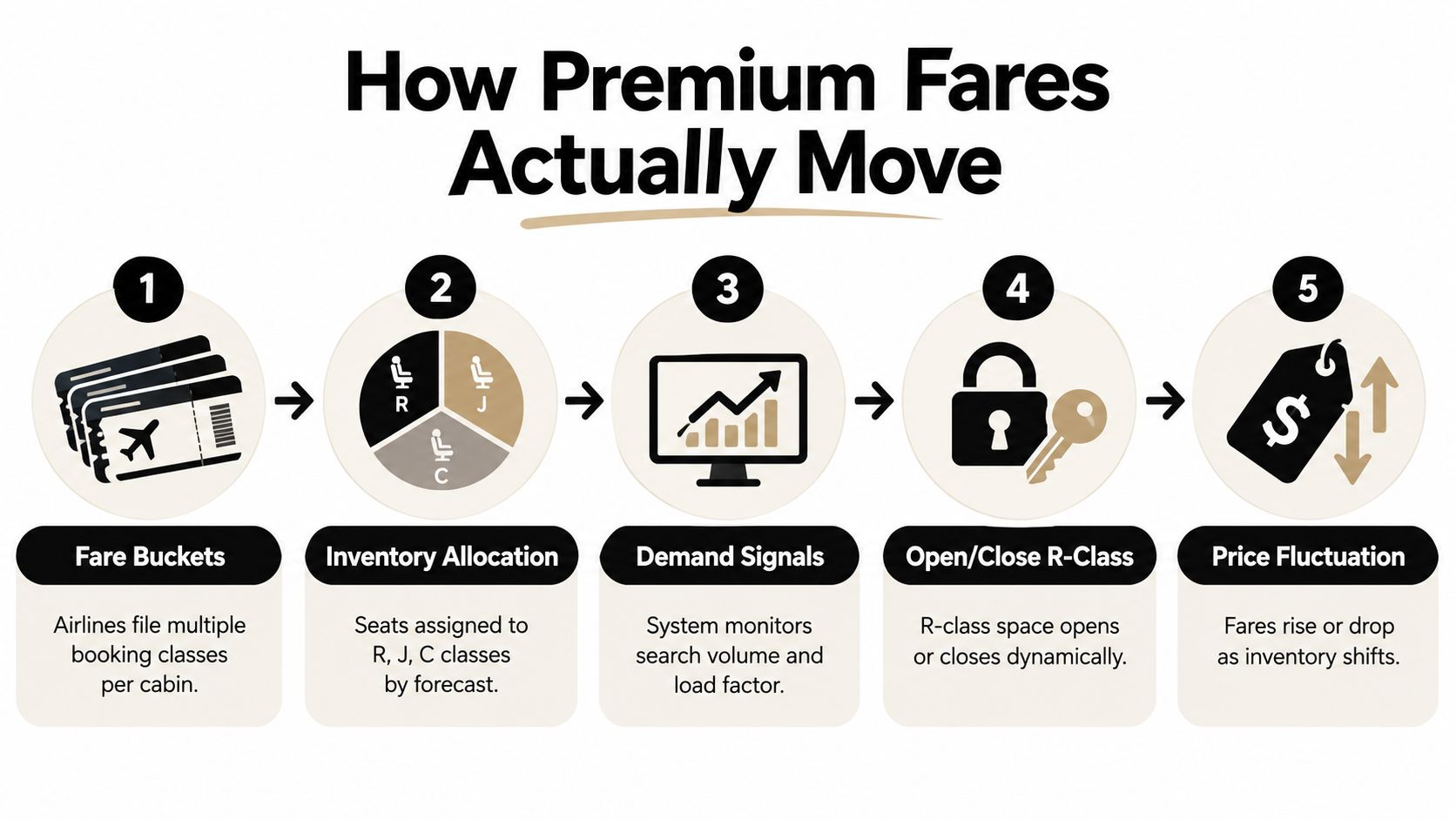
Premium fares move through inventory, not through a fixed upgrade ladder. Airlines create multiple booking classes within a cabin, then decide how many seats to expose in each class. A low business fare can disappear while a higher business fare remains, even though the physical seat hasn't changed.
Read the inventory signals
You don't need to become an airline revenue analyst, but you should understand the sequence:
- Fare buckets: The carrier files several prices and restrictions inside each cabin.
- Inventory allocation: The system assigns seats to booking classes based on its forecast.
- Demand signals: Search activity, bookings, remaining capacity, and competitor schedules influence the forecast.
- Class changes: Lower premium inventory can open or close as demand changes.
- Fare movement: The displayed price rises or falls when the available class changes.
Airlines also respond to corporate booking patterns, holiday demand, fuel-cost pressure, and schedule changes. Competitor launches can force a carrier to defend a route, while a weak booking curve can encourage the release of lower premium inventory.
Watch the fare class letters when a booking engine displays them, but don't treat one letter as universal across every airline. Search nearby dates, alternative airports, and mixed-cabin combinations. You may find business class on the long segment and economy on a short connection, which can preserve the main benefit without paying for a premium seat on every leg.
What to do: Track the itinerary, not just the fare. A price drop may appear on one segment while the rest of the ticket remains unchanged.
This guide to airline capacity management provides useful context for why airlines adjust available seats rather than lowering every fare.
The process is easier to understand visually, but the purchase decision remains practical. Set alerts, check the fare rules, and compare the complete itinerary before booking.
Real Cases of Premium Seats Pricing Below Coach
Premium pricing is a fare-construction puzzle, not a fixed reward for choosing a better cabin. The same route and aircraft can produce a higher coach fare and a lower business fare when the remaining booking classes carry different rules.
Consider a same-day itinerary with these sample options:
- Economy flexible: $1,180, refundable and changeable, with a higher economy fare class still available.
- Business restricted: $1,050, changeable only with a fee, nonrefundable, and limited to the lower business inventory.
- Premium economy: $1,090, with fewer included benefits than the flexible economy ticket.
The business seat costs less than the flexible coach seat because the comparison is between fare products, not just cabins. The restricted business fare can disappear as soon as its booking class closes, while the flexible economy fare remains available. A traveler who compares only the words “business” and “economy” will miss why the inversion exists.
What a buyer should notice
Read the fare rules before treating a lower premium price as a bargain. Check whether the business ticket applies to every segment, whether a connection carries a different cabin, and whether the ticket permits changes, refunds, seat selection, and checked baggage. A short connection in economy can also make the total price look attractive while limiting the premium experience.
The fare basis and booking class explain much of the difference. A carrier may sell a restricted business fare to fill a small amount of premium inventory, while coach remains priced for travelers who need flexibility. Those products target different buyers, so the lower cabin can cost more.
The buying window may be brief. Another traveler can take the final seat in the lower business bucket, or the airline can close that inventory after demand strengthens. Compare the complete itinerary, record the restrictions, and book when the total conditions fit your trip. Waiting for a perfect fare is not a strategy. It is a risk.
Membership vs Status Which Actually Saves Money
Airline status isn't a pricing strategy. It can provide upgrades, priority services, lounge access, or better treatment during disruptions, but those benefits depend on eligibility, inventory, and the rules of the specific program. A status promise doesn't guarantee a cheap premium fare.
Membership products deserve the same scrutiny. Credit-card annual fees, lounge programs, alliance tiers, and paid travel subscriptions all have costs, even when the marketing emphasizes included benefits. Priority Pass, for example, may be useful for a traveler who regularly uses its participating lounges, but it doesn't lower the underlying business-class fare.
Separate benefits from fare savings
The right calculation starts with behavior:
- Count actual premium trips: Include only journeys where you would have paid for the higher cabin anyway.
- Value the service you use: Lounge visits, checked baggage, seat selection, and change flexibility should reflect your real habits.
- Ignore unused perks: A benefit you never claim has no practical value.
- Compare open-market fares: A cash business fare can fall when demand softens, regardless of your status.
The supplied comparison of a $695 annual United Club Card against two transcontinental business-class tickets priced at $890 each illustrates the trap. Those figures don't establish a universal saving, and they don't prove the card pays for itself. They show why a traveler must compare the annual fee with actual lounge use and actual fare opportunities rather than assume the card creates premium value.
| Program | Annual Fee (USD) | Avg Premium Saving | Break-Even Trips |
|---|---|---|---|
| United Club Card example | $695 | Not established by the verified data | Depends on actual benefit use and fare savings |
| Priority Pass | Varies by plan | Not established by the verified data | Depends on lounge use and plan cost |
| Airline status | No single fee applies | Not established by the verified data | Depends on qualification cost and realized benefits |
Status-based upgrades are especially unreliable for travelers who need confirmed seats. Airlines release upgrade inventory according to their own forecasts, and a full premium cabin can leave a status holder in coach despite years of loyalty.
Candid assessment: Buy membership for benefits you already use. Buy the premium seat when the market price makes sense. Don't pay a recurring fee simply to avoid checking fares.
A Practical Playbook for Corporate and Frequent Flyers
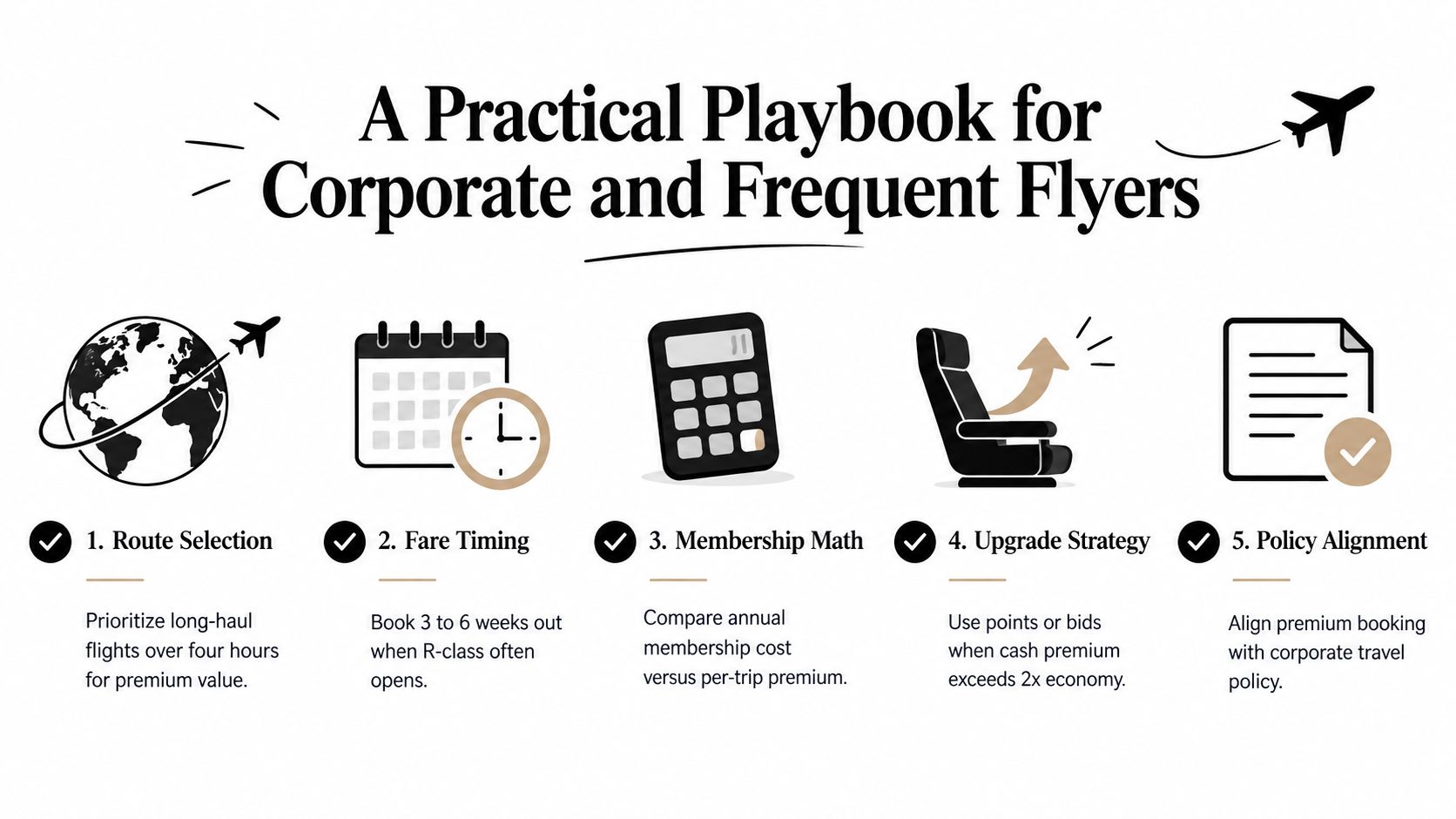
Corporate travelers should treat premium travel as a controlled purchasing decision, not an automatic status reward. The first question is whether the flight is long enough, disruptive enough, or important enough for the premium seat to solve a real business problem.
Start with the route
Prioritize long-haul flights over short daytime hops. A lie-flat bed has more practical value on an overnight international itinerary than on a brief flight where premium economy already provides enough space.
Your corporate policy should reflect that distinction. Instead of approving premium travel based only on job title or loyalty status, set a clear internal rule around flight duration, overnight departure, arrival obligations, and total fare difference. A red-eye can justify premium treatment when arriving rested protects a meeting or a workday.
Search before defaulting to the corporate tool
Check the flag carrier's website, reputable expert online travel agencies, and airline promotion pages before accepting the first corporate booking result. Corporate tools are useful for policy control and reporting, but they may not expose every useful combination as clearly as a broader market search.
Use fare alerts and compare nearby departure dates. For international travel, look at the entire itinerary, not just the longest leg. A mixed-cabin ticket may place you in business class where the sleep benefit matters and economy where it doesn't.
Review the economics every quarter
A travel manager should compare actual premium spend with negotiated discounts, status benefits, membership fees, and open-market fare observations. If the company renews a program, it should be because the realized benefits exceed the cost, not because employees are accustomed to the logo.
Use a simple internal record:
- Route: Note where premium fares routinely appear competitive.
- Purpose: Separate client-facing, overnight, and recovery-critical trips.
- Fare gap: Record the difference between the selected cabin and the best practical alternative.
- Outcome: Track whether the premium seat improved rest, productivity, or schedule resilience.
- Renewal decision: Keep memberships only when actual use supports the expense.
Passport Premiere offers a Fare Monitor, daily progress reports when lower premium fares are anticipated, access to more than 6 million international premium-fare combinations, educational guides, and fare-monitor demonstrations. It's one option for travelers and companies that want specialized monitoring instead of relying only on standard booking searches.
The best policy is flexible but disciplined. Require travelers to compare cabins, allow premium when the journey justifies it, and review the results against real fares rather than assumptions.
Passport Premiere helps travelers monitor international Business and First Class fare changes, understand premium-cabin pricing cycles, and identify opportunities where comfort can cost less than expected. Visit Passport Premiere to see how its fare-monitoring service can support your next premium booking.