
Flights from Florida: How to Find Premium Cabins Cheaper

The popular advice on flights from Florida is simple: search economy, choose the lowest headline fare, and ignore the premium cabin. That advice is incomplete, and on international routes it can be financially wrong. Business class can cost less than coach when economy inventory tightens, baggage and seat fees accumulate, or airlines reduce premium fares to fill unsold seats.

A flexible business-class fare from London Heathrow to Doha was published at GBP 3,029, while remaining economy seats on the same flight rose to GBP 4,494 after lower economy cabins sold out, as documented by Passport Premiere's analysis of discounted business-class fares. The lesson for Florida travelers is direct: compare the complete cost of each cabin, then compare departure airports and dates. Don't assume the cheapest seat is in the back.

Why Business Class Can Cost Less Than Coach

Business class does not follow a permanent price ladder with economy below it. Airlines open and close fare buckets according to demand, remaining inventory, competition, and booking behavior. From a Florida gateway with substantial international capacity, economy seats may sell quickly while business-class inventory remains available at a reduced fare.

The opportunity appears at checkout. Compare the final economy cost with the business-class fare available when you are ready to buy, rather than comparing the cabins only by their first displayed prices.

The fare gap changes with inventory

Economy fares often look inexpensive because the headline price excludes costs that many travelers require. Checked baggage, seat selection, and flexibility can turn a low fare into a weaker value. Business-class tickets may include benefits that economy travelers would purchase separately, although inclusions vary by airline and fare type.

One documented transatlantic example priced coach at $1,700, plus $150 in bags and $100 in seat fees, for a total of $1,950. Discounted business class on the same ORD–LHR itinerary cost $1,850 outright, as noted in Passport Premiere's analysis. Business class therefore cost less before assigning any value to the larger seat, priority treatment, lounge access, or onboard service.

Practical rule: Compare the all-in economy price with the business fare, not the first economy number shown in a search result.

Business class is not usually cheaper. The expensive mistake is assuming it never can be. Travelers who filter for economy only will miss a reverse-pricing opportunity, while corporate booking rules that automatically reject premium fares can overlook a lower total trip cost.

Read the airline's pricing behavior

Yield management drives these reversals. This guide to yield management pricing explains why airlines adjust cabin inventory instead of preserving a fixed relationship between economy and business fares. Your task is to identify when a premium fare has entered a genuine value range.

Prioritize routes served by multiple airlines, large aircraft, uneven business demand, or competing Florida gateways. Search flexible dates, include nearby airports, and compare refundable or changeable economy fares with business class. Route-specific demand matters: a premium cabin can be discounted to stimulate bookings even while lower economy buckets disappear.

For long-haul travel, judge the entire purchase. A business fare may cost less than a restrictive coach ticket after required baggage, seat, and flexibility fees are included. That is the comparison Florida travelers should make before accepting the cheapest economy headline.

Florida Gateway Airports and Their Premium-Cabin Dynamics

Florida isn't one airfare market. Miami, Orlando, and Fort Lauderdale serve different passenger missions, while Tampa is developing a stronger international profile. The airport you choose can change the carriers available, the number of nonstop options, the competitive pressure on a route, and the chance of finding a premium fare below a fully loaded economy ticket.

Florida's latest statewide airport dashboard reports 44,511,175 total passengers at Orlando International, 44,071,313 at Miami International, and 32,510,053 at Fort Lauderdale/Hollywood International. Together, those airports account for well over 120 million annual passengers, according to the Florida aviation airport dashboard. That scale gives airlines a large pool of domestic and international demand to manage across multiple gateways.
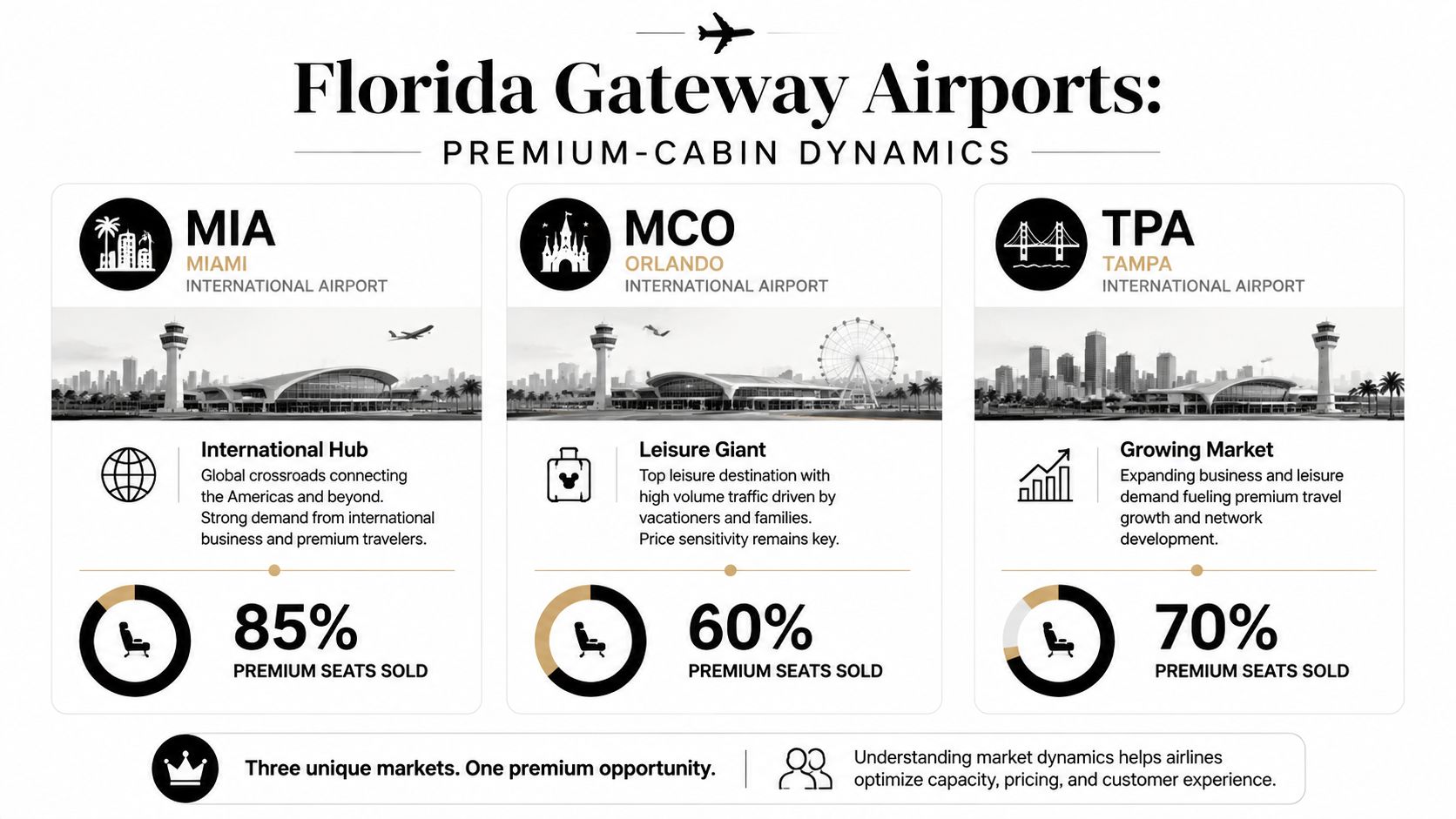
An infographic titled Florida Gateway Airports showing premium cabin seat sales for Miami, Orlando, and Tampa airports.

Miami is the international benchmark

Miami International handled 21,473,311 international passengers in the cited period, making it the natural first search for Latin America, the Caribbean, Europe, and other long-haul markets. Its international depth can support nonstop business-class options, but it also attracts intense demand. That combination produces both expensive peak departures and sharp competitive pricing when airlines need to defend share.

Orlando is a different proposition. Its enormous passenger volume is closely associated with leisure travel, which can create strong coach demand and less consistent premium-cabin demand. A business traveler should never assume MCO is inferior for premium travel, but should compare its schedule and fare buckets against Miami before committing.

Fort Lauderdale is increasingly important for travelers targeting the Caribbean and Latin America. Its carrier mix and expanding network can create alternatives to Miami, particularly when a nonstop premium fare from MIA is inflated.

Florida's aviation significance also runs deeper than current traffic. The state hosted the world's first scheduled commercial airline flight on January 1, 1914, a 23-minute, 18-mile trip across Tampa Bay using a Benoist XIV seaplane, with Tony Jannus piloting and A.C. Pheil as the lone passenger, as detailed in the Florida Aviation System Plan technical report. The same report notes that Florida now has 940 airports, heliports, and seaplane bases, an infrastructure base that helps explain the state's unusually broad departure choices.

For travelers adding time in South Florida, a practical non-flight activity is to choose sailing lessons in Miami or Tampa while building a flexible itinerary around fare availability. For airport-selection logic, compare the route-specific advice in this guide to the cheapest airport in Florida to fly into, then price the complete trip rather than the ticket alone.

Comparing Fare Cycles Across Florida Departure Hubs

Fare cycles differ because each airport attracts a different mix of travelers and airlines. Miami is the strongest international gateway, Orlando is a major leisure engine, Tampa is expanding its international reach, and Fort Lauderdale is adding competitive capacity in regional international markets.

Recent statewide data shows Florida's 19 commercial airports handled 29.9 million enplanements in Q1 2026, up 1.8% year over year, while overseas visitation reached 2.3 million, up 8.5%, according to Visit Florida's airport and visitation update. The same source reports that Miami, Orlando, and Tampa together handled about 1.59 million international arrivals in Q1 2026, with Miami alone accounting for 1.13 million. Global airfares were up 10.8% year over year in June 2026, so travelers should expect headline economy pricing to remain volatile rather than uniformly cheap.

Airport Annual Passengers International Focus Premium-Cabin Opportunity
Miami International, MIA 44,071,313 Deepest international profile, including 21,473,311 international passengers in the cited period Strong nonstop choice for long-haul routes, with competition worth monitoring
Orlando International, MCO 44,511,175 Large domestic and leisure-oriented market with international demand Compare premium inventory against MIA, especially on leisure-heavy dates
Tampa International, TPA Not provided in the verified data Growing European, South American, Latin American, and Caribbean service Look for new-route competition and consider positioning when schedules fit
Fort Lauderdale/Hollywood International, FLL 32,510,053 Strong Caribbean and Latin American role with expanding service Useful alternative to MIA when new capacity creates fare competition

Choose by mission, not geography

Miami usually deserves the first search for a nonstop international business-class itinerary. Orlando deserves a parallel search when your dates overlap with heavy leisure movement, because coach demand can make premium pricing unexpectedly attractive by comparison. Tampa is worth watching for travelers who can use new European or South American routes without backtracking.

Fort Lauderdale is especially relevant when JetBlue's network matches your destination. JetBlue planned nine new nonstop routes and a peak of 113 daily departures from the airport, including Caribbean and Latin American destinations, as reported in the verified market data. More route choice can create more fare pressure, but only on the specific city pair and travel dates affected.

The comparison should include driving time, parking, positioning flights, overnight stays, and the cost of a missed connection. A lower business fare from another Florida airport isn't a bargain if reaching that airport requires an expensive positioning itinerary with separate tickets and no protection during disruption.

Timing Your Purchase to Catch Business Class Buying Events

The best premium fares appear when the airline's pricing problem becomes your opportunity. Carriers may lower business-class fares when premium seats remain unsold, when a competitor starts a fare war, or when demand shifts away from a particular departure. These windows can disappear quickly, so passive browsing isn't enough.

The claim that fewer than 15% of premium-cabin seats sell at their initial asking price comes from Passport Premiere's publisher information. Treat that figure as a buying principle, not a promise that every route will fall sharply. The practical point is that the first displayed business fare often reflects an opening position rather than the final market value.

Build a monitoring habit

Start with the exact route, then add nearby Florida gateways. A Miami to Europe search should sit beside Orlando, Tampa, and Fort Lauderdale searches when the schedule allows. Track both economy and business class, including the total cost of bags, seats, and flexibility.

Watch for these signals:

  • A sudden premium reduction: A business fare drops while economy remains stable, which can indicate unsold premium inventory.
  • A competitor entering the route: New or upgraded service can force airlines to react with better pricing.
  • Unusual fare-bucket movement: A restrictive economy fare disappears while a higher economy tier becomes the only coach option.
  • Date-specific weakness: Midweek or less popular departures may show a business fare that doesn't appear on peak flights.

Confirm the buying window

Don't wait for a theoretical lowest price after the fare reaches your target. A good business fare can vanish after inventory changes, and a cheaper-looking economy ticket can become expensive once required extras are added.

Use fare alerts, airline websites, reputable premium-fare monitors, and a spreadsheet that records the full price by airport and cabin. Passport Premiere's guide to when to book business-class flights is one resource for understanding the timing process. Corporate travel managers should also create an approval rule that permits a business-class purchase when its total price is below, or close to, the fully loaded economy alternative.

Real Fare Scenarios Where Premium Cabins Beat Economy

Cabin comparisons become useful only when you compare the fare available, not the cheapest fare that has already sold out. Florida departures can produce the same result when economy inventory tightens, premium demand weakens, or required extras change the total.

A fully flexible business-class ticket from London Heathrow to Doha was listed at GBP 3,029, while the remaining economy seats on the same flight reached GBP 4,494 after lower economy fare classes sold out. The published business-class fare example shows the practical lesson: business class can be cheaper than the available coach fare, not merely better value.

Fees can decide the winner

The ORD–LHR case shows why Florida travelers should calculate the complete trip cost. Coach started at $1,700, then required $150 for bags and $100 for seat fees, bringing the total to $1,950. Discounted business class cost $1,850 outright, according to the analysis of discounted business-class airline tickets.

The base-fare comparison favored coach. The all-in comparison favored business class, before assigning any value to its cabin benefits or more flexible terms.

The correct question is not “Can I afford business class?” It's “What is the all-in cost of the best available economy fare?”

The opposite result remains possible. In a peak-season international example, economy reached $1,800 or more after bag and seat fees, while a strategic business-class fare was $2,200, according to this analysis of business-class ticket costs. Business class cost more, but the difference was much smaller than the cabin labels suggested.

Apply the test to Florida departures

Before booking from Miami, Orlando, Tampa, Fort Lauderdale, or another Florida gateway, record four figures:

  1. Economy base fare, including restrictions.
  2. Required extras, including baggage and seat selection.
  3. Business-class total, including change and cancellation terms.
  4. Positioning cost, if another Florida airport has the better fare.

Then compare equivalent itineraries. A restrictive economy ticket may work for a short domestic flight, but it is a poor benchmark for long-haul travel when baggage, seat selection, schedule changes, and missed-connection exposure affect the actual cost. For corporate travelers, document the comparison so the approval decision reflects the full fare rather than the lower headline price.

Routing Strategies and Connection Tactics for Florida Departures

The cheapest premium itinerary may not begin at the airport closest to home. Florida travelers should search the destination first, then test Miami, Orlando, Tampa, and Fort Lauderdale as competing origins. Tampa's route leakage is particularly important. Industry coverage notes that about 50% of Tampa International's international origin-and-destination traffic chooses other Florida airports, indicating that travelers already reposition for better schedules or routes, as reported by Aviation Week's coverage of Tampa's international expansion.

A person pointing at a flight departure information display board at an airport terminal.

A separate ticket or long drive can erase the saving, so calculate the full journey. If the positioning flight is separate, leave substantial protection against delays, collect and recheck baggage when required, and verify that your connection airport and nationality won't create a transit-visa problem.

Select the connection deliberately

A nonstop from Miami can beat a cheaper connection when the direct itinerary has a stronger business fare, fewer disruption points, and no positioning risk. Conversely, a connection through a major hub may expose a discounted premium fare when the Florida nonstop is priced for strong local demand.

Use multi-city searches to test combinations such as:

  • Florida gateway to the international hub: Useful when the long-haul segment carries the premium fare.
  • Open-jaw routing: Arrive in one city and return from another when the fare structure supports it.
  • Gateway comparison: Search MIA, MCO, TPA, and FLL separately rather than relying on one airport filter.
  • Protected through-ticket: Prefer one reservation when the schedule and baggage chain matter more than the lowest displayed fare.

Fort Lauderdale's expanding Caribbean and Latin American network can provide a practical alternative to Miami, while Tampa's developing European and South American service may open routes that weren't previously competitive. The correct choice depends on the exact destination, date, cabin, and ground-access cost.

The following video can help travelers think through airport displays, connections, and departure decisions before they book.

Building Your Premium-Cabin Strategy for Florida Flights

Business class from Florida can cost less than coach when you compare the full trip cost, not just the displayed fare. Airport competition, international demand, fare cycles, baggage charges, seat fees, and flexibility can shift the value calculation quickly. Airport choice and timing can matter more than the headline cabin fare.

Build the strategy around a route map. List every Florida airport that can serve the itinerary, then compare nonstop and connecting options. Set a target price using the complete economy alternative, including baggage, seat selection, flexibility, and positioning costs. That benchmark gives corporate and leisure travelers a clear buying trigger instead of an emotional response to a sale banner.
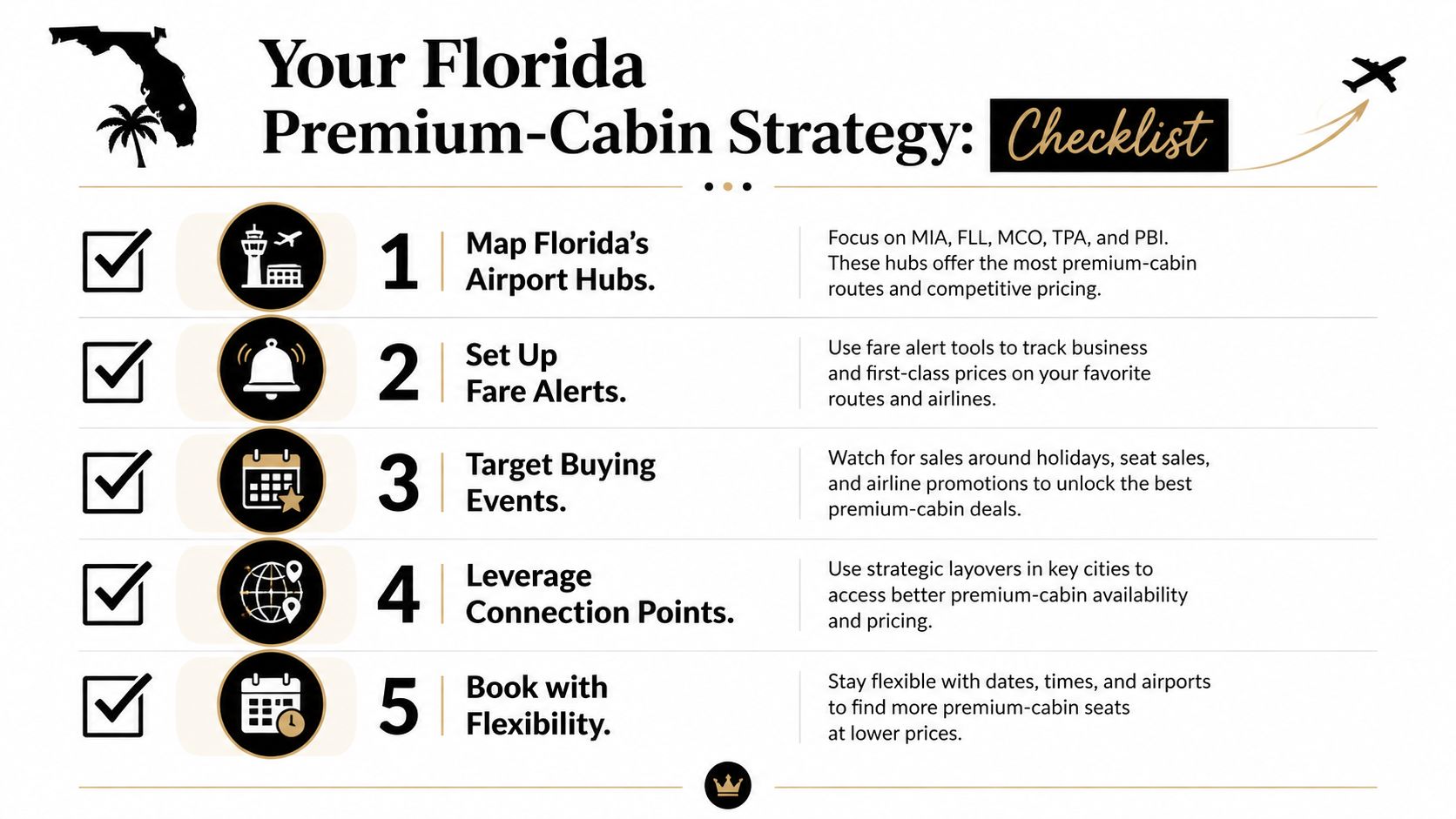
A checklist infographic titled Your Florida Premium-Cabin Strategy with five steps for finding affordable premium flights.

Use a decision checklist

  • Map Florida's airport hubs: Start with the gateway offering the strongest route, then test alternatives.
  • Set up fare alerts: Track economy and business class together, and record fees beside each option.
  • Target buying events: Act when a premium fare falls within your acceptable total-cost range.
  • Use connection points: Consider protected connections and multi-city searches, while pricing ground transport and baggage consequences.
  • Book with flexibility: Choose fare rules that protect the itinerary when the price difference remains reasonable.

Corporate travel managers should put this logic in the booking policy. Employees need permission to select business class when it costs less than the fully loaded economy option. A blanket rule rejecting premium cabins can produce the higher total cost. Leisure travelers can apply the same framework by setting alerts early, keeping Florida airport options open, and refusing to anchor on the first coach fare displayed.

Passport Premiere provides membership-based fare monitoring and market analysis for international Business and First Class purchases, with member tools and insights focused on premium-cabin fare drops. Visit Passport Premiere to evaluate whether its fare intelligence fits your Florida departure strategy.

The Cheapest Airport in Florida to Fly Into: 2026 Guide

Everyone wants the cheapest airport in Florida to fly into, but the cheapest listed fare often isn't the cheapest trip. A rock-bottom ticket can turn mediocre once baggage, seat fees, airport transfers, and schedule risk get added back in. Florida is one of the best states in the country for low airfare, but the right airport depends on whether you care most about base fare, total trip cost, or premium-cabin strategy.

I rank Florida airports through three lenses. First, average airfare and carrier mix. Airports with strong low-cost competition from carriers like Spirit, Frontier, Allegiant, JetBlue, and Southwest usually post more aggressive fares. Second, ancillary fee risk. A cheaper ticket at an ULCC-heavy airport can lose its edge fast if you need checked bags, seat assignments, or flexibility. Third, ground logistics. A lower airfare into one airport can be wiped out by a long transfer to Miami, the Gulf beaches, or central Florida resorts.

That's why the usual advice misses the mark. There isn't one permanent winner for the cheapest airport in Florida to fly into. Different datasets point to different leaders, and that's exactly how real airfare shopping works.

1. Fort Lauderdale–Hollywood International Airport (FLL)

FLL is often the smartest South Florida play, but only if you price the trip the way airlines do. The base fare can look excellent because this airport has deep low-cost competition, yet the ultimate win depends on what you add after checkout and how much it costs to reach your final stop.

Fort Lauderdale–Hollywood International Airport (FLL)

Broward County's official Fort Lauderdale airport website shows why FLL stays in the cheap-airfare conversation year after year. It handles a broad mix of domestic, Caribbean, and Latin America service, with Spirit as a major price setter and pressure from JetBlue, Frontier, Southwest, Delta, American, and United on overlapping routes. That mix matters. A route map with several carriers fighting over leisure traffic usually produces more fare sales and more useful one-way pricing than an airport dominated by one legacy airline.

Here is the trade-off. FLL is strongest on base fare, especially for travelers coming from East Coast, Midwest, and Northeast cities where Spirit and JetBlue overlap or where Frontier drops in with aggressive promos. If you travel with only a personal item, FLL can beat Miami by a meaningful margin on many dates. If you need a checked bag, a carry-on, seat selection, and a changeable ticket, the gap can shrink fast.

Where FLL delivers the best value

FLL works best for travelers who want South Florida access without paying Miami's usual fare premium.

  • Base fare advantage: Strong ULCC and low-cost competition keeps downward pressure on many domestic fares.
  • Better ground-cost math for Broward and nearby areas: Fort Lauderdale, Hollywood, Pompano Beach, and much of northern Miami-Dade are easier to reach from FLL without a long transfer.
  • Useful premium positioning option: A cheap arrival into FLL can still make sense if you plan to continue to Miami for a long-haul premium departure, especially when business class pricing out of MIA beats your home airport.

There is also a premium traveler angle that budget lists usually miss. MIA often looks more expensive in economy, but it can be the cheaper airport for Business Class because it has more long-haul competition and more sale activity from American and international carriers. I use FLL as the low-cost entry point and MIA as the premium exit point when the fare difference justifies the transfer.

One caution. Schedule quality at FLL varies by carrier. Spirit and Frontier can post attractive fares, but fewer fallback options matter if your flight cancels or misconnects. Legacy carriers usually give you better recovery options, which is one reason comparing fare families matters as much as comparing the first price you see. If you want a better sense of fare timing before booking, this guide on when airlines drop prices is useful, and this breakdown of whether flight tickets are cheaper at the airport explains why counter booking rarely improves the deal.

Ground transport is the final filter. A cheap FLL ticket for a Miami Beach stay can lose some of its edge once you add the transfer, while the same fare into Broward or Fort Lauderdale Beach is usually a cleaner value. Before you assume the lowest airfare wins, price out bags, seat fees, and local transport. For airport transfers, book planning your FLL airport ride before you lock in the flight.

2. Orlando International Airport (MCO)

MCO often beats smaller “cheap” airports on total trip cost, even when the headline fare is not the absolute lowest. The reason is simple. Orlando has enough volume to keep Spirit, Frontier, Southwest, JetBlue, Delta, American, and United competing on many of the same leisure-heavy routes. That pressure usually shows up in more fare buckets, more nonstop options, and better odds of finding a schedule that does not force an expensive compromise later.

Orlando International Airport (MCO)

That is the MCO advantage. Cheap here is not just about a bare-bones base fare. It is about three layers working together: competitive entry prices, enough carrier choice to avoid paying up for bags and seats if you do not want to, and ground transport that usually stays simpler for the main Orlando resort corridor than flying into a secondary airport farther out.

MCO works especially well for travelers who want low fare potential without accepting thin schedules. A family comparing Frontier or Spirit against Southwest or JetBlue can often make a cleaner decision here because all four may be in play on similar dates. A business traveler has a different reason to like MCO. If a delay or cancellation hits, the airport gives you more same-day fallback options than a smaller Florida airport with one or two meaningful departures.

Why MCO holds up after you price the full trip

The base fare is only tier one. Tier two is where many “cheap” Florida itineraries get exposed. A very low fare loses its edge once you add assigned seats, carry-on fees, checked bags, and the cost of fixing a bad schedule. MCO gives you more ways to manage those trade-offs because the airport supports ULCC pricing and legacy-carrier frequency at the same time.

  • Best for fare comparison across business models: You can compare Spirit and Frontier against Southwest, JetBlue, and the big three on many Orlando routes.
  • Better for schedule protection: More daily frequencies usually mean better rebooking odds if weather or maintenance disrupts your trip.
  • Stronger total-cost math for resort-area stays: If you are going to Orlando, shorter and simpler ground transport can preserve the savings.

There is also a premium angle readers often miss. MCO is not usually the airport I call cheapest for lie-flat or international premium cabins, but it can still produce smart value when network carriers and JetBlue are trying to fill front-cabin inventory on competitive routes. Economy travelers should check bag rules. Premium travelers should check fare class and lounge access. “Cheap” means different things depending on what you need the ticket to do.

Timing matters more at MCO than many buyers expect because school calendars, conventions, and holiday demand can move prices fast. If you want better odds of catching a real deal window instead of a brief fare blip, use this guide on how far in advance to purchase airline tickets.

Check routes and services on the Orlando International Airport website.

3. Orlando Sanford International Airport (SFB)

The cheapest base fare in Florida often shows up at the airport many travelers skip first. SFB is a classic example of why fare shopping needs three layers of analysis. Ticket price, add-on fees, and the cost of getting from the airport to where you need to be.

Sanford works because its route map is built around the low-cost leisure model. Allegiant has long used SFB as one of its key Florida airports, with a network focused on nonstop service from smaller and midsize cities rather than the high-frequency hub pattern you see at larger airports. You can review current carriers and destinations on the Orlando Sanford International Airport website. That model keeps base fares aggressive on the right city pairs, especially for travelers who can fly on fixed days and travel with only a personal item.

That does not make SFB the automatic cheapest choice in total.

Sanford's bargain, and its limit

I usually price SFB for one type of trip first. A simple leisure itinerary where the fare is low, the route is nonstop, and the traveler is not paying for bags, seats, or last-minute changes. In that setup, Sanford can beat bigger Florida airports cleanly.

It gets less attractive once the trip becomes less bare-bones.

  • Best for low base fares on specific nonstop routes: Allegiant can post very low entry prices from cities that do not have as much direct Florida competition.
  • Best for travelers who can avoid ancillary fees: A personal-item-only flyer gets the most out of SFB pricing.
  • Weaker for schedule protection: Fewer flights per route can turn a delay or cancellation into a long recovery.
  • Weaker for some Orlando-area stays: Ground transportation from Sanford can erase part of the airfare advantage, especially if your hotel is near the parks or the southwest side of Orlando.

This is the trade-off many travelers miss. A $20 to $60 fare gap can disappear after one checked bag, a seat assignment, and a longer ride to your final destination. If you are traveling with kids, golf clubs, or theme-park luggage, price the full trip, not the teaser fare.

There is also a premium-traveler footnote here. SFB is rarely the value play for Business Class because the airport's strength is low-cost economy flying, not premium cabin competition. Travelers booking front-cabin seats usually get better value by checking larger Florida airports where network carriers compete harder.

Because Sanford deals tend to be route-specific and inventory can disappear quickly, purchase timing matters. If you are deciding whether to book now or wait for a better fare, this guide on how far in advance to purchase airline tickets will help you judge the timing.

4. St. Pete–Clearwater International Airport (PIE)

PIE looks cheap because it is built for a narrow job. Allegiant uses it to funnel leisure travelers from smaller and midsize cities into the Gulf Coast with low entry fares and a stripped-down product. If your route matches that network and you can travel light, PIE can beat larger Florida airports on total trip cost, not just the first number you see at checkout.

St. Pete–Clearwater International Airport (PIE)

The advantage here is geography. PIE sits closer to Clearwater, St. Pete, and many Pinellas County beach stays than Tampa International. That changes the math. A modest airfare win becomes more meaningful when the ride is shorter and cheaper, especially if your hotel is west of Tampa Bay.

That said, PIE is one of the clearest examples of why this article uses a three-part definition of cheap. Base fare is often strong. Ancillary costs can rise fast if you add a carry-on, checked bag, or seat selection. Schedule protection is thinner too, because smaller airports usually give you fewer same-day recovery options when a flight is delayed or canceled.

Where PIE delivers the best value

PIE works best for a specific type of trip: nonstop, leisure, light luggage, Pinellas-side destination.

  • Best for Clearwater and St. Pete stays: If you are not crossing the bay after landing, PIE can save both time and ground transportation money.
  • Best for personal-item travelers: Allegiant's pricing is strongest when you avoid extras and keep the trip simple.
  • Less forgiving for schedule-sensitive travel: One missed flight option can turn a cheap ticket into an expensive disruption.
  • Less attractive for premium flyers: PIE is an economy airport first. Business Class shoppers usually find better value where legacy carriers compete more aggressively.

I usually treat PIE as a precision play. It wins when the route is nonstop, the timing works, and the bag count stays low. It loses value fast on trips that need flexibility, trip protection, or multiple fare types to compare.

Visit the St. Pete–Clearwater International Airport website for current routes.

5. Tampa International Airport (TPA)

Tampa is the practical airport. It may not always post the flashiest fare, but it often delivers the best balance between cost, convenience, and reliability. WUSF reported that Tampa International averaged $355 in airfare in Q4 2025, and the same report noted that Tampa, Orlando, Miami, and Fort Lauderdale were among the more affordable large airports to fly into and out of.

Tampa International Airport (TPA)

That's why TPA belongs on this list even if some smaller Florida airports beat it on pure average price. Tampa works when you want fewer compromises. You get meaningful competition, mainstream carrier coverage, and a better chance of finding a schedule that fits business travel or multi-stop trips.

TPA for real-world value

A lot of travelers should start with Tampa, not because it's always the cheapest, but because it's often the least likely to create hidden costs later.

  • Better for business travelers: More usable schedules matter when meetings or connections can't move.
  • Better for mixed fare shopping: You can compare legacy carriers, Southwest, and lower-cost options in one airport.
  • Better than a smaller airport when timing is tight: More options reduce disruption pain.

If your destination is downtown Tampa, the airport's practical value often improves further because you're less likely to need a long transfer. That's a recurring pattern in Florida. A slightly higher airfare can still produce a cheaper trip.

Check service details on the Tampa International Airport website.

6. Miami International Airport (MIA)

Miami usually isn't the cheapest answer for domestic economy. It can still be the smartest answer for premium travelers. That's the distinction many “cheapest airport in Florida to fly into” lists miss.

Florida fare data regularly shows South Florida airports among the better-value places to fly, but MIA plays a different role than FLL. It's the airport where domestic price discipline may be weaker, while international competition can be much stronger.

Miami International Airport (MIA)

Think of MIA as the premium-cabin chess move. If FLL gets you into South Florida cheaply, MIA may be where the better long-haul fare appears. That's especially true when multiple international carriers are fighting over the same traffic.

Why MIA can be the cheapest expensive airport

Business Class and First Class don't behave like domestic coach. Premium fares can soften when airlines need to move unsold inventory, and large international gateways are where those fare battles show up most often.

For long-haul travel, the cheapest coach airport and the cheapest premium airport often aren't the same airport.

MIA also rewards travelers who care about alliance coverage, mileage earning, and upgrade pathways. If you're trying to book one ticket all the way through on a major carrier, or trying to protect a corporate itinerary, Miami can beat a nearby “cheaper” airport in total value.

That doesn't make MIA a universal winner. If you're buying a basic domestic round trip into South Florida, FLL will often be the first airport to price. But for premium cabins to Latin America, Europe, and beyond, I'd always check MIA before assuming the higher domestic fare means higher overall value.

Explore routes and terminals on the Miami International Airport website.

7. Palm Beach International Airport (PBI)

Palm Beach is the low-stress wildcard. It usually won't be the statewide fare leader, but it can become the best buy when South Florida pricing gets uneven and you want a calmer airport experience. That's the role PBI plays best.

Palm Beach International Airport (PBI)

Many travelers tend to oversimplify their airport choices. A bigger airport with more carriers is often cheaper on average, but not on every date and not on every route. Palm Beach can become attractive when Fort Lauderdale or Miami spike on a narrow travel window.

PBI as a fallback airport

PBI is worth checking whenever you're headed to Palm Beach County or the northern side of the South Florida corridor. It can also be the right answer for travelers who put a premium on easier airport flow.

  • Useful for date-specific shopping: When nearby airports surge, PBI can occasionally undercut them.
  • Useful for lower-stress travel days: Smaller terminals can matter a lot on tight or tiring itineraries.
  • Less useful for maximum flexibility: You'll usually get fewer nonstop options than at FLL or MIA.

Palm Beach works best as a comparison airport, not as an assumption. If you only search one South Florida airport, you miss too much. If you search FLL, MIA, and PBI together, the pricing picture gets much clearer, especially for Northeast and Midwest origin markets.

See flight information on the Palm Beach International Airport website.

Cheapest Florida Airports: 7-Way Comparison

Airport 🔄 Complexity ⚡ Resource / Costs ⭐📊 Expected outcomes 💡 Ideal use cases Key advantages
Fort Lauderdale–Hollywood International Airport (FLL) Low, ULCC/LCC‑centric operations, straightforward routing ⚡ Low base fares; watch ancillary fees and ground transfer to MIA (25–35 mi) ⭐📊 Very low average domestic fare ($270.30); high seat supply keeps competition strong 💡 Budget domestic travelers; positioning for premium MIA departures Heavy ULCC competition, large route map, easy MIA access
Orlando International Airport (MCO) Moderate, high scale and many carriers increases booking choices ⚡ High seat supply drives frequent low fares; parking/transfer moderate ⭐📊 Consistently low average fare ($278.48); abundant flight times and sales 💡 Families/leisure travelers; same‑day positioning for long‑haul flights Scale, frequency, intense carrier competition
Orlando Sanford International Airport (SFB) Low, ULCC/Allegiant focus with simple operations ⚡ Very low base fares but limited frequencies; ancillaries common ⭐📊 Often undercuts MCO on base price; savings erode with add‑ons 💡 Minimal‑baggage, price‑sensitive leisure travelers on direct routes Very low base fares on Allegiant routes; quick curb‑to‑gate
St. Pete–Clearwater International (PIE) Low, small field with ULCC dominance ⚡ Low base fares on targeted routes; sparse schedule may require flexibility ⭐📊 Often the cheapest into Tampa Bay for served city pairs 💡 Travelers seeking cheapest point‑to‑point leisure fares to Gulf beaches Allegiant base, fast processing, close beach access
Tampa International Airport (TPA) Moderate, mix of legacy/LCC/ULCC with efficient operations ⚡ Moderate fares (higher than FLL/MCO) but frequent promos ⭐📊 Competitive market positioning; avg domestic fare $338.20 💡 Travelers needing reliability, frequency, or tight connections Robust connectivity, efficient terminal, frequent promotions
Miami International Airport (MIA) High, major international hub with complex operations ⚡ Higher domestic fares but deep premium inventory and transfers from FLL ⭐📊 Higher domestic average ($357.39) but strong premium‑cabin value on international routes 💡 International/business travelers seeking premium deals and long‑haul service Extensive international connectivity, premium‑cabin competition
Palm Beach International Airport (PBI) Low–Moderate, smaller airport with mixed carriers ⚡ Moderate costs; occasional sale fares but fewer frequencies ⭐📊 Avg domestic fare $368.16; lower‑stress travel experience outside peaks 💡 Travelers avoiding big hubs; fallback when FLL/MIA are expensive Shorter queues, quicker processing, periodic competitive sales

Your Final Approach: Choosing the Right Airport for Your Budget

The cheapest airport in Florida isn't a single place. It's a decision shaped by your origin, your final destination, your baggage needs, and how much schedule risk you can tolerate. If you want the best blend of low fares and broad usability, Fort Lauderdale and Orlando International are the most dependable starting points. If you want the lowest raw base fare, smaller airports like Sanford and St. Pete–Clearwater deserve serious attention.

Hopper's statewide ranking adds another reminder that context matters. It says Tampa is the cheapest Florida arrival point at an average of $203 round trip, while other datasets put Fort Lauderdale or Sanford on top for different time periods and airport groups. That isn't a contradiction. It's how airfare works. Cheapest for whom, from where, and when is the only useful question.

KAYAK also shows how noisy “cheapest” can get. It lists Lakeland Linder as the cheapest airport to Florida at about $59 average fare, while also showing Jacksonville with the cheapest ticket found in the last five days at $56 round-trip and flagging Fort Lauderdale as a popular low-cost major-airport option from Atlanta. Those snapshots are useful, but they don't replace all-in trip math.

Bottom line: Always price the ticket, the bag policy, the seat policy, and the ground transfer together.

PREMIUM TRAVELER INSIGHT: When Business Class Is Cheaper Than Coach

For international travelers, the cheapest airport calculus can flip. A domestic economy fare into a large international gateway may look higher at first, but that same airport can produce far better value in Business Class when competing airlines need to move unsold premium seats.

That's where most travelers still overpay. They shop airport-to-airport coach fares and miss the premium-cabin market entirely. A traveler positioning into South Florida through FLL, then buying the right long-haul departure from MIA, can sometimes get a much better overall outcome than buying a simple coach itinerary and calling it “cheap.”

Use airport rankings as a short list, not a final answer. Search multiple Florida airports. Price the full trip. Then, if you care about long-haul comfort, check whether the “expensive” airport is where the premium deal lives.


Passport Premiere helps travelers find those moments when premium-cabin fares fall back to reality. If you're booking international trips and want Business or First Class without paying inflated sticker prices, it's one of the few services built around fare timing, premium-cabin market behavior, and the question that matters most: what that seat is worth before you buy it.