
Busiest Travel Day: When Crowds Peak and How to Save

The Sunday after Thanksgiving set the modern U.S. benchmark with 3,134,613 TSA screenings on November 30, 2025. Globally, Friday, August 1, 2025 led with about 18.53 million scheduled airline seats, so there isn't one universal busiest travel day.

That distinction matters most if you're buying a premium cabin. The date with the most people passing through U.S. security isn't necessarily the date with the most seats offered worldwide, and neither necessarily matches the peak at your departure airport. A crowded travel period doesn't always mean business class costs more. On some long-haul itineraries, business class can be cheaper than coach after economy baggage and seat charges are included.

What the Busiest Travel Day Actually Means

The two headline figures measure different parts of the aviation system. The Sunday after Thanksgiving produced 3,134,613 TSA screenings on November 30, 2025, the highest single-day total in TSA history, according to TSA-focused travel data. OAG, meanwhile, identified Friday, August 1, 2025 as the busiest global day by scheduled capacity, with 18,531,658 airline seats offered worldwide, as reported in OAG's global air-travel analysis.

Those numbers answer separate questions. Treating them as interchangeable creates bad advice for travelers, particularly for people comparing business and economy fares.

Three measurements, three answers

  1. TSA throughput counts passengers physically screened at U.S. airport checkpoints. It reflects actual same-day movement through the security system, making it useful for judging congestion, screening queues, and the pressure placed on airport facilities.

  2. Global scheduled seat capacity counts the seats airlines plan to operate across worldwide networks. It measures supply, not necessarily the number of passengers who ultimately fly or how full each aircraft becomes. OAG found that the world's busiest capacity days have consistently fallen on Fridays since 2009, which makes the metric valuable for understanding airline scheduling patterns.

  3. Regional peak dates focus on a particular airport, city, route, or holiday calendar. A local airport can experience its heaviest international or domestic traffic on a date that has little relationship to the U.S. national benchmark or the global summer capacity peak.

Practical rule: Decide whether you're measuring people processed, seats offered, or traffic concentrated at a specific airport before calling any date the busiest travel day.

This framework changes how premium travelers plan. TSA throughput helps estimate airport friction. Global capacity highlights periods when airlines have created a large amount of inventory. Regional forecasts reveal whether your actual origin and destination face a separate surge. Airport operators can also use indoor maps for airport teams to improve wayfinding and manage passenger movement when those pressures converge.
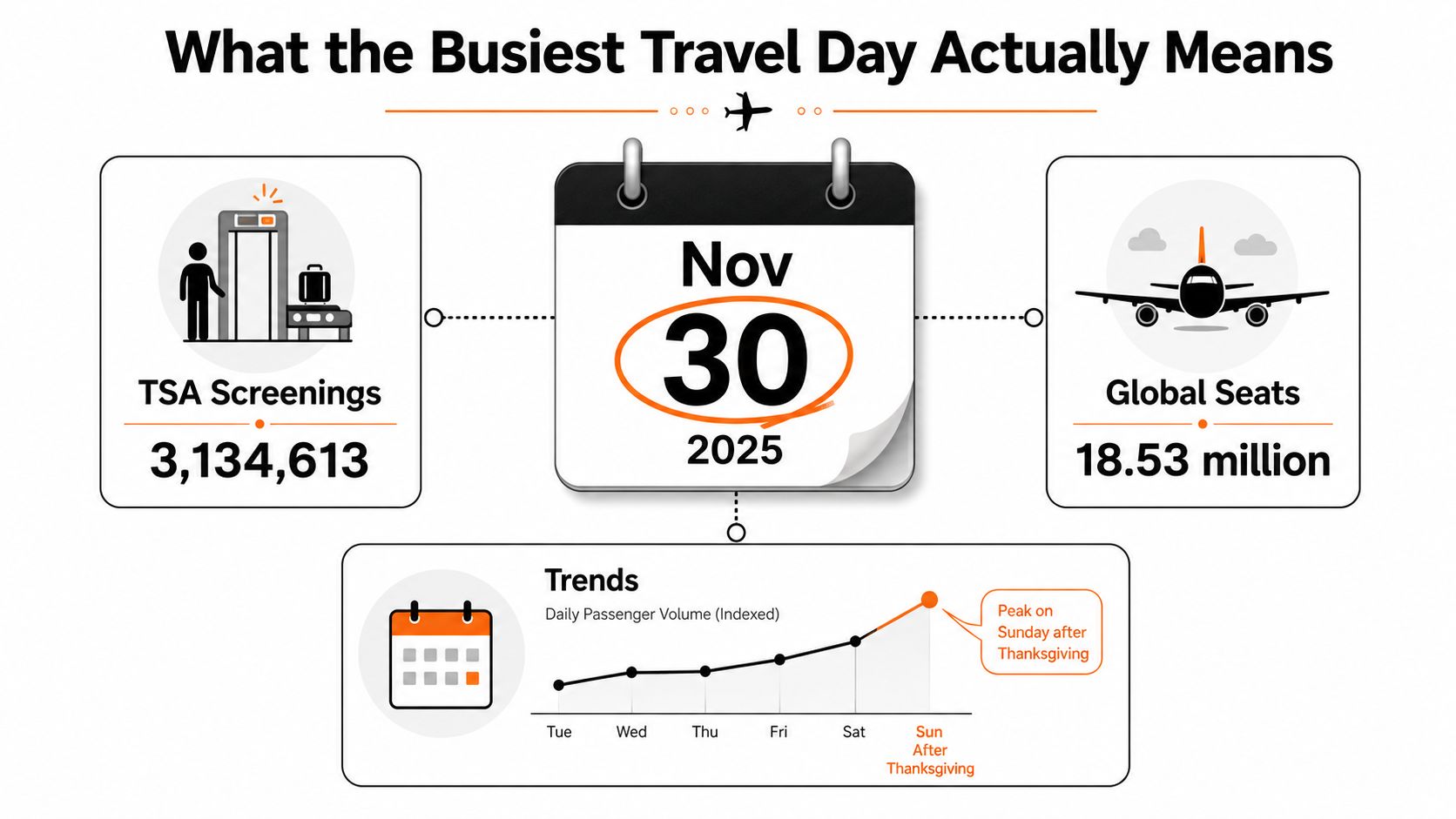
An infographic detailing that November 30, 2025, is the busiest travel day with record passenger volumes.

The U.S. TSA Benchmark and the Thanksgiving Pattern

For U.S. travelers, TSA checkpoint throughput is the clearest operational benchmark because it counts passengers processed rather than seats airlines intend to sell. The record of 3,134,613 screenings on Sunday, November 30, 2025 shows how strongly return travel can concentrate on one date. TSA data and travel analysis also identifies the Sunday after Thanksgiving as a recurring peak, while Thanksgiving Day itself remains among the quietest days for flying.

The reason is behavioral rather than mysterious. Thanksgiving creates a fixed destination and a compressed return window. Travelers who leave before the holiday often return on Sunday, while workers resume normal schedules and students travel back toward campus. That combination produces a synchronized movement in the opposite direction, and airport systems feel the impact all at once.

The leading U.S. dates in the available comparison

Date Holiday / Event TSA Screenings
November 30, 2025 Sunday after Thanksgiving 3,134,613
June 22, 2025 Summer travel peak 3,096,797
July 20, 2025 Summer travel peak 3,043,973

The comparison is more revealing than the Thanksgiving label alone. The post-holiday Sunday exceeded heavy summer dates such as June 22 and July 20, showing that return traffic can outpace major leisure periods. Travelers searching for Thanksgiving travel deals should therefore evaluate the return date separately from the outbound date.

Thanksgiving Day itself can look attractive for travelers who have flexibility, not because the entire holiday period is quiet, but because the main family movement has already occurred or is scheduled for another day. The broader pattern also appears around other fixed-date holidays. Friday departures and Sunday returns often compress demand around holiday weekends, although the exact ranking changes from year to year.

For premium-cabin buyers, TSA's record is primarily a friction signal. It warns you about airport queues, crowded terminals, and limited recovery options if a connection fails. It doesn't tell you that every business-class fare will be expensive. That requires a separate look at airline capacity and fare inventory.

Global Capacity Peaks and Why Fridays Lead

OAG's measure starts with airline schedules, not security checkpoints. Its 18,531,658 scheduled seats on Friday, August 1, 2025 represented the largest global capacity day of that year, according to OAG's published capacity analysis. The figure describes seats airlines planned to make available worldwide, so it captures coordinated supply across international networks rather than confirmed passenger throughput.

The Friday pattern has strategic value. OAG reported that the busiest worldwide capacity days have consistently occurred on Fridays since 2009. During the Northern Hemisphere summer, airlines coordinate substantial international schedules across Europe, North America, and Asia, creating a broad seasonal peak rather than a single isolated holiday spike.

Capacity isn't the same as a full cabin

A scheduled seat is an opportunity for an airline to sell inventory. It isn't proof that the aircraft will depart full, nor does it reveal how seats are distributed between economy, premium economy, business, and first class. That distinction is central to fare analysis.

Airlines may add capacity to meet strong leisure demand while still having difficulty filling premium cabins. A Friday can therefore be extremely busy at the network level and still contain business-class inventory that needs to be priced competitively. The availability of that inventory depends on route, aircraft, departure time, and booking behavior.

The useful question isn't only “How crowded is the day?” It's “Which cabin still has unsold inventory on that day?”

For a premium traveler, the global capacity peak is a forecasting clue. It identifies a period when airlines have scheduled substantial supply, while TSA throughput identifies where travelers are physically creating pressure. Combining the two prevents a common error, assuming that the highest passenger count automatically produces the highest fare in every cabin.

Why Regional Airports Tell a Different Story

A national benchmark can be accurate and still be irrelevant to your itinerary. The busiest travel day for a U.S. checkpoint system may not match the busiest international day at a specific airport, and a global Friday capacity peak may have little effect on a regional airport whose traffic follows school breaks, local events, or seasonal tourism.

The available regional evidence makes that variation clear. Sydney Airport projected its busiest international day for January 3, 2026, while its domestic peak was expected on December 12, 2025, according to the TSA holiday travel forecast coverage. Those dates differ within one airport because international and domestic passengers respond to different calendars and trip purposes.

Match the date to the market

Airport / Region Typical Peak Date Peak Passenger Volume Primary Driver
U.S. national network Sunday after Thanksgiving 3,134,613 TSA screenings Concentrated holiday returns
Global air network Friday, August 1, 2025 18,531,658 scheduled seats Summer airline capacity
Sydney international market January 3, 2026 projection Market-specific forecast International holiday returns
Sydney domestic market December 12, 2025 projection Market-specific forecast Domestic seasonal movement

The same logic applies beyond large international gateways. London demand can be shaped by regional holiday calendars, while U.S. hubs can experience sharp local surges tied to university schedules, sporting events, and connecting-bank patterns. Smaller origins do not inherit the national curve. A traveler leaving from Boise or Hartford may face a local peak that reflects school calendars or seasonal recreation rather than the Sunday after Thanksgiving.

This is why route planning should begin with the actual origin and destination. A traveler comparing the cheapest airport in Florida to fly into may find that an alternate gateway changes both the airport crowding profile and the available premium inventory.

Regional analysis also changes the booking window. If your origin is a leisure gateway, demand may concentrate around a local holiday or event. If your itinerary begins at a business-heavy hub, weekday connection patterns may matter more. The headline busiest travel day is a starting point, not a booking instruction.

The Counterintuitive Pricing of Peak Travel

Most travelers assume peak dates force every cabin upward together. Airline pricing doesn't work that way. Carriers manage several fare classes independently, and the price of an unsold business seat can move differently from the price of the last available economy seats.

Independent airfare analysis describes a particularly important long-haul pattern: in the 7-to-21-day window before departure, economy fares can rise sharply while discounted business inventory remains available. One cited example places a last-minute international coach fare above $2,500, while a discounted business fare is about $2,100, a difference of roughly $400, as explained in this analysis of business-class ticket pricing.

Why airlines create the inversion

Economy demand on a peak date often comes from leisure travelers who have fixed plans. Once lower economy fare buckets sell, the remaining coach inventory can become expensive, even though the aircraft still has premium seats that the airline would prefer to fill.

Revenue managers then face two different problems:

  • Economy inventory: Leisure demand can exhaust cheaper fare classes, leaving higher-priced coach seats.
  • Business inventory: Premium demand may remain softer, so the airline has a reason to release a lower business fare rather than depart with an empty seat.
  • Traveler timing: The same late-booking window can expose an expensive coach fare and a comparatively attractive business fare on one itinerary.
  • Total cost: Bags, seat selection, and other economy charges can narrow or reverse the apparent cabin premium.

The result isn't guaranteed, but it is rational. A peak day measures pressure on the system, not uniform scarcity across every fare class.
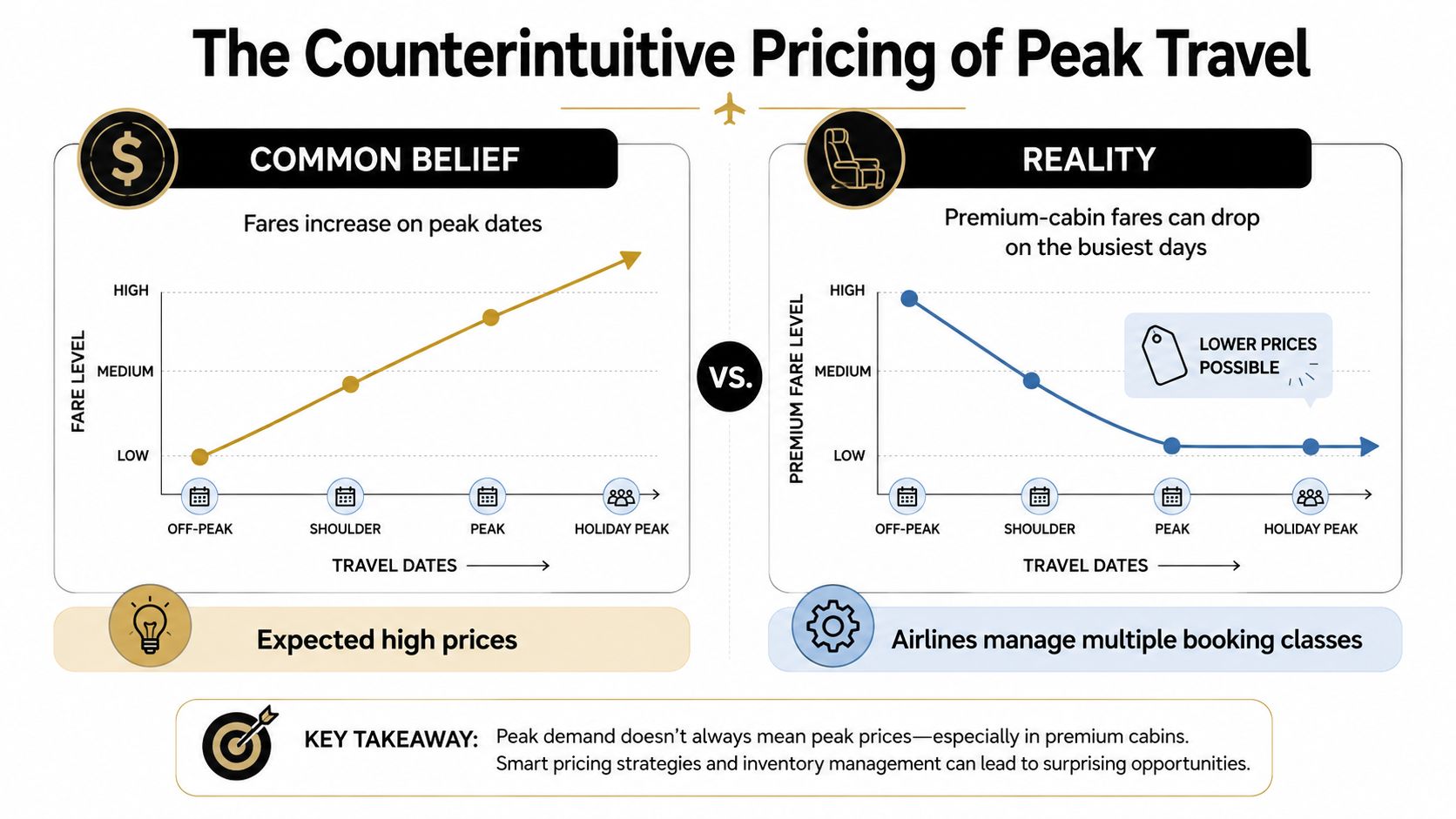
A comparison chart showing how premium cabin airfare prices can decrease during peak travel dates.

The following video provides additional context for travelers evaluating premium-cabin pricing:

The practical conclusion is uncomfortable for rule-based planners. Avoiding the busiest travel day may reduce airport stress, but it doesn't automatically produce the cheapest business fare. Sometimes the better opportunity appears precisely because the airline needs to solve a premium-inventory problem inside a high-demand schedule.

When Business Class Beats Coach on Real Routes

The clearest way to understand the inversion is to calculate the itinerary total rather than compare base fares. Economy can appear cheaper in the search display, then lose that advantage after baggage and seat charges. The verified route comparisons below show how the arithmetic can change on major long-haul markets.

Route Peak Date Business Fare Coach Base Coach Fees Coach All-In
ORD to LHR Last-minute transatlantic example $1,850 $1,950 Included in comparison $1,950
LAX to NRT Last-minute transpacific example $2,300 $2,400 Included in comparison $2,400
JFK to Paris Route-level comparison $2,450 $2,850 Included in comparison $2,850
SFO to Tokyo Route-level comparison $2,780 $3,100 Included in comparison $3,100
ORD to London Route-level comparison $2,120 $2,500 Included in comparison $2,500
LAX to Sydney Route-level comparison $2,990 $3,400 Included in comparison $3,400

These comparisons come from documented discounted business-class route examples. The first two include ancillary charges in the coach comparison, while the additional route examples show the base-price relationship presented by the source.

What the math changes

On ORD to LHR, business class is $100 cheaper than coach in the cited comparison. LAX to NRT produces the same $100 business-class saving, while the other examples show larger gaps between the listed economy and business fares. The value isn't limited to the fare difference. A business ticket can also include premium-cabin benefits such as a lie-flat seat, depending on the product and aircraft.

That doesn't mean every peak-period itinerary will reverse. Airlines can close discounted premium inventory, and an economy fare may remain cheaper when its lower buckets are still open. The disciplined approach is to compare the all-in itinerary, not the cabin labels or the first number shown in a search result.

Booking Strategies That Work on the Busiest Travel Days

Peak travel rewards travelers who monitor inventory instead of relying on one universal rule. The objective isn't to book early or wait until the last minute. It's to watch how the specific route behaves as the departure date approaches.

A practical monitoring sequence

  1. Set fare alerts 75 to 90 days out. Establish a reference point for the route and cabin. Without that baseline, a later price can look attractive or alarming without context.

  2. Recheck during the 21-to-14-day window. This is the period in which discounted business inventory may appear on some long-haul routes, even as restrictive economy pricing rises. Treat it as a monitoring window, not a promise of a discount.

  3. Compare shoulder dates. A Tuesday or Wednesday departure before a Friday capacity peak can reduce exposure to the most concentrated demand. If the date is fixed, compare nearby airports and connection paths instead.

  4. Watch schedule changes. Added or retimed flights can alter the inventory balance. A route with more scheduled options may give revenue managers more flexibility than a route with only one practical departure.

  5. Keep a fallback fare class. Don't evaluate only one airline or one cabin. A refundable economy option, an alternate carrier, or a nearby gateway can protect the trip while you continue watching premium pricing.

  6. Review the seat map around departure. Seat availability isn't a complete fare signal, but it can reveal whether the premium cabin looks heavily committed or broadly open. Use it alongside fare rules, not as a standalone forecast.

Passport Premiere gives travelers one place to examine premium-fare timing and market signals when deciding whether to buy or continue monitoring. For travelers moving with animals during holiday peaks, operational planning matters too, and guidance on ferried pet transport for holidays can help coordinate the ground and air portions of the trip.

The strongest decision combines schedule and price. If TSA forecasts indicate a difficult airport day but global capacity suggests abundant airline supply, you may accept the crowding and focus on cabin inventory. If your regional airport faces its own peak, an alternate origin may matter more than the national calendar.

Putting It All Together for Your Next Trip

The phrase busiest travel day hides three separate planning problems. TSA throughput tells you when U.S. checkpoints may face their greatest physical load. Global scheduled capacity shows when airlines have placed the most seats into the worldwide system. Regional forecasts tell you whether your actual airport follows either pattern.

The pricing lesson is equally important. A busy airport doesn't force business class and coach to move in lockstep. On long-haul routes, the 14-to-21-day period can produce a premium-cabin opportunity while economy prices rise, particularly when the airline still needs to fill business seats and economy inventory has moved into higher fare classes.
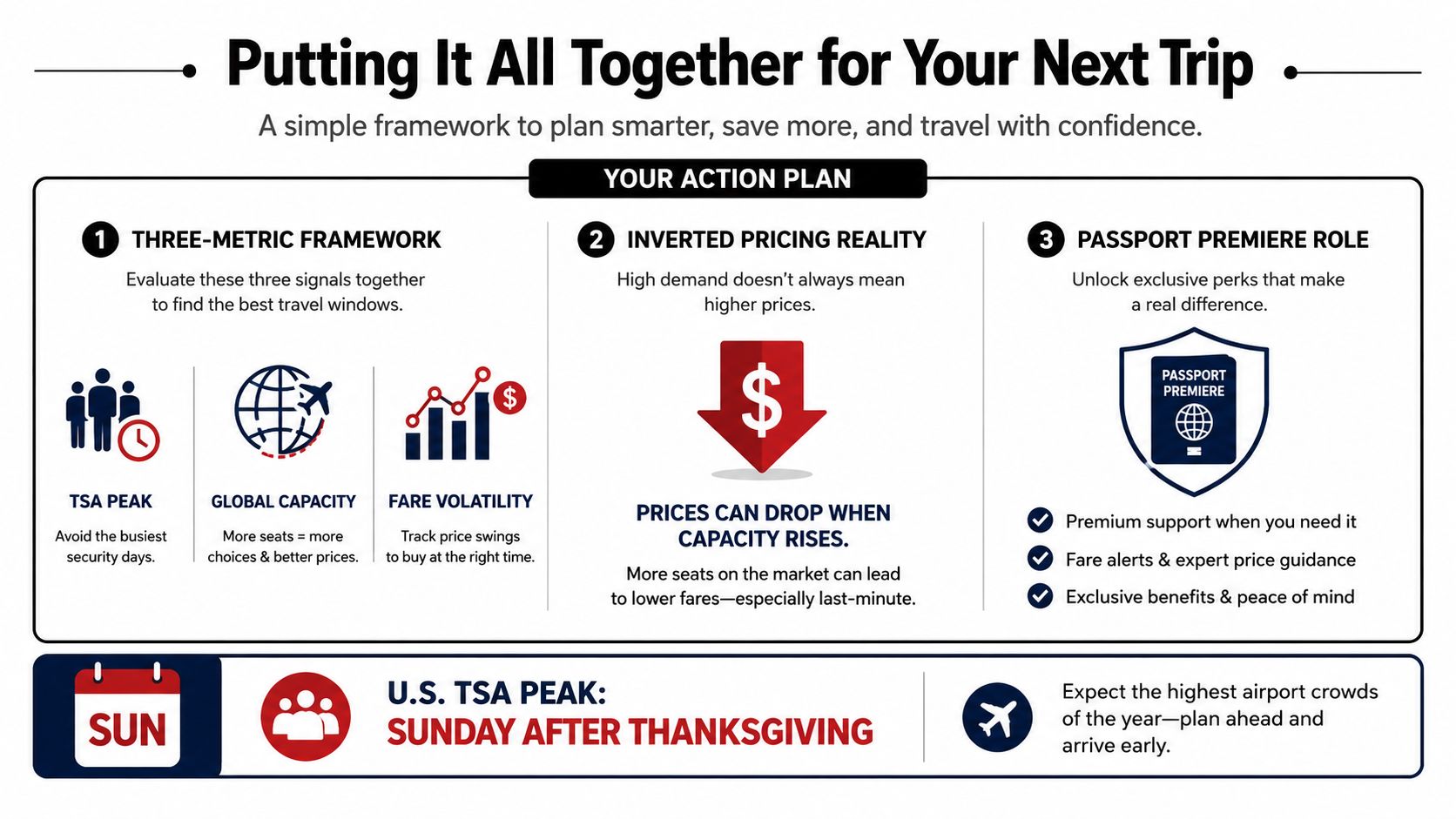
A travel infographic titled Putting It All Together outlining a three-part action plan for smarter trip planning.

Use the framework as an immediate checklist:

  • Check the right peak: Compare the Sunday-after-Thanksgiving TSA pattern, the global first-Friday-of-August capacity signal, and the forecast for your own airport.
  • Price the whole itinerary: Add economy baggage and seat costs before deciding that coach is cheaper.
  • Monitor before committing: Set alerts, inspect shoulder dates, and review premium fare signals inside the relevant booking window.

The most useful conclusion isn't that every traveler should avoid the busiest travel day. It's that the busiest date can create both operational inconvenience and a pricing opportunity, depending on which metric is peaking and which cabin still has inventory.


Passport Premiere provides fare monitoring and market analysis for travelers seeking international Business and First Class fares at prices that can sometimes fall below coach after fees. Visit Passport Premiere to review its premium-fare intelligence and use market signals before booking your next peak-period itinerary.

Thanksgiving Travel Deals: Fly Business for Less Than Coach

Most Thanksgiving travel advice is built on the wrong goal. It tells you to fight everyone else for a slightly less painful coach fare, then calls that a deal.

That's backwards.

If you're chasing real Thanksgiving travel deals, stop obsessing over bare-bones economy tickets on the most crowded dates. The better play is often outside the mainstream search pattern. On the right international route, in the right booking window, business class can price below what panicked travelers pay for coach, premium economy, or fully flexible last-minute economy. That sounds absurd until you understand how airlines protect, then dump, unsold premium inventory.

Holiday travel punishes conventional thinking. Smart buyers don't win by searching harder. They win by shopping a different market.

Why Cheap Thanksgiving Travel Deals Are a Myth

The phrase “cheap Thanksgiving travel deals” sounds useful. In practice, it usually means one of two things. Either the fare was never good to begin with, or the traveler accepted a bad itinerary just to feel like they saved money.

Thanksgiving is one of the worst times to shop for coach by instinct. AAA projected 81.8 million people in the U.S. would travel at least 50 miles from home over the 2025 Thanksgiving period, a new overall record, and air travelers represented only about 7% of that total, which still creates fierce competition for limited seats according to AAA's 2025 Thanksgiving travel forecast. When a relatively small slice of total travelers all compete for the same flights, coach doesn't behave like a bargain market. It behaves like a pressure cooker.

A crowded airport terminal filled with weary travelers waiting in long lines during the holiday season.

That's why the usual advice fails. “Book early” is incomplete. “Be flexible” is too vague. “Use points” is often lazy advice, because points can be a terrible redemption when cash fares briefly crack in premium cabins.

What most travelers get wrong

Many travelers treat Thanksgiving airfare like a race to the bottom. They compare economy fares across a few dates, see all of them are ugly, and settle for the least offensive option. They never ask a better question.

Is coach the best value on this trip?

For domestic holiday hops, maybe. For long-haul international trips, often not. Coach pricing around Thanksgiving gets pulled upward by family travel, school calendars, and fixed return dates. Premium cabins follow a different logic. Airlines can hold high business class fares for a while, but if those seats don't move, they sometimes cut aggressively because some revenue beats empty seats.

Practical rule: A Thanksgiving “deal” isn't the lowest fare on the screen. It's the ticket with the best comfort-to-cost ratio once holiday demand distorts coach pricing.

That's the opening you want. Not a cramped middle seat with a bad connection. A lie-flat seat that drops into a rational price band because the premium market didn't fill the way the airline expected.

The better target

Instead of asking, “How do I find cheap holiday airfare?” ask, “Where is demand irrational, and which cabin gets mispriced first?”

That second question leads you toward premium-cabin buying opportunities and away from mass-market fare traps. If you want to understand why airlines produce these odd pricing windows, it helps to know how dynamic pricing in the airline industry works. The headline matters less than the fare behavior.

Cheap coach at Thanksgiving is often a myth. Premium value isn't.

Master the Premium Cabin Fare Cycle

Airlines don't price business class the way most travelers think they do. They don't publish one premium fare and wait for wealthy travelers to buy it. They test the market, protect the cabin, watch booking pace, then react.

That reaction is where the opportunity lives.

The FAA said Thanksgiving 2025 would be the busiest Thanksgiving travel period in 15 years, with Tuesday, Nov. 25 expected to be the peak day and more than 52,000 flights expected that day according to the FAA's Thanksgiving travel outlook. That kind of concentration crushes economy buyers because the herd tends to move together. Premium demand often moves on a different rhythm, especially on international routes where business, leisure, and corporate booking patterns don't line up neatly with domestic holiday traffic.

A four-step infographic explaining the cycle of airline premium cabin fares from initial launch to purchase.

Premium seats are not priced to sell immediately

Airlines launch premium fares high because they can always come down later. That opening price is less a bargain invitation and more a filtering mechanism. It catches inflexible corporate demand, urgent travelers, and buyers who equate high price with certainty.

Then reality shows up.

Some routes underperform. Some dates don't fill in premium the way revenue managers expected. Some competing airlines nudge the market lower. That's when you get a genuine buying event. Not a coupon. Not a holiday sale banner. A real repricing event.

The key mindset shift is this. Coach fares at Thanksgiving usually rise because demand is obvious. Business class can drop because demand is uncertain.

How to read the cycle

Use this as your working model:

  1. Launch phase
    Airlines open premium inventory at ambitious prices and wait for early bookings.

  2. Testing phase
    Competing schedules, corporate demand, and route-specific interest start to reveal whether the market will support those fares.

  3. Correction phase
    If seats remain open, airlines may refile lower fares, match competitors, or widen availability in lower business fare buckets.

  4. Expiration phase
    Once the cabin begins to fill or the travel date gets too close, the best premium value often disappears.

The best business class purchase usually doesn't happen at first publication or at the final hour. It happens when the airline admits the original fare was too optimistic.

This is why generic booking advice underperforms. It assumes all cabins behave the same way. They don't.

What to do with this knowledge

You need to watch premium fares the way analysts watch market structure. Don't stare at one date and one airport. Track the route family. Watch fare changes over time. Compare one-way and round-trip logic. Learn how one-way versus round-trip fare construction can hide or reveal value, because airlines often price those structures very differently.

If you understand the cycle, you stop shopping emotionally. You stop “locking something in” just because Thanksgiving feels urgent. You wait for evidence. Then you buy fast when the premium cabin slips into the range where coach starts looking foolish.

Build Your Thanksgiving Fare Monitoring Workflow

Random searching is not a strategy. It's how people end up paying holiday pricing twice. First in money, then in discomfort.

A proper workflow starts with a hard truth. Bankrate cited average Thanksgiving flights at $751, versus $685 for Christmas, and also highlighted that the key opportunity may be when a $10,000 business class seat drops to $3,500, which can undercut last-minute premium economy or full-fare coach on some trips, as discussed in this Bankrate-cited airfare analysis video. That's the frame you need. Stop searching for miracles in economy. Start watching for premium mispricing.

Screenshot from https://www.passportpremiere.com

Set a target before you search

Most travelers react to whatever price appears. Pros decide in advance what counts as buyable.

For Thanksgiving international trips, define these three thresholds:

  • Your stretch fare
    The highest business class price you'd accept if schedule and comfort matter more than optimization.

  • Your target fare
    The number where you'll book immediately because the value is clearly there.

  • Your ignore zone
    Any fare that isn't low enough to beat the total value of premium economy, miles, or a shifted trip.

The issue is that holiday pricing creates false urgency. If you don't set your standards first, every small dip feels meaningful. It usually isn't.

Compare trip shapes, not just trip dates

The biggest mistake I see is overfitting to one “cheap” departure day. That's lazy shopping. You need to compare complete trip structures.

Start with pairs, not singles:

  • Tuesday to Tuesday
  • Tuesday to Thursday
  • Monday to Wednesday
  • Sunday to the following weekend

The point isn't to force a weird itinerary. The point is to see how the fare behaves when you move both ends of the trip. Sometimes one extra day reveals a completely different fare basis in business class.

Buying filter: If the fare difference is minor but the schedule avoids the worst holiday crunch, take the better trip. Thanksgiving punishes travelers who optimize for base fare alone.

Use alerts like a system

Once your route set is defined, build alerts that match your actual buying rules. Don't just create one broad notification and hope. Separate your searches by cabin, by origin region, and by trip shape. That's how you catch meaningful repricing instead of noise.

If you want a framework for airline price drop alerts, use one that helps you decide quickly rather than dumping fare changes into your inbox.

Here's the operational workflow I recommend:

  1. Track multiple gateways instead of locking onto your home airport.
  2. Save at least two trip lengths so you can compare full-trip economics.
  3. Check redemption value only after cash fares move. Don't lead with points.
  4. Buy when the fare enters your target band, not when you feel tired of waiting.

A short visual walkthrough helps if you've never built this kind of process:

The workflow isn't complicated. It just requires discipline. Thanksgiving travel deals go to buyers who prepare for a fare drop before it happens.

Unlock Savings with Creative Routing and Flexibility

If you only search your nearest airport on the obvious holiday dates, you're volunteering to overpay.

The best Thanksgiving travel deals often come from combining date flexibility with geographic flexibility. Most travelers use one or the other. Strong buyers use both at the same time. That's when premium fares start to crack.

ABC News reported that the Wednesday through Sunday window is the most expensive for Thanksgiving travel, while fares on some routes were down nearly 57% year over year on select routes, according to this ABC News report on Thanksgiving flight timing. That tells you something important. The savings aren't broad. They're highly specific to route and timing.

A visual guide explaining flexible travel strategies for saving money on flights using creative routing techniques.

Stop worshipping the nonstop

Nonstop is convenient. It's also where a lot of bad holiday pricing hides.

International premium buyers should think in terms of positioning. That means starting the long-haul itinerary from a different gateway if the total trip economics are better. Sometimes the winning move is a short separate hop. Sometimes it's a train. Sometimes it's a drive to a secondary airport with better long-haul competition.

Not every traveler should do this. But if the trip is long enough, premium enough, or expensive enough, it's worth checking.

Four flexibility plays that actually matter

  • Alternate gateways
    Major international hubs don't all price the same way. A nearby origin can expose a completely different premium fare structure.

  • Open-jaw planning
    Flying into one city and home from another can lead to stronger fare combinations while improving the trip itself.

  • Strategic layovers
    A longer connection can lower the fare enough to justify the inconvenience, especially when the premium product softens the pain.

  • Date shifts around the peak
    Moving off the obvious Wednesday outbound or Sunday return can change the entire pricing environment.

Don't ask whether one date is cheaper. Ask whether the whole trip becomes smarter if you move the departure city, the return city, or both.

A more useful way to search

A common search pattern is airport, dates, cabin. Reverse that.

Start with destination region and acceptable travel window. Then map all realistic departure airports. Then compare premium fare behavior across those combinations. This is how you find the hidden business class fare that doesn't appear if you insist on the most obvious path.

Use a simple decision screen:

Option Comfort Complexity Typical value logic
Home airport nonstop Highest convenience Low Often worst holiday pricing
Nearby major hub High Moderate Better competition, better premium odds
Secondary airport plus positioning Varies Higher Best for disciplined buyers
Open-jaw international trip High Moderate Strong if destination flexibility exists

The contrarian view is the right one here. Flexibility isn't about accepting random inconvenience. It's about buying access to a better fare market.

Case Studies Business Class Cheaper Than Coach

The theory becomes real. Not with invented miracle fares, but with the booking logic that creates them.

I'm not going to give you fake success stories with made-up numbers. What matters is understanding how these wins happen, what kind of buyer gets them, and why conventional coach shopping misses them.

Case study one: The panicked family booking

A family wants Europe over Thanksgiving. Their first action is a common one. They search the classic school-break pattern, outbound just before the holiday, return right after the weekend, all from the nearest airport.

Coach looks ugly. Premium economy looks worse than expected. Business class appears absurd at first glance, so they dismiss it.

That's the mistake.

A stronger buyer keeps tracking the route family instead of booking on the first bad result. They widen the search to a nearby gateway, shift the return slightly, and watch for a premium fare reset. On some international markets, that combination can put business class within reach of what inflexible travelers are paying for crowded economy and restrictive holiday itineraries.

Case study two: The consultant who stopped chasing economy

A consultant needs to be overseas around Thanksgiving and assumes policy or budget pressure means economy. That assumption breaks down when the remaining coach inventory is expensive, poorly timed, or tied to painful connections.

A premium buyer looks at the total equation:

  • overnight comfort
  • arrival readiness
  • change risk
  • airport stress on peak dates
  • whether a premium fare drop has moved business into rational territory

In this scenario, coach can become the expensive choice in practical terms even if the base fare is lower. If a business class fare drops enough, the traveler buys better sleep, lounge access, cleaner connections, and a lower chance of arriving wrecked for work. That is not indulgence. It's cost control with competence.

Buy the cabin that got mispriced, not the cabin everyone assumes is “supposed” to be cheaper.

Case Study: NYC to Paris Thanksgiving Flight

Metric Standard Booking (3 Weeks Out) Strategic Booking (Alert-Driven)
Search behavior Fixed dates, fixed airport, coach first Flexible dates, multiple gateways, business tracked alongside coach
Buyer mindset “Find the least bad economy fare” “Wait for premium repricing”
Cabin considered valuable Coach Business class if fare falls into target band
Risk High chance of overpaying in a crowded booking window Higher planning effort, lower chance of panic buying
Typical outcome Restrictive itinerary and poor comfort Stronger schedule and better onboard value

Case study three: The owner-operator with no patience for fake deals

Small business owners are especially vulnerable to bad holiday fares because they don't have time to monitor constantly. So they book late, and late Thanksgiving bookings often punish the obvious cabins first.

The better move is to automate the watchlist, define acceptable routings, and ignore headline sales language. Business class becomes cheaper than coach only when you're willing to reject the retail script. Airlines advertise “deals” to move mass demand. Real premium value often shows up subtly, without marketing copy, because it's a byproduct of fare management rather than promotion.

That's why some of the best holiday buys never look like deals at all. They look strange until you compare them with the coach alternative.

Stop Overpaying for Thanksgiving Travel

The average traveler attacks Thanksgiving airfare the wrong way. They enter a crowded market, focus on economy, and hope persistence will uncover a bargain. Usually it doesn't.

A smarter traveler does three things differently.

First, they stop treating coach as the default value option. Around peak holiday dates, that assumption can collapse fast. Second, they watch premium cabins for repricing instead of reacting to the first available fare. Third, they use flexibility with intent, not randomly. Date shifts, alternate gateways, open-jaw tickets, and route comparisons aren't hacks. They're the normal tools of anyone who understands how international fares move.

The new standard for Thanksgiving travel deals

If you remember one thing, make it this: the best Thanksgiving travel deals are often not in economy at all.

That doesn't mean every traveler should buy business class. It means every traveler taking a long-haul trip during peak season should at least check whether business has fallen into the zone where coach no longer makes sense. On some trips, it will. And when it does, the difference in comfort is enormous.

What to do next

Use a disciplined buying process:

  • Track the route family, not one rigid search.
  • Set target prices in advance so you don't panic-buy.
  • Compare whole trip structures instead of single dates.
  • Treat premium fare drops as a key opportunity, not as an afterthought.

The old advice tells you to search harder. My advice is simpler. Search smarter, and shop the cabin that the airline got wrong.


If you want help spotting premium-cabin buying windows before they disappear, Passport Premiere gives travelers focused insight into international Business and First Class fare drops, including situations where premium seats can cost less than coach. It's built for travelers who'd rather understand fare behavior than overpay during the most chaotic booking periods of the year.