
The usual advice about international first class seats is to pick a celebrated airline, find its flagship suite, and hunt for a discount. That puts the cabin label ahead of the purchase decision. A famous first-class seat can be a poor buy when business class already provides the bed, privacy, and airport access you need.
Start with the aircraft and the fare instead. Scarcity makes first class harder to find, but it doesn't make every ticket worth buying. Sometimes the smarter purchase is business class cheaper than coach, particularly when an airline discounts premium inventory while economy fares remain high.
How Rare International First Class Seats Are
Say you're planning a long-haul trip and want first class in both directions. You find an attractive outbound flight, then discover that the return offers business as its highest cabin. Moving the departure time might solve the problem, but changing airlines or connecting airports might be necessary.
That's not merely a booking inconvenience. International first class is a separate product on selected flights, rather than a standard upgrade above every business-class seat. Think of a ship with a few private cabins: some operators preserve them, while others use the space for more passengers.
The supply picture helps explain why route selection comes before bargain hunting.
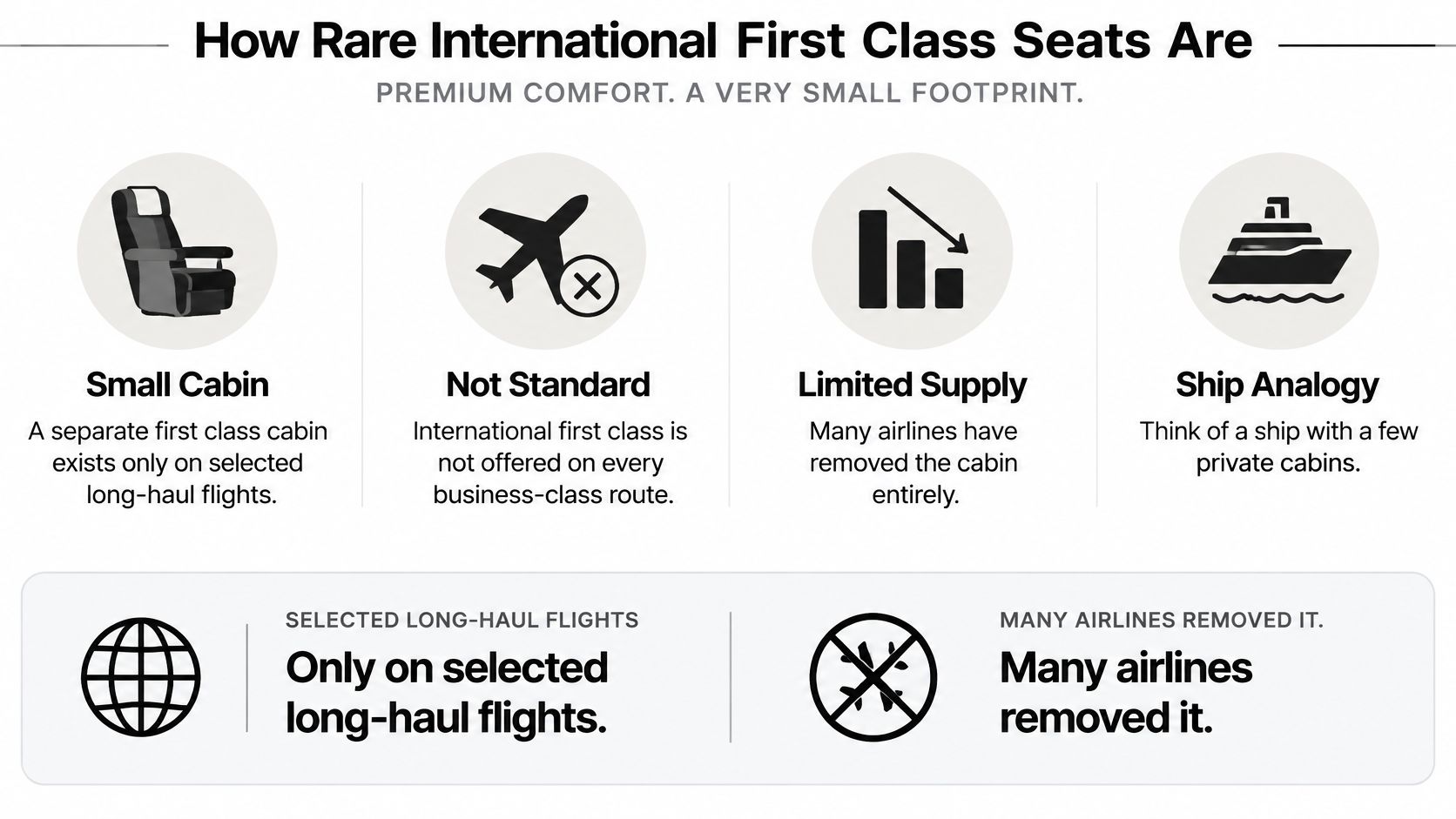
How international first-class supply has shrunk
The following figures, including Cirium's finding that fewer than half of approximately 60 surveyed long-haul international airlines retained a separate first cabin in 2025, are reported by AFAR.
| Measure | Figure | What it means |
|---|---|---|
| Airlines with a true separate first cabin | Fewer than half of about 60 long-haul carriers | Many long-haul fleets no longer sell it |
| Share of available seats | Less than 1 percent | A tiny slice of the seat market |
| First-class seats, 2019 | 21.05 million | Pre-pandemic baseline |
| First-class seats, 2024 | 12.6 million | More than 40 percent below 2019 |
| Seats removed, 2025 versus 2023 | 1.2 million fewer | Contraction continued as total capacity grew |
| Total airline seats, 2019 to 2024 | 5.7 billion to 5.9 billion | The network grew while first class shrank |
| Highest reported carrier share | ANA about 3.2 percent | Even the leader allocates a small slice |
For a traveler, the important contrast isn't that first class contracted. Airlines expanded their overall seating capacity while reducing this particular cabin. A broader choice of flights therefore doesn't necessarily create a broader choice of first-class tickets.
Airlines have different reasons to retain the product. A flagship cabin can attract travelers who want exceptional space and service, while another carrier may prefer to sell more business suites in the same aircraft footprint. Neither strategy tells you whether a particular fare is attractive.
Practical rule: Establish that the cabin exists on your actual flight before spending time comparing first-class prices.
Keep the supply table beside your initial shortlist. A nonstop business flight may be more useful than a first-class itinerary that requires an awkward connection, an inconvenient departure, or a substantial detour.
Seat Hardware That the Cabin Label Hides
Two tickets called first class can buy noticeably different rooms. Japan Airlines offers a particularly useful comparison because the airline name stays the same while the aircraft changes the physical product.
The photograph illustrates the importance of looking beyond the fare label to the seat and its surrounding partitions.
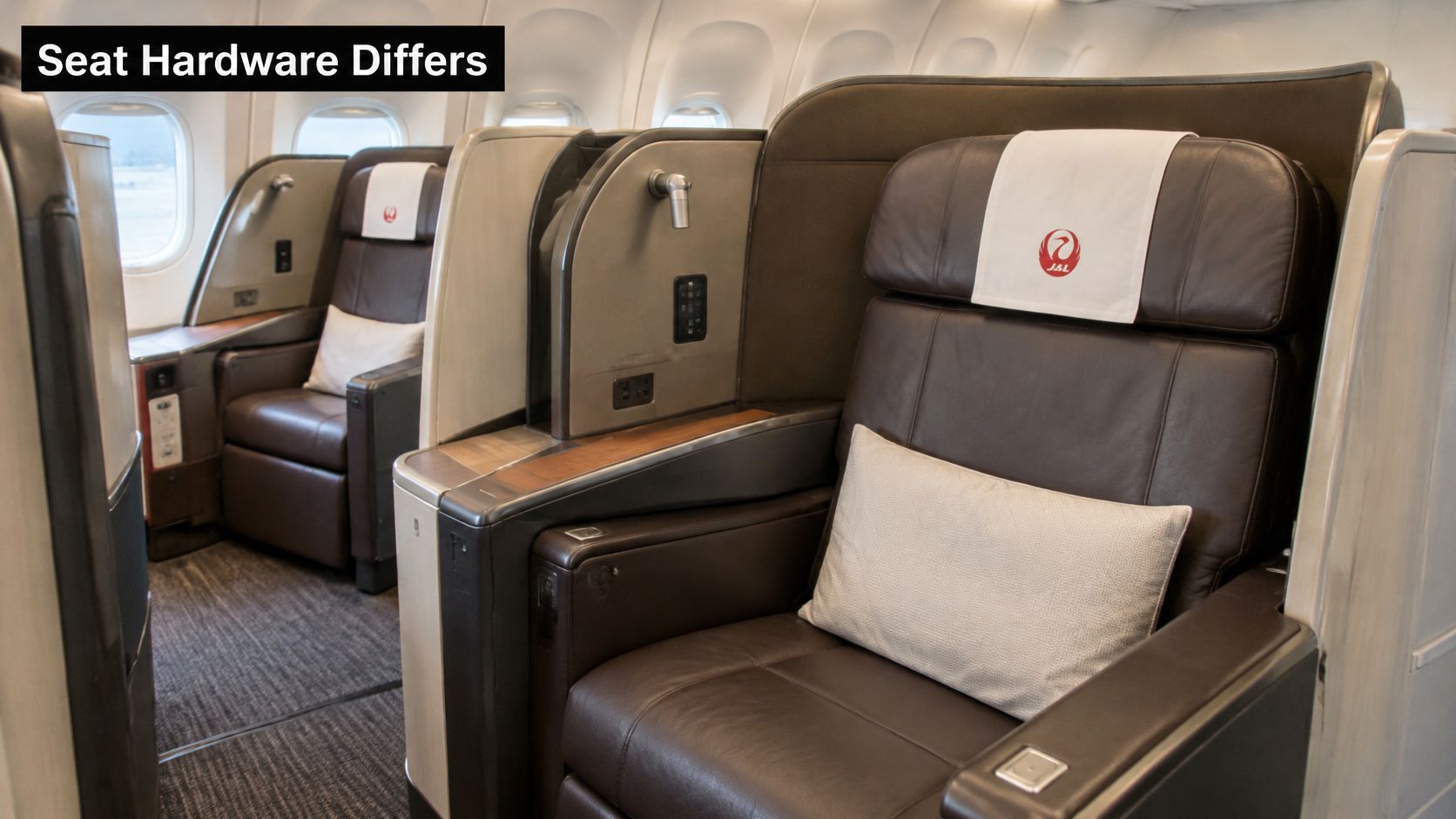
Measured first-class seats on two JAL aircraft
The dimensions below come from Japan Airlines' first-class seat specifications, which distinguish its Boeing 777-300ER JAL Suite from its Airbus A350-1000 product.
| Spec | 777-300ER JAL Suite | A350-1000 first class |
|---|---|---|
| Seat width | About 58 cm | About 123 cm seat and bed width |
| Bed | Up to 84 cm wide and 199 cm long | Up to 203 cm long |
| Screen | 23-inch | 43-inch 4K |
| Privacy | Stowable partition | Larger personal volume in a six-seat cabin |
| Layout | Individual suite | 1-1-1, only six seats |
| Cabin height | Not specified in the cited specifications | About 157 cm ceiling |
The difference isn't just a larger television. Extra bed width can matter when you turn onto your side, while usable surface area affects whether you can work, eat, and keep personal items accessible without repeatedly rearranging them.
Bed length deserves separate attention from seated comfort. A tall passenger should examine the sleeping position, including any enclosed foot area, rather than assume that a generous-looking chair guarantees comfortable rest. Published dimensions are the starting point, not a complete ergonomic verdict.
Privacy is part of the hardware
ANA's newer THE Suite includes a door and dedicated personal space, while First Square uses a self-contained shell, movable table, storage, and a 32-inch widescreen, according to ANA's first-class seat guide.
Doors, partitions, and walls solve different problems. A partition can block a neighbor's view without shielding you from aisle movement; a closable door can reduce visual disturbance, although it doesn't make an aircraft suite soundproof.
- For sleeping: Look at enclosure, bed shape, bedding, and proximity to the galley or lavatory.
- For working: Check table placement, accessible storage, and whether the seat remains comfortable with the table deployed.
- For traveling together: Examine whether the layout permits conversation without sacrificing privacy when you want to rest.
A guide to airlines with beds can help build a shortlist, but the operating aircraft and cabin version must settle the purchase.
Don't interpret an aircraft assignment as an absolute guarantee. Save the product description, check the itinerary after schedule changes, and understand the ticket's remedies before paying specifically for a particular suite. A substitution can preserve the cabin name while removing the feature that justified the premium.
What First Class Still Has Over Business
Business class has absorbed features that once made first class distinctive. Lie-flat beds, direct aisle access, privacy doors, and improved dining increasingly appear below the top cabin, a narrowing gap discussed by Trip Jaunt.
That doesn't make first class obsolete. It makes the comparison more demanding: the question is which additional benefits you'll receive, not which cabin sounds more prestigious.
This comparison captures the broad direction, but the operating flight's inclusions should determine the verdict.
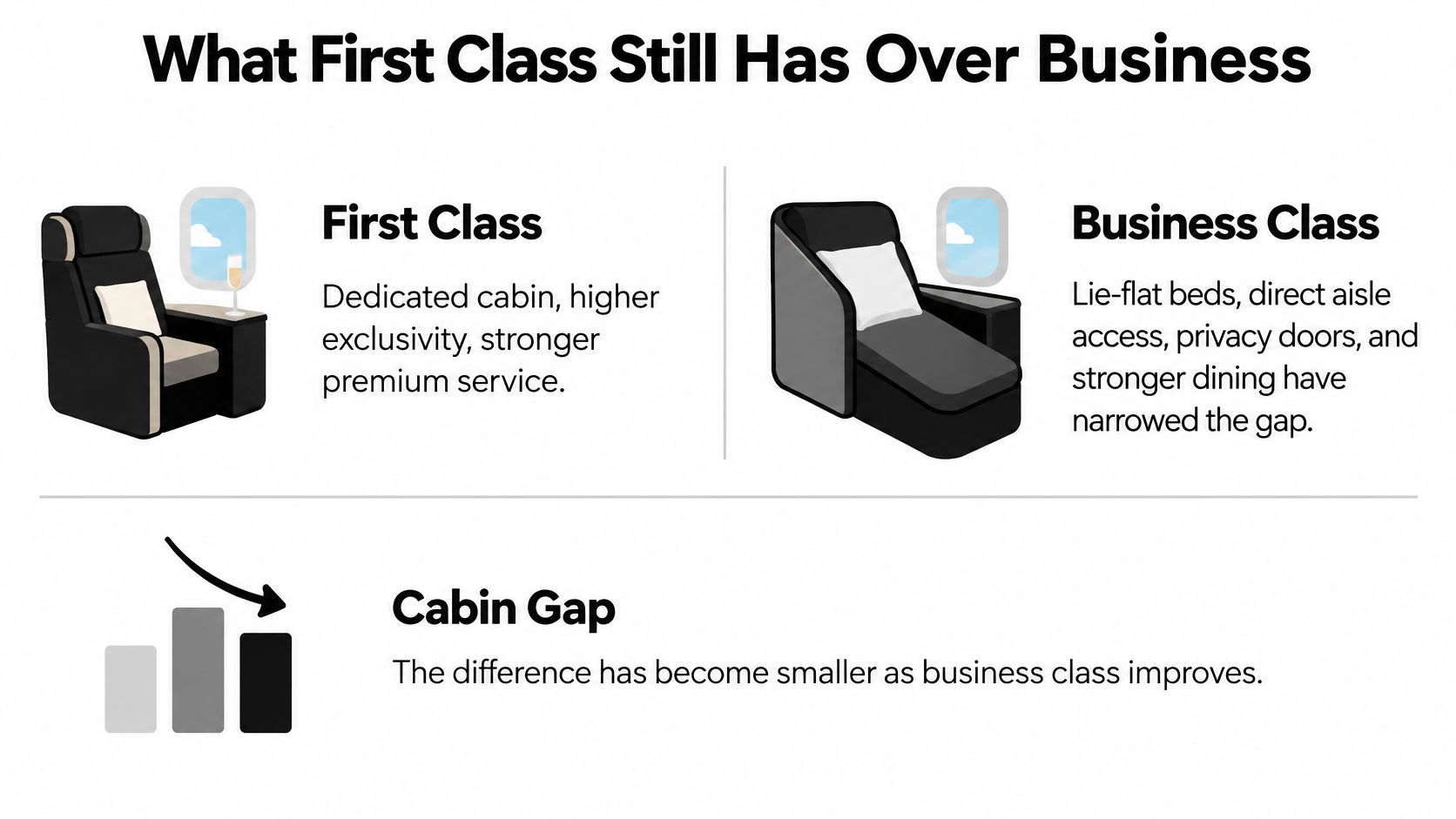
First class versus a modern business suite
These are buying criteria, not promises that every airline supplies each benefit.
| Benefit | Typical first class | Typical long-haul business | Worth paying up for? |
|---|---|---|---|
| Lie-flat bed with aisle access | Usually included | Standard on flagship long-haul products | Rarely, if business already has it |
| Privacy | Door, high walls, or partition | Door suites increasingly common | Yes, if this business seat is still open |
| Cabin size | Often a handful of seats | Often a substantially larger cabin | Yes, if quiet and attentive service matter |
| Dining | Individualized, course-timed | Strong but more standardized | Sometimes, on overnight flagships |
| Ground extras | First lounge, chauffeur or transfers on some carriers | Business lounge | Yes, when the ground service is real |
| Baggage and irregular operations | Potentially higher allowance and rebooking priority | Substantial benefits, subject to carrier rules | Yes, on complex trips, after verification |
| Fare | Large premium when both cabins are open | Often the value seat; sales can undercut coach | Default buy unless first's extras justify the difference |
For a corporate traveler who wants to sleep immediately after departure, elaborate dining may contribute little. A quieter enclosure and flexible service could matter considerably more.
A leisure traveler may reasonably reach the opposite conclusion. If the flight is part of a special holiday, the lounge, meal, and personal attention can be worthwhile experiences rather than tools for arriving ready to work.
Put a value on the ground product
Check lounge access by airport, not just by airline. Chauffeur eligibility, terminal transfers, guest privileges, baggage allowances, and connecting-flight access can have conditions that change the value of an apparently generous package.
Priority handling also isn't immunity from disruption. Ask what assistance the carrier provides when a connection fails, and don't assume that a first-class ticket creates replacement seats on a sold-out flight.
The cabin comparison is easier to judge when you watch how the space and service work together.
Pay for the benefits you would miss in business class, not for benefits both cabins already include.
Travel managers can make that principle operational. Require an explanation tied to the actual itinerary, such as a materially better sleeping enclosure or useful ground assistance, rather than approving an upgrade solely because first class is available.
Empty Seats Versus Sellable and Discountable Seats
An open-looking seat map isn't evidence of a cheap ticket waiting to be claimed. It shows seating assignments, which aren't the same thing as the inventory an airline is prepared to sell.
Demand provides useful context: IATA reported 116.9 million international premium-class travelers in 2024, representing 6% of international passengers. That total includes business and first class, so it shouldn't be read as a count of first-class customers.
Three buckets for every fare quote
The distinction between physical seats and booking inventory is central to the premium-market problem discussed by Travel Daily Media.
| Bucket | What it means | What to do |
|---|---|---|
| Empty seat | A physical chair appears unassigned, without evidence that a cheap booking class is open | Don't treat the seat map as a deal |
| Available seat | A seat is being sold in some booking class, often at a high fare | Compare it against the business suite on the same dates |
| Discountable seat | A seat the carrier may mark down because the cabin would otherwise depart with empty seats | Watch for bursts of fare corrections and set an alert |
Discountable is a possibility, not a published entitlement. An airline may prefer to hold inventory for a late-paying customer, sell an upgrade, or depart without filling the cabin rather than release a lower fare.
Consider a traveler who searches a nonstop flight and then searches the same long-haul segment as part of a connection. The quotes may differ because the airline prices the complete journey, not just the chair on the long sector. Direction, departure date, fare basis, and connecting segments can all affect what the airline offers.
Test the ticket behind the headline
A guide to business-class seat availability is useful for separating what appears on a map from what can be booked. The decisive test is whether the itinerary prices and tickets in the intended cabin under acceptable conditions.
Before treating a low quote as a buying opportunity, inspect its construction.
- Cabin mix: Open every segment and identify where the premium cabin applies.
- Travel window: Confirm that the advertised fare covers your usable dates, not merely an inconvenient departure.
- Fare conditions: Read refund, change, no-show, and reissue provisions.
- Journey structure: Compare the full round trip, including connections and airport changes.
Waiting can be sensible if your dates are flexible and acceptable alternatives remain. It can be expensive if a fixed meeting or family commitment leaves no fallback. An alert supports a buying decision; it doesn't guarantee that an airline will discount your flight before you need to book.
When Business Class Costs Less Than Coach
Business class can cost less than coach. The inversion is unusual, but it can occur when an airline discounts premium fares while economy remains expensive on the same travel dates.
A fare correction may reflect an airline's effort to stimulate demand for unsold premium seats. It may also be a broader promotion or a pricing mistake, so the low price alone doesn't establish why the airline offered it.
What published sale prices demonstrate
Going puts common long-haul business-class pricing at about $3,000–$5,000 round trip, gives a Los Angeles–Paris sale example falling from around $3,000 to approximately $2,000, and notes rare mistake fares as low as $300.
Those examples represent different buying situations. A conventional sale is a more realistic planning target than a mistake fare, which shouldn't become the assumed budget for an essential trip.
Transatlantic business-class sales regularly appear at roughly £1,200–£1,800 return, less than 40% of standard business fares, according to Airlines and Destinations. Such a discount establishes that premium pricing can move sharply, but it doesn't prove that economy was more expensive on every listed departure.
DealNews has recorded round-trip business promotions starting at $1,629 to Europe, $2,739 to Asia, and $2,129 to Africa, with advertised savings up to 70%, involving carriers including American Airlines, British Airways, Turkish Airlines, Japan Airlines, Philippine Airlines, and Emirates.
Compare the actual alternatives
The relevant comparison isn't a sale fare against an airline's expensive reference price. It's the complete premium ticket against the economy ticket you could buy for the same trip.
| Comparison | Why it matters |
|---|---|
| Same travel dates and airports | Avoids comparing a flexible holiday fare with a fixed-date business trip |
| Equivalent baggage needs | Economy extras can change the total |
| Usable connection times | A cheaper ticket can impose an unacceptable layover |
| Relevant change conditions | Flexibility may matter more than the cabin |
| Premium cabin on the long flight | Prevents a short premium connection from disguising economy long haul |
Buying insight: When a business sale undercuts your usable coach fare, compare ticket conditions before assuming the cheaper cabin is the more economical choice.
None of these published examples is a live quote or proof of a current first-class bargain. They establish a narrower, useful point: airlines don't maintain a fixed relationship between economy and premium prices.
For a traveler shopping international first class seats, that matters because the best-value correction may appear in business instead. Rejecting it solely because the original goal was first class can mean paying more without solving any additional travel need.
How to Buy the Cabin for Less
Treat the first price you see as a benchmark to investigate, not a value judgment. Most travelers won't negotiate directly with an airline, but they can change dates, compare products, monitor competing carriers, and buy when an acceptable fare appears.
The buying sequence starts with confirming what is for sale.
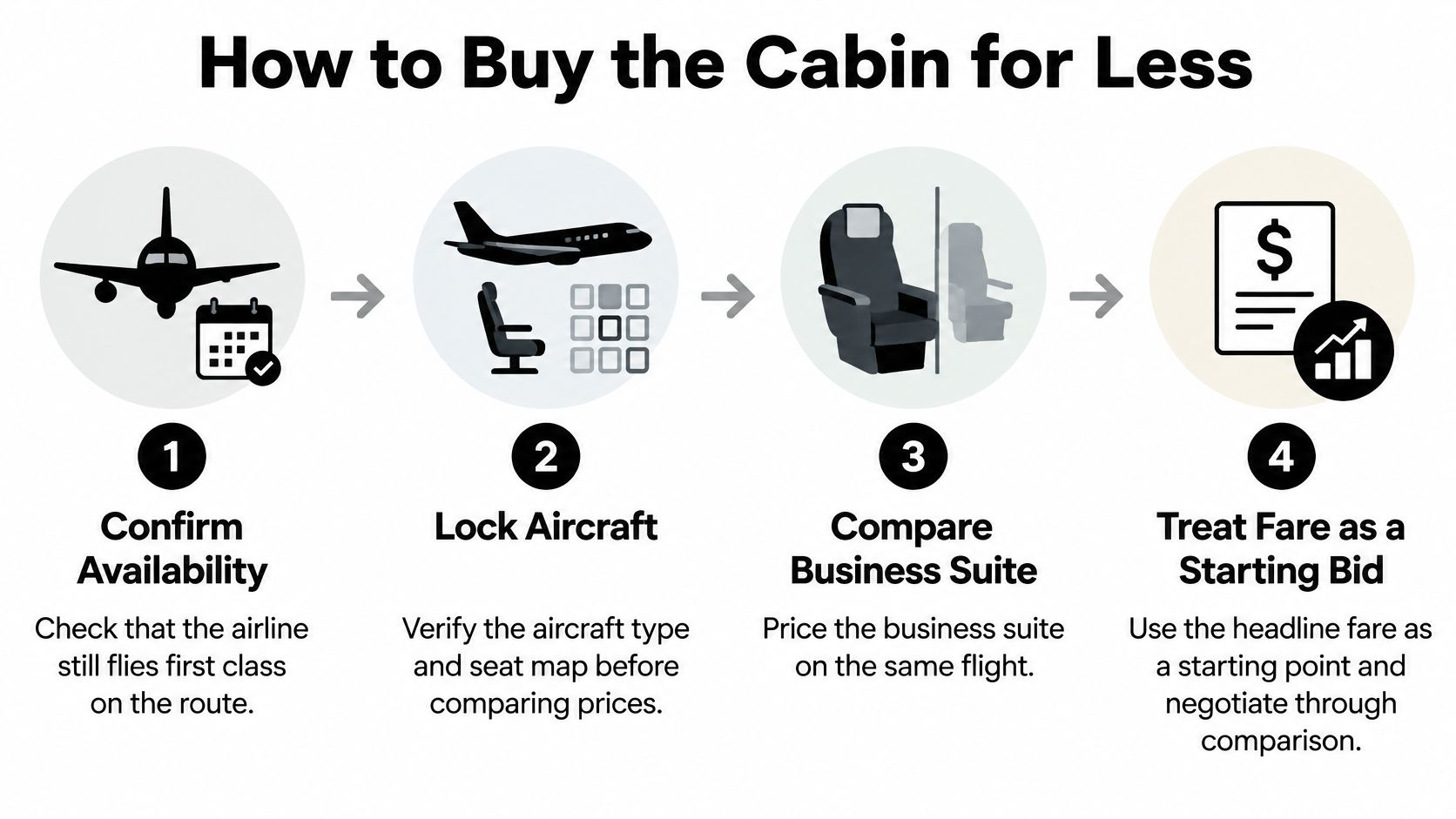
Build a purchase shortlist
Confirm the operating product. Find the operating carrier, aircraft type, and seat map for each long-haul segment. Record which features justify considering first class, rather than relying on the cabin name in search results.
Price the business alternative. Use the same dates and acceptable airports. Keep a first-class candidate only when its additional space, service, or ground arrangements address a real preference or requirement.
Choose your monitoring method. Airline alerts, flexible-date searches, and a specialist membership are options. Passport Premiere monitors premium-cabin fare cycles, fare wars, and buying events; its international first-class tracking information explains the monitoring approach, and travelers should review published membership fees before joining.
Set a decision threshold. Decide which itinerary, cabin, conditions, and total price you would accept. A clear threshold helps you act on a suitable fare without buying merely because an advertisement calls it a sale.
Time the search without depending on luck
SmarterTravel identifies January and February as slower long-haul months, describes British Airways and Virgin Atlantic promotions around Black Friday and Cyber Monday, and outlines upgrade bidding on Air Canada, ANA, Cathay Pacific, Etihad, Lufthansa, Qantas, and Virgin Atlantic, with results arriving a few days before departure.
Use seasonal windows as search prompts. Check departures you can use rather than reshaping the whole trip around a promotional headline. A calendar event is a reason to compare prices, not a promise of a bargain.
Read the rules before payment. Verify change and cancellation terms, ticketing deadlines, baggage, lounge access, and every segment's cabin. Reject a mixed-cabin itinerary if the long flight doesn't provide the comfort you're buying.
Keep upgrade bids as a backup. Eligible travelers generally buy economy, receive an invitation, and submit a bid above the carrier's minimum. Only use that route if you're willing to take the original economy seat when the bid fails.
For corporate bookings, retain the fare conditions and approval rationale with the itinerary. For leisure travel, make sure everyone in the party accepts the fallback before relying on a speculative upgrade.
Book First Class Only When the Extras Pay
Buy first class when the aircraft provides the space you want, the ticket includes useful extras, and the fare is acceptable against realistic alternatives. A discounted fare strengthens the case, but a traveler with fixed needs may reasonably pay more for certainty rather than wait for a correction that never arrives.
Apply a simple purchase test:
- The product qualifies. The scheduled aircraft has the enclosure, sleeping surface, and layout that motivated the purchase.
- The inclusions qualify. The lounge, transfers, service, or baggage benefits you value apply to your fare and airports.
- The price qualifies. The difference from a suitable business ticket is worth those additional benefits to you.
For a corporate manager, the justification should be explainable to the budget owner. For a leisure traveler, enjoyment is a legitimate benefit, provided it fits the trip's spending priorities.
Don't let the search for exclusivity replace the original purpose of the journey. A convenient business suite can be a better purchase than an exceptional first-class seat attached to a poor schedule.
Make the final check before payment
Reopen the operating flight details and compare the final ticket total with your chosen alternative. Confirm the rules, save the product description, and check that the premium cabin applies where it matters.
Then book the option that wins on total value. The right purchase may be first class, but it doesn't have to be.
Passport Premiere offers premium-cabin fare monitoring and market analysis for travelers comparing international business and first class. Visit Passport Premiere to review its membership options and decide whether purchase-timing intelligence fits your next long-haul trip.
