
You're staring at a $7,000 Tokyo business-class fare, wondering whether comfort is worth accepting a fourteen-hour economy flight instead. That price is real, but it isn't the market. Cheap business class to Japan appears when route capacity, demand, fare inventory, and airline competition line up. The traveler who waits for that alignment can sometimes find a premium seat priced close to, or even below, what coach costs on the same journey.
The mistake is treating airfare as a fixed product with a fixed price. It's an event-driven market. Your advantage comes from identifying the fare cycle, monitoring several origin and destination combinations, and acting when the right inventory opens.
Why Cheap Business Class to Japan Is Real
A Tokyo business-class seat can show $5,000 or more on Monday and fall below $2,000 when the airline needs to stimulate demand. That swing is not an error. It reflects changing booking classes, route competition, departure dates, and the amount of premium inventory still available. Cheap business class to Japan exists, but only during specific points in the fare cycle.
Airlines price these routes around strong corporate demand and uneven capacity. ANA, JAL, United, Delta, and their alliance partners adjust fares in response to one another, often creating brief discounts on city pairs that otherwise command premium prices. A published fare shows what the airline wants at that moment, not the lowest price it will accept later.
Route capacity adds pressure to the market. Fewer available seats can support high fares, while extra flights or weaker demand can force carriers to open cheaper booking classes. Wide-body aircraft also devote a substantial share of their cabins to business class, giving airlines a large block of high-value inventory to manage. Route capacity and Japan fare analysis illustrates how capacity and cabin mix influence the fare cycle, but treat its route figures as directional rather than definitive.
The headline fare isn't the target
Fare distributions show why a single search produces the wrong conclusion. Observed round-trip business-class fares to Japan have reached $758, while another market summary reports a low of $1,137 and an average of $5,473. The cheapest fare seen in the prior two weeks was $1,820, compared with an average near $4,335. Those figures describe volatility, not a price guarantee.
Practical rule: Treat a high fare as a timing signal, not a verdict. If your dates can move, keep watching.
Track fare cycles instead of relying on one flexible-date calendar. Compare East Coast and West Coast origins, test cash and award options, and check HND, NRT, KIX, and FUK rather than treating Japan as one market. Set a ceiling before searching, then book when the fare reaches it.
Random searches rarely beat a monitoring process. Search engines show the inventory available now, not whether the fare is unusually high or a cheaper booking class may return. Monitor several origin, destination, and travel-date combinations. The same cabin can move from a sub-$2,000 opportunity to a $5,000-plus fare while you wait. The timing window, not the headline price, determines whether the deal is real.
Reading the Price Spread the Right Way
The spread between the observed low of $758 round trip and the reported $5,473 average isn't a promise that every traveler can buy the lowest fare. It's evidence that Japan business-class pricing is volatile. Buyers should read that distribution as a map of possible market conditions, not as a normal price range available on demand.
A fare moves because airlines open and close booking classes, competitors react, and demand changes by travel date and departure airport. A nonstop from an East Coast gateway may carry a large premium over a one-stop itinerary from the West Coast. A Tuesday departure can behave differently from a Saturday departure even when the aircraft and cabin are identical.
The left tail is where the opportunity lives
Travelers usually miss the lowest fares for predictable reasons:
- They search once: A one-time result captures one inventory state, not the route's full cycle.
- They search too early: Peak-season fares can remain expensive months before departure, especially when demand is obvious.
- They ignore gateways: A nearby positioning flight can expose a cheaper fare market.
- They insist on nonstop service: One-stop itineraries often create more pricing competition.
- They focus only on HND: NRT, KIX, and FUK can carry different inventory and demand patterns.
The verified fare data supports a sharp conclusion. One neutral fare index places average U.S.-Japan business-class pricing around $3,716 to $4,271, depending on market and sample, while another route comparison showed Tokyo fares starting around $2,914 against a typical fare near $8,102. A route-level comparison of Japan business fares makes a sub-$3,000 itinerary look like what it is, an outlier that generally requires flexible dates, a lower-yield origin, or unusually favorable inventory.
| Route | Observed Low (RT) | Average (RT) | Peak (RT) |
|---|---|---|---|
| U.S. to Japan route family | $758 | $5,473 | $8,102 typical Tokyo fare |
The precise timing of every drop can't be guaranteed, and you shouldn't build a plan around an invented “magic day.” The practical approach is to watch for repeated movement across your chosen route family. When a fare falls sharply below its recent level, verify the cabin, fare rules, connection quality, and ticketing deadline immediately.
Timing Your Booking Window
A Tokyo business-class seat can move from about $1,650 to above $4,800 without changing aircraft or cabin. The difference is often the booking window, demand period, and fare inventory available when you search. For shoulder-season trips, start monitoring roughly 10 to 16 weeks before departure, then act when the fare breaks below its recent range. A Japan business-class booking guide also identifies Tuesday and Wednesday departures as generally cheaper than Friday and Saturday, with West Coast gateways often pricing below East Coast nonstops.
Use a shorter window for quieter dates and a longer one for predictable demand. Late January and mid-November departures can justify searches about six to ten weeks out. Spring travel deserves attention around four to six months ahead because cherry blossom demand and Golden Week can remove attractive inventory early.
| Monitor early | Monitor later |
|---|---|
| Cherry blossom travel: Peak spring dates. Search around four to six months ahead because demand concentrates quickly. | Late February and early March: Begin watching around 10 to 16 weeks out, then compare each fare against its recent movement. |
| Golden Week: April 29 through May 5. Treat this as a pressured period and search well before ordinary shoulder-season timing. | June: Often a quieter period for Japan travel. Watch for drops rather than assuming a particular booking day will produce one. |
| Obon: Mid-August, plus New Year from December 28 through January 4. Expect tighter inventory and monitor earlier than usual. | October: Start tracking early, but wait for a meaningful fare break instead of buying solely because the month is traditionally cheaper. |
A San Francisco to Tokyo Haneda itinerary for early March shows why volatility matters. A fare found about 56 days before departure could land near $1,650, while the same flight booked 120 days out for peak cherry blossom week could exceed $4,800. Treat that comparison as a timing pattern, not a promised quote. Date, fare class, and availability still have to align.
For a clearer explanation of booking-window mechanics, read this guide to when to book business-class flights.
Rebooking move: If changes are permitted, secure a workable fare, keep monitoring, and reissue when the same inventory drops by more than $400. Confirm the fare difference, ticketing deadline, and change conditions first.
Award Miles vs Cash Fares
Cash and points solve different problems. Cash fares usually offer better flexibility, simpler ticketing, and more useful one-way options. Awards become more valuable when peak-season cash pricing rises past $4,000, because the mileage requirement may remain comparatively stable even while the retail fare becomes unreasonable.
The award strategy must be route-specific. ANA Mileage Club round trips from the United States can price at 88,000 to 95,000 miles in business class, United MileagePlus can reach 70,000 to 80,000 miles with careful routing, and Aeroplan can fall within 55,000 to 75,000 points through partner carriers. These figures come from the supplied booking framework, so verify the live award calendar, taxes, carrier charges, and routing rules before transferring anything.
| Strategy | Typical Cost | Best For | Watch Out For |
|---|---|---|---|
| Cash fare | Varies by inventory and route | Flexible dates, last-minute availability, one-way travel | Retail prices can surge during peak demand |
| ANA award | 88,000 to 95,000 miles round trip | Travelers targeting ANA availability | Award space can be limited |
| United MileagePlus | 70,000 to 80,000 miles | Careful partner and hub routing | Dynamic pricing and routing differences |
| Aeroplan partner award | 55,000 to 75,000 points | Partner availability and planned trips | Taxes, fees, and transfer timing |
| Hybrid itinerary | Cash positioning plus an award | Travelers near a saver gateway | Separate-ticket connection risk |
JAL Mileage Bank and Asia Miles can be difficult during peak periods because premium-cabin award space is scarce. JAL's North America to Japan business awards were also revised upward in 2025, so old redemption advice can be dangerously stale.
When hybrid wins
A hybrid itinerary uses a cheap cash flight to a gateway such as Vancouver or Honolulu, followed by an award segment to Japan. It can reveal saver space that isn't available from your home airport, but separate tickets require generous protection against missed connections, baggage complications, and schedule changes.
A useful comparison is a Tokyo summer itinerary booked 11 months ahead for 75,000 Aeroplan miles, versus the same date at $5,200 cash. The award isn't automatically superior. Taxes, fees, transfer risk, and the value of your points still matter. But during peak demand, the stability of a confirmed award can beat waiting indefinitely for a cash sale.
Before moving points, review this MileagePlus upgrade and award guide and confirm that the specific itinerary fits your account and travel needs.
Routing Tricks That Lower the Fare
A Tokyo business-class seat can swing from $1,950 to $5,200 on the same broad route. The airport pair and connection plan often matter more than the airline you prefer. West Coast gateways such as LAX, SFO, SEA, and YVR usually price better than eastern origins because they sit closer to Japan and face heavier transpacific competition. A positioning flight to Los Angeles can beat a JFK to Haneda itinerary, provided you leave enough time between separate tickets.
Vancouver can expose Air Canada and ANA inventory, while Toronto may offer seasonal ANA nonstop options. Some travelers also test Mexico City or MEX to IAH to Japan through United. Each additional segment raises the risk of misconnection, schedule disruption, and baggage problems, so compare the saving against the operational burden.
Build the comparison around gateways
Start with a small route matrix, then narrow it to fares that survive a real trip:
- West Coast origin: Search LAX, SFO, SEA, and YVR to HND, NRT, KIX, and FUK.
- Home airport versus positioning: Compare your full itinerary through a U.S. hub with a separate ticket to the gateway.
- Asian connection: Test Taipei, Seoul, and other regional hubs before Japan.
- European connection: Check Istanbul or Helsinki only when the fare reduction justifies the extra travel time.
- Open-jaw itinerary: Arrive in Tokyo and leave from Osaka, or reverse the pattern. An open-jaw flight planning resource can help organize those combinations.
Connections through Istanbul, Helsinki, or Taipei can sometimes cut $800 or more from the fare. Taipei to Narita on JX and Seoul to Narita on OZ may also expose lower-priced premium inventory. Osaka can price 15% to 25% below Tokyo on comparable searches, which suits itineraries that already include Kyoto or western Japan. Treat these as search signals, not guarantees. Inventory changes quickly.
One comparison shows the tradeoff clearly. A SEA to IAH to HND itinerary could appear near $1,950 round trip, while a comparable JFK to HND nonstop could sit around $3,400. The cheaper ticket costs more time and adds connection exposure. That can still be the right decision when the savings cover a positioning flight, a buffer night, or the inconvenience of a longer journey.
Route discipline: Compare total travel time, airport changes, connection protection, baggage rules, and the aircraft assigned to every premium segment, not just the displayed fare.
Search each arrival and departure combination separately. The cheapest Tokyo fare may become more useful when you return from Osaka, and a slightly longer route can beat a nonstop once the fare difference is large enough.
Monitoring Fare Volatility
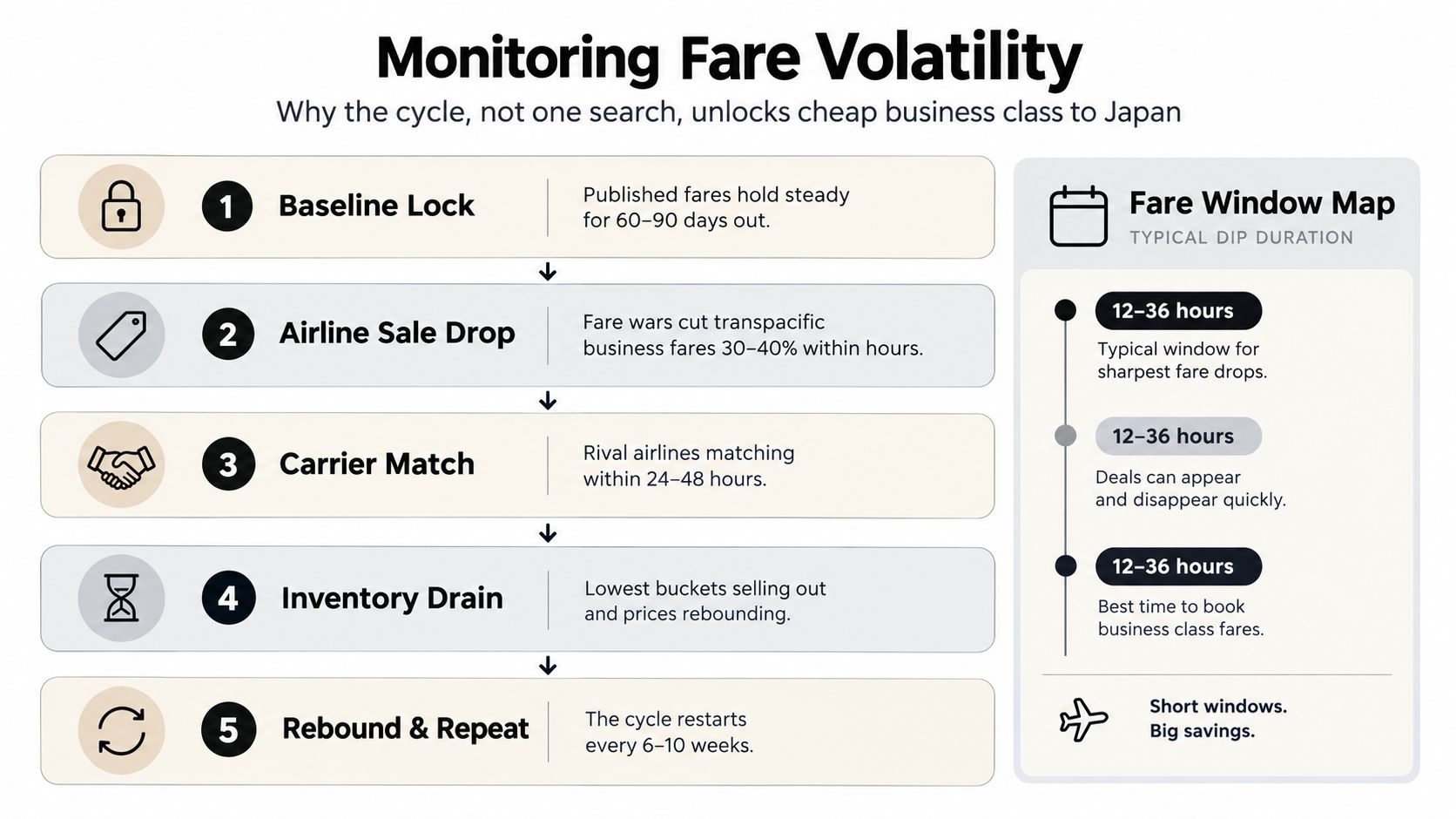
A Tokyo business-class seat can sit near $1,950, then climb above $5,000 after the lower booking classes disappear. A single search captures only today's price. Tracking the movement shows whether you are seeing a real opportunity or a temporary gap.
Airlines commonly adjust transpacific fares in response to competitors and booking activity. One carrier loads a lower fare, another matches it, and the cheapest inventory can vanish as seats sell. Our monitoring framework models this movement as a cycle that may develop over 6 to 12 weeks, with worthwhile drops appearing briefly. The cycle includes baseline pricing, a sale, a competitor match, inventory depletion, and a rebound that may return every 6 to 10 weeks, as shown in the fare-volatility infographic.
The practical rule is simple: record the fare before judging it. A price that looks low in isolation may be ordinary for that route, while a brief drop against its recent baseline deserves immediate review.
Build a watch system, not a larger spreadsheet
A weekly matrix can cover home airports, positioning gateways, four Japanese airports, multiple travel dates, and nonstop or connecting routes. It teaches you the market, but manual searching still misses changes that appear overnight or disappear before the next check.
Set up monitoring around the decisions that affect the ticket:
- Group routes: Include home airports, positioning gateways, and Japanese alternatives.
- Use flexible dates: Track a range rather than one departure and return pair.
- Specify the cabin: Confirm that alerts target business inventory, not premium economy.
- Set a ceiling: Compare new fares with your recorded baseline before calling them bargains.
- Verify quickly: Check the airline site, fare basis, operating carrier, aircraft, connection, baggage, and ticket rules.
Passport Premiere fare monitoring and deal signals can identify Japan-related premium-cabin drops by routing class and booking bucket. Use it to spot movement, then validate the actual ticket before transferring points or booking.
When an alert arrives, inspect the itinerary immediately. Confirm the cabin and fare basis, save the result, and act while the lowest class remains available. The objective is not endless searching. It is recognizing a meaningful Tokyo fare drop before the market resets.
Your Cheap Business Class Playbook in Action
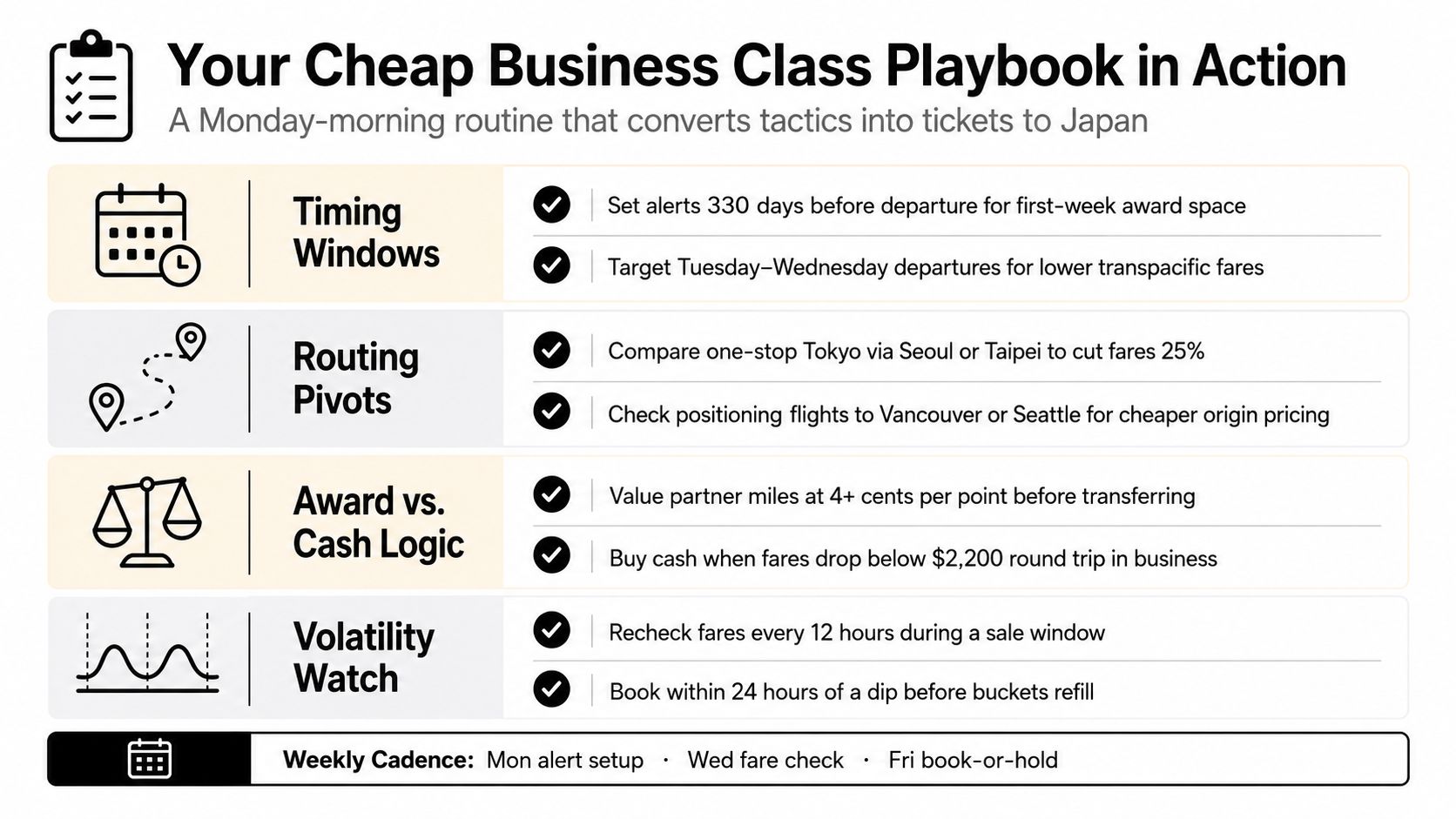
Turn the strategy into a routine you can run every week. Start with a 14-day rolling date search across three origin gateways, then compare the same dates through awards and positioning airports. Don't wait for a perfect result from one city pair. The cheapest business class to Japan ticket often appears only after you widen the map.
The Monday routine
- Define flexibility: Choose your acceptable travel period, cabin, maximum connection time, and Japanese arrival airports.
- Set the baseline: Record current cash fares for your three origin groups and your preferred destination airports.
- Layer awards: Search partner programs on the same routes before transferring points.
- Set the ceiling: Create a fare alert tied to your actual budget and route tolerance.
- Watch movement: Treat a 20% drop versus the trailing average as a trigger to investigate, not as an automatic purchase.
- Validate directly: Recheck the airline calendar, operating carrier, aircraft, baggage, and cancellation terms.
- Act quickly: Book the cash fare or transfer points within 24 hours when the itinerary passes your checks.
- Walk away deliberately: If the cabin is wrong, the connection is unsafe, or the terms undermine the savings, keep monitoring.
Build comfort into the operating plan
Long-haul comfort doesn't end at the seat. If you're repositioning, connecting, or working across time zones, small practical choices can protect the value of the itinerary. Travelers who want to reduce neck strain during airport waits and flights can browse travel neck pillows at SunnyBay as part of their preparation.
Keep the cadence consistent. Monday is for alert setup, Wednesday is for checking fare movement, and Friday is for deciding whether to book or hold. Your records should show the route, date, cabin, price, and reason for rejecting an offer. That history makes the next alert easier to judge.
Cheap business class to Japan isn't a lucky search. It's a repeatable purchasing system built around route flexibility, award awareness, and fast responses to temporary inventory. The traveler who watches the cycle has a better chance of buying the seat when the airline is discounting it, rather than when the airline is testing the highest price the market will tolerate.
Passport Premiere tracks premium-cabin fare cycles, price drops, and Japan-related business-class opportunities so you can judge whether a fare is attractive before booking. Visit Passport Premiere to explore its fare monitoring and market-intelligence membership, then set your Japan routes and price ceiling before the next drop appears.
