
The most popular advice about business class is also the least useful: compare the cheapest economy ticket with the most expensive business fare, then call the upgrade a waste of money. That comparison answers the wrong question. Business class can sometimes be cheaper than coach, but only when airline pricing becomes distorted. The normal relationship is still heavily tilted toward economy, with KAYAK listing typical global averages of about US$868 for international economy versus US$4,227 for international business (KAYAK's fare guide).
The sharper question is this: when is the published business fare inflated enough that a discount changes the entire calculation? That depends on the route, the departure date, your need for sleep, the value of your arrival-day time, and whether the airline is carrying unsold premium inventory. This guide gives you a practical way to decide instead of relying on the lazy “business is worth it for long flights” rule.
The Question Most Travelers Ask Wrong
Airlines don't price business class as a simple comfort upgrade. They price it as a high-yield product, and premium cabins now contribute disproportionately to airline revenue. McKinsey reports that between 2019 and 2025, business-class and first-class cabins across several major markets contributed a growing share of passengers and an even faster-growing share of revenue, while IATA says premium fares contribute about 15% of passenger revenue excluding ancillary income despite occupying a much smaller share of seats (McKinsey's premium-cabin analysis).
That structure creates a misleading comparison. A traveler sees a discounted economy fare beside a protected, high-yield business fare and concludes that the front cabin is irrational. Often, the traveler is right about that specific fare. But the conclusion doesn't apply to every business-class ticket, because airlines don't always sell premium seats at the initial asking price.
List price isn't the same as market value
A University of North Carolina paper on airline revenue management found an economy-to-premium seat ratio of about 11 to 1 across operated flights, with both cabins averaging just above 80% load factor at departure in the study dataset. Average premium fares were about $379, compared with $184 for economy, making the premium fare roughly 106% higher in that sample (the UNC revenue-management paper).
The implication is important. Airlines may have fewer premium seats, protect them for high-yield buyers, and still depart with some of them empty. An empty seat has no value after takeoff, but the carrier may prefer to leave it unsold rather than train customers to expect permanent discounts. When demand softens, fare events, competitive pressure, or inventory changes can force the airline to accept less.
The real buying decision: don't ask whether business class is worth the full published price. Ask whether the current premium is reasonable for this flight, this traveler, and this arrival schedule.
That turns a binary debate into an ROI decision. A rested executive flying overnight to a board meeting has a different threshold from a leisure traveler on a daytime hop. A consultant who can bill after landing has a different calculation from a family that wants a more comfortable holiday flight.
What Business Class Actually Buys You
Business class earns its price through space, sleep, and reduced friction, not through a better meal. On long-haul aircraft, business-class seat pitch commonly ranges from about 55 to 80+ inches, and many layouts convert into fully flat beds. Economy commonly offers about 28 to 32 inches of pitch and a shallow recline, according to this seat-pitch comparison.
That difference changes what you can do with the flight. In economy, an overnight sector often becomes a negotiation with your neck, knees, and the passenger in front of you. In business, a lie-flat seat can turn the same cabin time into usable sleep. The benefit isn't “more luxury” in the abstract. It's the possibility of arriving functional rather than spending the first day recovering.
Evaluate the seat by its output
A lie-flat bed matters most when the flight overlaps your normal sleep window. Direct aisle access matters when you need to work, use the lavatory, or leave your seat without disturbing another passenger. A wider surface and a laptop-friendly table matter if the alternative is losing productive hours before an important meeting.
The best test is practical:
- Sleep: How many hours can you realistically sleep or rest in a flat position?
- Work: Can you prepare, write, or take calls without fighting for elbow room?
- Arrival: Do you need to perform immediately after landing?
- Recovery: Will economy force you to lose part of the next day?
Lounge access belongs in the same calculation. Treat it as a productivity surface, not a champagne entitlement. A quiet seat, reliable power, food, Wi-Fi, and a shower can reduce airport fatigue before a long flight, especially when you're traveling for work. Fast-track security, dedicated check-in, and priority baggage matter only if they reduce stress or protect a tight schedule.
Use the three-output test
Before paying, estimate the outputs you need:
- Hours of sleep gained, especially on an overnight route.
- Hours of billable or decision-critical work protected on arrival day.
- Hours of recovery avoided, including lost meetings, reduced concentration, or a wasted first vacation day.
A business seat can be materially better than economy and still be a poor purchase. The product delivers the most value when it protects one of those outputs. If you're flying for three hours in daylight and have no work obligation afterward, much of the business-class package becomes expensive theater.
For a closer look at the feature that usually drives the decision, compare the practical differences in business-class lie-flat seats. The question isn't whether the seat looks premium. It's whether the seat changes what you can do after landing.
The Hourly Value of Rest and Productivity
The cleanest way to decide is to price the time business class protects. Start with the fare premium, not the total ticket price. If economy costs $900 and business costs $2,100, your decision concerns the $1,200 difference, not the full $2,100.
Use this formula:
Breakeven value = recovered sleep hours × hourly value + protected arrival-day work + avoided recovery cost
For a self-employed traveler, hourly value may be close to a billable rate. For a salaried employee, it may be better represented by the value of a meeting, a decision, or a day of usable output. Don't pretend every hour of sleep converts directly into cash. Assign a conservative value and see whether the fare still clears the test.
A worked overnight example
Consider a New York to London redeye. Suppose you estimate 6 hours of usable sleep in business versus 2 hours in economy, giving you 4 recovered hours. If your billable rate is $150 per hour, those recovered hours represent $600 in potential value.
Now add the protected work window. If you have a same-day meeting and business class lets you prepare, participate, and follow up without losing the morning, you might assign an additional value based on your role. The fare premium becomes rational only when the total of recovered sleep, protected work, and avoided recovery exceeds the extra cost.
The calculation changes sharply by traveler:
- Self-employed consultant: A direct connection between recovered capacity and billable work can make a premium defensible.
- Salaried employee: Salary alone doesn't justify the fare. The meeting's importance, company policy, and expected output matter more.
- Leisure traveler: The value is personal rather than financial. You may still buy business, but call it a comfort purchase, not an ROI purchase.
Cost-per-hour-saved breakeven on overnight long-haul
| Variable | Value | Notes |
|---|---|---|
| Usable sleep in business | 6 hours | Example assumption for the calculation |
| Usable sleep in economy | 2 hours | Example assumption for the calculation |
| Sleep recovered | 4 hours | Difference between the two assumptions |
| Hourly value | $150 | Example billable rate |
| Sleep value | $600 | 4 hours multiplied by $150 |
| Breakeven premium | Depends on arrival-day value | Add protected work and avoided recovery |
A short daytime flight almost never clears this threshold because the seat doesn't protect enough sleep or productive time. For comparison, people who outsource airport transfers can use an hourly luxury car when ground-time efficiency has a clear value. The same principle applies in the cabin: pay for time protection when you can identify what that time is worth.
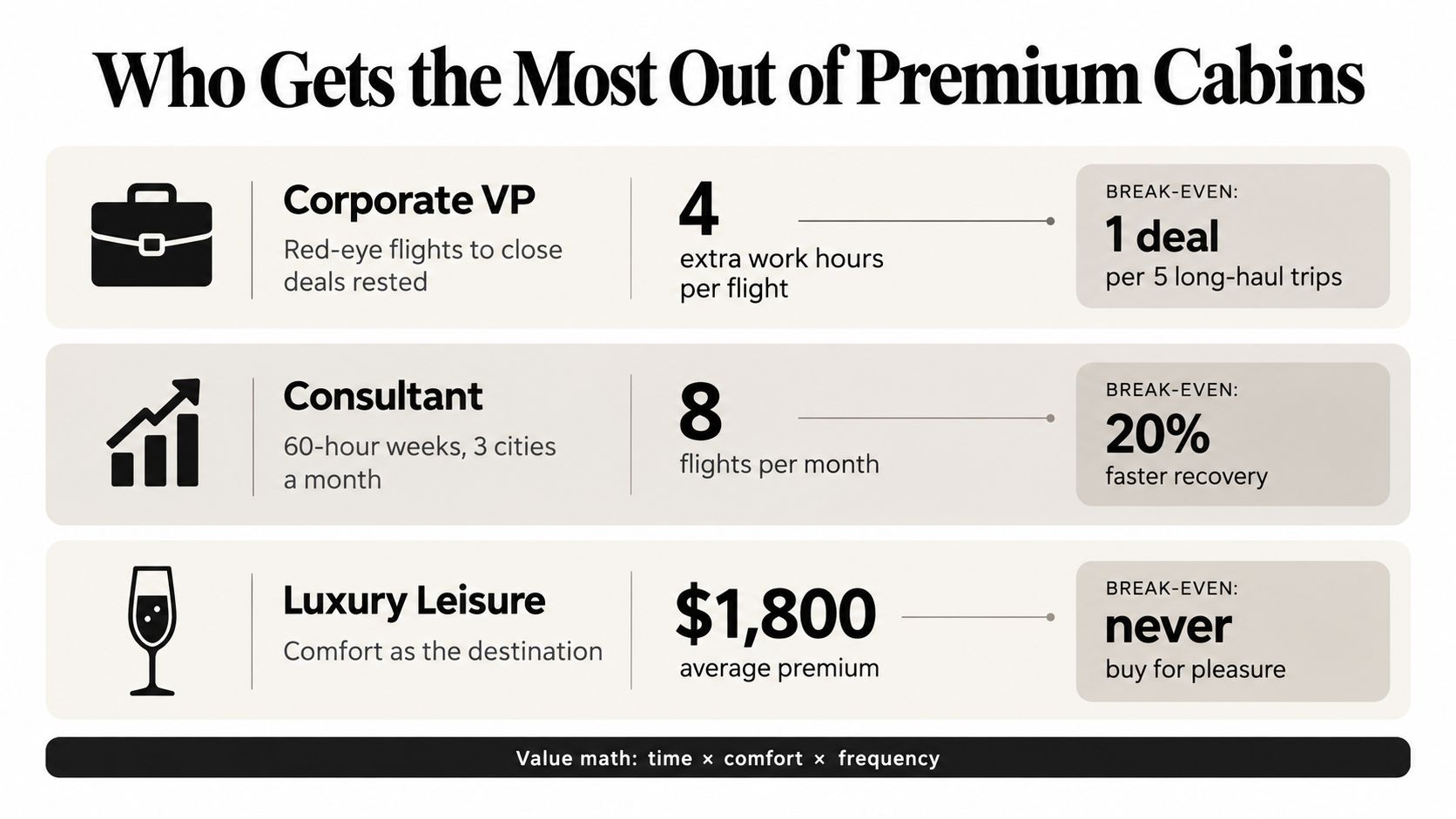
Who Gets the Most Out of Premium Cabins
The strongest business-class buyer isn't necessarily the wealthiest traveler. It's the person whose itinerary turns fatigue into a measurable cost.
The corporate VP
A VP flying JFK to Tokyo for a Monday board meeting has a narrow decision. The fare matters, but the bigger issue is whether the traveler can arrive, shower, review the agenda, and make high-stakes decisions without spending the morning recovering.
For this profile, business class is strongest on an overnight itinerary with a meeting soon after arrival. The company shouldn't approve it because the cabin looks impressive. It should approve it when the arrival-day performance risk is higher than the fare premium.
A weekday schedule can also matter. A lower-demand departure may provide a more defensible premium fare than a peak return, especially when the airline is trying to fill protected inventory.
The consultant
The consultant flying between London, Singapore, and other client cities has a different equation. The cabin functions as a portable office and recovery room. A lie-flat seat may protect preparation time before a client session, while lounge access gives the traveler a controlled place to work between airport and aircraft.
This traveler should track the premium against the number of long-haul sectors in the schedule. A single expensive upgrade may be indulgent. Repeated overnight flights can turn small productivity losses into a recurring operating cost. The consultant should also distinguish between time that can be billed and time that merely feels more pleasant.
The luxury leisure traveler
A leisure traveler flying to Singapore may not have a business case at all. The reason to buy can be the experience: a flat bed, a quieter cabin, a better start to the trip, and less exhaustion on arrival. That's a valid purchase, but the traveler shouldn't disguise it as financial efficiency.
Pleasure is a legitimate reason to fly business. It just needs a pleasure budget, not a fabricated productivity calculation.
The attributes that predict strong value are consistent across profiles:
- Overnight timing: The flight overlaps sleep.
- Long distance: Economy fatigue has more time to accumulate.
- Immediate obligations: A meeting, event, or first-day itinerary starts soon.
- Flexible dates: You can avoid the most expensive departure and return patterns.
- Discount access: The premium has fallen enough to match the trip's value.
Watch the video below for another visual perspective on the business-class decision.
Sample Fare Gaps on Real Long-Haul Routes
Business class is rarely worth its published premium. The better question is whether that premium has been inflated by demand, then cut far enough for the trip's value to justify buying it. Route snapshots without a travel date, airline, fare rules, and live inventory can mislead, so compare market relationships rather than invented prices.
KAYAK's global baseline, cited earlier, places typical international economy around US$868 and business around US$4,227, a gap of roughly US$3,359 per ticket. Independent analysis found business class averaging 250% more than economy across a sample of routes (Holidu's business-class fare analysis). That spread is the starting point, not a verdict. A discounted business fare can change the calculation completely.
A defensible route comparison
| Route | Economy (Shoulder) | Business (Shoulder) | Business/Economy Multiple | Peak Premium Markup |
|---|---|---|---|---|
| New York to London | Varies by date and fare rules | Varies by date and fare rules | Often materially above economy | Can widen sharply on peak departures |
| Los Angeles to Tokyo | Varies by date and fare rules | Varies by date and fare rules | Long-haul premium usually substantial | Demand and aircraft product matter |
| Chicago to Frankfurt | Varies by date and fare rules | Varies by date and fare rules | Discount events can compress the gap | Business demand can rise around work travel |
| Sydney to Los Angeles | Varies by date and fare rules | Varies by date and fare rules | Ultra-long-haul comfort can command a large spread | School holidays and peak returns can inflate fares |
The table avoids false precision. A single route price says little without the aircraft, cabin layout, connection, fare basis, and departure date. Judge the fare against the normal relationship for that city pair, then ask whether the compressed premium buys meaningful sleep, usable work time, or a better arrival.
Why the ratio moves
Airlines can price a Tuesday departure far below a Friday return because demand differs. A fare war may compress business class on one route, while a high-demand weekend keeps the forward cabin expensive. Flexible dates give you access to those gaps. Passport Premiere's business-class flight comparison can help compare the complete itinerary, including aircraft, seat layout, connection risk, baggage, lounge access, and change conditions.
Timing matters as much as the route. Watch for fare events before assuming the cabin is unaffordable, then compare the discounted fare with the cost of arriving exhausted or losing productive hours. A cheap business ticket with a poor connection can still lose to a slightly higher nonstop that protects sleep. The published fare is only the headline. The decision that matters is the price after the market has exposed its weakness.
Why Business Class Can Sometimes Beat Coach on Price
Business class can appear cheaper than coach, but the crossover is an exception created by fare mechanics, not the normal airline model. Skyscanner illustrates the usual relationship with an Air Canada example from Vancouver to Singapore: business started at about C$5,700, while economy started at C$425 on the same day (Skyscanner's business-class fare guidance).
The rare opposite result usually comes from mismatched fare buckets. A restricted economy fare may sell out, while a promotional business fare remains available. A carrier can then display business below that particular economy option, even though business remains above the broader economy market.
The empty-seat problem
Premium cabins aren't always full at the price airlines first publish. An industry analysis reported Emirates premium-cabin load factor at about 73% or higher in recent years, while revenue-management commentary describes airlines protecting high-yield premium inventory rather than discounting aggressively (Skift's premium-cabin analysis).
That creates a narrow opportunity. A carrier might hold a business seat at a high price while demand remains strong, then release lower fare inventory when the departure approaches and the seat still hasn't sold. The traveler sees a sudden price change, but the airline sees an inventory decision.
Other triggers can produce the same effect:
- Fare wars: Competing airlines cut premium fares to defend a route.
- Schedule changes: A revised timetable leaves flat-bed inventory on a less attractive departure.
- Contract releases: Corporate seat blocks return to public inventory after booking patterns change.
- Connecting-market pressure: The airline adjusts premium pricing to support broader network demand.
A price that is lower than one economy option still requires scrutiny. Check whether the business fare includes the same direction, dates, baggage, connection, and change conditions. The comparison must be like for like.
Advance-purchase rules can also affect the result, so review advance purchase excursion fares before assuming a displayed price is a genuine market anomaly. Timing alerts generally outperform static searches because a fare event may last only until the airline closes that inventory bucket.
When Business Class Pays Off and When to Skip It
My recommendation is simple: buy business class for protected performance, not vague comfort. The exception is a fare event that makes the premium small enough that comfort becomes a reasonable bonus.
The airline economics support discipline. McKinsey and IATA data show why premium seats command attention from carriers, while the UNC research shows why the average premium fare can be materially higher than economy. You shouldn't fight that pricing structure by paying whatever the first search result demands.
Use this decision table
| Scenario | Recommendation | Fare Gap Trigger | Passport Premiere Edge |
|---|---|---|---|
| Overnight long-haul, executive billing $300+ per hour | Book if arrival-day performance matters | Under $1,200 one-way is a strong starting threshold | Surface fare events when premium inventory softens |
| Transcontinental hop under four hours | Usually skip | Skip when the flight is under three hours or daytime | Compare only when the product materially changes the itinerary |
| Family leisure vacation under six hours | Usually skip | Skip when there are no work or sleep obligations | Watch for an unusually low premium spread |
| Ultra-long-haul economy itinerary | Consider business carefully | Buy when a discount makes the premium fit your comfort budget | Track changes instead of accepting the initial asking price |
| Same-day meeting after an overnight flight | Strong case for business | The fare can clear if it protects preparation and recovery | Help identify when the published gap has compressed |
| Leisure trip with no schedule pressure | Buy only for pleasure | Skip when the premium exceeds your personal comfort budget | Give you a market reference before purchasing |
The $1,200 one-way trigger is not a universal law. It's a practical discipline point for a traveler who can attach real value to sleep and arrival-day work. A fare premium above $2,500 demands a much stronger reason, such as an unusually important meeting, an ultra-long sector, or a deliberate luxury purchase.
Don't confuse a cabin decision with broader travel-budget control. Corporate teams comparing approval thresholds, traveler productivity, and policy exceptions may also benefit from reviewing Snyp travel expense management as part of their travel-spend process.
Passport Premiere monitors premium fare movements, analyzes fare events, and helps travelers identify when business-class inventory is priced below its usual market relationship. Use it as a timing aid, not as permission to buy every discounted seat. The correct outcome may still be economy or premium economy.
Your final rule should be blunt. Skip business on short daytime flights, flexible leisure trips, and any itinerary where the fare premium is larger than the value of your arrival. Buy it on overnight long-haul routes when sleep protects work, when the fare gap has compressed, or when the experience itself is worth the money to you.
Passport Premiere tracks international business and first-class fare events so you can judge whether a premium price is inflated or genuinely attractive. Visit Passport Premiere to monitor discounted premium inventory and make your next cabin decision with a fare target instead of guesswork.
