
The usual advice treats business vs first class international flights as a simple ladder: skip both, or pay whatever the airline asks because the front of the plane is always worth it. That advice compares the wrong tickets. It sets a restricted coach fare against a flexible premium fare, then declares a winner from the gap. On equal conditions, that gap shrinks, and on some filings it reverses, so business class cheaper than coach is a real booking outcome, not a slogan.
A premium cabin is a yield product. Airlines price it against remaining seats, corporate demand, and the rules attached to the ticket, not against the cheapest basic-economy bucket on the screen. First class is the smaller, more exclusive tier. Business class is the cabin that scales across long-haul fleets. The useful question is whether this aircraft, on this route, on this fare basis, buys a horizontal bed and a workable ground plan for less than a flexible coach ticket that already includes changes, bags, and a refund.
Business and First Class Side by Side
Business class is the mainstream premium cabin on long-haul widebody aircraft. First class is a smaller, route-specific product that offers more privacy and a richer ground package. The label on the ticket is a weak predictor. The seat map on the aircraft assigned to your flight is the one that matters.
| Criterion | Business Class | First Class |
|---|---|---|
| Seat layout | Lie-flat, usually 1-2-1 or staggered, direct aisle access for most seats | Enclosed suite on the few airlines and aircraft that still fly it |
| Bed and width | Seat width commonly 20–22 inches, bed length near 78 inches | Wider and longer on flagship suites, unpublished as a single industry standard |
| Privacy | Partial, sometimes a door on newer suites, denser cabin | Full enclosure in most suites |
| Dining and service | Full meal service, lounge access on most carriers | Multi-course dining and more personal service on some airlines |
| Ground benefits | Lounge access and priority check-in on most carriers | Chauffeur, private lounge or shower on select airlines |
| Availability | Nearly all long-haul widebody aircraft | Shrinking, limited to a small set of aircraft and routes |
| Typical long-haul round-trip price | Commonly $3,000 to $5,000 in published fares | Above the business fare on the same route and aircraft |
On a real overnight sector, the business row is a sleep product, not a bigger recliner. AeroCorner's cabin comparison describes common 1-2-1 or staggered layouts with direct aisle access, seat widths typically around 20–22 inches, and bed lengths commonly near 78 inches. Published specs still swing. Some business seats are angled-flat rather than fully horizontal, and dimensions can span roughly 18–23 inches in width and 55–65 inches of pitch or bed space.
Three checks before you trust the cabin name
Run the same three checks on every itinerary, whether the fare says business or first.
- Horizontal surface: The bed has to go flat, not merely recline. An angled-flat seat on a 10-hour sector is a different product from a true lie-flat.
- Aisle for every passenger: A window seat that climbs over a neighbor at 3 a.m. erases much of the sleep you paid for.
- Aircraft type on this flight: A door suite on one airframe and an older open seat on the next departure are not the same purchase.
A newer business suite with a privacy door narrows the gap with first class, but the cabin stays denser and less individualized. First class still pulls ahead when the hard product is a fully enclosed suite, the service ratio is higher, and the ground package adds a lounge shower or a chauffeur on that airline. If you want the product definition before you price it, what first class air travel actually includes is the cleaner starting point than a brand brochure.
The first-class seat is leaving the schedule
That advantage is available on fewer departures every year. Industry coverage of fleet redesigns reports more than 40% fewer scheduled first-class seats in 2024 than in 2019, with fewer than 20 airlines still operating dedicated first-class cabins. Delta, United, Cathay Pacific, British Airways, Lufthansa, Qatar Airways, and Emirates have all cut or restricted where first class flies.
Booking rule: Compare the cabin the exact aircraft on the exact route offers. A first-class ticket can be rebooked onto a different configuration after an aircraft swap, and the suite you paid for may not be the seat you board.
Pricing Patterns Behind Premium Fares
Premium cabins carry a share of revenue that has nothing to do with how many people sit in them. In the first eight months of 2017, premium passengers were only 5.2% of international origin-and-destination passengers but generated 25.5% of airline revenue, because those travelers paid approximately three to six times more than economy passengers on average, according to IATA's premium-demand note. That yield is why inventory is held back, not dumped into the cheapest public bucket.
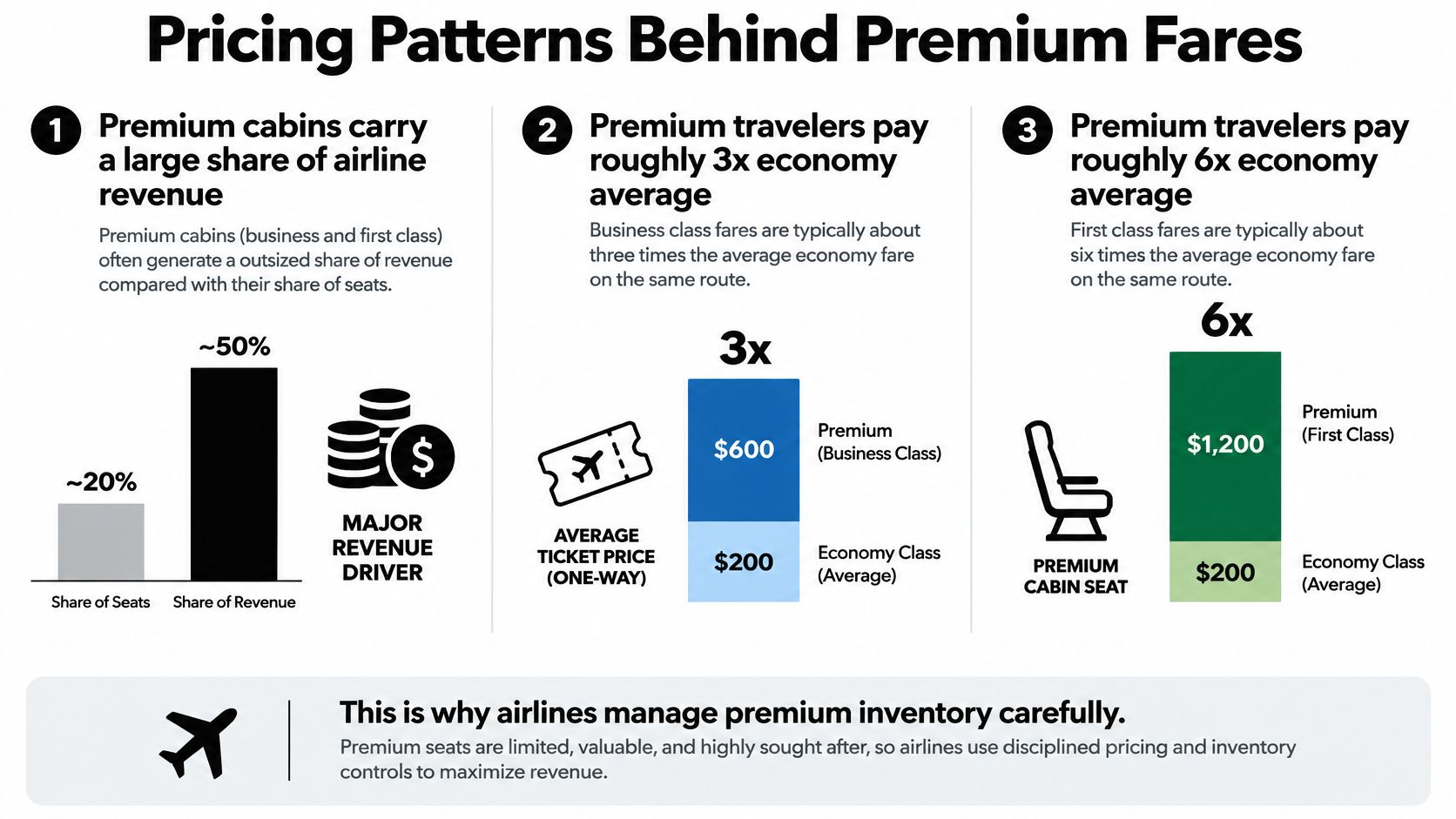
The same yield logic does not freeze the public fare. Three patterns show up in published prices: error filings, promotional sales, and ordinary routes where the gap was never wide.
| Route or Scenario | Premium Fare | Comparable Economy | What Drove the Gap |
|---|---|---|---|
| Long-haul business, standard published fare | $3,000 to $5,000 round trip | Often one third to one sixth of that premium fare | Normal premium pricing on long-haul routes |
| Long-haul business, mistake fare | About $300 round trip | Often above $300 on the same route | Airline or booking-system pricing error, may be cancelled |
| Chicago to London, American Airlines business | $2,389 | Not published next to the sale fare | Promotional sale, reported less than 50% below the 2019 price |
| New York to Paris, La Compagnie business | $1,662 | Not published next to the sale fare | Promotional sale, reported about 68% below the 2019 price |
| New York to Vienna, Austrian Airlines business | $1,861 | Not published next to the sale fare | Promotional sale, reported about 70% below the 2019 price |
| Madrid to Athens, Iberia business | £562 | £454 | Narrow normal gap of £108 |
| Tokyo to Seoul, business | About £289 above economy | The lower fare on that city pair | Narrow normal gap on a short premium route |
Error fares undercut coach
Going's business-class fare guide puts long-haul international business class at about $3,000–$5,000 round trip in ordinary filings. A mistake fare, an accidental airline or booking-system error, can cut that to roughly $300, sometimes a discount of up to 90%. A typical economy ticket on the same route can cost more than $300, so the misfile is cheaper than coach. Airlines may cancel obvious pricing errors. Treat the ticket as unconfirmed until it tickets and stays ticketed.
A short look at how those filings move through a booking screen makes the cancellation risk easier to spot.
Sales and short-haul gaps
Promotional sales are deliberate, not errors. Lifehacker's roundup of premium sales listed Chicago–London on American Airlines at $2,389, New York–Paris on La Compagnie at $1,662, and New York–Vienna on Austrian Airlines at $1,861. Those prices sat less than 50%, about 68%, and about 70% below comparable 2019 business prices. The comparison is against older premium fares, not against that week's coach fare, so the coach gap has to be checked on the same dates.
Normal pricing can already be tight. A Holidu fare comparison found Iberia Madrid–Athens at £454 in economy and £562 in business, a difference of only £108. On Tokyo–Seoul, the business fare was only £289 more than economy. These rows mix error fares, sale fares, and ordinary published fares. They are not interchangeable, which is why the next comparison has to hold the rules constant.
How Fare Volatility Changes the Value
A premium fare is not a posted price that sits still until you buy. The same city pair can be sold as a full fare, a promotional fare, or an error fare inside a short window. The American, La Compagnie, and Austrian business sales sat well below 2019 levels because the airlines chose to discount. An error fare is different. It can vanish, and the carrier can cancel it.
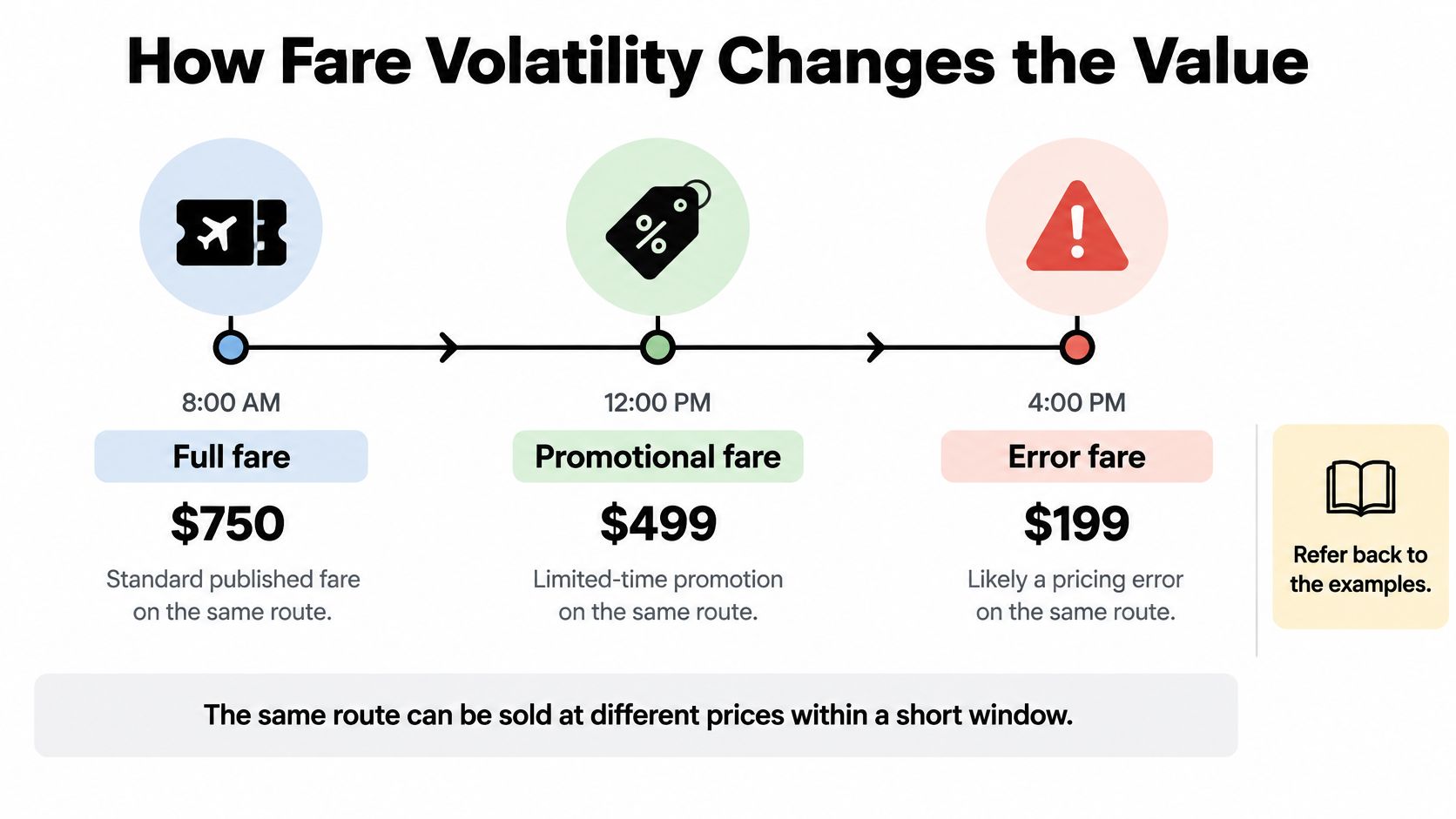
A booking window, not a schedule
Think of one long-haul round trip over a few weeks, not a smooth curve you can time.
- Full fare first. Inventory opens at a published premium level. Corporate buyers who need a refundable ticket often pay here because the meeting date is fixed.
- A promotional window. If forward bookings look soft, the airline files a lower business bucket to fill the cabin. That window is a choice by revenue management, not a calendar you can mark.
- An error, if one appears. A bad filing can undercut coach for hours. It is not a sale, and it may never reticket.
- A late move. Close to departure the same seat can rise if the cabin fills, or fall again if it does not. Neither move is predictable from last month's price.
A full-fare economy ticket can drift toward business pricing on the same dates, because the buyer is paying for changes and bags rather than for a bed. The cheapest cabin on the screen then changes with the day and the rules, not with the word "business" or "economy" in the header.
What a lower fare cannot repair
Volatility does not fix the product after you pay. An aircraft swap can replace a door suite with an older open business seat. Rebooking rules on a discounted premium fare are often stricter than the flexible coach fare people use as the benchmark. A cheap business ticket with no changes is a different asset from a flexible one.
Waiting pays off only when the cancellation and change rules let you refund or rebook without a penalty. Fare alerts help only after the cabin and the route are already chosen.
Tools that watch those filings, including a membership fare monitor from Passport Premiere, are useful once that choice is made. They do not tell you which cabin to want. For a plain read on what a forecast can and cannot do, airline fare prediction is worth separating from a hunch that "prices always drop on Tuesday."
Which Cabin Fits Each Traveler Profile
The right cabin follows the trip's purpose and the cost of a lost productive hour, not the prestige of the boarding group. A suite that does not change how you work the next morning is an amenity. A bed that does is an operating cost.
| Traveler Profile | Usually Better Fit | Deciding Factor |
|---|---|---|
| Corporate travel manager under a fare policy | Business | Total trip cost per productive hour and policy compliance |
| Frequent long-haul consultant on back-to-back meetings | Business | Horizontal bed and a consistent aircraft type |
| Overnight traveler arriving for a morning meeting | First if the route offers a suite with shower or chauffeur, otherwise Business | Whether ground benefits replace an expensive transfer |
| Leisure traveler on a celebration trip | First on routes with a strong suite and ground package, otherwise Business | Value of the ground package versus the fare gap |
| Traveler who can book a discounted business fare | Business | Business fare is at or below a flexible economy ticket |
Where first class still clears the bar
Managers should price the whole trip, not the cabin brand. Policy compliance fails when a first-class receipt cannot be tied to a meeting that a lie-flat business seat would have covered. Consultants on back-to-back sectors care more about a horizontal bed on a consistent aircraft than about a private dining room they will sleep through.
First class is more often rational on an unusually long overnight route, where a suite plus a shower or chauffeur replaces a paid transfer and an early hotel. If business already gives a true lie-flat bed and direct aisle access, the extra spend mostly buys seclusion. Leisure trips follow the ground package. A celebration flight with a weak suite and no useful arrival service is a poor place to pay the first-class gap.
This is no longer only a corporate question. ABC News reporting on premium revenue says non-economy passengers generated nearly half of global airline industry revenue in 2025, and global searches for first- and business-class flights rose 99% year over year in the first half of 2026. More than four in ten premium bookings in the second half of that year were long-haul. Leisure and mixed-purpose trips now move the same inventory companies bid on.
Compare Equal Fares Before You Pay
The comparison fails when the tickets carry different conditions. Point.me's fare guidance notes that full-fare economy tickets may sit very close to business fares, because the buyer pays for flexibility, changeability, baggage, and other inclusions rather than only the seat. A discounted business ticket can then cost less than unrestricted coach and still cost more than basic economy. Those are three different products.
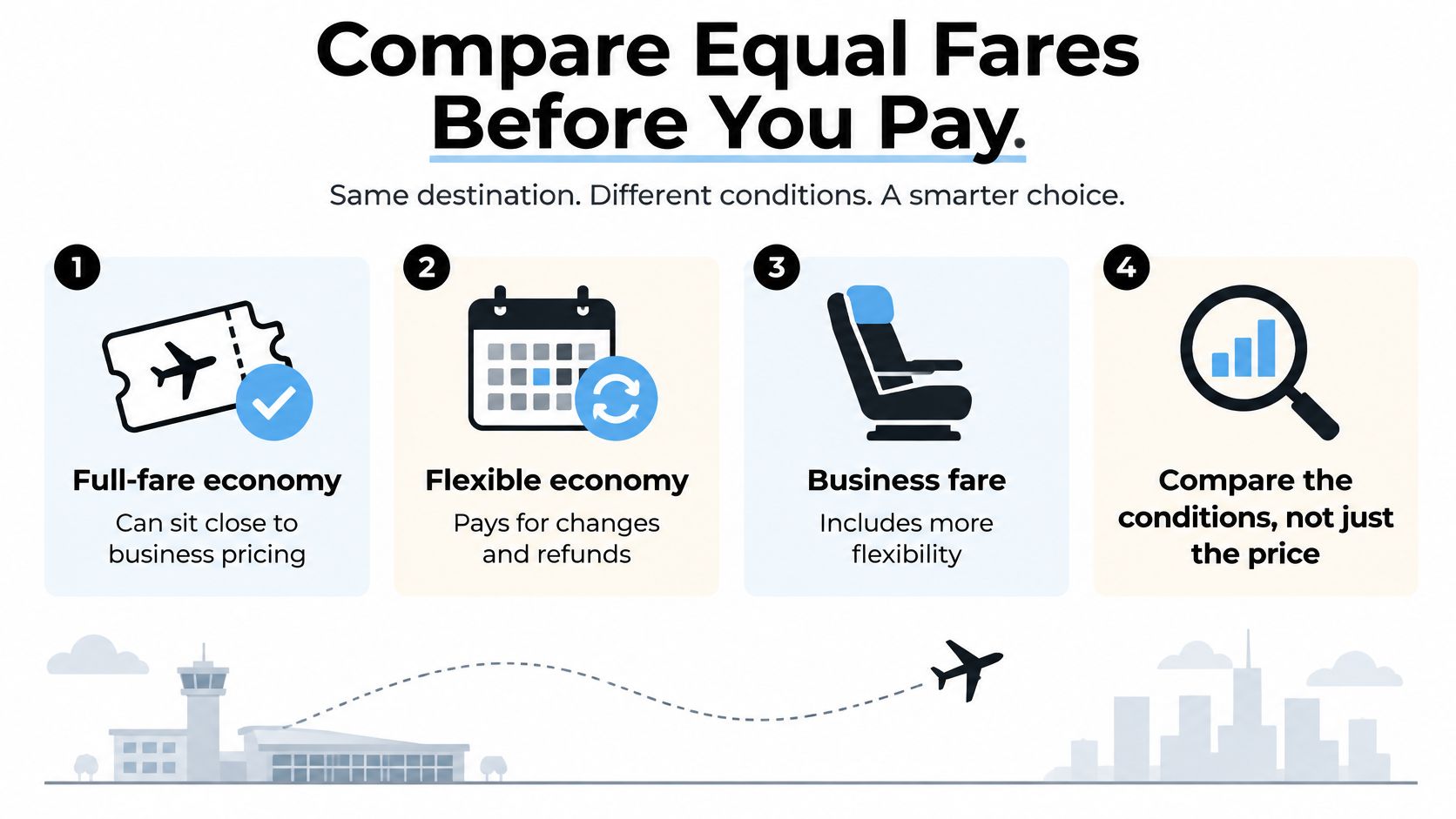
- Match dates, route, and airline. A Tuesday nonstop is not a Saturday one-stop. The common error is grabbing the lowest coach fare on a different day.
- Match refundability and change rules. A flexible economy fare is not basic economy. People understate coach by using the restricted bucket.
- Confirm baggage in each cabin. A "cheap" coach fare plus two paid bags can close on a business fare that includes them.
- Pull the seat map for the assigned aircraft. The airline's general business-class page is not your flight. Check the tail scheduled.
- Read the cabin on the ticket and the swap risk. Note whether a schedule change can move you to another configuration without a refund.
- Add ground costs. Lounge access, transfers, an early hotel, and the value of a rested arrival belong in the total. A practical way to line those up is to budget the trip as one number, not as a fare plus surprises.
- Flag mistake-fare risk. If the price only exists because of a filing error, assume it can be cancelled before you build a nonrefundable hotel around it.
Choose the Cabin That Fits Your Trip
Book business when the seat is fully horizontal, every passenger has aisle access, and the fare sits within reach of a flexible economy ticket on the same dates. Book first class when that exact aircraft and route deliver a clearly better suite and a ground package that closes a real cost, such as a transfer or a lost morning. Wait for a lower fare only when the change rules allow a rebooking without a penalty.
The numbered checks above are the last pass before you pay. Once the cabin is settled, read the cancellation rules on that fare basis and set an alert on the chosen route, not on a vague "premium" search.
Arrival logistics belong in the same total. On New York trips, travelers who compare fleets for Hamptons airport transfers can see whether a chauffeur-included first-class ticket replaces a car they would have booked anyway. Make the call trip by trip. Brand loyalty and the prestige of the cabin do not price the seat.
The cabin label predicts less than the seat, the fare conditions, and the aircraft.
Passport Premiere tracks international business and first class fare cycles and shows members when a premium seat is priced below its opening ask, including cases where that seat undercuts coach on equal rules. If you are pricing a long-haul cabin against a flexible economy ticket, review the fare monitor and membership details at Passport Premiere before you lock the booking.
