
The most popular advice about premium economy flights is also the laziest: choose the middle cabin because it must offer the middle value. That hierarchy breaks regularly. On competitive international routes, a discounted business-class fare can fall below both premium economy and economy, while premium economy can remain an expensive compromise with no bed and no lounge access.
The smarter question is not, “Which cabin should I book?” It's, “What is this seat worth today, on this aircraft, at this point in the fare cycle?” Premium economy has become a substantial global product, but its pricing and features vary sharply. The cabin may cost 50% to 100% more than standard economy, while still sitting as much as 80% below business class, according to 2026 premium-economy market analysis. Yet industry modeling also indicates that premium-cabin seats often sell below their initial asking price, with fewer than 15% sold at that opening level according to Passport Premiere's published market guidance.
That makes timing as important as cabin choice. Below, I'll define what premium economy buys, compare it with economy and business, explain how fares move, and give you a practical way to decide when to book, wait, upgrade, or jump straight to business.
The Premium Economy Promise and Where It Breaks
The familiar cabin ladder misleads travelers. Economy appears cheapest, premium economy seems like the sensible compromise, and business looks like the luxury choice. Airlines benefit when you accept that order before checking the actual fare gap.
Treat premium economy as a price-volatile cabin rather than a guaranteed value tier. Its value depends on the route, aircraft, schedule, and the fare difference on the day you search.
On transatlantic and transpacific routes, business class can drop sharply in price when premium inventory remains unsold or competitors start a fare war. Passport Premiere's analysis of business-class fare sales explains how surplus premium seats and intense international competition can push business fares below last-minute full-fare economy. An international fare comparison found business class cheaper than, or close to, premium economy more than 40% of the time in its test data.
The middle cabin does not guarantee middle value
Premium economy earns its price on a long overnight flight when the aircraft has a properly designed cabin and the fare gap remains reasonable. It loses that advantage when business is nearby in price, the flight is short and daytime, or the seat offers little beyond extra space with economy-level service.
The category is relatively young. AeroTime's history of premium economy traces an early version to EVA Air in 1991, using its Boeing 747-400 fleet, followed by Virgin Atlantic's “Mid Class” in May 1992. Virgin renamed it Premium Economy in November 1994. By 2016, American Airlines had become the first U.S. carrier to offer a true premium-economy product throughout its long-haul fleet.
That history explains why airlines now treat the cabin as a serious revenue class rather than a novelty. It does not make every fare sensible. Aircraft configuration, departure time, season, seat availability, and competitive pressure determine whether the extra space justifies the cost.
Advisor's rule: Do not book premium economy simply because it sits between two cabins. Compare its fare with economy and business on your exact flight, then buy the option that delivers the strongest price-to-comfort ratio.
What Premium Economy Actually Is
Premium economy is a separate cabin class between economy and business. A genuine premium-economy ticket is distinct from exit-row and preferred economy seats, which remain within the standard economy cabin and typically retain its service, meal, and baggage rules.
The difference is easiest to understand through a restaurant comparison. Economy is a tight two-top where each movement affects the passenger beside you. Premium economy is a larger table with more room, better spacing, and a more deliberate service rhythm. Business is a private dining space, with substantially more personal room and a seat designed around sleeping rather than sitting more comfortably.
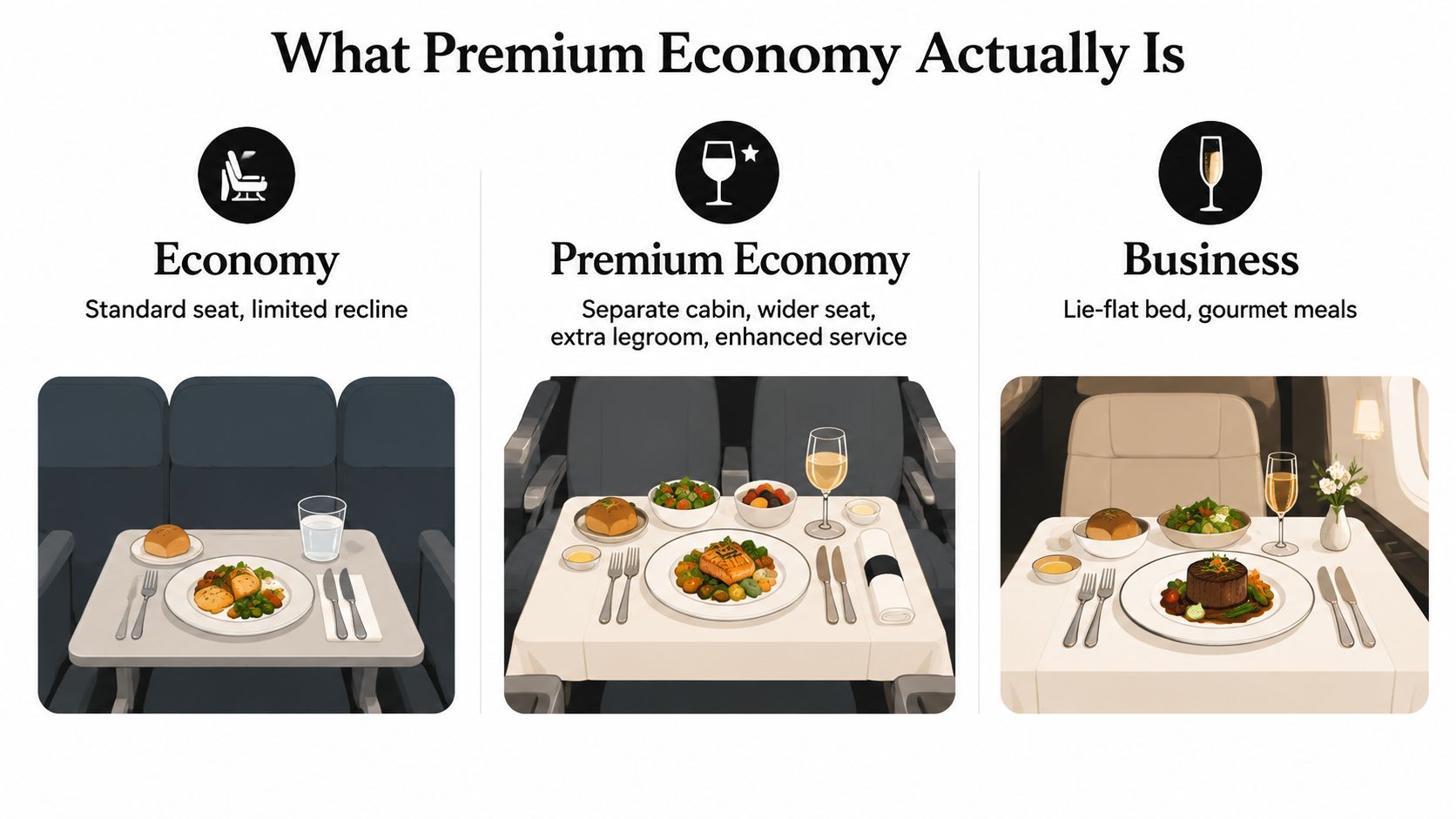
What your fare is meant to buy
A genuine premium-economy fare should provide several changes at once:
- A wider seat shell: The seat usually offers more lateral room than economy, rather than a better location in the same cabin.
- More usable legroom: The pitch and recline ranges covered above show why the extra space matters on longer flights.
- A deeper, better-managed recline: Premium economy should let you rest more comfortably without turning the seat into a bed.
- A dedicated cabin: Fewer seats per row and a curtain or physical divider can create a calmer setting, even when the lavatories remain shared.
- Enhanced service: Priority boarding, improved meal presentation, a larger beverage selection, or an amenity kit may be included. The package varies by airline.
- More generous baggage treatment: Some carriers include an increased checked-bag allowance, while others attach it only to particular fare families.
The details are airline-specific. ANA publishes a distinct premium-economy experience, while EVA Air advertises configurations reaching 42 inches of pitch with a cradle-style recline. Air Canada gives examples of 38-inch pitch and 7-inch recline. ANA's premium-economy cabin information shows why you should inspect the carrier and aircraft instead of trusting the cabin label alone.
Cabin quality also depends on the fare rules attached to the seat. A cheaper premium-economy fare can remove checked-bag benefits, flexibility, or upgrade eligibility, while a higher fare may include them. Check those conditions before comparing the headline price with economy or business.
For a concise explanation of the cabin's role in the broader premium market, see what premium cabin means. The practical test is straightforward: premium economy should change the seat, the space, and at least part of the service experience. If it changes only the seat location, you are probably buying extra-legroom economy.
How It Compares to Economy and Business
The cabin with the lowest price is not always the sensible choice. On international routes, a business-class sale can occasionally undercut both premium economy and economy, so compare all three cabins before paying for a middle option. Premium economy earns its price through extra personal space and a more usable seat, while business class changes the seat into a resting or sleeping surface on aircraft with lie-flat beds.
Using the seat-comparison ranges introduced earlier, premium economy sits at approximately 34 to 38 inches of pitch, 18 to 19 inches of width, and 7 to 9 inches of recline. Published aircraft examples from Air Canada, ANA, and EVA Air show why the aircraft and configuration matter more than the cabin label.
| Feature | Economy | Premium Economy | Business |
|---|---|---|---|
| Seat pitch | Usually 30 to 33 inches | Commonly 34 to 38 inches, with examples reaching 42 inches | Lie-flat layouts vary substantially by aircraft |
| Seat width | Usually narrower than premium economy | Commonly 18 to 19 inches | Commonly wider, with a bed-oriented shell |
| Recline | Roughly 2 to 4 inches | Roughly 7 to 9 inches | Lie-flat or near lie-flat on long-haul aircraft |
| Cabin layout | Highest density | Fewer seats per row | Substantially more personal space |
| Meal service | Standard service | Often upgraded presentation and options | More extensive service and beverage selection |
| Lounge access | Usually excluded | Usually excluded unless earned or purchased separately | Commonly included, subject to airline and airport rules |
| Priority services | Fare-dependent | Often priority boarding, but not universal | Broadest priority package |
| Baggage | Standard allowance | May be higher, depending on fare | Usually the most generous allowance |
The seat is where premium economy earns its keep
Seat pitch measures the distance between corresponding points on successive rows, making it a useful guide to knee clearance. Recline design affects comfort differently. A shell-style or cradle recline moves the passenger's body while limiting intrusion into the row behind, whereas a conventional recliner pushes more of the seat backward.
Premium economy still leaves important gaps. Meal choices can remain limited, lavatories are shared, and early boarding does not automatically include priority security or lounge access. Seat selection may be complimentary on one fare and charged on another. Fare rules can also restrict changes, checked baggage, or upgrades. Review the premium economy and business comparison before buying, because the cabin name does not define the full package.
Price changes the verdict. A premium-economy fare is sensible when the seat meaningfully improves a long overnight flight and business class carries a clear premium. During an international sale, however, business class can cost less than premium economy. Check live prices for economy, premium economy, and business at the same time, then buy the cabin with the strongest comfort value, not automatically the middle fare.
How Premium Economy Fares Actually Move
Premium economy fares do not rise in a neat staircase. Airlines publish several booking classes, adjust inventory as demand develops, and react to competitors. A fare can look excessive on Monday, reasonable on Wednesday, then jump again after the carrier closes its discounted bucket.
The broad pattern is familiar. Premium economy often sits 50% to 100% above economy, while some fares reach 80% below business class. As noted at the top of this guide, those ranges describe a possible spread, not a fixed tariff for every route. On international itineraries, business class can occasionally undercut both premium economy and economy when a sale reshapes the fare structure.
The opening price is not the market value
Airlines may file a high opening fare to protect flexibility and yield. Competitors can match it, undercut it, or leave it untouched. As departure approaches, the carrier might open a cheaper booking class to stimulate demand, then close that inventory if bookings strengthen.
Passport Premiere's published guidance says fewer than 15% of premium-cabin seats sell at the initial asking price. Treat the first displayed fare as a starting position, not proof that the seat is fairly priced. Track all three cabins before deciding.
| Route | Economy (USD) | Premium Economy (USD) | Business (USD) | PE Premium Over Economy | PE Discount vs Business |
|---|---|---|---|---|---|
| Representative long-haul corridor | Varies by date and carrier | Often 50% to 100% above economy | May be substantially higher, but can fall below premium economy during sales | 50% to 100% | Can reach 80% below business |
This table avoids invented fare examples. Without a route, travel date, airline, season, and currency basis, a dollar figure would create false precision.
Why the curve changes
Route competition usually produces the sharpest movements. A fare war can make premium economy suddenly attractive, while limited competition lets an airline preserve a wide gap above economy. Seasonality, fuel surcharges, currency movements, and corporate demand also change the available fare structure.
Use yield-management pricing to understand why booking classes open and close, then compare economy, premium economy, and business together. Do not assume premium economy is the target because business initially looks expensive. Passport Premiere's market-monitoring approach supports a better rule: watch the fare cycle, set a value threshold, and buy business when a sale makes it cheaper than the supposed middle ground.
When Premium Economy Is the Right Buy
Premium economy is not automatically the sensible middle ground. It earns its price on flights where economy makes the destination feel farther away, especially long overnight journeys on wide-body aircraft with a genuine footrest or cradle-style recline.
For a daytime transatlantic flight under seven hours, I am usually skeptical for leisure travelers. Extra space and better meal presentation help, but the comfort gain often fails to justify a 50% to 100% premium over economy, the range documented earlier in this guide. If the economy fare is well timed and the schedule works, keep the difference for the trip.
Match the cabin to the flight
Overnight routes to Asia, Australia, or deep South America change the calculation. Wider seats, more legroom, a footrest, and improved meal service can make rest easier and help you arrive functional. Premium economy is still not a flat bed, so treat it as a comfort upgrade, not a sleep solution. It becomes the balanced choice when business is priced far higher.
Review these conditions before paying:
- Flight length: Longer flights give you more hours to benefit from the seat. Short sectors rarely justify a large cabin premium.
- Departure time: Overnight flights increase the value of recline and personal space. On daytime flights, the seating and service upgrade matters less.
- Aircraft type: Reconfigured Boeing 777s and Airbus A350s with current-generation premium economy cabins deserve closer attention. Older dense layouts may deliver less than the label suggests.
- Seat map: Check the row layout, lavatory position, and distance from galleys. A strong cabin can still contain poor seats.
- Schedule: A nonstop premium-economy flight can beat a cheaper connection when the arrival time protects a workday. Do not pay blindly for speed.
- Business-class gap: Price business before purchasing. A sale can make the higher cabin the better buy.
Business class can undercut the middle cabin
International business-class fares sometimes fall below premium economy during fare wars or periods of excess premium-seat inventory, a pattern covered in Passport Premiere's fare-sale coverage. The fare analysis cited earlier found business cheaper than or close to premium economy more than 40% of the time in its test data.
That result changes the buying rule. Choose premium economy when it delivers a meaningful comfort gain at a sensible spread. If business approaches the same price, stop comparing premium economy with economy. Compare business with your budget, the schedule, and the value of arriving rested.
Track the fare cycle before committing. Passport Premiere's market-monitoring approach supports a practical habit: watch all three cabins, set a value threshold, and buy the cabin that wins when the sale appears. Sometimes that cabin is premium economy. On international routes, sometimes it is business.
Strategies for Finding the Best Premium Economy Fares
The best premium-economy buyers don't search once and accept the displayed fare. They monitor a route, recognize the normal pricing pattern, and act when the cabin becomes reasonably valued. The process works for individual travelers, corporate travel managers, and travel advisors managing several itineraries.
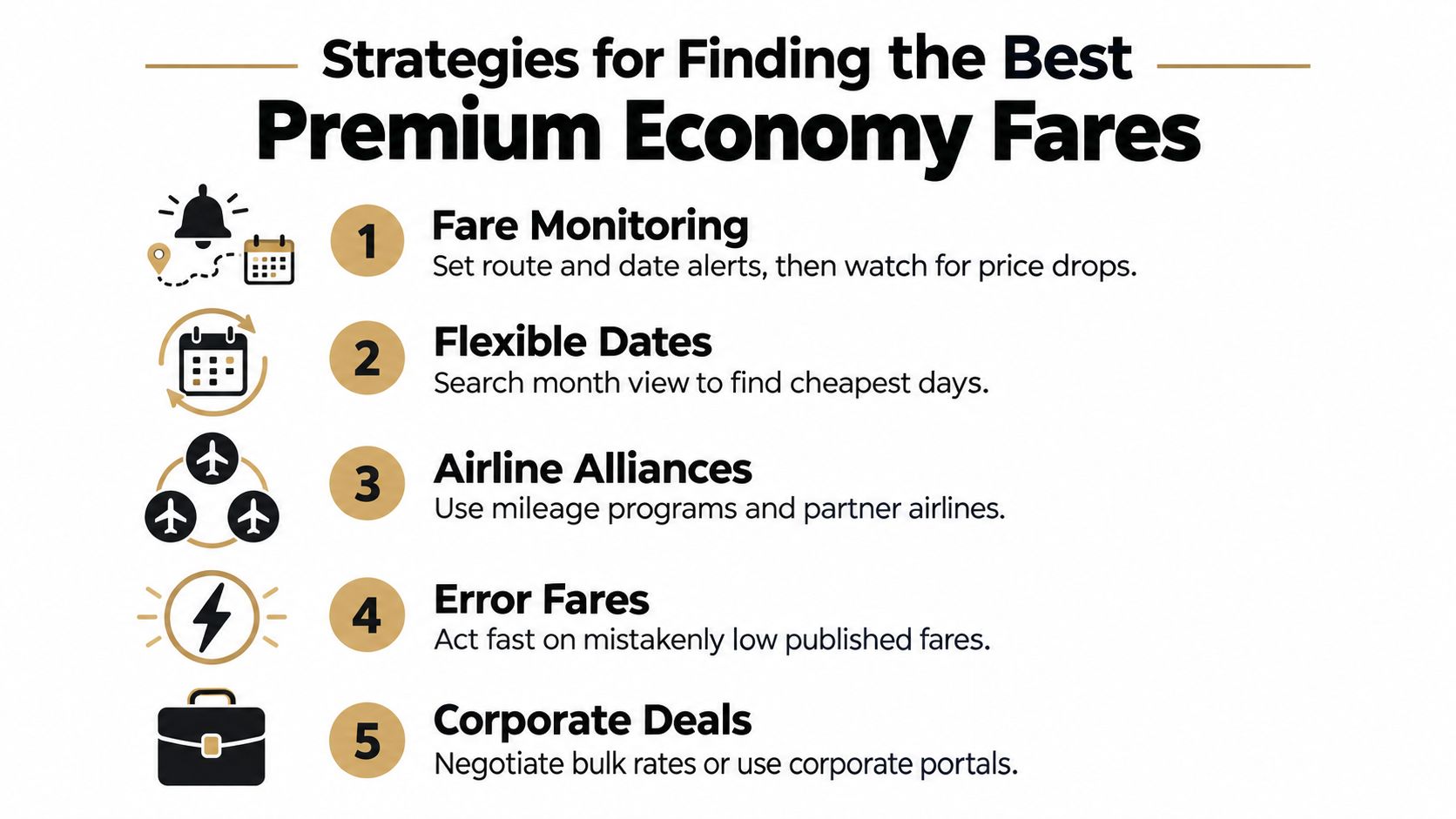
Five moves that improve your search
Monitor the route and dates. Set alerts for the exact city pair and a flexible date range where possible. Watch how the fare behaves over time instead of refreshing manually. A price that falls after a competitor changes its schedule may disappear quickly.
Search flexible calendars. Compare nearby departure and return dates, shoulder-season periods, and alternate travel days. The cheapest premium-economy seat may appear on a day that economy travelers overlook.
Compare one-way combinations. Price a premium-economy outbound with an economy return, then reverse the direction. You can also compare a premium-economy outbound with a business-class return when one direction is under sale pressure. Don't assume a round trip creates the best cabin combination.
Check upgrade paths. Some airlines allow cash or mileage bids after an economy booking. Upgrade availability depends on the carrier, fare rules, and inventory, so treat it as an option rather than a promise. Read the conditions before buying a restrictive economy fare.
Test alternate gateways and connections. A different departure airport or one-stop routing can materially change the fare. The tradeoff is time and convenience, so compare the total journey, ground transport, and connection risk rather than looking only at the ticket price.
Build a buying trigger
Choose a personal trigger before the search becomes emotional. For example, decide that you'll buy when premium economy offers the required comfort at an acceptable spread, but you'll switch to business if a sale brings it close enough to your ceiling. Corporate buyers should add schedule value, traveler productivity, and policy limits to that calculation.
Passport Premiere offers fare monitoring and premium-cabin market analysis, including progress reports and BUY or HOLD guidance for tracked fare movements. It can sit alongside airline alerts, flexible-date searches, and your own review of fare rules.
A fare monitor helps most when you define the route first. Track the same international city pair, aircraft, and travel window so you can distinguish a real improvement from a different product with a lower headline price.
Putting It All Together
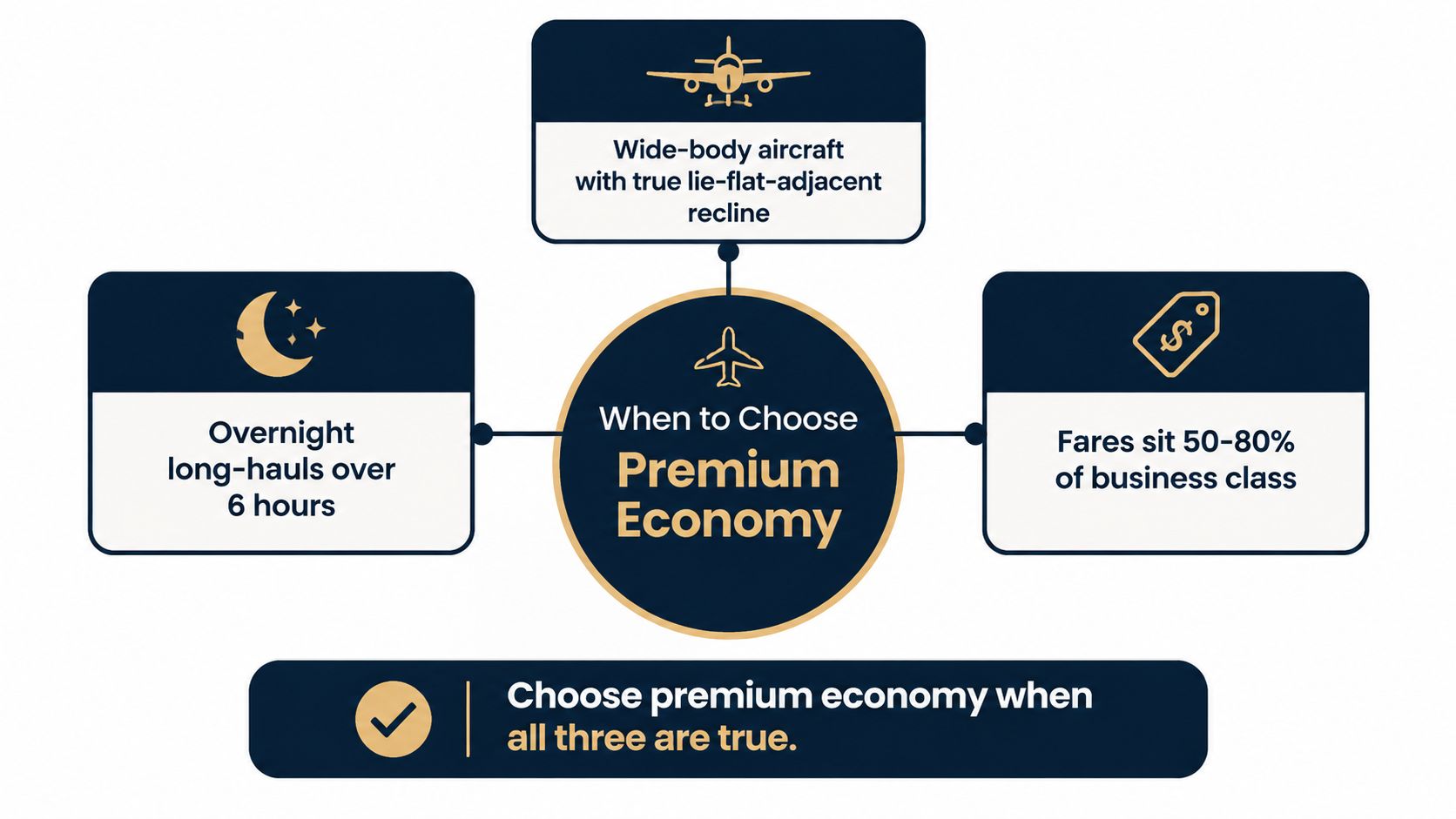
Premium economy is the smart buy when three conditions align: an overnight long-haul flight, a well-designed wide-body cabin, and a fare that leaves meaningful distance between the seat and business class. The seat can improve personal space and rest without forcing you to pay for a lie-flat product you don't need.
It's the wrong buy on short flights, weak aircraft products, and any itinerary where business has moved close enough to make the upgrade obvious. The industry data on premium-economy adoption shows how widely airlines now deploy the cabin, but wider availability doesn't make every fare attractive.
My highest-return habit is simple: check the same international route across a 6 to 12 week window before departure, compare economy, premium economy, and business together, and record how the prices move. That lets you catch the unusual moment when business drops below premium economy instead of committing to the middle cabin too early.
Use premium economy for meaningful overnight comfort, wait when the product is weak or the fare is inflated, and jump to business when the sale makes the higher cabin fairly priced. Start monitoring your next international itinerary through Passport Premiere, where fare-cycle intelligence helps members judge whether a premium-cabin fare is worth buying now or holding for a better opportunity.
