
A multi-city flight is a single reservation that combines multiple flight segments into one itinerary, and some airline booking options support up to 6 destinations. Unlike a standard round trip, it can take you from one city to another, continue to additional destinations, and return from a different airport.
That flexibility creates an unexpected pricing possibility: business class can be cheaper than coach when airlines trigger fare wars on competitive international routes. The catch is that multi-city value doesn't come from adding stops indiscriminately. It depends on how the reservation is constructed, how each airline prices its segments, and whether the convenience of one booking outweighs the restrictions attached to it.
Redefining Air Travel Beyond Round Trips
A traditional round trip follows a familiar loop, A to B and back to A. It works well when one destination is the purpose of the journey, but it becomes inefficient when a traveler wants to visit several cities or travel overland between arrival and departure points. A multi-city booking replaces that rigid loop with a connected itinerary, such as A to B, B to C, and C to A.
The important distinction is that the traveler generally searches for these segments together instead of building the trip from unrelated one-way purchases. Major travel platforms describe multi-city flights as a single reservation that can include several destinations, while one airline example supports up to 6 destinations worldwide through its multi-city booking option, as described by KAYAK's multi-city flight guide.
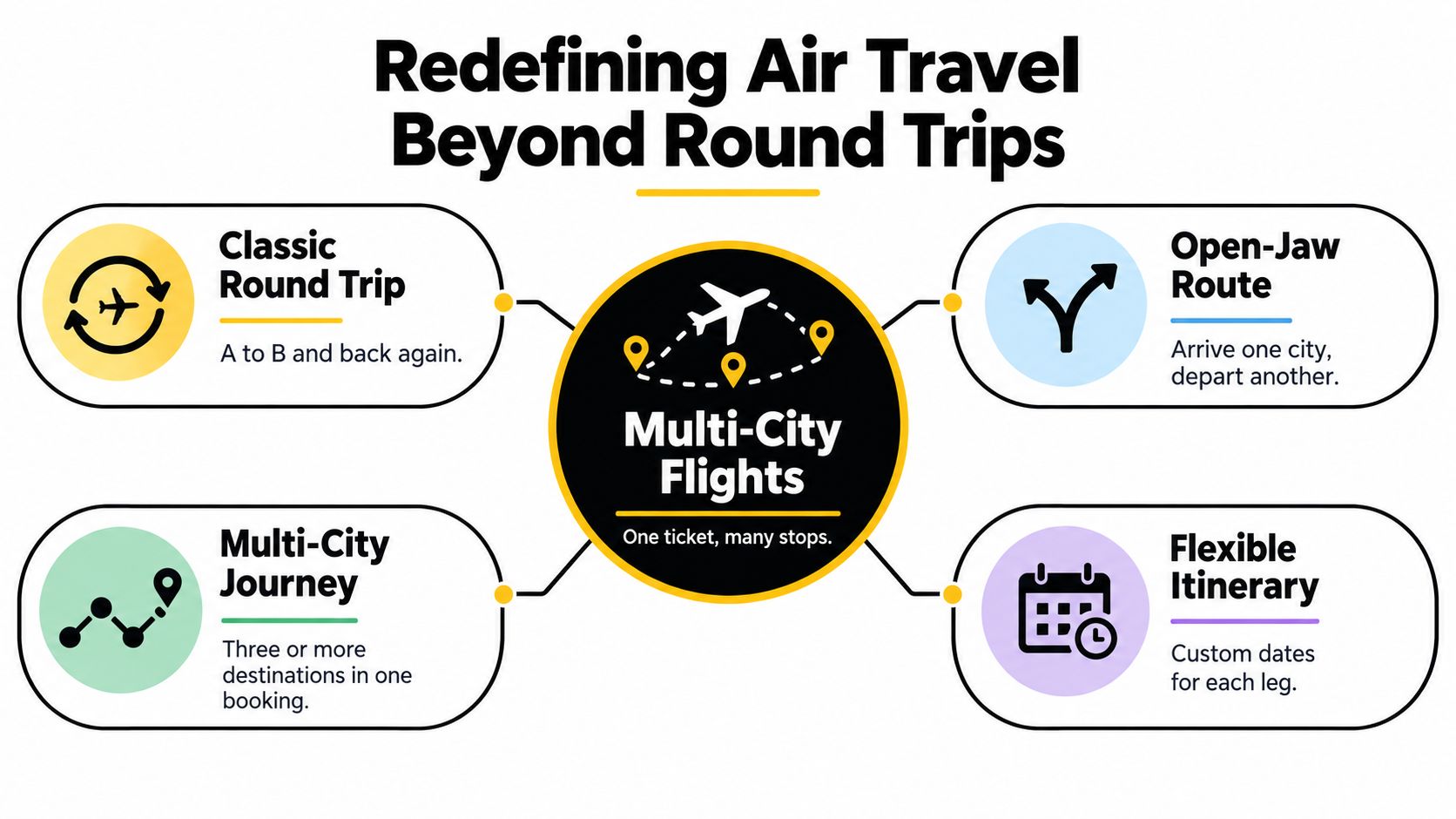
The route shapes that matter
There are three useful structures to separate:
- Classic round trip: You fly from your origin to one destination and return to the same origin.
- Open-jaw route: You fly into one city and depart for home from another, using rail, road travel, or another method between them.
- True multi-city journey: You book several flight legs that connect multiple destinations in one itinerary.
An open-jaw trip is therefore best understood as one form of multi-city travel, not a competing category. Travelers often search for “multi-city” when their actual need is just to avoid backtracking. A route into one city and home from another can save travel time even when the traveler doesn't add another flight segment.
The booking format also changes the planning burden. With separate tickets, the traveler must compare each fare independently and manage each confirmation, policy, and carrier relationship. With a linked itinerary, the segments are presented as one planned journey, which makes date coordination and route comparison easier. For professionals balancing meetings across several cities, a practical guide for busy professionals can also help connect itinerary design with time management.
Planning principle: The cheapest-looking route isn't automatically the best route. A logical sequence that avoids backtracking can deliver more value than a lower fare attached to an awkward connection.
A round trip still has a place. If you're visiting one destination and returning directly, its simpler structure may be easier to price and manage. Travelers comparing that option with a multi-city booking can review what a round-trip flight means before deciding whether extra routing flexibility serves the trip.
Understanding the Core Mechanics of Multi-City Itineraries
A multi-city flight is not just a longer round trip. It is a single reservation combining multiple flight legs into one itinerary, often allowing a traveler to fly into one city, return from another, or continue to additional destinations, as explained by Skyscanner's comparison of multiple-city and multiple-ticket bookings.
Consider the difference between these two plans:
| Booking structure | How it works | Main planning consequence |
|---|---|---|
| Round trip | Origin to destination and back to origin | Simple, but it may force backtracking |
| Multi-city | Several flight legs appear in one reservation | Dates and destinations are coordinated as one journey |
| Open-jaw | Arrival and departure cities differ, with travel between them arranged separately | Useful when ground travel replaces a flight segment |
| Separate one-way tickets | Each leg is purchased independently | More control, but more separate rules and confirmations |
The reservation structure is the key. A traveler flying London to Rome, Rome to Athens, and Athens to London has a conventional multi-city pattern because each flight leg is part of the air journey. A traveler flying into Madrid, traveling by train to Seville, and flying home from Seville has an open-jaw pattern. Both may be entered through a multi-city search tool, but they don't create the same operational responsibilities.
Why open-jaw isn't the same thing
An open-jaw itinerary contains a gap between the arrival city and the departure city. That gap might be covered by rail, car, or another form of transport, and the traveler must arrange it independently. A true multi-city itinerary, by contrast, can link the destinations with additional flight segments.
The distinction affects price comparison, mileage accrual, and flexibility. A combined ticket may simplify the air portion, but separate one-way fares may sometimes offer a better fit for unusual dates or a route involving carriers that don't work well together. The correct comparison isn't “multi-city versus one-way” in the abstract. It's the total cost and risk of the exact route.
For travelers who want to understand the open-jaw structure in greater detail, this explanation of open-jaw flights provides useful terminology before they start comparing fares. Once the structure is clear, the next question is whether the booking remains manageable when more segments and airlines enter the plan.
Navigating the Risks of Complex Booking Structures
Flexibility has a limit. A multi-city search can produce an attractive total while concealing operational differences between segments. Neutral booking guidance notes that these itineraries can involve different baggage rules, cancellation policies, and airline combinations, as outlined in Booking.com's multi-city flight tips.
The traveler should inspect the itinerary in a deliberate order.
Start with the policies, not the headline fare
First, check the baggage allowance for every leg. One carrier may include a checked bag while another applies a separate charge or uses a different allowance. A single reservation doesn't guarantee identical baggage treatment across every flight, particularly when different airlines participate.
Next, compare cancellation and change conditions. A flexible fare on one segment doesn't necessarily make the entire itinerary flexible. If one leg carries stricter conditions, changing the overall journey may involve restrictions that aren't obvious from the first search result.
Finally, identify who operates each flight. The airline displayed during the search may not be the carrier flying the aircraft. Operating-carrier details matter for check-in, baggage procedures, disruption handling, and the practical location where a traveler must seek assistance.
Operational rule: Treat every leg as its own policy decision, even when the booking screen presents the journey as one itinerary.
Know when complexity stops paying
A multi-city structure becomes less attractive when the route zigzags, the traveler must pay separate baggage charges repeatedly, or a small schedule change creates consequences across later segments. The initial fare may still be lower, but the traveler has exchanged simplicity for exposure to more moving parts.
That doesn't mean travelers should avoid complex itineraries. It means the route should have a clear purpose. Add a flight when it replaces a difficult transfer, connects destinations that belong in the journey, or creates a meaningful pricing advantage. Don't add a segment merely because the search tool permits it.
Ground travel can also reduce complexity. An open-jaw route may allow a traveler to arrive in one city, move overland through a region, and depart from another. Those arrangements require separate planning, but they can eliminate an unnecessary return flight and make the itinerary more coherent. Travelers considering flexible ticket concepts can also review what an open-ended ticket means without assuming that flexibility in one product automatically applies to a multi-city reservation.
Evaluating Platform Flexibility and Market Trends
Multi-city search has moved beyond a niche tool for experienced travelers. Major platforms now advertise the ability to combine flights from different airlines and build itineraries with up to six or seven stops, according to KAYAK's overview of flexible multi-city searches. That capability reflects a clear consumer demand for customized routing, but availability doesn't make every combination financially sensible.
A platform can assemble more options than a traveler could reasonably evaluate manually. That helps when the journey crosses several regions or when the traveler wants to compare different arrival and departure airports. It also creates a risk: the search result may optimize the displayed airfare without adequately communicating the time, policy, and disruption cost attached to the arrangement.
Compare three versions of the same trip
The strongest approach is to price the itinerary in parallel:
- A standard round trip, which establishes the simplest benchmark.
- A multi-city ticket, which tests whether combining the segments improves the overall arrangement.
- Separate one-way tickets, which may expose promotional fares or alternative airline combinations.
The winner can change with the travel dates, route, and number of passengers. A multi-city fare may be attractive for one traveler but less compelling when several passengers need matching flights. Conversely, separate tickets can create more choice while requiring the traveler to manage each booking independently.
Flexibility should serve the route
The market's technical flexibility is most valuable when it solves a real routing problem. Flying into one city and out of another can remove backtracking. Combining carriers can open a useful schedule. Adding a stop can turn a connection into a destination. These are strategic uses of the search tool.
The weaker use is to treat every available segment as an invitation to expand the trip. More stops can increase coordination work, baggage exposure, and the consequences of a delay. A traveler should therefore judge a multi-city result by total trip value, not only the price shown beside the itinerary.
Decision test: If removing a segment makes the journey easier without reducing the trip's purpose, the segment probably doesn't belong in the booking.
The Counterintuitive Economics of Premium Travel
Economy is not always the cheaper cabin. On competitive international routes, airlines may reduce premium-cabin fares to fill unsold seats. Rival carriers can respond with matching or lower prices, creating a short window when business class is cheaper than a last-minute full-fare economy ticket, as explained in Passport Premiere's explanation of business-class fare sales.

The pricing does not follow a consistent discount ladder across cabins. Airlines control availability through fare classes, demand forecasts, and competitor responses. An unsold premium seat expires when the flight departs, so the carrier may lower its price to attract demand. Economy fares can remain high when late-booking or flexible travelers still need seats.
Why multi-city travelers should check the cabin above
Multi-city searches expose this pricing inversion because they place several booking structures side by side. The lowest economy total may not offer the best value after accounting for comfort, flexibility, or the cost of changing a ticket. A premium fare on one long segment can change the economics of the entire itinerary.
The opportunity depends on route competition, remaining inventory, fare rules, and booking timing. Business-class fare wars can reduce prices by 50% or more, with deals disappearing within hours, according to Passport Premiere's guide to luxury travel on a budget.
The practical test is simple: compare cabins before defining “cheap.” A restrictive economy fare can appear attractive until a premium option costs less than a flexible coach ticket. Travelers who search only economy cannot identify that inversion.
A short visual explanation can clarify how airlines adjust cabin pricing:
The same pricing logic applies across a multi-city itinerary, with one additional complication. Each segment needs its own cabin comparison. Business class may make financial sense for the long-haul portion, while economy remains appropriate on a short regional flight. The strongest result may therefore combine cabins rather than apply one cabin throughout the booking. The right choice follows the route, fare conditions, and actual price difference.
Strategic Framework for Smart Travel Planning
A strong multi-city strategy combines route logic, policy review, and cabin comparison. Start by defining the journey's purpose. If the trip requires several meetings, choose the sequence that reduces backtracking. If it combines leisure destinations, decide which movements should be flights and which are better handled by rail or road.
Then establish a price baseline with a round trip and separate one-way tickets. Compare that baseline against a multi-city reservation rather than assuming the bundled option wins. The booking format is a tool, not a guarantee of savings.
Use a disciplined comparison process
- Map the essential legs: Remove any segment that doesn't add a necessary destination or meaningful convenience.
- Review each fare rule: Check baggage, changes, cancellations, and operating carriers before treating the displayed price as final.
- Test cabin alternatives: Compare economy and business class on the longest or most competitive international segments.
- Protect the itinerary: Avoid tight connections when a disruption on one leg would undermine every later stop.
- Watch timing: Premium fare wars can produce discounts of 50% or more, but those offers may vanish within hours, according to the documented fare-war pricing pattern.
Remote workers and extended travelers may also benefit from planning resources such as Global Pet Sitter's guide to working remotely while traveling, particularly when a multi-city route needs to support work schedules rather than only sightseeing.
The central conclusion is counterintuitive. A more complex itinerary can reduce waste when it removes backtracking, but complexity can erase the benefit when policies and disruptions become difficult to manage. At the same time, a premium cabin isn't automatically a luxury surcharge. Under the right fare conditions, business class can be cheaper than coach, especially when the alternative is a late, inflexible economy fare.
Use multi-city search to compare structures, not to justify more stops. Price the whole journey, inspect every segment, and treat premium-cabin inventory as something that can move independently from economy pricing.
Passport Premiere helps travelers monitor international Business and First Class fare cycles, evaluate premium-cabin market value, and identify opportunities where business class may cost less than coach. Visit Passport Premiere to explore fare intelligence for multi-city and premium travel planning.
