
Business class can cost less than coach: documented same-flight comparisons include $471 versus $575 and $449 versus $629, although those examples aren't proof of a Mumbai-origin fare. For business class flights from Mumbai, the right approach is to compare both cabins on the same departure rather than assume economy is cheaper.
The opportunity is real. The mistake is treating it as a standing offer on every route out of BOM. Business class cheaper than coach is a pricing outcome you search for, not a promise an airline makes.
My recommendation is straightforward: establish what economy costs for your trip, then price business against it. Don't let an economy-only search decide your travel budget before you've checked the premium cabin.
The Counterintuitive Truth About Mumbai Business Class Pricing
The clearest evidence comes from actual same-flight comparisons. One documented example priced business at $471 against $575 for economy; a Virgin Australia Canberra–Melbourne departure offered business at $449 against $629 for economy, as recorded in these independent cabin-price comparisons and the Virgin Australia fare examples.
Those examples establish the mechanism, not a Mumbai deal. Neither supports claiming that a particular BOM departure currently costs less in business. A credible Mumbai buying strategy starts with that distinction.
Mumbai does provide a substantial market to investigate. The airport handled 54.8 million passengers in calendar 2024, with the Middle East accounting for 48.8% of international passenger movements, Asia-Pacific 28.2%, and Europe 14.5%, according to reporting on Mumbai's passenger traffic. That mix makes several corridors worth comparing, but traffic volume alone doesn't establish how frequently fare inversions occur.
Compare the fare you can buy
The relevant benchmark isn't an advertised economy fare that disappeared before you searched. It's the available economy ticket with the conditions you need, compared with the available business ticket.
A corporate traveler may need change flexibility. A leisure traveler may accept a restricted return ticket. Those buyers shouldn't use the same benchmark, even when they're looking at the same flight.
- Use identical travel dates: Otherwise, you're comparing different demand conditions rather than cabins.
- Match the itinerary: A nonstop economy ticket and a connecting business ticket answer a different question from a same-flight comparison.
- Compare usable products: Include the baggage and flexibility you need, not every optional extra.
Buying principle: Economy is a cabin, not a guarantee of the lowest price.
Don't start by asking how much an upgrade costs. Start by asking whether the premium fare is already the better purchase. Your intended economy budget may cover business, but confirm that against live inventory rather than a headline.
Why Business Class Can Cost Less Than Coach on the Same Flight
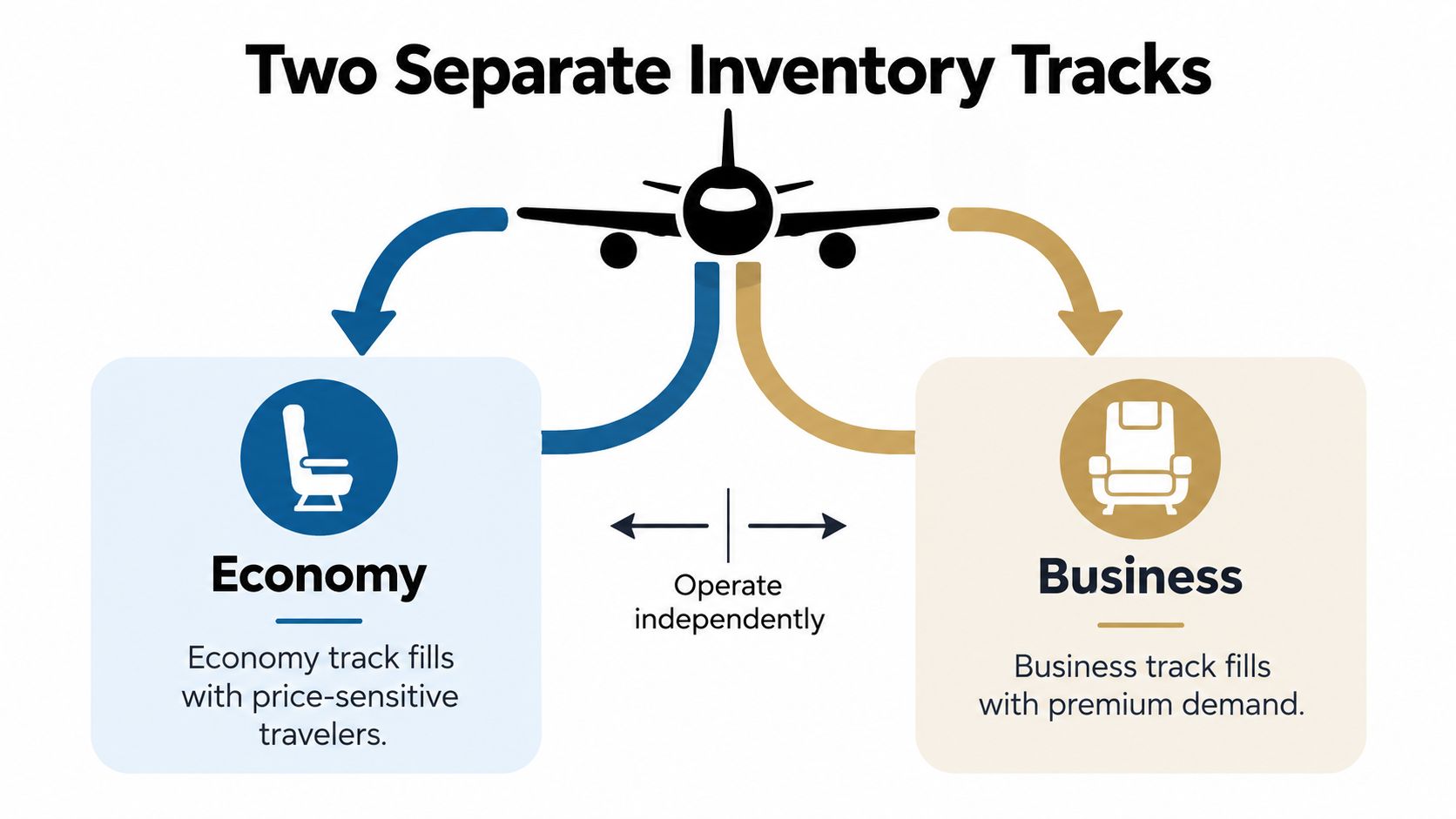
Think of economy and business as separate inventory tracks. The airline manages the prices available within each track independently, rather than keeping business a fixed amount above economy.
As cheaper economy inventory sells, the airline can leave only expensive coach fares available. Meanwhile, a lower business fare may remain open because premium demand hasn't filled that inventory. This independent management, along with advance-purchase conditions, travel dates, return-ticket pricing and minimum-stay rules, explains the documented inversions discussed earlier.
The distinction is easier to understand visually.
Search the ticket rules, not just the cabin
A booking class is the inventory category attached to a fare. It isn't another name for economy or business. Different fares within the same cabin can carry different prices and conditions.
That matters because changing your trip structure can reveal a fare your original search missed. A return journey may price differently from separate one-way tickets, while a different return date may satisfy a minimum-stay condition.
| Search variable | What to investigate |
|---|---|
| Departure date | Whether a nearby departure has a different available premium fare |
| Return date | Whether the stay length changes eligibility |
| Return versus one-way | Whether the complete journey prices more favorably |
| Fare conditions | Whether the lower price requires restrictions you can accept |
Don't confuse a low fare with an empty cabin. A seat map isn't a reliable substitute for checking what the airline will sell you at checkout.
Apply the mechanism to Mumbai carefully
On a Mumbai–Middle East or Mumbai–Asia itinerary, the practical question is whether your chosen departure has expensive remaining economy inventory alongside affordable business inventory. The regional traffic profile makes these corridors sensible search targets; it doesn't prove that coach demand exceeds premium demand on your flight.
Search economy and business together. If business looks unexpectedly competitive, inspect the return journey and fare conditions before drawing a conclusion.
The useful prediction is conditional: an inversion is plausible when economy has become expensive and a lower premium fare remains available. You can test that condition directly. You don't need to guess how the airline's entire revenue-management system works.
Airlines and Aircraft Flying Long-Haul Business Class From Mumbai
Buy the seat on the scheduled flight, not the airline's reputation. A business-class label doesn't tell you everything you need to know about sleeping comfort, aisle access or the cabin on a connecting sector.
For a Mumbai premium search, names worth investigating include Emirates, Qatar Airways, Etihad, Singapore Airlines, Lufthansa, Air India, British Airways, Virgin Atlantic and KLM. Treat them as candidates to check against current schedules, not as a promise that every carrier serves every desired route nonstop or supplies identical hardware.
Long-Haul Business Class Operators From BOM by Corridor
This is a booking-verification table rather than a live timetable. Confirm the operating carrier, route and seat specification for your actual travel date.
| Carrier | Long-Haul Nonstop From BOM | Lie-Flat Seat Standard |
|---|---|---|
| Air India | Check the current nonstop schedule for your destination | Verify the aircraft and cabin configuration |
| British Airways | Check current London availability | Verify the exact seat product |
| Virgin Atlantic | Check current London availability | Verify the scheduled cabin |
| Lufthansa | Check current Germany services and onward options | Verify configuration and aisle access |
| KLM | Check current Amsterdam availability | Verify the aircraft-specific seat |
| Emirates | Investigate Dubai connections for onward long-haul travel | Check both sectors separately |
| Qatar Airways | Investigate Doha connections | Check the product on each departure |
| Etihad | Investigate Abu Dhabi connections | Confirm seat type throughout |
| Singapore Airlines | Investigate Singapore connections | Confirm both the regional and onward cabin |
The table deliberately avoids blanket lie-flat guarantees. Published schedules and aircraft assignments need checking when you book, and the airline can subsequently substitute equipment.
Verify hardware before payment
An aircraft-family label isn't enough. If a search displays a Boeing 777, for example, ask which cabin configuration is scheduled instead of assuming that every aircraft bearing that label has the same seats.
Use the airline's booking details and seat map as inspection tools, then ask specific questions:
- Seat position: Can you reach the aisle without stepping over another passenger?
- Sleeping surface: Does the scheduled seat become fully flat?
- Sector coverage: Is every flight in the ticket booked in business?
- Substitution tolerance: Would you still accept the itinerary with a different cabin configuration?
For an overnight trip, prioritize the sleeping product. For a daytime journey, an inferior seat may still be acceptable if the fare and schedule work.
The cheapest premium ticket isn't automatically the best value. But neither is the nonstop with the most familiar logo. Judge the actual journey.
Nonstop or Connecting, Which Routing Wins From BOM
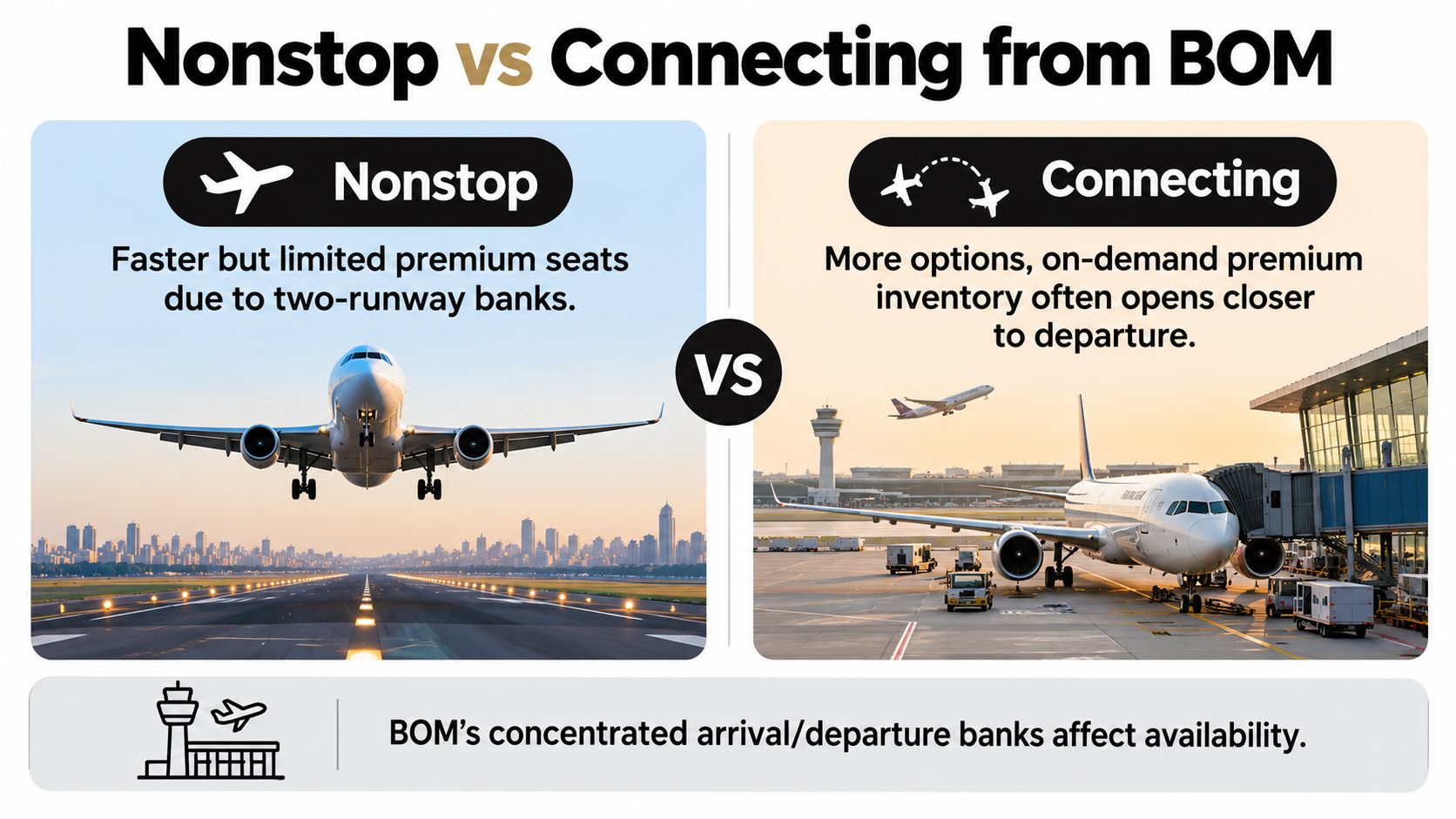
Mumbai's operating constraints make schedule quality part of the purchase decision. Its intersecting runways require single-runway operations, with declared peak capacity of approximately 46 aircraft movements per hour during high-intensity operations and 44 during normal periods, according to the government's explanation of Mumbai runway capacity.
That doesn't mean a connection is safer. It means you should assess recovery options rather than buying solely on the shortest published duration.
Dubai is an obvious routing benchmark: it accounted for 15% of Mumbai's international passenger traffic in 2025, while London and Abu Dhabi each represented 7.5%, according to Mumbai's international traffic breakdown. Those figures justify checking these corridors, not assuming a Dubai connection will always be cheaper.
The broad routing trade-off is illustrated below; actual premium availability still requires a live search.
Compare the whole journey
Suppose you're traveling from Mumbai to a European destination. Benchmark a suitable nonstop against an itinerary through Dubai, then inspect the transfer rather than stopping at the lower headline fare.
| Decision factor | Nonstop assessment | Connecting assessment |
|---|---|---|
| Elapsed time | Check departure and arrival suitability | Include the full transfer interval |
| Disruption exposure | Examine alternative departures | Examine onward recovery options |
| Cabin quality | Inspect the scheduled seat | Inspect every sector |
| Ticket protection | Confirm conditions | Confirm how the connection is ticketed |
| Arrival readiness | Assess usable rest | Account for interrupted sleep |
A connecting itinerary introduces another departure and another opportunity for disruption. It can also give you alternatives that the nonstop search doesn't reveal. Neither advantage nor disadvantage should be assumed from the fare alone.
For more detailed itinerary evaluation, use this guide to multiple-leg flights, then apply the same scrutiny to every proposed hub routing.
A cheaper connection that compromises the meeting you're traveling for isn't a saving.
Use a clear decision rule
Choose the nonstop when arrival certainty, uninterrupted rest or a tightly scheduled commitment outweighs the price difference. Choose the connection when the fare advantage is meaningful to you, the transfer is comfortable and the onward options are acceptable.
Don't assign your time a value of zero. Include airport waiting, interrupted sleep and the consequences of a delayed arrival in the decision. A longer itinerary can be the smarter purchase, but only when its economics survive that calculation.
When to Buy, Timing the Mumbai Premium Fare Cycle
Buy against a credible fare target, not a supposedly magical booking day. There's no universal advance-purchase window or seasonal discount threshold that should override what the airline is offering for your dates.
Keep the exact itinerary and fare conditions accessible while you monitor prices. A screenshot without the return date, cabin and ticket rules isn't a useful benchmark.

Large premium discounts do exist. A reported United Polaris promotion from the United States to London in summer 2023 reached $899 round trip, and a separate Virgin Atlantic Upper Class example reached $900 round trip, against a cited typical long-haul business range of $3,000–$5,000, as described in these business-class booking examples. They demonstrate potential discount depth, not a Mumbai price target.
Watch changes you can verify
Mumbai's direct international network expanded with seven routes added since April 2024, bringing connectivity to 55 international destinations, according to the airport information published by Mumbai Customs. New services are worth monitoring, but expansion doesn't prove that premium fare wars occur more frequently.
Look for observable changes:
- Competitor matching: Compare whether competing airlines have reduced comparable fares, not merely advertised unrelated promotions.
- New itinerary options: Test newly available routings against your existing shortlist.
- Date consistency: Check whether the price applies across workable departures or only an inconvenient combination.
- Checkout confirmation: Verify that the fare survives through the payment stage.
Use an airline's own booking engine alongside a comparison platform such as KAYAK. Keep separate searches for your preferred nonstop and acceptable connecting itinerary so changes in routing don't masquerade as discounts.
For a broader purchase framework, consult when to book business-class flights. Your decision still needs a personal ceiling and an acceptable set of conditions.
A fare-monitoring explanation can help turn scattered searches into a repeatable routine.
Decide before a fare appears
Write down your acceptable departure dates, arrival deadline and maximum all-in price. Then decide which restrictions you'll tolerate.
For a fixed corporate trip, book when an acceptable fare meets the budget. For flexible leisure travel, explore alternative dates before committing. Don't keep waiting for a theoretical bottom after a ticket already satisfies your requirements.
What Business Class Actually Gets You at BOM (And What It Doesn't)
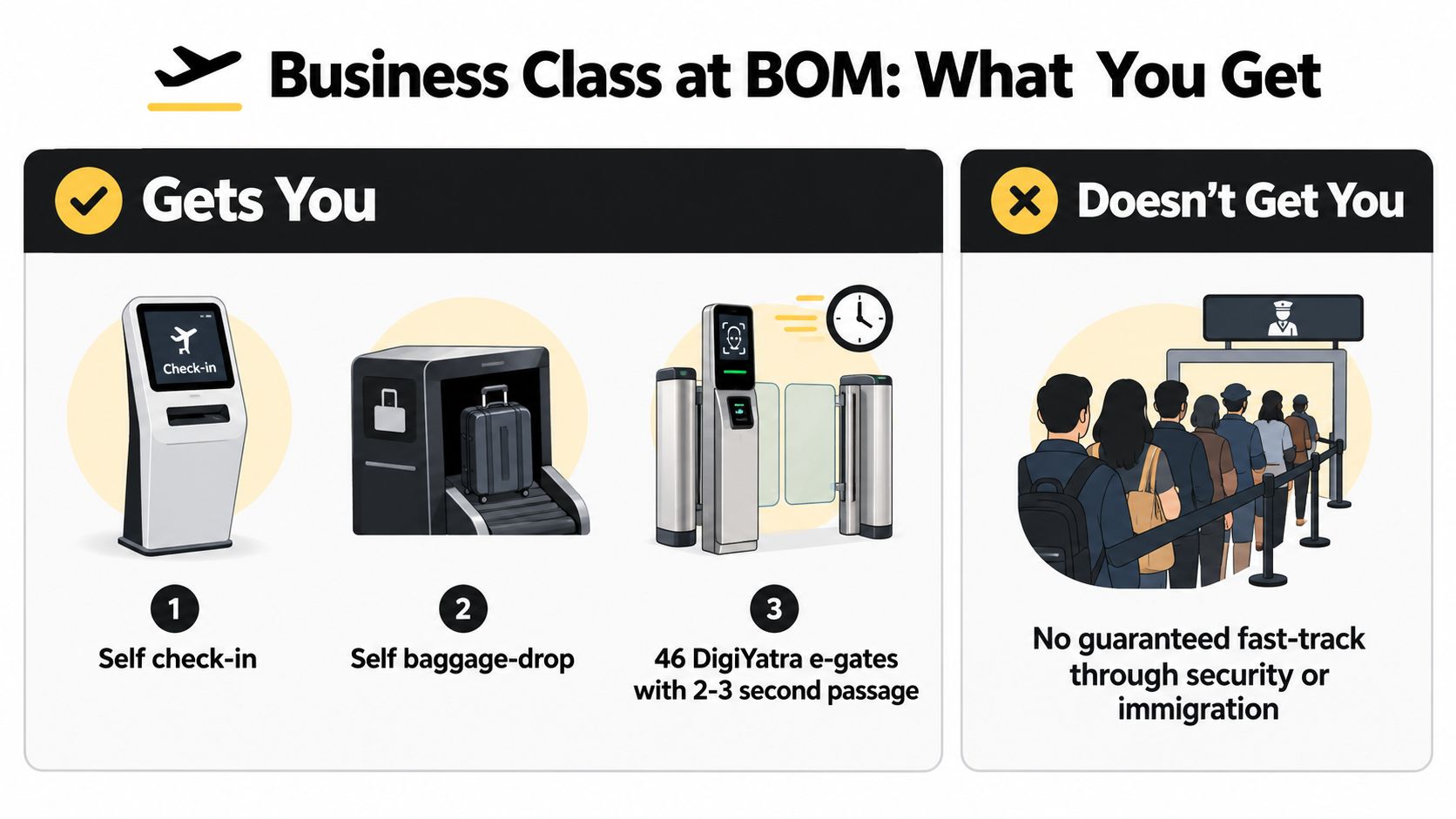
Business class is primarily a cabin purchase, not a guarantee of a frictionless airport. Dedicated check-in, lounge access, baggage handling and other privileges need verification against the airline, fare and terminal.
Mumbai has introduced self-check-in, self-baggage-drop and biometric processing. Reporting describes 46 DigiYatra-enabled e-gates and 40 face pods, with claimed checkpoint processing of approximately 2–3 seconds, alongside recognition in the 2025 Airport Service Quality awards as Asia-Pacific's best airport for departures in the over-40-million-passenger category, as summarized in KAYAK's Mumbai business-class airport guide.
That checkpoint claim isn't an airport-wide transit time. Nor does digital processing mean every passenger, airline or international journey has identical eligibility.
The distinction between airport infrastructure and ticket benefits matters.
Ask what your fare includes
Self-service facilities aren't exclusively business-class benefits. Before paying extra for the ground experience, distinguish access to airport technology from privileges attached to your ticket.
| Benefit or facility | Question to ask |
|---|---|
| Dedicated check-in | Is it available for this airline and departure? |
| Security priority | What access is explicitly included? |
| Lounge | Which lounge accepts this exact fare? |
| Baggage | What allowance and handling benefits apply? |
| Biometrics | Is this journey eligible for the process? |
| Boarding | What priority does the ticket specify? |
For an overnight long-haul flight, the seat may justify the purchase even if the lounge doesn't. For a daytime departure, paying a large premium solely for lounge access is harder to defend.
Use this explanation of what a business-class flight includes to frame your questions, then obtain answers for the actual ticket.
Airport reality: A premium boarding pass can change your entitlements. It can't eliminate every queue or operational delay.
Keep your ground plan independent
Carry what you need rather than relying entirely on lounge catering. Rip Van's guide to the best snacks for long flights is a useful planning resource; check applicable security and destination restrictions before packing food.
Confirm the terminal, transport plan and check-in requirements separately from the cabin purchase. Don't shorten your airport buffer just because you've bought business.
Pay for benefits you can identify and use. Treat any unverified promise of effortless airport passage as marketing, not part of your itinerary plan.
Your Mumbai Business Class Buying Playbook
A successful premium purchase fits the traveler, not just the fare spreadsheet. Corporate buyers, frequent flyers, leisure travelers and SMB owners need different definitions of value.
Corporate travel managers should establish policy compliance before pursuing a discount. Frequent flyers should inspect eligible mileage and status treatment rather than assuming all business fares earn alike. Leisure travelers can often explore a broader range of dates, while SMB owners need to weigh comfort against cash flow and the purpose of the trip.
Set the objective before searching
| Buyer | Primary objective | Avoid |
|---|---|---|
| Corporate travel manager | A compliant, workable business itinerary | Savings that conflict with policy |
| Frequent business traveler | Useful benefits and arrival readiness | Paying for status value you won't use |
| Luxury leisure traveler | A suitable premium return journey | Buying an awkward trip for the headline discount |
| SMB owner | Comfort at a defensible total cost | Treating travel time as free |
| Travel advisor | A documented comparison the client can approve | Presenting unverified cabin guarantees |
Lower-priced business products require particular attention. CNBC reported restricted business fares from United and Delta that retain the larger seat but may remove benefits such as lounge access, baggage, advance seat selection, flexibility or some mileage earnings, in its analysis of basic business-class exclusions. Read the actual fare conditions rather than assuming the cabin name supplies the complete package.
Include the airport in the calculation
BOM versus Navi Mumbai deserves a door-to-door comparison, not an airport-code substitution. Navi Mumbai's first phase was planned for 20 million annual passengers, with a mix of intended ground connections, as outlined in ACI Asia-Pacific's Navi Mumbai airport overview.
Treat planned links as plans until you've verified operational availability. For a traveler staying in South or central Mumbai, compare transport cost, dependable access and transfer uncertainty before accepting a lower airfare. Don't assume an inter-airport connection is practical without checking the logistics.
Keep this booking checklist
- Define the trip: Record destination, dates and arrival deadline.
- Benchmark both cabins: Compare tickets you can purchase.
- Inspect the itinerary: Confirm every sector and operating carrier.
- Verify the seat: Check the scheduled configuration.
- Read the restrictions: Add required extras to the total.
- Check airport access: Include the ground journey.
- Buy against your target: Stop chasing a hypothetical lower fare once the purchase works.
The objective isn't business class at any cost. It's the right premium journey for less than you need to pay.
Passport Premiere offers membership-based international Business and First Class fare monitoring and market analysis to help travelers assess premium prices before buying. Visit Passport Premiere to explore its membership and fare-monitoring guidance, then use your Mumbai corridor, travel dates and acceptable routings to build a disciplined buying plan.
