
A red-eye flight is an overnight flight that leaves late at night and lands the next morning during normal sleeping hours. In U.S. domestic flying, researchers counted 115,580 red-eye flights out of 6,898,743 flights in 2025, or 2.28%, using a working definition of departures between 9 p.m. and 3 a.m. and arrivals between 3 a.m. and 10 a.m. local time (Champion Traveler).
You're probably here because you're looking at a flight that leaves when your body wants a pillow, not a boarding group. Maybe it departs at 10:45 p.m., maybe it lands before breakfast, and maybe you're wondering whether “red-eye” is just slang or a real travel category.
It's both. Airlines and travelers use the term for a specific kind of schedule: late-night departure, early-morning arrival. Once you understand that, the rest gets easier. You can tell whether a flight counts as a red-eye, why these flights are clustered in certain parts of the map, and whether the trade-off makes sense for your trip.
Introduction to Overnight Flying and Why It Matters
At 11 p.m., airports feel different. The coffee line is shorter, people lean against backpacks, and gate areas turn into a mix of business travelers, families trying to keep kids awake, and leisure flyers hoping they can sleep in a seat just long enough to function after landing.
That's where the question usually starts. What is meant by red eye flight? In plain English, it means a flight timed to run through the hours when you'd normally be asleep. It isn't defined by luxury, route length, or plane model. It's defined by the clock.
Why this matters before you book
A red-eye can be smart. It can also be miserable.
If you leave late, travel while you'd otherwise be in bed, and arrive in the morning, you may protect daytime hours at your destination. That's a big reason people choose them for work trips, short weekend visits, or schedules that don't leave room for a daytime flight.
But the same timing creates the main problem. You're trying to squeeze sleep into a narrow seat, in dry cabin air, with lights, announcements, and other passengers around you. Even if you doze off, the rest often feels chopped into pieces.
Practical rule: Don't judge a red-eye only by departure time. Judge it by how functional you need to be after landing.
A simple way to think about it
A daytime flight asks, “Can you tolerate a few travel hours?”
A red-eye asks, “Can you trade a normal night of sleep for travel efficiency?”
That's a different decision. If you have a relaxed arrival day, a red-eye may work well. If you need to lead a meeting, drive a long distance, or parent small children immediately after landing, the same flight may feel much more expensive than the ticket price suggests.
This is why overnight flying deserves more than a dictionary definition. The skill is knowing what the schedule means for your body, your arrival, and your total trip plan.
What a Red Eye Flight Really Means in Practice
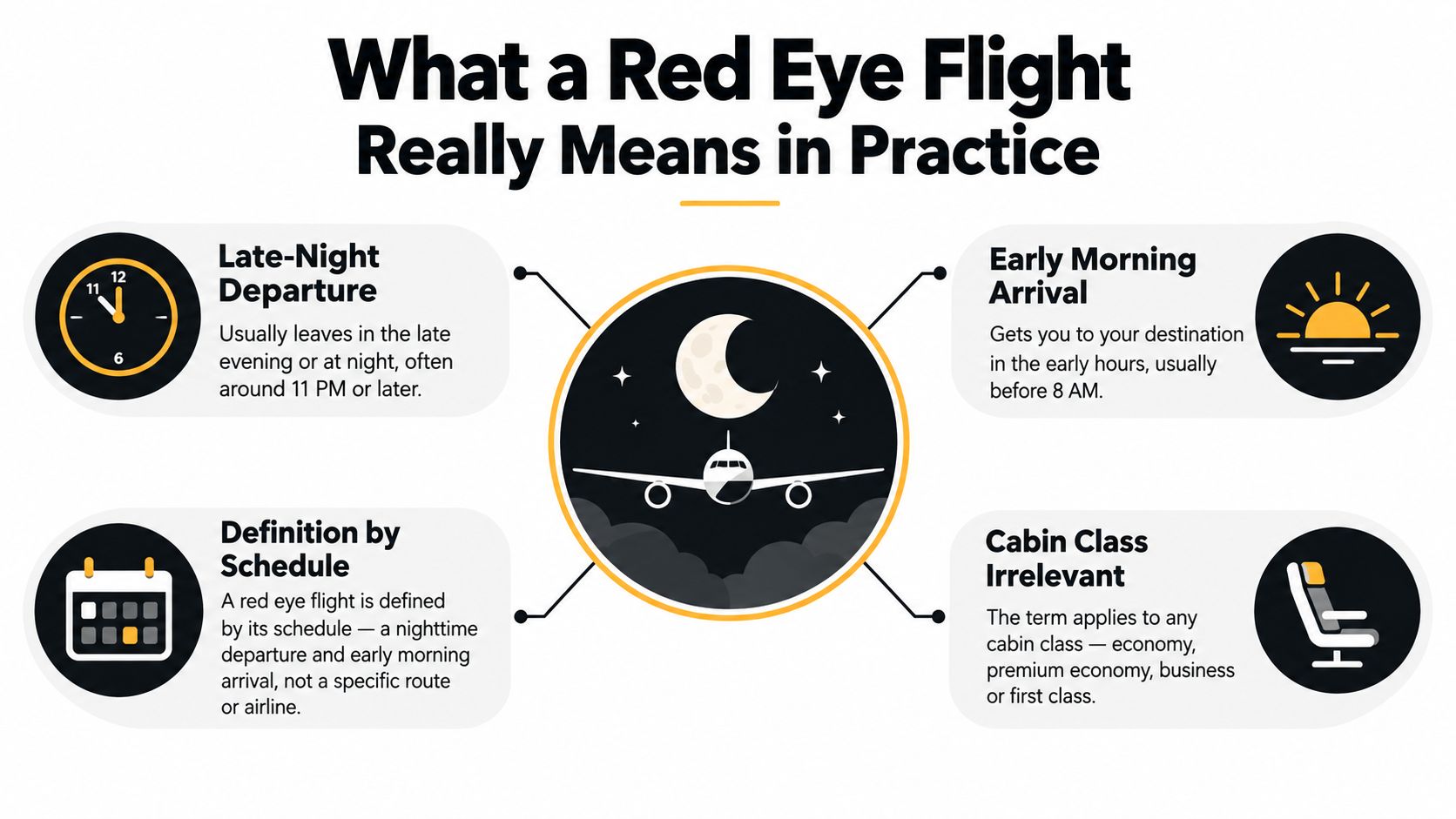
A red-eye is easiest to spot once you stop thinking about the plane and start thinking about your sleep window. If your flight leaves during the hours when you'd normally be winding down or asleep, and it lands the next morning before the day is fully underway, you're likely looking at a red-eye.
According to Skyscanner, the term is used for an overnight commercial flight that departs late at night and arrives the following morning, usually during the passenger's normal sleep window. In practice, that often means departures roughly after 9 to 10 PM and arrivals before 8 to 10 AM, and the schedule, not the aircraft type, fare class, or route length, is what defines it (Skyscanner red-eye guide).
It's about timing, not the seat map
People often mix up red-eyes with long flights, international flights, or premium cabins. That's where confusion creeps in.
A short domestic flight can be a red-eye if it leaves late enough and lands the next morning. A long daytime flight is not a red-eye just because it lasts many hours. Business class doesn't make a flight a red-eye, and economy doesn't prevent it from being one.
Think of it this way:
- A red-eye is a schedule type.
- A cabin class is a comfort level.
- An aircraft type is the machine.
- A route length is the distance.
Those are separate things.
Why sleeping on one feels different
Sleeping on a red-eye is a little like trying to nap in a reclining office chair while someone occasionally bumps your elbow and turns lights on. You might get rest, but it's rarely the same as uninterrupted sleep in a bed.
That matters because many first-time overnight flyers assume, “I'll just sleep on the plane.” Sometimes you will. More often, you'll get fragments of sleep. That can still help, but it changes how you should plan the next morning.
A few practical signs you're booking a red-eye:
- Late departure: It leaves when your evening routine would normally be ending.
- Morning arrival: You land before or around the start of the local workday.
- Sleep pressure: The trip overlaps your usual sleep hours, not just your leisure time.
If you're also sorting your packing for that kind of trip, compact carry-on gear becomes more useful than bulky luggage. A sturdy weekender can make an overnight itinerary simpler, especially if you want clothes and toiletries within reach. If you want examples of that style, you can browse leather overnight bags built for short travel runs.
Why Flights Are Called Red Eye and Where They Fly Most
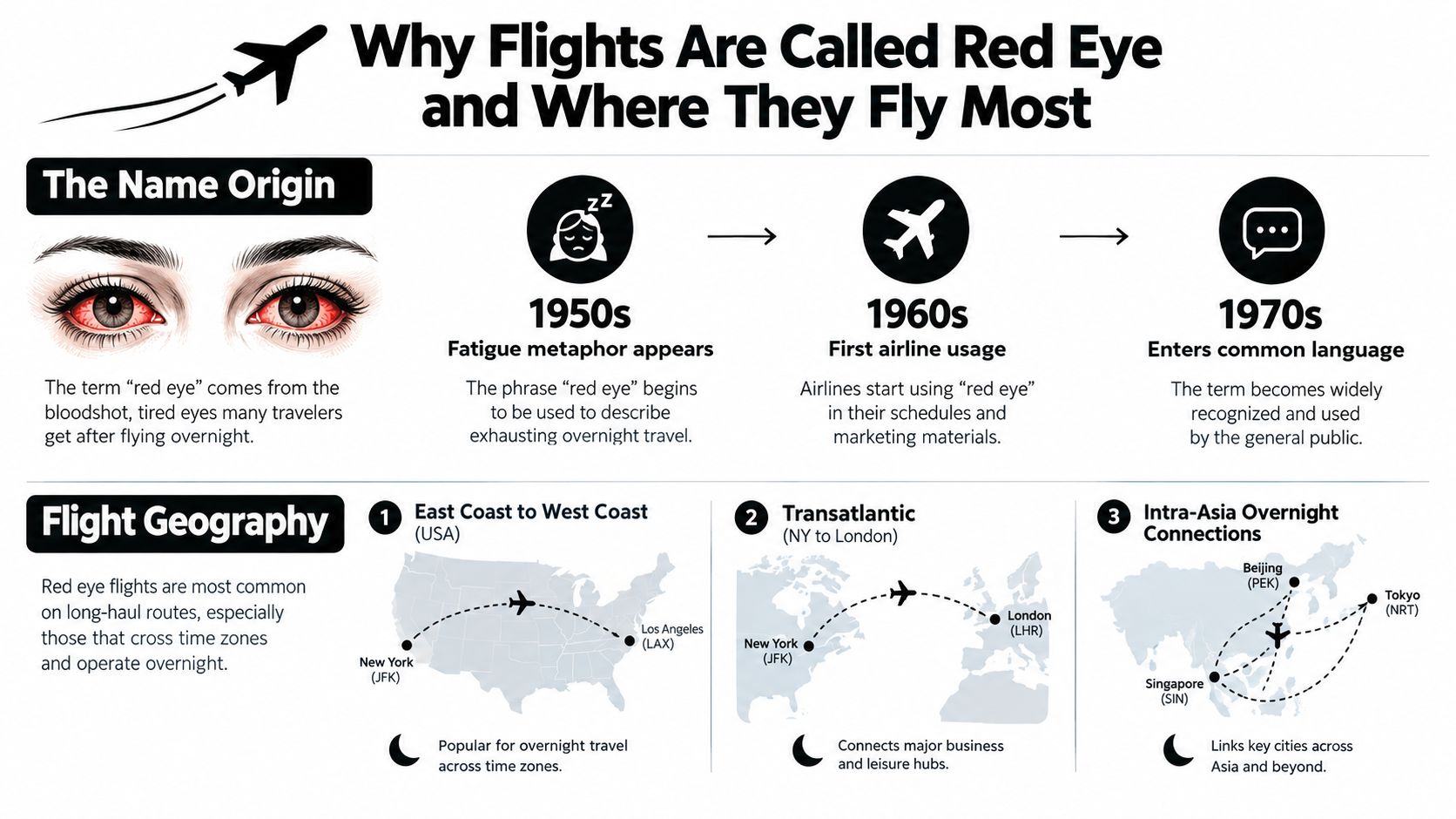
The name sounds dramatic, but it's grounded in something ordinary: tired eyes.
Historically, “red-eye” came from the visible fatigue people show after poor overnight sleep. In airline use, the term became common in the late 1960s. One reference notes that the airline sense was first heard in the United States in 1968, and another notes that American Airlines was advertising red-eye flights in 1969 as scheduling and navigation improvements supported more overnight routes (Wikipedia entry on red-eye flights).
The name is about the traveler, not the plane
A red-eye isn't named after a route code or an aircraft feature. It's named after how passengers often look and feel when they arrive. That's why the phrase stuck. It translates the whole experience into one image: overnight travel with too little real sleep.
Some travelers outside North America are more likely to say overnight flight. The meaning is close, but “red-eye” carries the extra human detail. It hints that this kind of trip isn't just late. It's physically demanding.
The phrase survives because it describes both the schedule and the consequence.
Why red-eyes cluster in certain places
Here's the part many travel pages skip. Red-eyes are not spread evenly across the map.
A 2026 industry analysis found 115,580 U.S. domestic red-eye flights in 2025, up from 75,158 in 2000, and reported that 97% of those overnight flights departed from the Pacific and Mountain states plus Alaska and Hawaii (Travel Industry Wire analysis).
That concentration makes sense once you think in time zones and aircraft use.
- West-to-east timing works better: A late departure from the West Coast can still arrive in the morning on the East Coast.
- Long domestic routes fit the overnight window: Airlines can cover a meaningful distance while passengers would otherwise be asleep.
- Aircraft utilization matters: Instead of leaving a plane parked overnight, airlines can keep it flying and generate another segment of service.
For travelers, this explains why you'll see many more red-eye options on some domestic corridors than others. If you live in or depart from the western side of the U.S., your odds of seeing overnight options are much better. If you're flying a shorter route with awkward timing, the airline may not offer a true red-eye at all.
Advantages and Drawbacks of Choosing a Red Eye Flight
Red-eyes aren't automatically good or bad. They're useful when the job of the trip matches the cost to your sleep.
A consultant flying home after a project may love one because it preserves the next day. A vacationer starting a beach holiday may hate one if it turns arrival day into a fog. A budget-minded traveler may accept the trade because overnight flying can line up neatly with a short schedule, while a parent with tired kids may decide the trade isn't worth it.
Who usually benefits most
Some travelers get more value from overnight flying than others.
- Business travelers with flexible mornings: If the first meeting isn't immediate, a red-eye can free up daylight on both ends of the trip.
- Weekend leisure travelers: Leaving late can stretch a short trip without using as many daytime hours in transit.
- Travelers trying to avoid a hotel night: An overnight schedule can reduce the need for one more evening on the ground.
Who should be cautious
The drawback isn't mysterious. It's sleep disruption.
If you know you don't sleep well sitting upright, if you're sensitive to time changes, or if you need to perform at a high level right after landing, red-eyes can backfire quickly. The hidden cost is not on the booking screen. It's in your energy, mood, and decision-making the next day.
If arrival day matters more than departure day, protect arrival day.
Should You Take the Red Eye Decision Matrix
| Factor | Red Eye Advantage | Red Eye Drawback |
|---|---|---|
| Daytime schedule | Preserves daytime hours for work or vacation | You may lose sharpness the next morning |
| Overnight timing | Travel happens while you'd otherwise be inactive | Sleep often feels fragmented |
| Short trips | Can make a quick trip more efficient | Recovery may take part of the trip anyway |
| Arrival day plans | Useful if you can ease into the day | Risky if you must drive, present, or make big decisions right away |
| Family travel | Sometimes helps children sleep through part of the trip | Bedtime disruption can make the whole journey harder |
| Cost thinking | May fit a practical trip plan well | Comfort shortcuts can feel expensive after a rough night |
A good rule is simple. If the red-eye gives you meaningful schedule savings and you can build in a soft landing after arrival, it's often worth considering. If it asks you to perform immediately after too little sleep, think twice.
How to Sleep and Stay Comfortable on a Red Eye Flight
The best red-eye strategy starts before boarding. Most bad overnight flights are the result of small mistakes stacked together: the wrong seat, bright screens, awkward clothing, no eye mask, no plan for arrival.
Before you leave for the airport
Start by making sleep easier, not by hoping sleep happens anyway.
Choose clothing you can sit and doze in comfortably. Keep your toothbrush, deodorant, medication, and a simple face wipe where you can reach them quickly. If you want a deeper routine for overnight flying, this guide on how to sleep on long flights is a useful companion.
Seat choice matters too. A window seat usually gives you a wall to lean on and fewer interruptions from neighbors getting up. If you're comparing premium options on a longer overnight route, reviewing best seats in business class can help you think about privacy, recline, and actual sleep posture rather than just fare labels.
What to do once you're on board
After takeoff, treat the cabin like a temporary sleep space.
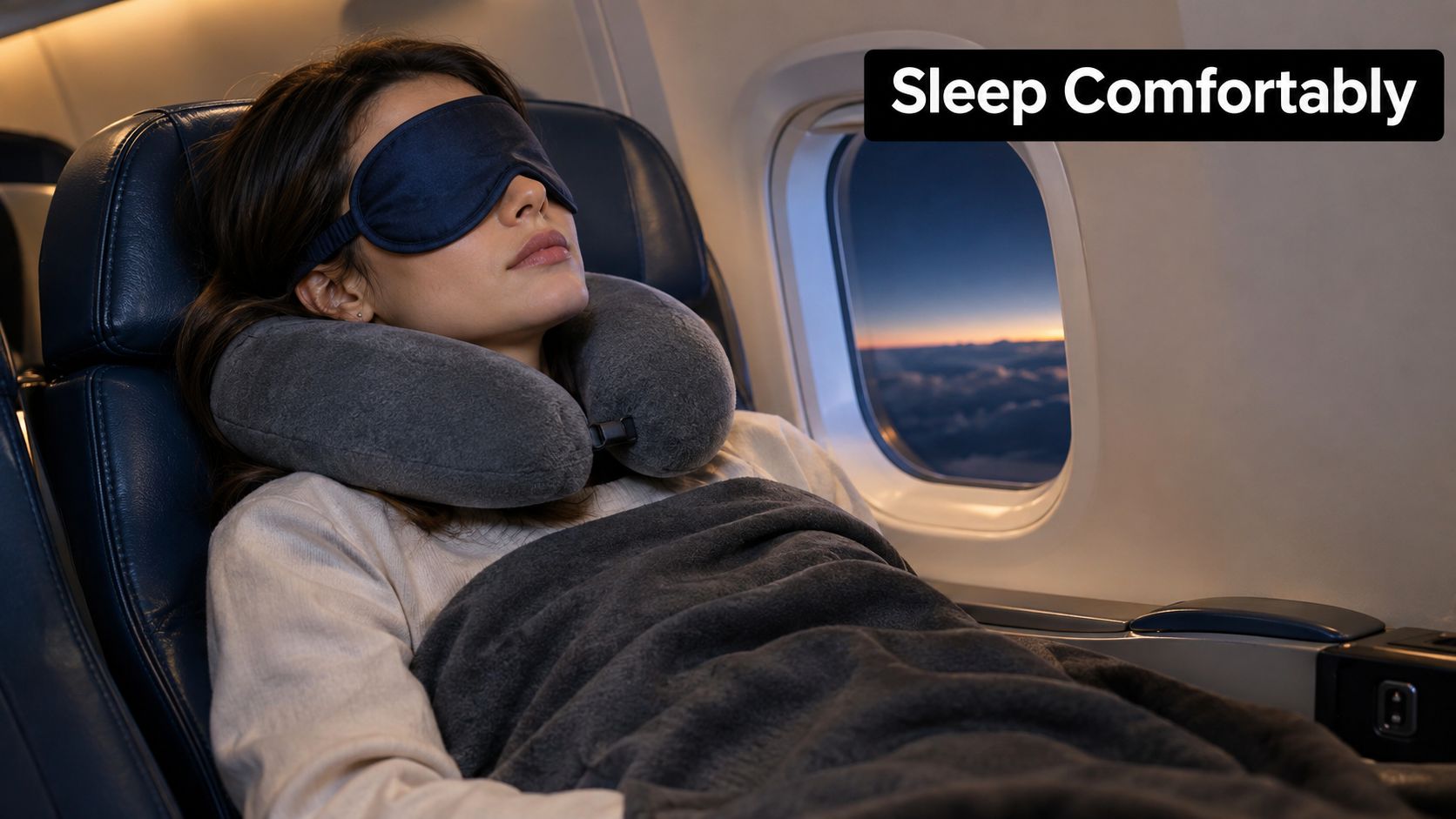
- Block light fast: Use an eye mask early instead of waiting until the cabin gets brighter.
- Cut noise deliberately: Earplugs or over-ear headphones reduce the small sounds that keep waking you.
- Limit phone scrolling: Bright screens tell your brain it's still daytime.
- Settle your neck: A neck pillow helps prevent the head-drop that keeps jolting people awake.
Arrival rule: Aim for “good enough sleep,” not perfect sleep. Even partial rest can make the morning much easier.
A red-eye usually rewards simple discipline more than elaborate hacks. Once the meal service ends or the cabin quiets down, start acting as if bedtime has already begun.
This video walks through practical in-flight sleep tactics that many travelers find easy to apply:
How to handle the arrival
The morning after a red-eye is where comfort turns into function.
Don't expect to feel polished the instant you step off the plane. Give yourself a reset. Wash your face, brush your teeth, change your shirt if needed, and get daylight when you can. If possible, avoid stacking your first hour with complicated decisions.
Many seasoned travelers also keep a tiny “landing kit” together:
- Fresh basics: Toothbrush, toothpaste, deodorant
- Face and eye relief: Face wipe or splash of water
- A simple clothing backup: Clean shirt, underwear, or socks
- One comfort item: Lip balm, moisturizer, or eye drops
That small routine won't create a full night's rest. It does help you feel more human, which is often enough to turn a rough arrival into a workable one.
When Upgrading to Premium Cabins Costs Less Than You Think
People often treat premium cabins as a pure luxury question. On overnight travel, they're often a value question instead. Business class cheaper than coach sounds backwards, but it can happen.
Independent travel reporting notes that business class being cheaper than economy is “not unheard of,” especially on competitive routes where airlines discount premium inventory more heavily to fill empty seats (One Mile at a Time analysis).
When the math flips
The biggest mistake travelers make is comparing only the base economy fare to the premium fare headline. That leaves out the extras many people add anyway.
One industry example shows an ORD to LHR itinerary where a typical coach total of $1,950 is higher than a discounted business-class fare of $1,850 once common extras like bags, seat selection, and meals are included (Passport Premiere fare example).
Another example for a New York to London trip shows a discounted business-class fare around $1,800 that can come in below the last-minute economy price on the same flight, illustrating how volatile premium and coach pricing can be (Luxury travel fare example).

Why this matters more on overnight flights
On a daytime hop, extra comfort may be nice. On a red-eye, extra comfort can change the whole outcome of the trip.
That's why fare monitoring matters. Tools and services that track premium-cabin swings can help travelers decide whether a lie-flat seat is overpriced or unexpectedly reasonable. One option in that category is red-eye fare tracking for premium cabins, which focuses on watching fare cycles rather than assuming the first listed price is the market value.
Don't ask only, “Can I afford business class?” Ask, “What am I already spending to make coach tolerable?”
If you'd pay for seat selection, checked bags, airport meals, and maybe a rough hotel night because you're too tired to function after arrival, the comparison changes. On some overnight long-haul routes, a premium cabin isn't just comfort. It's a cleaner travel plan.
Making the Right Call on Your Next Overnight Trip
A red-eye is easiest to judge when you stop seeing it as a flight label and start seeing it as a travel strategy. The question isn't whether overnight flying sounds efficient. It's whether that efficiency still works once your sleep, arrival plans, and comfort needs are part of the equation.
A quick booking filter
Before you book, run through three checks:
- Timing fit: Does the departure cut into your normal sleep window, and can you handle the morning after?
- Arrival reality: Are you landing into a light day, or into tasks that require patience and sharp thinking?
- Comfort value: Would paying a bit more, or upgrading smartly, protect the whole trip?
For fare timing, it also helps to watch booking patterns instead of guessing. If you're trying to decide whether to buy now or wait, this guide on when airlines drop prices can help you think more clearly about timing.
The takeaway most travelers miss
What is meant by red eye flight isn't just “a late flight.” It's a flight shaped by sleep hours, time-zone geography, and airline scheduling choices. That's why some routes are full of them and others barely offer them.
Once you understand that, you can book more intentionally. You'll know when to use a red-eye to save daylight, when to avoid one because the morning matters too much, and when a premium seat may be the more rational buy instead of an indulgence.
A good overnight trip rarely happens by accident. It happens because the schedule, the seat, and the next morning all fit together.
Passport Premiere helps travelers evaluate international premium-cabin fares, monitor fare changes, and spot situations where business or first class may make more sense than standard coach on overnight routes. If you want help turning red-eye pricing volatility into a smarter booking decision, visit Passport Premiere.
