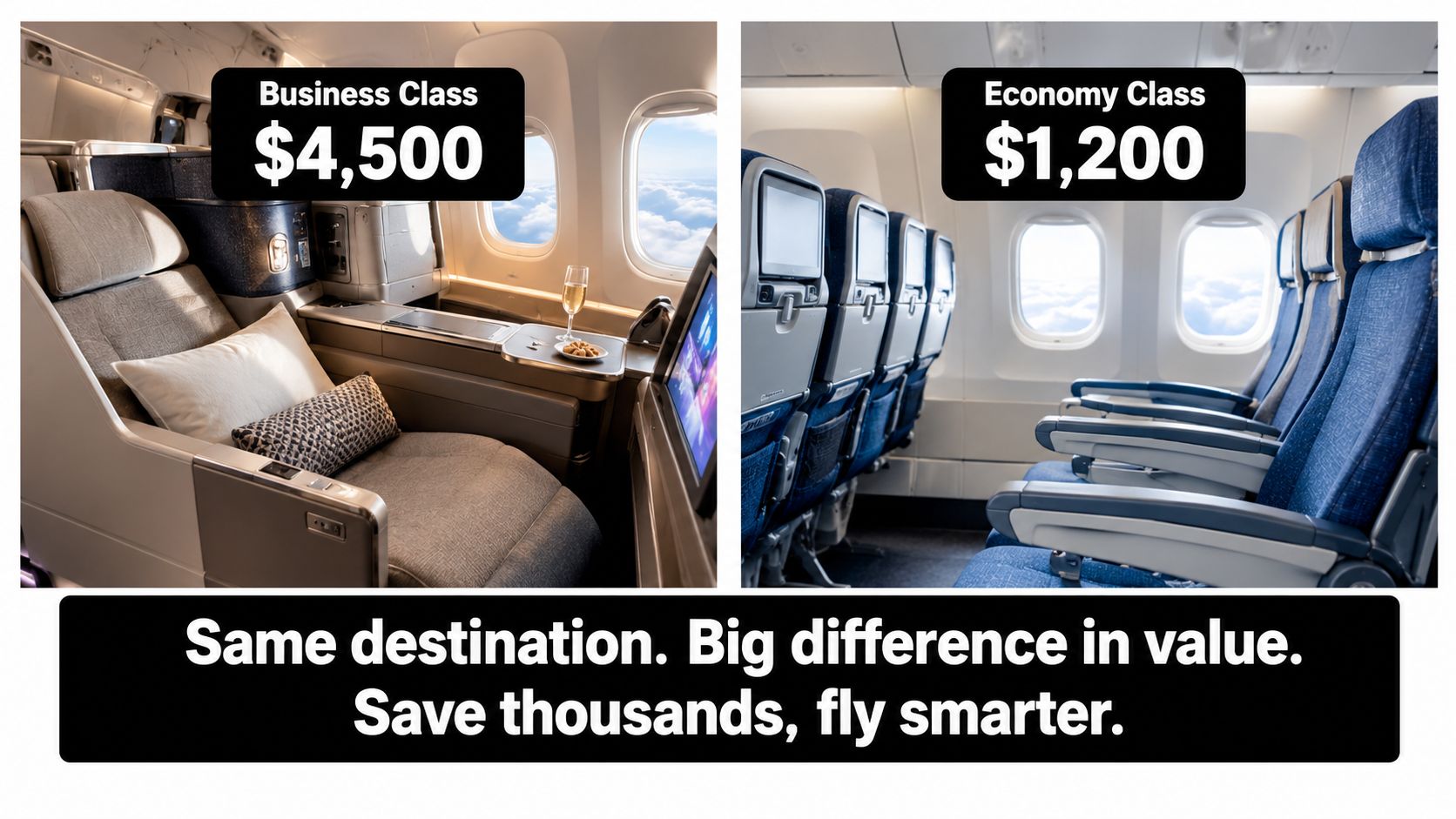
A business class ticket to South Korea can, on the right dates, price within a coach fare's shadow. That's not a slogan. It's what happens when premium inventory sits unsold on a competitive, high volume corridor while economy seats on preferred nonstops sell out. If you're shopping business class flights to South Korea as a fixed luxury purchase, you'll miss that window. If you treat it as a timing and routing puzzle, you'll start seeing it.
The Counterintuitive Truth About Business Class to Seoul
Start with the published minimums. KAYAK's recent U.S. to South Korea minimums list $555 for business class versus $478 for economy, a difference of only about $77, or roughly 16%. Those are minimum observed fares, not averages, and that distinction matters. They don't prove business class is usually cheap. They prove the gap between cabins isn't fixed.
That gap compresses for a specific reason. Airlines price each cabin against its own remaining inventory, not against a neat ladder where business must always sit several multiples above coach. When a nonstop economy cabin fills for peak dates, its remaining seats move into higher fare buckets. When a one stop business cabin on the same corridor is light, its lowest buckets stay open longer. The two curves cross, or nearly cross, and a traveler comparing only headline cabin labels never notices.
What the cheap fare actually signals
A low business fare usually signals one of three conditions. The departure date is soft for corporate demand. The routing requires a connection that time sensitive travelers are avoiding. Or a competing carrier has added capacity and others are matching selectively, not across the whole calendar.
None of those conditions lasts. That's why checking once, on your preferred date, from your home airport, tells you almost nothing about the market. You're sampling one cell in a grid shaped by date, gateway, routing, and aircraft. Change one variable and the lowest premium fare can move closer to, or below, the coach fare you were about to buy for a worse itinerary.
Practical rule: Compare business class against the specific coach itinerary you'd actually accept, on the same dates, not against the cheapest coach fare in the abstract.
The honest version of business class cheaper than coach is narrow but real. It happens as a comparison effect, when a discounted premium fare on a flexible routing meets an expensive coach fare bought late, on peak dates, or on a constrained nonstop. It doesn't happen because airlines have permanently repriced premium cabins downward.
That framing changes how you should shop. You're not hunting for a secret coupon. You're monitoring for moments when inventory, competition, and routing flexibility pull a lie flat seat into coach territory. The rest of the decision, which routing, which airport, which aircraft, and whether premium economy is enough, determines whether that fare is good value or just a cheap label on a tiring trip. Price gets you to look. The mechanics tell you whether to book.
Why South Korea Is a Premium-Cabin Powerhouse
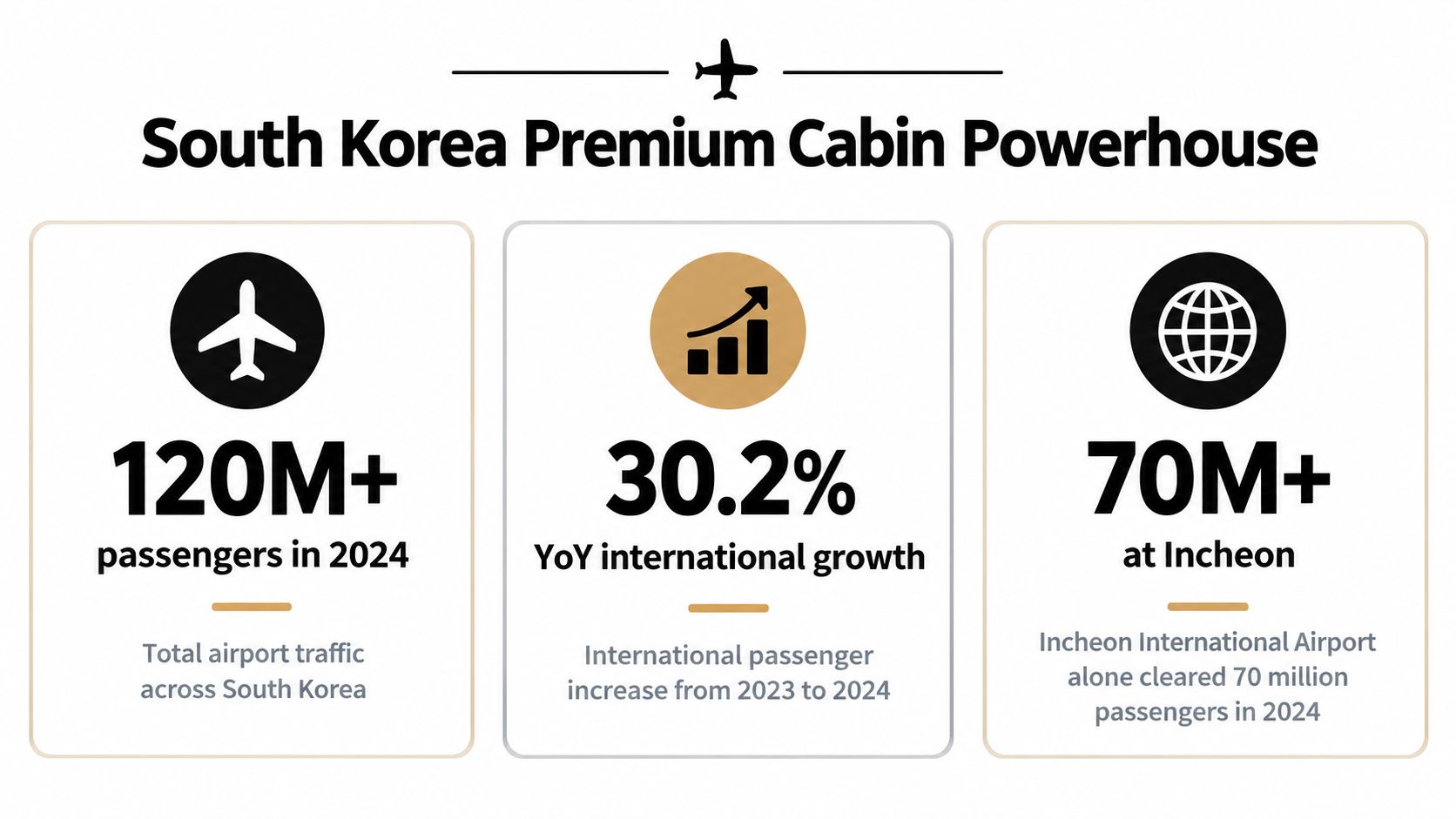
South Korea isn't a thin market where one carrier controls a handful of weekly seats. South Korean airports handled more than 120 million passengers in 2024, up 19.5% from about 100.5 million in 2023, with Incheon alone recording more than 70 million passengers, up 26.8%. International traffic drove that rebound, which means the long haul network feeding business cabins grew faster than domestic flying.
That scale changes fare behavior. In a small market, premium inventory is scarce and pricing stays rigid because there's little competition to force a discount. In a large hub market, multiple carriers, alliances, and connecting routings compete for the same corporate and leisure premium traveler. More seats doesn't automatically mean lower fares, but it does mean more fare signals, more mismatches between cabins, and more chances for one routing to price below another.
Premium demand recovered at least as fast as economy
Globally, international business and first class travel grew 11.8% in 2024, slightly ahead of 11.5% for international economy, with premium cabins accounting for about 116.9 million passengers, roughly 6% of international traffic. Premium demand isn't lagging the recovery. It's keeping pace with it.
For Seoul, that combination cuts both ways. Strong premium demand supports higher fares on peak corporate days, when executives travel regardless of price. Deep overall capacity, though, means off peak premium seats still need buyers, and airlines would rather discount an empty lie flat seat than fly it vacant. That tension is exactly where fare volatility comes from.
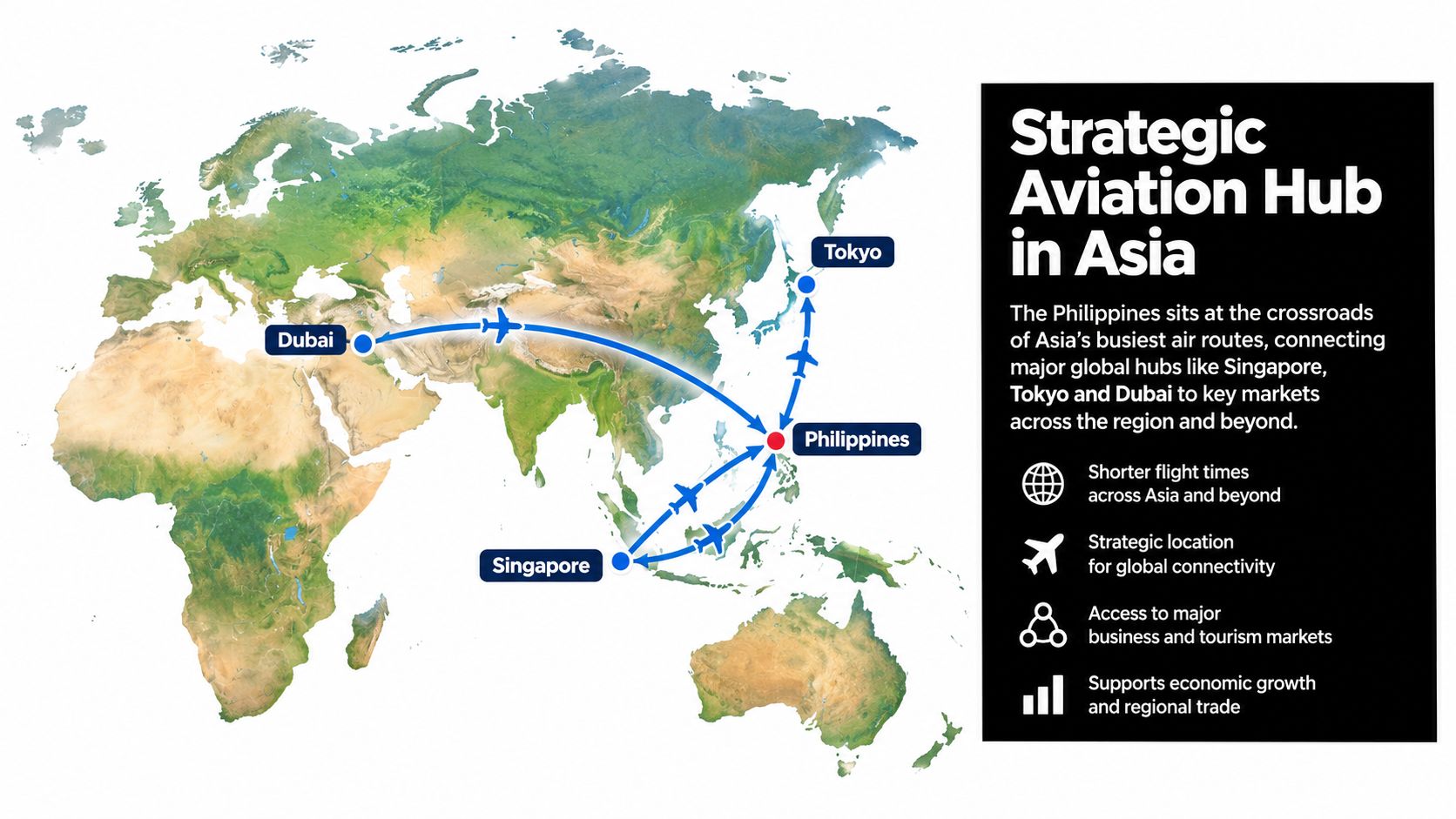
Incheon also functions as a transfer hub linking North America, Europe, and Asia, not just as a final destination. Connecting passengers fill seats that point to point demand alone wouldn't support, which sustains frequencies and aircraft sizes that create more premium inventory to price. A traveler to Seoul benefits from capacity that exists partly because other travelers are passing through.
- Hub depth: More carriers and routings mean more competing business fares to compare
- Corporate cycles: Weekday and seasonal business demand creates predictable peaks and soft spots
- Transfer traffic: Connecting flows sustain larger aircraft and more premium seats on Seoul routes
The takeaway is simple. You're shopping in one of the world's most active international aviation markets, not on an isolated route. Volatility isn't a glitch in that system. It's the predictable product of scale, competition, and uneven demand, and it's why methodical comparison pays more here than on a route with a single daily flight.
Nonstop Versus One-Stop Versus Two-Stop Routing
Routing is the largest single lever you control. Most travelers treat a stop as a quality downgrade and filter it out before they ever see the price. On Seoul routes, that filter can remove the very fares that make business class competitive with coach.
The spread is measurable. In a dataset of 492,433 round trip fares from 15 U.S. departure cities and 54 airlines, one stop business class fares began at $3,733, compared with $4,443 for nonstop and $4,125 for two stop itineraries. The one stop minimum sat $710 below the nonstop minimum. One stop itineraries also represented 76% of fares with known routing in that same dataset, so the cheapest pool is also the deepest.
Business Class Minimum Fares to Seoul by Routing
| Routing | Minimum fare | Share of fares |
|---|---|---|
| Nonstop | $4,443 | Not stated |
| One stop | $3,733 | 76% |
| Two stop | $4,125 | Not stated |
Read that table carefully. Two stops did not produce the lowest minimum, which breaks the assumption that more inconvenience always means a lower fare. One stop routings win because they combine competition from many hub combinations with schedules travelers will accept. Two stop itineraries add risk and elapsed time without reliably adding savings.
How to judge a connection
A stop only helps if the connection is protected, sensibly timed, and in a hub you'd choose deliberately. Before you accept one, work through how connecting flights work in practical terms for your itinerary, including whether your bags transfer, whether you change terminals, and what happens if the first leg runs late.
- Protected ticket: One booking means the airline rebooks you after a misconnect
- Buffer time: A tight connection in an unfamiliar hub can erase the value of a cheaper fare
- Arrival timing: A business fare that lands too late for sleep before a morning meeting isn't a bargain
- Backtracking: A connection that flies you well past Seoul adds hours no seat can fully repay
The comparison that matters is door to door. A nonstop coach seat that leaves you upright overnight and a one stop lie flat seat at a similar price aren't equivalent products, even if the premium routing takes a little longer. Sleep quality, arrival condition, and the ability to work or rest undisturbed belong in the same calculation as elapsed time.
That doesn't mean you should always connect. If you're flying in for a fixed morning commitment, the nonstop's reliability may justify its premium in either cabin. The point is to price both before deciding. Travelers who refuse connections on principle are choosing from the smallest, most expensive slice of premium inventory, then concluding business class is always out of reach. The dataset suggests the opposite conclusion. Flexibility on routing is often what brings a premium seat within striking distance of the coach fare on your preferred nonstop.
Aircraft, Seat Geometry, and What to Verify Before You Book
A cabin label isn't a product specification. Two flights sold as business class on the same airline can offer different bed lengths, aisle access, storage, and privacy depending on the aircraft operating that day. On an overnight flight to Seoul, those details determine whether you sleep or merely recline.
Here's the current cabin standard to use as your reference point before checking a specific departure.
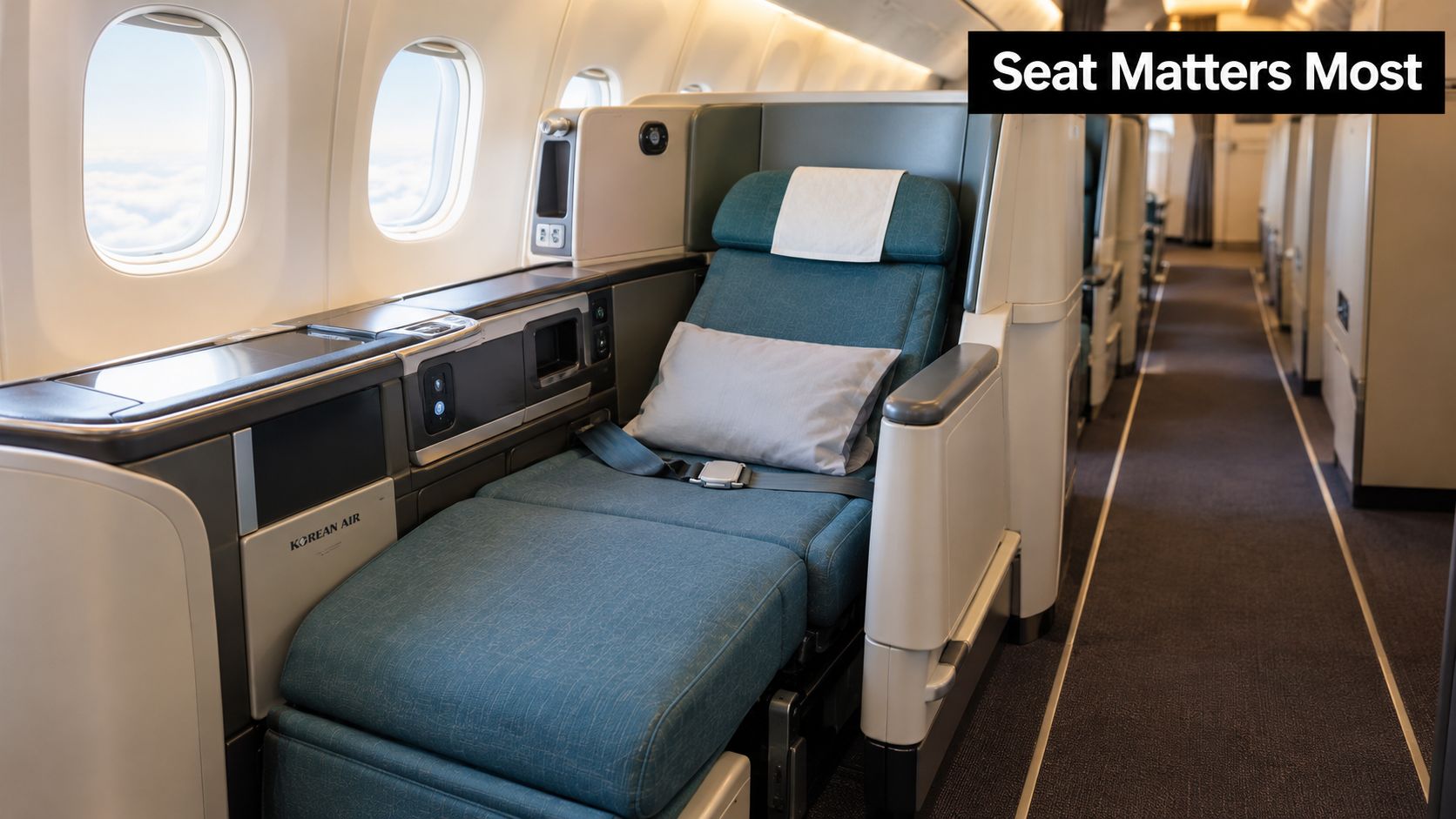
Korean Air's long haul Prestige Class fleet includes the Boeing 787-9, Boeing 777-300ER, and Airbus A380, with reported configurations including fully flat beds about 73 inches (185 cm) long, 17 inch entertainment displays, power outlets, and USB connectivity. That's a workable overnight product for many travelers. It's also a specification you should verify, not assume, because subfleets vary and scheduled equipment can change.
The checks that matter before payment
Start with the seat map for your exact flight number and date. Confirm the seat converts to a fully flat bed rather than an angled recline, since the difference shows up in your sleep, not in the marketing name. Then check whether every seat has direct aisle access. A layout that requires climbing over a neighbor undermines the uninterrupted rest you're paying for, and it matters more on a transpacific overnight sector than on a short regional leg.
Bed length deserves a personal check. A 185 cm bed suits many passengers, but taller travelers may find it restrictive, especially in footwells that narrow toward the end. If you're assigning seats to executives, match the specification to the person rather than booking the cabin generically. Power and USB access, storage for documents and devices, and a work surface you can use without clearing the whole seat area all affect whether someone can prepare for a meeting and still rest.
Watch this cabin walkthrough with those checks in mind, paying attention to bed conversion, foot space, and storage rather than styling.
Finally, account for change of aircraft risk. Airlines swap equipment for operational reasons, and a swap can change your seat type even when your flight number stays the same. You can't eliminate that risk, but you can reduce surprises by rechecking the seat map after booking and again before departure. If the product changes materially, you'll at least know early enough to adjust seats or expectations.
The seat map is the real product. The airline name and cabin label are just the packaging around it.
This discipline protects the logic of the whole purchase. Finding a business fare near coach pricing only helps if the seat delivers the sleep and working space that justified choosing it. Verify the aircraft first, then decide whether the fare is cheap for what you're getting.
Choosing Incheon, Gimpo, or a Connecting Hub
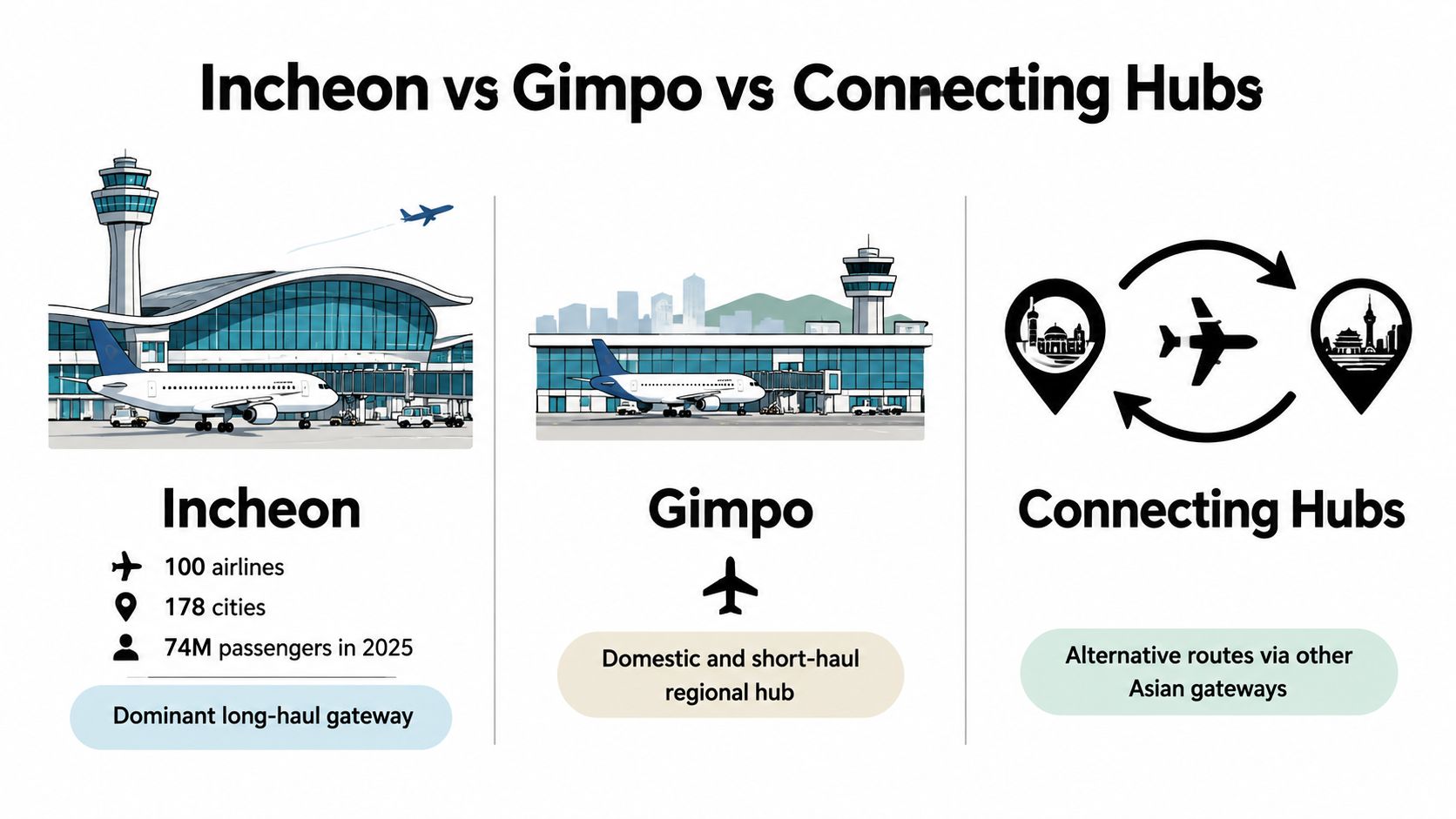
Most fare searches treat Seoul as one airport. It isn't, and the distinction can change both your total travel time and your total cost. Incheon handles the overwhelming majority of long haul traffic. Gimpo serves regional and domestic routes closer to central Seoul. A connecting hub elsewhere in Asia is a third option when nonstop premium inventory from your origin is expensive or badly timed.
Incheon's scale is the starting point. Incheon International Airport operator data lists about 100 airlines serving 178 cities in 54 countries, with 74.07 million passengers in 2025, its highest annual total since opening. That breadth gives you the widest choice of nonstop and one stop business class flights to South Korea, plus the deepest lounge, ground transport, and rebooking options when schedules shift.
When each option makes sense
Choose Incheon (ICN) for intercontinental arrivals, protected onward connections, and the broadest premium cabin choice. Its distance from central Seoul is the trade off, so factor ground transfer time into your arrival plan rather than treating landing time as arrival time.
Consider Gimpo (GMP) when you're arriving from a regional city it serves, including Shanghai Hongqiao, Taipei Songshan, and Beijing Capital, or connecting from a domestic Korean flight. Its proximity to central Seoul can shorten the ground leg to a meeting. It won't solve a long haul arrival from North America or Europe, because that traffic overwhelmingly uses Incheon.
Use a connecting hub when it produces a materially cheaper premium fare or a better departure time on a single protected ticket. Reject it when the savings depend on separate tickets, a terminal change with a tight buffer, or an overnight positioning move that adds a hotel night. Separate tickets are the quiet trap here. If your first flight runs late, the second airline has no obligation to rebook you, and a cheap premium fare can become a full price replacement ticket.
Price the whole journey
Add the fare, airport transfers, any hotel night, and the cost of arriving fatigued or late. Then compare options. A lower ticket price into a more distant or less convenient arrival point can be the more expensive choice once ground time, transfer risk, and a missed connection are included. Conversely, paying slightly more to arrive at the right airport, at a workable hour, on one protected ticket is often the disciplined corporate choice.
Hub scale also doesn't remove operational homework. Large airports offer more flights, but they can also involve longer walks, busier immigration queues, and more complex terminal transfers. Check terminal compatibility and minimum connection requirements for your specific itinerary. The best airport decision is the one that gets you to your Seoul meeting rested and on schedule at the lowest total cost, not the one attached to the lowest fare on a results page.
When Premium Economy Beats Business Class
Business class isn't automatically the right premium purchase on Korea routes anymore, because the cabin below it is changing. Korean Air's fleet decisions are reshaping what sits between economy and a lie flat seat, and that gives travelers a genuine middle option to price rather than dismiss.
Korean Air announced plans in 2025 to retrofit 11 Boeing 777-300ER aircraft, about 8% of its fleet, by removing first class and reducing business class capacity to add 40 premium economy seats, with its new Premium Class priced roughly 30 to 40% more than discounted economy. Fewer business seats on those aircraft can make remaining premium inventory scarcer and more price volatile. More premium economy seats make the mid tier easier to find.
Run the fare spread before choosing a cabin
On averages, the cabins aren't close. Recent South Korea pricing put average business class at about $5,244 round trip versus about $1,760 for premium economy, making business roughly 198% more expensive, while a flexible date business fare was found as low as $2,321. That low end figure is the important one for decision making. When a discounted business fare drops toward premium economy territory, the lie flat seat is usually worth taking. When business sits near its average, premium economy often delivers most of the comfort gain over coach for far less.
If you're weighing the two cabins directly, premium economy versus business class comes down to sleep, not legroom alone. Premium economy gives you more space, a deeper recline, and a calmer cabin than coach. It doesn't give you a flat bed. On a daytime sector where you'll work and stay awake, that trade can be entirely rational. On an overnight flight before a morning presentation, the flat surface is the product, and a wider recliner is a partial substitute.
- Choose premium economy when the flight is daytime, the fare gap is wide, and you can sleep properly after arrival
- Choose business class when you must sleep on board, work in privacy, or perform soon after landing
- Choose schedule over cabin when a better timed premium economy flight beats a badly timed business departure
Also verify what you're buying as cabins are renamed and retrofitted. Check the seat map, lounge access, priority services, and baggage rules for your aircraft and date. A marketed premium label isn't a guarantee of a lie flat bed. The travelers who get value from this cabin reshuffle are the ones who price all three tiers on the same dates, then buy the cheapest cabin that meets the trip's real sleep and work requirements.
A Practical Playbook for Booking Business Class to South Korea
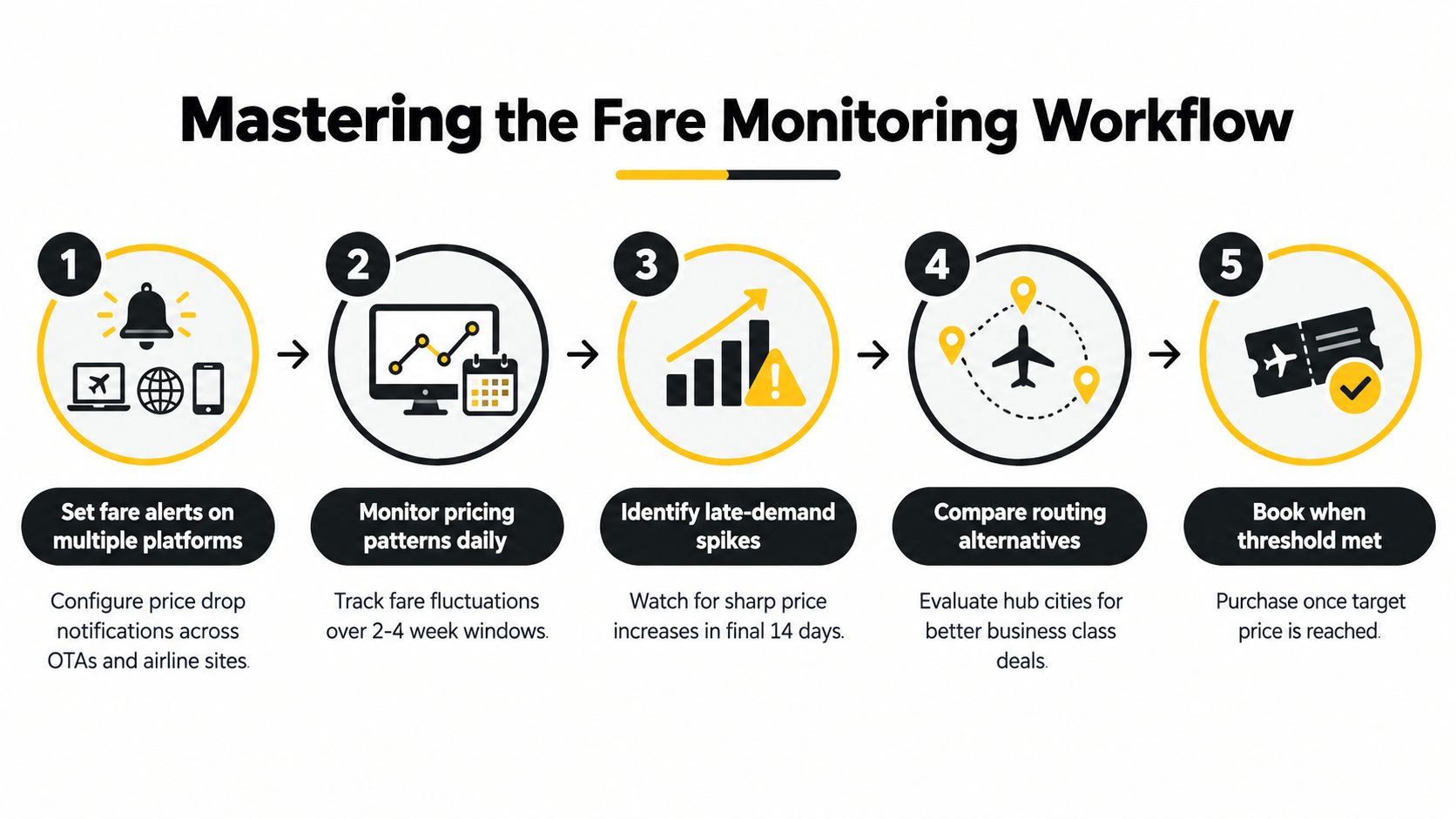
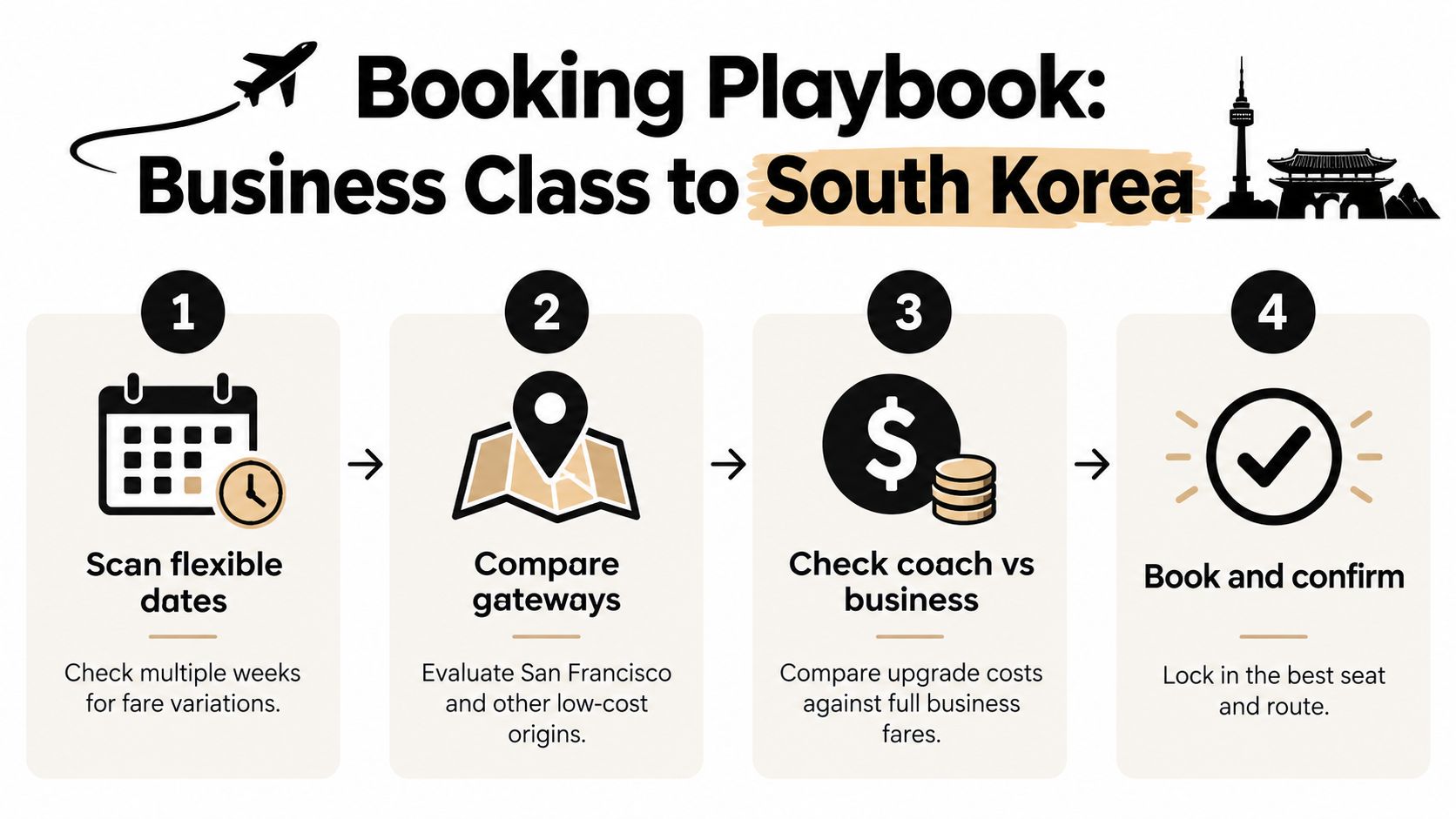
Put the pieces in the right order and the search gets simpler. Most travelers start with a cabin, then a date, then complain about the price. Start with flexibility instead, and let the fare spread tell you which cabin and routing make sense.
Run this sequence before you pay
1. Scan flexible dates first. Check a range of departures around your target rather than a single day. Soft corporate dates are where discounted premium inventory appears, and you won't see it if your search is locked to one peak departure.
2. Compare gateways against a coach baseline. Departure airport changes the fare materially. San Francisco was identified as the lowest priced U.S. departure point for business class to South Korea at $3,151 per person, versus a cited typical price of about $5,203, a 39% reduction. If you can reach a cheaper gateway easily, price it, then compare the result with the coach fare from your home airport. Broader regional patterns for the cheapest business class to Asia can help you spot which origins to test first.
3. Price one stop routings alongside nonstops. Don't filter connections out before you see the spread. Accept a stop when it's protected, sensibly timed, and brings the premium fare close to your coach baseline. Reject separate ticket combinations that only look cheap.
4. Verify the aircraft and seat map. Confirm a fully flat bed, aisle access, and power on your exact flight. A cheap fare into the wrong seat product isn't the deal you think it is.
5. Decide the airport by total journey cost. Weigh Incheon, Gimpo where it's available, and hub routings on fare plus ground time, transfer risk, and arrival hour.
6. Choose the cabin tier last. Once you know the spread between economy, premium economy, and business on your dates, buy the cheapest cabin that meets your sleep and work needs. Sometimes that's a discounted lie flat seat near coach pricing. Sometimes it's premium economy and a better schedule.
Analyst view: Business class beats coach on price only under specific, checkable conditions. Flexible dates, an alternate gateway, a competitive one stop routing, and soft premium inventory. Test for those conditions and you'll know within one search session whether they exist for your trip.
That's the defensible answer to the question this topic raises. Business class to South Korea isn't normally cheaper than coach, and anyone promising otherwise is selling you something. But on a deep, competitive hub market, the gap narrows often enough that checking properly, in the right order, is worth real money and a night's sleep.
Passport Premiere monitors international business and first class fare cycles so members can spot when premium cabins on routes like Seoul drop toward, or below, comparable coach pricing. If you'd rather have that timing and routing analysis done for your next Korea trip than run every gateway and date combination yourself, visit Passport Premiere to review the membership and fare monitoring service.