
Fewer than 15% of premium cabin seats are sold at their initial asking prices, and on select routes QR 787 Business Class has been seen below economy fares when timing lines up with airline discount cycles. That's why you should treat Qatar's 787 as a pricing opportunity, not just a premium-cabin splurge.
Why the QR 787 Business Class Question Deserves a Closer Look
The biggest mistake shoppers make is assuming QR 787 Business Class is one fixed product with one fixed price. It isn't. Qatar Airways runs different Boeing 787 layouts, and the cabin you get changes the number of premium seats, the degree of privacy, and the odds that you're paying for the version you wanted.
That matters because premium-cabin pricing is already messy. If airlines sell fewer than 15% of premium seats at their first asking price, then the actual game is timing, inventory, and route selection, not blind loyalty to the word "business" Passport Premiere. On a good day, that means a business-class fare can look surprisingly close to coach. On a better day, it can beat coach outright.
Treat the aircraft like part of the fare
On Qatar's 787, the aircraft subtype is not a footnote, it's the product. The 787-8 can be set up with either 18 or 22 Business Class seats, while the 787-9 carries 30 Business Class seats. Those differences shape how crowded the cabin feels, how often you get direct aisle access, and how likely you are to board the more private suite-style setup.
Practical rule: never buy a QR 787 fare by airline name alone. Buy the cabin you're actually expecting to sit in.
That is also why price comparisons against economy can mislead. A cheaper premium fare is only useful if the seat map matches your needs. If you're flying overnight, want uninterrupted sleep, or care about solitude, the wrong 787 variant can wipe out the value of a good fare very quickly.
For route planning, I'd use the aircraft family as a filter, not a promise. Qatar's 787 business class can be excellent, but only if you check the subtype before you commit.
Inside Qatar Airways' 787 Fleet and Cabin Configurations
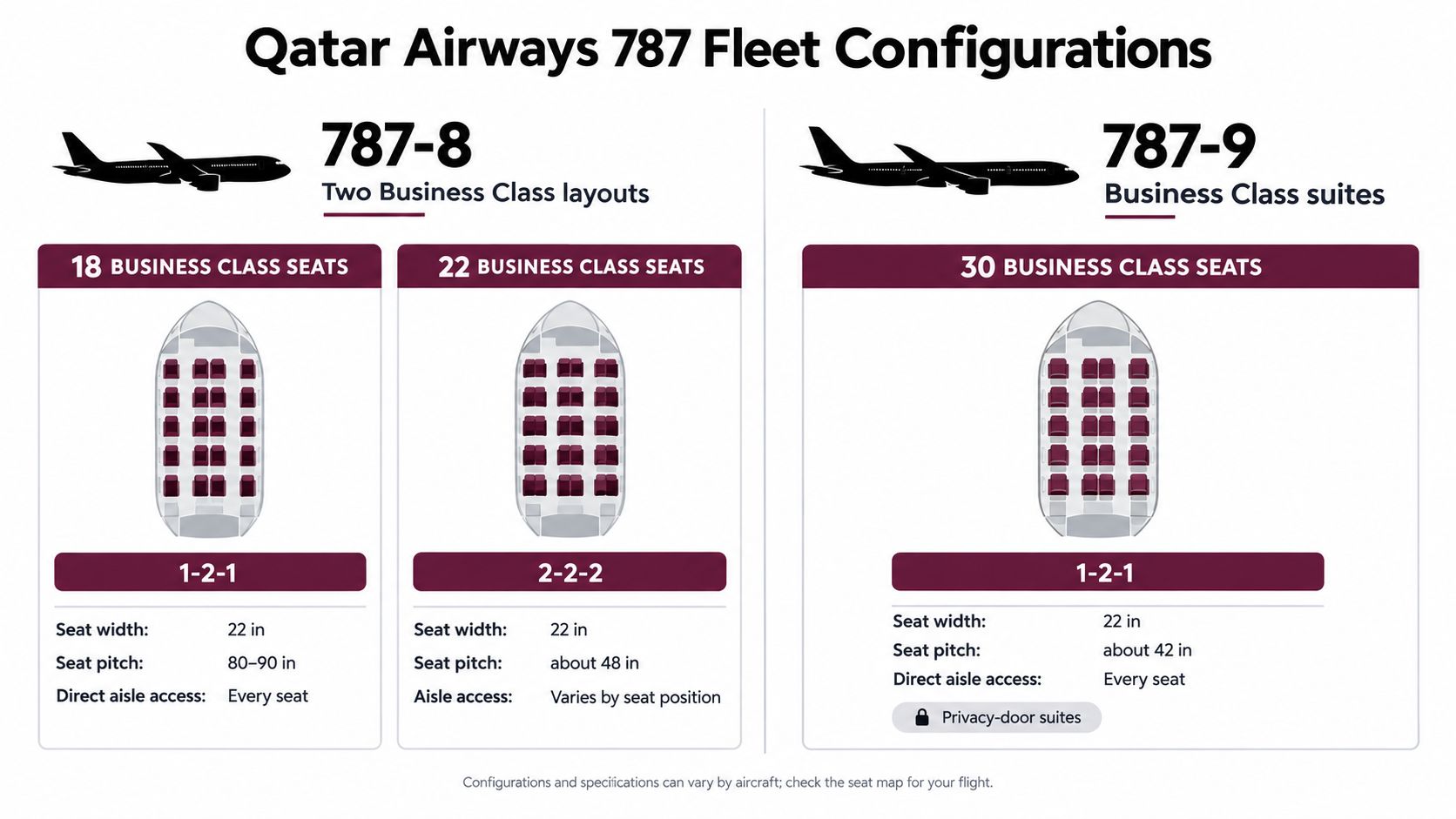
Qatar Airways operates two distinct 787 business-class products. Its 787-8 appears in two configurations, with 18 or 22 Business Class seats and 249 or 232 Economy seats. The 787-9 carries 30 Business Class seats and 281 Economy seats, according to the Qatar Airways Boeing 787 fleet page.
Those numbers affect more than cabin capacity. Some 787-8 aircraft have a smaller premium cabin, which can feel quieter, but their seating arrangements are less predictable. The 787-9 presents a more consistent premium product, making it the better target when privacy and a defined cabin layout matter more than aircraft availability.
Read the seat map, not just the booking engine
Qatar lists Business Class pitch ranging from roughly 50 to 90 inches, seats measuring 22 inches wide, and fully flat beds measuring 77.7 to 80 inches. Personal screens range from 17 to 18.5 inches, with seat power, USB connectivity, and on-demand audio and video. Those specifications establish a capable hardware baseline, but the actual seat arrangement determines whether the flight feels open or private.
Check the aircraft and seat map before paying a premium. A reference such as this Dreamliner seat map can help you compare the published layout with your itinerary, although Qatar can still change aircraft. For overnight flights, prioritize a confirmed seat with direct aisle access and enough privacy for how you sleep.
Keep Qatar prepaid data SIMs in mind for a Doha connection if you need airline apps, maps, or booking tools to remain available. The right 787 choice starts with the aircraft, then the seat map, and only after that the fare.
787-8 Versus 787-9 Business Class Seats Compared
The simplest way to think about this is blunt: the 787-8 gives you a solid flat-bed business-class seat, while the 787-9 gives you a more private suite. Qatar launched commercial 787-9 Business Class Suite service on June 25, 2021, on the Doha-Milan route, with 30 business-class seats in a 1-2-1 layout and beds extending to about 79 inches Airlineratings. That date matters because it marks the point where “QR 787 Business Class” stopped meaning one thing.
Here's how I'd compare them in plain language.
| Feature | 787-8 Business Class | 787-9 Business Class Suite |
|---|---|---|
| Seat type | Fully flat reverse-herringbone seat | Suite with closing door |
| Aisle access | Direct aisle access | Direct aisle access |
| Privacy | Open cabin, no privacy door | More enclosed, privacy door |
| Bed feel | Strong for sleeping | Better for privacy and seclusion |
| Best for | Travelers who want a simpler, less boxed-in seat | Solo flyers who want separation and calm |
| Route consistency | More variable interior configurations | More defined premium identity |
Choose by sleep style, not by hype
If you sleep badly in enclosed spaces, the 787-8 can be the better seat. It still gives you a 180-degree flat bed, 22-inch width, and direct aisle access, which is more than enough for a decent long-haul rest. The cabin is older and more open, but that openness can feel less claustrophobic on daytime flights or shorter overnight sectors.
The 787-9 wins when privacy is the priority. Its suite-style setup gives the flight a more deliberate, premium feel, and the closing door changes the experience for solo travelers who want to shut out the cabin. Couples should be careful, though, because privacy is not always the same thing as togetherness.
If you travel with a companion, the better seat is the one that lets you talk, eat, and work without feeling isolated. That is not always the suite.
So don't ask whether the 787-9 is “better” in the abstract. Ask what you're doing onboard. Sleeping, working, or traveling alone? Take the suite. Want a simpler flat seat and a potentially less enclosed feel? The 787-8 is still very good.
Amenities, IFE, and the In-Cabin Service Experience
The seat matters most, but it is not the whole story. Qatar equips its 787 business cabin with 17 to 18.5-inch personal screens, in-seat power, and USB connectivity, so the hard product clears the premium-cabin baseline. What separates a good flight from a great one is how the cabin feels once you settle in.
Service rhythm matters as much as the hardware. Some crews pace meals and drink runs with real attention; others move faster and keep the cabin quiet, which suits sleep. If you care about dining, use the Qatar Airways business class menu before you board so you can decide whether to eat in the lounge or onboard.
The onboard mood changes with the aircraft, too. A 787-9 with a closing-door suite feels more private and controlled, while a more open 787-8 cabin feels easier for conversation, working, and moving around. Choose the one that matches your trip, not the one with the flashier marketing.
For long-haul rest, comfort accessories matter. A good eye mask helps more than polished extras if you plan to sleep through bright cabin lighting. If you also want to compare lighter travel tech for the trip, the XREAL vs Viture verdict gives a clear side-by-side view.
The practical test is simple. Pick the cabin that fits your sleep style, then judge the service by whether it lets you eat, work, and rest without interruptions.
Verifying the Exact Aircraft and Seat Map Before You Book

The biggest mistake with Qatar's Dreamliner is assuming 787 business class means one standard product. It does not. Qatar's 787-8 appears in more than one interior configuration, with 18 or 22 business-class seats, so check the exact aircraft version and seat map before you book SeatMaps.
Use a simple verification workflow
Start with the flight number, then check the seat map, then confirm that the cabin matches the version you want. If the map shows the more open 787-8, don't expect a suite-style layout. If the booking screen shows the 787-9, still verify the details, because aircraft swaps happen.
The cabin choice also affects price timing. January and February are slower months for long-haul travel, and premium fares can soften as airlines try to keep those seats filled. That is the window where QR 787 business class can look better value than usual, especially if coach inventory is tight.
Practical rule: buy the seat map first, the fare second. A cheap fare is only worth it if the cabin matches your plan.
Treat this as a route-by-route decision. Check whether the flight is scheduled with the suite cabin, compare the premium fare against coach, and decide whether the seat layout justifies the extra spend. On some routes, the spread narrows enough that business stops feeling excessive.
Pack for the cabin you verified, starting with the best eye mask travel guide. Sleep quality starts with the right gear, and the wrong cabin choice makes that harder to fix later.
When QR 787 Business Class Books Cheaper Than Economy
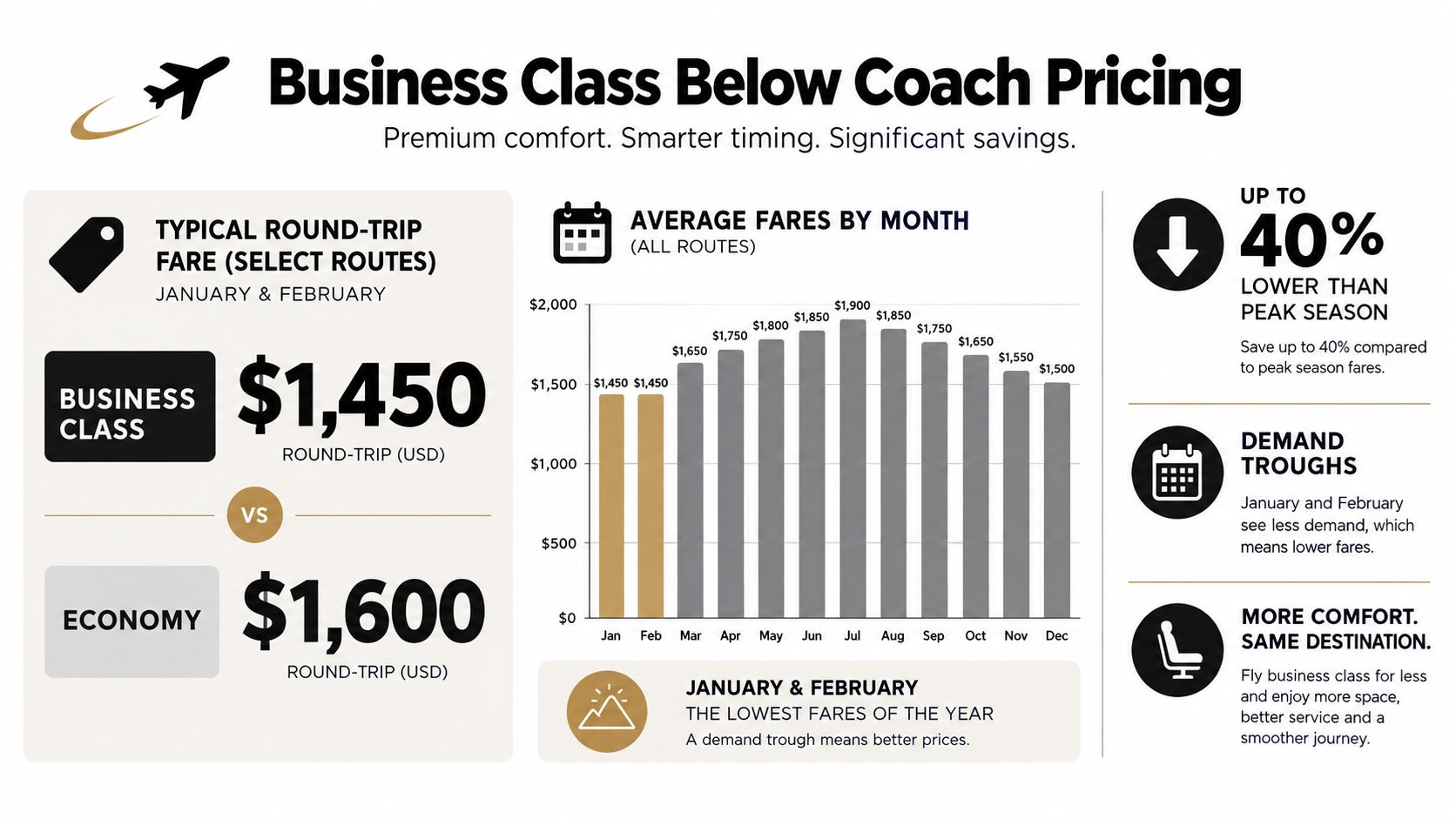
QR 787 Business Class can beat coach when premium inventory is weak and airlines would rather fill the cabin than leave it empty. That pressure usually shows up in January and February, when long-haul demand softens and carriers get more aggressive with premium fares SmarterTravel.
The spread can also narrow to the point where business looks sensible even if it does not drop below economy. Some fare samples show that result clearly, and route by route the gap can shrink enough to make the upgrade easy to justify. That is why the cabin matters as much as the price. The 787-8 and 787-9 are not the same product, and the wrong aircraft at the right fare is still the wrong buy. For fare watching, the Qatar business class overview at Passport Premiere explains the patterns shoppers track and the signals that matter.
The rare cheap-business window
There are edge cases where business class can be priced far below expectations. Travel-industry examples have shown international business-class tickets selling for around $300, which means a premium seat can occasionally undercut ordinary economy on the same long-haul market when pricing is loaded unusually hard Going. Those deals are exceptions, but they prove the point.
Watch for three signs.
- Weak demand months: January and February.
- Tight economy inventory: coach rises while premium stays soft.
- Fare drop events: the airline opens a lower booking class or pushes a short-lived promotion.
A route-specific comparison matters more than a blanket rule. The premium can stay high on one city pair and collapse on another, so the only sensible move is to check the exact flight, the cabin version, and the live fare together. A narrow spread can make business worth paying for. A sudden discount can make it the cheaper seat outright.
Smart Booking Strategies and Common Pitfalls to Avoid
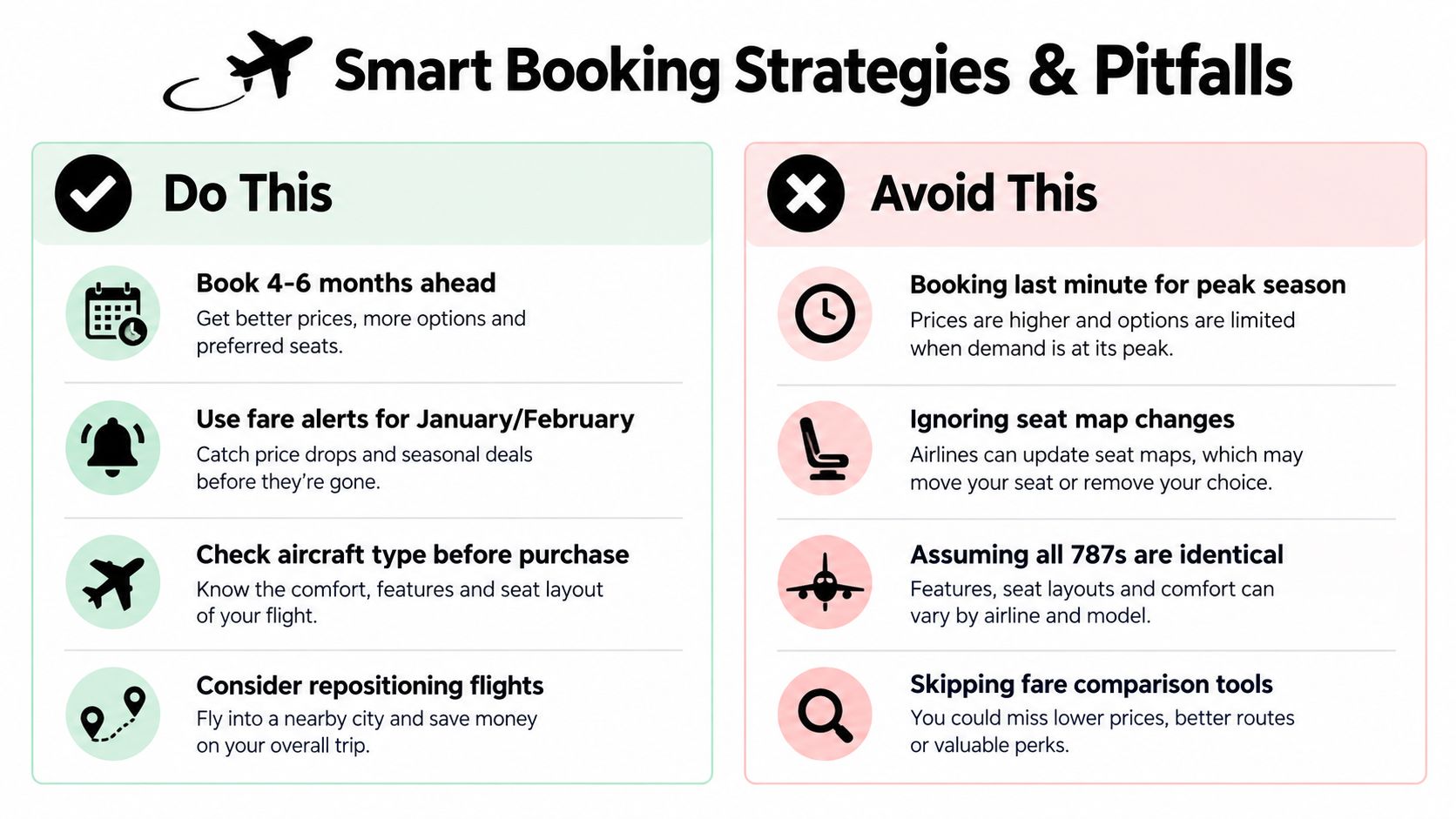
Book the aircraft first, then judge the fare. A Qatar Airways 787 fare can be a smart buy on one route and a poor one on another, because the 787-8 and 787-9 are different business class products. Choose the 787-8 if you want the more open feel and the schedule works. Choose the 787-9 if privacy matters more and you have checked the seat map carefully.
What to do and what to skip
- Verify the exact aircraft before you pay. A cabin swap can turn a good fare into the wrong purchase.
- Compare the cabin, not just the airline name. The 787 family label does not guarantee the same seat, privacy, or layout.
- Use fare alerts for premium cabins. The useful bargains are often short-lived, and the first price you see is rarely the best one.
- Check the economy fare on the same flight. Sometimes the gap is small enough that business class is the cleaner buy, and sometimes the premium still makes sense because the difference is modest.
- Skip blind bookings based on route reputation. Qatar can price one 787 flight aggressively and keep another much higher on the same city pair.
- Refund or change the ticket if the aircraft changes and the cabin no longer matches what you booked. That is the moment to act, not after you board.
- Treat mistake-fare alerts as opportunities, not guarantees. They can disappear fast, and a real deal is only real if the cabin and routing still work for you.
Passport Premiere's fare monitoring is built around tracking premium-cabin price movement and spotting the moments when the math turns in your favor Passport Premiere. Use that kind of tracking to confirm the aircraft, not just the headline fare, and to avoid paying for a seat you did not want.
