
Business class can cost less than coach on the same Boeing 777-300ER flight. That sounds backwards, but it happens when cheaper economy fare buckets close while a lower business fare remains available, as documented by Australian Frequent Flyer's fare analysis and Oliver's explanation of business-class inventory. The catch is that 777-300ER business class isn't one product, and the cheapest premium fare is useless if it puts you in an old angle-flat seat.
Why 777-300ER Business Class Is Not One Product
Searching for “777-300ER business class” as if it identifies a single cabin is the first mistake. The aircraft is the same broad airframe across Emirates, Qatar Airways, Singapore Airlines, ANA, American Airlines, Air India, Cathay Pacific, and other operators, but the passenger experience can be radically different. A legacy 2-2-2 cabin, a staggered layout, a reverse-herringbone seat, and a private suite may all appear under the same aircraft label.
The airframe entered commercial history in the early 2000s. Its first flight took place on February 24, 2003, FAA and EASA certification followed on March 16, 2004, and Air France received the first delivery on April 29, 2004, according to the Boeing 777 historical overview. Boeing positioned the 777-300ER as the extended-range version of the 777-300, with a maximum range of 7,370 nautical miles, or 13,650 kilometres, in a two-class configuration, a capability that made it valuable on long-haul routes linking major business markets.
The model became the best-selling 777 variant, overtaking the 777-200ER in orders in 2010 and deliveries in 2013. That popularity matters to travelers because airlines have kept the type in service long enough for multiple cabin generations to coexist. The aircraft's commercial success created a large retrofit canvas, not a uniform passenger product.
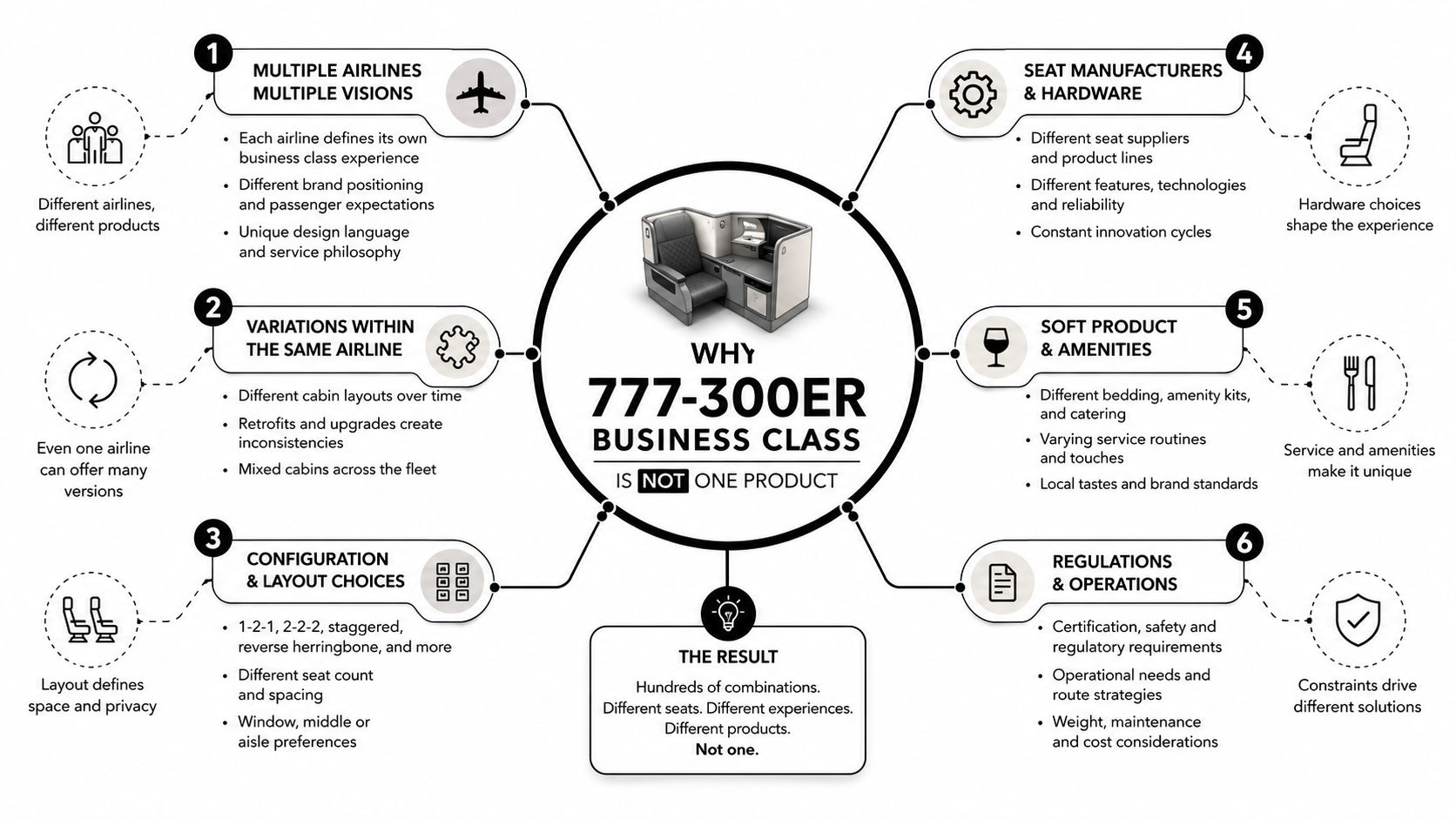
The tail number beats the airline logo
The practical rule is simple. Verify the aircraft operating your flight, then verify the seat map for that aircraft. Airline-level reviews are useful for understanding the brand, but they can't tell you whether your assigned 777-300ER has an older high-density cabin or a recently installed suite.
Boeing's published layout illustrates the scale of the aircraft's premium potential, showing 22 first-class seats, 70 business-class seats, and 273 premium-economy seats in one 777-300ER arrangement on its official passenger-aircraft material. By 2018, 784 777-300ERs were in service, while Emirates alone operated 123, reinforcing why the aircraft appears in so many different cabin configurations.
A fare on the right tail can be excellent value. The same fare on an old layout can be a poor purchase, especially overnight. Judge the seat architecture, bed, privacy, and rollout status, not the aircraft name printed in the booking engine.
Seat Families and Layouts You Will Actually Encounter
The aircraft tail and retrofit timing matter more than the airline logo. A seat map exposes the product faster than a marketing description. Count the seats across the cabin, inspect the spacing between pairs, and confirm that every seat reaches an aisle. Those clues separate a private, fully flat seat from an older business cabin carrying the same label.
The four layouts that matter
Legacy 2-2-2 deserves caution. Window passengers usually reach the aisle only when the adjacent seat is empty, and one traveler in the middle pair may need to climb over the other. Older versions often provide around 60 to 62 inches of pitch and approximately 20 to 22 inches of width. Some use angle-flat seats instead of a horizontal bed. Qatar Airways fleet information shows that its 777-300ERs can include both 1-2-1 and 2-2-2 configurations, so check the Qatar Airways 777 fleet details before booking.
Staggered 1-2-1 gives every passenger aisle access, though privacy and personal space vary by seat. Some positions sit close to the aisle, while others rest behind a console. A representative version offers about 78 inches of pitch and roughly 21 inches of width, but the footwell and side table depend heavily on the seat generation.
Reverse-herringbone 1-2-1 remains the dependable modern standard. Seats angle toward the window or slightly away from it, the footwell typically sits inside a shell ahead of the passenger, and aisle access is available from every position. The trade-off is orientation. Some even-numbered window seats face away from the window, improving privacy while reducing the view.
Suite-style 1-2-1 adds a door or partial enclosure. It delivers the strongest privacy and a more residential feel, but an enclosed seat is not automatically wider or better served. Check the bed length, footwell position, storage, and whether the seat faces forward or backward.
| Seat Family | Layout | Pitch (in) | Width (in) | Direct Aisle Access | Example Operators |
|---|---|---|---|---|---|
| Legacy angle-flat | 2-2-2 | 60-62 | 20-22 | No for every seat | Older 777-300ER fleets |
| Staggered seat | 1-2-1 | 78 | 21 | Yes | American, selected Singapore layouts |
| Reverse herringbone | 1-2-1 | Around 78 | Varies | Yes | Qatar Airways, Cathay Pacific, ANA |
| Suite-style seat | 1-2-1 | Varies | Varies | Yes | Emirates, selected Singapore layouts |
Read the geometry, not the marketing name
Air India's 777-300ER business cabin is specified at 76-inch pitch and 19.95-inch width, while Philippine Airlines lists 78-inch pitch and up to 21.13-inch width. Those dimensions help indicate whether the seat supports a true lie-flat bed of roughly 6.3 feet or more while retaining usable shoulder space.
The gap between a 60-inch angle-flat seat and a 76 to 78-inch lie-flat seat affects sleep, privacy, and the fare premium attached to the cabin. A 2-2-2 map paired with a recliner or angled-flat description earns only a modest premium in my view. For an overnight sector, choose a true 1-2-1 flat-bed seat whenever the price is sensible, then confirm that the aircraft tail is not scheduled for a pre-retrofit swap.
How Major Airlines Configure Their 777-300ER Business Cabins
The leaders are clear, but the aircraft assignment still matters. Qatar Airways remains the privacy benchmark when Qsuite is installed, thanks to sliding doors and the possibility of a quad arrangement. Emirates' newer 1-2-1 retrofit is the stronger choice for travelers who care most about consistent aisle access and a comfortable bed, while Singapore Airlines remains compelling for finish quality and bed design.
The strongest products
Singapore Airlines' 2013-era business seat offers an exceptionally long bed, reported at 82 inches, with polished finishes and a refined operating style. Its weakness is that not every Singapore 777-300ER presents the same generation, so the seat map remains decisive.
Qatar Airways Qsuite is the privacy specialist. A closed door, paired seats, and the quad arrangement make it especially attractive for couples, families, and colleagues traveling together. Solo travelers should still inspect the exact seat position because privacy from the aisle doesn't eliminate galley or lavatory traffic.
ANA's Room belongs near the top of the Asian market. Its enclosed design borrows the visual language of a private suite while preserving a generous working surface. ANA's older 777-300ER aircraft shouldn't be treated as interchangeable with the refreshed version.
Emirates' newer 1-2-1 cabin is my pick for travelers who want a straightforward, comfortable seat without gambling on a middle seat. The product is materially better than Emirates' older 2-3-2 business cabin, but the rollout is uneven.
The middle and the laggards
Cathay Pacific's Aria suite is competitive and attractive, though I wouldn't rank it above Qsuite, ANA's Room, or Singapore's strongest seat. American's new Flagship Suite brings privacy doors and a premium-configured 777-300ER, but the airline is still managing a transition from the older cabin. Air India's Vistara-derived product sits in the middle of this group. The hard product is promising, while the soft product is still maturing.
Use the Qatar 777-300ER business-class guide as a useful route-specific reference, but don't let any review replace the live seat map.
| Airline | Seat Type | Pitch (in) | Privacy | Retrofit Status | Verdict |
|---|---|---|---|---|---|
| Emirates | New 1-2-1 suite-style seat | Varies | High on retrofitted aircraft | Rolling retrofit | Excellent when confirmed |
| Qatar Airways | Qsuite or older 2-2-2 | Varies | Very high with Qsuite | Mixed fleet | Best privacy, verify aircraft |
| Singapore Airlines | 2013-era business seat | 82 on the cited product | High | Mixed generations | Excellent finish and bed |
| ANA | The Room | Varies | Very high | Selected aircraft | Asia leader when installed |
| Cathay Pacific | Aria Suite | Varies | High | Rolling introduction | Strong, not class-leading |
| American Airlines | Flagship Suite | Varies | High | New premium configuration | Promising, execution varies |
| Air India | Vistara-derived cabin | 76 | High on the new layout | Newer subfleet | Good hard product, developing service |
The Retrofit Race Reshaping the Passenger Experience
The 777-300ER retrofit cycle has turned aircraft identification into a core booking skill. Airlines aren't replacing every seat at once, so the route, flight number, and operating tail can produce very different results within the same airline schedule.
Emirates is replacing a dated baseline
Emirates has retrofitted 25 of its 120 777-300ERs with a 1-2-1 layout and direct aisle access, while aiming for a majority of the fleet by late 2026, according to VisaVerge's Emirates retrofit coverage. That rollout changes the buying decision. The older Emirates 777-300ER business cabin uses a high-density arrangement and can feel dated beside Qatar Qsuite or a modern reverse-herringbone seat. The retrofitted aircraft offers a much more private experience.
The important point isn't that Emirates is improving. It's that the improvement is not universal yet. A booking page may show “Boeing 777-300ER” without making the retrofit status obvious, leaving the passenger to decode the seat map.
American is building a different premium proposition
American has announced a premium-configured 777-300ER with 70 Flagship Suite seats and privacy doors. That product gives the aircraft a dramatically different cabin identity from the earlier American configuration. It also signals that airlines increasingly view the 777-300ER as a platform for premium-cabin investment rather than merely an aging workhorse.
ANA's refreshed 777-300ER uses The Room concept, while Singapore's more recent refresh narrows the gap with the best competing products. These changes create a wide spectrum, from older angle-flat or dense layouts to modern suites.
The practical conclusion: the aircraft type tells you the shell. The tail number tells you the experience.
| Airline | Retrofit Launch | Product | Fleet Status |
|---|---|---|---|
| Emirates | Rolling programme | 1-2-1 direct-aisle-access cabin | 25 of 120 completed, majority targeted by late 2026 |
| American Airlines | New premium configuration | 70-seat Flagship Suite cabin | Announced and entering fleet rollout |
| ANA | Refreshed aircraft programme | The Room | Selected 777-300ER aircraft |
| Singapore Airlines | Recent cabin refresh | Updated business-class product | Fleet introduction varies |
A carrier's frequent-flyer reputation can't compensate for a poor tail assignment. If the booking engine offers a seat map with the wrong geometry, I'd rather take a better aircraft on a less glamorous airline than pay for the logo.
Reading Seat Maps and Picking the Right Seat
Stop searching for a “good Emirates seat” or a “good Qatar seat.” Search for a good seat on the exact operating aircraft. The map usually answers the question faster than a polished cabin page.
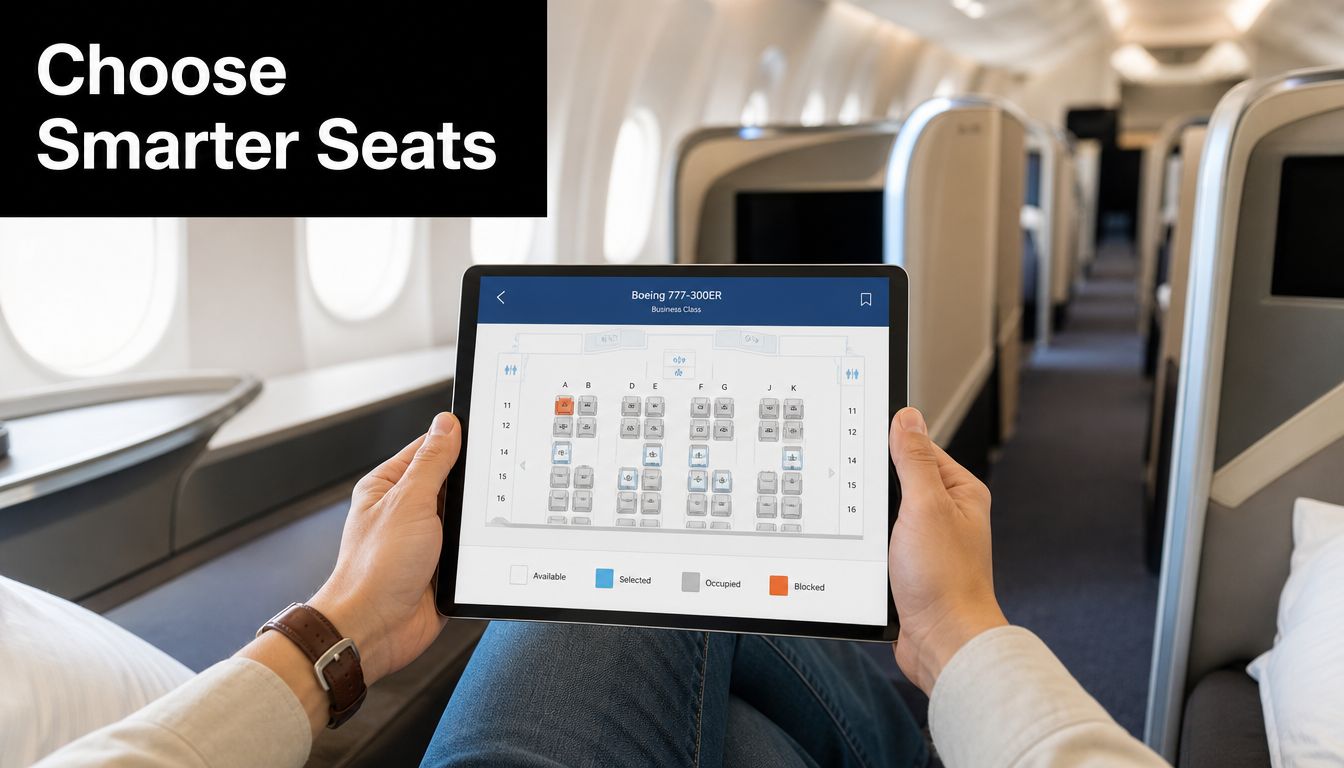
Three tells reveal the cabin
Start with the seat count. A business cabin with fewer than 50 seats often points toward suites or a very spacious layout. A cabin with roughly 60 to 70 seats may indicate a modern staggered product, while 80 or more seats usually signals a denser legacy configuration. These are practical map-reading cues, not guarantees, so cross-check the individual seat design.
Next, inspect the lavatories and galleys. Bulkhead seats may offer more privacy, but they can attract bassinet use, queueing, and crew movement. A seat directly beside a galley might be convenient for service, yet it can expose you to light and noise during the rest period.
Finally, identify the window-seat direction. In reverse-herringbone cabins, even-numbered window seats may face away from the aisle, improving privacy but limiting the view. If you care about looking outside, don't assume every window seat points toward the glass.
Tools that make the map useful
ExpertFlyer can help monitor seat availability and alert you when a preferred seat opens. Set alerts for the final 14 to 7 days before departure, then recheck after schedule changes or aircraft swaps. SeatGuru can provide a visual starting point, while FlightRadar24 can help you check the aircraft tail on the morning of departure.
The Dreamliner seat-map guide is also useful for building the habit of reading seat geometry rather than relying on airline branding. The same method applies across widebody fleets.
A bulkhead isn't automatically superior. It can provide privacy and a larger footwell, but some designs place the feet in a narrower box or force you to store personal items during takeoff. For solo travelers, I usually prefer a true window seat with direct aisle access, away from the galley and lavatory. Couples should consider paired center seats only when the divider lowers enough for conversation and the seat remains fully private at bedtime.
The following video offers a visual reference for the kind of seat-map scrutiny worth applying before payment.
Fare-Timing Tactics That Put Business Below Coach
The best 777-300ER business-class bargain comes from matching fare buckets to the aircraft tail you will fly. Airlines can close cheap economy classes while leaving a lower business class open. The result is an unusual inversion, with business costing less than the remaining coach seats, a documented outcome in travel-fare analysis from Holidu.
Compare the cheapest available fare in each cabin on the same flight. Business class normally carries a substantial premium over economy, so a lower business fare signals restricted economy inventory, weak premium demand, or a short-lived filing error. The fare is only half the decision. Check the seat map and aircraft configuration before paying, because a low price on an older 2-2-2 cabin delivers a different experience from a current 1-2-1 retrofit.
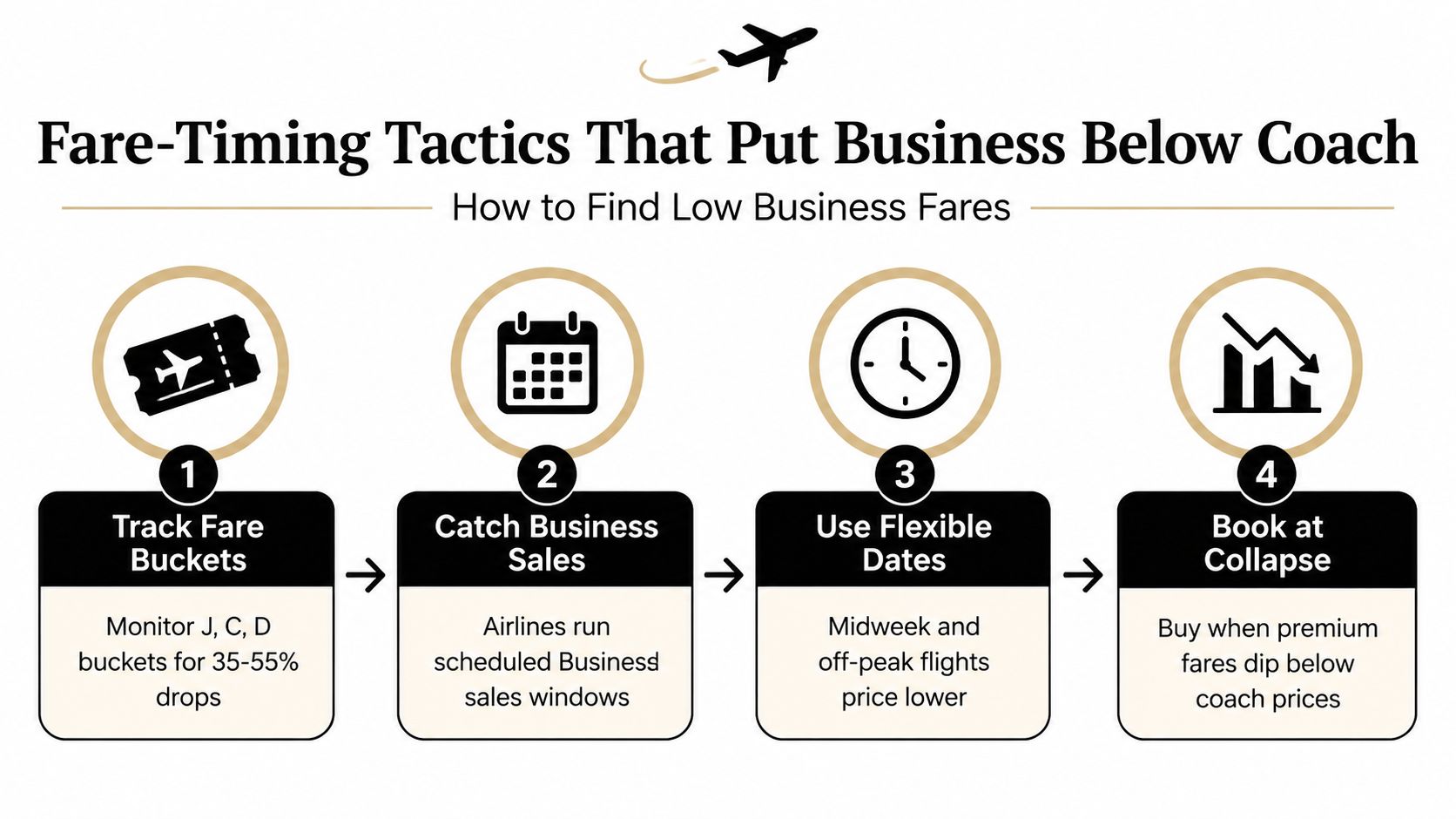
Search the inventory, not the advertising
Airlines commonly use fare classes such as J, C, and D for business inventory, although the order differs by carrier and alliance. Track how those classes open and close instead of waiting for a page labeled “business sale.” A promotion has little value if the useful booking class has already disappeared.
Start with flexible dates. Midweek departures and shoulder-season travel can expose lower premium inventory, while peak dates often leave only expensive business classes. Google Flights price tracking shows broad movement. Fare-class alerts can reveal a useful opening before the public price changes.
Passport Premiere can monitor premium-cabin fare drops and help members judge whether an empty business-class seat is priced near its market value. Pair that monitoring with airfare prediction guidance and direct airline tracking. Watch the fare and the tail together, because a cheap ticket loses its appeal if an aircraft swap removes the cabin you wanted.
The booking sequence I'd use
- Compare cabins on the same flight. A business fare on one itinerary tells you little about an economy fare on another.
- Watch the fare buckets. Look for a lower premium class opening while cheaper economy inventory is restricted.
- Keep the itinerary flexible. Shift departure days or nearby airports when the route allows it.
- Book when the inversion appears. If business is cheaper than the remaining coach fare, treat it as a real opportunity.
- Protect the purchase. Use free cancellation or a fare rule that gives you time to verify the aircraft and seat map.
A cheap business fare on a legacy 2-2-2 cabin can work for daytime travel. Overnight, prioritize the bed, then privacy, then service. The right bargain is the fare that buys the cabin architecture you need, not merely the lowest number on the screen.
Your 777 300ER Business Class Decision Playbook
The strongest strategy combines two checks: which cabin is installed, and whether the fare has entered a useful pricing window. Travelers who do only one of those jobs can still overpay or select the wrong product.
The frequent flyer chasing consistency should prioritize a confirmed retrofitted aircraft over a favorite airline logo. The value hunter should search multiple dates and compare the cheapest business bucket against the remaining economy inventory. Honeymoon couples need privacy and paired seating, while points maximizers should confirm that the award seat is attached to the modern cabin rather than assuming the aircraft code guarantees it.
| Traveler Profile | Target Subfleet | Seat Family | Verification Step | Fare-Timing Tactic |
|---|---|---|---|---|
| Frequent flyer chasing consistency | Confirmed modern 1-2-1 aircraft | Reverse herringbone or suite | Check the seat map and operating tail | Set alerts for aircraft changes |
| Value hunter | Any aircraft with a genuine premium fare opening | Lie-flat 1-2-1 when possible | Compare business and economy on the same flight | Watch fare buckets and flexible dates |
| Honeymoon couple | Qsuite, suite-style Emirates, ANA Room, or comparable paired product | Enclosed 1-2-1 | Confirm paired center seats and divider design | Track sales around flexible travel periods |
| Points maximizer | Award inventory on the newest subfleet | Direct-aisle-access flat bed | Verify seat map before transferring points | Search several dates and monitor availability |
Four final rules
First, reject the generic aircraft label. “Boeing 777-300ER” tells you the airframe, not the seat. The product can range from an older 2-2-2 cabin to a fully enclosed suite.
Second, treat retrofit status as a booking variable. Emirates' rollout, American's Flagship Suite introduction, ANA's refreshed aircraft, and Singapore's updated cabins all show why fleet status changes the answer.
Third, use fare inversion intelligently. Business below coach is real, but uncommon. When it happens, the low price doesn't erase the need to inspect the seat. A cheap angle-flat product may be less useful than a well-priced premium economy seat for a long overnight journey.
Finally, save the seat map before you pay. A screenshot gives you a record of the product you selected, which matters if the airline later swaps aircraft. Recheck the map near departure, then confirm the tail when possible.
The best 777-300ER business-class booking is not necessarily on the airline with the strongest reputation. It's the flight that combines a verified modern cabin, a seat you want, and a fare that reflects current inventory rather than the airline's opening price.
Passport Premiere helps travelers monitor international premium-cabin fares, identify fare drops, and judge when business-class pricing may fall below the remaining coach options. Visit Passport Premiere to explore its fare-monitoring tools and apply that intelligence to your next 777-300ER booking.
