
The usual advice for SFO to HYD is to find the cheapest fare and book before it disappears. That's incomplete advice for a journey where a poorly timed connection can undermine the comfort you paid for. The better question is what the fare buys across the entire trip: usable sleep, manageable transfers, consistent seating, and an arrival time that works.
Business class cheaper than coach. Treat that as a proposition to test, not a promise. A credible comparison uses the same itinerary and booking moment, then accounts for baggage and fare rules. Otherwise, an apparent bargain may only compare different trips.
Routings, Hubs and Connection Risk
There's no regular nonstop SFO to HYD service, and KAYAK's route guide puts the city-pair distance at roughly 8,400 miles. Every practical fare comparison therefore needs to include the connection, not just the long-haul seat.
Cathay Pacific's route page describes roughly 14 to 15 or more weekly connecting options in each direction and advertises about 21 hours 45 minutes outbound, versus about 21 hours 15 minutes returning. Those aren't nonstop frequencies, and the directional difference reflects winds and schedule construction rather than a different geographic distance.
Compare the itinerary, not just the hub
Singapore Airlines reported daily one-stop service through Singapore in 2026, with typical journey times of 21 hours 35 minutes to 22 hours 5 minutes. Treat that as a dated schedule statement, not a guarantee for every future departure.
Indian Eagle's route guide reports an average Doha connection of about 1 hour 38 minutes and identifies Dubai with the shortest average one-way journey, roughly 21 hours 45 minutes. These measures aren't interchangeable: a connection interval isn't a total journey time.
SFO to HYD routings by connecting hub
| Routing via | Example carriers | Typical elapsed time | Connection note |
|---|---|---|---|
| Hong Kong | Cathay Pacific | About 21 hours 45 minutes SFO to HYD | Reverse about 21 hours 15 minutes |
| Singapore | Singapore Airlines | 21 hours 35 minutes to 22 hours 5 minutes | Daily one-stop service reported in 2026 |
| Doha | Qatar Airways | Check the complete dated itinerary | Average connection about 1 hour 38 minutes |
| Dubai | Emirates | About 21 hours 45 minutes average one-way | Shortest average one-way time in the cited schedule comparison |
| Frankfurt | Lufthansa | Check the complete dated itinerary | European hub, check transit and visa rules |
| Delhi or Mumbai | Air India | Check the complete dated itinerary | Indian domestic connection before reaching HYD |
| Two-stop routing | Carrier combination shown at checkout | Can approach 28 hours or more | Greatest transfer exposure among these choices |
KAYAK's connecting-itinerary guide describes one-stop elapsed journeys near 21 to 23 hours, while poorly timed two-stop itineraries can approach 28 hours or more. The table deliberately leaves unverified hub-specific durations to the dated booking results rather than assigning an unsupported average.
Doha's short transfer can be attractive when everything operates on time. It also leaves less room for an inbound delay, gate changes, or baggage transfer. Hong Kong, Singapore, and European routings may offer longer buffers, but inspect the actual flights rather than assuming the airport name guarantees an easy connection.
Protection matters more than lounge quality
A protected connection and a self-transfer aren't equivalent purchases. On a through ticket, the airline's applicable terms govern disruption handling; with separate tickets, you may have to arrange replacement travel yourself. Confirm the ticket structure rather than relying on a booking website's single checkout screen.
Use this explanation of how connecting flights work to distinguish through-ticket transfers from arrangements requiring baggage collection and recheck. For an Indian domestic connection, establish where immigration, customs, and any baggage procedures occur before judging the transfer interval.
Practical rule: A premium seat doesn't compensate for a connection you can't comfortably complete.
Before comparing prices, apply this protection checklist:
- Elapsed time: Sort by the complete journey, including airport waits.
- Ticket protection: Confirm the flights form a protected itinerary, not an undisclosed self-transfer.
- Transfer buffer: Use at least two hours as a personal planning preference for international transfers, not an official airport minimum.
- Transit eligibility: Check current requirements for your passport, terminals, and routing.
- Checked bags: Obtain the baggage-routing instructions, including any collection requirement.
- Overnight timing: Identify airport nights, terminal closures, and accommodation needs.
- Arrival readiness: Leave room to reach your hotel and sleep before important work.
The best connection isn't automatically the shortest. It's the shortest one that fits your documents, baggage, tolerance for disruption, and arrival commitments.
What Business and First Class Fares Cost on SFO to HYD
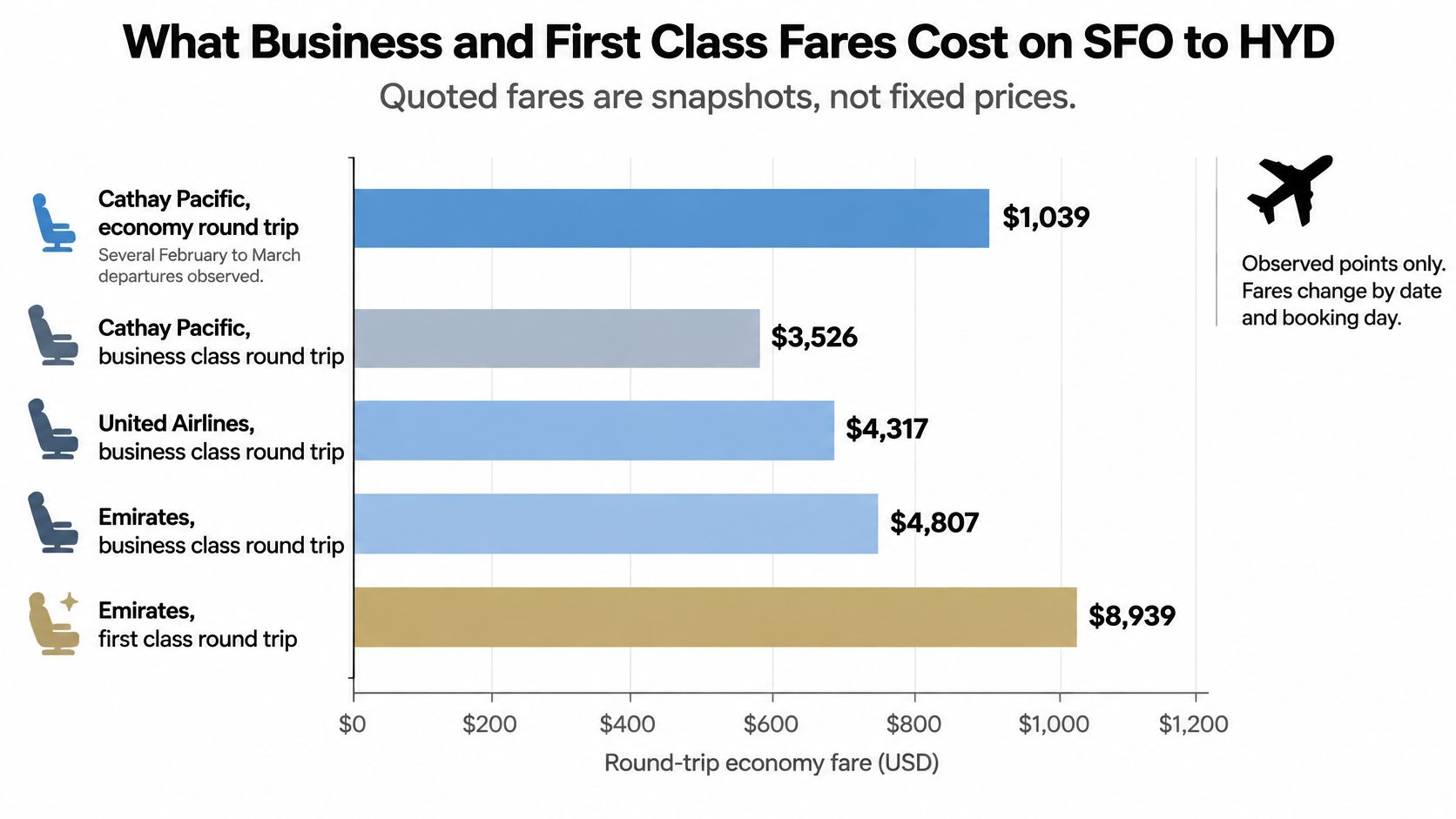
Quoted fares are snapshots, not fixed prices. The observed premium-to-economy gap is substantial, but the examples don't establish what either cabin will cost for your dates.
The chart isolates an observed economy starting point rather than presenting a live fare comparison.
What the observations actually establish
Cathay Pacific's fare display showed economy round trips from USD 1,039 for several February to March 2027 combinations and business from USD 3,420 for November 10 to 16, 2026, about 3.3 times the economy starting fare. These are advertised travel-date examples, not forecasts or confirmed availability, and the differing dates prevent a like-for-like verdict.
Observed SFO to HYD fare points
| Cabin | Observed starting fare (USD) | Travel dates | Source |
|---|---|---|---|
| Economy round trip | 1,039 | Several February to March 2027 combinations | Cathay Pacific SFO to HYD page |
| Business round trip | 3,420 | November 10 to 16, 2026 | Cathay Pacific SFO to HYD page |
| Business round trip | 4,294 | Not specified in the quoted observation | KAYAK business page, deals seen within the previous 72 hours |
| Business round trip, Air India | 3,824 | Not specified in the quoted observation | KAYAK business page |
| First class | No verified quoted fare | No verified travel dates | No supported first-class price observation |
The KAYAK entries are recent observations, not standing tariffs. None of these examples documents business undercutting economy on an identical itinerary.
There's also no verified first-class figure to use as a benchmark. Compare the fare families offered on the booking page, and inspect what cabin each segment includes.
When a lower business fare would count
A temporary promotion, unusual inventory, or fare correction could make business cheaper than an expensive coach option. That possibility isn't evidence that it happened here. Confirm matching dates, flight numbers, baggage requirements, change conditions, and cancellation terms before declaring an undercut.
For a broader search framework, use this guide to business-class airfare to India. Keep any miles strategy separate from the cash comparison: CreditCardCult's guide to earn 110,000 United miles is a resource for evaluating the advertised offer, subject to current eligibility, spending requirements, and award availability, not proof of an available Hyderabad redemption.
The video offers additional context for evaluating premium-fare opportunities.
Record the business price, the coach price, and business divided by coach. Without those entries for the same search, a low-looking business fare remains an isolated quote.
When to Buy Premium Seats
There isn't sufficient route-specific evidence to name a cheapest month for SFO to HYD business class. Nor do the available fare observations justify assigning premium-demand peaks to festivals, university calendars, or holidays.
Expedia's SFO to HYD route page presents a market spanning Air India, Qatar Airways, Emirates, Singapore Airlines, Cathay Pacific, and Lufthansa, but doesn't establish a dependable premium-cabin buying season. Travelers are comparing different networks and products, not interchangeable seats.
Build a dated buying range
Start with the dates on which the trip can genuinely happen. Searching an unrealistically broad calendar may reveal a cheap fare you can't use, which doesn't improve the purchasing decision.
- Choose a target window: Include your meeting schedule, hotel check-in needs, and acceptable return dates.
- Search alternatives deliberately: Try several departure-and-return combinations, plus one or two alternate weeks as a search exercise.
- Keep a dated log: Save each observation over several weeks when your deadline permits, including the itinerary and fare conditions.
Long-range advertised travel dates show that you can investigate future departures. They don't prove that buying farther ahead always costs less. Likewise, a recent deal observation doesn't tell you how long that fare will remain bookable.
Separate flexibility from compromise
Search flexible dates, open-jaw trips, and nearby Bay Area airports as distinct combinations. For an open-jaw itinerary, include the cost and time needed to travel between the different arrival or departure cities. For another Bay Area airport, include positioning, parking, and any additional connection.
Don't call a fare cheaper until you've priced the travel needed to use it.
Corporate travelers should set their approval deadline before monitoring. If a fare meets the approved budget and itinerary standards, booking can be more defensible than waiting for an unproven seasonal dip.
The useful purchase window is therefore personal: the period during which you can still choose among acceptable trips. Once the remaining alternatives threaten your work schedule or travel policy, the potential saving needs to justify that exposure.
How to Track Premium Fares
Build a fare log that lets you reconstruct the offer. A screenshot of a price alone won't tell you whether the same flights, cabin, or ticket conditions were available when you returned.
KAYAK's SFO to HYD business-class page reported fares from USD 4,294, an Air India option at USD 3,824, and deals available within the previous 72 hours, subject to changing price and availability. That observation window is a reason to timestamp your comparisons, not a promise that a fare lasts that long.
Use a repeatable search record
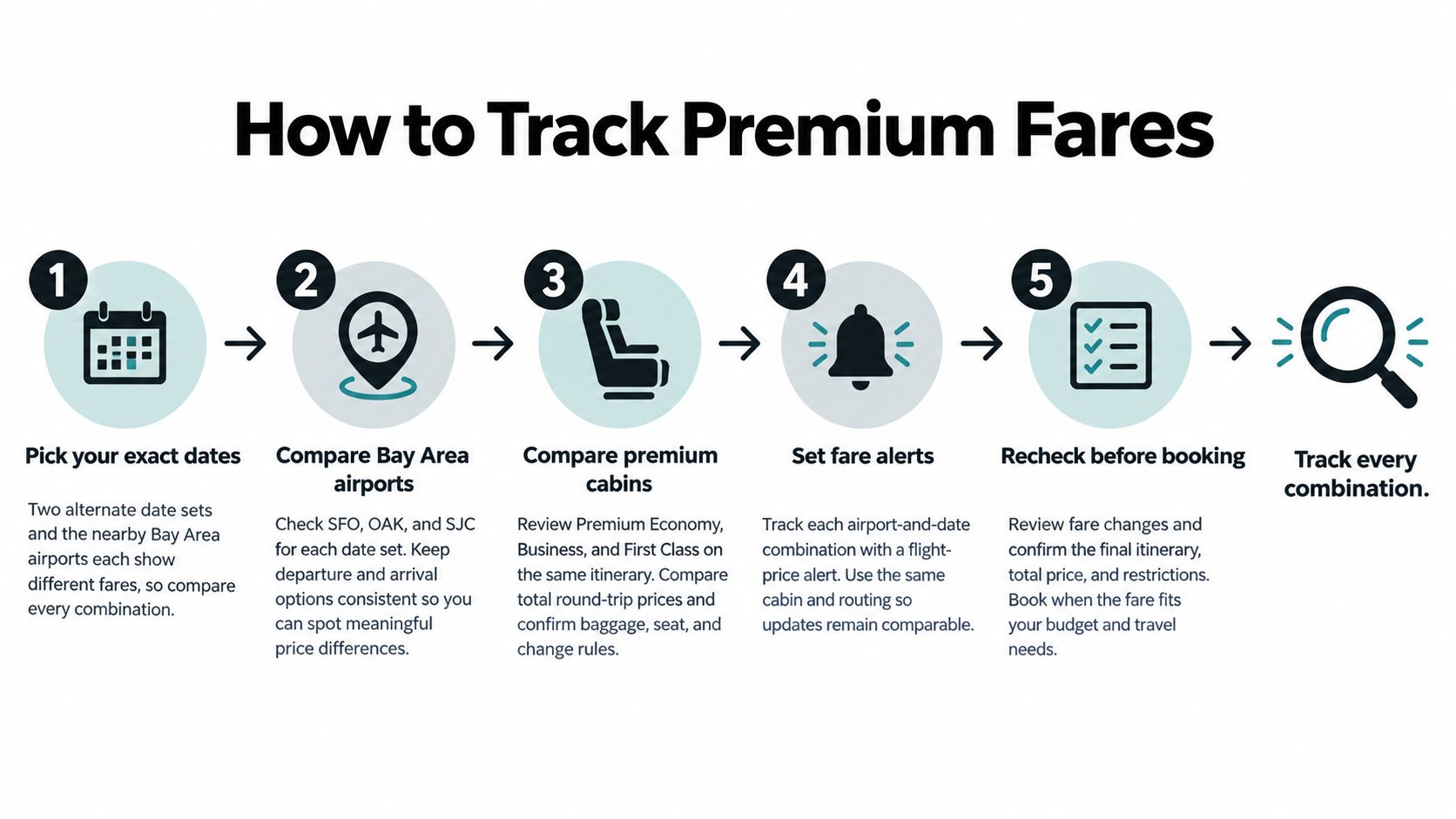
Pick your exact dates. Add two alternate date sets and nearby Bay Area airports as separate search combinations. Each result must remain identifiable so you don't mistake a different departure airport or extra connection for a price reduction.
Record coach for the identical itinerary. Match flight numbers, departure dates, baggage needs, and the flexibility you actually require. Keep the cheapest acceptable coach fare as your baseline, rather than selecting an unusually expensive flexible fare to make business appear attractive.
Log business with a timestamp. Save the final quoted total, currency, cabin on every segment, booking channel, and fare conditions alongside the observation time. Recheck the payable total before purchase because a search result isn't a completed ticket.
Set a ratio threshold. As a hypothetical personal rule, you might investigate whenever business falls below twice the comparable coach fare, rather than alerting at an arbitrary dollar amount. The KAYAK and Cathay starting prices produce a screening ratio of about 4.1, but their unmatched travel dates make that arithmetic unsuitable as a buying verdict.
Choose monitoring support proportionate to the task. If you follow many international trips, a paid membership can supplement your own spreadsheet and airline searches. Compare its published fees with the savings you realistically expect, and treat a business-class fare-alert service as an option rather than a prerequisite.
The workflow below keeps the search combinations separate and the comparison repeatable.
Distinguish a price move from a product change
Add a notes field for equipment, transfer length, and mixed-cabin warnings. If the newly cheaper fare replaces a lie-flat long-haul segment with economy, you've found a different product, not necessarily a better offer.
The same applies when a lower total removes cancellation flexibility that your employer requires. Preserve the original search alongside the replacement so you can identify what changed.
Comparison discipline: A drop is meaningful only when the coach baseline, product requirements, and observation time still match.
A useful alert tells you to investigate. Your saved itinerary and final booking-page checks determine whether there's anything worth buying.
Business Versus Coach on One Trip
Say a consultant is traveling to Hyderabad for a week, carrying two checked bags, and needs to arrive ready for a full working day. Their decision isn't just whether business feels better. It's whether the incremental cost purchases useful rest or avoids a more expensive disruption to the assignment.
The Cathay observations imply a USD 2,381 premium, while pairing the KAYAK business observation with the same economy starting point implies USD 3,255. These are calculations from the displayed fare points, not additional quotes, and neither pairing matches travel dates.
Use the gap as a screen
Business versus coach verdicts by gap
| Scenario | Coach fare (USD) | Business fare (USD) | Gap and verdict |
|---|---|---|---|
| Observed Cathay figures, different dates | 1,039 | 3,420 | USD 2,381; about 3.3 times coach; screening only |
| KAYAK listing, recent observation | 1,039 | 4,294 | USD 3,255; about 4.1 times coach; screening only |
| Hypothetical identical dates, same bags | Live matched coach total | Live matched business total | Subtract coach from business; compare the identical itinerary before deciding |
| Business at or below coach, identical itinerary | Confirmed coach total | Equal or lower confirmed total | No positive premium; book promptly after checking rules |
For the consultant, calculate incremental fare divided by additional usable sleep or productive hours. Use a conservative estimate of what the seat and schedule can deliver, not the entire time spent aboard.
Compare that cost with the actual alternative: an extra hotel night, an earlier departure, or a working day the traveler may not be able to use effectively. Don't treat sleep as guaranteed merely because the cabin includes a bed.
Let the itinerary determine the verdict
- Small gap, meaningful benefit: Business deserves consideration when it improves rest and arrival readiness.
- Wide gap, little benefit: Coach or premium economy may preserve the budget without undermining the assignment.
- Business at or below coach: After matching bags, routing, and rules, there's no reason to pay more for the lower cabin.
The ratio helps identify which offers deserve attention. The consultant's schedule, baggage costs, and ability to use the premium product determine the actual value.
Confirm the Fare and Decide Before You Book
Don't buy from the alert alone. Open the complete booking itinerary and verify that the offer you can pay for still meets the requirements you used to assess it.
A premium fare is defensible when you can explain both the price comparison and the operational benefit. A low headline price without those checks is an invitation to buy a different trip than the one you intended.
Check the ticket before payment
- Comparable total: Match dates, routing, baggage needs, currency, and required fare flexibility against coach.
- Journey duration: Check the complete outbound and return elapsed times, not just airborne hours.
- Connection protection: Confirm the ticket arrangement and whether the transfer meets your planned buffer.
- Cabin consistency: Inspect every segment for mixed cabins and verify the lie-flat product wherever you expect to sleep.
- Change and cancellation terms: Read the applicable conditions, including any restrictions relevant to corporate approval.
- First-class availability: Compare the actual fare families offered rather than assuming a first-class option exists throughout.
- Final payable price: Recheck taxes, fees, and selected extras before authorizing payment.
Apply a buy-or-wait rule
Buy business when the premium is small enough for your budget or when better sleep timing, arrival readiness, and connection quality justify the additional cost. If the gap is wide and the trip gains little, choose coach or premium economy, or continue monitoring while acceptable alternatives remain.
Don't wait just because a lower fare is imaginable. Wait only when you have time, workable backup itineraries, and a threshold that the current offer hasn't met.
Save the search and keep alerts active until you purchase. Today, run the three-number record for your actual dates: coach price, business price, and business-to-coach ratio.
Passport Premiere offers membership-based international premium-fare monitoring and market analysis to help travelers evaluate when to buy. For SFO to HYD, use those signals alongside your matched coach baseline and connection checklist. Visit Passport Premiere to review its approach and membership fees before deciding whether the service fits your travel needs.
