
Fewer than 15% of premium-cabin seats are sold at their initial asking price, and on specific Singapore routes, business fares can fall below flexible coach when fare wars, mistake fares, or limited promotions open up. So business class cheaper than coach isn't a dependable everyday price, but it is a real outcome when you compare the right fare, route, and ticket conditions.
That changes the question from “How much does business class to Singapore cost?” to “When does a business fare beat the coach ticket I'd buy?” Singapore's wide network, different aircraft configurations, and competing nonstop and connecting routes create a market where the cabin name alone doesn't tell you what a ticket should cost. The practical starting point is the fare's construction and availability, not its advertised premium.
Why Business Class to Singapore Is Not Always Priced Like Premium
The assumption that a business-class ticket to Singapore must always cost several times more than coach misses how airlines sell premium seats. A headline fare is an asking price, not a reliable measure of the seat's current market value. When airlines compete for travelers, release discounted booking classes, or correct a mistakenly filed fare, a business ticket can undercut a flexible economy fare, even if it remains more expensive than the cheapest restricted coach option.
For travel managers, that distinction matters. A low economy fare may come with conditions that don't work for a changing work schedule, while a promotional business fare may be cheaper than a fully flexible coach ticket. The comparison needs to match the actual options: same route and travel dates, comparable change and cancellation terms, and the same view of what's included.
Singapore behaves like a market, not a single fare
Changi's role as a connection point for business travelers across regions gives airlines many different origin markets to price. The competition and nonstop choices from a nearby Southeast Asian city won't match those available to someone flying from London, New York, or Sydney. That means there's no single benchmark that can tell you whether a Singapore business fare is unusually high or worth booking.
A useful price signal is a change in the options available on your specific route. If a competing carrier adds a connection or an airline releases discounted premium inventory, the fare you see may move even though the destination and cabin haven't changed. Route, schedule, and ticket flexibility help explain the price more than the words “business class” on their own.
Practical rule: Treat the first fare you see as a reference point. Check competing routings and ticket conditions before deciding that the premium is unaffordable.
For people who also compare the cost of staying connected while traveling, check BubblyPhone rates as a separate budgeting step. It won't tell you whether an airline fare is a deal, but it can help keep connectivity costs distinct from the airfare decision.
How Singapore Business-Class Pricing Actually Works
A fare comparison starts with the total ticket cost, not just the base fare shown in search results. The airline sets the fare and may add a carrier surcharge. Government taxes and airport charges can also form part of the ticket total, while some taxes or service fees may remain payable separately depending on the itinerary and booking channel, as Singapore Airlines explains in its taxes and service fees guidance.
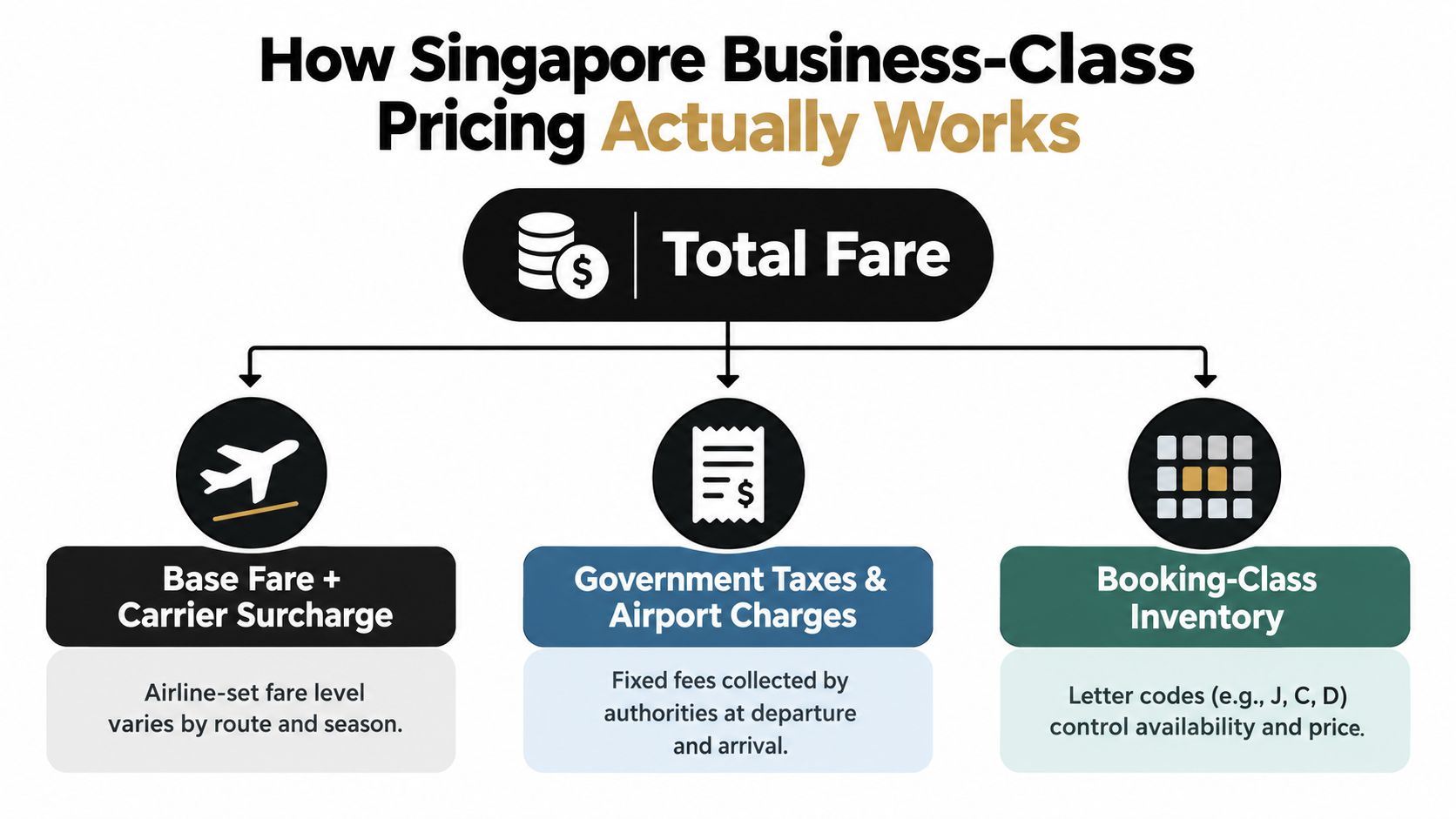
Read the fare in three parts
Start with the base fare and carrier surcharge. These reflect the airline's pricing for the route and inventory, and they're the elements most likely to shift with competition or a promotion. Then identify taxes and airport charges. Don't assume the advertised number includes every amount due: check the ticket breakdown and booking channel.
The third piece is booking-class inventory. Airlines use letter codes to control which fares are available on a flight. A discounted fare can disappear when its limited inventory sells, even if seats remain in the cabin.
Singapore Airlines' published fare instruction coded Business Lite as D, with a 20% discount from the structural fare for specified travel windows and flights, including SQ898 and SQ899. The offer covered travel from December 1–18, 2025, and January 7–31, 2026, so it wasn't a permanent reduction across every Singapore-bound flight. The Business Lite fare instruction shows why checking the flight number and fare conditions matters as much as looking at the cabin.
Compare like with like
A published Singapore Airlines promotion gives a concrete regional comparison. Return business-class fares were listed at THB 22,790 from Phuket and THB 23,990 from Bangkok, compared with economy fares of THB 6,890 and THB 7,800, respectively. The airline said the fares included airfare, airport taxes, and surcharges; the travel period ran from October 10, 2026, through September 30, 2027, with sales available through October 31, 2026, according to its Time to Fly promotion.
A search result still isn't the final acquisition cost. Check change and refund rules, any separately collected fees, and the full amount payable. A lower base fare can lose its advantage if the ticket's restrictions don't suit the trip.
What Drives Singapore Premium-Cabin Supply and Demand
A large number of flights gives travelers more choices, but it doesn't guarantee a lower business fare on every route. Changi handled 69.98 million passengers in 2025, up 3.4% year over year, and by January 2026, approximately 100 airlines operated more than 7,300 weekly flights to over 170 cities, according to reporting on Changi's traffic and network. That connectivity creates a broad market, but the effect of added capacity depends on where it appears and which airlines compete for the same travelers.
Aircraft type changes the number of seats for sale
Singapore Airlines' A350-900ULR retrofit changes its business cabin from 67 to 70 seats while reducing total capacity from 161 to 132 seats. Business class therefore accounts for roughly 53% of the refitted aircraft, compared with about 42% before the retrofit, according to the airline's A350 retrofit announcement. On the standard long-haul A350-900, the retrofit keeps business capacity fixed at 42 seats while increasing economy capacity from 187 to 192.
The difference matters because a flight's total size doesn't tell you how many business seats the airline has to sell. A premium-heavy aircraft can have a different pattern of available fares from a standard long-haul configuration, even on a route with similar schedules. For a travel manager comparing alternatives, the airline capacity management overview provides additional context on how airlines manage seats and capacity.
Compare the actual flight, not just the city pair
Before treating two Singapore itineraries as equivalent, check the aircraft type, flight number, and nonstop availability. A connecting itinerary may put a different airline or hub in the mix. A nonstop option may offer a better fit for a tight work schedule, but the fare and inventory could differ from a one-stop alternative.
A seat count is a supply clue, not a price promise. The useful signal is whether the specific flight you'd take has competing options and a fare that fits your trip's flexibility needs.
Added airport-wide capacity can create more flight options without forcing every premium fare down. Route-level competition, the aircraft assigned, and the type of traveler an airline expects all shape the price a traveler sees.
Comparing Carriers and Routes on the Singapore Corridor
A comparison of Singapore business fares makes most sense by origin and routing, not by picking the lowest carrier name in a search result. Published Singapore Airlines round-trip examples range from about USD 1,525 from Mumbai to USD 8,071 for a nonstop London itinerary and USD 10,492 from Dubai. That's roughly a 6.9-fold spread between the lowest and highest example, based on the airline's published business-class fare examples.
| Singapore business-class round-trip examples by origin | Carrier/route type | Approx. round-trip business |
|---|---|---|
| Mumbai | Singapore Airlines example | USD 1,525 |
| London | Singapore Airlines, nonstop itinerary | USD 8,071 |
| Dubai | Singapore Airlines example | USD 10,492 |
Those examples aren't a universal fare ranking. They show why the same cabin and destination can carry very different prices depending on departure market, nonstop competition, and the fares available on the travel dates.
Compare schedule value as well as price
A nonstop Singapore Airlines flight may suit a traveler who values a simpler itinerary or needs a direct schedule. But one-stop options through Doha, Dubai, Abu Dhabi, Istanbul, Hong Kong, Tokyo, or Bangkok can create different price and timing trade-offs. A lower fare is only useful if the connection, arrival time, and ticket rules work for the traveler.
Middle Eastern and East Asian hub carriers can compete for some of the same long-haul passengers. If that competition prompts an airline to discount a particular flight or release lower-priced inventory, the result may be a buying opportunity. But a one-stop fare isn't automatically better value: consider the total time, the risk and inconvenience of a connection, alliance benefits, and how changes are handled.
Use a trip-specific comparison
For each origin, place nonstop and connecting itineraries side by side. Compare the complete fare, cabin, schedule, connection conditions, and flexibility rather than sorting only by price. A fare from Dubai shouldn't serve as a benchmark for London or Mumbai, and a nonstop London example shouldn't be treated as a general Singapore price.
The useful conclusion is narrower and more actionable: compare like routes from the same departure market, then watch how competing flights change the available choices. A low price from another origin can show that fares vary widely, but it doesn't mean your own route should reach that level.
Three Real Scenarios Where Business Class Undercuts Coach
“Business class cheaper than coach” describes a specific pricing event, not a stable promise. The clearest examples come from misfiled fares, promotions that narrow the premium, and booking-class offers tied to particular flights and dates.

Mistake fares can invert the comparison
AwardWallet describes cases where travelers obtained round-trip business-class tickets for about $800, against a normal price of about $5,000, an 84% reduction. The same source contrasts that with long-haul economy priced around $200 against an expected $1,000, in its guide to finding inexpensive flights.
A mistake fare can vanish before a traveler finishes weighing options. If you find one, verify that the cabin, routing, baggage terms, and ticket conditions are what you expect. The striking headline price isn't enough if the itinerary or rules don't fit your needs.
Promotions can bring the premium closer
Singapore Airlines' published Phuket and Bangkok examples show how a promotional business fare can narrow the gap with economy on regional trips. In those examples, business remained more expensive than economy, but the fares were specific, all-inclusive promotional prices rather than an abstract claim that premium cabins always carry the same large markup. The comparison becomes more useful when the business ticket offers the schedule and conditions you need.
Booking-class offers are flight-specific
The Business Lite D-class example shows another route to a lower premium: a discounted fare attached to selected flights and travel dates. Such an offer may compete with a higher-priced flexible economy ticket, but it isn't automatically the right purchase. Confirm the applicable flight, travel window, and fare rules before booking.
These mechanisms differ in duration and reliability. A mistake fare may be fleeting; a promotion has stated conditions; a booking-class discount is available only when the relevant inventory is open. Speed helps, but flexibility and careful verification keep an apparent deal from becoming a costly mismatch.
For a closer look at how these fare events work in practice, watch this video before making a booking decision.
Monitoring and Timing Singapore Business Fares
Fare monitoring works best when you track the flight and fare conditions you'd consider, rather than waiting for a generic booking window. Changi's network is expanding, but extra airport-wide capacity doesn't prove that a particular business-class route has become cheaper. The useful signal is a route-level change: a new competitor, a different connection, or a lower booking class appearing on a flight that fits your schedule.
Build a route-level watchlist
Start with your departure city and identify the carriers that can serve Singapore nonstop or with a connection. Then track both types of itinerary. A fare alert can surface price movements, but it won't explain by itself whether you're seeing a meaningful promotion, a change in routing, or a fare with less favorable conditions.
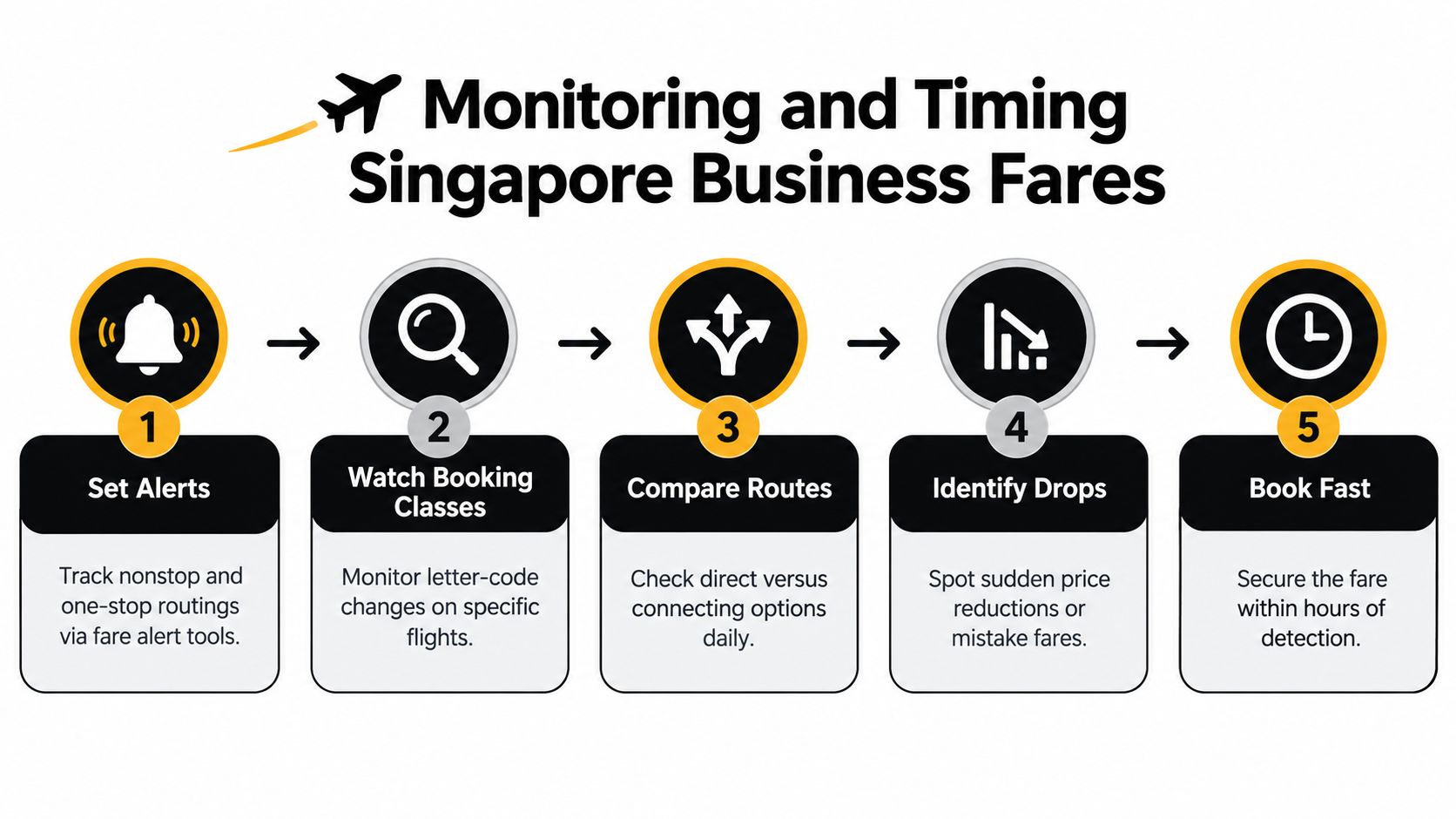
Use this sequence to keep the comparison focused:
- Set alerts: Track the nonstop and one-stop routings you'd take.
- Watch booking classes: Check whether the fare is tied to a specific letter code and flight.
- Compare routes: Review the direct option alongside connections that work for your schedule.
- Identify the change: Determine whether a sudden drop reflects a promotion, competing capacity, or a possible misfiled fare.
- Verify before booking: Confirm the cabin, full ticket total, and change or cancellation terms.
Separate a real discount from a fare change
If a Singapore Airlines fare rises or falls, don't assume the airline has changed its overall pricing strategy. The lowest-priced inventory may have sold, or a different booking class may have become available. Compare the same flight and fare conditions before calling it a deal.
A fare war linked to route competition is different from a one-off buying event caused by a misfiled fare or a limited release. The first may be visible in changing alternatives; the second can disappear quickly. In either case, a lower headline fare matters only if the all-in price and conditions still suit the trip.
For travelers who want a structured way to follow these changes, Passport Premiere business-class fare alerts are one monitoring option. Its approach combines fare monitoring and market analysis to help members follow premium-cabin price movements. Compare any service with ordinary fare alerts by asking what routes and fare details it tracks.
Planning the True All-In Cost for 2026 and Beyond
A business fare can look cheaper than flexible coach and still cost more once you account for charges and the practical consequences of the itinerary. That's why the comparison should end with the amount payable and the cost of using the ticket, not the first number displayed in a search result.
Singapore's Sustainable Aviation Fuel levy is scheduled to begin in October 2026. It's projected to range from S$1 to S$41.60 per departing passenger, with business and first class charged at four times the economy rate, separate from existing airport charges reported at S$65.20, according to the report on Singapore's upcoming aviation levy. The charge depends on the departure and cabin, so travelers should check how it applies to their itinerary instead of assuming an advertised fare already captures every future charge.
Calculate what the trip will actually cost
Before choosing between business and coach, put each option on the same footing:
- Ticket total: Include the base fare, carrier surcharge, taxes, and airport charges shown for that itinerary.
- Flexibility: Compare change and cancellation conditions against the likelihood that the schedule could move.
- Connection costs: Consider whether a one-stop fare requires a separate positioning flight or adds other costs to reach the departure point.
- Departure-date charges: Check whether the travel date and point of departure trigger additional applicable charges.
A lower advertised business fare can lose its advantage if the traveler needs an expensive positioning flight or faces restrictive change conditions. Conversely, a more flexible premium ticket can be the better acquisition when a schedule change would make a cheaper ticket unusable. For another explanation of carrier-imposed costs, see this guide to international surcharges.
Judge value against the ticket you'd really buy
The meaningful comparison isn't always discounted business versus the cheapest restricted economy fare. It may be business versus a flexible coach ticket, with both measured by complete cost and practical terms. That's the comparison that reveals when a Singapore premium fare wins.
Business class can beat coach, but only under the right conditions: a competitive route, a fare or booking class that opens at the right time, and a total cost that still works after charges and ticket rules. Track the flight you'd take, compare suitable alternatives, and verify the fare before you book.
Passport Premiere provides membership-based fare monitoring and market analysis to help travelers follow international business- and first-class fare changes. If you're comparing Singapore routes or managing premium-cabin travel costs, visit Passport Premiere to see how its fare intelligence and member resources could fit your search.
