
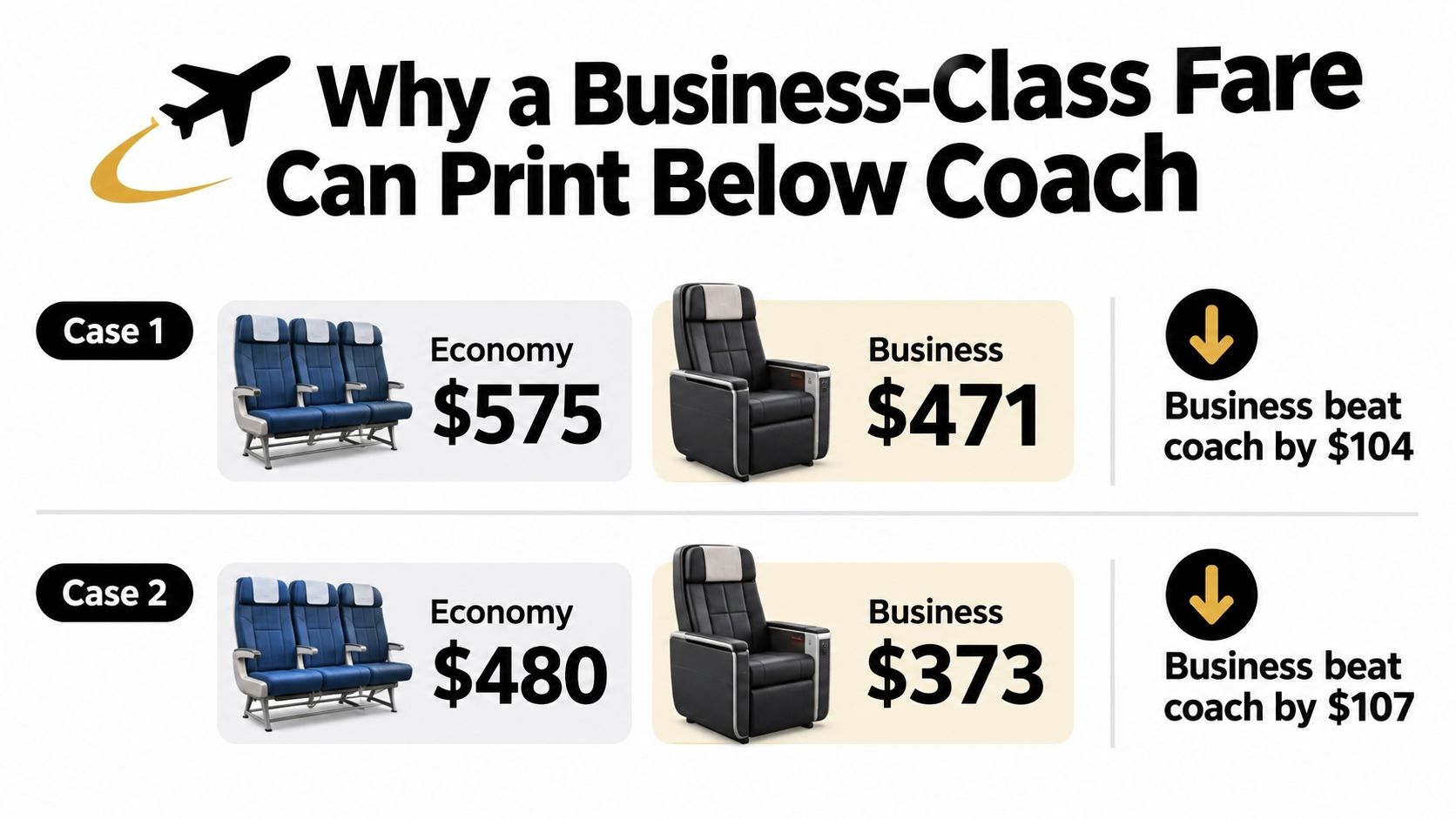
Business class can cost less than coach on the same flight. Published comparisons found economy at $575 while business class sold for $471, and another showed economy at $480 against business at $373 (documented fare comparisons). That isn't a pricing glitch to ignore. It's evidence that airlines sell cabin inventory through separate fare systems, and that premium seats sometimes enter the market below the price of a badly timed economy ticket.
The right question isn't just, “What does business class cost to Europe?” It's, “What is this seat worth today, on this aircraft, under these rules, from this departure market?” Travelers who ask the second question can find genuine premium value. Travelers who trust the first advertised fare often overpay.
Why a Business-Class Fare Can Print Below Coach
The cabin hierarchy does not guarantee the price hierarchy. Economy, premium economy, and business class operate through parallel ladders, with separate inventory, restrictions, and demand. A lower cabin can therefore remain expensive while a premium cabin opens a cheaper fare.
The two documented comparisons from the introduction show the result. Business class undercut economy on both flights, proving that a search for airfare business class to Europe must compare the available fare pools rather than rank cabins by habit. (the published comparison)
The cabin hierarchy isn't a price guarantee
Airlines sell the same flight through multiple fare buckets. Each bucket can set different rules for refunds, changes, advance purchase, and available inventory. An economy seat may remain only in a costly bucket while a discounted business bucket stays open.
Consider a route with economy inventory available in a higher-priced bucket and business inventory still open in a lower-priced one. The aircraft and seat assignments have not changed. The airline has released different quantities at different prices. That divergence is the opportunity, especially when premium seats are not filling at the expected pace.
Airlines protect higher business fares when bookings support them. If demand weakens, they can release a lower premium bucket to stimulate sales, even while economy inventory is selling at a higher level. Empty premium seats earn nothing after departure, so an airline may prefer a discounted sale to an unused seat.
Market signal: A business fare below coach calls for a fare-bucket check, not an automatic error report.
Investigate before booking. Confirm that both fares cover the same flight, that the itinerary is round trip or one way as advertised, and that the business fare's change and cancellation rules suit the trip. The service hierarchy remains real. The price hierarchy can reverse temporarily, and travelers who check inventory behavior can catch that reversal before paying for the wrong cabin.
How Booking Classes Set the Price
Airlines price business-class seats through inventory buckets, not through a single fixed fare. Each bucket carries its own price, change rules, refund conditions, advance-purchase requirements, and seat availability. The aircraft and physical seat remain the same while the airline opens, closes, or reopens different buckets.
Revenue-management teams monitor bookings, remaining inventory, competitor fares, and expected demand. Strong premium demand lets an airline restrict its cheaper business-class buckets and reserve seats for travelers willing to pay more. Corporate passengers booking close to departure often support that approach because schedule options and flexibility can matter more than the lowest fare.
The pricing logic reverses when premium seats remain unsold as departure nears. An empty lie-flat seat earns nothing once the aircraft leaves, so the airline may reopen a lower bucket or release a promotion. That discount is not a different cabin. It is a change in the fare inventory available for the same cabin.
What travelers need to understand
You do not need to memorize every booking letter. You need to recognize that business-class pricing is continuously managed, then compare how the fare changes across dates and routings.
Use this search routine:
- Track the same route repeatedly. Record the fare, dates, carrier, connection, aircraft, and restrictions.
- Compare nearby dates. A small shift can expose a cheaper inventory bucket.
- Check alternate routings. A connection through a competing hub may show a lower business fare.
- Read the conditions. A low fare with strict change penalties can be poor value for a corporate itinerary.
For North America to Europe business itineraries, an analysis cited by Business-Class.com of 917 million airfares identified a 65 to 110-day predeparture window in which observed prices were approximately 15% below the overall average. Treat that figure as a benchmark, not a guarantee. The later booking-window analysis examines when to test this pattern (the airfare-window analysis). For the mechanics behind different prices in one cabin, review airline fare class codes.
Seasonality, Routes, and Carrier Effects on Transatlantic Premium Fares
The advertised business-class fare is only the opening price. Airlines can reopen lower booking buckets when premium seats remain unsold, so the useful question is whether the fare reflects strong demand or an attempt to fill empty seats before departure.
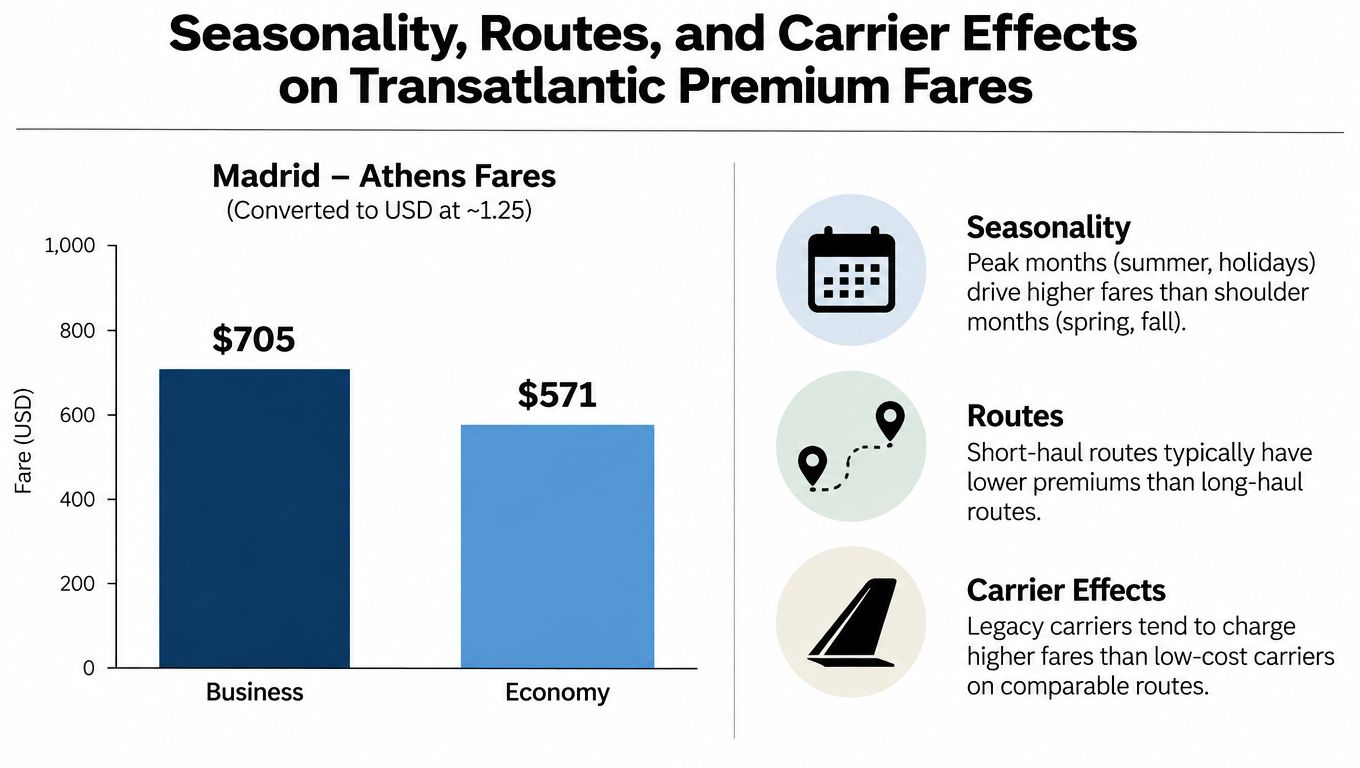
A short European business-class flight can carry a surprisingly small premium. In a Holidu comparison, Iberia's Madrid to Athens fare was £562 in business versus £454 in economy, a difference of £108, or about 23.8% (the Madrid to Athens comparison). This is not a transatlantic lie-flat benchmark. It does show how route competition can compress the gap between cabins.
Seasonality changes the demand band
Peak leisure periods can fill premium seats, while major corporate travel periods can tighten inventory. Shoulder periods give airlines more reason to reopen lower fare buckets when competition is strong, but the calendar alone is a poor buying signal.
A quiet month can remain expensive on a constrained nonstop. A busier period can produce a sale when carriers add capacity or compete aggressively. Track the same itinerary across nearby dates, and look for a recurring lower level rather than assuming that a particular month or weekday will be cheap.
Routes determine the premium you receive
For a transatlantic comparison, test New York to London against Boston to London using the same travel dates, cabin, connection rules, and advance-purchase timing. The fare gap can reflect local competition, available capacity, and carrier schedules, not just the distance flown. A nonstop may cost more because it saves time, while a one-stop itinerary can expose competing inventory.
Short-haul European business class may use an economy-style seat with a blocked middle seat and enhanced catering. Long-haul transatlantic business class generally provides substantially more space and, on many aircraft, a lie-flat product. Price comparisons must account for that product difference.
A self-connection can reduce the headline fare, but baggage handling, missed-connection exposure, and the lack of through-ticket protection change the value. Travelers considering unconventional routings should review what Mazurly found on hidden city fares before treating the saving as risk-free.
Carrier scale creates more places to look
A 2024 analysis of 24 European airlines estimated approximately 19 million premium-class tickets sold for long-haul departures from Europe, an 8.1% year-over-year increase (the European premium-cabin analysis). Reported volumes included approximately 3.7 million luxury-class tickets for Emirates, 2.7 million for Lufthansa, 2.6 million for Air France, and 2.5 million for Turkish Airlines.
Those figures combine business class, first class, and premium economy, so they are not a direct count of business seats. They do show why a Europe search should cover several hubs and carriers. Compare inventory across products, then judge whether a lower fare reflects genuine route competition or a temporary attempt to fill premium seats.
Reading the 65 to 110 Day Premium-Cabin Booking Window
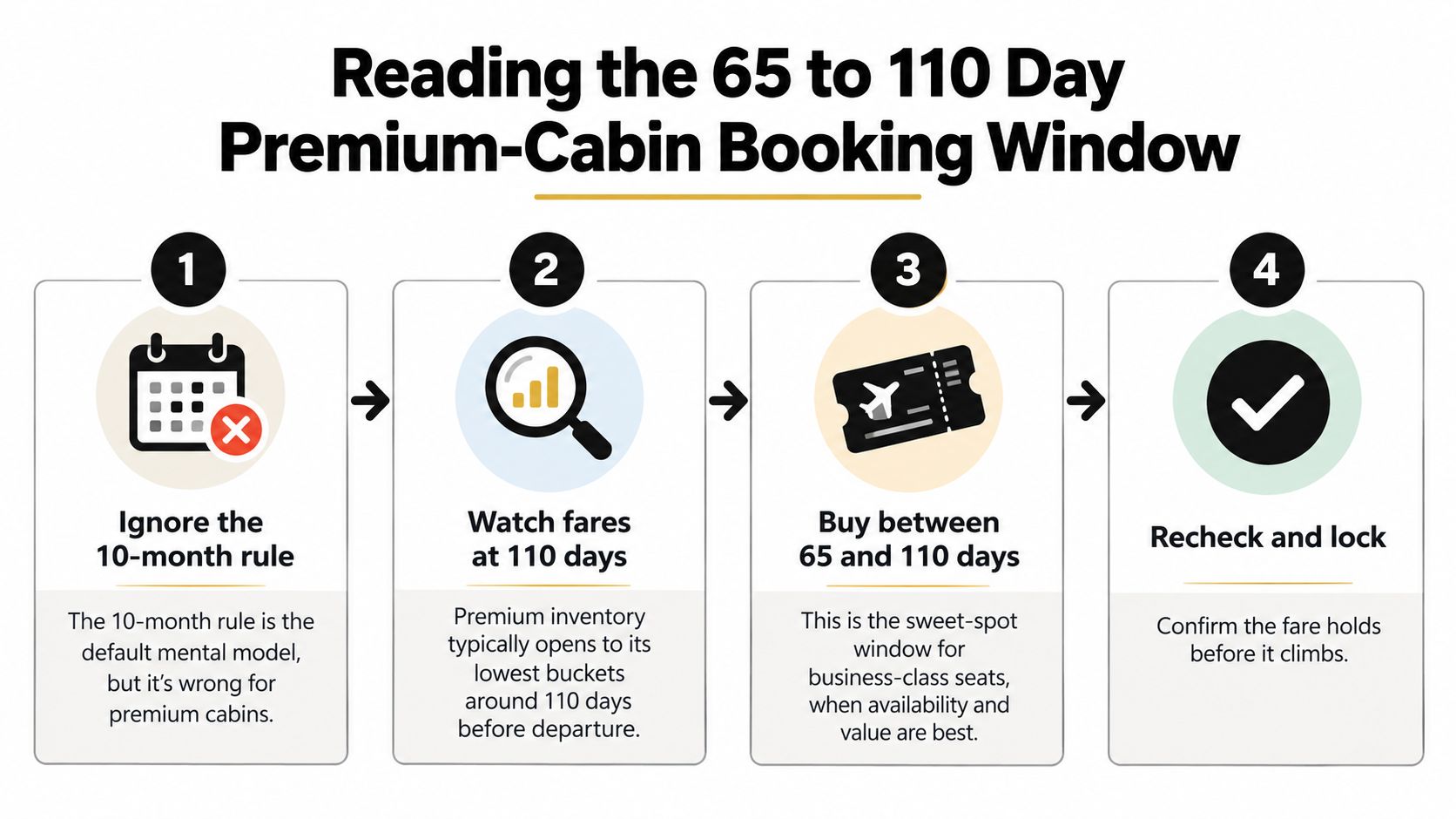
The 65 to 110-day band is a monitoring period, not a magic purchase date. Treating it as an automatic booking rule can make you buy before airlines release lower fares.
Start tracking at least four months before departure. Record comparable fares across several dates, routes, and cabin products, then establish the lowest recurring level for the market you can fly. The Business-Class.com analysis found prices approximately 15% below average during the 65 to 110-day window. Use that result as a reference, not a promise.
Turn the window into a routine
Your tracked average is the right benchmark. A fare 10% to 15% below that average deserves serious consideration when the aircraft, connection, schedule, and ticket rules meet your requirements. The threshold supports a decision. It does not guarantee the fare will not fall again.
Compare the fare with the route's recent behavior, never with a dramatic price from an unrelated origin. New York to London can follow a different cycle from a West Coast to Frankfurt itinerary. Nonstop inventory may move differently from one-stop inventory, while corporate-event demand can close discounted booking classes earlier than expected.
Do not wait for the lowest fare you can imagine. Buy when the fare is convincingly low against the market you can fly.
Buying at the first release often means paying aspirational pricing while airlines measure demand. As the departure date approaches and bookings develop, carriers may open lower booking classes to fill premium seats. Waiting until the final weeks works only when premium demand remains weak, and it can fail once corporate travelers begin filling the cabin. Use the guide to when to book business class flights alongside your own fare tracking.
The practical rule is simple: monitor early, compare like with like, and act when the market shows a genuine discount rather than an advertised headline fare.
Why the Departure City Changes the Premium Fare More Than You Think
Departure market can matter more than booking patience. A Europe-focused comparison found business fares ranging from $2,756 out of New York to $9,968 out of Las Vegas, a roughly 3.6 times spread. Economy fares in the comparison ranged from $643 out of Boston to $1,036 out of Las Vegas, a 1.6 times spread (the departure-city comparison).
| Departure City | Business Fare | Economy Fare | Spread Ratio |
|---|---|---|---|
| New York | $2,756 | Not specified | Business range reference |
| Boston | Not specified | $643 | Economy range reference |
| Las Vegas | $9,968 | $1,036 | Business about 3.6 times, economy about 1.6 times |
The lesson is blunt. Premium fares are more sensitive to origin-market economics than economy fares in this comparison. Airlines price against corporate contracts, hub competition, nonstop supply, and the customers they expect to book each cabin. A city with strong premium demand can hold business fares high even when economy inventory looks reasonable.
Search the market, not just the airport
If you're flying Boston to London, checking New York may save more than watching the Boston fare for another week. The saving isn't guaranteed, and repositioning introduces costs and risk, but the comparison belongs in the search from the beginning.
Price a through-ticket from the alternate gateway first. Then calculate the cost of reaching that gateway, including an overnight stay if the schedule requires it. A separate positioning ticket can leave you exposed if a delay causes you to miss the long-haul flight, so a lower fare isn't automatically a better itinerary.
The practical order is simple:
- Check nearby major gateways. Premium competition is often stronger where multiple long-haul carriers operate.
- Compare nonstop and one-stop options. Connection time can reveal lower inventory.
- Price the complete journey. Include ground transport, positioning flights, bags, and disruption risk.
- Keep the cabin comparison honest. Don't compare a restrictive business fare with a fully flexible economy fare without reading both sets of rules.
Capacity Growth, Cabin Products, and the Real Definition of Underpriced
A low business fare is underpriced only relative to the product and alternatives you're considering. A discounted seat with no lie-flat bed, an inconvenient connection, and punitive change rules may be worse value than a more expensive fare on a superior aircraft.
Premium supply can change that calculation. A 2026 industry briefing reported that long-haul premium-cabin available seat-miles across nine major carriers serving North America and Western Europe were approximately 6% to 8% higher year over year, while managed-travel reports showed average paid business fares to Europe roughly flat to slightly lower year over year (the premium-capacity briefing). When airlines add premium seats faster than demand grows, discounted buckets have more opportunities to reopen.
Demand is no longer only corporate
Delta's premium revenue rose 7% year over year in 2025, while United's rose 11%, even as both reported softer economic demand. Delta's premium revenue exceeded main-cabin revenue in Q4 2025 for the first time (the Air Monitor report).
Those figures show why old assumptions fail. Leisure travelers, remote workers, and customers buying a special trip now compete for premium inventory alongside corporate travelers. Demand can remain strong, but its timing is less predictable. That makes route monitoring more valuable than relying on a single corporate-booking theory.
Use a value checklist
Before calling a fare a bargain, verify:
- Seat and aircraft: Is the long-haul segment lie-flat, and does the seat map match the advertised product?
- Privacy: Does the cabin offer direct aisle access or a meaningful privacy advantage?
- Airport benefits: Are lounge access and priority services included, or do the fare rules exclude them?
- Baggage: Compare the included allowance with premium economy and flexible economy.
- Flexibility: Read change, cancellation, and no-show conditions before comparing prices.
- Itinerary risk: A protected through-ticket can justify paying more than a fragile self-connection.
Airline capacity management is the commercial backdrop, but your decision should remain practical. Compare the fare with other business buckets on the route, then compare the actual product with premium economy and flexible economy. A headline discount matters only after those checks pass.
A Worked Example Reading a Real Published Fare
KAYAK reported an average round-trip business-class fare to Europe of $4,138, while identifying a cheapest fare of $420 during the preceding two weeks, roughly 90% below the average (KAYAK's Europe business-class fare data).
That $420 fare is neither an automatic miracle nor an obvious error. It's a prompt to investigate four specific facts.
First, identify the market
Which origin produced the fare? Was it a major hub, a secondary airport, or a limited promotion? Was the destination a competitive gateway, and did the itinerary use a connection? A fare that appears broadly available may depend on a narrow city pair or a particular date combination.
Next, verify the product
Check the aircraft on the long-haul segment. Business class on a transatlantic wide-body can be materially different from a short European sector marketed in the same cabin. Look for the seat map, lie-flat availability, privacy, and connection details before judging the fare.
Then read the restrictions
Confirm whether the ticket permits changes, whether cancellation produces a refund or credit, and whether missed segments cancel the rest of the itinerary. A very low fare can be appropriate for a fixed leisure trip, but unsuitable for a consultant whose schedule changes frequently.
Finally, compare alternate gateways and carriers. If the $420 fare requires costly positioning or an unsafe self-connection, its real value may be much lower. The correct response to an extreme fare is disciplined verification, not instant booking or dismissal.
Putting the Reading-the-Market Method to Work
Business-class airfare to Europe rewards market reading, not headline chasing. Compare business, premium economy, and flexible economy on the same route, then check the aircraft, lie-flat seat, lounge access, baggage, and fare rules.
Search alternate departure cities, carriers, hubs, and connection patterns before accepting a headline fare. Monitor the itinerary in the 65 to 110-day window, and buy when the fare sits clearly below your route average and the product suits the trip.
The Madrid to Athens example from earlier shows why cabin labels mislead: business can sit close to economy when empty premium seats clear and fare buckets align (the published Iberia comparison). Treat that gap as a market signal, not a universal rule.
Passport Premiere helps travelers monitor international business-class fares, assess fare drops, and compare Europe routes with market conditions. Visit Passport Premiere for fare intelligence and monitoring tools.
