
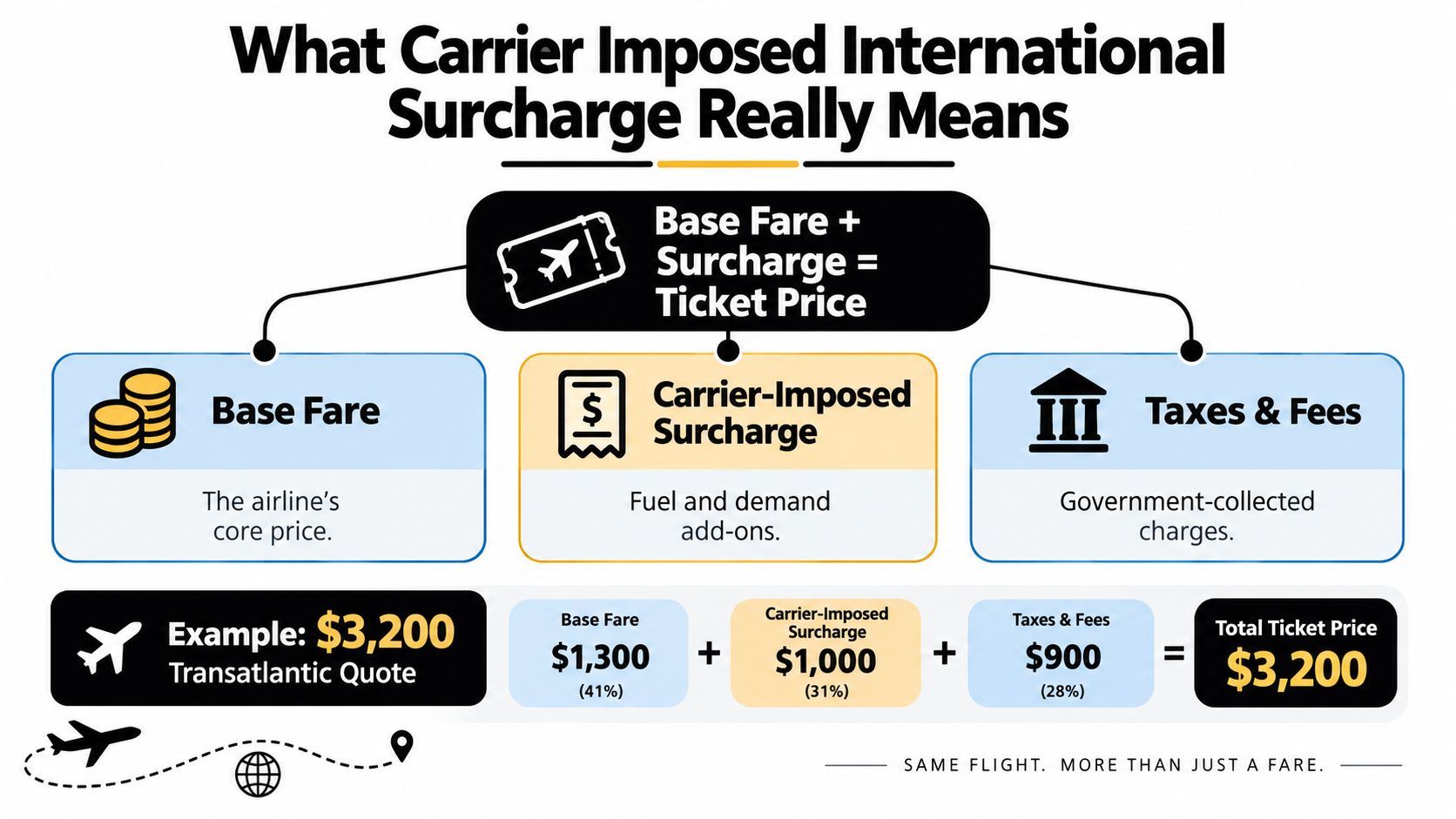
Carrier-imposed international surcharges can add $500 to $1,500+ to a single transatlantic business-class ticket, and on some itineraries they're the largest invisible part of the price. A quote that looks like a $3,200 fare can hide a very different total once the airline's own YQ or YR charges are layered in.
Business class can look expensive right up until the surcharge line is added to coach, then the gap narrows fast or even flips. That's why the comparison is never just base fare versus base fare, it's the full ticket total.
What Carrier Imposed International Surcharge Really Means
Carrier-imposed international surcharge can change the economics of an international ticket as sharply as a fare sale. Airlines add YQ or YR charges to the base fare, separately from government taxes, so the visible fare may conceal a substantial part of the amount payable at checkout.
The mechanism emerged from the early 2000s fuel shock and later became a permanent pricing tool. Industry summaries place the practice's expansion around 2004. It has since become partly decoupled from actual fuel costs, allowing a surcharge to remain high even when fuel prices no longer explain the full amount Navan's explanation of fuel surcharge history and pricing behavior.
What it looks like in a real fare
A New York to London itinerary cited in public reporting illustrates the structure: a $1,012 base fare, a $320 carrier-imposed surcharge, and $225 in taxes and fees Delta's published taxes and fees page. The traveler who compares only the headline fare is therefore measuring the wrong cost.
The surcharge also changes the premium-cabin decision. Economy tickets on transatlantic routes often carry about $100 to $200 in YQ or YR, while premium cabins can exceed $500 per direction Navan's surcharge guide. For executive travel programs, that difference affects budget forecasts, approval limits, and whether a business-class quote is a premium at all.
The timing matters because airlines can adjust the surcharge independently of the base fare. A lower advertised fare may therefore be offset by a higher carrier charge, while a surcharge reduction can produce savings comparable to a fare promotion. Compare both components across the same itinerary and booking date.
Practical rule: If the quote does not show the surcharge separately, the comparison is incomplete.
Teams arranging executive air travel solutions should review the full fare before approving a booking. The objective is straightforward: identify the airline-controlled cost, compare it across options, and commit funds only after the total ticket price is visible.
How YQ and YR Fees Appear on Your Fare Breakdown
YQ and YR are airline-controlled charges, not government taxes. That distinction affects both accounting and fare comparisons. Airlines must identify these amounts clearly so travelers can distinguish carrier pricing from government-collected taxes, as outlined in DOT compliance guidance on fee and tax display.
How to read the line items
YQ usually reflects fuel-related surcharge logic. YR can cover other carrier-imposed costs, including distribution, environmental, or operating expenses. The labels do not create a universal allocation rule, because each airline decides how to structure and apply its charges. Two tickets on the same route can therefore have comparable base fares but materially different totals.
The surcharge line also acts as a market signal. Airlines can change it independently of the advertised fare, so fare shopping that ignores YQ and YR can miss a cost change comparable to a sale on the base ticket.
For corporate buyers, coding matters. A surcharge is not a tax. Misclassifying it can distort expense reports, weaken route comparisons, and hide how much of the price comes from airline-controlled charges.
What to check before approving a fare
- Look for YQ and YR separately. If the fields are absent, the airline may have bundled the charge into the fare, making its pricing decision harder to assess.
- Scan for government agency names. Government taxes typically identify a country, airport, or regulator. Carrier surcharges do not.
- Compare the complete ticket total. A lower base fare can still produce the higher price after YQ or YR is added.
- Read the refund language before ticketing. In practice, some carriers treat surcharges differently from the base fare on refunds, so flexibility can cost more than the seat itself.
A fare breakdown is a pricing record, not a formality. Review the surcharge line alongside the base fare, taxes, itinerary, and refund conditions before approving the ticket. That process shows whether a quoted saving is genuine or only offset by an airline-controlled charge.
Why 2026 Surcharge Moves Matter Now
Carrier-imposed surcharges now operate as a separate pricing signal. Airlines can raise or reset them while the advertised fare stays unchanged, so the right booking window can matter as much as a base-fare sale. In 2026, Air India introduced international surcharges as high as $280 per leg on North America and Australia routes, Cathay Pacific doubled its long-haul levy to about HK$1,560, Korean Air tripled its international fuel surcharges, and Thai Airways adjusted Japan-origin charges for tickets issued in 2025, according to Travel Market Report's 2026 surcharge roundup.
The Asia-Pacific signal is especially loud
Korean Air's September 2026 surcharge tier was described as a seven-tier jump in a single month. One-way charges ranged from roughly 36,200 won to 451,400 won, depending on distance and cabin context. For a travel manager, that is a ticketing variable, not background noise. A fare that looks competitive in the morning can carry a materially different total after a surcharge reset.
Japan-origin tickets show how deliberately these fees are structured. ANA applies the surcharge to adults, children, and seated infants, refunds it on unused refundable tickets, and recalculates it using the prior two-month average Singapore kerosene price. United's 2026 schedule follows the same two-month pattern, with fees as high as ¥65,000 one-way on Japan to U.S. routes for tickets issued in July to August 2026, then ¥55,000 for tickets issued in September to October 2026. The schedule details are reproduced in Air Canada Japan's fuel surcharge update, which reproduces ANA and United schedule details.
| Carrier | Route | Surcharge Change | Impact Level |
|---|---|---|---|
| Air India | North America and Australia | Up to $280 per leg | High |
| Cathay Pacific | Long-haul | About HK$1,560 after doubling | High |
| Korean Air | International | Tripled, with a seven-tier jump in one month | Very high |
Why buyers should care now
The practical question is not only today's surcharge. It is whether the charge is moving before ticketing, particularly on premium cabins where a surcharge increase can erase savings found through base-fare shopping. Corporate programs should compare the complete ticket total across booking dates, not just the fare displayed first.
A discounted fare can therefore conceal a higher trip cost if the airline-controlled surcharge changes during the same purchase window. Surcharge timing deserves its own tracking alongside fare availability.
Business Class vs Coach After Surcharges Are Added
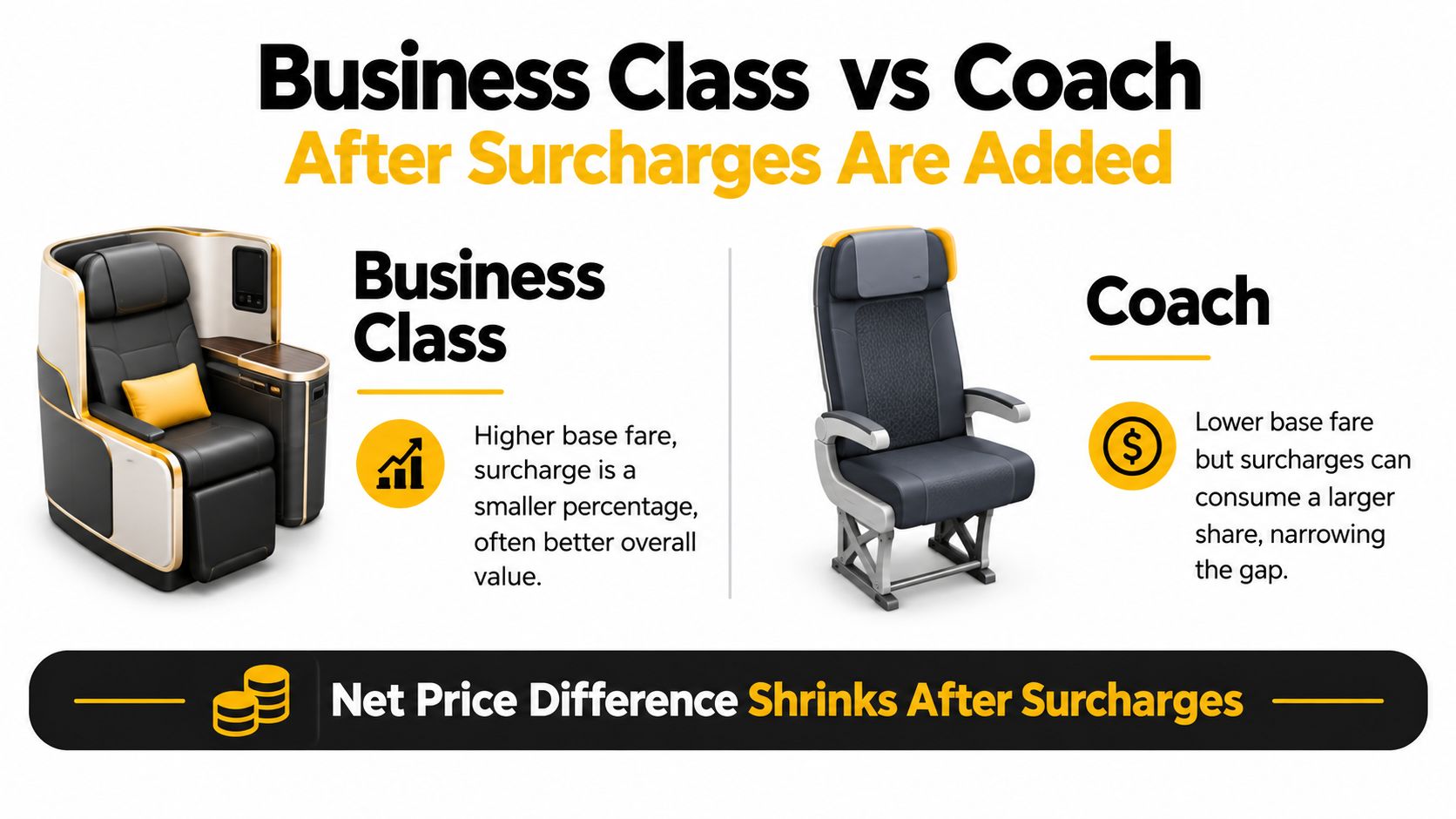
Coach is not automatically the lower-cost choice once carrier-imposed surcharges enter the comparison. A 2026 airfare guide gives an urgent cross-country example of about $850 for business versus $1,200+ for flexible last-minute economy, plus a last-minute international example of about $2,100 for discounted business versus $2,500+ for full-fare coach Passport Premiere's 2026 cost examples.
Why the paradox happens
Airline pricing separates the cabin product from the market conditions around it. Fare buckets can shift, premium demand can soften, and route competition can force business-class prices down while flexible economy remains expensive. A July 2024 explainer reported that first-class or business-class fares can cost less than economy because airline pricing behavior, rather than cabin quality alone, determines the displayed fare One Mile at a Time on business class being cheaper than economy.
Surcharges add another signal. They are attached to the ticket separately from the base fare, so a lower advertised fare does not guarantee a lower all-in total. The surcharge level can move the final price by an amount comparable to a fare sale, especially on long-haul premium tickets. Compare both components on the same itinerary and ticketing date.
On competitive Atlantic and Pacific routes, unsold premium inventory or a sudden fare war can push business class below last-minute economy Passport Premiere's premium fare sales guide. A transatlantic business-class ticket from the United States typically averages about $3,000 to $5,000 roundtrip on major carriers, showing how widely the total can vary before surcharge timing is considered Going's 2026 business-class guide.
Decision rule: Compare the all-in price, including the carrier-imposed surcharge, then assess whether the cabin difference justifies the remaining gap.
For another cabin comparison, see first class versus coach. The final total and ticket flexibility matter more than the seat label alone.
When to Time Your Booking to Control Surcharge Costs
Carrier-imposed surcharges follow fuel review cycles, creating a separate pricing signal from the base fare. For Japan-origin international tickets, carriers use the prior two-month average Singapore kerosene price, so the surcharge changes during defined review windows rather than moving randomly each day Air Canada Japan's fuel surcharge update. That timing can alter the all-in price by as much as a fare sale, particularly on long-haul premium tickets.
The booking logic that works
Track the surcharge direction alongside seat availability. If the benchmark has fallen across two review periods and premium inventory remains open, waiting for the next window may reduce the total. If the benchmark is rising, issuing the ticket before the carrier refreshes the fee can protect the lower rate. Fare-cycle tracking tools such as Passport Premiere's airline fare prediction guidance apply the same timing logic to base fares.
United's published examples illustrate the potential difference:
| Origin and route | Published surcharge example |
|---|---|
| Japan to the United States, tickets issued in July to August 2026 | ¥65,000 one-way |
| Japan to the United States, tickets scheduled for issue from September to October 2026 | ¥55,000 one-way |
| Hong Kong to the United States, Canada, and Latin America | HK$1,164, later reduced to HK$965 |
The reduction matters only if the desired cabin is still available. A lower surcharge cannot compensate for a business-class fare bucket disappearing or a replacement itinerary costing more.
Timing rules that hold up in practice
- Falling surcharge cycle: wait for the next review when premium seats remain available.
- Rising surcharge cycle: ticket promptly, especially for long-haul business class.
- Tight inventory: buy sooner, because availability can erase the benefit of a lower fee.
- Flexible dates: compare issue dates as well as travel dates.
The practical advantage is clear. Surcharge timing operates as its own market signal, and tracking it can save as much as chasing a modest base-fare reduction.
How Passport Premiere Helps Members Avoid Overpaying
A Cathay or Korean Air quote can change midweek when the carrier resets its international surcharge. The base fare may look unchanged, yet the total rises because the YQ/YR line has moved. That separate price signal can erase the benefit of a fare sale, which is why Passport Premiere focuses on fare monitoring and market analysis rather than the headline fare alone.

Where the signal becomes usable
Passport Premiere's FARE MONITOR can help members compare two quotes for the same route and cabin. One result might show a lower base fare with a higher YQ/YR amount, while another shows a slightly higher fare with a smaller surcharge. The useful comparison is the all-in price, not the fare headline.
That distinction matters for corporate travel programs. A traveler who checks only the base fare can approve an itinerary that appears cheaper but costs more after the carrier-imposed charge is added. Monitoring also gives the buyer a chance to act before a surcharge reset, provided the required fare bucket and seats remain available.
Passport Premiere presents a Video Gallery, news updates, and a Fare Monitor demonstration. These materials can help members recognize recurring premium-cabin patterns and identify whether a price change comes from the fare, the surcharge, or both.
The service is most useful when members record the surcharge line during repeated searches. A route with stable availability but a rising YQ/YR amount may justify earlier ticketing. A route with a falling surcharge and flexible premium inventory may justify waiting. The decision depends on the fee cycle and seat availability together, not on either one in isolation.
Passport Premiere's business-class fare sales guide and Passport Premiere's business-class guide provide broader context on premium-cabin pricing, while the surcharge comparison supplies the missing cost check.
Practical Checklist for Travelers and Travel Managers
Request the full fare breakdown before you pay, because YQ and YR tell you whether the airline's own pricing is inflating the total. If the quote only shows a headline fare, you're not seeing the full cost yet.
Compare the all-in price across carriers on the same route, not just the base fare. The cheapest base fare can lose once the surcharge column is added, and that's a common mistake in both leisure and managed travel.
Check the surcharge review cycle for your origin market, especially on Japan-origin itineraries where the benchmark follows a two-month average. If your ticket date sits just before a likely reset, the timing may be worth more than a small fare discount.
Ask whether a business-class fare drop is live before assuming coach is the cheaper option. On some routes, business can beat coach once you include the full ticket total and the volatility of premium-cabin pricing.
Use a monitoring service only if it changes your buying behavior. Passport Premiere's corporate travel expense management guidance is relevant when your team needs a process for watching premium-cabin value, not just a one-off fare quote.
Travel manager rule: If your approval process ignores surcharge timing, it's approving incomplete prices.
Passport Premiere helps travelers track premium-cabin fare cycles, spot surcharge-driven price swings, and buy when the market makes sense instead of when the headline fare looks tempting. If you're trying to keep international premium travel under control, visit Passport Premiere and use its fare intelligence to check the all-in price before you book.
