

You're staring at a travel spreadsheet that no longer tells the whole story. Employees have booked flights through different websites, hotel invoices arrived in inconsistent formats, policy exceptions sit in email threads, and nobody can confirm where every traveler is during a disruption. Meanwhile, finance sees costs after the money has already left the business.
That situation is common when business travel grows faster than its operating system. Corporate travel management replaces scattered decisions with a coordinated program for booking, policy, expenses, supplier relationships, traveler support, and risk visibility. The aim isn't to make every trip rigid or choose the cheapest option automatically. It's to make each decision visible, defensible, and aligned with business needs.
Introduction to Modern Travel Challenges
An unmanaged travel program often looks harmless at first. An employee books a convenient flight, chooses a familiar hotel, pays with a company card, and submits receipts later. Multiply that process across departments, booking channels, and destinations, and the travel manager inherits a maze rather than a program.
The costs appear in several places. Employees may select fares that don't match negotiated supplier terms, book outside approved channels, or choose a cabin without a clear business rationale. Finance then spends time reconstructing itineraries, matching invoices, and investigating exceptions instead of planning future spend.
Risk creates a second blind spot. If a traveler books independently, the company may not receive the itinerary data needed to contact that person during severe weather, a security event, or a major transport disruption. Duty of care still exists, even when the booking record doesn't.
A structured program brings those decisions into one operating model. Travelers get clear rules and support, managers gain visibility into spend and compliance, and suppliers receive a more consistent flow of business. The goal is controlled flexibility, not control for its own sake.
Practical rule: A travel policy works only when the approved booking path is easier to use than the workaround.
Understanding Corporate Travel Management
A corporate traveler may book a flight, change a hotel, and submit expenses through separate systems. Corporate travel management brings those steps into one operating process. It covers planning, booking, monitoring, reconciliation, air travel, accommodation, ground transportation, policy enforcement, supplier negotiations, expense data, and traveler support.
The function began in a largely manual setting. Before digital booking platforms, companies often relied on in-house travel desks, paper tickets, telephone calls, and fax machines. In 1994, Corporate Travel Management was founded in Brisbane, Australia, while those methods still shaped daily operations. That year also brought the first airline e-ticket, a practical move toward electronically managed reservations. Corporate Travel Management's market history and growth places this shift in the wider development of the sector.
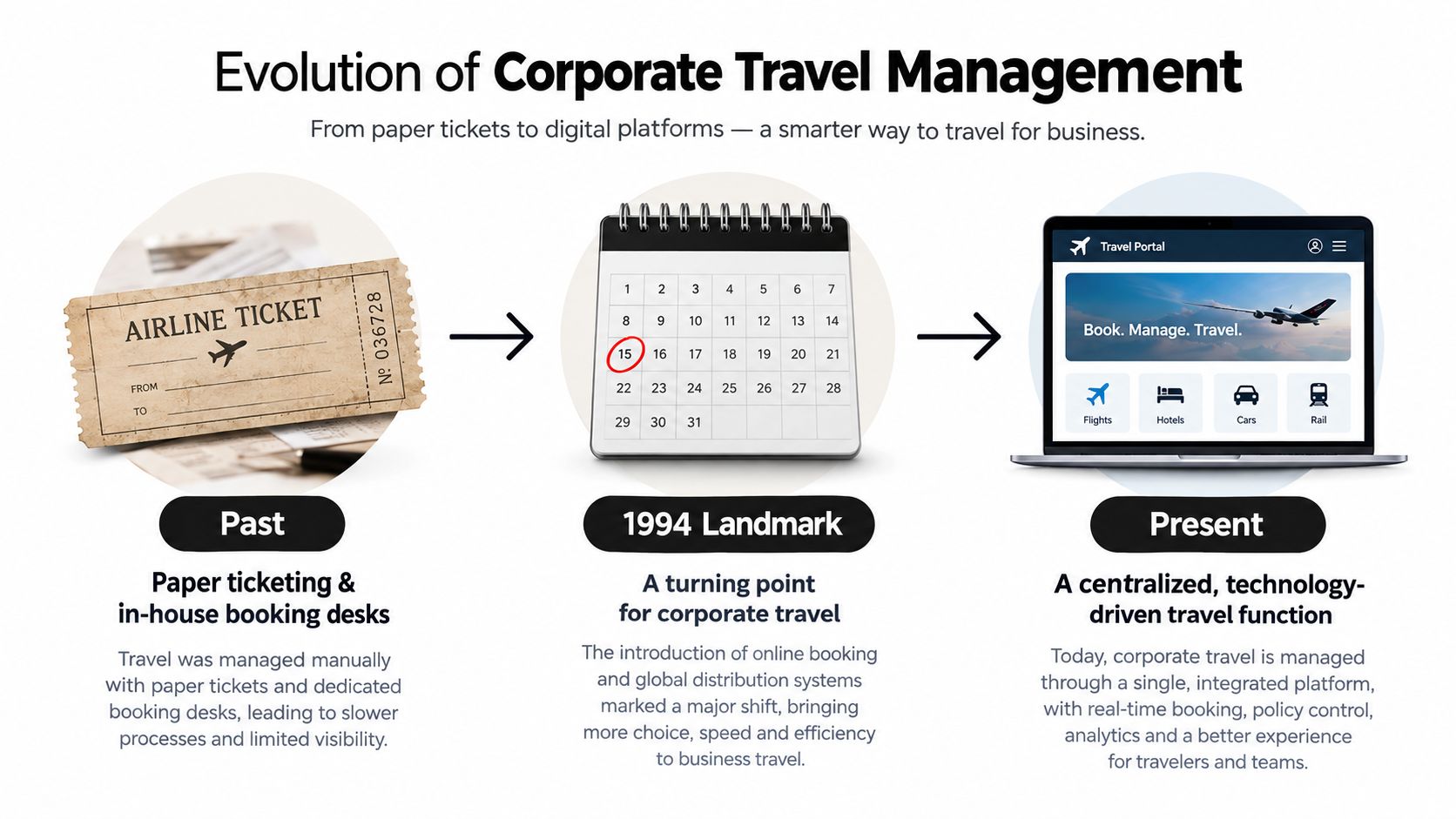
Today, the program connects information that once lived in inboxes, spreadsheets, and separate supplier systems. An online booking tool can show approved choices and record itinerary details. A travel management company can handle complex routes and disruptions, while expense software can match transactions with accounting records. Together, these tools create a repeatable process instead of leaving each trip to individual judgment.
The market has grown as organizations invest in central policy and travel technology. One independent estimate values the global business travel management service market at $8.53 billion in 2025 and $9.06 billion in 2026, with 6.1% annual growth. The Business Research Company's market report helps explain why the function now involves procurement, finance, operations, and risk, alongside administration.
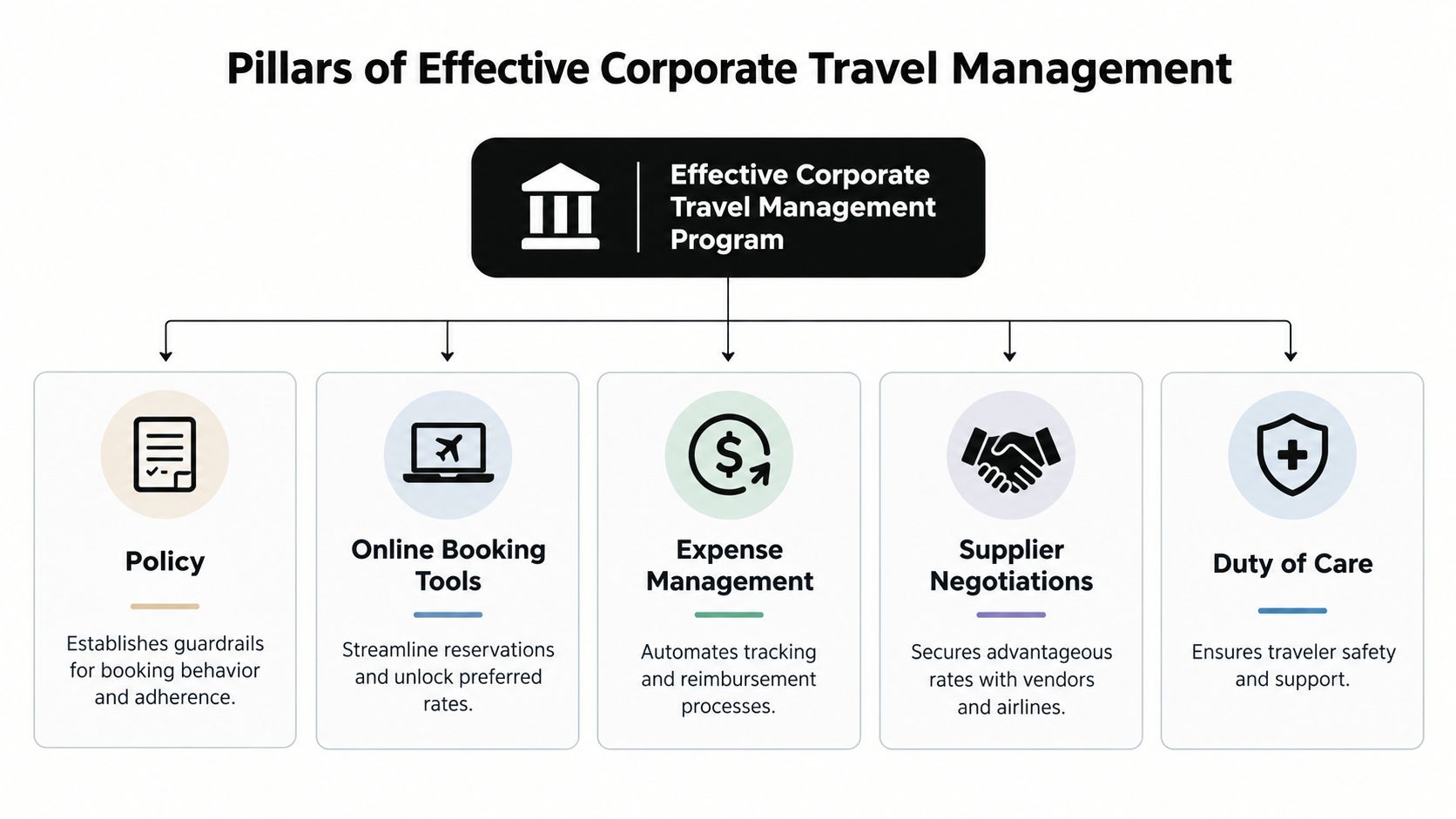
A travel manager coordinates those interests while protecting traveler productivity and company control. The role includes policy decisions, supplier negotiations, technology oversight, reporting, and traveler service. Specialized providers can also reveal savings that standard booking workflows miss. For example, Passport Premiere may help companies access hidden premium-cabin value when route, fare, and cabin choices are reviewed together.
Deloitte's 2024 corporate travel research found that travel spend could grow by 8% to 12% in 2024. Deloitte's corporate travel study reflects the broader shift toward a strategic travel-management role.
Core Components of an Effective Program
A reliable travel program works like a well-run procurement system. Procurement does more than ask employees to spend less. It defines approved suppliers, creates buying rules, captures transactions, measures results, and adjusts contracts. Corporate travel management applies the same logic to trips.
Policy creates useful guardrails
Start with rules that answer practical questions. Which booking channel should employees use? When does a trip require approval? What qualifies for flexible fares, premium economy, or business class? Which expenses require receipts, and how should exceptions be documented?
A strong policy doesn't treat every traveler or trip identically. It can distinguish between a short domestic meeting, a long-haul client visit, an urgent executive trip, and a journey requiring accessibility support. The policy should explain the reason for each rule, because employees follow systems more readily when the decision standard makes sense.
Booking tools turn rules into action
An online booking tool is the storefront of the program. It should display compliant choices first, show relevant fare conditions, route exceptions for approval, and capture itinerary data at the moment of purchase.
The tool also needs a human support path. Travelers with complicated connections, schedule changes, or urgent disruptions may need an agent rather than a self-service workflow. Resources covering essential travel agency services can help managers compare the support functions that sit alongside digital booking.
Duty of care keeps the traveler visible
Duty of care means the organization can locate travelers, communicate with them, and assist when circumstances change. It depends on complete booking records, emergency contacts, risk procedures, and support outside normal office hours.
Out-of-channel bookings weaken that visibility. A traveler may still be safe, but the company may not know the itinerary or have a reliable way to reach them. A managed program therefore treats channel adoption as a safety requirement as well as a financial control.
Expenses close the financial loop
Booking data shows what the traveler intended to purchase. Expense data shows what the company paid. Connecting the two lets finance compare the approved itinerary with final charges, identify missing receipts, and reconcile costs without rebuilding the trip manually.
For a deeper look at how booking records and reimbursement processes fit together, review corporate travel expense management. The key principle is simple: capture information once, then reuse it across approval, payment, reporting, and reconciliation.
Suppliers and TMCs provide leverage
Airlines, hotels, car rental companies, ground operators, and travel management companies each influence the traveler experience and the final cost. Managers should evaluate negotiated rates, cancellation terms, service levels, availability, reporting quality, and disruption support rather than focusing only on headline price.
Deloitte's research identifies travel managers as the people who set policy, negotiate supplier rates, and oversee technology. That combination makes the role a coordination function. Each pillar supports the others, and a cheap rate is less valuable if travelers avoid the booking channel or cannot receive help when plans fail.
Benefits and ROI of Travel Management
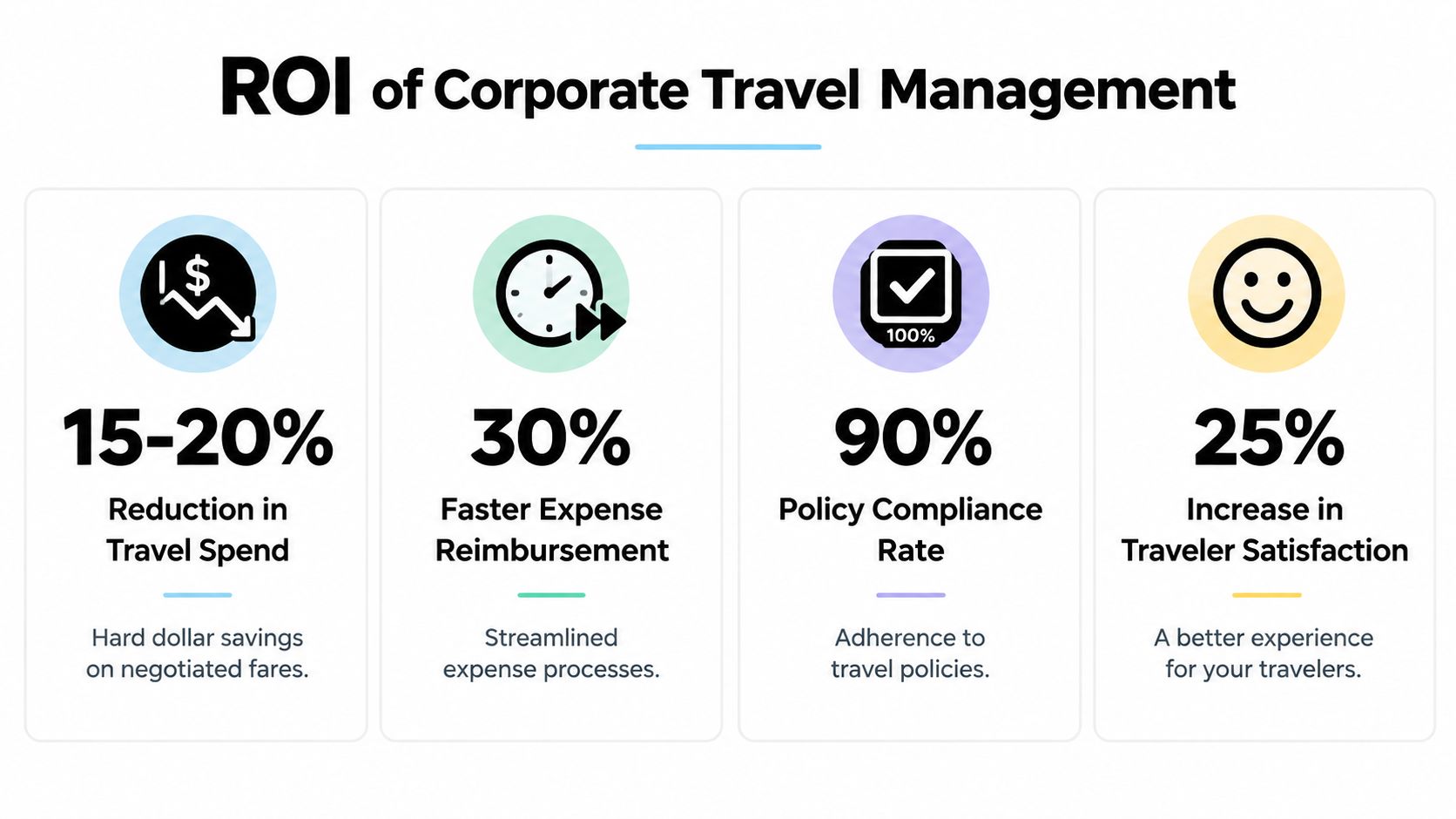
A managed program earns its place by improving more than the ticket price. It can reduce leakage, make supplier performance visible, shorten reconciliation work, and help travelers arrive ready to perform.
The strongest ROI case connects travel decisions to business outcomes. For example, a lower fare may look attractive until it creates a restrictive change condition, an exhausting itinerary, or a missed meeting. Conversely, a premium cabin may be justified when comfort, arrival readiness, or schedule flexibility directly supports the trip's purpose.
Premium economy provides a useful middle ground. Premium economy bookings grew 35% year on year, and 67% of business travelers reported productivity gains from more comfortable seating, according to Business Travel Authority's 2026 outlook. Those figures support a broader evaluation of travel value, but they don't justify an automatic upgrade for every employee or itinerary.
Decision test: Compare the total trip outcome, not just the base fare. Include time, flexibility, comfort, support, and the cost of an employee arriving unable to work effectively.
A practical ROI model can track:
- Avoided leakage: Compare managed-channel purchases with the unmanaged patterns they replace.
- Supplier value: Review contracted rates, cancellation terms, service quality, and actual booking share.
- Administrative effort: Measure how much time finance and travel teams spend on approvals, receipts, and reconciliation.
- Productivity support: Assess whether cabin and itinerary choices help employees work effectively after long journeys.
- Risk readiness: Confirm whether the company can identify and support travelers during disruptions.
Ground transportation belongs in the same analysis. A consistent supplier strategy can improve pickup reliability, invoice handling, and itinerary visibility, particularly for recurring airport or client transfers. Managers evaluating this category can use guidance on corporate rates for ground transfers when comparing supplier terms.
Technology and Metrics Driving Control
Technology becomes valuable when it changes a decision. A dashboard that merely displays monthly spend is a historical record. A dashboard that identifies out-of-policy bookings, supplier underperformance, or weak advance planning gives the travel manager a control mechanism.
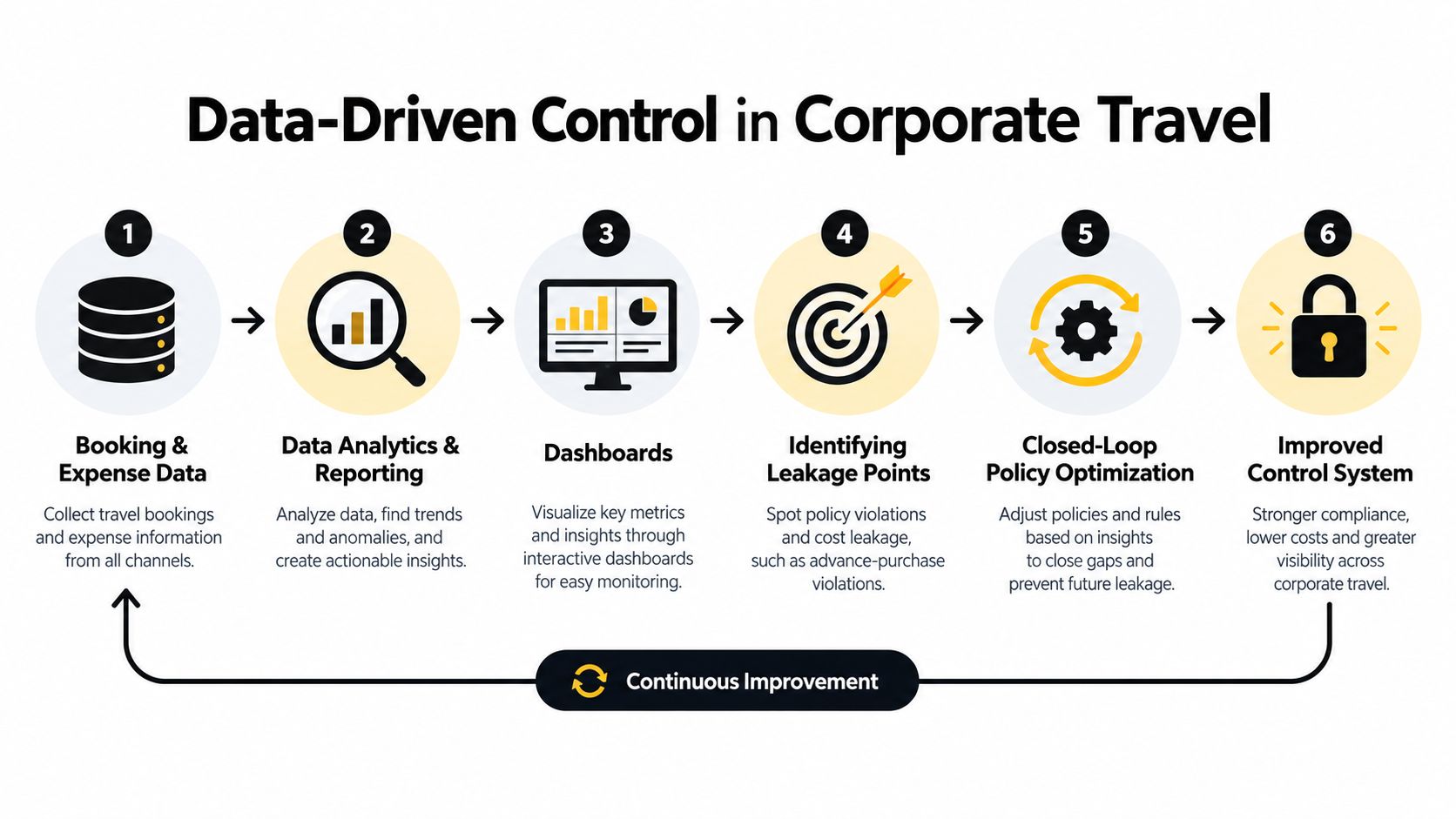
Travel managers use closed-loop analytics to collect booking and expense records, analyze policy behavior, forecast demand, and turn findings into targeted changes. Navan's explanation of travel data analytics describes this approach as a way to connect raw records with compliance, spend control, and supplier performance.
Build the feedback loop
The operating sequence is straightforward:
- Capture: Bring booking, card, expense, and itinerary records into a common reporting environment.
- Analyze: Group spend by department, route, cabin, supplier, traveler type, and policy status.
- Diagnose: Find leakage points, such as bookings outside the approved channel or repeated exceptions.
- Act: Adjust policy wording, approval rules, supplier settings, or traveler communications.
- Review: Measure whether the intervention changed behavior and whether traveler friction increased.
Useful metrics include policy compliance, booking lead time, preferred-supplier usage, average fare by route, exception frequency, expense completion, and traveler support response. The manager shouldn't treat any single metric as the answer. A high compliance rate may hide poor traveler adoption if employees are booking outside the system and never entering the data set.
Real-time itinerary visibility adds a risk layer. If a flight disruption affects a destination, the travel team can identify exposed travelers, send relevant instructions, and coordinate alternatives. Calendar synchronization can also reduce operational friction by keeping itineraries aligned with meetings and availability. A guide to real-time calendar synchronization offers useful context for that workflow.
Premium fares deserve their own reporting view. Track cabin, route, fare family, purchase timing, flexibility, and the reason for approval. This prevents the organization from treating every business-class purchase as wasteful or every economy fare as efficient. For teams monitoring fare movements, airline price-drop alerts can fit into a broader exception and savings workflow.
Best Practices for Implementing a Travel Program
Implementation works best as a controlled rollout rather than a policy announcement. Begin by interviewing finance, HR, IT, security, executive assistants, frequent travelers, and employees who arrange complex trips. Each group sees a different failure point, and those perspectives reveal whether the program is practical before you configure a platform.
Start with a measurable baseline
Collect current booking, expense, supplier, cabin, and exception records. Identify where employees book, how invoices arrive, which routes create repeated problems, and where traveler support breaks down. Don't set targets until you know which data is complete and which bookings sit outside the managed record.
Next, write the policy in plain language. Include approval logic, preferred channels, cabin principles, flexibility rules, hotel and ground transportation guidance, receipt requirements, and emergency support. Corporate travel policy best practices can help structure that document without turning it into an unreadable rulebook.
Make the compliant choice convenient
Select a booking tool or TMC based on search quality, policy controls, traveler support, integrations, reporting, and international capability. Run a pilot with travelers who represent different trip types. Watch where they abandon the workflow, request agent help, or book outside the platform.
Train managers on exceptions, not just restrictions. A policy becomes more credible when it explains who can approve a premium cabin, what evidence supports the decision, and how the company evaluates the outcome afterward.
Treat premium cabins as an optimization problem
Long-haul premium-cabin demand has run 18% to 25% above 2019 levels, and business-class loads have stayed above 84% for four straight quarters, according to industry coverage of corporate travel management. Tighter availability makes timing and fare analysis more important than a simple cabin ban.
Set a decision framework based on route length, meeting requirements, traveler role, flexibility needs, and total trip value. Compare the full cost of coach, including upgrade miles, change restrictions, baggage, and lost productivity, with the available premium fare.
Business class can be cheaper than coach when fare inventory, restrictions, or upgrade economics differ. Airlines can set different prices across cabins, and the U.S. Department of Transportation consumer notice explains why a premium seat may sometimes cost less than an economy seat. USA Today's explanation of airline cabin pricing provides a clear example of that mechanism.
FCM Consulting reported that global business-class airfares fell by an average of $119, or 4%, from January to May 2025, while economy fares fell by $18, or 3%, in the same period. FCM's H2 2025 insights shows why managers should monitor fare cycles instead of assuming economy always offers the lowest total cost.
The Points Guy documented a Delta itinerary where a discount business-class fare cost $3,347, compared with an upgradeable coach fare priced at $3,256 plus 50,000 miles. The fare comparison demonstrates how an all-in comparison can change the decision.
Passport Premiere can be evaluated as a specialized supplier for international premium-cabin intelligence, using fare monitoring and market analysis to identify lower-priced business and first-class opportunities. Include its alerts in the sourcing process, require documented approval, and measure the resulting fare against the best compliant alternatives.
Conclusion and Next Steps
Corporate travel management turns scattered bookings into a governed operating system. Clear policies guide behavior, connected technology captures the data, supplier relationships improve purchasing, and duty-of-care processes keep travelers visible. Premium-cabin decisions also deserve analysis based on fare mechanics and business outcomes, not assumptions about cabin labels.
Start by auditing current spend and booking channels. Then pilot dashboards, formalize supplier standards, test traveler support, and create a documented premium-fare review process. As programs mature, managers can add more personalized recommendations, sustainability reporting, and connected traveler support without losing financial control.
Passport Premiere helps corporate travelers monitor international business and first-class fares, evaluate fare movements, and identify premium-cabin opportunities that may cost less than coach. Visit Passport Premiere to review its membership options and determine whether its fare intelligence fits your company's travel program.
