

Business class can sometimes cost less than coach on the same flight. Australian Frequent Flyer documented examples where Canberra to Melbourne priced at A$629 in Economy and A$449 in Business, while Sydney to Christchurch showed A$489 in Economy and A$462 in Business. (Australian Frequent Flyer)
That sounds irrational until you understand how airlines sell seats. First class and business class aren't priced as simple upgrades from economy. Airlines divide each cabin into separate fare inventories, forecast what travelers will pay, and adjust availability as demand changes. The result can be a very expensive premium ticket, or occasionally a premium seat priced below coach.
The Premium Cabin Pricing Illusion
The common explanation is that first class costs more because it includes better food, wider seats, private space, premium drinks, lounge access, and more attentive service. Those benefits matter, but they aren't the main reason the fare becomes so high. The larger explanation is that airlines treat premium seats as scarce revenue assets.
A first-class seat isn't just an economy seat with luxury extras added on top. It belongs to a different commercial product, sold to travelers who may value privacy, flexibility, schedule convenience, and a more productive journey far more than the average leisure passenger does. Airlines therefore set its price around willingness to pay, not around the proportional cost of the meal or the additional seat width.
That distinction also explains why the price can feel detached from the physical experience. A cabin may contain only a small number of premium seats, while the same aircraft carries a much larger economy inventory. The airline has fewer opportunities to sell those premium positions, so each one must contribute more toward the flight's financial result.
The central question isn't “How much more does the seat cost to operate?” It's “How much revenue can this scarce seat produce before departure?”
This is similar to the logic behind other luxury products. If you're curious about how scarcity, craftsmanship, positioning, and customer willingness to pay combine in another market, why Rolls Royce cars are so expensive offers a useful comparison. Airline pricing is more dynamic, but both markets show why production cost alone doesn't determine the final price.
Three mechanisms do most of the work:
- Revenue concentration: A small premium-cabin customer base can generate a large share of route revenue.
- Fare buckets: Each cabin contains multiple prices and conditions, and airlines can close cheaper inventory without selling every seat.
- Volatility: Travelers who monitor routes, dates, and fare classes can sometimes find premium prices that don't match the usual cabin hierarchy.
Understanding these mechanisms gives you a better answer to “why are first class tickets so expensive?” than pointing to champagne and extra legroom.
Premium Cabins Drive Outsized Airline Revenue
Premium cabins can matter far more to an airline's finances than their passenger counts suggest. IATA's analysis of premium-class demand found that premium travelers represented 5.2% of international origin-destination passengers in 2017, yet produced 25.5% of airline revenue. The same analysis found that they paid, on average, three to six times more than economy travelers. (IATA's analysis of premium-class demand)
That difference changes the value of each seat. On North Atlantic routes, premium travel contributed close to 47% of revenue. The comparable figure was around 37% between Europe and Asia and across the Pacific, and about 15% within Asia. A relatively small group of customers can therefore support a substantial share of a route's income.
Revenue per seat matters more than passenger volume
A premium seat takes up aircraft space that could hold several economy seats. Airlines accept that trade because one premium booking can produce much more revenue from the same limited space. On long-haul routes, where aircraft, crews, fuel, airport charges, and maintenance create large fixed costs, those higher-yield bookings help the route cover its expenses.
The comparison with a short-haul aircraft clarifies the point. A narrowbody configured mainly for coach spreads operating costs across many passengers. A long-haul widebody with a sizeable premium cabin has fewer seats to sell, so its financial result depends more heavily on what selected customers pay and on how the remaining inventory is released.
The same IATA analysis placed average premium fares at approximately five times economy fares. Premium traffic represented about 7% of revenue passenger-kilometers and contributed about 15% of passenger revenue over the 2011 to 2019 period. Those figures explain why first-class pricing is not an economy fare plus the cost of a better meal or a larger seat.
One concrete consequence is investment in premium products designed to protect that fare advantage. A private suite on a long-haul route, for example, gives an airline another way to distinguish a scarce seat from coach. Travelers comparing commercial first class with a private plane to Dominical are weighing privacy and convenience too, although private charter and scheduled airline service use entirely different operating models.
For travelers, the practical conclusion is clear. A first-class fare reflects the seat's revenue potential, not just its incremental operating cost. Because premium prices can move sharply between fare buckets, checking several dates and monitoring premium inventory may reveal an unusually low offer. Passport Premiere's guide to the cost of flying first class provides further context for evaluating those fares.
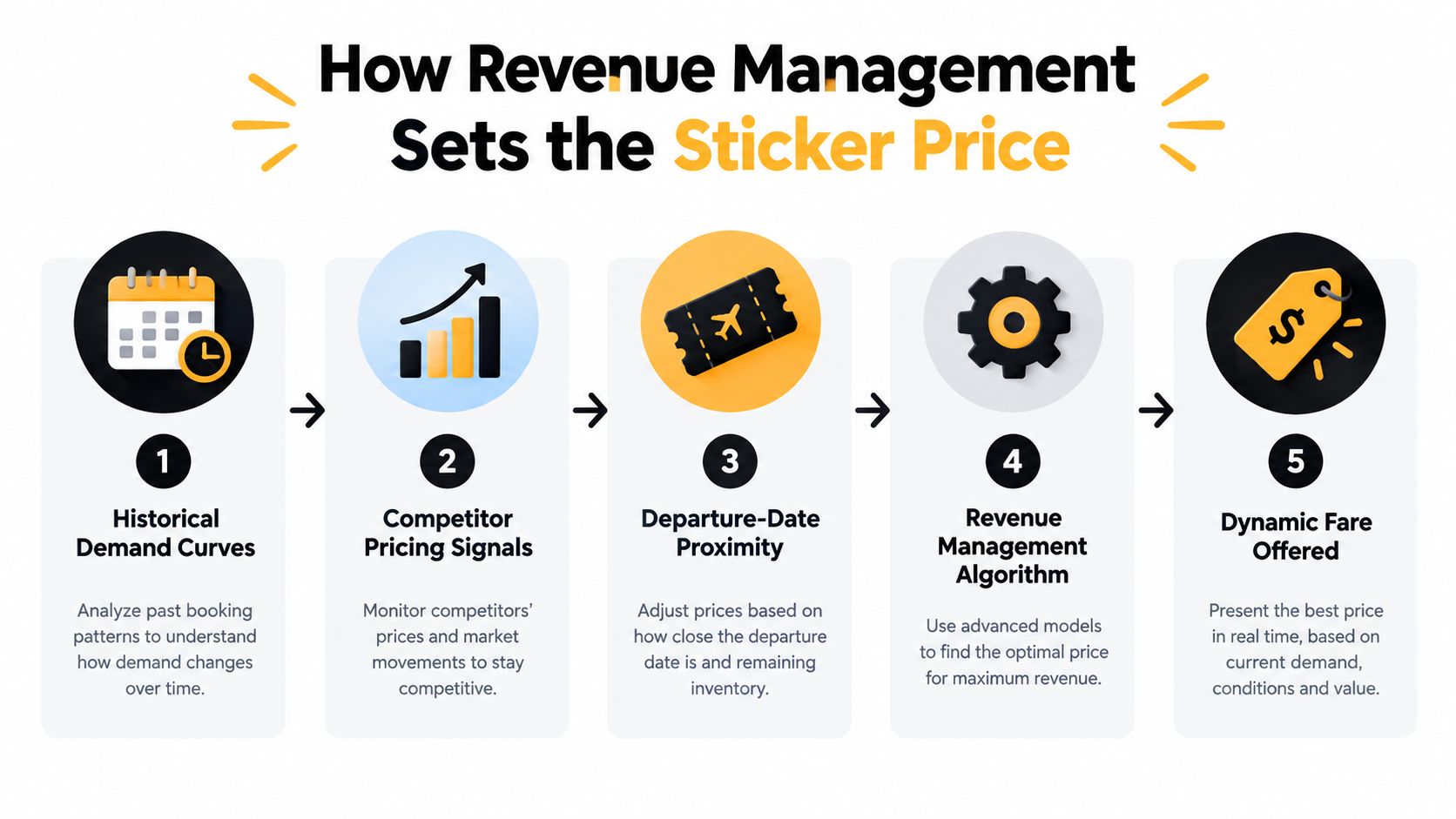
How Revenue Management Sets the Sticker Price
Airlines don't usually ask, “What should first class cost?” They ask a more specific question: Which fare should be available for this seat, on this route, on this date, given the demand that has already appeared?
Revenue-management teams use several inputs:
- Historical demand curves show how quickly similar flights filled and which customers booked at different points before departure.
- Competitor pricing indicates whether another carrier has opened a lower fare on a comparable route.
- Departure proximity changes the expected value of holding a seat for a late-booking traveler.
- Current booking pace reveals whether demand is running ahead of, behind, or close to expectations.
- Fare rules determine which customers qualify for each price.
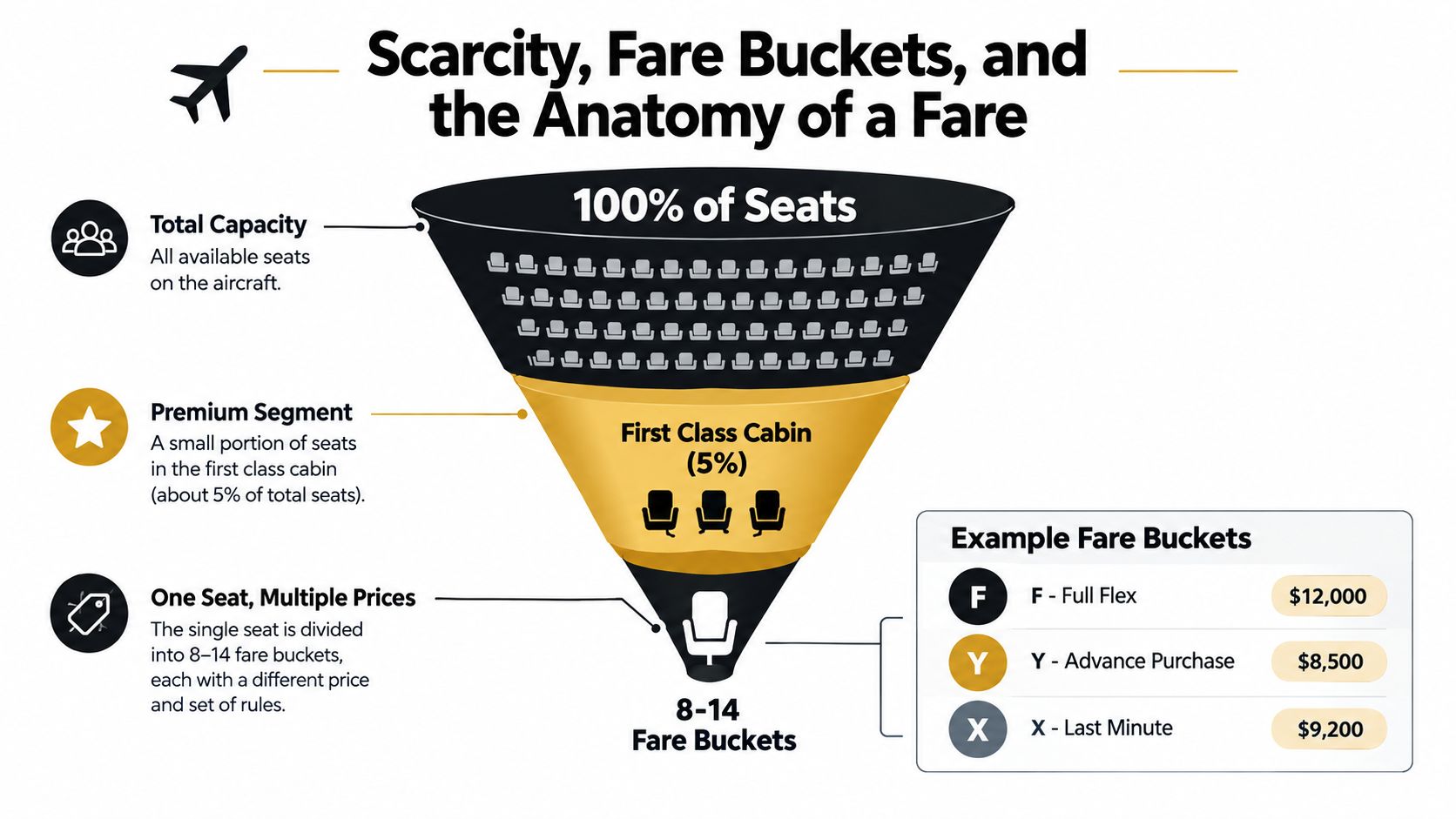
These inputs feed an inventory system that controls which fare buckets remain available. A bucket isn't a physical section of the aircraft. It's a limited pool of seats attached to a price and a set of conditions.
Why the highest fare can remain visible
Suppose a premium seat appears at a very high price. That doesn't necessarily mean the airline expects every customer to pay it. The fare may be designed for a traveler booking late, needing flexibility, or facing a schedule constraint. Keeping that fare available protects the airline from selling too early to someone who would've paid more later.
The opposite can happen when demand disappoints. If the airline believes the seat may otherwise depart empty, it can release a lower premium bucket. The price then falls because the airline is trading some fare value for a better chance of filling the inventory.
Academic research on premium-cabin revenue management found that allowing premium capacity sharing only late in the booking cycle can produce total revenue gains of up to 1.1%, while earlier sharing can reduce revenue by displacing full-fare premium demand. (University of Michigan analysis) That result captures the basic tension: discount too early and you lose higher-value bookings, but refuse to discount at all and you may fly with an empty seat.
The system can therefore produce prices that seem inconsistent with the cabin's comfort. A fare that looks unreasonable may be protecting future revenue. A lower fare may be a controlled release, not a permanent repricing of first class.
For a plain-language explanation of the broader system, see this guide to yield management pricing.
Scarcity, Fare Buckets, and the Anatomy of a Fare
A first-class seat is better understood as a collection of conditional offers than as one fixed product. The airline can attach different prices to the same physical seat, with each offer carrying its own rules about advance purchase, changes, refunds, minimum stays, or other restrictions.
The fare-letter code identifies inventory, but it doesn't automatically tell you the complete value of the ticket. Two travelers sitting beside each other may have paid different amounts because they bought different fare products at different times. One may have chosen a flexible fare, while another accepted restrictions in exchange for a lower entry price.
A typical process looks like this:
- Lowest premium bucket: The airline releases a limited number of seats at its most attractive qualifying fare.
- Bucket closure: Once that inventory sells or the forecast changes, the airline removes the price from sale.
- Next fare tier: The same cabin remains available, but the cheapest option has disappeared.
- Rule differences: The new fare may offer greater flexibility, fewer restrictions, or a higher price for the same seat.
The result is a staircase rather than a smooth curve. Prices jump when an inventory class closes, even if no passenger has occupied the cabin since the previous search.
The cabin label doesn't tell the whole story
Airlines have also experimented with unbundled premium fares. A lower public price may exclude benefits that travelers associate with traditional first class, such as seat selection, lounge access, baggage, or other services. The product can look cheaper because the airline has separated the fare from some of the extras.
That creates a more honest comparison. Don't ask only whether the ticket says “first class.” Ask what the fare includes, which restrictions apply, and whether the benefits you care about remain attached. A lower premium fare can be useful if you don't need every perk, but it may offer poor value if you later pay separately for the services you expected.
This segmentation also explains why premium prices can remain high despite apparently modest demand. The airline isn't selling one uniform inventory pool. It's sorting customers by urgency and willingness to pay, then limiting access to each fare tier.
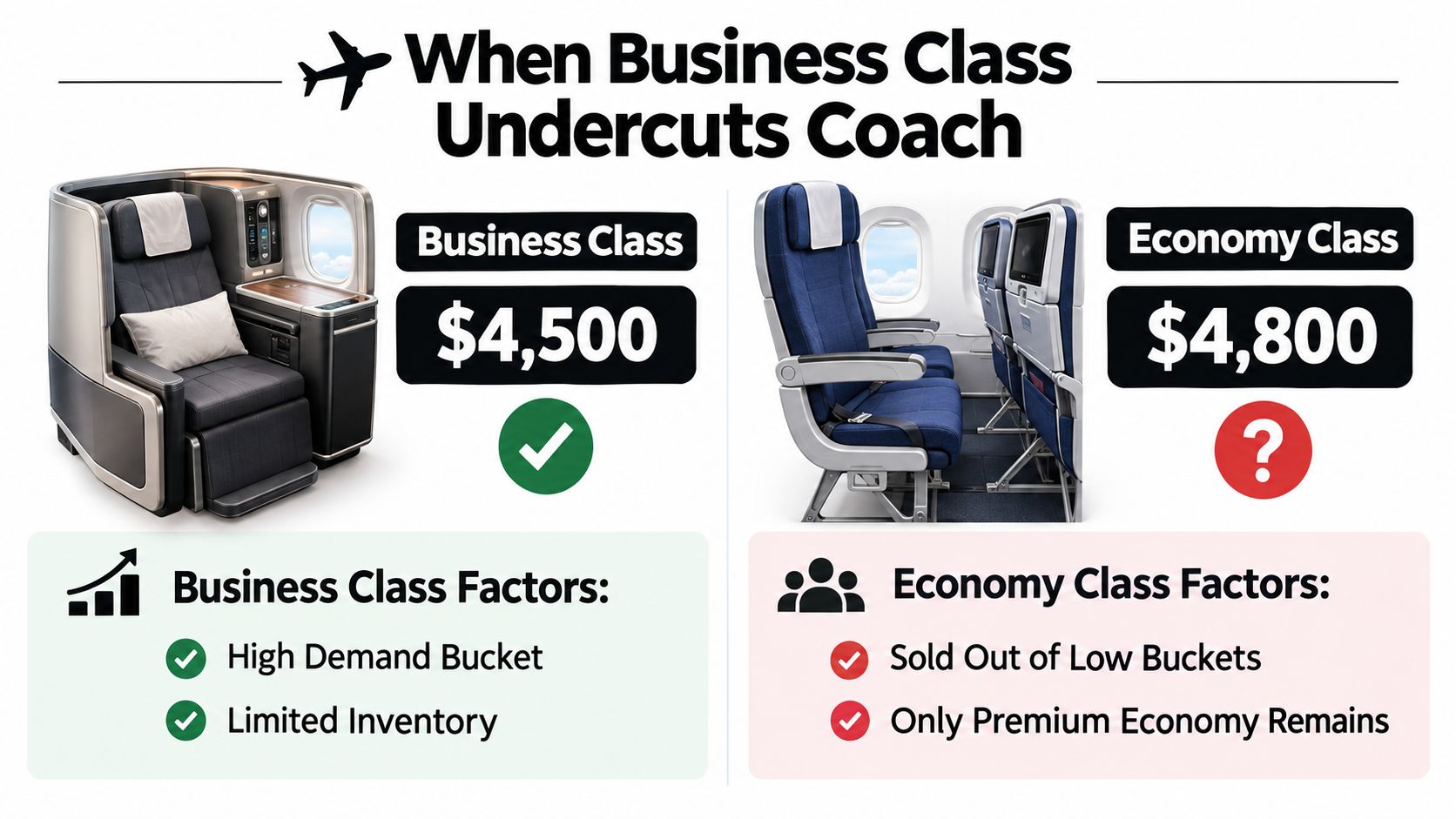
The important twist is that airlines manage cabins separately. A cheaper economy bucket can close while a discounted business bucket remains open. That makes the cabin hierarchy a poor guide to the final price.
When Business Class Undercuts Coach on the Same Flight
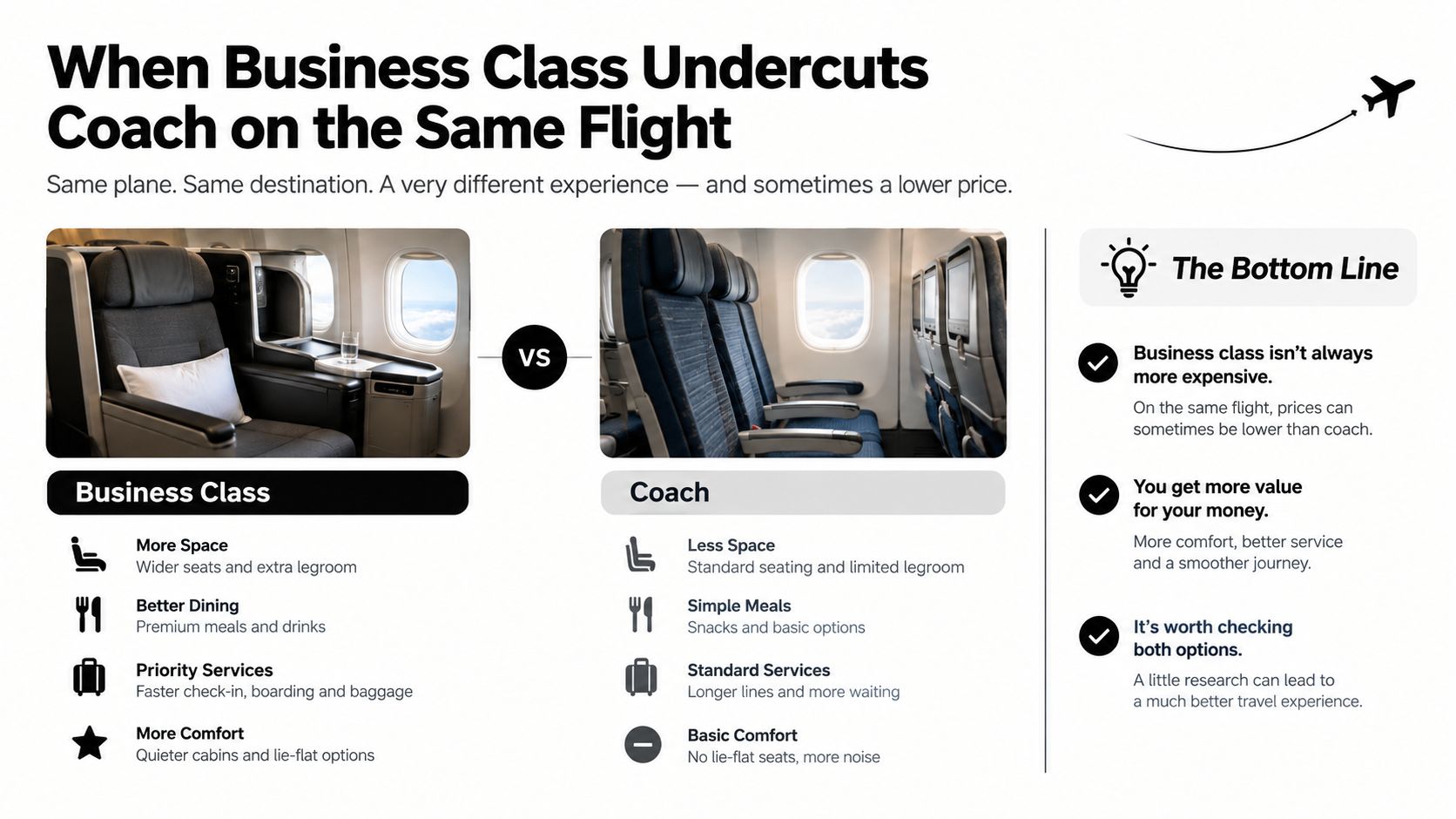
Business class can cost less than coach without any pricing error. Airlines manage each cabin through separate fare buckets, so the cheapest available seat is determined by inventory and demand, not by a fixed ladder from economy to business to first.
The Australian examples cited earlier show this inversion on real routes. The same travel date can have an open discounted business bucket after lower economy buckets have closed. A higher economy fare then becomes the cheapest remaining option, even though the business cabin is physically more expensive to operate.
How the inversion happens
Suppose you search a route for one traveler on a weekday flight. The results initially show economy at its lowest fare, while business appears far higher. Later, the airline sells enough economy seats to close that lower bucket, but bookings in business remain weak. The next search may show a higher economy fare beside a reduced business fare.
The airline does not automatically reopen the cheaper economy bucket because business has become less expensive. Each cabin responds to its own forecast, booking pace, and remaining inventory. The fare system behaves like separate shelves: removing the low-priced items from one shelf does not restock them when another shelf goes on sale.
A revenue management explanation describes how a last-seat economy fare can exceed an earlier business-class fare on the same flight. Cabin class and fare price are connected, but they are not locked together.
A practical search should therefore compare every cabin before setting a budget. Open the same itinerary in economy, premium economy, business, and first, then review the total price, fare restrictions, seat type, baggage, flexibility, and included services. A lower business fare may still be unsuitable if its rules conflict with the trip.
The pattern also gives fare intelligence services, including Passport Premiere, something specific to monitor. Their membership-based searches can watch premium-cabin volatility and surface cases where an available business bucket undercuts the remaining coach inventory. That opportunity is easy to miss when a search filters out premium cabins before displaying the results.
How to Actually Pay Less for First Class
The most useful strategy is to stop treating first class as a fixed luxury price and start treating it as a volatile inventory category. Airlines may file multiple fares for the same route, and the cheapest premium option can appear only when demand forecasts, competitor behavior, and remaining inventory line up.
Build a route-monitoring habit
Monitor long-haul routes several weeks before departure rather than checking once and assuming the first quote is the market price. Test nearby airports, alternative travel days, and multiple carriers. Carrier-specific inventory decisions mean one airline may keep a lower premium bucket open while another has already closed its cheapest option.
Use a comparison routine that includes:
- Every cabin: Check economy, premium economy, business, and first before choosing a budget.
- Multiple carriers: Compare the same city pair across airlines because each carrier controls its own buckets.
- Flexible dates: Shift departure or return dates when your schedule allows it.
- Fare conditions: Read the change, refund, baggage, and lounge rules before comparing headline prices.
- One-way combinations: Test separate tickets and different carriers where the itinerary and connection risk are acceptable.
Some itineraries also benefit from married-segment pricing, where the airline prices a complete origin-to-destination journey differently from an individual flight segment. That can make a premium ticket through a connecting city less expensive than a direct segment, although travelers should check connection times, baggage handling, and rebooking protection before buying separate tickets.
Let alerts watch the volatility
Manual searching is useful for learning a route, but it can't reliably catch every short-lived fare change. Membership-based fare intelligence services such as Passport Premiere monitor international business and first-class pricing, track fare movements, and alert members when premium fares fall. Its model is relevant to this question because it looks for the same volatility that creates occasional premium fares below coach, rather than assuming the first displayed fare represents normal value.
For a practical framework on reducing premium-cabin costs, review how to fly first class for cheap. The goal isn't to make every first-class ticket inexpensive. It's to identify when the airline's inventory position creates an unusually favorable opportunity.
Start this week:
- Choose a route you expect to fly.
- Compare nearby airports and carriers across all cabins.
- Set fare alerts for business and first, not just economy.
- Check the full fare rules when a premium price falls.
- Test a sample search before you need to travel, so you recognize a genuine dip.
Recap and Your Next Move
First-class tickets cost so much because airlines optimize scarce premium inventory for revenue per passenger, not affordability. The price reflects concentrated demand, limited seats, fare-bucket controls, and the risk of selling too cheaply before a higher-paying traveler appears.
You can still improve your odds with five practical levers:
- Monitor early: Watch premium fare buckets instead of relying on one search.
- Target flexible long-haul travel: Off-peak dates and less constrained routes can create better value.
- Compare cabins together: Business can occasionally undercut economy when inventory closes unevenly.
- Evaluate points and cash: A premium redemption may make sense when the cash fare is unusually high.
- Automate the search: Alerts can surface short-lived fare drops that manual checks miss.
Relative pricing can also move in the traveler's favor. A major U.S. travel report found that the average transatlantic business-class fare in 2023 was 3% lower than in 2019, demonstrating that premium fares don't always rise in lockstep with the broader airfare market. (USA Today travel fare report) Typical business pricing remains higher than economy, with one multi-airline study finding business class was about 250% more expensive than economy, or roughly three and a half times the economy fare on average. (Holidu's business-class fare study)
The answer to why are first class tickets so expensive is therefore structural, not decorative. Airlines protect a small supply of high-value seats, but travelers who understand the system can search for the moments when that protection breaks down.
Passport Premiere offers membership-based monitoring and analysis for international Business and First Class fares, including alerts for premium-cabin price drops and fare changes. Visit Passport Premiere to explore the service and test whether its fare intelligence fits your next long-haul trip.
